
9 Spaceship Earth
2I’ve often heard people say, ‘‘I wonder what it would be Alike to be on board a spaceship,’’ and the answer is very simple. What does it feel like? That’s all we have ever experienced. We are all astronauts.’’
3 That’s what Buckminster Fuller was telling audiences around the world as the huge Montreal dome rose toward the sky. In a sense, Fuller himself wanted to rise even above the dome—this dome, that dome, any and all domes. Domes were very visible things, after all. They were eye-catchers. But they had little to do with the BIG PICTURE. What Fuller really wanted was a mind-catcher. Perhaps he found it in the term Spaceship Earth.
4 How is the earth like a spaceship? Fuller would go on to explain. As part of the whole universe, our planet is a tiny, tiny object—only about 8,000 miles across. It speeds through space at about 67,000 miles an hour. It also spins around like a top. ‘‘Each minute we both spin at one hundred miles and zip in orbit at one thousand miles. That is a whole lot of spin and zip.’’ Light and heat come from a kind of mother ship, the sun. But except for that, the earth is entirely on its own. There is no happy landing ahead. Spaceship Earth is in orbit forever. What happens to it is largely up to the human race. When a person buys a car, he or she gets an operating manual with it. But with the earth, there is no operating manual. According to Fuller, we astronauts will have to write that manual as we spin on through space.
5 And how are we doing? Terribly, thought Fuller. We astronauts on Spaceship Earth spend much more money on weapons than we do on repair of the human race. Nearly half of us are illiterate, hungry, or both. We have organized ourselves into about 150 countries. Hence, 150 admirals are fighting for control of the ship. One side of the ship tries to sink the other. The stern threatens to break off. Meanwhile, fossil fuels—the earth’s original oil and coal—are being used up in a no-tomorrow binge. This is like ‘‘burning your house-and-home to keep the family warm on [a] cold midwinter night.’’ Atomic weapons threaten to blow the whole place apart. Pollution affects our minds as well as our atmosphere. In fact, the planet may have to be renamed ‘‘Poluto.’’
6 More than 5 million people attended the World’s Fair in Montreal and saw the Fuller dome. Few of these people, however, knew that Fuller originally saw the dome as having an important use. Inside the huge shell, there would be an immense map of the world. There would also be computers programmed with information on the earth’s resources. Where were the earth’s great stores of water power? How could electricity be transferred from here to there? If the rain forests were destroyed for lumber and food, what would
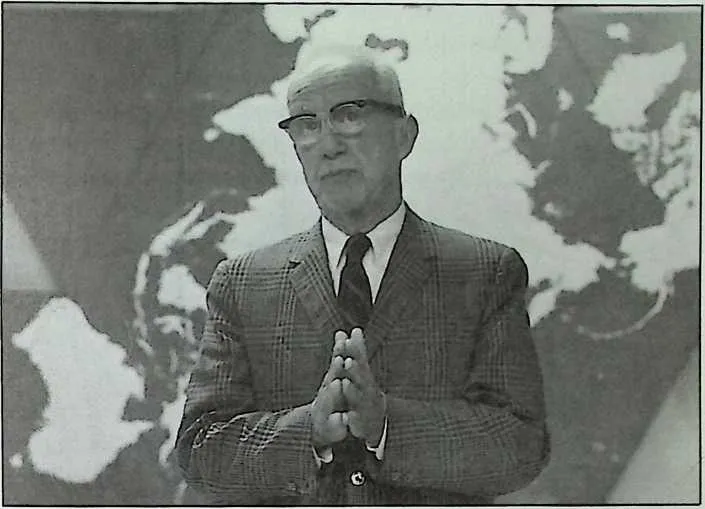
8 Fuller lectures about the World Game. Behind him is his Dymaxion Map.
9 happen to the balance of nature? Did it really make sense to raise beef cattle in crowded Japan? If not, where could the Japanese get their meat? What could the Japanese best offer other people? For years, Bucky had been gathering such information at his SIU headquarters. He know where the world’s resources were. He knew distribution patterns. Now it was all on computers, ready to go.
10 Fuller called it the World Game. (The term war games had been used for years by military planners.) Inside the Expo ‘67 dome, teams of scientists, world leaders, and ordinary people would play the game. The teams would play ‘‘against’’ each other only to solve the world’s problems. Everyone would win—because the whole world would win. For instance, take the problem of hunger. The ‘‘winning’’ team would be the one that first solved the problem of providing everyone with food in the most sensible way. Then other teams would go on to other problems: energy, health care, housing, education, and so on. Fuller’s aim was to demonstrate that the world’s problems could, in fact, be solved. What better way to celebrate the importance of a great ‘‘World’s Fair’’?
11 Unfortunately, Fuller’s World Game idea was not accepted by the United States government. Instead, the dome housed a show called Creative America. Many people yawned at the exhibit.
12 Fuller was determined to turn this minus into a plus. He stepped up his speaking schedule to over a hundred lectures a year. He took his World Game to Washington, D.C., and then around the world. Airplanes carried him millions of miles. For years he wore three watches. One showed the time back in Carbondale. Another showed the time where he was. The third showed the time at the next stop. Fuller’s energy kept him going long after a normal man would have retired. He could still take a half-hour catnap, then wake up ready to take on another piece of the world.
13 Nevertheless, Fuller did have health problems. As he approached seventy, he felt himself slowing down. The old spin and zip were gone. Part of the trouble, he thought, might be his weight. Years of eating out had helped him put on the pounds. Fuller attacked this problem in his typical fashion: mind over matter. He thought that too much of his body’s energy was spent digesting carbohydrates he didn’t really need. What his body really needed was protein. The diet he finally decided on was an odd one. He ate lean steak three times a day, lots of it. Along with the steak came something light—applesauce, a salad, fruit, or Jell-O. Some people called the diet dangerous, but Fuller stuck to it. His old energy came surging back. Before long he was down to 140 pounds, an ideal weight for his five feet, six inches, and his stocky build.
14 Hearing problems also troubled Fuller. Some help came from a hearing aid, but he never entirely solved the problem. Eventually he came to need someone on the stage with him, to field questions from the audience. Also, Fuller developed a noticeable limp. It seemed to be more than the return of his old football injury. Finally it was found that one of his legs was three-quarters of an inch shorter than the other. A steel hip joint later gave some relief. And in his late seventies, Fuller learned that even he could be felled by too much work. On a trip to California he suddenly collapsed. He was rushed to the hospital. Was it a heart attack? No, the doctors discovered. Fuller was simply an exhausted man. After a good rest, he was back on his travels again.
15 Even during these busy years, however, Fuller always reserved the month of August for Bear Island. There, beyond the reach of even a telephone, he could catch up with his thoughts. He could look up at the stars. The salt air always seemed charged with new life. On Bear Island he could relax—if that was what Bucky Fuller ever did for long. He bought and sailed a series of ever-sleeker yachts. He invented and patented what he called a ‘‘Rowing Needle,’’ a twin-hulled boat propelled by oars. Most of all, he enjoyed talking, joking, and laughing with his relatives. His sister Rosy, the informal Bear Island manager for years, finally gave up the job. Leslie Larned, Bucky’s niece, took over. Allegra and Bob came from California. Bucky particularly liked the company of his grandson, Jaime Snyder. Bucky had never had a son. Now he watched Jaime grow up with the same tender concern he had once shown for Allegra.
16 If Fuller had an aching regret as he grew older, it was probably this: He had never found time to write his great book. For years—in speeches, articles, and smaller books—he had thrown out hints. The great book would explain what he called synergetic geometry. This was to be a geometry based on the visible world. (Schoolroom geometry, Fuller thought, had little relationship to what actually existed.) More than that, it would be a geometry of thought. Another claim was that the basic building blocks of nature were not blocks at all but tetrahedra, or four-sided pyramids. Bucky even signed a contract to write the book.. .but no pages appeared. He was simply too busy.
17 Then, in 1969, another piece of the famous Fuller luck appeared. It appeared in the form of a man named E. J. Applewhite. As it turned out, Applewhite, in his own way, was almost as interesting a person as Fuller himself.
18 Ed Applewhite was a tall, scholarly man. A distant relative of Anne’s, he had known Fuller, on and off, for years. In 1969 Applewhite decided to retire early from government service (the Central Intelligence Agency). He wanted to devote his talents to something truly important. One day he walked into Fuller’s Carbondale office and offered his services. What could he do? The two men talked at some length. At last they decided that Applewhite would help Fuller write the big book.
19 Fuller’s staff at Carbondale helped Applewhite gather his materials. Fuller’s books, articles, handwritten notes, letters, drawings, unpublished writings, hundreds of hours of lecture tapes—all began to pile up in Applewhite’s Washington, D.C., home. Applewhite began typing notes on index cards. It soon became clear that the book would have to go beyond geometry, since the Fuller mind seldom considered one thing at a time. Onto his cards Applewhite copied Fuller’s sentences exactly. He went on typing…and typing…and typing. Eventually he would end up with 22,000 cards.
20 Then the cards had to be put in order. When a series of sentences seemed to fit together, Applewhite would type them out as a manuscript. He typed with triple spaces between lines and left wide margins, so that Fuller could make changes and additions. Fuller did this as he found the time. If Fuller had a few hours between planes, Applewhite could fly to the airport. They often worked in hotel rooms. Carbondale was a poor place for such efforts because of interruptions. More often, Fuller would find a few hours or days to work at Applewhite’s home in Washington. Fuller would change and add, change and add. Applewhite would make sure that Fuller’s words made sense to others, then go on typing. Some pages went through seven drafts. Fuller’s mind connected everything to everything else. He had to keep adding, adding, adding.
21 Finally, after four years of constant work, Applewhite was finished—or so he tought. The book was now in the hands of the publisher. But when the printed sheets were returned for correction, Bucky seemed far from finished. He couldn’t limit himself to a small change here and there. No, he insisted on adding still more. He added so much that the whole book had to be printed for a second time—at Fuller’s expense.
22 Synergetics—all 876 pages of it—finally came out in 1975. Most readers found some pages easy and interesting, other pages nearly impossible. The reviews were good. According to Applewhite, most reviewers probably decided ‘‘not to tangle with a text they could not master.’’ They tended to treat the book ‘‘as a gorgeous intellectual toy.’’ But Fuller himself was far from satisfied. He still wanted to add to it. He and Applewhite soon set to work on Synergetics 2, published four years later.
23 Meanwhile, Fuller had changed his headquarters. In 1972 he moved from Carbondale to Philadelphia. Four Pennsylvania colleges had offered him generous support. Fuller became World Fellow in Residence at the University City Science Center. Actually, the move was more of a change for Anne. She loved the culture of Philadelphia and the East. Bucky was still away most of the time, jumping from lecture to lecture.
24 Even as he neared eighty, Bucky felt that he had to go on speaking. There were at least three reasons for this. First, he could get $5,000 or more for a major lecture. He needed the money for his many projects. These ranged from real possibilities to far-out ideas. A huge floating city nearly became a reality near Baltimore, Maryland. Called Triton City, it was to be a complete community for 5,000 people. Bucky never gave up on the project. Harder to imagine is his fantastic Manhattan Dome. It would have covered midtown Manhattan, from the Hudson to the East River, from Twenty-Second Street up to Sixty-Second Street. A most practical idea, said Fuller. The height of the two-mile dome would make it invisible. The weather would be controlled. Heating and cooling costs for all contained buildings would be next to nothing. And even harder to imagine is Fuller’s Cloud Nine, an amazing city in a floating sphere. A sphere half a mile across, Fuller said, would float in air if the inside temperature were just one degree warmer than the outside temperature. It was perfectly possible for people to live in the clouds.
25 Another reason Bucky kept speaking was that he was so good at it. He never wrote out a lecture and seldom planned one. Instead, he would start by standing before a crowd with his eyes closed, his hands together in front of him. Slowly he would begin speaking, quite simply at first. Then his mind would find sudden links between this subject and that. He spoke at over 7,000 words an hour. He raced from idea to idea, from example to example. The examples were always good ones. For instance, in the early 1970s Fuller was shocked that the world was spending $200 billion a year on war budgets. Now, just how much money is $200 billion? To most people, big numbers are just big numbers; they all seem alike, beyond the mind’s grasp. Fuller would ask people to imagine piling up new dollar bills. Two hundred of them make an inch. Go on stacking up the bills. By and by, the pile gets so high that it falls over. But somehow go on adding bills to the fallen stack.. .out of the room, out of the building. Suppose someone started in New York. Two hundred billion dollar bills would take that person to San Francisco, across the Pacific Ocean, through Asia and Europe, and back to New York. Around the world!
26 Fuller seemed to have a special feel for any kind of audience. Years before, little Alexandra had taught him to believe in mental telepathy. Was the crowd bored? Fuller would know. Were they interested? He knew that, too. He could tell by their eyes. Once Fuller was asked to speak to a group of prisoners at San Quentin. He talked for seven straight hours; no one wanted to break the spell. Another time, he addressed a Chicago street gang called the Young Lords. The meeting was held in a cold church basement. People sat shivering, but no one left. Fuller was especially good with children. One evening he sat in the California living room of his friend Hugh Kenner. A cheerful fire blazed on the hearth. Three-year-old Lisa Kenner suddenly broke into the adult conversation. It was a typical why question of a typical kid: Why was the fire hot? Bucky took it seriously. ‘‘You remember, dear,’’ he began, ‘‘when a tree was alive, and gathering in the sunlight?’’ Here he imitated a tree, his body the trunk, his arms and face the gathering, grateful branches. ‘‘Then someone cut the tree down, and sawed it into logs. Some of the logs came here.’’ He pointed at the fireplace. ‘‘And what you are seeing is the sunlight, unwinding from the log.’’
27 The third reason Fuller kept speaking until he died was the most powerful one. His own honesty wouldn’t let him stop. He felt forced to go on spreading his vision of a better world. The way we think about ourselves and society, he said, is based on past possibilities for the human race. In other words, we use yesterday’s answers for today’s problems. But the present possibilities for humanity are entirely different. This difference is a truly revolutionary one. In the past, only a few people could enjoy a high standard of living. Wealth and comfort were in short supply. There wasn’t enough food or anything else to go around. Life was a matter of ‘‘you or me.’’ My kind of people or your kind of people. My country or your country.
28 But by 1970, Bucky said, he could demonstrate that the good life was possible for all the world’s people. Then: ‘‘You or me.’’ Now: ‘‘You and me.’’ What will it take to get there? In a word: cooperation. Not weaponry but ‘‘livingry’’ is the key to the future. ‘‘War is obsolete.’’ Increasingly, we will do more and more with less and less. The average person will have to ‘‘work’’ only about fourteen years in a lifetime. Politics, war, weapons, and debt will be words of the past. ‘‘Earning a living’’ will no longer mean ‘‘earning the right to
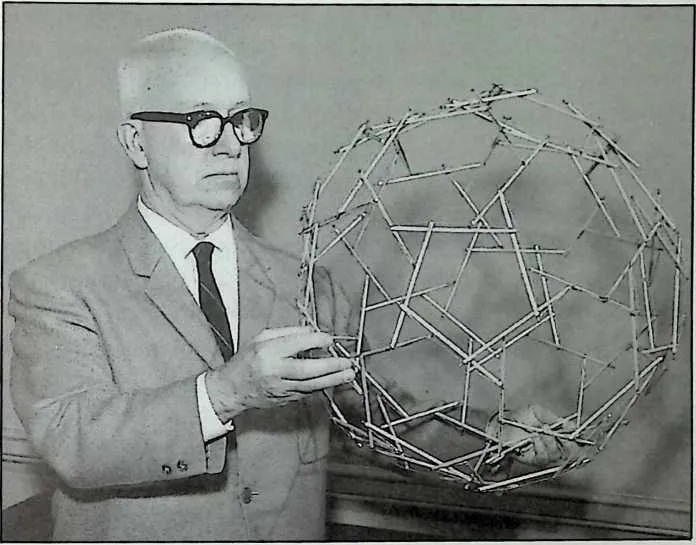
30 During the last two decades of his life, Buckminster Fuller gave many lectures to enthusiastic audiences. Here he holds up a model of sticks that are held together by the wires that connect them.
31 live.’’ Every human being should have that right. In truth, ‘‘wealth is as much everybody’s as is the air and sunlight.’’ Moreover, all this can be done without atomic power or fossil fuels. Energy will come from such sources as the sun, the waves, the tides, and the winds. If people cooperate as ‘‘one harmonious world family,’’ all this can be done in ten years.
32 That was Fuller’s vision. He was absolutely certain he was right. He had the facts to prove it. And he could show that such a Spaceship Earth could continue on and on. Treated with the respect a good home deserves, the earth will provide more and more. There will not, however, be
33 more and more people. ‘‘The population explosion is a myth.’’ As societies reach a high standard of living, the birthrate actually starts to decline. According to Fuller, humanity’s numbers will level off at about 5 billion.
34 But wouldn’t there be problems? How about all the idle people? Aren’t idle people dangerous people? No, Fuller would say. There is no proof of that. In the past, idle people have often been fearful people. When fears about ‘‘earning a living’’ are gone, people will be free to use their minds and enjoy themselves. Learning and travel will become the ways of the future. For instance, the ancient cities of Greece and Rome could be rebuilt exactly as they were. Then people could travel in time as well as space. If someone wanted to, he or she could experience life in a medieval castle for a month or two. Today we worry about something called unemployment. Nonsense! Seen in the right way, unemployment is a plus, not a minus. It is humanity’s hard-won right to be free from burdensome toil.
35 By 1980, both Bucky and Anne were slowing down. Actually, Anne’s health started to go first. Allegra, of course, was concerned. As a professor of dance at the University of California, it wasn’t easy for her to get away. Why didn’t Bucky and Anne move to California, to be nearer Allegra and Bob? This is just what happened. The Fullers moved to Pacific Palisades, a Los Angeles suburb. Their house was just two blocks from the Snyders’. Jaime Snyder moved in with the eighty-five-year-old couple, to be of what help he could.
36 Fuller’s office and staff, however, remained in Philadelphia. Moving it would be a problem. By that time, Fuller’s Chronofile numbered 737 volumes. Each contained more than 300 pages. There were about 260,000 letters and 40,000 articles. There were hundreds of tapes and thousands of unpublished pages. Bucky decided to leave the treasure where it was. In his travels, he could easily visit Philadelphia when he wanted to.
37 Fuller went on traveling and speaking, on and on and on. Late in June 1983, a reporter from The New Yorker gave a good picture of a typical Fuller performance. Bucky appeared on the Hunter College stage with his grandson Jaime. It was midmorning when he started. ‘‘To Bucky’s credit, virtually no one in a crowd of more than a thousand got up to leave as he wound his way through a list of topics that included (in chronological order) the East India Company, Thomas Malthus, royal blood, the discovery of X rays, electricity as invisible reality, mile-long radio waves, new alloys of metal, gills of fish, wings of birds, Johannes Kepler, the temporal versus the eternal, the large percentage of the human body that is water, the enormous stresses on ships at sea, why human beings are in the universe, stages in the patent process, eclipses of the moons of Jupiter, the bright star at the end of the Big Dipper handle, caterpillar metamorphosis, the Big Bang, DC-4 airplanes, the navigational abilities of South Sea islanders, a sphere painted on a pharaoh’s forehead, the direction in which a tree falls, and Alexander the Great. And that was before lunch.’’
38 That was before lunch, and that was quite a show for a man of eighty-seven—particularly for a man with other things on his mind. Anne had already had two operations for cancer. For more than six months, she had been in and out of a Los Angeles hospital. Bucky tried to be at her side whenever he could.
39 On the morning of July 1,1983, Bucky and Jaime visited Anne at the Good Samaritan Hospital. ‘‘Visited’’ isn’t quite the right word. Anne had already lapsed into a coma. She was unconscious. After going out for lunch, Bucky returned to the intensive care unit alone. Sitting at Anne’s side, he was hit by a sudden massive heart attack. In a very short time he was dead.
40 And just thirty-six hours later, Anne Hewlett Fuller joined her husband in death. Bucky might have liked it that way. He might have said, once again, ‘‘There’s something of the miraculous in all that.’’