
8 The Dome Man
2As the name suggests The American Scholar is a most serious magazine. It is read by people of learning in many fields. On its editorial board are some of the top minds in the sciences and the arts.
3 Soon after World War II, one of these minds belonged to Harlow Shapley, a famous astronomer. One day Shapley gave the editorial board what he thought was a good idea. Bucky Fuller, he said, should be asked to write an article. ‘‘I suppose,’’ Shapley added, ‘‘that he’s the brightest man alive.’’
4 The response was like a sudden roar of snow-chilled wind. Bucky Fuller? The brightest man alive?
5 ‘‘An eccentric!’’ snorted one board member.
6 ‘‘A crackpot!’’ shouted another.
7 Shapley pointed out that such words had once been used for people like Galileo and Einstein. But his arguments got nowhere. The board just did not believe that R. Buck
8 minster Fuller belonged in a scholarly magazine. And in fact, it would be about twenty years before the magazine printed anything by Fuller.
9 What accounted for this rise in Bucky’s reputation? Most of the answer can be put in three words: the geodesic dome. By 1966, when The American Scholar opened its pages to Fuller, the dome had made him famous. ‘‘Oh yes,’’ people would say, ‘‘Fuller, the dome man.’’
10 Fuller’s two years of study, 1947 and 1948, were not entirely without relief. In the summer there was Bear Island, as always. By this time, Fuller had managed to buy back his share of the property. Once again, he could be with his relatives as a rightful owner. The depression days were over. So were the days of the creaking Lady Anne. Now Bucky had the money for a sleek yacht. He spent many breezy afternoons teaching Allegra to sail.
11 Most of 1947 and 1948, however, Fuller spent in the Forest Hills apartment. He brought his Chronofile up to date. Also, he had to learn more about the geometry of the sphere. An idea had been bubbling in his brain since his work on the Dymaxion Map: Why wasn’t the dome—a part of a sphere, after all—the lightest, strongest, and most logical structure a person could build? His map work had taught him about great circles. A great circle is the largest circle one can draw on the surface of a sphere. (The equator, for instance, is a great circle. So is a circle passing through both of the earth’s poles.) Fuller discovered a way to put thirty-one great circles on a sphere so that the entire surface became a network of triangles. Cut such a sphere in half, and you have two domes.
12 The more Bucky worked at it, the more his mind tingled with possibilities. Of all solid shapes, the sphere encloses the most space with the least amount of surface. Of all flat shapes, the triangle is the most rigid. So a dome made of triangles was both the most economical and the strongest of all building systems. This idea put the old Stockade Building System back into the Stone Age.
13 In the language of geometry, a geodesic is part of a great circle. Fuller’s first domes, then, were made of geodesics that ran from edge to edge. Before long the little Forest Hills apartment was crowded with models. Bucky turned to other geometrical ideas. There is a somewhat sphere-shaped form called an icosahedron, made of twenty equal triangles. Each of the twenty triangles can be subdivided into nine smaller triangles. When that is done, something of a miracle occurs. Each of the smaller triangles becomes a pie-shaped section of either a pentagon (five-sided figure) or a hexagon (six-sided figure). Moreover, the pentagons and hexagons overlap, so that each small triangle forms a part of three of the larger figures. (You may be able to observe this pattern by looking at a Fuller dome yourself. Most of the figures will be six sided, or hexagons. A few, where the points of the basic icosahedron touch, will be five sided, or pentagons.)
14 Now Bucky’s tabletop models were strong beyond belief. But to make a really large dome, he knew, would take months of tiresome work with numbers. From a distance, all the short rods that make up a geodesic dome seem to be the same length. In fact, however, they are not. The strength of the whole dome depends on very exact measurements. In those days, of course, Bucky had neither computer nor calculator to help him. He had to figure out these measurements one at a time. He used an old adding machine, and the job took months.
15 Meanwhile, Bucky gladly left the apartment for lecture
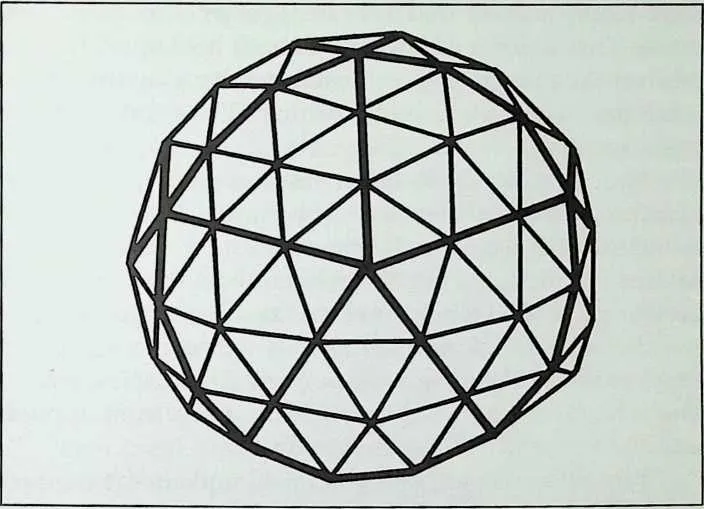
17 The heavy lines show the pattern of an icosahedron placed over the pattern of triangles on the top three-fourths of a sphere.
18 dates. In 1947 one of these took him to Black Mountain College, an experimental school in North Carolina. He liked the informal surroundings and the eager students. In 1948 he returned to Black Mountain for the summer session, and again in 1949. Driving to North Carolina, Bucky told Anne that he was now absolutely sure of it: The geodesic dome was the shape of the future. The trouble was that he didn’t have the money to experiment on a greater scale. How much money would it take? A lot—about $30,000. It happened that Anne had just inherited some IBM stock. If she sold it, the money would make a real difference to Bucky. Would he accept it? Even as a loan? He certainly would.
19 Anne’s faith in Bucky started to pay off soon after he reached Black Mountain College. Using thin aluminum rods, Bucky and his students put together a fourteen-foot dome. They tested it with their weight. It held up. A picture taken at the time shows nine husky men hanging from little more than a spider’s web of structure. The geodesic dome was a success.
20 Back in Forest Hills, there was now more room in the apartment. Allegra had liked her dance classes, but she found that they led to something more. She wanted not only to dance on the stage, but also to learn about the dance as an art form. How had dance developed in different parts of the world? Just how did body movements communicate? At the time, questions like these could be studied in very few places. One was Bennington College in Vermont. Allegra applied and was accepted, with a scholarship.
21 Part of Bennington’s program gave students off-campus experiences. Allegra’s jobs included, finally, working for a motion picture company. Among its members was Robert Snyder, a gifted young director. He and the graceful, darkhaired, deep-blue-eyed Allegra became good friends. Their friendship grew…to the point where they mentioned marriage to Bucky and Anne. The father probably remembered his own trouble with the older generations back in 1916. He smiled his approval. But the mother was not about to smile. Motion pictures meant Hollywood, and Hollywood meant…well, wasn’t there another scandal in nearly every paper? Did Allegra really want to get mixed up in that crowd?
22 Yes she did—if that was where love led her. Anne Fuller clamped a lid on her doubts, and even managed a smile. Allegra Fuller and Bob Snyder were married in 1951. Anne grew to like Bob more and more, and finally even she agreed that the marriage was a good one indeed.
23 By the time of Allegra’s marriage, Bucky’s domes were taking him places. Literally. He could now charge a thousand dollars for a lecture, and he was on the road more and more. Pulling a trailer full of demonstration materials, he drove from place to place like a salesman of the future. Some of his lectures were one-shot talks before groups of architects or engineers. Other appearances were like mini-courses, at MIT, Cornell, Dartmouth, and other colleges. Fuller would stay on the campus for some time. He would teach students and often use their help to make domes or other structures. Still, however, Bucky was selling the dome mainly as an idea. No big company offered him the big bucks for the big dome that would be the big break.
24 That break finally came late in 1952. The Ford Motor Company had a problem that its engineers couldn’t solve. For years, the center of Ford’s activities had been a curious building next to its enormous River Rouge plant in Michigan. The Ford Rotunda was a round structure with an open courtyard. It had originally been built for the Ford exhibit at the 1933–34 World’s Fair in Chicago. Then it had been taken apart, piece by piece, and moved to Michigan. As the headquarters building, it was to house the ceremony that would honor Ford’s fiftieth year in business. That date would come in April 1953. Festivities were being prepared for the big event. Yet all could be ruined by another event not uncommon in a Michigan spring: rain.
25 Couldn’t the courtyard in the Ford Rotunda be covered? No, said the engineers. Even the lightest roof would weigh 160 tons. Built as a temporary structure, the Rotunda could not possibly support this load. Then Buckminster Fuller was called in. He not only looked at the problem, but solved it quickly. An aluminum geodesic dome, he said, would weigh
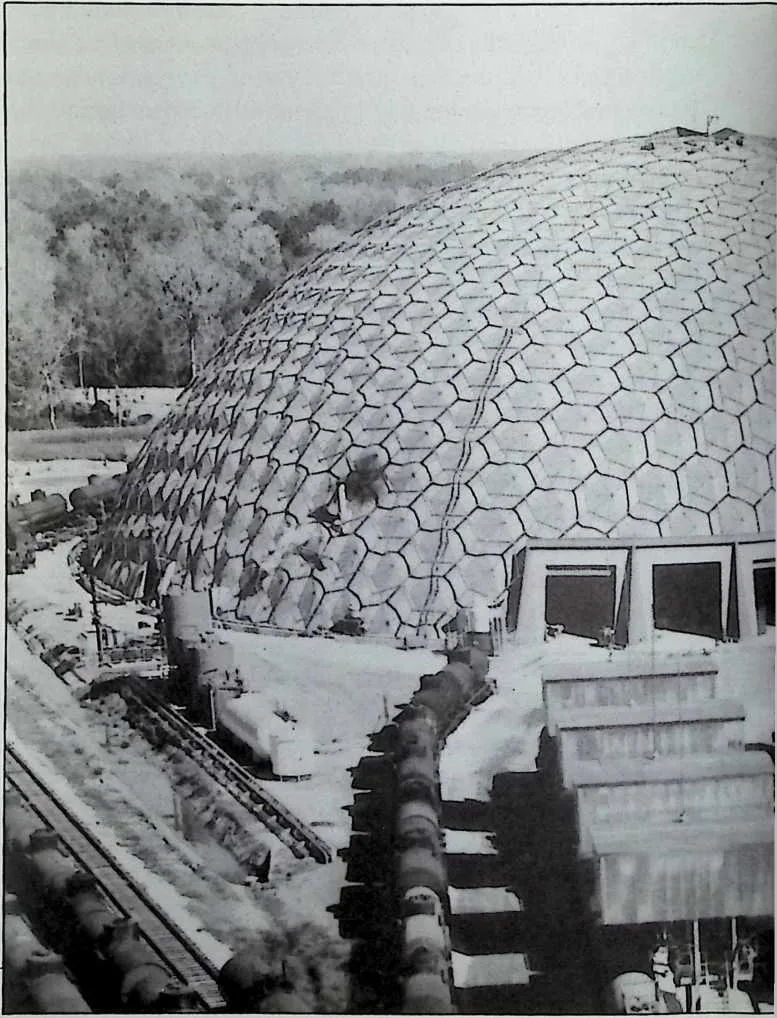
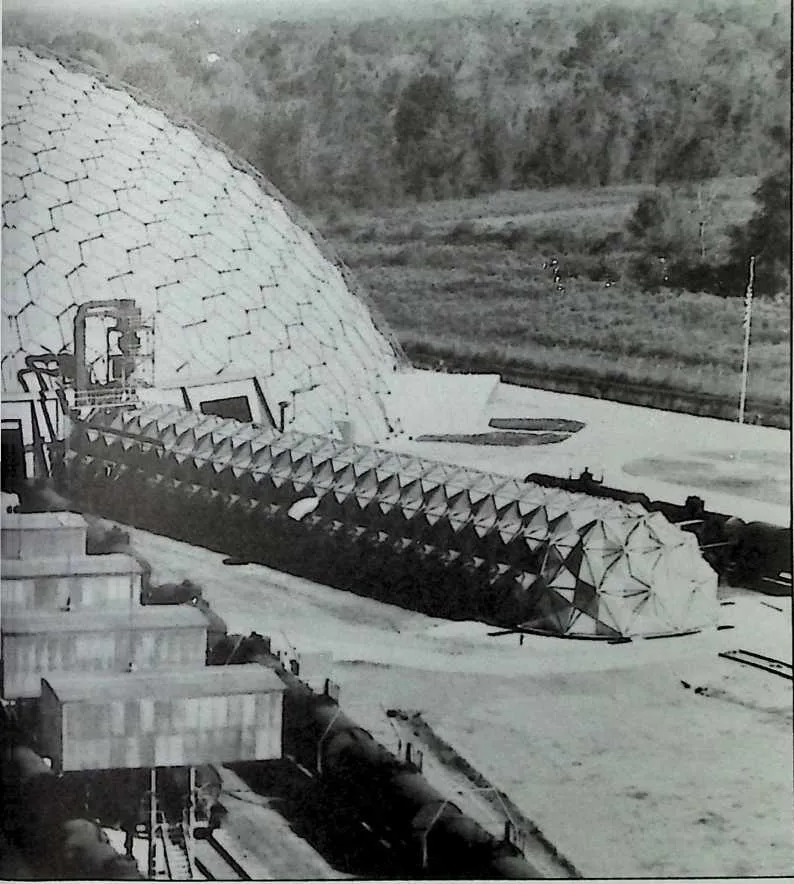
2829A geodesic dome used in industry in Baton Rouge, Louisiana.
30 only eight and a half tons. The building could easily support it. The cost? Less than the people at Ford had planned to pay.
31 Fuller signed a contract with Ford in January 1953. He had spent years on the math, so the plan rapidly took shape. Soon the first of about 20,000 aluminum rods went into place. Day by day, the strange new kind of roof grew larger. Some of the Ford engineers looked at the dome with wonder—and at each other with doubt. They shook their heads. Without telling Fuller, they made arrangements with another company. When Bucky’s dome collapsed, Ford would be spared the embarrassment. The carcass of the doomed dome would be hauled away with all possible speed.
32 The Ford engineers need not have worried. In fact, Fuller had over-designed the dome. It contained a built-in octet truss, another Fuller invention. When the big day arrived, the ceremony went off as planned—except for the ‘‘Oh’s’’ and ‘‘Ah’s’’ at the ninety-three foot span overhead. The dome was big news.
33 With the Ford dome behind him, Fuller could almost pick and choose his projects. In 1927, he had predicted that factory-built housing would be delivered by air. Now, in 1954, The New York Times carried a front-page photo of a U.S. Marine helicopter lifting a thirty-foot Fuller dome to another site. In 1954 also, Fuller received the first of his honorary degrees. North Carolina State University, in Raleigh, made him a Doctor of Design. The Harvard castoff must have looked at that diploma with particular delight.
34 …As he certainly regarded another document: his patent on the geodesic dome. No one could build a geodesic dome without Fuller’s permission. This permission usually meant 5 percent of the total cost. Fuller’s income went up
35 and up, peaking finally at $1 million a year. The U.S. Air Force bought hundreds of radomes (radar domes) for use near the Arctic Circle. Playdomes became common in parks and schoolyards. Orders poured in…for a concert hall…for a railroad repair yard…for a bird enclosure at a zoo. Huge Fuller domes came to stand for the United States at fairs around the world. They were eye-catching, easy to put up, and inexpensive. Bucky himself, often with Anne at his side, traveled to many foreign countries. In Moscow, Soviet Premier Khrushchev gazed up at a 200-foot dome and paid Bucky an odd sort of compliment. All Russian engineers, Khrushchev said, should take lessons from this American master, ‘‘Mr. J. Buckingham Fuller.’’
36 Fuller spent the money nearly as fast as it came in. Little of it went for himself. Most of the dollars supported his pet projects, all part of the design revolution. Bucky was a president here, a senior partner there, a consultant almost everywhere. Meanwhile, he was hurrying from lecture to lecture, from award to award. He worked on articles and books when others would be sleeping. All this activity could not be run from a little apartment in Forest Hills.
37 In 1959, Southern Illinois University (SIU) made Fuller an outstanding offer. He would get a good salary, an office, and a staff. He would be named Research Professor. In return, he would have to give SIU a few weeks a year. The rest of the time he would be free to lecture, to do research, and to write. In short, SIU wanted to share the spotlight of Fuller’s fame. Bucky very much wanted a headquarters. The two needs went together, and the Fullers soon moved to Carbondale, Illinois. Bucky quickly designed a house—a dome, of course, made of plywood and painted blue and white. Now ‘‘the dome man’’ lived in a dome himself. Anne
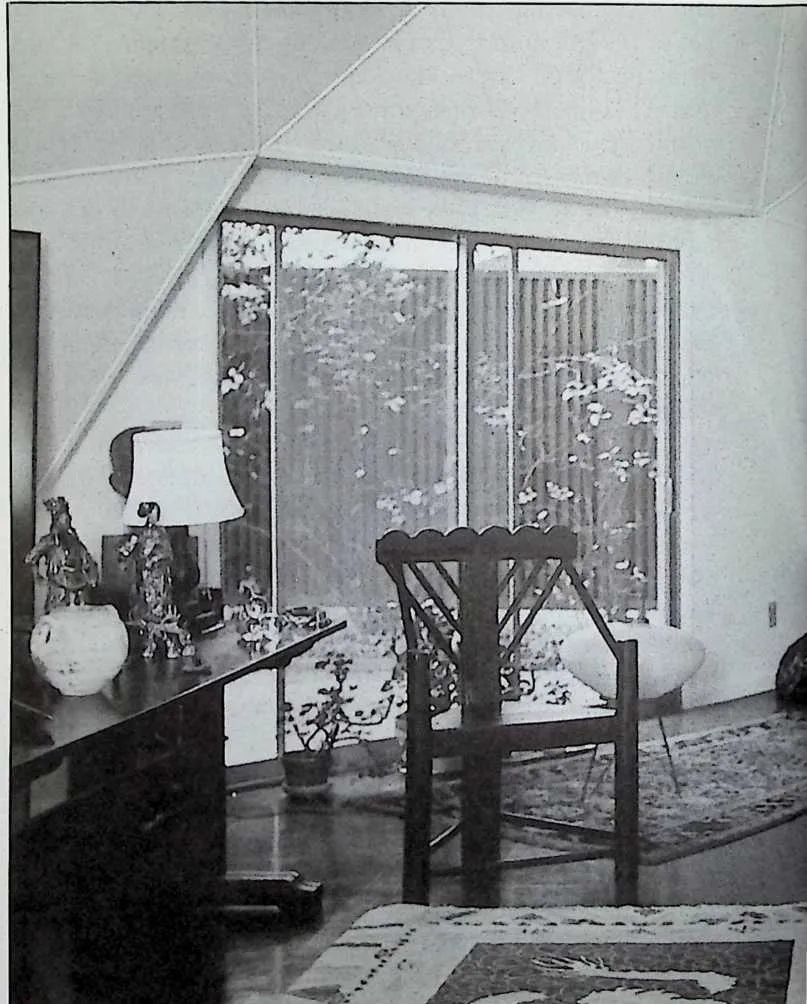
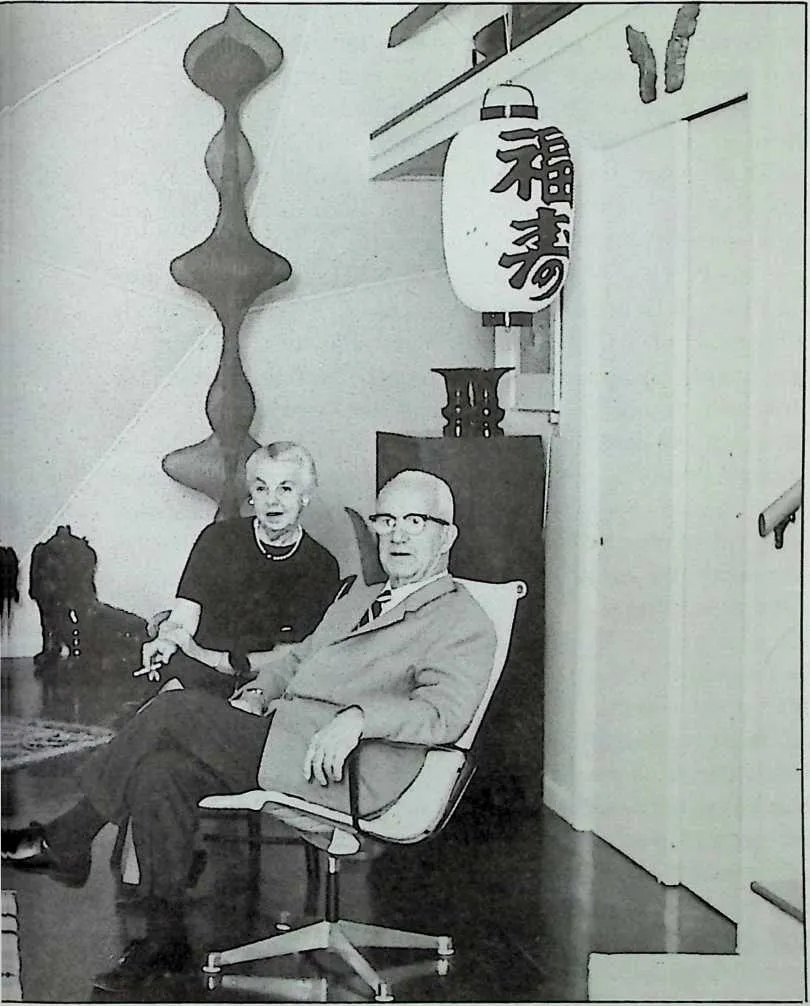
4041Anne and Buckminster Fuller inside their Carbondale, Illinois, home.
42 liked the house, too, for the most part. ‘‘The bad thing was you could not hang paintings because they would be just sort of dangling out from the curve.’’
43 Doctor of Design…Research Professor…Famed inventor of the geodesic dome. What more could the future hold for R. Buckminster Fuller? In 1962 he found out. Harvard University wanted to name him the Charles Eliot Norton Professor of Poetry, a one-year position.
44 Bucky Fuller? A professor of poetry? This offer was confusing at first. How could he accept it? Wasn’t he already a professor at SIU? Then he learned that the appointment was mainly an honor. It would require very little time. He wouldn’t actually have to move to Cambridge, Massachusetts, where Harvard is. A few lectures would be enough. Also, Harvard used the word poetry in a very general way. The honor went to people of vision, whatever their skill with words. So with great pride, Buckminster Fuller returned to the same Harvard that had expelled him nearly fifty years before.
45 And in fact, Bucky Fuller was something of a poet. Even in his youthful Harvard days, he could come up with funny little poems on the spot. His serious poetry had started later, when he worked at Phelps Dodge. As a writer, Fuller always tended to use big words and long sentences. For this reason, the top people at Phelps Dodge had trouble understanding his prose. One day a fellow worker told him that his writing made much more sense when Fuller read it aloud. Why? Bucky’s friend pointed out that when he read, he broke his endless sentences up into short units of thought. Couldn’t he break his sentences apart this way on a piece of paper? Fuller tried the idea. Instead of writing margin to margin, he stopped at the end of each thought unit, then went on to a
46 new line. The result looked very much like poetry. When his subject was a serious one, it even sounded very much like poetry. And at its best, it certainly was poetry:
47 And as we gaze around
48 The starry heavens
49 We see right now
50 Live shows of ‘‘yesterdays’’
51 Ranging from millions to sextillions of years ago,
52 As we look at the stars
53 We see all of history
54 Now alive.
55 Later in life, when he wanted to reach an ever-wider audience, Fuller found that his own personal kind of poetry was often the way. Many readers found his books of poetry easier to understand than his prose works.
56 Fuller’s honorary degree from North Carolina State was the first of many. He probably became the most honored man in the United States. The list of his awards runs on for pages. One honor, however, had a very special meaning for Fuller. This honor it was Fuller’s privilege to give, not to receive.
57 The best-known Fuller dome was the one he and the brilliant young architect Shoji Sadao designed for the 1967 World’s Fair in Montreal, Quebec, Canada. (With no formal training as an architect, Fuller never had more than an honorary license. For legal and other reasons, he usually worked with a licensed architect.) The dome served as the United States pavilion, or exhibit hall. This Expo ‘67 dome was 250 feet in diameter. To see it was to catch your breath. Some called it the ‘‘skybreak bubble.’’ Others said ‘‘Buckminster Cathedral.’’ Its thin plastic skin seemed transparent
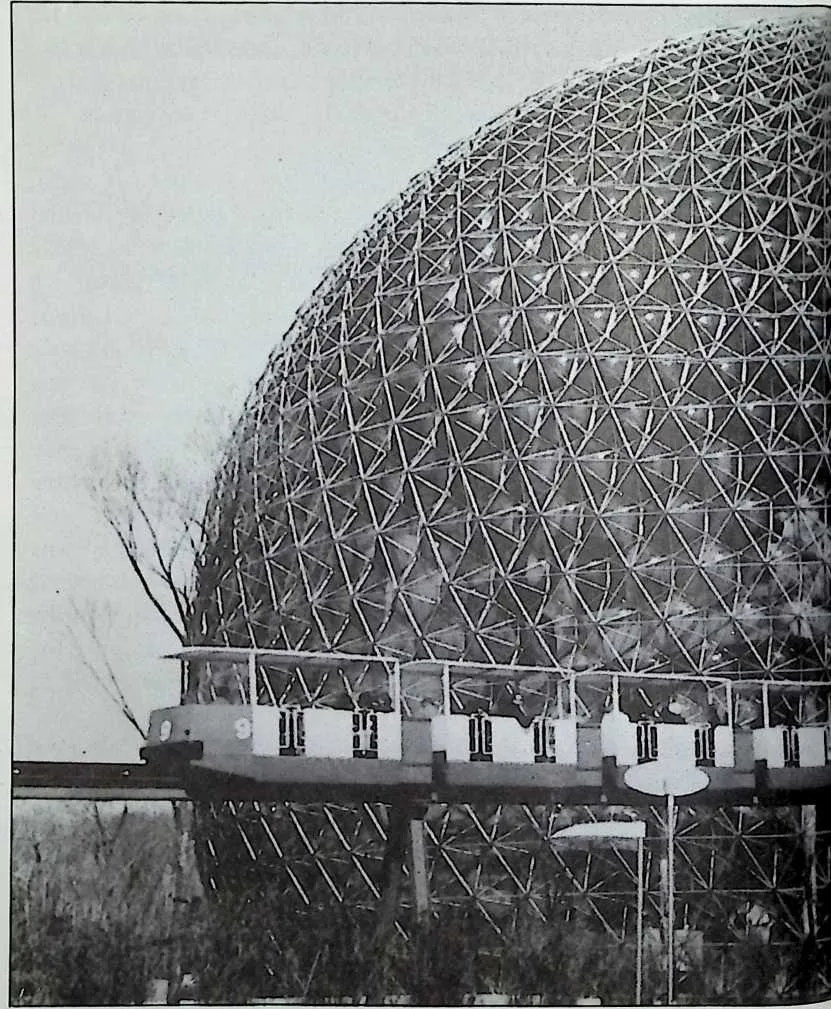
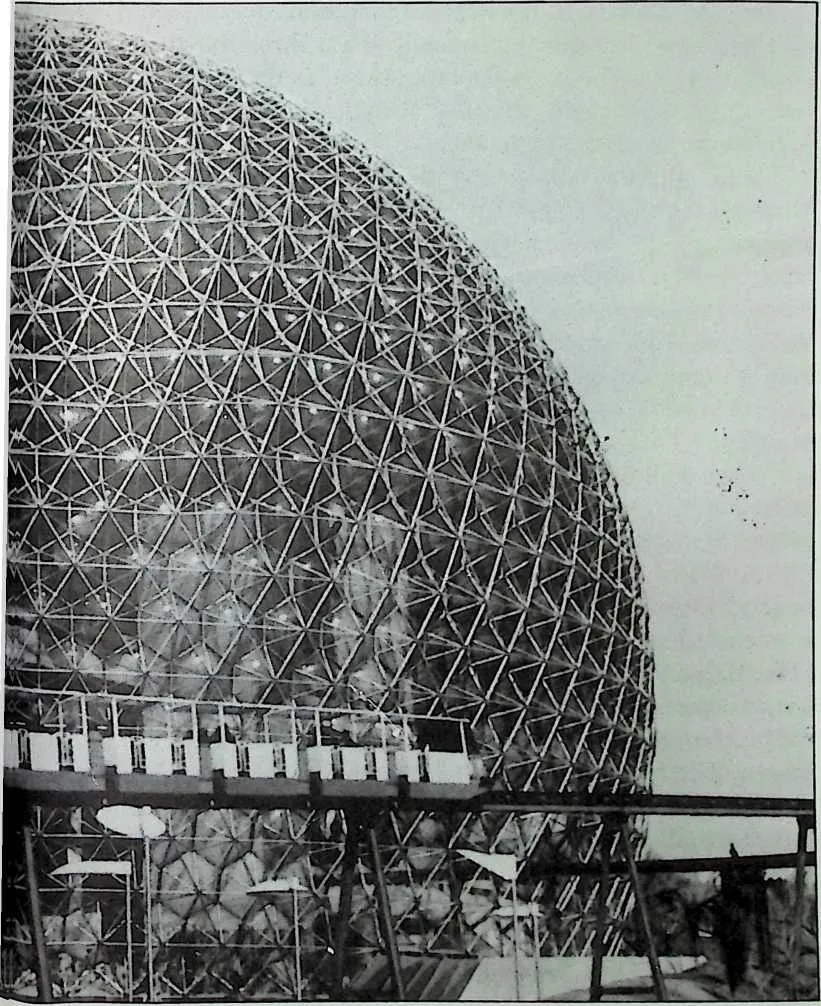
60 Fuller’s ‘‘skybreak bubble’’ at the. Expo ’67 World’s Fair in Montreal, Canada.
61 at times. At other times, the weather conditions made it seem like a floating silver sphere. (Actually, it was three-fourths of a sphere, so that the walls sloped outward as they began to rise.) After dark, under the play of lights, it was a gem of perfection against the night sky.
62 Soon after the fair opened, Bucky took Anne north to Montreal for a look. Their fiftieth wedding anniversary was approaching, so it was a special trip for both. The United States pavilion stood on an island in the St. Lawrence River. To reach it, people had to pass through a tunnel. For a time Bucky and Anne stood by the tunnel exit, watching people as they stopped to blink at the ‘‘skybreak bubble’’ for the first time. According to Bucky, most people blurted out, ‘‘How beautiful!’’
63 Then Fuller had a sudden memory. It went back even more than fifty years. His mother had shown him pictures of the Taj Mahal in India. For more than three hundred years, the Taj Mahal had been considered by many to be the most beautiful building in the world. It had been built by a ruler as a memorial to his beloved wife. Caroline Fuller had explained that the beauty of the Taj Mahal had little to do with the structure itself. No, the building was beautiful because the builder’s love had been beautiful. Again, it was mind over matter. The invisible over the visible.
64 Bucky felt that the ‘‘skybreak bubble’’ was rather like his own Taj Mahal. It would be his golden wedding gift to the person who had loved and supported him for so long. The ‘‘Expo Taj,’’ he told Anne, is ‘‘pure fallout of my love for you.’’