
10 Incoming
2Beirut on Sunday (day’s work with a mathematical collaborator), Cyprus on Monday (inspection of World Man Center site), Athens on Tuesday (confer with city-planner Constantine Doxiadis), London Wednesday through Friday (nothing specified, which permits anything), Boston by Monday (commencement speaker), Connecticut Tuesday (address on ‘‘We and the Cosmos’’), a blank on Wednesday, Israel Thursday and Friday. . . . Long ago he commenced wearing three watches, time here, time in Carbondale, time at the place after here. He resets two of them almost daily, and has trouble getting his hair cut because he’s never free when a barbershop is handy and open. Each year he sleeps in 200 different beds and aboard some hundred planes, which leaves about sixty-five nights for three familiar environments (Bear Island, his Carbondale base,* his daughter’s home at Pacific Palisades). Mild versions of such a routine have murdered poets, but Bucky seems in better shape than ever. He stopped drinking years ago, having found that people were ascribing the things he
3 • A tidy Geodesic Dome made to his specifications by a resourceful local contractor. It has two bathrooms, two bedrooms, and an upper floor with a circumferential library round which he zips on a low castored chair. was saying to the glass in his hand. His digestion thrives on his minimally varied fare, steak and Jell-0 and fruit and tea. (‘‘The cattle metabolize the vitamins for me.’’) He can will himself to sleep whenever he chooses, for instance a reviving fifteen minutes in the car from reception to auditorium. The minute he touches ground he's thinking out loud, and when mike cables anchor him before an audience the collective trip commences one more time.
4 ‘‘The century’s biggest ego trip,’’ someone said. Fair enough. He may as well thrive on its satisfactions. Most lecturers are sick to death of themselves.
5 Vectors radiate from where he stands. (There’d be twelve of them.) Bucky’s minute self streams out, finite, selfregenerating. No more sleeping on friends’ spare pallets, no more soup bought every other day. As to what happens out where the vectors terminate, where the hearers sit, it’s by no means all one-way. He says there’s an equilibrium. The sphere pulsates. Thoughts come back to his center, thoughts beamed by all those eyes, all those other ego-trippers, elated by the reinforcement of what they hardly dare believe: that (as Stewart Brand put it) ‘‘We are as gods and may as well get on with it.’’
6 What people long to believe isn’t necessarily not so. We’ll never believe what we don’t want to believe. Educators sometimes forget that.
7 What do they take away really, all those hearers, emerging into dark streets much later than they’d scheduled? A kind of bewildered euphoria, very often. Reviewing notes won’t help: there are generally none to review. ‘‘Specialization,’’ a confident girl wrote atop a blank page, then waited for subheadings; three and a half hours later that was all she had written. Sheer information overload, unannounced shifts from the ‘‘local’’ mode to the ‘‘express,’’
8 292 | BUCKY radiating instead of linear patterns, make him rather an experience than a list of enlightenments.
9 It’s not a canned lecture; that’s part of the appeal. It’s a remarkable mind thinking out loud, remarkable most evidently for its eager presence. Who else cares so much about the next thing he will tell you? It’s like that bright memory, father’s undivided attention, when you were seven and the Universe was strutting its stuff. The two of you dropped sticks into the swift eddies below a bridge, and you stood on the lower rung of a black iron railing to watch the current catch them. Nothing failed, not his vigilance, nor gravity, nor those eddies.
10 Did the last man you talked with care what his next sentence would be? Does the President care? For that matter does the President think in sentences, taut between concentration and concentration? Does most discourse not shred into phrases, like a crumbling wall? But real sentences are tensile, extended discourse a Tensegrity. And Fuller keeps it up three, four hours unbroken, spinning his weave, departing on great hexagonal circuits from the juncture to which he will suddenly return, six struts meanwhile laced tight.
11 And there’s the unfailing readiness to clarify, amplify, one mode of generosity. And always the elation of triumphant fit, as the great circle closes with six holes aligned for the final bolt. Those are the aphoristic moments:
12 ---Principles do not begin and end.
13 ---Nature always works in the most economical way.
14 ---Nature never fails, it is we who invent failure.
15 ---We have a function in the Universe.
16 ---You do not need to prove your right to survive.
17 ---Man is meant to be a success.
18 He means these things literally. Who doesn’t want to
19 believe them, while the taxman cometh? Isolated, they seem vacuously optimistic, axiomata of hophead raps. Tied into his large system of discourse, they twang like articles of faith. Bucky preaches the building of the new city here on earth, harmonized with the beneficence of the Grand Designer whose waves and oak trees, radiant spheres and pulsating energy knots, do the very most always with the very least.
20 As for us, we do not tamper, he says, no more than the honeybee tampers. Like the bee, we shunt energy circuits into leveraging patterns. Unlike the bee, which settled down long ago, we blunder about, trying stuff. But also unlike the bee, we can select among memories of what we’ve tried, and gradually discern our own large-scale patterns. We’ve just now come to that stage. Always, we’ve altered the Universe, unwittingly. Now we commence to see how.
21 The first man who built a fire altered the Universe. That day some wood was oxidized, some carbon was airborne; those things had happened before, for instance after lightning struck a forest. But thenceforward our part of the Universe contained a novelty: fire was apt to occur independent of lightning; was apt to occur inside caves, or on hearths. It could occur, as we say, ‘‘at will.’’ Our will was a new operative principle. Soon a million fires glowed at once in a single city.
22 People building those little fires did not reckon their interaction with Spaceship Earth, nor even with their local patch of its workings. Yet they accommodated to such interactions, not quite knowing that that was what they were doing. For instance the West End became the preferred quarter of London, as prevailing winds carried thousands of smoke plumes eastward. A large-scale pattern arranged itself unwittingly, zoning the less affluent toward the city’s east. That was a kind of ecological decision, and a workingclass district grew. (Marx acquired his constituency.)
23 Then fires were contained in Bessemer converters, and two bicycle mechanics flew. Meanwhile the atmosphere aboard the spaceship was changing. People learned to call the change pollution, and at last to think of large-scale patterns activated by simple activities. So the Total Thinker emerges from the egg. Just when he is capable of doing irreversible damage, bringing himself to ‘‘chemical process irretrievability’’ (i.e., species death), he has also learned enough not to. True, a precarious plight, the knowledge just capable of containing the power, but the vector equilibrium is precarious. We can fold it into an octahedron now, and the unreflective will call our escape miraculous.
24 But there are no miracles, outside of the fact that the Universe is a miracle, the Universe in which a set of weightless generalized principles---‘‘the wellspring of reality’’--- transform and intertransform. Principles are never shy, never shrink away. They manifest themselves: that’s part of being a principle. They were manifesting themselves before we came---from another star, Bucky even speculates ---and whenever we learn one, acquiring pure weightless knowledge, we have hold of an imperative to rethink our actions. This is called putting principles to use; it is also called technology. Mind discerns order from the Universe, and subsequently injects new modes of order into its environment. Why be scared of the word technology? The word automation? (Automation is principle left to run by itself.)
25 Running by itself, it shapes bones, covers them with flesh, strings neural networks, pushes hairs through scalps. All that dimension of life is automated, and by Darwin’s account the very species were shaped by long-term automation. Alter some parameter: that beast is favored,
26 INCOMING | 295
dominates; that other one becomes extinct. In that way
Neanderthal Man might have emerged, the dominant ape
of a time when conditions favored apehood.
27 But Mind, discerning order, impressing on matter the order it discerns: that is never automatic, never a function of principles running by themselves, and Bucky is not the first speculator to doubt that Mind simply evolved. So Mind, he supposes, came from elsewhere, as it were from the domain of the Great Mind that informs the Universe, and since Mind came here the only evolution that has really mattered has been weightless Mind’s evolving understanding of the weightless principles Mind alone can encompass. A dog can experience tension and compression. So far as we know, he cannot conceptualize them. We can, because we share the Cosmic Mind in which alone they are real.
28 Myth, or History? It is hard to say. A myth is a story, told as if it were history, with the intent of transcending time to help us understand. We have seen Bucky extracting myth from his own past. In bringing Mind inward to Spaceship Earth from the stars, he seems to be mythologizing the past of humanity, of which he knows no more than anyone else, by way of emphasizing his cardinal theme, that Mind is not Brain (brains are automated), that Mind is not local, not trivial, not constrained, but integral, whenever it entertains principle, with the weightless integrity that sustains the nebulae and light and photosynthesis and grass.
29 Bucky tells us, then, that we are so designed that we can harmonize our decisions with the rest of the Universe, accelerating its evolution in directions that will yield a minimum of disconnects and irretrievabilities. We may not achieve this; we may become extinct. But---he slams the lectern---we can achieve it.
30 Mystical faith, groans the scientist, reaching for his hat.
31 He is apt to forget his own equally mystical faith that neat laws await a discoverer. No physicist contains so little of the mystic that a cumbersome equation will do. Millions of cats, all different, all specified by heredity, would seem to imply a rain of variables no one can keep track of, but when a double helix was said to accommodate them all the model was not rejected as over-simple. It seemed right. We are Pythagoreans all. Pythagoras had hold of a great principle, that the greatest principles are simple. Bucky simply extends this simplicity to the doings and the welfare of the law-discoverer. We already expect that what we know shall be neat and modelable. What we do, he is telling us, can also be neat: as diverse as the rest of the Universe, but as orderly. ‘‘No generalization ever contradicts another generalization in any respect. They are all interaccommodating.’’ It is Bucky’s faith that human actions might present a comparable interaccommodative simplicity.
32 Audiences pick up the throb of this, and go away euphoric. Yet barely a detail is invulnerable to someone’s carping. Names are wrong, or dates.1 Paraphrases are hasty. When Bucky commences a sentence ‘‘Einstein said . . .’’, you can be sure that an Einstein specialist would take half an hour persuading you that what Einstein had in mind was a good deal more intricate. As for his irrefutable assertions, a committee would tell you that they were fervent platitudes, scraps from some specialist’s alphabet. His science is ‘‘superficial.’’ His mathematics is ‘‘trivial.’’ We’d better look into this. ‘‘Trivial’’ is a technical term. Mathematicians use it to denote a rather slight advance on what they know already, some bit of housekeeping, not a new wing for the house. Once we know that 3+4 = 7, the deduction that 3 = 7 --- 4 is trivial. Much Fuller math follows that pattern. Descartes showed long ago that when you fold a flat surface into a polyhedron, the ‘‘tucks’’ you gather together will always total 720 degrees. It’s easy to figure out that the sum of the angles round a tetrahedron’s four vertices is also 720 degrees. By combining these facts, we can say, as Bucky does, that the difference between flat and closed is one tetrahedron, and as we look up we’ll catch the mathematician’s lips forming the word ‘‘trivial.’’ True enough: that’s not ‘‘deep’’ mathematics, not a breakthrough like the great theorem in thanksgiving for which Pythagoras sacrificed an ox.
34 Still, we may be arrested by the reflection that between a straight string and a minimum knot---remember?---the difference is also 720 degrees, as though that were a key number that presides over the birth of a system. (A system? Well, something to arrest attention. The mere string is featureless.) If your theme is attention, sit in the dust, like Job, or by a pond, like Thoreau, and reflect that all you can ever think springs from relationships between points of attention. They are finite in number. Compute, if the mood of Ecclesiastes is on you, the sum of all the relationships of all the days since you were born, each new day rearranging the Gestalt. When you have the number, send for that many oranges, and stack them into a neat tetrahedron. There will be none left over, a result so neat you may feel like sacrificing an epistemologist. Octet Truss patterns will permeate that stack. Their unit, the vector equilibrium, models uniform growth outward from a nucleus, and the tetrahedra it generates configure all carbon molecules and therefore every trace of living tissue. And if you shrink the center orange in a cluster of thirteen the others shift to make an icosahedron, which generates the geodesic
35 structures which also give us the configurations of many viruses. . . .
36 Guided by Pythagoras’ ghost, you have moved a long way from certain bleak insistences, as (1) that the vector equilibrium has been known for twenty-two centuries under a less glamorous name, and (2) that the strictly mathematical facts about it are neither numerous nor especially profound. Nor are the chemical facts we have touched on profound, nor the biological, nor the architectural. Each science has its own meaning for ‘‘profundity.’’ Yet a theme of stubborn persistence runs through such chains of instances: that by way of pattern, every part of knowledge is accessible from every other part. The study of pattern is a new discipline, still forming. Whether patterns are simply mental conveniences, or real, and if so what order of reality they own, is still in lively dispute. Yet artists, in this zone, confer with historians of science, and design departments sponsor symposia to which metallurgists as well as draftsmen are invited. Scientific knowledge itself, we sometimes hear, is built less out of facts than out of master patterns, invented in moments of insight and for decades refined and filled in. The Periodic Table of the Elements was divined when just over half of them had been isolated. It predicted the niches into which the rest would fit.
37 Mendelejeff, who divined the Periodic Table, was right in principle on grossly insufficient facts. Newton, moreover, was right on faulty facts. His solar system fitted the observations he had. When more accurate observations spoiled the fit, it turned out that the system wasn’t faulty; it was responding to more planets than Newton knew of. Science advances by synergetic leaps, achieving whole systems before all the facts are in. The great scientific innovators have often been right only in principle.
38 The principle is a model, to marshal later facts by. After a while, enquiry changes direction, and questions arise that the model will not accommodate. Then the pressure of nagging problems is responded to by the sudden formation of a new model---in The Structure of Scientific Revolutions Thomas S. Kuhn calls it a paradigm---and this Whole System (a Newton’s Principia, a Darwin’s Origin of Species, a Lyell’s Geology) tells us what details are henceforth to be followed up. ‘‘Other problems,’’ Mr. Kuhn writes, ‘‘including many that had hitherto been standard, are rejected as metaphysical, as the concern of another discipline, or sometimes as just too problematic to be worth the time.’’ That is why science generally seems to be succeeding; it pursues questions the paradigm says have answers. Men engaged in that pursuit, once the paradigm is there, have the right to be very fussy about facts. (Lord, how they brandish that right!) The man who invented the paradigm was right only in principle.
39 Being right in principle is a common human experience. Some cases are spectacular. Working on Cathay in 1914, Ezra Pound misconstrued detail after detail of Chinese poems he knew only through the Tokyo classnotes of a Harvard-educated half-Spaniard; yet grasping the poem’s Whole System, he made translations before which scholarship is helpless. Pythagoras and Heraclitus were right in principle about things they had no business understanding at all (how little they knew; how naive were their methods!). Homer was right in principle about geography, when he thought of the whole earth engirdled by Ocean.
40 Dig Wholes, then, as the Whole Earth folk put it.
41 Bucky’s work, seen part by part, is a story of crisis and failure, buildings that don’t get built, industries that don’t
42 get financed, theories that don’t get heard. Seen whole, it is an effort to develop a vast new paradigm, the synergetic vision. Scientists have evinced no special eagerness for it, because their response is to scientific crises, in between which they feel no need at all for new models of the Universe. No, the crisis to which synergetics is pertinent is a crisis of popular enlightenment, popular faith.
43 The spectacle we’ve glimpsed, of specialists passing him from hand to hand, not quite venturing to dismiss him but hoping somebody else will worry about him, expresses a truth, that he’s centered in no specialty: not mathematics, nor chemistry, nor ecology, nor architecture, nor even engineering. His concern is for all the onetime ‘‘Com- prehensivists’’ who grew up to get locked into specialties or ‘‘livings,’’ and see little sense around them. His subject is large-scale dynamic patterns, of a very generalized order: so general any special case, passing through them, will find itself on speaking terms with any other.
44 He made houses, made cars, made bathrooms, made domes, always with a view to demonstrating some larger pattern. One reason they never made him rich was his lack of entrepreneural fanaticism about the end product; they were not end products, but instances. In his sixth decade the large pattern finally worked itself clear. His mission, he has come to believe, has always been single: to supply folk no more than normally curious with a coherence for the experience they are likely to have. Bucky says with a ‘‘model.’’ Commoner jargon says, ‘‘frame of reference.’’ He rejects that phrase because frames are two- dimensional.
45 Frames of Reference are what we use now, and we find we need several. The girl who tried to make notes and
46 INCOMING | 301 found she couldn’t was employing one: the tacit conviction that anything comprehensible will fit a piece of paper. (‘‘A clear outline,’’ her composition teacher had said. But try that for Finnegans Wake, in which, nonetheless, anyone who has dabbled has discerned a vast order.)
47 So paper is one of our tacit paradigms, its flatness, its 90-degree angles, its ‘‘top’’ and ‘‘bottom.’’ You should be able to put the first item at the top, and work down to the last item, at the bottom, and that means the thoughts you have set down are in order. This mimics the arraying of a brick wall (remove a brick: things are weakened). Dryden found English brick and left it marble, said Dr. Johnson, remembering what Augustus had done with the buildings of Rome: a neat instance of a transferred paradigm.
48 You are grasping Bucky Fuller’s challenge to such a paradigm when you have tried to draw one of his structures, and found it nearly impossible, and perceived that this tells you something about what you expect of flat paper. Structural integrity---whether of ideas or of artifacts ---is tested (we all suppose) by paper’s willingness to receive it. (We can all draw cubes. Quick!---can you draw an icosahedron?) This means we can draw a skyscraper’s cubical grid, and hence suppose it’s stable, though it isn’t till workmen put little triangular gussets at every joint. No one can really draw an Octet Truss. One meaning of Bucky’s 60-degree space grid is that it rejects the paper paradigm.
49 Geodesic Domes aren’t assembled from blueprints, not like houses. House blueprints are instructive. One view is as though the flat outside wall had been laid against the flat paper, letting the facade register. Another view is as though the paper sliced the house downward through the middle, end to end. Everything it shows is on the plane of
50 the paper: walls, doorways, rooftree. From another, the floor plan, we are to imagine partitions rising toward us at 90-degrees from the drawing. The paper plane is intimate with a 90-degree structural system, and the carpenter, picking his measurements right off the drawing, translates what he sees on it into wood.
51 But press paper flat against a Geodesic Dome, and at most you pick up one triangle. Draw a section, and it looks like a jerky half-circle. A floor plan is a big uninformative polygon. There’s no useful information here, nothing to copy, though a Building Inspector may insist on having it to file away. You can make a perspective rendering if you want to, taking infinite trouble to catch all those little subtle changes of angle in a grid system to which they do not comply. You can do a lot of useless things if you really want to.
52 Years ago the Chicago Institute of Design retained Bucky to give a crash course, and made a roomful of drawing tables ready. He began by announcing that drawings were obsolescent. What his students were going to learn to envisage would not take form at a pencil’s end. The tabletops ended up against the walls, where they did for bulletin boards. The design work went forward with language, later with three-dimensional stick models, centered on the vector equilibrium’s twelve 60-degree radii. Building instructions consisted of tables of figures, to index machine tools. Nowadays the route would go from concept straight to computer.
53 For the great Montreal Bubble there were no assembly drawings, except a few hub details. Assembly procedure for the Wichita House of 1946 called for color-coded bolts, carried in the color-coded pockets of special workmen’s aprons. They would pass through color-coded holes, and no one would look at a picture.
54 These aren’t just contractors’ field tricks. They tell us something about our working sense of order: that it clings to notions of flatness, 90-degree turns, 180-degree returns and gravity pulling straight down through a piled stack. Mercator’s map fills a paper rectangle to its edges and corners. The Dymaxion map depended on the realization that a world map needn’t fit a rectangle. It has no special shape, and its system radiates from twelve gathering-points. You can diagram each sentence of Milton’s, however intricate, but only some of Joyce’s. To read Joyce is to spot the local radiating centers. The Miltonic flat page is a sample of a flat plane extending in all directions to infinity. But nothing real extends there. The real has always natural limits, incurving.
55 Then there is politics, an affair of 180-degree encounters, left meeting right: action, reaction. The party system, creation of the post-Newtonian century, seemed a natural way to order opposed forces, which intuition said had a natural existence. Today we increasingly suspect that the model may create the forces, as the blueprint creates the house.
56 The man at the post office asked for 60 stamps. The ones he was offered bore Franklin D. Roosevelt’s image. He refused to buy them. Years ago the license plates issued to a thousand Californians bore the three-letter combination IKE. Despite stiffish fees in the event of lost plates, an unknown number were promptly, indignantly, ‘‘lost.’’ Of such are political passions.
57 The party system presupposes that parties are functionally equivalent, otherwise one would be slowly squeezed out of existence. In the long view, either it doesn’t matter which party governs, or else we project ‘‘good’’ and ‘‘evil’’ onto their surfaces, in which case our polity is Manichaean. Many voters simply adopt the pragmatic view that power corrupts. The rascals must be periodically turned out, amid thanks for a system that provides a replacement team ---of potential rascals.
58 These models fit short-term facts, but afford strange paradigms for major decision-making. Bucky will urge us to imagine two cases: (1) all the politicians on earth peeled off for encapsulation in a secondary spaceship for their own trip around the sun, and affairs on Spaceship Earth not a bit impaired; or (2) the power-station attendants, flight controllers, telephone repairmen packed off on such a trip, and on Spaceship Earth mounting misery and imminent starvation. (Imagine the day the refrigerators stop!) It’s an over-simple model---men would hastily breed new politicians---and yet it underlines a truth: politics may answer many human needs, but politics is not where it’s at.
59 He downplays politics to a sometimes alarming degree. He refuses to compare the human cost of systems, prefer- ing instead to fix attention on the real gains which occur regardless of system (though system tries to theologize them), and are really to be ascribed to industrialization. After a time of hoping that Dymaxion ideas might be inserted into the five-year plans, he came to see that Russia never pioneered any completely new industry, that its adherence to capitalist prototypes was ‘‘slavish,’’ but he doesn’t dwell on this, and the patterns that hold his attention continue to transcend politics. In the same breath he will ascribe American drugs and insurgency to Mainland Chinese connivings, and find this ‘‘quite understandable’’ since the Chinese after all wanted to industrialize undisturbed. It’s his faith that that’s what they’ve been doing.
60 Still, he’s right to observe that no politician, no political arrangement, can remedy scarcity. They can redistribute it, amid announcements that scarcity is caused by profits. If injustice is simply imbalance, then Robin Hood’s way will redress it. But if its root is net scarcity, then Robin Hood’s ministrations are cosmetic merely. (They may get him elected sheriff.) More wealth is not his to create, and when he allocates money---often for ‘‘feasibility studies’’--- he is ‘‘sprinkling greenbacks on the conflagration.’’
61 Then does Bucky think of the withering away of the state? No, but simply of reserving its role to ‘‘housekeeping functions.’’ Don’t waste time, he says, inciting governments to save us. It is not in their power. (If you can see how to keep them from destroying us, there may be some point in that.)
62 These days, such talk coincides with a deepening mood. It grows normal to trust nobody---nobody---who aspires to office, unless, like some of Eugene McCarthy’s supporters in 1968, you sense that there’s really no hope of his getting there. So we get symbolic campaigns, token candidates, metatheater.
63 At this moment a syndicated column comes to hand. Its author’s commitment to politics is lifelong, to ways of fine- tuning the machinery of power. Yet he calmly notes, not expecting to be challenged, that there is no seeker after the Presidency, not one, whose campaign rhetoric an undereducated mule would take seriously. This moves our attention to a third paradigm, mental shrinkage. Talkers talk down, talk down: no eggs are thrown. Teachers teach down: no one fires them. Interviewers coddle: viewers stay tuned. We rehearse the rituals of failure. The great sphere of public discourse, political, educational, even interpersonal, becomes a Stupidity Factory.
64 That schools are such factories is by now an open secret. Each season brings a new spate of books to testify that the
65 306 | BUCKY most education-minded people on earth are high-mindedly doing irreversible damage in every cubical classroom in the land. Teaching brings paradigms, formulated by the teacher, into contact with whatever experience the student has in his head. The fit is poor, but the system says it is perfect. Caught in the system, the student has a simple recourse: he ‘‘fails.’’
66 Since nature always pursues paths of least effort, there is always a short-term gain in appearing stupider than you are. The easiest way to evade the thrust of an order is not to understand it. This strategy has a hundred rituals: ‘‘I could never do math.’’ ‘‘Art is beyond me.’’ ‘‘You cannot expect our readers to understand that.’’ There’s the talkshow host’s strategy: deputize for a million viewers, and either act lovably dumber than the guests, or by mugging adroitness make the guests seem deficient in the savvy that really counts.
67 With one remarkable exception, the network showing of Robert Snyder’s film Buckminster Fuller on Spaceship Earth, that is how TV has preferred to deal with Fuller. He can hold a thousand people’s attention for hours, but he has never been able to crack an interviewer’s professional ignorance. On a Sunday afternoon late in 1971, NBC put him on public display for an hour. The talk, for some reason, was conducted outdoors, by a lake where water-skiers were performing. Since the whine of motors made every third sentence inaudible, viewers were able to concentrate on the grimaces. Bucky, as usual not noticing negatives, launched into his exposition of the nonexistence of straight lines. He used a rope and a blackboard. At one point, glimpsing obtrusive condescension, he said sharply, ‘‘Pay attention. This is important.’’ After he had finished being clear step by step for ten minutes, the he-host agreed with the she-host that they hadn’t, either of them, under-
68 stood a word. This constituted their oblique directive to the audience, which after all spent many years in school, learning chiefly that its normal grade was C.
69 There have come to be just three kinds of diagnostic books about schools. Some are really political---schools are middle-class, they exacerbate the ghettoization of the ghet- toes. Some anatomize the ever-bleaker facts about an environment in which children normally fail, and learn to camouflage failure or to accept it without going mad. Some simply promote ‘‘higher standards,’’ i.e., more failures.
70 On the other hand the ‘‘positive’’ books, the what-do- we-do-about-it books, work from a political paradigm since what they promote is chiefly a restructuring of classroom communities. (Have two teachers. Have no teachers. Move to Vermont.) That reflects a conviction as old as America, that communities are designed (Oneida, Brook Farm, Levittown, the Company Town, the Retirement Haven). Emerson, we may remember, thought differently. He thought of communities that would simply express the way energy centers interact: the vector equilibria of properly confident, interaccommodative individuals.
71 Bucky Fuller, similarly, ignores classroom communities the way he ignores politics. He would ask whether classroom troubles are not arising from the wrong paradigms: the 180-degree traffic between teacher and pupil, its ideal model the pipeline, and the whole array of paradigms that pass for ‘‘subjects,’’ increasingly divergent from anyone’s real experience. We use seapower maps in an air-ocean world. We make arithmetic a rite of mysterious rules ("Here you put down seven and carry two.’’ ‘‘Why?’’). We model history as linear causes between unreal situation reports. We allude to the ‘‘structure’’ of just about everything, from a Shakespeare song to Jefferson’s foreign
72 308 | BUCKY policy, heedless of the intuitions bottled up in the word structure. And having raised these cardhouses of knowledge, we expect a roomful of plodders at exam time to massage them back onto the flat paper whence they arose (and Neatness Counts). Naturally failure is normal.
73 ‘‘How’s school these days?’’ John Holt asked a friend’s daughter. He describes the conversation in How Children Fail.
74 ‘‘OK.’’
75 ‘‘What sort of stuff do they teach you?’’
76 ‘‘Oh, stuff like the difference between ‘gone’ and ‘went.’ ’’
77 ‘‘I see. By the way, can you tell me which is right, ‘I have gone to the movies’ or ‘I have went to the movies.’ ’’
78 Long thoughtful pause. Then, ‘‘I don’t know. I can’t tell when it isn’t written on the board.’’
79 You can see that ‘‘the board’’ = ‘‘paper.’’ No doubt the child’s speech was expert. Think of it as a transfer of speech to a rectilinear coordinate system in space, where peculiar rules apply since normal experience does not survive the transfer. Think about it that way; think of ‘‘subjects’’ in general that way, as transfers of experience to an alien system, and you glimpse one thing a tireless world-traveler means when he walks off his plane talking of Nature’s coordinate system, one we elect not to use.
80 In How Children Learn Mr. Holt tells of making some cardboard boxes, open-topped, folded from a single sheet of cardboard he had accurately cut. First-graders watched him. Then they wanted to try it. ‘‘By watching me, or each other, or by thinking, or by trial and error, they all figured out that to make a rectangular box with an open top you had to cut out a piece in the shape of a heavy cross.’’ First they did it badly. Later they did it well. (‘‘Nobody asked me for advice.’’) Later still, a boy figured out how to vary
81 the cross so the box would have a closable top. Then he wondered about a house with a peaked roof. ‘‘I didn’t see him work on the problem, and don’t know by what steps he managed it, but within a few days his teacher showed me a cardboard house, with peaked roof, that he had cut out in one piece. It was well made, too; the sides and roof fit together quite well. And he had cut out, not drawn, the doors and the windows, before folding the house together. A most extraordinary piece of work.’’ He had been a troublesome boy.
82 Models, you see. Something real. For first grade, the mathematics it entails is most advanced. Mr. Holt is careful to specify that to substitute Model Building I for Arithmetic I, ‘‘with the same old business of assignments, homework, drill, and tests,’’ will leave us where we started. The ‘‘curriculum’’ is one more transfer of coordinates, from the vectorial outthrust of felt needs to the rectilinear ‘‘What Teacher Wants.’’ The latter, by two-dimensional definition, stretches out to infinity. That is dismaying.
83 Not that any problems, any solutions, are simple. But Bucky’s large-scale dynamic patterns gratify precisely because in touching on so many problems they leave his audiences with at least the feeling that a mind can move about reality freely, that strategies exist that don’t entail vertigo. All real problems go finitely outward from centers. Grasp that, he wants us to intuit, and any reality you encounter has at least the prospect of making sense. We seldom reflect how deep runs the conviction that most problems are really insoluble, most reality unassimilable. Hence tranquilizers, and situation comedies, where the perennially insoluble at least yields laughs.
84 So what do I do? He’s not going to tell me. An Architectural Forum article preserves his emphatic words to one young man:
8586I realize you have this very big love and you want to do some very fine things with it. But I’m afraid you won’t be able to do anything beneficial until you really start to think and get inside what’s causing this love. You are going to have to think very clearly about basics and about what moves you can make to bring about changes in the things you see wrong. It doesn’t do any good to get angry. And it doesn’t do any good for you to sit here with me unless you can find in all this something of your own to say.
87 Thoreau also said something like that: don’t bother looking for a lake and building a cabin. That will express nothing but your dropout’s conviction that nothing makes sense.
88 A familiar plaint: nothing makes sense. (Parts predict no Whole System.) We go by nonsynergetic paradigms for ‘‘sense.’’ Custom, language, paper, politics, the omnipresent Stupidity Factory, all teach us that sense, could we have it, would be static. (‘‘People want single-frame answers.’’)
89 But the world changes. For single-framers, change seems unnatural. You cannot argue with a jet plane, but you can spend your life feeling it is a little unnatural. There are many things like that to find unnatural: Finnegans Wake, and Hair, and traffic lights hung above a Venetian canal, and a museum that can assimilate Rauschenberg’s stuffed goat with a tire around its middle, and forks you throw away and young Italians strolling through Catullus’ ruined villa on the tip of Sirmio with transistor sets clapped to their ears.
90 These are all technology: step-by-step implementations of some principle not widely understood. Writing Finnegans Wake was a technological feat. Joyce slogged at it for seventeen years, and one time even supposed he could retire and deputize another man to finish it. His innovative genius consisted in glimpsing the possibility of such a book---nonsimultaneous, readable only in weeks, structured only by patterns---and then working out its principles. Afterwards he was quite calm about it, as calm as a jet pilot. It is precisely the participants’ calm that identifies a technology: the innovative frontier is safely passed. The stop-and-go light hung over waters in Venice is something to be calm about once you have made the great leap, which is seeing that the boat traffic at a certain blind corner is modeled after car traffic in a Roman street.
91 But it is hard to be calm about all those folk being calm. As technology goes on proving its own possibility, and people live with this or that manifestation, some with snowmobiles, an affront to silent woods, some with telephones, an affront to privacy, some with Tensegrity Spheres, an affront to common sense, a subliminal fear begins to insinuate itself, to the effect that society is breaking up, or going mad or marching toward some Tarpeian cliff. People fling off their clothes, or revert to sandals, or join societies for shouting Stop, or perceive in the political insanity of the moment an index to some radical insanity that only return to the woods will expiate. Some regress to bead-stringing, denying technology while tape-players blare. Others league to prevent people from being born, and hope the next generation will swell their ranks.
92 Bucky Fuller, in such a juncture, seems heaven-sent. (If you take a long view, the forces that produced the crisis helped produce him too.) When his words do no more than soothe, that is probably beneficent, though it in
93 furiates stirrers-up of causes. But a commoner experience is that he invigorates. He lets us hope that the world in which all these changes occur can still make sense: that it has one Coordinate System.
94 There is a peculiar aptness in the story of his long life, which has consisted of successive fantasies being elaborated: suspended houses, air-delivered dwellings, even a three-wheeled car, actually built and faster than anyone else’s car. (What a potent fantasy!) Which fantasies were fully realized, which ones remained talk, is oddly immaterial. Thoreau gave America one of its most fructive fantasies in going through the motions of a retreat to nature which in fact he didn’t fully realize. (‘‘On many evenings,’’ Quentin Anderson writes, ‘‘he stepped off the scene of his demonstration and went home to his mother’s boarding-house for supper.’’) We forgive the fiction. He was quite clear about the status of his famous gesture: not a panacea, that retreat to that handmade cabin by that pond, but one man’s fantasy become a metaphor. He tells us not to emulate; certainly not to emulate him. (What if all 200,000,000 Americans headed for pond shores?) But because one man did it, out of his deepest private need, and wrote a book, the whole population has been freed a little.
95 Geodesic Domes, if they never go into production, still free us a little too. They are metaphors: Whole Systems, first of all. They draw together functional shelter, elusively simple laws of Nature’s structuring, symmetry, medium- high math, countercultural community (or solitude, as you wish), Eskimo simplicity, utter up-to-dateness. It is much to have developed a metaphor like that, and the Domebook folk, whom Bucky never envisaged, have constructed what may be the most coherent fantasy of outlawry since Robinson Crusoe. Not content with dreaming, they hew timbers. Others read their building manual for escape literature, and read the Whole Earth Catalog, that Space-Age Walden.
96 It is also symbolically right that Thoreau’s cabin used a framing system that was already obsolete. Important phases of his thought were obsolete too. The Whole Earth Catalog has sensible words on ‘‘the blanket rejection of technology that is trapping many people in an alternate life-style of shabby creativity.’’ These people, such is the force of paradigms, repeat Thoreau’s fundamental error, which was to suppose that invention merely complicates the simple. He thought you could walk to Boston in the time it would take you to earn the price of a railway ticket. That is to say, he did not think there was such a thing as synergy, and a naked Hindu at a spinning wheel was his paradigmatic disciple: Gandhi, who got the British out of India---a political triumph---but had no remedy for Indian starvation.
97 Bucky Fuller is here to tell us that synergy is nothing exotic, is in fact the most common of all human experiences. Every sentence exemplifies it, every child. Systems always yield more than goes into them. We can’t predict what. Invention, systematized, makes available resources of knowledge the whole human community has accumulated. Thus a man building his own dome in the woods--- unforeseen by Fuller---taps Fuller’s insights, and NASA’s chord-factor tables (reprinted from a study on ‘‘Advanced Structural Design for Future Space Missions’’), and computers therefore, and the electric company (via a radial saw---how else make 300 identical struts?)---wooing simplicity only in zones of his choice.
98 That man, however numerous his tribe, is a metaphor, not a general-case solution. So is Fuller’s synergetics. So
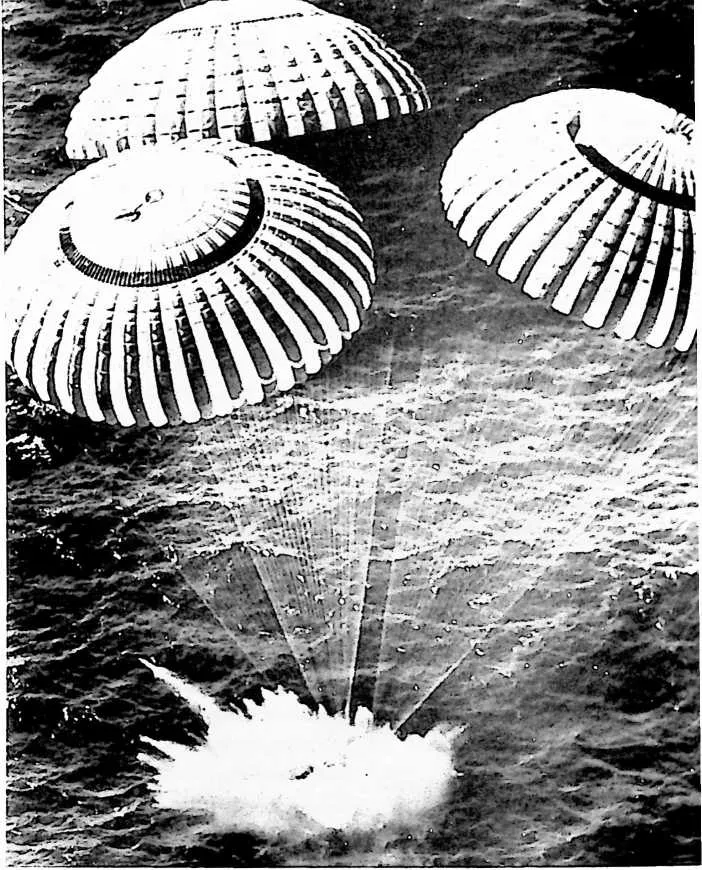
100101Apollo 16 splashdown (NASA)
102 is Fuller’s life. Metaphors, paradigms, these are our deepest needs, irradiating minds with heuristic images: points of departure, not solutions; encouragements to Dig Wholes.
103 * * *
104 I stopped to watch Apollo 16 descend. A tensile thread invisible except to mind had reeled it in from the moon: one little compressive island rushing to rejoin another. As Spaceship Casper neared the liquid cushion spread out aboard Spaceship Earth, a vast tension-compression structure of minimum weight was erected in a split second: the three parachutes below which the conical capsule dangled, the system an indrifting dynamic tetrahedron. Casper had carried only the tensile part, neatly folded. Spaceship Earth carried the compressive part, air, which filled domical cloth cups at hurricane violence. Over the triple domes an unseen low-pressure cone formed, whose ‘‘tensile draft on the inertia of the atmosphere’’---the phrasing is Bucky Fuller’s---‘‘can be satisfed at a rate so slow as to ease the paratrooper down.’’ That was thirty years ago; now he would say ‘‘in.’’ And three decades’ evolution had transformed the paratrooper into a spacecraft and a trio of lunar explorers. Nothing was spent, not even energy. Energy parted the ocean, lifted its great mass, which subsided infolding huge gulps of salt-tanged air, to spray outward in many million spherical bubbles, each a short-lived equilibrium, molecule-thick, unique, instantly patterned, almost as instantly gone. On that sea, change is normal: on any sea.
105 In the forty-five years since Bucky Fuller had speculated that a modest shelter properly designed might be delivered by air, governments had gone on studying the ‘‘housing problem.’’ Only this spring (March 26, 1972) the Office of Economic Opportunity proposed to devote yet another four million dollars to an experimental design program, ‘‘to find out,’’ said a spokesman, ‘‘if it’s possible to construct a low-income home on a massive scale.’’ Those designers can be counted on---Bucky talking---to stay ‘‘settled upon the real estaters’ sewers like hens on glass eggs.’’ And they’ll use simple cubes---cheaper, aren’t they? It’s expensive running-in-place.
106 Meanwhile a fully habitable environment, utterly self- sufficient for ten days, complete with three tenants, their mechanical shavers, their pressurized ballpoint pens and their foods and fluids and their sewerage system, cameras and films and computers and radios, even their 4-wheel- drive car, had been airlifted clear out of earth’s domain and part way across the solar system to a base where the men did work. They discarded part of their subsystem and flew the rest home again.
107 Home? To the Whole Earth, with only humanity aboard: an earth blue and white, growing larger in the incoming spacecraft window. People in wooden cubical boxes, termite-eaten, crushingly mortgaged, linked by tons of buried plumbing, saw on their colored viewscreens the Whole Earth the astronauts saw. Meanwhile Spaceman Fuller traced geodesics through the air-ocean, touched down, talked, soared out, touched down again. His baggage is mostly weightless now: models of the dynamic universe, verbal strings from which to spin the tension systems we must fill with our local compressives to use them at all.