
5 Bubbles and Destiny
2Bucky’s peculiar fervor, preaching these themes---there is only one vector equilibrium, and he is its prophet---sweeps us past simply being comfortable with the atom. His vocation is nothing less than to save the world. Stark beauty and simplicity allure him---those Platonic constructs, those gratifying round numbers---but he has too New England a mind to rest in beauty. Beauty has an allure beyond itself, the promise of rightness. Can anything be so neat and not be right? And it is supremely important to be right, because finding what Nature’s working principles are is the key to ‘‘making man a success in the Universe.’’
3 Vocation is the right word: it is like a saint’s. And his life, like a saint’s life, contains crisis points of conversion. As he tells it, there were two conversions, the second completing the first. He was converted (1917) to a new mathematics, and converted again (1927) to a new mission. Each event involved gazing at water. We may call them the Vision of the Bubbles, and the Vision of Destiny. It is possible that neither of them happened.
4 Not that he deceives. He mythologizes, a normal work of the mind. The mind, like the Universe, has contracting and expanding phases. It expands to embrace multitudinous perceptions, making thousands of separate statements about different things. It contracts to utter summarizing statements, out of which time tends to be squeezed. A man says, ‘‘I fell in love,’’ as though it had been instantaneous. If he teased what actually happened into its elements, he would talk for hours, to little effect. ‘ ‘I fell in love’’ is a mythological statement; it is not ‘‘untrue.’’
5 ‘‘Cadmus gave men letters’’ is a similar statement. ‘‘Pericles built the Parthenon.’’ ‘‘The emperor Seu-Gin taught the breaking of branches, the knotting of cords.’’ More recently, ‘‘Lincoln freed the slaves,’’ and ‘‘Lenin overturned Russia’’ and ‘‘The United States lost China.’’ All these are useful myths. And everyone knows the story of Washington and the cherry tree, or Newton and the apple, or Watt and the teakettle. They are mythological statements; they concentrate truth.
6 Thus, that uncle we have encountered, talking of Malthus: did he indeed take Bucky aside just before the 1913 Harvard term? That was how a 1965 audience heard it; the version is printed in Utopia or Oblivion, pages 121-22. Or was it in the Navy, four years later, that the Golden Rule was denied on principle, and did the talk with the uncle occur still later than that? So runs the version in the 1963 Ideas and Integrities, page 60. And why does Utopia or Oblivion put ‘‘uncle’’ in quotation marks? Was there really a single uncle, holding forth on a single eloquent occasion? Or does ‘‘uncle’’ mean ‘‘the elder generation,’’ reinforced for purposes of exposition by remarks remembered from one man in particular, perhaps not remarks all spoken on one day but collected from a span of memories? Such questions do not challenge Bucky’s purpose in telling the story, which is to establish his elders’ Malthusian postulates. They do serve to cast doubt on an illusion his talk often generates, of thought suddenly
7 BUBBLES AND DESTINY | Igl crystallized on red-letter days when he went to bed knowing a fundamental thing he had not known at breakfast, thanks to some epiphanic experience that occurred at 10:32 a.m.
8 What a myth squeezes out is linear time, reducing all the fumblings and sortings of years to an illuminative instant. We can see why Bucky needs myth. The vision that possesses him eludes linearity. To present it sequentially is a technical problem, like geodesic design, and a true solution, if one were ever found, ought to merit a U. S. Patent. (A patent on Linguistic Arrays? Why not? He already holds the only patent on Cartography, to spread the earth out flat.) For his is a Whole Systems Vision, and the ultimate Whole System (and only functional perpetual motion machine) is nothing less than the Universe. How to spread that out?
9 He can talk it through, he says, in fifty-five hours, 385,000 words, a discourse half as long again as Ulysses. But even the fifty-five-hour exposition has to proceed word by word from somewhere to somewhere else, and one should grasp it whole. One solution is to seem to be uttering many strings of words simultaneously; warmed up, he will generate this effect by sheer pace. Another is to extract local clusters for inspection, and since ‘‘no man has ever seen outside of himself,’’ the clusters tend to fit into an autobiographical myth.
10 This myth is anecdotal; its unit is the Germinal Moment, with place and time specified. Aboard a ship, in 1917, he had a great insight. Beside Lake Michigan, in 1927, he made a pivotal decision. These are patterns danced into being by his speech, as Orpheus’ music moved stones. He believes that we partly create experience by talking of it, and extend the Universe by thinking of it. ‘‘Intellect may be ‘creating,’ finitely extending and re-fining universe
11 as it asks each next good question,’’ and it is in the act of creating, thinking-out-loud, that Bucky is being uniquely Buckminster Fuller.
12 Imagine him then, standing, age twenty-two, at the stern of a running ship, gazing at its white wake on the dark water. Millions of little bubbles compose this whiteness, each one a little sphere or partial sphere, each exemplifying the mathematics of spheres, including presumably the famous pi which enters the mathematics of anything circular.
13 Pi is a very old scandal. Generations of circle-squarers attested to the persistent intuition that it ought to have a rational value, but nobody ever found one. Eventually it was proved that none was findable. The decimal sequence for pi, circumference divided by diameter, commences 3.141592653589793 . . . and will go on forever. This appears to mean that infinity will invade any circular system, which feels wrong since circles are closed. In practice the embarrassment is slight. Human dexterity encounters limits, and the specifications for making anything practical, like airplane engine cylinders, can accept an error of one part in 10,000, four decimal places, 3.1416.
14 Being unhampered by a machinist’s finite eyesight, Nature need not stop at a rounded-off fourth place. At what place then?
15 ‘‘I’d learned at school that in order to make a sphere, which is what a bubble is, you employ pi, and I’d also learned that pi is an irrational number.’’ So ‘‘when,’’ he recalls asking, ‘‘does nature have to fudge it and pretend it comes out even and then make some kind of compromise bubble?’’ And millions of them per second. ‘‘I think it’s too many decisions for nature to make.’’
16 And now the insight, and the vocation. . . . ‘‘And I
17 BUBBLES AND DESTINY | 133 reached the decision right at that moment that nature didn’t use pi. I said to myself, ‘I think nature has a different system, and it must be some sort of arithmetical- geometrical coordinate system, because nature has all kinds of models. . . And I decided then, in 1917, that what I’d like to do was to find nature’s geometry.’’
18 What makes this an especially beautiful story is that just fifty years later the world was to be enriched by what is still the most spectacular geodesic structure ever erected, a giant 250-foot steel and plexiglass ‘‘skybreak bubble.’’ It is as free as a soap bubble of internal supports, the load on its foundations is less than the weight of its separate materials, and had it been a half-mile in diameter it would have been capable of drifting away.
19 Still, the Vision of the Bubbles invites query. We shan’t learn if it really happened quite as he tells it, though our legacy of Romantic introspection, commencing with Wordsworth’s Prelude, may remind us how recollection in tranquillity, and still more recollection in excitement, shapes what is being recollected. We can safely say that as of the mid-1960’s, when the Bubble Story began turning up in Bucky’s talks, it seemed to him that his quest for Nature’s geometry has been on his mind since 1917, and that its origin was entangled with a memory of watching bubbles. Many reflections about pi and vectors were no doubt later refinements. It resembles the story of Newton and the apple in being an incident only potential with meaning.
20 We may next ask what it may mean. Its explicit yield was, ‘‘Nature does not use pi,’’ which has the ring of perdurable crackpottery, of flat-earth dogmas and other sturdy defiances of book learning. I can draw a circle with a compass, we may think of retorting, and draw it well without giving a thought to pi. Ah, but the challenge was not
21 to draw a circle, the challenge was to make a sphere. Well, I can massage clay until it feels right, and if my clay ball is not perfectly spherical, very likely those bubbles are not perfect either. But nature makes bubbles too fast for any such trial and error, and by the million, changing and disintegrating.
22 Still, we can describe how this is done. Disturbance, for instance from a passing ship, folds a little air into the water, and the air bubble, being light, shoots toward the water’s surface. At the surface, it is enfolded by surface tension, which we may envisage as an elastic membrane, met with at the boundary layer of liquids. (Water bugs walk on it.) The surface tension is uniform, closing in. The air’s thrust is uniform, shoving out. The two reach equilibrium in a surface of minimum area, which is a sphere though not a long-lived sphere unless there is soap in the water to cohere that membrane. It’s the contained- explosion principle once more, and the vector equilibrium is its model.
23 A balance of tensile and compressive forces, then, and nothing to do with 3.1416*. If Bucky was taught at school that you use pi to make a sphere, then he was simply mistaught. More likely he is doing what we can sometimes catch him at, scoring points off a phantom adversary. Nature is not alone in not employing pi. It is difficult to think of even a man-made sphere you need pi to undertake. And if geodesic spheres occur in nature, as Bucky affirms they do, you might well object that designing a geodesic sphere entails much tedious spherical trigonometry which nature hasn’t time for either.
24 No, the real principle involved is somewhat different. What the Bubble Vision illuminated was the difference between generating spheres and answering questions about them. They can be generated without pi and described
25 BUBBLES AND DESTINY 135
26 without pi. But the minute someone fixes his attention on the linear distance straight through the bubble’s middle, and commences phrasing questions that entail that measurement, then pi starts turning up. Since the measurement can’t be made without destroying the bubble, these questions are apt to be rather fanciful. That distance is the bubble’s diameter. What is the distance clear round the bubble? Pi times the diameter. If I slice the bubble in half, then---quick before it vanishes!---what is the area of the circle I expose? Fanciful indeed, since that circle has no surface; but if it had, its area would be pi times the second power of half the diameter. And the area of the bubble’s whole outside surface? Four times that. And the volume of the air in the bubble? Four-thirds of pi, times the third power of half the diameter.
27 None of these questions has the least pertinence to making a sphere, whether in the wake of a ship or in a bowlingball factory. Nor does any of them enter the explanation of how it hangs together, since if you graph the forces a bubble equilibrates you draw straight lines with little arrows on the ends to denote thrusts. Pi has nothing to do with those lines. We might even say harshly that they are such questions as would only occur to idle curiosity, doodling in a static universe of ideal forms. What Bucky means by ‘‘nature’s own geometry" is a set of economical statements about the way patterns come into existence and then hold together. This means, statements about forces, which always interact with maximum economy, as in the triangle. By the criteria of ‘‘nature’s own geometry,’’ the greater part of formal mathematics is elegantly irrelevant game-playing.
28 Part of the game is the game of definition. There’s a classical definition of a sphere. ‘‘A sphere is a surface equidistant at all points from a central point.’’ Bucky delights
29 to tell us what such a thing would be like. ‘‘That means, you see, that it couldn’t have any holes in it, because as you went over the edge of a hole you’d be getting closer to the center. So it’s a perfectly closed system, and it divides the universe into two parts, the part inside the system, the part outside the system. No communication between them. So no energy could pass through the barrier, hence no entropy. A local system totally conserving energy: that would be a perpetual motion machine.’’
30 But we know, he says, that there are no real surfaces; there are molecular meshes full of holes. And if the air stays inside a bubble, that is because the holes in the bubble’s skin are smaller than the molecules of air. The bubble is a tension network, and the compression system within is an agitation of air molecules. The ones near the outside, being crowded by the ones toward the center, keep hitting the molecule-thin mesh and stressing it outward.
31 The mesh, for that matter, has not even continuous threads. The nodes of the mesh are ‘‘ ‘Milky Way’-like constellations, great energy aggregates cohering only ‘gravitationally’ to act as the ‘webbing’ of the pneumatic ball’s net.’’ The skin of the sphere is a discontinuous network of energy events, interspersed with vast spaces which are nonetheless not so large as the molecules of air that blunder against them.
32 And the shortest distance between two energy events is not an arc but a chord, so a diagram of the intermolecular tension network would consist of tiny straight lines. There is no ‘‘real’’ curved surface; hence no need for pi. Any three of these boundary events make a triangle, so the bubble is omnitriangulated, hence (surprise!) geodesic.
33 We’ve hinted that the questions pi answers tend to be frivolous questions. In the real world they don’t even get accurate answers, since they postulate curves, which in fact
34 are nonexistent. Which is not to deny the great usefulness of pi as a rapid-calculating device for getting answers as good as we need. (It got us to the moon.) That’s what it is for Bucky, nothing more.
35 A world freed of pi, it is not too much to say, seemed freed of a deep scandal. For millenia it has seemed wrong to numerous minds that seams of irrationality should run through the universe. At Kroton, about 500 B.C., the Pythagoreans encountered such a seam when their beautiful sets of whole numbers pervading all creation collided with the diagonal of the square, which will no more yield a whole number than will pi. This quantity they named alogon, The Unutterable, and when initiates were told of its existence they were sworn to secrecy. They executed a man named Hippasos for babbling it.
36 The Pythagoreans had good reasons for their veneration of whole numbers. They had discovered that when the seeming randomness of sound was zoned into concords, the octave, the fifth, the fourth, then the lengths of the lyre strings bear simple numerical ratios: 2:1, 3:2, 4:3. They had learned that if you group stones into squares,

38 4 9 16 25
39 then you can pass from square to square indefinitely by adding the successive odd numbers. To go from 4 to 9 you add 5; to go to 16 add 7 more; to go to 25, 9 more. You might expect to get the next square number by adding 11, and so you do: 36. This was marvelous; the bare number system itself generating orderly patterns the senses can caress.
40 lg« | BUCKY
41 And they had discovered a remarkable piece of Synergy, behavior of a whole system unpredicted by our knowledge of its parts. The Whole System is a right-angled triangle scratched accurately on the sand, with a square jutting out of each side; and behold, the two smaller squares taken together will always enclose as much sand as the largest square does. This is still called the Pythagorean Theorem.
42 It works backward too. Now that we understand the three-parted Whole System, knowledge of any two parts will yield exact knowledge of the third. Here is a triangle, with shorter sides 3 and 4. The square on 3 has 9 units, the square on 4 has 16. Sum them, 25. Then the square on the longest side has 25 units, and by arranging 25 stones into a square pattern we can see that the length of that longest side is 5. We learn this without measuring; we need not even draw the figure.
43 And here the trouble arose. Let us have 10 units for each of the shorter sides (meaning that our right-angled triangle is half of a square). Then 102 plus 102 is 200, and by arranging 200 stones into a square we can discover the length of that remaining side. But 200 stones will not arrange into a square. 196 will give a square 14 to a side, and 225 will give one 15 to a side, but 200 is impossible.
44 Or put the problem another way. Lay uniform counters along the two short sides, 10, and 10. Then lay them up that diagonal: 14, plus an awkward little gap, like a gap in nature: The Unutterable.
45 For while it is not surprising that numerous right-angled triangles should yield numbers we cannot manage, so infinitely variable are the proportions of triangles, we are not here confronting just any triangle. The triangle we are struggling to rationalize is one-half of the sacred Square itself, and it seems unthinkable that the Square should fizzle in this way. What to do?
46 The Pythagoreans might have decided they were asking an empty question. (What meaning has the diagonal of a square?) They chose instead, with what anguish we can only guess, to accept an inherent unreason locked into the beautiful world their researches had been revealing. They also chose to conceal the fact from casual enquirers. They left two traditions, the tradition, extending forward twenty- four centuries to Einstein himself, that one could expect tidy relationships of number in the very depths of the universe, and the tradition, seldom dwelt on but always obscurely suspected, that scientific thinking at a certain point will always stop making sense.
47 Subsequently, alongside the system of whole numbers, 1, 2, 3, 4, and their fractional parts, 14, %, 14, a new compartment was opened up for the irrational numbers to be kept in, the numbers no finite fraction can represent.* Such numbers are as plentiful as any other kind. They need not give pleasure except to special tastes, but being on the census rolls they need no longer embarrass. They describe innumerable physical facts, for instance the lengths of geodesic struts, figured from trigonometry tables crammed with irrational numbers. Whether they pertain to nature’s cohesive forces remains a different question.
48 For remember, there ‘‘are’’ no surfaces: just meshes. And there ‘‘are’’ no solids, just molecules. When it’s hot enough, the molecules swarm like bees, and we speak of a gas. When it’s colder their aggregation starts being shapeless but incompressible, which is what we mean by a liquid. When it’s cold enough---which means room temperature for most things---they usually arrange themselves into symmetrical
49 • When 1/3 becomes .333 ... it’s non-terminating but not irrational. The fraction is perfectly good, it just won’t reduce to tenths. The fraction for an irrational number is non-existent. Pi is nearly 2^, not exactly.
50 lattices, where they keep ranks but wriggle in place like itchy soldiers. Then we say ‘‘solid.’’ In any case we have the same molecules, therefore the same number of molecules.
51 This means that in the real world there’s always something to count. When we talk of ‘‘lengths’’ and ‘‘areas’’ and ‘‘volumes’’ we might instead be counting molecules, and always getting whole numbers. You can’t have 3.1416 molecules. One of Bucky’s Geodesic Spheres has a countable number of components, and so has a soap bubble.
52 In 1811, a chemist named Amadeo Avogadro announced the surprising discovery that identical boxes filled with any gas you like will all contain exactly the same number of molecules, if temperature and pressure are kept constant. Hydrogen molecules, oxygen molecules, molecules of gas from the cookstove, all diffuse themselves through space with identical uniformity, keeping identical average distances as though fitting into a uniform invisible system. Bucky cites Avogadro’s Law repeatedly. It helps anchor his intuition that describing reality is based on counting, as Pythagoras counted stones, and that nature’s arrangements permit an orderly count. School mathematics, he tells us, inherits a very old tradition of asking the wrong questions, and has drifted off in another direction where it mostly handles abstractions based on squares.
53 To understand this, look at a bathroom floor covered with hexagonal tiles. Here’s a piece of it. An appraiser wants to know its area. For this piece, a sensible answer would be eleven tiles (count them). But that’s not what the schoolteacher told the appraiser to mean when he asked about areas. The schoolteacher told him areas were measured in square somethings, square inches, square feet. This means, here’s a grid, of one-inch squares. Fit it over the tiles. (To make it easy, the tiles are one inch to a side.) Now, how many squares cover tiles?
54 Hexagons in square grid
55 No, nothing fits. We can count the whole squares--- eighteen---and then keep lumping part-squares together, estimating as best we can. Or instead of fussing with the grid we can apply a mathematical jiujitsu based on squares, and say that the area of that piece of floor is 28.6 square inches approximately. We have to use \ 3 to get this result,* and since \ 3 is an irrational number you can see why we have to say ‘‘approximately.’’ When we call "V 3 irrational we are saying that no piece of luck, no accident of dimensional fit, will ever express a hexagonal reality in squares. Yet there is a whole number of tiles, exactly eleven. If we talked in hexagons instead of in squares we could get a whole-number area, or at least a finite fraction.
56 • Each hexagon consists of six equilateral triangles. The area of each triangle---you can get it from Pythagoras’ Theorem---is \ 3 / 4. So the area of a hexagon is 6 times this, or 3V 3 / 2, or about 2.598.
57 Floor tiles might be just a beginning. Frank Lloyd Wright built a house with hexagonal rooms, opening onto a hexagonal-contoured patio. We might imagine it on a hexagonal lot, abutting other hexagonal lots laid out in hexagonal blocks. In fact we can imagine a country in which everything is structured in hexagons. Let’s infest it with insane tax assessors who insist on thinking in squares. Every time they want to survey a potato patch they solemnly drag out tables of square roots, muttering about the mysteries of their craft, and get unwieldy numbers like 23.1786* square yards. Though simple uniform unbroken hexagons abound for the counting, the hex-squarers are too snobbish to count. Mathematics isn’t counting; that’s for kindergartens.
58 The square grid they impose is a coordinate system, which simply means the system you count with to say where anything is. Four-cornered city blocks fit a square system, and you can send a stranger three blocks east, five south. In Hexland, where three streets meet at every corner, you’d need to guide tourists differently.
59 The assessors in Hexland are using a coordinate system that doesn’t fit the nature of things. It would be a trial, doing official arithmetic in a country like that. Bucky Fuller tells us we are in a Universe like that, and teaching our children just such a mad arithmetic.
60 Nature---look at the honeycomb---favors hexagons and three-way intersections. Even dried mud cracks in a three- way grid. ‘‘Surfaces’’ are layers of events. In the top layer of a honeycomb all the events are hexagonal. ‘‘Volumes’’ count the events distributed through a cup of water or a bar of steel: how many molecular happenings go on in there? To extend hexagons into the domain of volumes, we have only to interlock four of them, obtaining our old friend the vector equilibrium, which models an ideal distribution of molecules in three-dimensional space.
61 four hexagons make a vector equilibrium
62 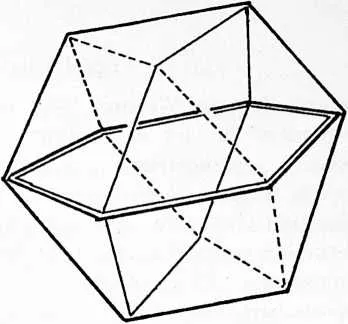 We call space three-dimensional because three measurements will locate a fly anywhere in
the room. But though space needs a three-way coordinate system there is no reason why its
elements need branch at 90 degrees, to-fro, left-right, up-down. The vectors that radiate from the
heart of the vector equilibrium are at 60 degrees to their neighbors, and a 60-degree coordinate
system is perfectly workable. Its grid in space will look like the Octet Truss, and unlike the
squares the surveyors used in Hexland, it will map the structural lines of chemical and biological
events.
We call space three-dimensional because three measurements will locate a fly anywhere in
the room. But though space needs a three-way coordinate system there is no reason why its
elements need branch at 90 degrees, to-fro, left-right, up-down. The vectors that radiate from the
heart of the vector equilibrium are at 60 degrees to their neighbors, and a 60-degree coordinate
system is perfectly workable. Its grid in space will look like the Octet Truss, and unlike the
squares the surveyors used in Hexland, it will map the structural lines of chemical and biological
events.
63 A few years ago Bucky began attributing two awkward numbers, Planck’s constant and the gravitational constant, to the lack of fit between the 60-degree system and the cubical. Since the gram in which mass is measured is defined as the weight of a cubic centimeter of water, a hidden cube enters equations dealing with mass, to infect with the irrational any statement about energies radiating from centers or concentrating toward them.*
64 Each of us carries in his mind a phantom cube, by which to estimate the orthodoxy of whatever we encounter in the
65 • A vector equilibrium’s volume is 20/3 or 6.6 times that of a cube. Delicate empirical measurements for both the gravitational constant and Planck’s constant give something pretty close to 6.6 preceded by appropriate strings of zeroes. I don’t know if any physicist has commented on this, nor what we are supposed to make of the fact that Bucky gets his neat ratio, 20 / 3, by measuring the cube’s diagonal instead of its edge.
66 world of space. We note ‘‘squareness’’ or lack of it, ‘‘uprightness’’ or lack, of it. This is a moral terminology as well as a geometrical: a coordinate system for assessing satisfactoriness. And because a brick stack topples if it does not rise at 90 degrees to the plane, a system of construction is implied as well, wholly compressive, disregarding tension. So deeply does geometry pervade our minds, sponsoring whole families of conditioned-reflex judgments.
67 But Nature, Bucky is telling us, works not by piled bricks but by systems of radiation from centers, for which the appropriate coordinate system uses vectors radiating at 60 degrees. What we should carry in our heads to understand reality with is not a phantom cube but a phantom vector equilibrium, and the sooner this figure gets installed in kindergarten curricula, the better. Speech radiates from centers; Finnegans Wake radiates from nuclear phrases; light expands spherically; an oak tree is a system (below ground as well as above) which has radiated from an acorn and stopped one kind of energetic transaction-growth in space---only to specialize in another kind, photosynthesis, self-renewal. There are no ‘‘things,’’ no ‘‘building blocks,’’ none of those phenomena the cube connotes.
68 If we make the vector equilibrium by packing spheres, the spheres are the component ‘‘events,’’ and ‘‘area’’ means the count of surface events, ‘‘volume’’ the total count clear through. We impose no squared grid nor cubed lattice, and Bucky will happily tell us we are looking at a model of how Nature actually works.
69 In nature, for instance, a microscopic sphere will somehow become a frog or a cat or a man. The microscopic sphere is the fertilized egg. We were all spheres once--- close-packed concentrations of exquisite energy events--- and during nine months some transformational system that always dealt in whole numbers turned a long-ago close- packed sphere into you.
70 The instructions that came with the egg were coded into DMA helices. (Bucky has a model for these, made of chained tetrahedra, and had it before the DNA double helix was discovered.) The patterned integrity did its orderly business with local air, local water, local nutrients, and structured them into its patterned transformations, which began with a ceil splitting into two, then four, then eight.
71 To be less personal, we may talk about a frog.
72 If you could see a just-fertilized frog’s ovum you might be excused for calling it a ‘‘point.’’ A ‘‘point,’’ for Bucky, is not ‘‘position-without-magnitude,’’ but an agglomeration of events we have not resolved. From a transcontinental jet, eleven men in a football huddle look like a ‘‘point.’’ From my window, the rose a quarter-mile away is a pink point. From your back garden, a star looks like a point. They are all systems of energy, and the star is a huge one.
73 The ovum divides, divides, new cells clinging in a spherical conformation. There are two cells, then four, then eight. Later the spherical form is growing outward in layers. Cells are packed upon cells, and we can see the ones in the outer layer nudging one another into hexagons. ‘‘Perfect fit’’ is one principle of nature’s design, and the hexagon is now the economical shape.*
74 It happens that a sphere inscribed with hexagons is mathematically impossible. A few other shapes must be mixed in. Pentagons---since we’re idealizing---will be the most economical, and if they appear there will be, by inexorable law, exactly twelve of them.
75 We now have (1) a spherical system of closely packed
76 • Electron-scanning photomicrographs of the eye’s cornea show a hex pattern like the surface of a geodesic dome.
77 cells; (2) the surface hex pattern; (3) an even dozen pentagons. The dozen may remind us of the twelve balls that would pack around one ball. Sure enough, this system is projected from the vector equilibrium, that module of radiating growth. It is also a very young frog.
78 Having followed its progress as far as the blastula, we may leave the frog to develop by itself while we ask what the model has to do with it. The model, first of all, is highly idealized. The frog is going to be hollow, and hollowness has already invaded the upper part of the blastula, which isn’t as closely packed as it looks from outside. And there’s no guarantee, let alone probability, that the layers of cells have been added in an orderly fashion, permitting an off- the-cuff mathematical statement of how many cells there must be. What the frog and the model have in common are a general configuration, and the theme of growth.
79 Or think of a flame emitting photons, another energetic transaction. We may imagine little radiant globules packed round it, filling space with a fast-growing sphere of radiance. That sphere expands outward at the speed of light. In four and a half years its wave front will sweep past a planet of Alpha Centauri, where they may suddenly note that we have lit a candle. At any moment we can talk about the number of photons on the radiant surface, or the vastly greater number that fill space between the surface and the flame: a sphere, an area, a volume, and no pi.
80 The Pythagoreans, it would seem, were right all along. All things are number. All arithmetic derives from counting. The principles of the Universe answer to a triangular way of enumerating. And when we collide with an irrational number, we have asked a question that does not pertain to the interaction of energies.
81 Pythagorean faith in number is a mystical tradition. Bucky inherited it because everyone does in the Western world: every watchmaker, every bookkeeper, and everyone who believes that Kepler and Newton accomplished something important. So pervasive, so unexamined is that faith that we seldom think to be surprised by the extreme simplicity and neatness of physical laws, though we have no a priori reason to expect anything as tidy as gravitation proportional to the second power of the mean distance, or the second power of planetary years proportional to the third power of their mean distances from the sun.
82 And Bucky inherited a second mystical tradition too, not numerical, this one, but rhetorical and visionary, and apparently to be traced to Eastern sources. This was the transcendentalism of his great-aunt Margaret’s friend Ralph Waldo Emerson.
83 If Pythagorean numbers bound together the orderliness of crystals, planetary orbits, vibrating strings, and figures scratched on sand, transcendental insight bound together absolutely everything, though with no promise that all truth was penetrable.
84 Penetrable or not, it was there. ‘‘Things admit of being used as symbols,’’ wrote Emerson, ‘‘because Nature is a symbol, in the whole and in every part.’’ (So bubbles may be a vehicle of revelation.)
85 ‘‘Throw a stone into the stream, and the circles that propagate themselves are the beautiful type of all influence.’’ (Bucky was one day to devote twenty-five dense pages to what those propagated circles may portend; they explain vision, substantiality, surfers, porpoises, knots, galaxies, the ninety-two elements and man’s role in the universe.)
86 Not just a few poets, Emerson went on, but man himself is always an analogist, and studies relations in all objects. ‘‘He is placed in the center of beings, and a ray of relation passes from every other being to him. And neither can man be understood without these objects, nor these objects without man.’’ (Here is authority for Bucky’s repeated insistence that man has a function in the universe, indeed completes the universe, which consists of ‘‘all that is not me, and me.’’)
87 Hence only the Whole Systems view is worthy of man, who has better things to do with the language he has derived from the whole cosmos than expedite pot-and-kettle affairs with it, quite as if it was he who did mountains and waves the favor of using them for his figures of speech.
8889Have mountains, and waves, and skies, no significance but what we consciously give them when we employ them as emblems of our thoughts? The world is emblematic. Parts of speech are metaphors, because the whole of nature is a metaphor of the human mind. The laws of moral nature answer to those of matter as face to face in a glass. . . . The axioms of physics translate the laws of ethics. . . .
90 All natural things image all others, and image invisible laws, and ethical laws. Bucky Fuller’s whole generation of genteel New Englanders shared the heritage of such sentiments, but few had his incentive to ponder whether statements Emerson made about the physical world might be physical truths as well as ethical metaphors. ‘‘Everything good in man leans on what is higher’’: New England repeated that maxim, but tended not to notice Emerson’s example of it: that when the force of gravity brings down a carpenter’s axhead, ‘‘the planet itself splits his stick.’’ Morality and technology always rhyme. Alone among Emerson’s inheritors, Bucky Fuller has kept this principle steadfastly in sight. Both morality and technology derive from the largest patterns of the Universe.
91 Man’s wisdom, Emerson said, is to hitch his wagon to a star. It would astonish ten thousand commencement speakers to learn what prompted that famous sentence:
92 the spectacle of harnessed tidal power, which ‘‘engages the assistance of the moon, like a hired hand, to grind, and wind, and pump, and saw, and split stone, and roll iron.’’ (And since coal is solar energy, for that matter, railway wagons are hitched to a star.)
93 It is hard to find a sentence in Emerson that Bucky Fuller would reject:
94 ‘‘The most advanced nations are always those who navigate the most. The power which the sea requires in the sailor makes a man of him very fast, and the change of shores and population clears his head of much nonsense of his wigwam.’’
95 ‘‘The ship is an abridgement and compend of a nation’s arts.’’
96 ‘‘As our handiworks borrow the elements, so all our social and political action leans on principles.’’
97 Emerson’s mind was open to science and technology as his friend Thoreau’s mind was not. On an Atlantic crossing he stood marveling at how the engine that drove the ship was also made to desalinate 200 gallons of water every hour, ‘‘thereby supplying all the ship’s want.’’ The economy of good design thrilled him. Fresh water as a byproduct of the ship’s powering, like ‘‘the man that maintains himself, the chimney taught to bum its own smoke, the farm made to produce all that is consumed on it,’’ exemplified in their tidy economical recyclings a highly moral conformity with principle.
98 He drew on the science of his day to support a Whole- Systems vision in which all phenomena repeat one another at different rates and with different degrees of subtlety:
99100The law of harmonic sound reappears in the harmonic colors. The granite is differenced in its laws only by the more or less of heat from the river that wears it away. The river, as it flows, resembles the air that flows over
101it; the air resembles the light which traversed it with more subtile currents; the light resembles the heat which rides with it through Space. Each creature is only a modification of the other; the likeness in them is more than the difference, and their radical law is one and the same. A rule of one art, or a law of one organization, holds true throughout nature.
102 He seems to be inviting us to find that law. Combine his vision with the Pythagorean vision it so intimately resembles, and we have Bucky’s mandate for his lifelong quest after what he calls the Coordinate System of Nature: that economical geometry sustaining all structures, the icosahedronal viruses, the tetrahedral carbon molecules. And when he slips from number and structure into a mysticism that annoys scientists, or from man’s affairs into geometric talk that bewilders literary folk, he makes a transition not only natural to him but faithful to a kinship between the traditions of Emerson and Pythagoras. Emerson himself moves toward Pythagoras at the end of the long paragraph we were just quoting:
103104Every universal truth which we express in words, implies or supposes every other truth. Omne verum vero consonat. It is like a great circle on a sphere, comprising all possible circles; which, however, may be drawn and comprise it in like manner. Every such truth is an absolute Ens seen from one side. But it has inumerable sides.
105 A sphere, inscribed with great circles, yet many-sided: Emerson might have been glimpsing the Geodesic Sphere from which the famous Fuller domes are sliced.
106 The Pythagorean vision could live with pi, albeit grumpily. The Emersonian vision, serene in its conviction of vast interreflective order, would have responded to such
107 BUBBLES AND DESTINY | 151 an anomaly like a buzz saw to a nail, and it was well for Emerson’s psyche that he did not trouble himself deeply with number. To eradicate pi from nature was a true transcendentalist deed. It is not surprising that Bucky’s next Mythic Experience had to do with his obligations to the Oversoul, and crystallized a nearly prophetic mission.
108 This experience is dated 1927. Once more we have Bucky gazing at deep water, but this time he is deciding whether to throw himself in. The ten years since the Vision of the Bubbles have been crammed with experiences, of which the economic balance is alarmingly less than zero, and he is wondering whether a world from which he has subtracted himself and his capacity for getting into trouble would not be a more hospitable world for his wife and his infant daughter. Dr. Johnson remarked that knowing one is about to be hanged ‘‘concentrates the mind wonderfully.’’ ‘‘So standing by the lake,’’ as he puts it, ‘‘on a jump- or-think basis,’’ Bucky Fuller elected to think.
109 I have, he remembers thinking, if no fiscal wealth, yet a wealth of experience, uniquely mine.
110 The double expulsion from Harvard had initiated a many years’ pattern of diverse employment. A man with no degree takes what jobs he can get, and his first job, the one in the textile mill, became a point of reference for many industrial insights. He learned how cotton-mill machinery is constructed and installed, and seems to have glimpsed, for later understanding, a large-scale pattern wherein the factory---run by shafts and pulleys from a single powerhouse---was adding ‘‘a rich synergetic admixture of technology and energy’’ to the intake of raw cotton. The energy (obtained from steam in boilers) was ultimately solar---the mill hitched to a star---and as for the knowledge,
111 152 | BUCKY gathered over many decades, less of it was discoverable in the workers than in the cunning design of their machines. (And replacing broken parts, he learned how to recapitulate the machine-designers’ strategies.)
112 It’s a typical Fulleresque gamut, from the cotton mill’s Whole System to the logic of single metal parts. There’s a twentieth-century aesthetic implicit here too, reminding us that the scope of aesthetic matters was even then growing increasingly operational, less contemplative. Fuller’s elder contemporary Ezra Pound has recalled young lads of his generation poring over machine catalogues, excited by configurations of parts and wholes they had no prospect of owning, perhaps no ambition to own. (Two generations later, the Whole Earth Catalog with its chain saws and beekeepers’ manuals was to prove a surprise best seller.) Elsewhere, fragments of destroyed Greek poems were becoming no longer the poor remains of loss but excitements for minds that were learning to discern, all round the torn edges, traces of the energies that had animated and structured the onetime whole. Pound happens to have been working on Sapphic fragments in London just about when Bucky was learning to cope with parts that arrived broken from the factory.
113 Any object in space is a memory system. Gazing at a piece of metal like an archaeologist, Bucky ‘‘had to rediscover the economic considerations and production strategies’’ that had helped shape it. Then he had to find ways of realizing British or French conceptionings with the resources of Sherbrooke, Quebec. (‘‘I came to know shop foremen, molders, machinists, . . . the beginnings of metallurgical procedures.’’) Performing a function anew by substitute processes, with local means: it was more like translating a poem than he need have realized. Pound at that time was elevating translation into an archetypal po-
114 etic act. And Pound soon after, in a book about sculpture, was quoting Whistler’s ‘‘Nature contains the elements,’’ and affirming that the artist ‘‘is not forbidden any element, any key because it is geological rather than vegetable, or because it belongs to the realm of magnetic currents or to the binding properties of steel girders and not to the flopping of grass or the contours of the parochial churchyard.’’
115 Pointing as they do to Brancusi’s aesthetic and George Antheil’s, these words are worth our pondering. They suggest a way of de-jargonizing Bucky’s talk about a Whole- System view. It is the aesthetic view. Or so it is once we understand the artist to be a man with simultaneous intuition of both a Whole System’s energies and its crafted parts. At a similar point in time James Joyce was trying to make such a thing clear with the aid of a scholastic jargon he seems to have lifted from Bosanquet’s History of Aesthetics, the purpose of this terminology being to keep us from thinking we understand before we do. In the first place, Joyce instructs us, the whole system (integritas') is grasped; then the fitting of the constituents (consonantia'y, the reward is called claritas. This meant that the old preoccupation of poets and critics with Unity required modifying. Instead of resting in connoisseurship of Unity (and testily checking the contour for violations), the mind works from it inwardly to details, multivalent details, and then fortified by its encounter with details returns outward for a refreshed encounter with the whole. It can do this whenever a whole system is identifiable, as well in a cotton mill as in reading Ulysses.
116 Then another distasteful experience at Harvard; then Armour and Company, where eventually he had worked at twenty-eight branches and risen to be Assistant Export Manager. At Armour and Company, where there was less machinery to study, there was still much system, all of it in motion. Meat had to be moved, from barnyards to dinner tables. And it was perishable, so the systems could afford no hitches. Turnover was a key concept: the time dimension, which by 1928 was obsessing his architectural thinking, ousting a millennial architecture of achieved stabilities, like the Great Pyramid. This stability is illusory, since the purchaser is in for a lifelong battle against dilapidation, blandly called ‘‘maintenance.’’ Even the Pyramids have decayed considerably.
117 And one reason the computations of Malthus were lagging behind actuality was that less and less food got spoiled uneaten. Design science underlay this, designing refrigerators, designing systems for moving the beef. Bucky learned, he says, ‘‘of the economics of abattoirs, refrigeration, byproduct chemistry, and high-speed cross-nation perishable tonnage movements impinging endlessly on sidewalk market trading’’; also ‘‘of distribution shrinkage, of comprehensive premechanical accounting and auditing methods, and, most importantly, of broad-scale, high-speed, behind- the-scenes human relations in the give and take provisioning of men’s essential goods.’’
118 One way of summarizing this is to say that he did not need to guess about details when he began thinking, long afterward, about ways of feeding the world.
119 His time at Armour was interrupted, from 1917 to 1919, by the Navy, where he learned perhaps more than from any other span of experience. Ships more intricate, more sophisticated, than anything dreamed of in Penobscot Bay were concentration points for the most advanced technology of their time. They used anything that might prolong their independence of land: oil heating, air conditioning, mechanical refrigeration, systems no one yet had in a house. Even electric light bulbs were hist used at sea. Such a ship was a life support system, a whole community sustained by mechanization.
120 And naval captains had to be ‘‘comprehensivists,’’ since they were solely responsible for a self-contained world no higher authority could get in touch with, once they had slipped over the horizon with perhaps the nation’s destiny in their keeping. Ever since Lincoln’s time, land-bound militarism had been linked by telegraph with the Commander-in-chief, and had grown technologically indolent. Armies scavenge. A corps commander can seize a farmhouse if he needs billets, or some horses if his guns are mired down, and if he must get instructions he can send a runner. But there is nothing to scavenge at sea, a navy must take its habitable environment with it, and its equivalent of a runner would be a futile man bobbing in a rowboat. So the thrust to develop laboratory curiosities into working inventions was apt to come from sea warriors, and it was not surprising to find Marconi’s wireless being made reliable under naval auspices. (Ironically it was wireless, by linking the captain with the shore, that destroyed the need for him to be a comprehensivist. ‘‘I was fortunate,’’ Bucky says, ‘‘in belonging to the last generation that received comprehensivist training at Annapolis.’’ Being a ninety- day course, this was more a metaphor than an education, but many thoughts were later spun from its node.)
121 Since the Navy, his experience had been largely managerial. He had been, in just three successive years, assistant export manager at Armour & Company, national sales manager of the Kelley-Springfield Truck Company, and president of the Stockade Building System. Milton, Massachusetts, might have noted with approval that the wild Fuller boy was after all making his way: a Company President at twenty-seven, and even taking out patents. That was the Alger way, to apply oneself. Had the truth been known, he was spending money as compulsively as his exact contemporary Scott Fitzgerald, who confided to a million readers in 1924 how easy it was to go broke on ^36,000 a year. He was also learning the rationale, such as it was, of the building industry, whose procedures, he decided, belonged in the Middle Ages.
122 The Stockade Building System turned on an invention of Anne Fuller’s father, the architect and painter James Monroe Hewlett. It was one of those inventions on which, with luck, fortunes are built: a simple component, easily mass-produced, for which there ought to be unlimited demand. (Hooks to hang gutters from roofs---spike and a half-circle, patented---had made one early twentieth-century fortune, and the patent on the valve atop an aerosol can today maintains its inventor in Switzerland.) That is one aspect of the American Dream, that with something very simple you can hope to coin money.
123 Mr. Hewlett’s patent invention (1923) was a substitute for the common brick: a ‘‘Stockade Block’’ cement-bonded from excelsior or straw and pierced with two vertical holes. The blocks were so light they were not hod-carried: a workman could throw them up to a second-floor scaffolding, and if they fell the tough fibers did not break apart. (One building firm in one city typically broke a million common bricks a year.) They constituted the key to a building system which Bucky and his father-in-law co-patented. You stacked them, omitting mortar but lining up the vertical holes. Then cement poured down the holes gave your wall a concrete frame, and a plaster on both surfaces yielded two walls, the inner and the outer, bonded to a fibrous insulating substance, eight inches thick, which would neither burn nor pass moisture. Bucky devised the machines
124 BUBBLES AND DESTINY | 157 and the processes to mass-produce the bricks, and gradually through a network of five companies got the system into operation in a total of 240 structures, a disappointing sliver of the potential market.
125 Requiring no hod carriers and no mortar, such a system interfered with the bricklayers’ lucrative choreography. And what union should do what? That had to be negotiated every time. And were the newfangled structures even legal? They were declared not legal in Glencoe, Illinois, ‘‘where not even an engineer was on the excluding committee.’’ When they were approved, as well as when they were not, time was wasted explaining things to the building commission. Every house meant starting this dismaying routine all over again.
126 And the brick industry felt threatened. At one ‘‘Own Your Home’’ Exhibition the president of the Common Brick Manufacturers’ Association showed up drunk and commenced to smash the Stockade exhibit.
127 This was a prime discovery for Bucky, that the building industry is wholly irrational. Men who know how to do what they have always done, locked into craft unions that perpetuate their specializations, stumble through sequences immune to violation. Typically, everything possible is done on the site, as though Ford’s crews were to build your car in your garage. Men with saws measure and cut, one by one, hour after hour, dozens of identical framing studs which it would be more rational to square off in a jig at some factory. But that would be mass production, and builders pride themselves on not duplicating designs. Uniformly dimensioned lumber they will tolerate, notably the ‘‘two-by-four’’ which really means one and a half by three and a half, and machine-made nails, but little standardization beyond that. Each house ‘‘is a pilot model for a design which never has any runs.’’ That is how roofs are
128 gotten over people’s heads; no wonder the mortgages burden them half their lives.
129 Such realities interfered with the working of one of Bucky’s intuitive faiths, that if you found out how to do something better, and worked out the details, it would receive a spontaneous and simple acceptance. (Emerson had said something similar of mousetraps.) No, cheaper- and-simpler did not at all prevail; too much standard operating procedure was threatened. Nor were the shareholders of the Stockade Building System aflame with Fuller- esque zeal. They simply wanted their dividends. In 1927, a crisis forced Mr. Hewlett to sell his stock, and the Celotex Company, on purchasing the controlling interest, instantly pronounced Mr. Fuller’s services no longer essential.
130 If it was managerial skills they valued they were probably right. Not only did Bucky let larger vision distract him from pursuit of this week’s dollars, he had also been coping throughout his entire Stockade period with a depression triggered by the death of his only child. Alexandra had successively contracted influenza, spinal meningitis, and polio in her second year, had come to require round-the- clock nursing, and had died toward the end of 1922, just before her fourth birthday.
131 Such a death, Bucky came to believe, was ‘‘design-preventable,’’ but instead of attending to comprehensive design the whole world was pursuing short-term goals, with ensuing collisions and gear-strippings such as the wars that fostered the influenza epidemics, not to mention the houses that sheltered microbes more efficiently than they did people. There were still outhouses in Brooklyn, and Bucky had seen New York secretaries give their parties in the office buildings because of the gleaming marvel of indoor plumbing. There was a complex liaison, he was slowly to
132 BUBBLES AND DESTINY | 159 decide, between the scandalous irrationalities of the housing game and the Whole-System irrationality of which war was the culminating expression, and today’s lecture audiences frequently hear of Alexandra’s death as a catalytic experience. The most visible things it catalyzed at the time were sustained depression and heavy drinking. ‘‘The minute I was through work for the day I would go off and drink all night long, and then I’d go to work again. I had enough health, somehow, to carry on.’’
133 In 1927, he was stranded with Anne in Chicago, jobless and with the stigma of having been ousted from a top position. From there, the normal curve points further down. He surveyed himself: a gestalt of ‘‘manifold ineptitudes.’’ ‘‘I had not been vicious; yet even to myself, I appeared, in retrospect, a black, horrendous mess. I had wanted to give, not take, but I seemed to have converted the opportunities to give into negative waste.’’ Against the rot of a tenement district they were sheltering, on no funds, the health and mind of a newborn second daughter. It seemed to Bucky that Anne and little Allegra would be better back east with relatives, and he himself better canceled out by Lake Michigan. He was thirty-two years old.
134 According to legend, the crisis took place at the very lakeside, where in a dialogue with himself he turned his life round. This makes an acceptable symbol, though as with the story of the bubbles we can never be sure how many subsequent clarifications he has read back into it. The principal insight appears to have been that he possessed a remarkably diverse inventory of experience and no reliable knowledge whatever. If he destroyed himself the experience would all perish too, and be lost to others whom it might benefit. He had no right to take it from them. ‘‘You do not have the right to eliminate yourself,
135 you do not belong to you. You belong to the universe. The significance of you will forever remain obscure to you’’--- this sententious phrasing is of a much later date---‘ ‘but you may assume that you are fulfilling your significance if you apply yourself to converting all your experience to highest advantage of others. You and all men are here for the sake of other men.’’
136 He has phrased it another way: ‘ ‘Whether you care to be or not, you are the custodian of a vital resource.’’ This resource, his inventory of experience, might help him provide bridges for mankind, ‘ ‘to span the canyons of pain into which you have gropingly fallen.’’ Sometimes his bigpicture rhetoric can be tacky.
137 Contingent resolves, according to later legend, included giving up speech until he was sure he knew what he said when he spoke, and giving up all thought of making a living, in the faith ‘‘that one of the rules of Nature is that she permits us each day the integrity of that day’s thinking.’’ They survived somehow. Some day a biographer will ferret out the details.
138 Since he had no schedules, he commenced sleeping whenever he needed to, like a dog. This worked out to a half- hour every six, and gave him twenty-two thinking hours a day. ‘‘I was trying to find out how much I could get done, and noticed that a dog when he gets tired simply lies down and sleeps. So it could be that if the minute you’re tired you just lie down, you’d need far less sleep. So I just tried it out.’’ (He still goes to sleep in about thirty seconds, and feels a little defensive that in his seventies he needs to absent himself from the waking world for five or six hours, even eight, a night.)
139 The next project, as he tells it, was to put his thoughts in order, which was difficult because while he had always been a fluent talker he had never had any confidence in his mind. Here the narrative is drifting past great archetypes. Thus another connoisseur of geometry, Rene Descartes, had sat a whole day in a room with a stove and resolved to think all knowledge out afresh, commencing from the mere certainty that he was thinking. This had entailed the provisional rejection of everything he had picked up in his formal studies. It had also entailed the certainty that God must exist because he was a necessary thought, and the ambition of ordering a structure of certain knowledge not for the delectation of philosophers, but for practical use, to improve the human estate.
140 We can make many parallels, if we like, between Fuller-esque and Cartesian aphorisms; we can note that both of them evolved geometries based on dissatisfaction with a geometry in which nothing moved; we can account for the similarities as we choose; but we shouldn’t fail to register a fundamental difference. Descartes encountered a great theoretical difficulty in switching from the track of deduction to the world in which men breathe and bodies move, whereas Bucky’s starting point was what he had experienced, breathing and moving: not ‘‘I think, therefore I am,’’ but ‘‘I experience, whatever I am.’’
141 Making what he calls ‘ ‘a blind date with principle,’’ he compounded his ten-year-old resolve to discover Nature’s system of patterned principles. What he could discover he would ease across the design gap into practical application, for everybody’s benefit. It is wholly unsurprising that he turned his attention at once to housing.
142 And it was the year of Lindbergh’s Paris flight, of Heisenberg’s indeterminacy principle, of the Holland Tunnel under the Hudson River, of Henry Ford shutting down the Model T production line, so that during months of retooling for a wholly new model there were, for the first time many people could remember, no new Ford cars at all. It was therefore natural for Bucky’s thoughts to be guided by analogies with aircraft, with massive industry, and with the automobile production line. These were clearly the day’s themes.