
7 Stillbirth of an Industry
2What Fuller had conceived in 1928, with his eye on Ford, was an industry. He had seen, moreover, that it would alter the world, far more than the automobile had. Unlike Ford, whose mind was on producing a product, he set out to imagine the world his housing industry would create, and worked inward from that to the function of the house. When he came to the house itself he reversed this process; ‘‘designing from the inside out,’’ he envisaged the maximum enhancement of human lives, tailored the innards to suit and hung around them a logical envelope. So one process ran in from macrocosmic man, newly placed in relation to his world, and another ran out from micro-cosmic men, newly placed in a new kind of intimate environment, and the two met in the house itself. It is misleading to isolate the house, though in the absence of either industry or inhabitants a tabletop model of the house was all there ever was to attend to.
3 The reason this industry would alter the world was that it implied total mobility. People would cease to be anchored to the houses they were scrimping to buy, the houses would cease to be anchored to the utilities grid, and everyone would cease to be anchored by tons of debt. He con-
4 STILLBIRTH OF AN INDUSTRY | 201 ceived a world full of houses like telephones: simple, functional, ubiquitous, mass-produced, components in a system and rented.
5 To indicate what such a world might be like, he had suggested houses deliverable by zeppelin. A tower-shaped structure 170 feet high could be slung beneath a 700-foot dirigible, and planted like a tree in the crater made by a bomb the zeppelin could drop. While cement was setting around the base to hold it, the crew could be drilling a well. Then the ten-story structure, with its own power generator and provision for recycling its inhabitants’ wastes, would be independent of the network of ‘‘utilities’’ which today dictate where it is feasible to build. Men could populate the terrene outlaw sector, far from the vetoes of idiots like the police chief who once forebade the Stockade Building System in his community. He was the building inspector ‘‘because his father built the first privy in town.’’ He scratched, smelled, even bit a Stockade Block, recalled a sad experience his father once had with concrete and turned the system down.
6 That tower was not only to be planted like a tree, it was shaped like a tree, ten decks suspended from the trunklike central shaft. A year or so later the tower had been scaled down, for the time being, to the ‘‘4-D House,’’ a one-family minimum model less unlikely to go into production. Bucky detailed it inside and out, and showed a beautiful dollhouse version with the parts demountable and a nude in the bedroom (to demonstrate the climate control). A central mast still bore the weight, and the floors were still hung on tension cables. Thus tension and compression were separated out, ‘‘compression diminishing directly as we recede from the vertical until the building finally flows downward in pure tension,’’ hanging about the mast like a hoop-skirted dress. Bucky’s rhetoric took
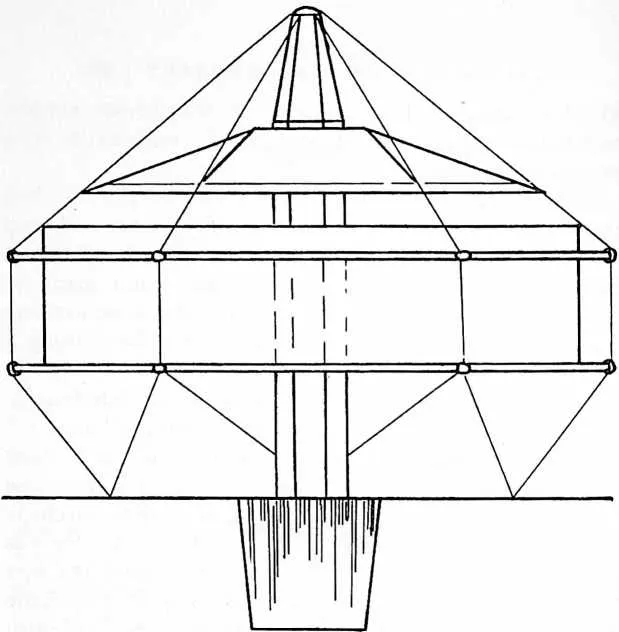
89Dymaxion House
10 a characteristic flight: ‘‘Then may the exterior enveloping shell, completely freed of spiny skeleton, present a lithesome fullness and harmonic grace, not dissimilar to the sheer and lovely, though sufficiently austere lacy veils flowing from the hennins of the fifteenth-century French court ladies, so marvelously portrayed in Maurice Boutet de Monvel’s Joan of Arc at the court of Chinon.’’
11 More pertinently, a house that was going to hang would be symmetrical all around the mast. Circular? No, suspension points for the cables suggested corners, in fact six of them, making the floor plan hexagonal, the rooms wedge-shaped. Since the floor deck and the ceiling deck
12 STILLBIRTH OF AN INDUSTRY | 20g were both suspended, the walls that joined their edges bore no weight whatever and could be wholly glassed. Atop the upper deck was sunbathing space, with a rain canopy above that. Below the bottom deck was car space or plane space. The house between the decks was to feature every manner of appliance, all machinery housed in the central mast: exactly, and in ways Le Corbusier never envisaged, ‘‘a machine for living.’’
13 As Reyner Banham tells us in The Architecture of the Well-Tempered Environment, Le Corbusier and the Bauhaus designers learned nothing from technology except a visual style. The simplest physical transactions were beyond them. Their lights glared, their corridors echoed. Bucky on the contrary started from real machines, to ‘‘valve the environment into preferred patterns.’’
14 Though most of the machines he talked about were still to be invented, Fuller understood quite clearly what he meant them to do. Decades before the key concepts were widely accessible, he was thinking of single-family homes as ecosystems, trapping sunlight, recycling wastes, taking a minimum toll of unreclaimable resources. What goes on in an ordinary house is consumption; its input is resources, its output trash. Bucky wanted to build not a trash factory but a valve, to deflect the circulating energies of the universe into serviceable patterns, taking thought for their next retransforming (on the premises if feasible). One could shower with a "fog gun,’’ using just ounces of water; and that water could be reclaimed.
15 Nobody understood what he was talking about. Forty years later a substantial part of the world’s engineering talent was working along such lines, though not to increase man’s freedom on earth but to help him penetrate space. Fundamentally the space program is a shelter program. Take a man off Spaceship Earth, move him to Space-
16 ship Moon, and both in transit and after he’s on the moon he needs, if he’s going to stay alive, a shelter more scrupulously thought out than any shelter has been in human history. The simplest spacecraft of the first Mercury program was not just a capsule but a Whole-System environment control, modeling at absolutely minimum weight as much as was needed of the ecosystem we all depend on at home. The longer people stay in spacecraft, the more elaborate the recyclings and the more of the ecosystem they must reproduce. We now envisage Skylabs for months- long habitation, and Bucky expects that some day everything we call ‘‘utilities,’’ all that ties our homes to a network of buried wires and pipes and a graft-ridden trash-collecting system, and subjects us to the controlled scarcities that enrich subdividers, will be packaged into a 500-pound ‘‘black box’’ for which the space program will have done the research and development work. With a lightweight dome for envelope and a lightweight black box for resources, anybody would be able to live at whim anywhere.
17 The house was to do the laundry and the dishes. It was to warm and circulate its air, bearing smoke and odors away. At ideal temperatures, the pneumatic beds would need no ‘‘bedbug incubators’’ (covers). One would walk across a soundless pneumatic floor, supported on a ten- sional net. In the bathroom one might use the ‘‘vacuum tooth brush,’’ also the chinning bar. The shelter would be erectable in one day, proof against ‘‘earthquake, flood, fire, gas attack, dirt, pestilence and cyclone,’’ and complete with ‘‘sewage-disposal tanks, fuel oil tanks, diesel engine, electric generator, storage batteries, motors, artesian well, water pump, water softener, water heater ...’’ A hand intercepting a light-beam would open doors.
18 The idea was not silly luxury, but the canceling of silly
19 STILLBIRTH OF AN INDUSTRY | 205 toil. Bucky tabulated years later the rituals of a cleanliness that is next to godliness: dish-cleaning, clothes-cleaning, house-cleaning, food-cleaning, self-cleaning: ‘‘an eight-hour day devoted to yesterday’s dirt,’’ with ‘‘not one constructive act’’ accomplished. Thus it took a seventh day, ‘‘hallowed for resting, and considerable preaching, praying and psalm-singing, to keep a mother housekeeper in good humor.’’
20 These ideas were all developed during little Allegra’s first months of life in that Chicago apartment. He was watching a child explore the universe, and his wife spending ‘‘ten hours a day keeping the baby from killing herself.’’ Out a window, down an elevator shaft, into the street where cars maimed a million a year---the baby saw no reason not to head in any of these directions. Eliminate openable windows then; eliminate elevators; move the house away from traffic (abolish the jammed city).
21 The directness seems nearly insane. What is really unsettling about the Dymaxion House is that it doesn’t perform the most important office of a house in most people's lives: it doesn’t tell you what to do with yourself, doesn’t give you so much as a hint. That’s up to you.
22 A man who could use twenty-two hours a day needed no directives from the brickwork. Why should standardized housing generate standardized people? What an insult to people. No, they deserved ‘‘a home wherein the real individualism of man and his family may be developed, as a minimum of time is given to what he has to do, willy- nilly, eat, sleep and be clean.’’ Real individualism means people doing what they want. The logic of architectural practice was to put people into ‘‘individualized’’ houses, whereupon they all found themselves doing just the same thing, i.e., looking after the house.
23 As he wrote, the majority of the houses Americans in-
24 206 | BUCKY habited were ‘‘still without even bathrooms, toilets or sewage disposal.’’ That was in 1927. They were ‘‘pasted, piled and tacked together,’’ out of materials no maker of ocean liners would contemplate: brick, stone, wood, concrete, their structural virtue mindless Egyptian weight.
25 As to those who were affluent enough to consult an architect, he devoted to their plight the most memorable of his early flights of rhetoric, a 347-word sentence still sometimes reprinted:
2627If today a man, let us say a resident of Chicago, wishing to acquire an automobile, were to visit one of 2,000 automobile designers in the city, equivalent to Chicago’s 2,000 architects, and were to commence his retention of the designer by the limitation that he wanted the automobile to resemble in its outward appearance the Venetian gondola, a ginrickshaw of the Tang Dynasty, a French fiacre, or coronation coach of Great Britain, pictures of which he had obligingly brought with him, all final embellishment of course to be left to his wife; and they were together to pick and choose from the automobile accessory catalogues, advertisements, and auto accessory shows, motors, fly wheels, fenders, frame parts offered in concrete, brass, sugarcane fibre, walnut, etc., and succeeded in designing an automobile somewhat after the style of some other fellow; and they were then to have the design bid upon by five local garages in Evanston, picking one of the bidders for his ability, or price; and the successful bidder were to insist on the use of some other wheels than those specified; and the local bank, in loaning the money to the prospective owner to help him finance, had some practical man to look over the plans and absolutely guess at the cost and base a loan thereon, incidentally insisting on the replacement of several parts and methods in which they were interested; and then the insur-
28ance company were to condemn a number of units used, because they had not been paid for their ‘‘official approval’’ and other units were therefore substituted; and fifty material or accessory-manufacturers’ salesmen were informed by a reporting agency whose business it was to ferret out this poor man’s private plans, that he was going to build and hounded him with promises; and finally the local town council had to approve of the design and individual materials and give permit to build, sending around assertive inspectors while it was being built, it is certain that few of those desiring automobiles would have the temerity to go through with it.
29 He added that the car would cost $50,000 and perform ludicrously. Also, ‘‘It should have been mentioned that in the building of the automobile, not one but many mechanics from different trades would have to be employed, though many times there would be but room for one man to work. The contractor, who would also be building other cars in Lake Forest, Elgin, etc., would stop in for an hour a day to look over the work, outside of which it would receive no organization of method. There would likely be strikes by the plumbers or electricians, who would insist on most of the improvements in design being left out as they had no rule permitting them. To cap all, the car would take from six months to a year to build.’’
30 By such insanities were roofs gotten over heads. And still are.
31 Not a ‘‘house,’’ then, an industry. The house did not even exist, and Bucky would not have known how to go about building one. The mechanisms did not exist---the automated washer-drier, the temperature-controlled ventilation, the dishwasher, for that matter the ‘‘radio-television receiver.’’ Prototypes existed, in hotels, hospitals, ocean liners. What we know today was evident then, that they were all possible. But not off the shelf, not in domestic models, in 1928.
32 He was counting on the rapid research and development at a huge industry’s command. Let someone of Ford’s stature give the word, and battalions of engineers would bring what was possible into the domain of practice. We are as used to this idea now as we are to dishwashers. Men were on the moon nine years after the word was given, though when it was given not one of the requisite items of hardware existed. But in 1928 there was no such example of an intricate set of problems solved on command from scratch, and it’s hard to know which to be more astonished by: Bucky’s grasp of what industrial teams might do, or his belief that anyone else would believe it.
33 No one did, at least no one capable of giving the word. In 1927, Fuller estimated that perhaps a billion dollars would be needed for research, development, tool-up. Five years later much basic work on the all-important metals and alloys had been done; the investment was down 90 percent, to a mere hundred million. Still there were no takers.
34 But in 1945, the Dymaxion Dwelling Machine was almost produced. Two prototypes were actually assembled, with their furnishings and their mechanisms in place. The structure weighed just three tons, the parts would nest for shipping into one truckable cylinder, and no component a workman had to handle weighed more than he could lift with one hand. It would sell, erected, for the price of a Cadillac. The tooling cost was down to ten million dollars. Ten million was not forthcoming. Bucky never devised a complete working house again. His attention for the next twenty years was focused on the envelopes only,
35 developed from the geodesic principles he was discovering. The innards could wait for NASA’s power pack. There is still no housing industry.
36 Still, it is not quite true, as Fuller contends, that American building techniques remain where Egypt and Greece left off. About 1860, an American student of trends might have supposed a housing industry was coming. The need to roof a new continent in a hurry inaugurated a kind of spontaneous industrialization, seldom perceived because it stopped developing.
37 America’s first innovation was to build houses wholly of wood, with clapboard outer walls attached to the frame, and a wooden frame has a certain structural integrity. You can jack a wooden house off its foundations and move it, something a brick box won’t tolerate.
38 Moreover, wood can regenerate: forests grow back. One need not think of a house lasting forever. It would make ample sense if it lasted till nature had replaced its materials.
39 Most important, these houses were soon built in a new way. The craft method, used in New England as it had been used for centuries on European barns, was superseded by an industrial method which depended on railways, power saws, machine-made nails, and the geometry of the frame was altered accordingly.
40 Thoreau’s cabin was built the medieval way. In Walden he describes the procedure. The main timbers, hewed from fresh pine with his borrowed axe, were six inches square and stood eight feet high. Each piece of the massive frame, and likewise each stud and rafter, was carefully mortised and tenoned---skilled work indeed---and as sections were fitted together neighbors helped him raise them. Once the frame stood by itself, he nailed on the clapboards and
41 shingles. He is so proud of his thrifty shopping---$8,031/2 for boards, $3.90 for nails, a thousand old bricks for the chimney at $4.00---that we do not notice the enormous investment of time that went into the framing. So much labor, anyhow, seemed a mode of virtue.
42 But when his cabin went up in 1845, Thoreau’s way of framing was already obsolete. In Chicago, about 1833, George Washington Snow had devised what was soon called, in derision, the balloon frame---‘‘the point,’’ says Sigfried Giedion, ‘‘at which industrialization begins to penetrate housing.’’
43 The balloon frame dispensed with those heavy six-inch timbers and all that careful mortising. It was simply nailed together from 2-by-4’s, like a box, the vertical members sixteen inches apart. It is still the normal American method of framing. It depended on mechanization: sawmill lumber and machine-made nails, cheap enough to be used lavishly. Handmade nails had run 250 a pound, which was high. By 1828, machine nails were down to 80, then 50, and by 1842, 30. (It is not clear why three years later the nails to make Thoreau’s cabin cost $3.90. Did he really use 130 pounds of nails?)
44 The new frames looked so light it was clear they would fall down. Though they didn’t, the ‘‘balloon’’ nickname stuck. Contemporary observers soon pointed with pride. By 1865, a man and a boy could ‘‘attain the same results, with ease, that twenty men could on an old-fashioned frame.’’ The saving in cost was something like 40 percent, the saving in effort enormous. ‘‘If it had not been for the knowledge of the balloon frame,’’ a man named Robinson wrote in 1855, ‘‘Chicago and San Francisco could never have arisen, as they did, from little villages to great cities in a single year.’’
45 Being wooden, they were both destroyed by fire, San
46 STILLBIRTH OF AN INDUSTRY | 211 Francisco six times in a two-year span (1849-51), Chicago definitively in 1871. That was a drawback. Anyhow, they were quickly rebuilt.
47 When there were not even the local skills available to nail such a frame together, the nailing could be centralized. A survey called Great Industries of the United States did not miss this. ‘‘The western prairies are dotted all over with houses which have been shipped there all made, and the various pieces numbered.’’ That was by 1872.
48 By a natural extension, there should soon have been production-line houses, but the evolutionary process terminated. American home-building practice did not stick, as Bucky would have it, in the Middle Ages; it stuck in 1833.
49 A related tradition didn’t get stuck, it got deflected. That was the invasion of mechanical design into every detail of human surroundings. Sitting, especially, received ingenious attention. Toward 1860, and for thirty years thereafter, chairs were devised that moved as the body wished and supported it as it required to be supported. How people sat in trains was investigated, how a woman’s posture at a sewing machine compressed her thighs if the seat did not slope forward. Backs reclined, seats tilted, chairs rocked on springs and moved on casters. There were metamorphoses too, for economizing space. Beds turned into sofas, a lounge turned into a swing, a tricycle was patented that would turn into a hammock. Living rooms, by a few touches, became bedrooms. On trains, beds came out of ceilings and compartment walls. Some of these devices were merely ingenious, some ludicrous. All of them indicated two principles: that imagination was playing over elements no longer taken for granted, and that leisure was being taken seriously enough for design to accommodate its postures.
50 Then in 1893, confronted at the Chicago World’s Fair with sumptuous and tasteless European taste, this inventiveness suddenly felt ashamed of itself. ‘‘Patent furniture,’’ Sigfried Giedion writes, ‘‘was banished from the house, and the countless attempts to create a truly nineteenthcentury comfort went to waste.’’ * It was banished to the office, where the typist sits on a chair someone gave thought to. That authority symbol the swivel chair her boss occupies was also thought out. It was designed in 1853 for the home, where instead we now make do with agglomerated cushions and springs.
51 The tradition that was stirring piecemeal into life might well have culminated in designed surroundings that understood the interplay of the body, the senses, the ambient mechanisms. Instead Bucky Fuller had to write at the top of his voice not about solutions but about the very principle, and got a reputation for being eccentric whenever he ventured a solution. His plug-in ‘‘Dymaxion Bathroom’’ of the 1930’s is one man’s attempt to achieve from scratch what the engineering genius of a society might have accomplished with authority had the principles of the Pullman roomette not been shut from home design by invisible barriers of taste and custom.
52 From the Dymaxion House he projected in Chicago, in 1927, to the Dymaxion Dwelling Machine he designed for production in Wichita, in 1945, Bucky was trying single-handed to do a tradition’s work. It is not surprising that his detailed solutions sometimes seem thin and improvised. The 1927 house was a fantasy: a structural principle, plus a list of the amenities it should contain. The
53 •For more about patent furniture, see his Mechanization Takes Command; for the balloon frame, his Space, Time and Architecture, from which I have gleaned the nineteenth-century quotations.
54 Dymaxion Bathroom was in a way no less a fantasy: evidently designed by a stocky man not much more than five feet high, it had a tub three inches wider than standard tubs but not very long, the total floor area of the tub- shower-washbasin complex being only five feet by five. It carries on that lost nineteenth-century tradition, compacting the facilities and deleting petty annoyances. (The stream of mixed hot and cold water jetted away from the user of the basin, and couldn’t shoot up his cuffs.) The principal annoyances it eliminated were great weight and great cost. The whole thing, shell, fixtures, heating, forced ventilation and all, weighed 420 pounds, assembled from just four stampings each of which two men could carry up narrow stairs. They bolted together, and a plumber could hook up the works in minutes. Twelve were built. It is said that fear of the plumbers’ union underlay Phelps- Dodge’s decision not to order quantity production.
55 The best fantasy of all was the Dymaxion Car, which Bucky insists was not a car at all. ‘‘I knew everybody would call it a car. It was the land-taxiing phase of a wingless, twin-orientable-jet-stilts flying device.’’ The jet-stilts---he’d begun to conceive them in 1917---were inspired by the fact that a duck flies though it hasn’t the wingspread for gliding. It fires sharp little spurts of air earthward from between wing and body. Maneuverable jet engines might do likewise, thrusting; a vehicle both aloft and forward. Since no metals existed to contain the heat of those jets^ he elected, he says, to concentrate on the ‘‘ground-contact maneuvering problems,’’ where planes usually had trouble anyway. (Their pneumatic tires are ‘‘packaged sky-oceans to insulate earth and ship.’’)
56 Thus the Dymaxion Car, in the best American tradition of unlikely combinations, was really part of a jet plane, with a Ford V8 engine substituted for the jets. The whole was part of a still larger fantasy. Bucky was still propelled by his 1927 dream, developing the private air transport people would need to reach Dymaxion houses that had been air-delivered to mountain tops. Everything he did in the 1930’s was a detail of something larger. In a sense, this is true of everything he has done.
57 The car, unlike the house, really got built. It looked like a bulbous wingless plane with two powered wheels up front, and was steered at the rear like a plane or a ship. The single rear wheel had a kingpin like a rudder post (‘‘That was a beautiful casting’ ’) and airplane cables ran forward to the steersman through ball-bearing sheaves.
58 ‘‘She was the most stable car in history. Front-steered cars act like pushed wheelbarrows, always having to skid their turns. With my rear-steering car she’s never skidding.’’
59 How did it behave when it did skid?
60 ‘‘She didn’t skid. You couldn’t skid her. I brought her from London, Canada, to New York during a big ice storm, when you had to be careful not to slide off the road just standing still. But she was so stable I learned to handle her on anything.
61 ‘‘In New York they used to have traffic cops at every corner. One would always stop me and say, ‘What the hell have you got there?’ And while he was talking to me, looking in, I’d put my wheel completely over to the left, and go completely around him, slowly, and he’d suddenly find himself facing the opposite way. I could describe a one- foot circle with the inboard wheel, bring it right around his feet.’’
62 What a fantasy! It was real. There is more.
63 ‘‘I practiced seeing how fast I could do that. Finally I got it to fifteen miles an hour. Any faster would pull the
64 STILLBIRTH OF AN INDUSTRY | 215 tire off the rim. You could hook it around 180 degrees, a turn no motorcycle could make. Like if the cops came after me, I could turn and go in the opposite direction. They could never catch me.’’
65 That happened often.
66 ‘‘It was lots of fun. They just wanted to rubberneck this thing, and take me to the station so they could show it off.
67 ‘‘At the Wings of the Century---the Chicago World’s Fair---they had it as the last episode, after Indians going over trails, then the Pony Express, and so on. Then the Gray Rolls, then my car as the ultimate thing. And I used to go around the track, making my turn at fifteen.’’
68 This wonderful plaything was hand-built in a few months of 1933 on a gift of a few thousand dollars, by a crew of twenty-seven men under the direction of a yacht designer, Starling Burgess, who had some spare time between America’s Cup defenses. Not surprisingly, she had one sailboat characteristic. She slid with so little turbulence through the air that crosswinds affected her as they do a boat; instead of yielding to them, she tried to nose into them. It wasn’t steering play that permitted the swerve, it was the tires yielding. ‘‘So I had to practically fly her along the highway on a northwest gusty day. I wouldn’t allow anyone else to do it.’’
69 Cars, like boats, move through weather. Buildings exist in weather. To hear Bucky talk of wind loads on a structure is to sense his sailor’s respect for atmospheric movements. Like tensegrities, they do the opposite of what landlubbers expect. Everyone ‘‘knows’’ a crosswind pushes a car. Not the Dymaxion; her tail was sucked leeward.
70 Bucky’s buildings fool us likewise. ‘‘Everybody knows that heated air rises. So I put a vent in the top of my dome, and they say, yes, the warm air goes up and out. But it’s just the opposite. You have the sun beating down on the
71 shiny dome, and a ‘thermal’ spirals up in that column of heat. You can see it carry birds up. And the air to supply that thermal rushes up the outside of the dome, and if you put little openings around the base, the stale air inside moves out to join the uprush. So the inside pressure drops. And that sucks a core of cold air down the center of the thermal, and through the hole at the top. Sun-powered air conditioning.’’ He’s demonstrated this on the equator, in Ghana.
72 The seemingly empty space within the dome is full of ‘‘invisible energy operations in your favor.’’
73 ‘‘Think of the structure as sailors think of their masts and spars: a mobile system for mounting local circuses of atmospheric and energetic events.’’
74 The first Dymaxion Car’s energetic circus was terminated by a vacuum drag, human curiosity, which sucked in catastrophe. A man chasing it, which happened all the time, flicked its tail on a ten-lane highway and rolled it over. The Dymaxion driver---a racing driver---was killed. A distinguished passenger, a British aviation hero, was hospitalized for weeks. King George V telephoned about him, and newsrooms buzzed.
75 ‘‘The Associated Press called me, and I flew out from Bridgeport where I was working on the next car. I thought a steering cable must have broken, but I couldn’t find a thing the matter with my car. Nobody knew what had happened. The man who caused it had simply disappeared. And the newspapers said, Freak Car Rolls Over, Driver Killed.’’
76 The man who caused it was a politician, with influence. By the time the British celebrity was fit to testify, thirty days had passed and the headlines had done their work.
77 ‘‘I felt I had a responsibility. I had demonstrated a principle that could be of advantage to man, and I didn’t want
78 STILLBIRTH OF AN INDUSTRY | 217 it to suffer because of the falsehood. So I took all the money I had in the world to build the next two cars.’’
79 Impatient creditors closed in, and Bucky lost his share of Bear Island. (He was years getting it back.) The wrecked Dymaxion Car was restored and later lost in a garage fire. One exists somewhere. The third has been lost track of.
80 Broke again, he went to work for the Phelps-Dodge Copper Company, helping set up an R & D department. The twelve Dymaxion Bathrooms were one by-product. Two others were of more lasting significance. One was the discovery of a kind of quantum theory of discourse, which made Fuller for the first time continuously intelligible to anyone who would pay attention. The other was his inventory of human knowledge, arrayed along a time line, which led to the World Resources Inventory and the World Game of the 1960’s.
81 What he learned about his own thinking was that despite its Whole-System continuity, it was conducted in small natural units, like aphorisms.
82 Something about working with one’s hands conduces to aphorism: some correlation between the manipulable unit, grasped, lifted, and the mind’s intermittent.concentrations. Like tensegrity’s islands of compression in a tensional sea, the quotabilities of a Franklin or a Thoreau are suspended amid connections they do not state, in the silent mental continuum of a man setting type, building a cabin, hoeing beans. Here’s a contributor to The Last Whole Earth Catalog telling you how to build with stone:
83 ‘‘Stone walls and buildings. These are actually weaker than they look. It was the wood frame houses that survived the Alaskan earthquake.’’
84 That’s the stuff of a moral parable---one can guess how
85 Emerson would have used it---or a place to start a discourse on tension vs. compression. But our man’s mind is on conveying information, and he’s soon explaining how ‘‘Strong beautiful wall is laid up rock by rock. No other way. . . . Knowing which rock to choose from your pile. Like a puzzle with no two parts the same. Choosing the wrong rock means that your work comes down on your feet. (So don’t be barefoot! . . .) An old Maine stonemason told me that ‘Even a round rock has a flat side if you can find it.’ ’’
86 You can see this exposition weaving in and out of the zone where aphorisms are generated. You can also see the meditation emerging in discrete packets, time-structured, paced by the remembered movements of hands among stones. (It’s been speculated that since dolphins have no hands, their famous language would distinguish event from event after principles we can barely make an effort to conceive. Is a ‘‘noun,’’ in the first place, something you can pick up?)
87 Bucky thought this way, in increments, but tended to write differently. One man when he was putting lines into a drawing or parts into a car, he was another man entirely when he tried to graph trajectories of enlightenment on writing paper. At Phelps-Dodge midway through the 1930’s, the Director of Research had to inform his Dymax- ion deputy that a technical paper on ‘‘forward research strategies’’ was simply incomprehensible.
88 Bucky’s response was to read it back aloud, ‘‘in spontaneously metered doses,’’ watching for expressions of comprehension. ‘‘The Director pondered each verbal dose, and when hi? face signaled ‘that is clear,’ I would intuitively measure out the next portion.’’ Retyped the way it had come clear it looked like poetry, which meant it couldn’t possibly be submitted to the Board of Directors.
89 But, said Bucky, it is chopped-up prose.
90 No, said two poets, it is poetry. (Who were those poets? Where did the Research Director find them? The story glistens with wonders.)
91 When the report went to the Board it was chopped by dashes, commas, asterisks, everything but line-breaks. As long as they didn’t see lines of irregular length the Directors weren’t nervous: a fascinating conditioned reflex.
92 Thereafter, when there wasn’t a Board to worry about, Bucky frequently let the compositor clarify a sentence like this:
9394However, that motion is only measurable in dimensional limits of energy, time and space which are mostly infra or ultra to the dimensions which the personal faculties of man are accustomed to detecting by direct sensing and by conscious awareness of relative comparisons made by himself to previously established measures of any conscious experience with motion.
95 In ‘‘ventilated prose’’ it reads like this:
9697However
98that motion
99is only measurable in dimensional units of energy, time and space which are mostly infra or ultra to the dimensions
100which the personal faculties of man are accustomed to detecting by direct sensing
101and by conscious awareness of relative comparisons- made by himself to previously established measures of any conscious experience with motion.
102 Not that typography can ventilate just any prose. Bucky had discovered something about the way of his own thought. Though he did not, like Thoreau, polish aphorisms till they resemble souvenirs, yet like the aphorist he thought in discrete energy packets, linear in sequence. The key to clarity was to make their boundaries somehow evident. From this time even the sentences he prints as ordinary prose have a new awareness of internal marking points.
103 He had discovered, in his own roundabout way, a mode of American poetry, the straightforward sentence collected out of energized units, and analyzed into them again by a visual aid. Marianne Moore, for one, understood this principle by 1921, the year of her first volume, Poems. (‘‘What I write,’’ she later said, ‘‘could only be called poetry because there is no other category in which to put it.’’) She had even discovered that the energized units need not be composed by the poet but could be borrowed from auction catalogues, magazine captions, technical leaflets---occasions when sincerity of perception (never mind whose) was engaged with some reality. (Bucky often quotes too, though mainly from himself.)
104 William Carlos Williams, who discovered the principles of his own mature poetic by brooding on her work, called a Marianne Moore poem ‘‘an anthology of transit,’’ brilliantly aware that what the poet contributed was the ten- sional system between the compressive units. No audible words need correspond to that system, and the casual eye saw not an anthology of transit but an anthology of quotations.
105 Bucky’s deliberate statements about poetry are fairly simple. ‘‘Emerson said the great poet put the most in the fewest words. By that test the greatest poem is Einstein’s ‘E = me2’, which says everything in six syllables.’’ He also sees Henry Ford as the creator of America’s epic, an orchestration of worldwide movement and transformation, ores from the ends of the earth converging on River Rouge, then evoluting as cars to putt-putt out again to the ends of the earth. Slowly and invisibly too the cars were transformed: steel after steel received special-purpose alloying, until by the time the Model T was discontinued it drew together 135 different alloys, folding in yet more and more knowledge, drawing with yet more exquisite differentiation on earth’s resources of metal and man’s of conception- ing. Ford’s intentions were not aesthetic, by any stretch of the imagination. It was Bucky’s response, as long as forty years ago, that exhibited the aesthetic imagination (and foresaw ‘‘conceptual art’’).
106 It is normal for him that Beauty should be transsensual, and look after itself. ‘‘Don’t worry,’’ he told some architectural students, ‘‘about making your work beautiful.’’
107 Too many architects, he insists, are willing to sit around drawing pictures.
108 ‘‘You don’t ever have to worry about ‘beautiful’ or ‘pretty,’ because if you really understand your problem, if you solve it correctly, so life really goes on; if you do it so economically it is realizable: then it always comes out beautiful.
109 ‘‘That’s why a rose is beautiful: as one part of the great regenerative process whereby the a priori design of the Universe is working. If you want to be part of that, you can’t miss beauty.’’
110 Had Frank Lloyd Wright not been so exquisite a draftsman, would his imagination have expended itself in so many hundreds of special-case designs? Was the lovely paper in some sense his end product? His structures tended to solve local problems: how to build a house over a waterfall; how a skyscraper might look if it were a mile high. If your own life craved Wright’s enhancing, you came in person to Wright. (‘‘Frank,’’ an architect said, ‘‘saw a client as an opportunity.’’) There was only one Wright, and the world’s people were numbered in billions. His satisfactions were one-to-one. Bucky Fuller’s satisfactions are conceptual: the domes, a general case, and the worldwide process he has envisaged for so long, a general case as well.
111 Similarly, the satisfaction he takes from writing (mostly verse now---the published prose comes from lecture transcripts)---is that of conveying with clarity the most accurately general statement he can manage. Beauty does not concern him. It is not banished, though, by those enjambed polysyllables. The 1956 poem he dedicated to Dr. Jonas Salk not only resembles Roman and Elizabethan attempts to versify advanced knowledge, it is the nearest thing we have to a Metaphysical poem.
112 The other Phelps-Dodge accomplishment was the Inventory of Scientific Events, done with six students he had at his disposal for a summer. They were listing key discoveries, ‘‘pretty well defined by scientists themselves. And the dates are very very sharp.’’ As with his poems, he was following Max Planck’s model, dissociating process into quanta. Every life consists of days, interrupted by sleep. Every day consists of experiences, separable. Every thought rearranges elements, recoverable. (‘‘The sum of finite quantities is finite. Universe is finite.’’) And history has proceeded by increments, each irreversible. Each discovery divides the time line into two parts, a before and an after. One day vanadium had been isolated; thereafter machinists’ hammers were possible. One day carbon steel was in production; thereafter the bicycle wheel was possible. One day the Wrights had flown. One day E = me2 had been written down.
113 ‘‘I made a long chart, a quarter-inch to the year. And
114 STILLBIRTH OF AN INDUSTRY | 22g for each invention I would go up one increment in altitude, so the curve on the chart kept rising, discontinuously. The earliest go back to things like irrigation systems in India; then a 500-year lapse before the next item. As our plot moves through time they get a little more frequent, still more frequent, then fantastically frequent. The curve picks itself up and tends to rise almost vertically.’’
115 Discovery augmenting discovery: synergy.
116 ‘‘I found I could grade them. A mathematical discovery was weightless: pure principle. The chemical elements had some weight. Bessemer steel---an engineering process---was very heavy. So I gave them spectrum colors, the most weightless concepts purple, the heavy mechanics red.
117 ‘‘So you saw patterns of precedence, purple constantly preceding a related red. The mental discoveries, the abstract things, come long before the inventions. The abstract and mental set up an environment in which thinking man invents applications rapidly. It was clear that the metaphysical preceded the physical, and the greener type of physical preceded the redder.’’
118 Later he devised a simpler chart, often reproduced, which confines itself to the ninety-two chemical elements. Man entered historical time with just nine of these at his disposal. Each had been ‘‘discovered,’’ we do not know when, and isolated from Adam’s environment by processes men learned to repeat at will. These isolations transformed life. From the Stone Age, men entered the Iron Age; then (with copper and tin) the Bronze Age.
119 Arsenic followed in 1250 a.d.; antimony after two centuries, phosphorus after two centuries more. Then just sixty years brought platinum and cobalt; then about the 1740’s the curve starts to head upward. The work was completed in the 1930’s, and men had on the shelf the regenerative components of everything that exists. In the
120 sixteenth century there would have been a poem about it.
121 In the 1960’s, combining his principle of Inventory with the Dymaxion Map he’d developed by then, Bucky essayed a kind of Action Poem which he called the World Game. He was thinking of War Games, where someone, by Malthus’ principles, ultimately loses everything, and he pointed out that in the World Game everyone would win. The idea was to pool every bit of available data about all the world’s resources and all its technical knowledge, and let the players try ‘‘Moves’’---collect this chemical element at this port, locate this industry here, join these two countries with electric wires---of which a computer could show them the consequences. The goal was to optimize consequences: to ‘‘make the world work.’’ The Game would model the world’s industrial ecology, and its results could then be tried out in the world. Since adequate computer resources were never obtained, nor the data, for that matter, adequately marshaled (what a staff that would take!), the World Game still exists chiefly as an idea, a sort of weightless model of a model.
122 Bucky’s product even in the Phelps-Dodge days was tending toward weightlessness. By 1940 it was wholly so: explanations, clarifications. By then he had been for two years a Technological Consultant at Fortune, which guaranteed him readers and supplied editors.
123 Time, Inc., Fortune's parent company, had a first-class research department, expert at turning up answers to odd questions. Fortune itself had a clear-cut purpose: to keep American executives aware of their work. Locked into the problems of his own corporation, the executive tends to specialize blindly, and Bucky, who had longed for ways of reaching such men when the 4-D house needed a backer, welcomed the chance to clarify for them their location in
124 STILLBIRTH OF AN INDUSTRY | 22g Einstein’s universe of change and Ford’s world of coordinated process.
125 Forced by his editors to use very simple words and attach them to pictures, he mastered the techniques he uses before audiences today: the rope, the stacked balls, the wooden triangle, models so simple they need no longer even be shown. (In the 1940’s he traveled with a trailer full of models; by the 1960’s he was unencumbered.)
126 At Fortune they used little explanatory pictures. Pictures are discrete; their sequence structures the discourse into increments. Bucky’s 1940 explanation of precession, in a story about the Sperry Corporation, is a small triumph of incremental enlightenment. Here is a man swinging a weight round and round on a <"hain. As he spins, the weight rises till its plane of rotation is parallel to the earth’s surface, at 90 degrees to gravity. Here is the swinging weight replaced by a circle of orbiting balls, chasing one another round and round in near contact. Here is a finger pressing down on that whirling circle. Each ball is deflected, and the consequence of all those deflections is a new orbit, tilted at an axis we can visualize just where the finger interfered. The low point of the plane of spin is 90 degrees forward of where the finger was applied. That is precession, a resultant not at the point of applied force but somewhere else. And the gyrocompass, mysterious till you understand it, was precession enmetaled, disturbances receiving inexorable corrections, not instantaneously (nothing is instantaneous) but as fast as the spinning rotor’s rim could move forward a quarter-turn.
127 His new habits coalesced into copious verse: typographer’s increments. His notebooks were filling with odd dynamic facts:
128 ---that the pipelines of the United States carried twice as much tonnage as all the motor trucks;
129 ---that the interface ‘‘between which time and energy are masculated’’---the total surface of all the bearings in the world---was about 1,000 square miles;
130 ---that just in those 1,000 square miles (the battleground of humanity’s one significant war) 94 percent of the national energy income was vanishing into heat.
131 Such matters, running down synergetic pages, became the Untitled Epic Poem on the History of Industrialization (not published until 1962), Machine Tools (partly written for Fortune'), the famous No More Secondhand God. These all date from 1940, a bumper year. They were published twenty-two years later, which was more or less the usual industrial lag. Discoveries take about that long to get into the environment.
132 They offer swift startling glimpses: Lindbergh setting forth, ‘‘no hat and two sandwiches’’; Lindbergh’s antithesis, the ultragenteel pre-crash banker,
133 a hot-house white-calla hybrid
134 of the former wild tiger lily
135136exuding soft negatives fertilized never
137 with an imaginative ‘‘yes’’
138 God, playing ‘‘shoot-the-works’’; man, bemused by ‘‘superwhizzing atomic universes,’’ dust-mote or elephant.
139 The Epic Poem has a page on mutual trust, its focal figure a man sorting mail on an express train,
140141with unuttered faith that the engineer is competent that the switchmen are not asleep, that the track walkers are doing their job, that the technologists
142 who designed the train and the rails
143 knew their stuff,
144145that thousands of others
146whom he may never know by face or name are collecting tariffs, paying for repairs, and so handling assets
147that he will be paid a week from today
148and again the week after that,
149and that all the time
150his family is safe and in well-being without his personal protection.
151 This man ‘‘constitutes a whole new era of evolution---the first really ‘new’ since the beginning of the spoken word.’’ That was the new era Bucky had in mind when he wrote the famous vision of trust going into action:
152153The revolution has come---
154set on fire from the top.
155Let it burn swiftly.
156Neither the branches, trunk, nor roots will be endangered.
157Only last year’s leaves and
158the parasite-bearded moss and orchids
159will not be there
160when the next spring brings fresh growth and freestanding flowers.
161 Embellished, calligraphed and issued by a poster company, this hangs now on thousands of walls. Its readers may not all understand its indifference to the sacking of palaces. It means to articulate the trust that sustains the railway mail-sorter, and the jet passenger and the pedestrian, a web of tensile trust that bypasses faith in ‘‘leaders.’’
162 Then the war, and war work, and much refinement of what he was calling the Energetic Geometry, and among much else, close experience with production lines, and the realization that the auto lines had grown fat and static and concerned with freezing design and taking out profits. Aircraft procedures stayed flexible---a million change orders as the B-29 evolved. Cars were made of steel, aircraft of aluminum. Aluminum could be processed with soft dies it was easy to shape and easier to remelt. Vividly, the diminishing weight of the product was correlated with facility of change. It was in an aircraft plant in Wichita that the Dymaxion Dwelling Machine (1946) almost went into production. One account of the fiasco has Bucky refining his designs till even aircraft executives ran out of patience.
163 Whatever happened, after so many years’ concentration on that house, it seemed a major and irrevocable defeat. Instead of pounding other executives’ doors, he returned to his geometry, and pursued something that had crossed his mind in wartime, while he was working out his one- world map: the fact that you could subdivide triangles with great circles, the sailor’s straight lines, called geodesics. He had the idea that there might be a structure in this.