
4 Modeling the Universe
2Something to astonish, made of sticks and wires. Here’s one of the sticks. It has a little piece of wire fastened through its middle. It also has a little screw eye at each end, to attach things to. We have thirty of these ready.
3 Next we can join two of them together, using (screw eye to screw eye) the wire that passes through a third. We can hold the outside sticks and watch the middle stick dangle. Nothing remarkable yet.
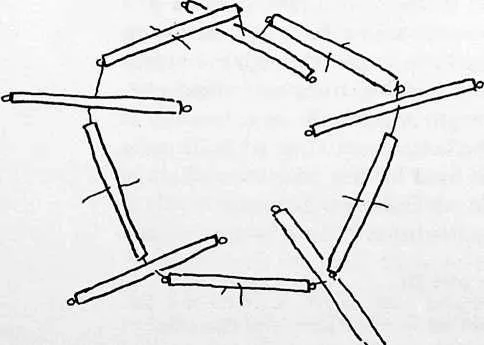
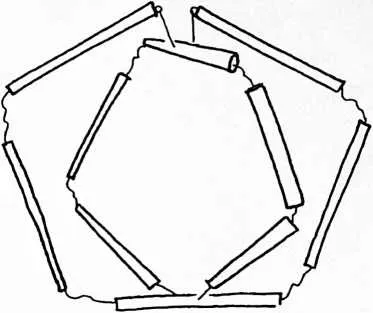
4 Next stage: We can keep this up till we have a closed loop of five, a pentagon, with a dangler at each joint. If we had enough hands, we could hold the pentagon upright, as in the picture, while doing things to it. Since we haven’t, the picture idealizes what is really a floppy mess.
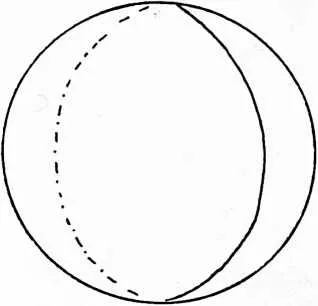
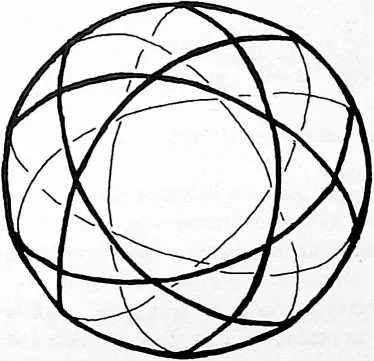
5 On. Let’s use the dangler at the top of the picture to start a second pentagon. It will cross the first one again at the bottom, and can be hitched there, using the piece of wire that’s hanging available. We now have two intersecting pentagons, like a pair of great circles on a globe. At least that’s the idea. In front of us, on the worktable, the mess is getting floppier and more complicated.
6 Keep this up, completing great circles. In the diagram you see the general pattern we’re aiming for. As more and
7 MODELING THE UNIVERSE | 87 more sticks get wired in, we have to be extra careful about what goes where.1
9 And, surprise! Just when the confusion verges on hopelessness, it’s as though unexpected forces were suddenly released. It’s like a physical encounter with synergy. For no clear reason, the contraption mounts up off the table and starts to support itself. The last struts don’t fall into place, you press them into place, against hidden powers. And when the last joint is wired fast, a queer kind of spiky sphere stands free in space.
10 Bucky Fuller, who invented this in the early I950’s,t calls it a Tensegrity Sphere: tensional integrity. No stick comes anywhere near touching another stick. Really there’s no sphere there, no continuous surface: just a connectedness, alternately wire and stick, enclosing empty space, and penetrated moreover by empty spaces, roughly pentagonal or roughly triangular. Look at a pentagon edgewise, and the pentagonal alignments dissolve into a jumble of unrelated sticks. (The Big Dipper in the sky would also disintegrate if we could inspect it from another part of the universe.)
11 A bee might pass right through, or a canary; not a partridge. (And you understand how a balloon’s meshwork traps molecules of air, too large to pass through the holes.)
12 Everything seems to be hanging from everything else. Common sense says it ought to collapse in a jumble. It doesn’t. And look near the bottom: are those sticks hanging up? One man stared at it hard for five minutes, and christened it The Suspension of Disbelief. It seems hardly a thing. It’s a whole system, its behavior utterly unpredicted
13 Stick and wire
14 Two sticks joined by a third
15 First circle
16 ■v
18 Two circles
19 Great circles in tensegrity sphere
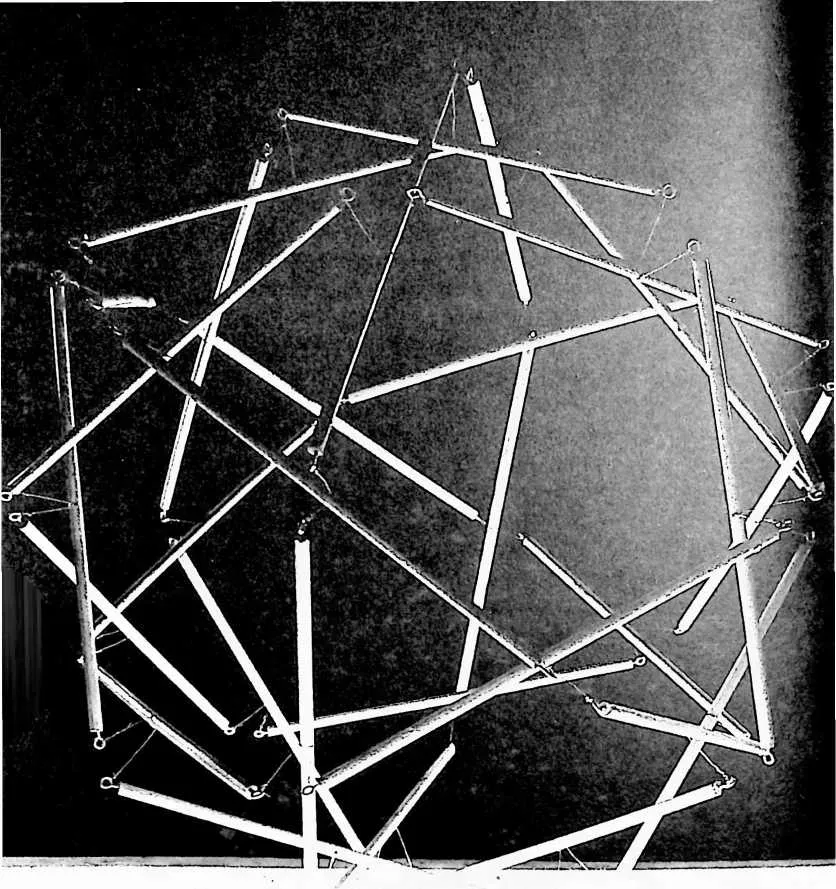
2223Tensegrity sphere (William Acker)
24 by its parts, and as dramatic an example of synergy as we are likely to find.
25 Magic, obviously. Everyone wants to touch it, and is afraid to. It looks about as stable as a cardhouse. Yes, it’s
26 MODELING THE UNIVERSE 01
27 quite safe to touch it. In fact, pick it up and even squeeze it. It’s not the least bit delicate. Between the hands it yields like a rubber ball, and pops firmly out again. A really determined squeezer would break something, a wire or a stick, but short of that you won’t damage it.
28 One’s intuition is that a wire would break first, one of those gossamer wires. But another invisible synergy is at our disposal, the tensile strength of metals. From a metallurgical catalogue it would be easy to specify wires stronger than the sticks. And then stronger sticks, of metal tubing possibly. And better fastening than twisted wire' affords. Any force we are likely to apply, a good engineer could defeat by specifying components and details. His attention would be on components---wires, struts, fastenings---not at all on the system, which is simply invulnerable. Yet at first glance it was precisely the system that looked so precarious. Not at all. Things break. The system abides.
29 The Tensegrity Sphere is a remarkable discovery, in many ways Buckminster Fuller’s most profound. Not that it has yet been put to practical use, our conceptions of practicality lagging in a different order of experience.* The U.S. Patent (#3,063,521) which describes its principles contains the remark that a fine enough tensegrity meshwork, spun from billions of ultralight components, could vault over whole cities. It would be perceptible only as a faint darkening of the sky. In 1965, Bucky described an ‘‘Octa Spinner’’ to mass-produce the weave.
30 Getting oriented to this object takes a while. It seems to be posing a question you’re not sure how to formulate. ‘‘Why doesn’t everything fall?’’ is a first approximation. We may learn part of the answer by unfastening one wire
31 • As we’ll see, the Geodesic Domes do use this principle, though less showily.
32 02 BUCKY
33 from one screw eye. The stick we’ve freed doesn’t fall, it springs outward, and everything nearby relaxes a bit. When we press the freed stick back where it belongs, our fingers encounter a powerful springy force, all the tension on all the other sticks, each flexing slightly like a little bow. Bow and bowstring, that’s a partial analogy. It helps us grasp the kind of force we’re dealing with.*
34 But each bow is another bow’s arrow, and no archer in sight. Intuition still says it ought to collapse.
35 So we’d better ask what’s guiding intuition. Obviously, some notion we’ve never formulated, about what makes structures stable. A notion we’ve never formulated is apt to be called ‘‘common sense,’’ and common sense tends to forget about tension (pull), attributing stability to compression (push). A stack of bricks or blocks is in compression; every child knows that at a certain height it gets unstable and every adult tends to suppress this knowledge, adults having access to nails, spikes, brute-force fastening devices. Even Maria Montessori omitted tension from her inventory of fundamental experiences. A porch swing hangs, and seems frivolous; what we’ll trust is a platform rocker. This may be because tension networks, however strong, have no shape unless they are stressed, and common sense is comfortable only when shape inheres. This ‘‘common sense’’ is a conditioned reflex which we mistake for insight into the universe.
36 Chains, wires, ropes, tension elements, can only pull taut. They have no other useful property. Since all the wires in the Tensegrity Sphere are taut, everything is being pulled. Since the direction of the wires seems to
37 • The sticks bend because they are members of the tension network, this particular sphere being somewhat degenerate. I chose it because it’s easy to construct. In the mature Tensegrity Spheres the wire network is continuous, and the struts receive no bending loads. They have nothing to do but hold nodes of the mesh apart: pure compression afloat in pure tension.
38 MODELING THE UNIVERSE | 93 make no difference, the important pull isn’t gravity. (That’s part of our trouble. When we see a tight wire, we think, ‘‘weight.’’) Forces are pulling outward, away from the center, trying to pull the structure apart. Counterforces are restraining them. The interplay between force and restraint settles into a spherical pattern.
39 The same is true of a balloon. The expansive forces that are trying to burst it meet the restraining network in the rubber envelope. The equilibrium between explosion and restraint is spherical, pretty nearly.
40 A balloon is a successful restraint of an explosion.
41 This covers much of Fuller’s sense of things. His most important model for reality is energy radiating from a center, and being restrained. (The center may be just a point of reference. In our Tensegrity Sphere there is nothing important happening at the center. The action is around the periphery.)
42 Stubborn folk, having grasped all this, still feel it works against nature. One man called it an insult to God. Bucky gives us the theme to remember: ‘‘I cannot do anything nature does not permit.’’ Since the Tensegrity Sphere exists in the natural world, it’s our sense of nature that we’d better rethink. The conviction that its pieces ought to fall down rests on a conditioned reflex as old as Aristotle, who thought that ‘‘down’’ was the place for heavy things.
43 When Aristotle’s concept of ‘‘heavy’’ and ‘‘light’’ is expounded, every science student smiles. Poor deluded old Greek! Nevertheless that concept sleeps in the student. Only he does not know it as a concept of ‘‘weight.’’ It lives within him as a concept of ‘‘down.’’
44 ‘‘I don’t know why I am talking to you,’’ said Bucky, ‘‘because you are all so ignorant.’’ He was trailing his coat before a roomful of scientists. Their ignorance consisted in knowing that the earth rotates, and yet saying that the
45 94 | BUCKY
46 sun rises and sets; also in knowing that the earth is spherical, and yet speaking the flat-earth words ‘‘up’’ and ‘‘down.’’ (‘‘How are things down there?’’ the astronaut over Australia asked the Controllers in Houston, his words contradicting everything he knew.) Since the learned consensus about the spherical earth dates from the fifteenth century, the learned ‘‘have had 500 years to organize themselves in relation to their fundamental information and have done nothing about it.’’ Men’s conditioned reflexes may lag half a millennium behind what they know.
47 It is not the experience of being alive in one’s body that conditions those reflexes, it is the ease with which we learn words. Words have been a preoccupation of Bucky’s since his 1927 crisis, when legend has him keeping silent till he’d learned how to talk sense. (It took some two years.) In 1932, when C. K. Ogden had just reduced the English vocabulary to 850 molecules, called Basic English, Bucky’s magazine, Shelter, immediately featured the system, no doubt to subscribers’ bewilderment. And Korzybski’s General Semantics, demarking the word from the thing, the map from the territory, appealed to Bucky as soon as he heard of it.
48 Body-knowledge, being exquisitely complex experience, is by definition never wrong, though our minds can misinterpret it. Bucky claims he can feel the earth’s spin with his body. ‘‘At Bear Island I drink a great deal of tea, so at night I have to go outside a lot. And standing there facing the Pole Star, seeing how the horizon since my last visit has blotted some stars and uncovered others, I can orient myself and feel the earth turn, slowly, like the hour hand of a clock.’’ That turning earth uncovers and covers the sun; sunsight is the morning word, its fellow sunclipse.
49 "Eclipse’’ said a philologist, ‘‘an abandonment, a dropping out. So sunclipse, when the sun goes into hiding?’’
50 ‘‘Is hidden,’’ Bucky corrected.
51 MODELING THE UNIVERSE 95
52 ‘‘You will teach me accuracy yet.’’
53 In the same way, the body-knowledge of aviators teaches them that they go out and in: out in any direction, an omnidirectional word; in to home, a concentering word, a locator. Though opposite in feeling, they are not really opposites. The universe contains no mirror images, as according to Bucky the Nobel committee attested when it awarded the 1963 Physics prize for the overthrow of ‘‘parity.’’ So one has reason to be suspicious of those mirrorimage words up and down. Fliers, avoiding these words, intuitively say ‘‘in’’ and ‘‘out,’’ and Bucky wishes the rest of us did too. This is one theme the Tensegrity Sphere forces on us.
54 ‘‘Why doesn’t it fall down?’’ is a meaningless question. The question we can answer is why struts don’t fall in or fall out, which is what they are trying to do. In and out are the relevant directions, not up and down. This is one way of saying that the tensional forces running through the sphere are so powerful we can forget about earth’s gravity. The system doesn’t use earth’s gravity; weightless in deep space, it would behave just as it does here.
55 Tensional forces, applied through the little sling at the middle of each stick, are pulling the stick out. It would fly out except for the tensional forces applied to its ends, which are holding it in. When you tighten the wires the thing gets larger, not smaller, which is perhaps its most unnerving bit of behavior.
56 In a whole system the directions are always out and in. When we gain an inkling of this fact we may grasp why the words ‘‘up’’ and ‘‘down’’ annoy Bucky.
57 Those tensional forces are strong and stable. To rupture them we have to break sticks, or break wires: which means that the network which holds our tensegrity sphere is modeled in the tensile strength of the wires, the cohesive
58 forces that bind the wood of the sticks. These are, when we come right down to it, intermolecular bonds. That’s what the system harnesses, chemical bonds.
59 To be quite clear about this, take a few minutes off and build the Great Pyramid, in your mind of course. You do this by hoisting great stone blocks outward against earth’s gravity till they clear the blocks below them, and then sliding them into place. They settle where you put them, pulled snugly against other stones by earth’s gravity, a pervasive in-pulling field.
60 Inside that field the pyramid is stable, and has been stable for millennia. The field is wholly indifferent to the pyramid; its tug is on the separate stones. Occasionally a corner of stone erodes loose from the system, and gravity, feeling no responsibility for the system, tugs the loose pieces to the desert floor. If you could flip the pyramid over onto its apex, the same gravity which had been holding it together would instantly pull it apart. If you could move it away from earth’s gravity, out somewhere in the direction of the moon, its uncohered stones would gradually drift in separate directions.
61 This means that the pyramid, standing there near Gizeh, is not a Whole System. It depends for its cohesive integrity on a force that is not part of it, a strong reliable force but extraneous to the pyramid. A complete balance sheet would show ‘‘materials’’ and ‘‘gravity.’’ The denser the materials, the more massive the stones, the more gravity’s effect. Mortar will keep stones from slipping, but will not support them. Only other stones will support them, and only when gravity pulls load against support. That is why, for so many thousands of years, weight has meant strength.
62 MODELING THE UNIVERSE | Q7
63 Gravity pulls inward toward a center, like the wire sling that pulls each stick toward the center of the Tensegrity Sphere. Other wires are pulling each stick outward, and the system of pulls is in delicate equilibrium. There’s nothing delicate about the pulls, but the equilibrium is delicate, and the system responds to disturbances by trembling slightly. Pick it up, it elongates minutely, gravity pulling the system away from your hand. Set it down, it spreads and flattens minutely, gravity squashing it toward the table. At the instant of changeover a tremor of rearrangement spreads through all the sticks and slings as they regroup to accommodate the new vectors of stress.
64 Like the Tensegrity Sphere’s two-way pull, forces in the great world counter gravitational forces, else the universe would gather into a point. One countering force in the universe is centrifugal: the force you can feel pressing water against the bottom of a bucket, if you swing it round and round at the end of a rope. These two forces in balance keep a satellite in orbit. These two forces in balance cohere the solar system, the outward plunge of planets in equilibrium with the inner tug of solar gravity. The planets neither escape nor fall into the sun. That’s another restrained explosion.
65 In the solar system as in the Tensegrity Sphere, the operative forces are strong and reliable but their equilibrium pulsates a little. That is why the planetary orbits are not circular, as everyone assumed for so long, but elliptical. Now they move further from the sun, now they are dragged closer: it’s like a tensegrity trembling. And while the system never settles down into circularity, its way of not settling down is so regular we can plot the track of Mars and obtain an ellipse, which is like a circle vacillating between two centers.
66 Though equilibria pulsate, their norm is stable. Nothing in man’s experience is as stable as ‘‘sea level,’’ a norm to which we refer the heights of mountains. Ancient wisdom says ‘‘water seeks its own level.’’ Yet sea level is a mathematical average, pulsing twice daily with the tides and moment to moment with the passing waves. Wave motion, that is what ripples the surface of the Tensegrity Sphere, just as it ripples the liquid surface of the earth. (And the solid surface too; a seismograph trace is never still.) The pattern called ‘‘wave’’ sweeps along the ocean’s face, but the molecules of water move in and out, only in and out, in toward earth’s center and away again. (So do the tensegrity struts.) It is the ordered succession of these movements we see as a wave.
67 Offshore, a mass of submarine kelp rides on its little pneumatic floats, in buoyant equilibrium, lifted and dropped by the vast heave of passing waves, yet not swept shoreward until a storm drags it there. Down the wave’s face planes a surfer, in toward earth’s center, always toward earth’s center as he glides obliquely along the wave, yet no more lessening his distance from earth’s center than a planet lessens its distance from the sun, till he runs out of wave and is beached. ‘‘I seem to have been only like a boy playing on the seashore,’’ said Isaac Newton, ‘‘diverting myself in now and then finding a smoother pebble or a prettier shell than ordinary.’’ Bucky Fuller on the Malibu shore in December stoops to collect a stone worn by aeons’ pounding. ‘‘A truncated tetrahedron,’’ he remarks. It is. Most of them are. He tosses it seaward, and a set of airborne waves brings our ears a plop, while a slower set radiates on the heaving swell. A great wave obliterates it. ‘‘Yet it had an integrity of its own.
68 ‘‘The wave is not the water. The water told you about the wave going by. But the wave has a patterned integrity of its own---absolutely weightless.
69 ‘‘Just really great,’’ he marvels. ‘‘Every wave in the universe has its own integrity.
70 ‘‘And look at all this whiteness and all those bubbles. Beautiful, beautiful bubbles, every one of them. They tell you spheres use pi, and pi is irrational. 3.14159 . . . , and on goes the number. Every time nature is making one of those bubbles, to how many places did she carry out pi before she discovered you can’t resolve it, and at what point does nature decide to make a fake bubble?’’
71 (Having no curved surface, the Tensegrity Sphere is not even described by pi, let alone generated by pi.)
72 ‘‘Nature has formed relationships that are just to me unbelievably magnificent.’’
73 The surfer out on his wave---‘‘a neat matching of rates’’ ---is ‘‘spending his gravitational advantage’’ yet never approaching earth’s center, trading gravitational advantage against the outward motion of water molecules.
74 ‘‘Spending is a fallacy. Nothing is spent in Universe.’’
75 With strength, luck and skill he could surf clear across the Pacific, always spending his gravitational advantage yet nothing he spends ever spent, for he would never reach the low point of the wave. It is steadily regenerated beneath him. He moves in; at the same rate exactly, water molecules move out. ‘‘His pattern of movement, along the face of the wave, is at ninety degrees to the lines of in-and- out action. That’s called precession. A gyroscope uses it. Press down on a gyroscope’s rim. It tips away 90 degrees from where you press it.’’ Likewise the ‘‘centrifugal’’ tug on your arm when you whirl a weight is at 90 degrees to the weight’s circular track. It vanishes the instant you let go, and the weight instead of flying outward goes ‘‘off on a tangent.’’ And the planets’ effort, which gravity restrains, is not to move outward from the sun, but laterally. That outward pull is precessional. The solar system precesses. Modeling it, under Arctic ice, a spinning gyrocom-
76 1OO | BUCKY
77 pass’ precession registered changes of course, guiding the Nautilus with exquisite accuracy through hours of darkness. Bucky still cites with pride his exposition of precession to the readers of the Sperry Gyroscope story in Fortune, as long ago as 1940.
78 The surfer’s body understands the universe better than does his mind, which is programmed with up and down and with worries about spending. Black in his rubber wet-suit, he plods ashore unaware. Bucky’s mind is on another tensegrity, the air-ocean’s tensional force drawing the sea-ocean’s wave-tops into cresting curls of spindrift, which move---precessionally---at 90 degrees to the drag, sidewise along the wave-tops. Nature models all principles. Years previously---1956---his mind leaped from surfers and spindrift to porpoises:
79 and porpoises are the royal protagonists
80 of the synergetic precessional surfboarding realms
81 for porpoises employ and enjoy
8283these purely abstract and integratable principles as they languidly, almost effortlessly coast in lovemaking couples
84 around the cresting waveslopes encompassing earth.
85 At home in the forces they ‘‘employ and enjoy,’’ porpoises presumably know nothing of precession, of tensegrity, of wave propagation and patterned integrities. That is the human mind’s unique function, to extract principles. A man, not nature, designed the Tensegrity Sphere, which models so much of nature.
86 ‘‘I’m not trying to imitate Nature, I’m trying to find the principles she’s using.’’
87 ‘‘Islands of compression’’---like those sticks---‘‘in a nonsimultaneous universe of tension’’---like that net of wires: that’s apparently Nature’s way when she has ‘‘very large
88 jobs to do, such as cohering the universe or the solar system.’’ Or ourselves, for that matter.
89 Or a tree, in which compressional spheroids of waternothing that we know is as incompressible as water---are packaged in a ‘‘cellulose tension network,’’ whose flexing allows limbs to bend while the liquid globules keep them from collapsing. (Nothing in his repertoire is more wonderful than Bucky’s exposition of a tree. Talking faster and faster, arms spread, he becomes the tree, heaving his chest, arms in wave-motion as the tensional fibers hold tons of outspread limb in undulant equilibrium. For anyone who sees it, no tree will ever be a ‘‘thing’’ again.)
90 And Jell-O, trembling, is a molecular tensegrity.
91 Countering all our intuitions by not collapsing, that Tensegrity Sphere is not after all more marvelous than the universe it models: empty space, mostly, through which energy events are oscillating with so repetitive an equilibrium our senses can tune them. One kind of energy event is vibrating 600,000,000,000,000 times per second; and we are so constituted that when this kind of event solicits the retinal structures of our eyes we perceive ‘‘blue light.’’ Another kind, pulsating 261 cycles per second, is registered by our ears as ‘‘Middle C.’’ The stable pulsing of molecules against the molecules in a fingertip is likewise registered, through electrified nerve ends, as ‘‘solid table.’’ We, so far as our senses go, are a network of responses to pulsations. Amid this network, unlocatable, the phantom captain is constantly monitoring, intuiting, guessing, deciding, willing.
92 When Lieut. R. B. Fuller, U.S.N., was consorting with Navy captains, a small ship under his command was put at the disposal of Lee De Forest, whose recent invention of the triode vacuum tube had made the Navy wonder
93 102 BUCKY
94 if its planes might now talk to its ships. Since the primitive tubes had little ‘‘gain’’ to deliver, De Forest had recourse to regeneration, a strategy for getting more boost out of the tube by passing the signal through it more than once.
95 In practice this was so ticklish an operation that regenerative receivers are no longer met with. Currents tended to flywheel pell-mell around the system, and the operator jerked the headphone from his ears to avoid being deafened by a self-sustaining howl. A burp of static could initiate this howl. Chasing its amplified image round and round, it discovered a resonance at which it could cycle comfortably, each pulse from the output presented again at the input exactly in time to catch the system off balance.
96 What plagued De Forest seems to have fascinated Bucky, whose writings are filled with the word regenerative. The sky out over the Atlantic pulsed with lurches of electromagnetism: pure invisible principle, its patterns so large- scale one might loosely call them random. But sweep the skies, funnel those randomnesses into the regenerative receiver the technician was struggling with, let the flywheel effect but commence, and the earphones are filled with a sustained banshee tone, stable in pitch, stable in loudness, and ‘‘permanent’’ until something breaks down or a plug is pulled. It corresponds to no sound locatable ‘‘out there.’’ Rather, regeneration has so organized energy that the ear receives sustained stimuli as physical as a steel block.
97 It is in just this way that ‘‘things’’ make themselves known, when they are presented to hearing or sight or touch. They are patterns of recurrence, patterned solicitations of the senses: light interfered with steadfastly, for the eye to detect as a colored surface, or the fingers bombarded just here (not over here) so that they report contact with something ‘‘solid.’’ These stimuli are our experienced reality. They interact so reliably that we speak of inhabiting a world of ‘‘things.’’
98 But these ‘‘things’’ are regenerative patterns, like that steady howl in the ship’s radio shack, and when common sense speaks of the fundamental nuclear particles of the iron atom, constituting a bar of iron we can see and touch, the knowing mind should think accurately, as it knows how to, of ‘‘purely regenerative abstract principles,’’ insubstantialities, but sustained.
99 and the predominantly associative resultants
100 of self-interference patternings
101102which precessionally regenerate as almost exclusively inwardly shunting chordal patternings of systems of periodic self-interference are known to man’s ‘‘common sensing’’
103 in superficial, solid-thing-apprehending terms
104 as the ‘‘basic building blocks of universe’’---
105 the ‘‘chemical elements’’
106 ---though these elements are not ‘‘blocks’’ but pure knot- tings of energy. How the mind does run on blocks, when it designs houses of blocks! But the Tensegrity Sphere has no blocks.
107 It has not even palpable sphericity: no curved lines, and no surface whatever. Only our Platonizing minds say ‘‘sphere.’’ It is an ordered system of Energy Events, and these energies at least are palpable. You can locate them by applying a fingertip and sensing the yield and recoil. Energy (what else?) is pulling all those wires taut. The same energy is holding those sticks in place, and you can see it restore them to place when they are disrupted.
108 Since it trembles, ‘‘place’’ is an average, which resembles what we are told about atoms in a molecule, never exactly located from instant to instant. What is stable, in this closed system, is the sum of forces. The forces have not only intensities, they have lengths: the force along a wire reaches from anchor point to anchor point, just the length of the wire.
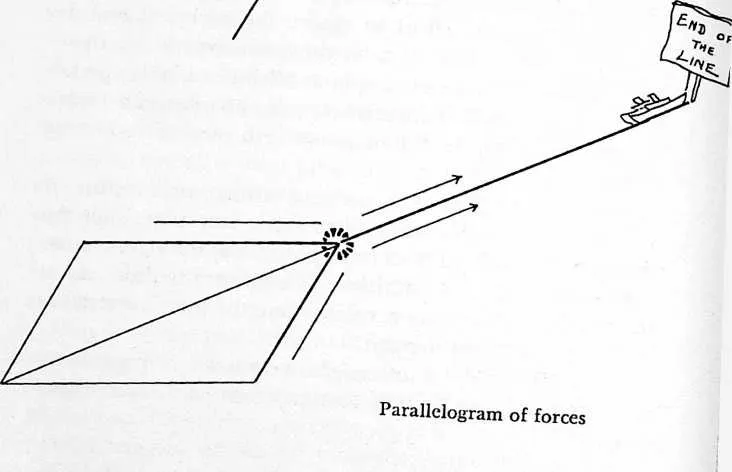
109 Lines of definite length and direction, which do not go on to infinity because they represent forces, are called vectors, a key word in Bucky Fuller’s scheme of things. In the Navy Academy classrooms, in 1917, they drew vector diagrams, modeled on a procedure of Galileo’s, to represent what happens when two ships collide. Each line’s direction represents a ship’s direction. Each line’s length represents its ship’s momentum, made up of two realities, its speed and its weight. Where the lines meet the ships will meet.
110 Complete the parallelogram, draw its diagonal, extend the diagonal by its own length, and the extended line is supposed to show what happens next: the speed and mass of the two ships being violently united, they ‘‘waltz gayly north-north-east twelve miles together,’’ and drift to a halt where that vector comes to an end, all passion spent.
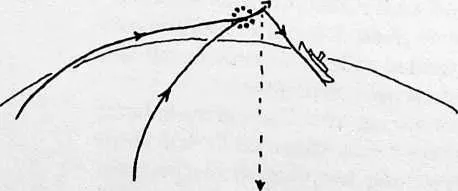
111 Bucky, as usual, protested that this was idealized. One ship, we don’t know which, will likely plunge toward earth’s center with a hole in its bow, and we can’t be sure what will happen to the other. Anyway it will glide a good deal less than twelve miles: perhaps a few yards.
112 The direction toward the sea-bottom isn’t in the diagram. Nor is the direction outward from the center of the earth, which is the direction both ships are trying to pursue as they accelerate. If they speed fast enough they will go ‘‘off on a tangent,’’ into orbit. When they collide, their combined momentum lifts their bows outward
113 MODELING THE UNIVERSE | 105 against gravity, absorbing most of the energy in one mighty heave. Then the survivor drifts ‘‘downhill’’ a few yards. The real vectorial diagram is tetrahedonal.
114 So much for plane geometry, which we teach beginners because it’s simple and easy. It excludes important energetic realities even when it claims to be mapping energies, and for Bucky the effort to ignore the excluded realities was much more difficult than the geometry, which therefore seemed to him not simple at all but a highly specialized case of ‘‘pure mathematics,’’ i.e., an idealized fraud. ‘‘Plane geometry is the most special case of ‘not true at all.’ ’’
115 Nevertheless there was nothing wrong with vectors, if you drew the right ones. They were very nice lines, he thought, because they didn’t ‘‘go on absurdly forever to the nowhere of two infinities.’’ They literally didn’t have time. Time determines a vector’s length: the time it takes an energy event to happen.
116 ‘‘I wondered if nature might have a set of omnidirectionally operative vectors that represented all our experiences.’’
117 I wondered, in short, if everything might be modelable.
118 ‘‘Vectors are like spears. I could ‘massage’ any object into a spear shape, point and thrust-throw it in a discrete direction. I intuitively liked those directional vector ‘spears.’ I felt that they tended at least to embody all the energetic qualities of represented experiences.’’
119 Since we’ve been experiencing the Tensegrity Sphere, we might try our hand at a vector diagram. It will have to represent the way everything is trying to escape from the system, and is being exactly restrained. On page 108 some vectors head outward. I could have drawn more, but
120 Ships
121 Tetrahedron of forces
123 MODELING THE UNIVERSE | 107 twelve seems to be the right number. If you turn the sphere around and look at it, you see that its symmetry repeats twelve times, around twelve pentagonal arrays, so a vector running toward each of these will represent the out-thrusts.
124 Now bind these vectors together with in-closing hoops, and what we get doesn’t look like the Tensegrity Sphere but does map its equilibrium of forces. We’ve drawn twenty-four lines to make the in-closing network, and if it weren’t for the perspective flat paper imposes, you could check that each of them is the same length exactly as the spears that radiate out. Same-length lines mean the forces balance, which is correct: the Tensegrity Sphere neither explodes nor collapses. We can call this figure a vector equilibrium, and take note that nothing will turn up more often in Fuller’s model of the Universe. Since most things are neither exploding nor collapsing, the vector equilibrium will model any of them: a football, a cat, a parked Volkswagen, what have you.
125 Lines mapping energies led Fuller to his energetic triangles, in which the three lines are not just lying there but are busy stabilizing the angles opposite them. We can see this if we put a triangular truss under a roof, and rely on its lower side to keep the roof from collapsing. (The triangle has six events: three compression sides, three tension angles.)
126 Energetic tetrahedra also map forces. They bear weight: their own at least, or perhaps that of a camera on a tripod. They map forces in the real world, and include the direction the unlucky ship took to Davy Jones’ Locker.
127 If all the sides and all the angles are the same, all the forces a tetrahedron represents are equal. If we wanted to represent stable energies thrusting through space in all directions, we might try to do it by filling up the space
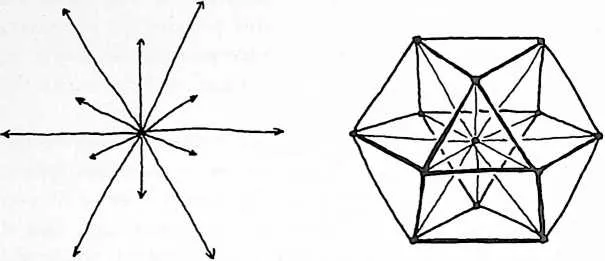
129 Twelve radiating vectors
130 Vector equilibrium
131 with tetrahedra. But we find we can’t, because octahedral gaps turn up between them. We can fill as much space as we like with octahedra and tetrahedra alternating: we are back in a Milton, Massachusetts, kindergarten, 1899, and have discovered the Octet Truss. It’s easy to model, maddening to draw. Yet anyone can draw a cubical lattice, which fact is as cogent an explanation as we may need for our intuitive recourse to cubical models.
132 Still, cubes are appealingly symmetrical. It would be pleasant if the oc-tet structure disclosed some module symmetrical in all directions the way cubes are. If we go into it and explore we shall find one. It’s the vector equilibrium again. Any node in the Octet Truss lattice is the center of one: a point from which twelve vectors radiate into rings of restraint. That’s where the Octet Truss gets its great strength: every stress is dissipated twelve ways, and caught in those rings.
133 So we come back to his interest in equilibrated explosions, like balloons which are trying to burst and also trying to shrink, and strike a spherical balance. You can
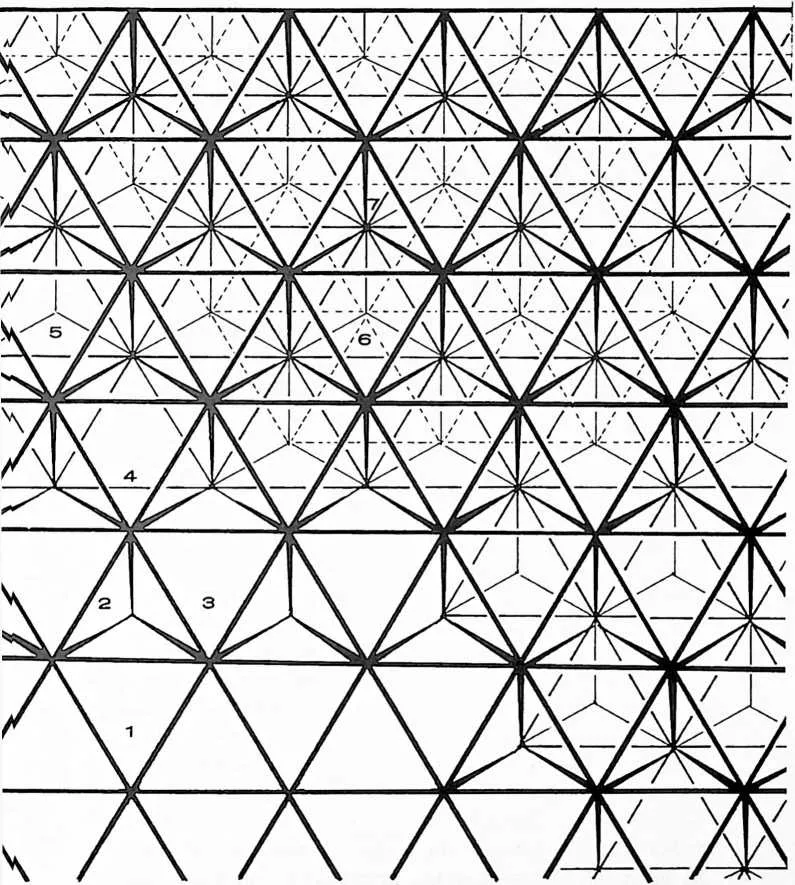
135 The Coordinate System of Nature, alias Octet Truss. Thickest lines are elements nearest you and (despite effect of perspective) all members are the same length. Start at bottom left. i. First-level triangular grid. 2. Tetrahedra, pointing away from you, with octahedra (3) appearing between them. 4. Second-level grid joins tips of tetrahedra. 5. Next array of tetrahedra. 6. Dotted lines show third-level grid. This can be continued indefinitely. Twelve-way vertices (7) in second level are centers of vector equilibria.
136 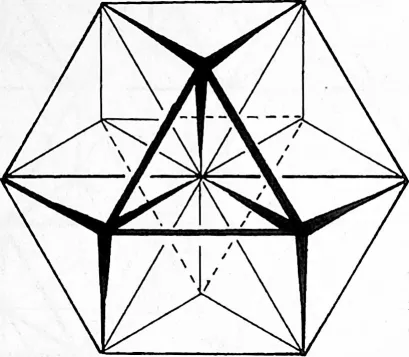 Vector equilibrium extracted from the grid in previous drawing, and shown with
irrelevances omitted.
Vector equilibrium extracted from the grid in previous drawing, and shown with
irrelevances omitted.
137 see that a vector equilibrium would make a sort of stress diagram of a balloon. Its four crisscrossing hexagonal rings represent the tensile skin, restraining twelve different outward thrusts that represent the compressed air. And we’ve seen that if you filled up your room with an Octet Truss latticework, every junction point would have twelve rods radiating from it, restrained by the rings of a surrounding vector equilibrium. Energy radiating along those rods would collide with the energies radiated from neighboring junction points. The vector equilibrium around each point models the resulting pattern of restraint, and the Octet Truss lattice, extending in all directions, models the whole system’s equilibrium.
138 Standing inside it, you would know what it feels like to be inside a bar of some idealized metal, watching the attractive and repulsive forces between all the atoms equilibrate. (It’s idealized because atoms themselves are complicated; but copper or gold will come pretty close.) Each atom, in this model, is surrounded by twelve others, restraining it. Each atom occupies a junction point in an invisible Octet Truss. Held in place, they cause us to say that the metal is stable, massive. If the attracting forces
139 MODELING THE UNIVERSE
140 111
141 could be cut like tension wires, the energy (E) locked into that mass (m) would radiate at enormous speed (c2).
142 The knot we have heard Bucky talking about models the same kind of phenomenon: a self-interfering pattern of energy and restraint. The more you tighten a knot, the harder it resists tightening.
143 So ‘‘matter’’ itself is a contained explosion, and the vector equilibrium is its austerest image. I am a contained explosion. So is my thought. So is my cat. So is a star, from which radiation streams out, but not faster than it is generated. None of these looks in the least like a vector equilibrium, but it models these energy systems.
144 It is not chosen by accident. No other model is possible. It’s true that a cubical lattice will fill all space, like the boxes in a warehouse, but it won’t give us equilibria outward from centers. If along each edge we have a force of 1, then from center to corner the force is 2, which seems meaningless as a description of real events. You can’t have an unresolvable fraction of an energy event, and V 2 is unresolvable.
145 Since the model has exactly twelve outward vectors, you will not be surprised when symmetrical enclosures have something to do with twelve. Bucky’s Geodesic Domes are sliced from spheres with twelve key points, which stand out amid the intricate array because the eye can pick out pentagons surrounding them. All the other configurations are hexagonal. If you turn back to page 42 you’ll see the pentagon where the five big triangles join. A complete sphere would disclose twelve of these.
146 When he made his Dymaxion Map in about 1940, he modeled Spaceship Earth as a vector equilibrium, and projected the continents and oceans onto its squares and triangles. Sure enough, if you fitted the thing together, you found twelve points of intersection, symmetrically
147148Dymaxion map (icosahedral version) Two of the twenty triangles are dissected to keep Australia and Japan intact (Copyright R. Buckminster Fuller)
149 The five platonic solids
150 spaced. Current versions of the map use the icosahedron instead. Its jigsaw puzzle uses six more components, but it has the advantage of yielding identical pieces, all triangular. And it still has twelve gathering points.
151 Bucky was so enchanted with the vector equilibrium that he called it by his copyright name, Dymaxion. Later he had second thoughts about egotism. Anyway, he was not the first to gaze on it. Under the name cuboctahedron, it has been around since Archimedes’ time. We find it officially listed among the Archimedean Solids, a collection of miscegenated objects whose equal edges surround faces or angles of more than one kind. This fact chilled the Greek imagination. Greek connoisseurship singled out the Platonic Solids, five aristocrats that flaunt perfect equality everywhere: equal edges, equal angles, equal faces: the tetrahedron, the octahedron, the cube, the dodecahedron, the icosahedron. But the cuboctahedron presents both six squares, like a cube, and eight triangles, like an octahedron, and in Plato’s Republic it is obviously a second-class citizen.
152 Yet it has extraordinary qualities. Bucky enjoys showing us how it will fold up, if we make it with rubber joints. He sets one triangle on the tabletop, and holds the top triangle in his hand, and lowers it. Immediately the rest of the system commences twisting. It twists a little till its vertices occupy just the position in space of an icosa-
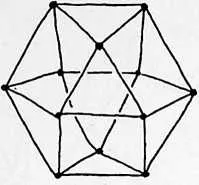
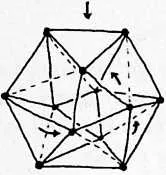
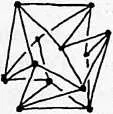

154 Vector equilibrium folding to octahedron
155 hedron’s vertices; ‘‘and I keep lowering, lower, lower, and suddenly it becomes the octahedron.’’ It does indeed, a perfect octahedron, and all the sides are doubled.
156 He pulls it up again, to the vector equilibrium configuration, and invites us to imagine its vertices as a huge star group, majestically symmetrical, revolving in space; and ‘‘suppose another great star group made a mass attrac-
157 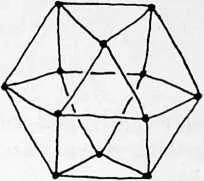
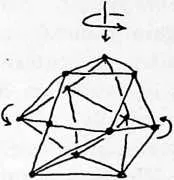
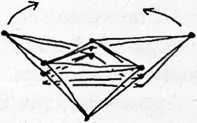 Vector equilibrium folding to tetrahedron
158 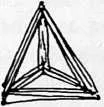 tion, and simply retarded this thing, then it would be forced to contract.’’ And the edge
drag from the second great star group interferes with its orderly progress toward the
octahedronal stage; it folds in a more complex manner; and behold, the tetrahedron! The edges
are aligned in fours; ‘‘all the vectors are fourfold.’’
tion, and simply retarded this thing, then it would be forced to contract.’’ And the edge
drag from the second great star group interferes with its orderly progress toward the
octahedronal stage; it folds in a more complex manner; and behold, the tetrahedron! The edges
are aligned in fours; ‘‘all the vectors are fourfold.’’
159 ‘‘This is the way we go from carbon, which is relatively
160 116 | BUCKY lightweight and soft, down to the very hard diamond---by getting down into the doubling-up of the vectors of the edges.’’
161 No boy’s concentration on an electric train was ever more intent. ‘‘Now we’ll unwind again, up we come, back again to our friend the vector equilibrium. Sometimes it’s called the jitterbug. Pumping, pumping, but the center is not twisting. So the whole system is contracting symmetrically. All twelve points approach the center at a symmetrical rate.’’
162 We are to think of pressure on the roof of a building. ‘‘You’re used to the idea of the building flattening.’’ (Cubical buildings flatten.) ‘‘But you put pressure on the top here, it means that the whole building contracts symmetrically.’’ (Geodesic Domes do that.)
163 ‘‘The vector equilibrium contains the whole phenomenology of the universe. The vector equilibrium is never witnessed by man. It is as pure as God. It is truth which is approached; it is exactitude that is approached.’’
164 When he spoke of the forms of carbon, the graphite crystal and the diamond crystal (which every schoolboy knows are chemically identical) he had in mind another route by which the vector equilibrium may be approached' the closest packing of spheres. In classrooms atoms are often modeled by spheres, and in 1883 an Englishman named Barlow proposed that the ways they pack might underlie the geometry of crystals. Ping-pong balls make good models, and there was a time when Bucky Fuller lived surrounded by ping-pong balls. The aluminum trailer he took to lectures in those days seemed full of them. He would stack four and demonstrate the invisible tetrahedron whose vertices are their centers, and then point out that when spheres are piled high, like oranges in a
166 Spheres packed as vector equilibrium
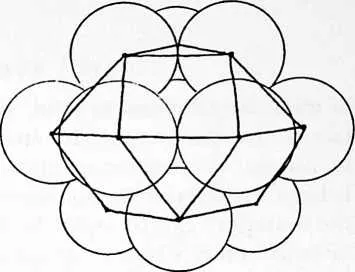
167 grocer’s bin, the array ‘‘goes on triangulating in all directions,’’ which suggests the Octet Truss. Sure enough, if we take three layers we can find the vector equilibrium,2 which suggests that it may have something to do with atoms when they nestle in closest proximity. In fact, this is the minimum symmetrical array we can build around a center: twelve balls, all touching every neighbor and touching the center ball also. If you could make the center ball disappear, the remaining twelve would shift slightly, like Bucky’s ‘‘jitterbug’’ commencing its collapsing act, and an icosahedron would join their centers. If six of the twelve balls each absorbed one neighbor, the octahedron would result.
169 So the vector equilibrium, nd cuboctahedron, stands out among the Archimedean Solids. As to why the Greeks didn’t make more of it, the obvious explanation is that the total symmetries of the Platonic Solids infatuated them. The word solid is perhaps another clue. If you think
170 of the cuboctahedron as solid, you concentrate on its surface, where the irregularity strikes your eye, and dismiss its interior as a featureless putty. So you won’t reflect that it has a natural center, and that the vectors radiating from the center are exactly equal to the vectors that bound the faces. No other structure in space can make this claim.
171 For that matter, if you’re a Greek you won’t think in vectors. Vectors map events; Greek geometry was eventless. Euclid spoke of ‘‘points’’ and ‘‘lines.’’
172 This is all such fun that we may forget to ask what it may mean. One thing it means is that we can now make a model for energy events distributed uniformly through space. Atoms, might they arrange themselves like the intersections of an Octet Truss? Atoms are energy events, united by energetic bonds; the oc-tet, with its minimal and uniform distances, would be the most economical and stable arrangement.
173 The fit between reality and Bucky’s abstractions seems not to be quite that neat. There is only one kind of oc-tet intersection, with twelve radial vectors to the corners of the vector equilibrium that surrounds it, but there are ninety-two different kinds of atoms. We should not be surprised that the compounds of these atoms are structured in an enormous number of ways. Nevertheless, certain Fulleresque themes recur and recur. Every scrap of living tissue, for example, whether the polio virus or the elephant, contains molecules that are tetrahedronally structured.
174 That is because living things use carbon compounds, and the carbon atom presents four opportunities for other atoms to attach themselves. In 1874, two chemists independently suggested that these might be tetrahedronal vertices, which was scoffed at as a Pythagorean notion
176 Methane molecule
177 until evidence grew overwhelming. Thus the methane molecule, diagrammed on flat paper
178 H
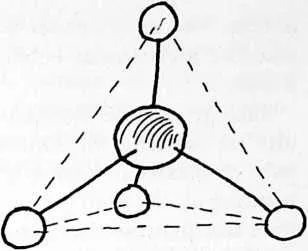
179 I
H---C---H
A
180 ---carbon and four atoms of hydrogen---is a tetrahedron with the carbon atom at its center. There are thousands upon thousands of other carbon compounds, every one tetrahedronal.
181 After that, things get complicated. Linus Pauling, the Columbus of molecular realities, has found tetrahedronal, octahedronal, icosahedronal structures in profusion, as well as far more cubes than Bucky prepares us for. A glance at the diagrams in his Nature of the Chemical Bond, or the beautiful colored drawings in his Architecture of Molecules, discloses tantalizing approximations to Bucky’s a priori system, but little of the neatness of fit Bucky’s audiences may be led to expect. He has none of Pauling’s zest for inconvenient data, numbers that don’t fall into the sequence of integers his dogmatizing calls for, angles that are skew, unassimilable cubes. His lack of interest in such data seems radical, and confronting the Platonic perfection of what he claims is ‘‘the coordinate system of
182 120 BUCKY
183 nature,’’ we may wonder what happened to the boy who asked of a classroom cube what it weighed and how hot it was.
184 Such grit on the interface between theory and data gives him no pause at all. One morning he responded with a pair of maxims: ‘‘Don’t try to make me consistent. I’m learning all the time’’; and ‘‘Principles are more of a reality than the qualities they produce.’’
185 Notice his phrasing: the principles produce the qualities, not vice versa. The principles are generative forces, like Tension and Compression. They are rather numerous, and they interact. They never produce exceptions to one another---if they had exceptions they wouldn’t be principles---but they produce fairly complicated reactions and resultants. In one order alone, the order of energy knotted into mass, they produce not simply ‘‘matter,’’ that primal world-stuff minds have lusted after, but ninety-two different regenerative chemical elements. (Why just ninety- two? Bucky thinks he knows. If you keep packing more balls round a vector equilibrium of balls, there will be ninety-two in the third layer.) With so much complexity, so many local principles to equilibrate, you may expect to get many patterns that look like exceptions: local systems like the camel, the aardvark, the cube. Bucky’s attitude seems to be that someone else can wrestle with them.
186 Meanwhile, piecemeal confirmations keep surfacing. About 1963, it turned out that many viruses were icosa- hedrally configured, and moreover geodesically subdivided, like Fuller domes. The geometer H. S. M. Coxeter summarizes: ‘‘In 1955, Fuller built a dome as bachelor officers quarters for the U. S. Air Force in Korea. This seems to be the shape of the REO virus. His ‘thirty-one-foot geodesic sphere’ at the top of Mount Washington in New Hampshire is like the herpes virus and the varicella
187 (chicken pox). His U. S. pavilion in Kabul is like adenovirus type 12. His ‘radome’ on the Arctic DEW line is like infectious canine hepatitis.’’ Geodesics and Tensegrity Spheres are first cousins. The Tensegrity, we have seen, helps us model the very large, and the virologists’ correlation with the very small is suggestive. Perhaps nature does use a single system after all.
188 We can transfer the Tensegrity Sphere to the domain of the very small if we perform an operation on those sticks. The sticks are a little misleading anyhow, their solid appearance concealing the presence of important tensile as well as compressive forces within them. We have only to replace each stick by a linear structure in which tension and compression have in turn been differentiated out.
189 Such a structure exists: it is called a Tensegrity Mast. The sculptor Kenneth Snelson discovered it when he was a student of Bucky’s at Black Mountain College in 1948. It fitted into the Fuller System so patly that a large one was exhibited, with Snelson’s name attached, in a Fuller Special at the Museum of Modern Art, in 1959. It climbed up and up like a space-age Indian Rope Trick, evidently suspended from wires which were nevertheless not hanging from anything.
190 One cell shows how it works. The two V-shaped sticks are held fast in a sling. Points A and B cannot move together (inward) because of circumferential restraints, and cannot move apart (outward) because of the vertical wire. By stacking these cells we can go as far as we please, within the limits of wire strength. Exactly as the Sphere refutes the principles of the Great Pyramid, the Mast refutes the principles of a brick chimney. Unlike a column of bricks, the Tensegrity Mast models all the forces that hold it together, and can be turned on its side or suspended or
192 Cell o£ Tensegrity Mast
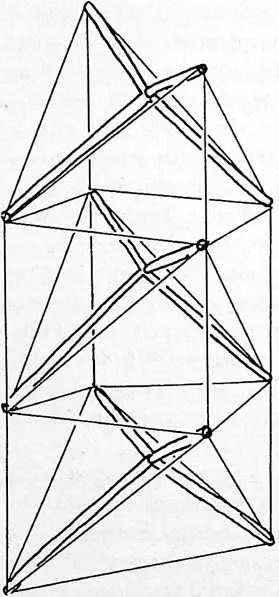
193 Tensegrity Mast
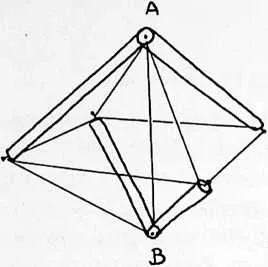
194 pointed at the sky. It behaves like a stick, not a brick-pile, and restores itself if you flex it. But whether you pull, push or bend, it is tension you are working against.
195 Now, suggests Bucky, imagine that each strut of the Tensegrity Sphere is replaced by one of these masts. (This exceeds my model-making skill at least. I don’t know if it’s ever been tried. Anyway, imagine.) The ‘‘solid’’ sticks are gone, each replaced by a system that is mostly empty space, through which run tensile forces that hold in position little floating islands of compression shaped like children’s jacks.
196 Now remove, one by one, those little jack-shaped islands of compression, and replace them, one by one, with arrays of ultraminiature Tensegrity Masts. The V-jointed compressive members are now very numerous, and also very small indeed. And the percentage of empty space is rising sharply. Next, under a microscope, replace each tiny strut in turn with a Tensegrity Mast yet smaller . . .
197 No one’s fingers are clever enough, but the mind can follow. Finally, under a scanning electron microscope, the last struts would be replaced by the last set of sub-sub- miniature Tensegrity Masts, down at the order of size where we speak of an atom’s diameter.
198 Step by step, before the mind’s eye, in stages each one perfectly discrete and conceivable, we have dissociated a wooden stick nine inches long into ‘‘the inherent discontinuous compression, tensional integrity of the nonsolid atomic structures themselves.’’ The last tensile wires will be simply the chemical bonds.
199 As the empty space in the system multiplies, its crisscrossing tensional members also multiply, until they start interfering with the ambient light. The rays that passed through it in the earlier stages are diffracted by many wires as the wires get smaller and closer. Next the rays are absorbed and reflected the way a substance like wood absorbs and reflects. Finally, as we reach the microminiature stage, the assemblage will look ‘‘solid’’: this despite the fact that we’re taking solidity out of it. It will feel ‘‘solid’’ too, poked by an inquiring finger. We should not be surprised if it looked and felt father like a piece of wood. But now we know what to think of wood’s ‘‘solidity.’’ We can understand too, thinking of those tension bonds, why the wood behaves as it does, flexing and restoring itself.
200 So the payoff for a lot of work is a synthetic wood. Components, each one too small to be seen or felt, have come, collectively, into our senses’ domain. It is not hard to understand that they were perfectly ‘‘real’’ when we couldn’t see or feel them. Nevertheless an inherent prejudice, like the one that responds to words like up and down, equates reality with the visible and palpable. Very well, Bucky urges, rethink the domain of ‘‘reality.’’ Reality is a broad spectrum of energy events, across a small portion of which our senses can ‘‘tune.’’
201 Like ‘‘regeneration,’’ this image of ‘‘tuning’’ comes from his radio days. The room you are sitting in is filled with the patterned energies of what you see and hear, and also with the patterned energies generated by thousands of radio and TV transmitters: ham calls, quiz shows, weather reports, satellite transmissions relayed from collars round the necks of polar bears. Instrumentation gives access to some of these. A simple American AM broadcast receiver will tune anything between 550,000 events per second and 1,600,000, but nothing beyond: no police calls, no astronauts’ chatter.
202 Your eye in the same way responds to a restricted band of the spectrum, the wavelengths between what it sees as ‘‘red’’ and what it sees as ‘‘violet.’’ Your ear picks up neither bat cries nor the slow beat of an eagle’s wing, but only air disturbances midway between those in frequency. A touching hand passes unheeding through air whose impact at a higher velocity will lift a 747 into the skies.
203 Being restricted in bandwidth, each of our senses resembles a radio, and whatever is ‘‘infra or ultra to man’s sensory tuning’’---one of Bucky’s ‘‘mental mouthfuls’’---we
204 MODELING THE UNIVERSE | 125 tend to discount as imperfectly ‘‘real.’’ Extending the senses with instrumentation is like equipping a radio with additional tuning bands. In this way the electromagnetic spectrum was slowly explored, the entire bandwidth of energetic events. Bucky says that the map of that spectrum in its totality was published only in 1933. In that year men supposed they were deep in a Depression, when in fact they had acquired their first full chart of the areas where significant history would thenceforth be transacted. Through fully 99 percent of this reality, our senses with their limited tuning range give no guidance.
205 None of this is new. Everyone knows that his dog hears sounds he cannot. Everyone has read of the interatomic spaces into which, for the physicist, ‘‘solid’’ reality vanishes. But hardly anyone knows what to do with such knowledge. It enjoys a kind of Sunday-supplement reality, after the brief astonishments of which we return to the really real, for instance television. We have learned this attitude from a long tradition of using the scientist’s reality to startle, thus stressing its incompatibility with common experience. Fifty years ago Sir James Jeans and Sir Arthur Eddington, founding fathers of this tradition of popularization, were making their living from elegant mystifications, and since then the scientifically literate have been mostly split men.
206 Bucky puts it differently. Science, he says, lost touch with nonscientists, and engendered the famous ‘‘two cultures,’’ when it gave up the use of models, thus letting us suppose it was talking about nothing real. His own principal contribution to humanity, he thinks, has been to restore modelability. That is what he claims for his coordinate system, where for instance you can go in four directions from the faces of a tetrahedron, or pack twenty
207 126 | BUCKY units o£ volume round the center of the vector equilibrium. Cubes have just three axes, not four, and around a point you can pack just eight (or 23) cubes, restricting you therefore to three-dimensional space and allowing you to model no equation that goes beyond x3.
208 For years a big book has been promised, spelling out with proper rigor the transition between Einstein’s reality and the oc-tet coordinates. Meanwhile Bucky has been contenting himself with lecture-hall metaphors that tend to raise more questions than they answer. While we wait for the book, we may fondle the Tensegrity Sphere, and ponder the rhetorical plight the mainstream scientific pop- ularizer has gotten into.
209 Arthur Koestler, for instance. In The Sleepwalkers Koestler showed us in brilliant detail how a sequence of great cosmological discoveries really got made. But when he came to his last chapter, and a confrontation with what had been discovered, he succumbed as readily as a Sunday supplement to the rhetoric of mystification.
210 ‘‘Each advance in physical theory, with its rich intellectual harvest, was bought by a loss in intelligibility.’’ That’s his theme sentence. For, ‘‘compared to the modern physicist’s picture of the world, the Ptolemaic universe of epicycles and crystal spheres was a model of sanity.’’ (Bucky Fuller would here ask what can be expected of scientists who say up and down, their verbal reflexes 500 years out of date.)
211 Koestler presses on. ‘‘The chair on which I sit seems a hard fact, but I know that I sit on a nearly perfect vacuum.’’ (Gee whiz.) So small are its atoms’ particles, so wide their orbits, that ‘‘a room with a few specks of dust floating in the air is overcrowded compared with the emptiness which I call a chair and on which my fundaments rest.’’
212 To dispel any notion that the substantial is somehow
213 MODELING THE UNIVERSE | 127 resting on the insubstantial, it would be helpful to examine the corresponding composition of the author’s fundaments. Instead of doing that, Koestler tells us how electrons in fact do not occupy space at all, how reality is mathematical, mind-stuff, and how we must deal not with transcendental vistas but with the imperatives of a dismal peroration:
214215Thus the mediaeval walled-in universe with its hierarchy of matter, mind and spirit has been superseded by an expanding universe of curved multidimensional empty space, where the stars, planets and their populations are absorbed into the space-crinkles of an abstract continuum---a bubble blown out of ‘‘empty space welded onto empty time.’’
216 Bucky likes bubbles, in fact the Tensegrity Sphere models a bubble, and Time gives the measure of its vectors’ lengths. Koestler however likes nothing he feels compelled to say. On his showing, the world which science opens up is therefore unexperienceable, unintelligible, unthinkable. We are consequently---this is the old political revolutionary’s closing flourish---immersed in a sort of permanent darkness at noon, at the mercy of ‘‘the new Baal, lording it over the moral vacuum with his electronic brain.’’
217 But this is not the tune that Bucky sings. Bucky has certain bridges to and fro between the world of patterned energies and the world where one feeds the dog, bridges he crosses and recrosses freely. Some of these are bridges of homely analogy, for instance the knotted rope, which he uses the way Lincoln used proverbs and frontier anecdotes. Others are substantial technological bridges, like the one Lee De Forest built between the electromagnetic spectrum and the deck of Bucky’s ship. Still others are devisings of his own, like that way of building spheres
218 128 | BUCKY which we shall be calling technological when someone has imagined a use for it.
219 All technology models principles. The radio set puts into everyone’s hands a sensory patterning of invisible inaudible energies. Since Bucky perceives in its tunings a special case of the sensory encounter, and in its regenerative circuits a special case of the reiterations that will sustain a bar of steel, he finds all these invisibilities and impalpabilities quite domestic. His complaint that expounders of science stopped using models about a century ago is matched by his observation, from as long ago as 1932, that technology is the popularization of science. Every gadget is a model, and a virtually perfect model since it really does grapple with the mysterious principle and bring it into the domain of experience.
220 This took less expounding once. The radio sets of 1919 kept their tuning condensers in plain sight, the brass plates interleaving with as physical a demonstration as a piano tuner twisting a peg, and when regenerative circuits were being peaked, rather large coils came cautiously into proximity. You could watch a steam engine’s pistons on any train, or an airplane’s propellor blades chopping back air and its ailerons responding to taut piano wire. In those days before everything was enshrouded and encapsulated technology was a public flirt, inviting a Bucky Fuller by quiver and wink to tarry with its incarnations of pure principle. Its devices still accelerate his mind. And his own eyes and ears are ‘‘tuned,’’ for that matter, with lightweight gadgets, and nothing in the universe, he is convinced, lies outside human experience. Hence his cheerfulness.