
3 The Outlaw Area
23‘‘I was born cross-eyed’’---that was the first relevant experience; and not only cross-eyed, but presbyopic to an absurd degree. The usual farsighted person can focus his eyes over the distant range, and requires assistance only for near vision. But when Bucky was being gestated, some hiccup in the DNA transcription dictated that his eyes should not focus in the normal world at all. He needs glasses to see anything whatever, the moon, or a visitor’s face. ‘ ‘Until four I could see only large patterns, houses, trees, outlines of people with blurred coloring. While I saw two dark areas on human faces, I did not see a human eye or a teardrop or a human hair until I was four.’’ The moon he sees is like a globe of stars. He would lie in bed pondering the clusters of luminous points he saw where others saw lights. He still thinks in clusters.
4Imperfect vision has shaped the specialization of more than one genius. ‘‘How is it,’’ the adolescent William Butler Yeats asked his father, "that we are given two eyes and can see out of only one?’’ Instead of rushing W. B. to an oculist, the elder Yeats placed together the tips of his fingers and discoursed on the two lobes of the brain. So a certain disdain for the merely physical crystallized at the
5center of W. B.’s mental habits, an unwillingness to be impressed by what numerous people repeatedly said they saw, a moon merely, a cat merely. The cats and moons of his mature poetry are cats and moons of the mind; so are his swans, and so is his Byzantium. Alfred Tennyson was so nearsighted he could see the flower in the crannied wall (‘‘I hold you here, root and all, in my hand’’) but was apt to turn distant blurs into the likes of
6The lone glow and the long roar
7 Green-rushing from the rosy thrones of dawn, with incalculable effects on the imagination of Victorian England.
8 Bucky Fuller, though he developed no disdain for minute things, became ‘ ‘a student of large-scale patterns,’’ the world having presented itself for four years in large-scale patterns exclusively. Having spent his earliest years assenting to others’ testimony about what he couldn’t see, he had less difficulty than most of his generation in following the leap of the scientific mind off the sensory part of the spectrum altogether. Having known about hairs and teardrops only by rumor, he had no reason to balk at the electron, not to mention such abstractions as tensile strength (you cannot tell grades of steel apart by looking). He also trusts purely mental large-scale patterns, statistical projections for example, and invisible small-scale accuracies like the machining of parts for the Ford Dome, which he likes to say transcended the visual acuity of any machinist. It gained strength from being wholly instrumented.
9 When he acquired glasses he took his first step toward the ready assimilation of technology. To see anything at all he relies on the expertise of the oculist, the craft of lensshapers, the cunning of frame-makers. (Nowadays he hears with similar assistance.) His oculist’s diagnostic equipment
10 54 BUCKY
1112comes from Rochester and from Switzerland, and expresses in its gleaming accuracy many generations of metallurgical and geometrical lore. Glass, extracted from sand by refinements of methods first discovered in Mesopotamia, is shaped, in conformity with refractive laws written down in the seventeenth century, by machines developed in the nineteenth and twentieth; behind the machines in turn stands a worldwide technology (alloys for their gears come from all around the globe), and the frame-makers’ plastics draw on the results of generations of organic chemists. More recent chemistry’s scratchproof acrylic trifocals have taken a quarter-pound of glass off his nose. Much of what the human race has learned since the dawn of the Iron Age is concentrated in assisting Bucky Fuller to see a piece of string, and if anybody supposes that nevertheless all this industrialization can be bypassed, he is welcome to assault with his bare hands the resources of any island he chooses, and try if he can make us a pair of spectacles.
13Bucky helps us look at it yet another way. Eyes evolving during millions of years, spectacles evolving during thousands, both are mechanisms to serve the phantom captain. To the second of these evolutionary chains countless human intellects contributed discoveries; and man’s life, inconceivable apart from what many men have thought of, is uniquely characterized by the number of human discoveries that have been folded into it. Dogs have never altered their role by taking thought: only men have done that. It is natural for men to do that, and the line between nature and artifice is less easily drawn than the platform ecologist would have us suppose. Aluminum for instance, though a chemical element, does not occur ‘‘in nature.’’ Every pound of aluminum in the world exists thanks to man’s intervention. And man can do nothing nature does not permit.
14 * * *
1516When Bucky entered the human community, how was man’s evolution proceeding? During the century a remarkable thing had happened: the human male had ceased being a creature that lived, on the average, about three decades. For every Lincoln who lived long enough to be assassinated at fifty-four, for every Edison whom natural causes carried away at eighty-four, enough male babies succumbed within weeks, enough Keatses at twenty-five and Mozarts at thirty-five, to hold the average down. If most of the men we have heard of lived past their thirties, that is only to say that living long enough is one of the factors that conduce to being heard of.
17When Bucky’s father was born in 1861, his calculable life expectancy was not much greater than a cave man’s, but greater. It was under forty years. He beat the odds somewhat; he lived to be forty-nine. Bucky’s own life expectancy when he was born thirty-four years later was forty- two years, a result obtained within quite recent history by improved shelter, improved nutrition, above all by a massive drop in infant mortality. So an insurance company would have bet that Bucky would die in 1937, and given him 1 chance in 100 of living to be ninety. As of 1972 he was still going strong, and an American male born this year has a 72.7-year bet placed on him. ‘‘Expectancy,’’ Bucky used to say, ‘‘has rocketed ahead of me.’’
18What else? A man walking and riding (horseback, coach, train, ship) might expect in 1895 to cover some 1,000 miles per year. Two men in Bucky’s home town had been to Europe. ‘‘They gave talks about it each year.’’ In Paris they had been able to move upward 898 feet, by steam lift to the third platform of the Eiffel Tower. That was as high as anyone got without climbing mountains, though the Swiss were already thinking of a tourist railway to the summit of the Jungfrau. The Eiffel platform is just a place
19 56 | BUCKY
2021to visit; the highest conventional rooms in the world were in the twenty-first story of the Flatiron Building at Twenty- second Street and Broadway. One could ride a horsecar or an electric trolley. Steam moved the mails, and copper wires moved messages, encoded in clicks. There were 208 times as many Americans as telephones; Alexander Graham Bell declined to have one, thinking its invasions of privacy discourteous.
22In 1895, on July 12, Richard Buckminster Fuller, Jr. was born in Milton, Massachusetts, in a new house designed by Longfellow’s son ‘‘Waddy.’’ In that year Gelett Burgess published that assertion that he had not seen a purple cow. Many years later Bucky was to plot his career against an inventory of his time’s achievements. In his birth year, it turned out, the first American gasoline- engined car had been designed under Charles Duryea’s patent; Guglielmo Marconi, at his father’s country place near Bologna, had sent messages more than a mile with no wires at all; and W. K. Roentgen had learned that rays his apparatus was emanating passed clean through opaque materials; not knowing what such rays might be like, he named them ‘‘X.’’ If anyone in 1895 had known how to correlate these three curiosities, he might have foreseen what Bucky calls the prime theme of man’s recent evolution: the transition ‘‘from tracked to trackless, from wired to wireless, from visible to invisible.’’ But no one seems to have intuited a large-scale pattern of that order, and even when it has been clearly stated most people still have trouble remembering it most of the time, though Bucky reduces it to a single word, Ephemeralization.
23The next year the Duryea brothers produced all of ten cars, and the first Ford was completed in a brick workshed. Humanity was also enriched in 1896 by the steam turbine, in 1897 by the electric trip-hammer drill, in 1898 by the
24electron, a truly elegant invisibility. In 1899, still not fitted with glasses, Bucky Fuller was manipulating by touch the toothpicks and dried peas on the kindergarten table. He had still never really seen what shape houses were, and having no idea it was orthodox to make cubes, he proceeded to discover the tetrahedron, a three-legged pyramid, and the octahedron, eight triangles born of interlacing three squares. Archimedes and Euclid had been among their earlier connoisseurs. His fingers told him these triangulations were rigid.
25He also found that they would nestle together in structures that could be extended in four directions. A teacher called another teacher to see this space-filling doodle. One day, rethought and equipped with engineered hubs, it was to be the subject of U. S. Patent #2,986,241. By then he was calling it the Octet Truss. In 1959, sixty years out of kindergarten, he erected outside the Museum of Modern Art a giant octet structure in which the toothpicks had been superseded by gold-colored aluminum tubes. Twenty feet above the ground, its rooflike lattice cantilevered forty feet in one direction, sixty feet in the other, with no visible sag and yet with no support except a spidery off-center pier. It was a splendidly useless thing, a gesture: a gesture of ephemeralization. No one would have conceived such an insouciance during all the centuries when it was self- evident that strength entailed weight.
26That principle was still perfectly self-evident when the tallest structure in the world was inaugurated a decade before Fuller’s birth. That was the Washington Monument, which in getting just 555 feet five inches into the air used up more than 81,000 tons of stone. Stone is too heavy to be easily dislodged. That is its virtue when you build with it, weight. Weight is what holds the Washington Monument together, and except for containing an elevator, it
27 Octet Truss
2829embodies no design innovation later than the time of the Pharaohs, who were also impressed by weight. The New World in those days was intensely cautious about the idiom of its public gestures.
30But it was the Old World that replied, just four years later, with a structure nearly twice as high, achieved, moreover, with about one-twelfth the weight. Slice Eiffel’s tower (1889) where you will, and chiefly you encounter air. In fact it weighs just about as much as the air would weigh in a canister big enough to fit over it, a mere 7,000 tons, and all the metal in its lacy frame, melted down into a square the four legs could straddle, would make a plate just over two inches thick.
31The Eiffel Tower, until antennas were mounted on it, was like Fuller’s structure at the Museum, quite magnificently useless, yet paradigmatic. When it was still on Eiffel’s drawing boards the united taste-makers of Paris disliked intensely what it portended. It would be the shame of Paris, ran a manifesto of which Dumas fils and Guy de Maupassant were among the signatories. It would be mon
32strous without the excuse of being useful; not even commercial America, they thundered, would perpetrate such a thing. (And think of that graceful obelisk by the Potomac!) What, moreover, would visitors say? It must be forbidden. It went up nonetheless, and commenced to sway very slightly; its tip continually traces a dainty circle, never more than five inches in the fiercest gale, and on a patch of ground a chair might cover it imposes no more weight than would a man sitting in the chair. (The Monument’s pressure on three square feet of soil is twenty-seven tons.)
33Eiffel’s Tower was four years old when Bucky Fuller was born, prophet of ephemeralization and performance per pound. Had it changed the world’s intuitions of how strength may be related to weight, Fuller might have saved much breath. But buildings, post-Eiffel, and notably in Washington, went on being heavy, heavy.
34Nevertheless ephemeralization was proceeding, and performance per pound controlling at least some calculations. In 1900 Count Zeppelin made an Eiffel-like steel framework light enough not to burden the dirigible balloon it stiffened. The same year Max Planck, having brooded on the new electron, published Delphic equations whose purport was that ways of giving off energy inhered in the structure of matter, and that energy was emitted not in streams but in discrete packets you could count, 1, 2, 3, 4, much as you might disassemble peas from toothpicks.
35The next year Marconi sent a telegram across the Atlantic, on (so to speak) weightless wires, and the Wright Brothers, bicycle mechanics, took to gliding. (Bucky entered elementary school.) In 1902, in a laboratory demonstration, photographs were dissociated into pulses at one end of a wire, and reconstituted at the other end; the picture weighed nothing in transit. (Bucky first saw an automobile.) In 1903; a telegram went around the world in twelve minutes, and Orville Wright was aloft in a sort of gasoline-powered box kite for twelve seconds. The Wrights had allowed 200 pounds for their engine weight. It delivered sixteen horsepower. By pedaling and cranking at once, a 200-pound man can work up perhaps one horsepower for about as long as Orville flew, so one secret of flight was an ephemeralization factor of 16 to 1.
36In the few years before Kitty Hawk, flight had somehow seized young imaginations; all over the country lads were tossing darts about schoolrooms, and paper planes out of attic windows, to loop and swoop and get lodged in the maple trees. Bucky’s taste ran to biplanes and triplanes, something of a technical challenge; he thinks that by the age of nine he must have launched (and lost) twenty of them. That was fine play, said the grownups of America, but you mustn’t waste all your time on impractical things. ... A year’s effort was devoted to various proofs that what the Wrights announced must have been a hoax. Indeed two years before they flew, Professor Simon Newcomb, America’s foremost astronomer, investigator of the perturbations of the moon, had explained to the large readership of McClure’s Magazine that constructing an aerial vehicle which should carry even a single man from place to place at pleasure ‘‘requires the discovery of some new metal or some new force.’’ So it was clear that the kids were just playing.
37Newcomb’s argument was based on the simple law that the bigger the heavier, but disproportionately heavier. (A five-inch trout has twice the weight of a four-inch trout.) Lifting area increases fourfold for doubled dimensions, but unwanted weight increases eightfold, so in making a wing big enough to lift a man you also make it too heavy to lift itself. There is an upper limit to the size of birds;
38the condor cannot even get off the ground without help from an updraft.
39 All those boys with their paper airplanes may prompt us to ask how such prescient fads arise. Not all adult speculation about flight was negative; had some of it filtered down, perhaps by way of magazine pictures? Had Jules Verne something to do with it? Is there perhaps some orchestration in the mind’s themes, which allows us to see in retrospect that the humblest diversions were all the time in accord? Is that why the random thoughts of the audience and Bucky’s thoughts are congruent? When Sigfried Giedion researched the history of mechanization, he found that the detailed study of motion, indispensible to mechanizing it, was being conducted in the nineteenth century by artists whom it is nearly certain the pioneer mechanizers were paying no heed to. And it is entrancing to discover how much detailed attention was being paid to themes Bucky would spend a lifetime developing, notably the relation of structure to weight and of geometry to natural growth.
40 The footnotes in Sir D’Arcy W. Thompson’s classic Growth and Form (first version published in 1917) disclose instance after instance of seventeenth- and eighteenthcentury insight leading to curious detailed Victorian researches. Thus in the 1840’s a German, Carl Bergman, was showing that a warm-blooded animal much smaller than a mouse is physically impossible, since as the creature is made smaller its heat-producing bulk diminishes faster than its heat-dissipating surface: a mini-mouse could not get food down fast enough to maintain its temperature. Really small creatures therefore are cold-blooded: little frogs, little fishes. Other workers were verifying the calculations of the great seventeenth-century naturalist Borelli, who showed that similar creatures, whatever their size, are constrained by mechanics to jump to the same ceiling. In jumping 200 times its own height, a flea gets no higher than a grasshopper (20-30 times). And it was argued in 1881 (following up an eighteenth-century hint) that 300 feet was about the upper limit of growth for the tallest tree, for beyond a certain height a tree bent ever so little by the wind will continue bending of its own weight and be unable to recover.
41 The notion of structural limit haunts all these studies. We find for instance that most creatures smaller than mice are constructed upon radically different principles, with a hollow exoskeleton and no provision for keeping the system heated. And we do not find creatures heavier than the elephant, whose four columnar legs can just support his bulk, since the whale, though larger, is not heavier because it floats and is weightless. The swamp-dwelling brontosaurus half-floated.
42 D’Arcy Thompson even assigns structural limits to the dome-shaped crab or lobster: for the stresses within a hollow shell, he says, ‘‘increase much faster than the mere scale of size; every hollow structure, every dome or cylinder, grows weaker as it grows larger, and a tin canister is easy to make but a great boiler is a complicated affair. The boiler has to be strengthened by ‘stiffening rings’ or ridges, and so has the lobster’s shell; but there is a limit even to this method of counteracting the weakening effect of size.’’
43 That is why geodesic structures similar to Fuller’s are used by nature only for very small objects: diatoms, radio- laria, virus molecules. So what are we to think when Bucky affirms that his geodesic domes get stronger, more efficient, and proportionately lighter as they increase in size: that in fact there is no upper limit at all?
44 Had Bucky somehow evaded a law of nature? He re
45 plied that he could do nothing that nature did not permit, and then invoked anew his principle that man’s intelligence is part of nature whenever man chooses to exercise it. Materials for the aluminum struts and the steel tension cables of the huge ‘‘tensegrity’’ structures that may dome whole cities did not occur in the Nature that lay before Adam. They could not exist until men had ‘‘differentiated’’ metal out of stone, and then tensional and compressional factors out of metal. Using the raw stone that raw nature affords, builders indeed encountered what the naturalist calls natural limits. Across stone columns whose finite height is set by their tendency to topple, you may lay, as they did at Stonehenge, a stone lintel whose length is limited by its tendency to break in two of its own weight. It breaks in two because the strain along its lower edge is tensile, and the tensile strength of stone is relatively slight because its particles pull apart. But separate the metal from the stone, and the tensility from the metal, and enhance the tensility . . . D’Arcy Thompson’s great book, cataloguing natural limits, is the terminal moraine of a conception of nature which education still perpetuates though design science has rendered it obsolete.
46 On similar principles, the tension-spoked bicycle wheel had to await the invention of carbon steels. Tension struts held the Wrights’ airplane together, and did not break, says Bucky, thanks to a piece of design science familiar to bicycle mechanics but to few other craftsmen. You tighten bicycle spokes by turning a threaded collar, which grips threads cut into the end of the spoke. But to cut usable threads into a thin spoke entails such an incursion into its thickness that three-quarters of its strength is cut away. So bicycle-makers thicken the spoke’s end by ‘‘swaging,’’ and cut their threads into the extra thickness. The cables that laced the Wrights’ biplane wings were swaged, and
47 64 | BUCKY
48 had it not been for this piece of bike-shop lore they would either have snapped or have had to be made too thick, hence too heavy, for that chancy flight. So metal to fly with was segregated from rock, and tensility from metal, and the swaged wire’s-end from its normal slenderness. Each of these separations meant an act of attention that can often be analyzed into many detailed acts of attention: all that attention impressed on the flying-machine that it slowly extricated from the stone.
49 Bucky thinks naturally along lines of separating-out. One of his most striking images invites us to envisage man
5051converting one hundred tons of raw broad countryside into five tons
52of scintillating airplane-in-flight
53 ---the plane potentially in the landscape, as the statue was once considered to be inside the stone (and Michelangelo had only to knock away the nonstatue). But you cannot just dig away and discard the nonplane.
54 In a similar way we might dig around indefinitely in the cultural history of Bucky’s early years and find most of the components of Bucky’s thought without finding a convincing explanation of Bucky. A genius is more than the epitome of his time: that is part of what Bucky means when he calls himself ‘‘a random element.’’ Still, it is surprising what close analogies we may sometimes find. What are we to make, for instance, of Alexander Graham Bell’s infatuation with the tetrahedron?
55 About two years after little Bucky’s adventure with the toothpicks and the peas, the veteran inventor of telephony perceived in the tetrahedron a figure of singular virtue. It is the three-dimensional equivalent of the triangle, holding its form with invincible tenacity. It is the minimum space
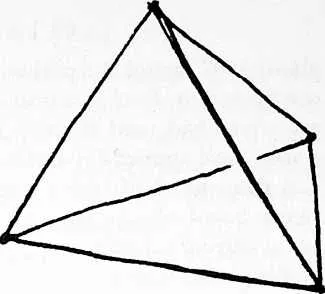
57 Tetrahedron
58 enclosure, with four identical sides; nothing simpler can be envisaged. Having of all space enclosures the maximum structure in proportion to its content, it has therefore the maximum attainable strength. Bell’s mind moved to performance per pound and to aeronautics, and the very summer before the Wrights flew he wrote in his son-in-law’s National Geographic of the virtues of a tetrahedronal configuration in kites. Such a kite will not easily lose lift, and Bell’s idea that the future of aeronautics lay in a design which wouldn’t tend to kill the pilot in case of a stall led him to hundreds of experiments with kites composed of many tetrahedral cells, as many as 1,300.
59 In 1905 such a kite, powered by a feeble breeze, lifted a man some thirty feet into the air. Bell danced about like a schoolboy while his wife developed the photographs. He was too convinced of the tetrahedron’s transcendency to bother noticing its enormous aerial drag, and aeronautics consequently passed him by. (Stabilities held his attention, whereas aircraft design was to turn on velocities.) He did erect, on his Nova Scotia island, a tetrahedronal tower, its seventy-two-foot legs meeting tripod-fashion five stories above the ground. Each leg was subdivided into four-foot tetrahedral cells of half-inch pipe, and each cell could support two tons without signs of distress. Bell had effected
60 about 1907 one of the periodical rediscoveries of the oc-tet configuration Bucky stumbled on in kindergarten, and moreover had used it in a practical structure. He seems not to have applied for a patent, and the tetrahedral tower was dismantled after a decade. Bucky had very possibly never heard of it when he came upon the principle yet again during his geometrical work of the 1940’s and wrote to his patent lawyer.
61 In 1904, the year in which Henry James revisited America and the Ford Motor Company observed its first anniversary, Bucky’s grandmother Caroline Wolcott Andrews bought an island. Bucky’s formal biographer, when he gets to work one day, will ponder Caroline Andrews at considerable length. Her three-times-great-grandfather Roger Wolcott was colonial governor of Connecticut; her two-times-great- grandfather Alexander Wolcott was brother to George Washington’s aide-de-camp. The wedding of her grandfather was the first to be solemnized in Chicago and is recorded on a bronze tablet on the lower southwest wall of the Wrigley Building. The next generations prospered in Chicago, and she herself, in Civil War days, married a Chicago lawyer, John Andrews. Their daughter, also named Caroline, was to be Bucky Fuller’s mother, and tell him how it was to watch all of Chicago burning five miles to the south of their many-acred Briarwood Farm, where the Edgewater Beach Hotel stood until recently. Young Caroline had her unforgettable view of the orange blaze from the window of a cupola atop the house. One can nearly imagine the great house from that detail: a prosperous family’s stately pleasure-dome, gingerbreaded, cupolaed, nearly min- aretted. The idiom of elegance was assured in those days.
62 Grandmother Andrews was assured, and articulate, about her family past, and decades after her death in 1906 it was a pleasure of Bucky’s to recall it in anecdotal detail. Her presence, in his first eleven years, had helped shape his world. In one photograph a large, calm woman with black mutton-chop sleeves and a lace stomacher shares something the camera has not recorded intelligibly---a piece of embroidery, perhaps?---with two grandchildren, a dark-haired girl whose attention is on something else, and small Bucky, the student of large-scale patterns, whose big-brimmed hat will not blow off thanks to that chin strap. In this comfortable vignette of a century’s end, grandmother enjoys the unforced authority of a Presence.
63 One thing with which she and her affluent relations pervaded the family was the note of success. It went without saying that one amounted to something, earning leisure time to spend at a summer place. Which is why we find Grandmother Andrews island-hunting in Penobscot Bay early in the summer of 1904. She led what was nearly a small colonizing party: her two daughters, Caroline Andrews Fuller and Lucy Andrews King, their husbands, Richard Buckminster Fuller, Sr., and Rockwell King, and all of their tribe, a total of seven grandchildren of whom one had been born cross-eyed but was far from hopeless. They moved with the easy calm of the entitled: Boston to Rockland, Maine, by scheduled side-wheeler, Rockland to Eagle Island by chartered steamer (after six decades Bucky could still recall the captain’s name--- Crockett). From a boardinghouse on Eagle Island they explored by boat and with picnic baskets the purchasable domains, and by August Grandmother had selected a mini-archipelago: Bear Island, which she purchased in her own right, and Compass and Little Spruce Islands, which her sons-in-law purchased jointly.
64 Everything, that summer, enchanted Bucky. When the side-wheeler docked at 4 a.m. at Rockland, June dawn was commencing to silhouette shadowy islands out in Penobscot Bay beyond the breakwater. Suddenly the wilderness silence was broken by the first seagull’s call, and the dawn wind touched the rapt nine-year-old’s cheek. That touch, that sound, the ghostly islands and the salt tang in his nostrils---‘‘exquisite sensorial thrill’’---remained ever after his paradigm of natural beauty, a tranquillity mysteriously astir, pressure waves and photons and particles of salt composed into moving stillness.
65 And Bear Island, thereafter the family’s summer retreat and still the chief geographical constant in his life, presented themes with which all his later speculations have comported.
66 For instance, the vision of special men, men on the move, who have stayed on Bear Island since before history begins: Indians, and then Norse fishermen perhaps, and since 1604 successive colonial settlers, building, moving, leaving. The underbrush conceals their overgrown foundations. Such men obeyed the natural laws of the sea, and shrugged off other laws. All seamen, Bucky eventually reflected, are ‘‘outlaws.’’ About 1956, at San Quentin, he confronted a roomful of prisoners, each with bowed head as if he could hardly look up. ‘‘I can’t tell you how shocked I was to see how young they all were. They were all about twenty, very few with any age at all.’’ They were ‘‘outlaws’’ whose luck had been bad. (Only the physical laws of the Universe are self-enforcing.) He told them it was ‘‘by a tiny little hair of luck’’ that he wasn’t locked up with them. (‘‘My mother used to say to me very many times that she was scared to death I would go to the penitentiary.’’) He meditated aloud on this theme a full hour, so intently that his eyes closed tight, and he nearly fell off the platform. And all human advances, he once told a visitor, originate ‘‘in the outlaw area.’’ If the Wright
67 THE OUTLAW AREA I 69
68 Brothers had required permits they would be waiting yet.
69 In the seamen’s outlaw area, where laws are real, you cooperate with powerful moving masses because there is no use getting angry with a hurricane, nor legislating against it. You design your way through it. You also treat resources as communal. Possession means use, and everyone understands that a house that is not being used is liable to removal piece by piece if some seafarer has a use for the lumber. Wealthy folk from the domain of statute law would often be surprised to find that the island buildings they had vacated last Labor Day had mysteriously disappeared during the winter, all but the foundations, no one ever knew how. The Bay folk said that such houses had ‘‘gone a drift,’’ like abandoned ships which are anybody’s property. Human laws codify customs, which in turn secure a web of mutual convenience, and the laws of the mainlanders secured a static existence enforced by title deeds. Seamen’s law defines change and the allocation of limited resources.
70 Then there were the seamen’s crafts. Nothing afloat stayed put; twice daily a tide lifted everything .fifteen feet. Combating such rhythms, and hurricanes and multitonned seaquakes, they had recourse not at all to mass and bulk but to thin asymmetrical structures kept operational by tensioned cordage. A man mastered cordage, in all degrees from heavy to delicate, and a sound splice was one of the modes of virtue. A compressioned mast held erect by tensioned cables was able to prevail because able to bend as its parent tree had bent: that was a design principle of nature, carried over to the service of human requirements. Being flexible, a tree is less often broken by wind than uprooted. A mast, being flexible, is seldom broken, and if the heeling ship makes the gesture of a tree being uprooted, it regains equilibrium as the land-
7172based tree will not. And wind fills sails held outspread by tension systems, wind sufficient to move many tons of ship, governed by cunning systems of slim lines pulling taut.
73The tendency of a tensed line to pull true pervades Bucky’s feel of the universe, where the tensest lines are of zero diameter, the intermolecular bonds or the invisible cords on which planets swing. ‘‘Therefore when nature has very large tasks to do, such as cohering the solar system or the universe, she . . . has compression operating in little remotely positioned islands, as high energy concentrations, such as the earth and other planets in the macrocosm, or as islanded electrons or protons or other atomic nuclear components in the microcosm, while cohering the whole universal system, both macro and micro, of mutually remote, compressional, and oft nonsimultaneous islands by comprehensive tension:---compressional islands in a nonsimultaneous universe of tension.’’ Earth, moon, a silicon atom, are islands like Bear and Compass, and the Universe is also like a sailing ship, with tension and compression separately emphasized and usefulness gauged by performance per pound, since every unnecessary ton of ship is a ton of cargo the less. And large interchangeable elements in a geodesic structure he sometimes calls ‘‘rafts,’’ sensing that they are afloat above our heads on a spherical tensional sea.
74If boatbuilding was the local parent technology, the primary local industry was fishing. ‘‘Such tension systems as seines, trawls, weirs, scallop drags, lobster pot heads, and traps, together with all their respective drag and buoy gear,’’ exacted of the men who tended them ‘‘deft tension techniques as spontaneous as those of spiders.’’
75Living things at home in that world taught one its economies. Bucky’s first venture in imitating the design
76 THE OUTLAW AREA | 71 principles of nature resulted from pondering the jellyfish, which moves by opening and closing, umbrellalike. He designed an umbrellalike rig to go on the submerged end of a pole, and on his daily four-mile trip to Eagle Island for the mail he was able to face the way the boat was going, pulling the pole in with the folding cone collapsed and pushing it out as the cone spontaneously opened to grab against water almost as though touching bottom. It was faster than rowing, and he didn’t need to keep turning his head to make sure of his course. (Not that he rejects rowing, though he prefers to see it scientifically enabled; a patent of his granted as late as 1970 is entitled ‘‘Rowing Device.’’ 1 ) He also made tensionally partitioned gramophone record cabinets. They have been in use now for two-thirds of a century, preserving on edge and shielding from dust such ancient discs as long ago escaped the emphatic critique of cousin Andy King, whose way of eliminating something played oftener than he liked to hear it was to skysail it into the sea like a discus. Caroline Andrews’ grandchildren were a willful brood.
78 A big house went up, designed, like Bucky’s birthplace, by his father’s classmate Henry W. Longfellow, Jr. The lumber was carried in by a two-master that had seen service in the War of 1812. Each smallest component of the house came in by ship: lumber, nails, hinges, locks, glass, bricks: a vivid enactment of what Bucky was to spend years trying to rearrange, the insane logistics of building.
79 The house is still called The Big House. Records were
80 played: they still are, still nonelectrically. Water was collected-still is---by bucket and pitcher from rainwatergathering cisterns. Books were read aloud---still are---by kerosene light. It is one of the pleasant anomalies of Bucky’s existence that he schedules a month each year in a place where the technology---but for jeep and bottled gas---is still too unobtrusive for unpracticed eyes to recognize it. A cistern, nonetheless, is true technology: a valving of certain random energies into a pattern human convenience prefers.
81 And there was Jim Hardie, who said that the hardest thing about building a boat was the ends, and preferred to splice an enormous center section between the two ends of a wreck. At six feet one he seemed twice Bucky’s size, but competed with Bucky because Bucky had schooling, while Bucky competed with Jim’s strength and his seaman’s skills. Few men had more effect on Bucky’s early life, unless Uncle Waldo Fuller who, as an alumnus of the Klondike gold i;ush and a chief engineer when they built the New York subway, was for a time Bucky’s greatest living hero. But not even Uncle Waldo could dream of matching Jim Hardie’s feat of digging and shelling eighty barrels of clams one winter, nor of teaching himself, all alone, to read and write. Jim put together the words under newspaper pictures with the words he heard on the radio. Champoilion’s feat with the Rosetta Stone was scarcely more impressive. He and Bucky shared work that entailed moving tons of stone---building a road from the harbor through the swamp, building the island’s first tennis court---with only the help of horses and oxen. The interaction of intelligence, character, and mobilized energy . . . one could start a dozen Fulleresque themes from that.
82 * * #
83 In 1907, Ford announced the Model T (and Bucky, aged twelve, coincidentally first drove a car). In 1909, Bleriot flew the English Channel (and Bucky, coincidentally, saw his first airplane). In 1913, Bucky Fuller went to Harvard, where four generations of Fullers had enrolled. Harvard was part of the family’s commitment to stability. Its roots were generations deep in New England. The first New World Fuller, a sometime British Navy lieutenant, had come to Massachusetts in 1630, seven years before Harvard College was founded.
84 And yet there was a contrary family tradition, to the effect that Fullers were random elements, disruptive of New England complacencies. The Reverend Timothy Fuller, the family’s first Harvard man (class of 1760) was a Massachusetts delegate to the Constitutional Assembly, but declined to sign a document which did not prohibit human slavery. His son, the Honorable Timothy Fuller, helped found Harvard’s Hasty Pudding Club, but was demoted to second place in his class (1801) for being mixed up in a student revolt. The Reverend Arthur Buckminster Fuller (class of 1840) got himself shot dead while leading a charge across the river at Fredericksburg. As Chaplain of the Fifth Massachusetts Regiment he had no business leading charges, but his abolitionist sentiments were too ferocious for dissipation in mere spiritual talk. He left a son, Bucky’s father, Richard Buckminster Fuller (class of 1883), who broke with a generations-long tradition of pulpit and bar to found his prosperity on tea and leather. In great lead-lined teak chests, the teas of Ceylon, India and China filled his warehouses near India Wharf on the Boston waterfront. His aunt had been Emerson’s and Thoreau’s liberated friend Margaret Fuller, and he had a nephew named John P. Marquand whose vocation was to be the chronicling of Brahmin tensions.
85 Richard B. Fuller had entered his son at birth in the Somerset Club, with an Agassiz and a Longfellow for sponsors. Bucky has not been one to disown such a heritage, though he sees no incompatibility between the Somerset Club and a card in the machinists’ union. Nor has he regretted his years in Milton Academy, where young men were prepared for Harvard. He had no trouble with mathematics classes, only with Latin, and things he learned from his physics teacher at Milton have stood him in good stead ever since, if sometimes as themes for dissent. And he played football---characteristically, he speaks of ‘‘the historically differentiated family of controlled physical principles known as ‘athletics,’ ’’ a phrase to put beside Henry James’s summation of the spectator side of football as ‘‘the capacity of the American public for momentary gregarious emphasis.’’
86 Especially since he could not distinguish friend from foe without his glasses, his football experience contributed to heightening ‘‘the ‘intuitive dynamic sense,’ a fundamental, I am convinced, of competent anticipatory design formulations.’’ He came to his freshman year (class of 1917) ‘‘puerilely in love with a special romantic Harvard of my own conjuring---an Olympian world of super athletes and alluring, grown-up, worldly heroes.’’ He was to further the family tradition for dissent by getting himself expelled, twice.
87 Two other things happened in 1913, one symptomatic, one formative. The first was the opening of the seven- minute subway between Cambridge and Boston. The second was a talk with an uncle.
88 The subway served notice that the pace and quality of Harvard experience were altered forever from norms more than two centuries old. Fullers for four generations--- Richard B. Fuller, Sr.; his father, Arthur Buckminster Fuller; his father, the Honorable Timothy; and his father, the Reverend Timothy---all had passed undergraduate days at a walking pace. Their diaries and letters, carefully preserved (the Fullers, including Bucky, have been great preservers of paper), told the same story generation by generation: a life governed by the time plans took for execution, in which it was a day-long excursion to visit Boston via Water town Bridge. You took the day off with forethought, much as a man might take off some months for a voyage to China. Now suddenly the trip could be made at whim, and in the time it takes to hard-boil an egg, very much as fifty years later China would have moved as close to Boston as a day’s flight. One coordinate of the ‘‘special romantic Harvard’’ had dissolved away, a fact Bucky’s class would be the first to experience. (Official Harvard noticed little change: did not its routines stand steadfast?)
89 As to the uncle: he was one of the rich uncles, and he did Bucky the favor of taking him aside to explain in Boston’s terms how the world was. The world was like this: it did not contain enough to go round. This fact had stood established for a good three generations, but never been widely publicized. It was Thomas Malthus, with mankind’s first comprehensive statistics at his disposal, who had shown at the threshold of the nineteenth century how population tended to outstrip resources, exactly as, by Professor Newcomb’s calculations, the weight of an airfoil would always exceed its lift. Population had since done just what Malthus predicted, and men had outgrown the era of the Golden Rule, the formulation of a less crowded world. The possessions of the haves were now founded on the destitution of the have-nots, and despite Sunday-school pieties serviceable to placate women, that was henceforth the unalterable state of things.
90 The fittest, said Malthus’ disciple Darwin, were the survivors. It behooved a man, therefore, to cultivate enough of the red tooth and the unsheathed claw to ensure that he and his loved ones should be haves. This was not nice, and he need not distress the innocent by talking of it, but there was really no choice. It had been established that a man’s chance of passing his life in any comfort was about 1 in 100. "It is not you or the other fellow,’’ explained Bucky’s uncle, ‘‘it is you or one hundred others.’’ To prosper in the Fuller way with a family of five, he would have to slit the throats---genteelly, of course---of 500 others. "So, do it as neatly and cleanly and politely as you know how, and as your conscience will allow.’’ That was a new role for conscience: the lubricant of murder.
91 The uncle warmed to his oration, which he cautioned was for Bucky’s ears alone. ‘‘I’m not going to try to educate your grandmother because she’s quite happy thinking in her own golden-rule way. And of course---unknown to her---I have taken care of her one hundred alternates.’’ She was therefore free to be grateful to God. Others, all around the world, clung to their gods and yet died off, short of their potential years, no relative having taken care of their alternates. ‘‘But they keep themselves happy by having their hopes and their infinite possibilities. So we don’t tell them about it.’’
92 That uncle was the first closed-system theorist Bucky had met. The system had closed 150 years before with the implementation of the great worldwide trade routes, shuttling resources from the domain of the ignorant to that of the enterprising. Infinity no longer surrounded a triangle, nor infinite resources a dinner table. It was clear before 1800 that there were no more undiscovered lands. There were unexploited lands, but these too had limits. Malthus could think of men becoming so numerous, spreading themselves so widely, that the limits would hem
93 THE OUTLAW AREA | 77 them in at last: indeed, were already doing so (famines in India).
94 Bucky never forgot the conversation. Elm-shaded tranquillity, attic windows to launch paper airplanes out of, Bear Island summers, fanlights and alabaster and steamship journeys to see the towers of Pisa and of Eiffel, the Somerset Club and Harvard College itself, these were founded on the elimination of other claimants, a hundred dismal failures for every success. That elimination could be wholly impersonal, hence the aperture through which conscience might breathe. No Boston tea broker administered the coup de grace to unnumbered Chinese whom starvation tended to take care of. Yet that they should covet his living standard was unthinkable (and was anyway a problem for the Emperor of China).
95 From the Harvard debacle a few themes emerge. One was Harvard’s conviction of a static world, at variance with intuitions sharpened on Bear Island. This conviction both shaped the curriculum and underwrote a system of social boxes, impressed upon Bucky at the threshold of his freshman year when his best friend at Milton Academy chose to room with someone more affluent. (What had Four- Eyes Fuller been doing at Milton Academy if he hadn’t the cash to sustain an appropriate style?) There were even three automobile owners in that class, one of them Ray Stanley of the Stanley Steamer family, and the clubs which structured social life seemed not open to a boy whose presence on campus derived from a family decision to pool such money as would suffice to keep him there. (His father was three years dead. It was only the relatives now who had money.) Meanwhile his courses---English A, Government, Musical Composition, Art Appreciation, German Lit, Chemistry---seemed as dull as the Latin in which he had
96 not achieved an A at Milton. On the eve of the midterm exams he suddenly resolved to spend as much money as the next man. He withdrew his semester’s stake, entrained for New York, and lived it up. A Ziegfeld star, Marilyn Miller, was his dinner guest, and the entire chorus line also. The waiters at Churchill’s were deferential when he signed the check.
97 As to how he had first caught the eye of Miss Miller, there is an instructive story. Being too short to be noticeable at the stage door, he equipped himself with a white wolfhound and had no difficulty standing out. His knack for the appropriately arresting gesture---the personal symbol, ‘‘Dymaxion,’’ ‘‘geodesic’’; the model home with the nude doll in the bedroom---is inextricable from his story. It puts off people who excuse themselves from paying attention because they think his chief talent is for publicity. (‘‘A punk,’’ snarled a retired dean of engineering, ‘‘who has appropriated the icosahedron.’’) He is the century’s most tireless explainer, and whatever is explained is dramatized, and in the course of the drama subtly taken possession of. At one juncture an uncomplicated routine subtracting of 2 is called ‘‘applying the Fuller Synergetic Treatment,’’ which is a kind of mathematical white wolfhound. He is publicity agent for the universe, and unfriendly folk are discoverable who feel that he explains it as though he had invented it. ‘‘I’ve gotten leery of meeting him,’’ wrote another structural innovator. ‘‘He’d tell me so much more about my own ideas that I’d end up thinking they were his.’’
98 Then there is the sense that one is entitled to money. He explains why the Industrial Equation entitles everyone, and while he arrives at this view with such careful logic that there need be no question of the wish fathering
99 THE OUTLAW AREA | 79 the thought, it would likely have been an unthinkable conclusion had he not been temperamentally pressed toward experimenting with what it would be like to do what one wanted. He has also recalled that until 1928 Robin Hood was his mythological ideal. He discarded Robin only when he perceived that affluence might be distributed without expropriation, from a cosmic bank account design science has accumulated.
100 In the early winter of 1914, however, it was the family bank account in Milton that was liable for the champagne charges. Back in Cambridge, he was not surprised to find his family agreeing with the Harvard authorities that Buckminster would have to leave. The following fall, having demonstrated acumen and reliability in a textile mill owned by a cousin, he was readmitted and promptly reexpelled as generally irresponsible. This terminated his connection with Harvard until, at the instigation of Dean McGeorge Bundy, they appointed him Charles Eliot Norton Professor of Poetry in 1962. T. S. Eliot had occupied that chair.
101 ‘‘I am the opposite of a reformer,’’ he told an academic audience forty-six years after his second expulsion. ‘‘I am what I call a new former. The new form must be spontaneously complementary to the innate faculties and capabilities of life. I am quite confident that humanity is born with its total intellectual capacity already on inventory, and that human beings do not add anything to other human beings in the way of faculties and capacities.’’ (He might have been remembering that no one taught Jim Hardie to read.)
102 ‘‘What usually happens in the educational process is that the faculties are dulled, overloaded, stuffed and paralyzed, so that by the time most people are mature they
103 have lost many of their innate capacities.’’ An old priest once spoke to W. B. Yeats in a railway train of ‘‘ignorance spreading every day from the schools.’’
104 Bucky’s belief that the school is an ignorance factory distills a half-century’s reflection on the fact that, essentially, he educated himself, and to such effect that fifty years after his class graduated without him, Phi Beta Kappa, to repair an oversight, awarded him the key he is never without.
105 In missing formal higher education he missed the advantages and liabilities of being initiated into a shared culture. That is perhaps the most that college accomplishes. George Santayana, a sometime Harvard instructor, was to reflect that the precise books young aspirants might read mattered less than that they should read the same books. Homer in some such sense had been the educator of Greece, and the biblical authors the educators of Western Europe. Whatever misinformation these works may contain---and the Bible for instance seems to assign to pi a value of 3.0---everyone who was familiar with them enjoyed the enormous advantage of a shared terminology. (Biblical quips pervaded demotic English speech as late as Victoria’s time; a pub-keeper was a publican, and a cabby a Jehu, after the man celebrated in II Kings 9:20 for driving ‘‘furiously.’’)
106 When President Eliot late in the nineteenth century made Harvard’s curriculum a smorgasbord of electives he sacrificed that principle to some extent, but not wholly, the curriculum having ceased to be really central. College youths whether they major in Education or Egyptology proceed for the rest of their lives from a shared rite we may call the College Experience. It hardly matters what college. An alumnus of Wesleyan and an alumnus of Iowa State will have more in common than will two Vermonters of whom one has gone to college and one not. In a country without a capital as the French and English understand a capital---for Washington is not so much a capital as the place where the government is kept---intelligence flows and experiences are shared through the College Network. Places otherwise inconspicuous are points on that network: Hanover, New Hampshire, Charlottesville, Virginia, Bennington, Vermont, Poughkeepsie, New York. But on such a map, for instance, Sacramento, the capital of the most populous and richest state, is invisible, though its neighbor Berkeley is marked with the circled star which mapmakers reserve for major centers.
107 Time spent in a node on that network means many things. It means, for one thing, that shared idiom. Lacking this, Bucky has developed a curious jargon of his own for discussing the universe. He would be quick to point out that he also escapes a shared idiom’s liabilities. What is known is apt to be identified with what the common language readily describes, and novel combinations are so difficult to achieve that people gifted that way are given the special name poets, and run the special risk of having their communications thought insubstantial.
108 College also brings classifiability. You are apt to be what you have majored in: an engineer, an historian, a linguist. This promotes acceptance. Real impediments attend life outside the authorized box. Is Bucky an architect? No, say the architects, an engineer; no, say the engineers, a mathematician; no, say the mathematicians, but perhaps some kind of poet; no, say the litterateurs, a jargon factory. In any case listening to him is somebody else’s responsibility. He calls himself ‘‘a comprehensive anticipatory design-science explorer,’’ and moreover has said ‘‘I seem to be a verb,’’ but there is no major in verbhood.
109 82 I BUCKY
110 Another thing a man may get out of college is a sense of what the faculty agrees has been found out. Let us postulate an idealized case. Let us roll back time, and reenroll Bucky Fuller in Harvard, and remove the social and financial pressures, and put him in mathematics classes where he may indulge his great aptitude. Let us graduate him in 1917, appropriately oriented in the advanced reaches of that subject as 1917 understood it. He has complied, unresistingly. He has approached the known themes by the orthodox routes. He is no verb but a noun: ‘‘a mathematician.’’
111 One impression may be that such an experience would have saved him years of time. ‘‘I found . . .’’ he says repeatedly, describing his tireless investigation of geometrical models: and what he found was time and again some detail established long ago. ‘‘He doesn’t know anything Archimedes didn’t know,’’ whispered a bright student during one of his expositions. That isn’t true, but it points toward a certain truth.
112 Working with models, he has kept his mind on the parts of mathematics that cope with forces, counterforces, changes. A Fuller triangle is something that will twist if it isn’t braced, a pencil-line triangle isn’t. By staying at Harvard he would have acquired the habit of deducing from postulates---those unreal postulates, the point, the line ---quite as though nature, like Harvard, kept mathematics in a separate department where two lines can pass through the same point even though in the physics department two electrons can’t. And he would have inherited the orthodox conventions as to which are the main themes, which the details. Rediscovering the subject by his own curious route, he has had no reason not to emphasize what are normally considered details. The cuboctahedron, for instance, is a detail in most expositions of solid geometry, one of the
113 THE OUTLAW AREA | 83 so-called quasiregular or non-Platonic solids. Bucky, who calls it the vector equilibrium and for a while even called it the Dymaxion, encountered it not as a ‘‘solid’’ but as a system of equipoised thrusts, and was not inhibited from perceiving ‘‘the Grand Central Station in the energy system of Nature.’’ Ignorance of the orthodox hierarchies was as liberating as his kindergarten ignorance of cubical norms.
114 Ezra Pound, aspiring to musicianship, drew encouragement from a performance of Debussy’s Pelleas, ‘‘ignorance having no further terrors if that DAMN thing is the result of what is called musical knowledge.’’ Let it pass that his own Le Testament did not revolutionize opera: the attitude is intelligible. In appraising Fuller’s relationship with the academy, the experience of Pound’s literary generation may help us.
115 Though Pound might seem to have been a more likely candidate for expulsion than a fifth-generation Harvard man, he nevertheless persevered to take not one degree but two (B.A. Hamilton, 1905; M.A. Penn., 1906). He had the advantage of knowing what it was he wanted to become, a man of letters, and could see the use of various sorts of classroom knowledge. Indeed his career is unintelligible apart from his classroom work in what would now be called Comparative Literature. Yet he was to spend much of the next two decades putting the facts he had been taught together again in a historical pattern of his own, and excoriating the academic system. What his complaint amounted to was this, that the system imparted the facts but had only a received and inert sense of the relations between the facts. These were dynamic relations, whereas syllabi are static affairs of language and period. When everything has become ‘‘evidence’’ the lecturer can no longer distinguish the unique virtu of Arnaut Daniel, Dante’s high estimate of whom becomes one more fact, a
116 84 | BUCK.Y curious one. The lecturer has the Provencal syllabus to get through, and Daniel is difficult anyhow.
117 The experience of Pound’s friend T. S. Eliot is subtler. Like Fuller he attended Milton Academy. Like Fuller he had family ties with Harvard. Unlike Fuller, he graduated (class of 1909). Later, like Fuller, he occupied the Charles Eliot Norton chair, and his was, like Fuller’s, a somewhat daring appointment, for in the years since his graduation he had become known for poetry that seemed not to answer the seminar definitions of poetry, and for historical pronouncements the likes of which had been heard in no classroom anywhere. In classrooms opinions of Shakespeare were imparted; and, ‘‘Who,’’ Eliot asked a few years after he graduated, ‘‘has a first-hand opinion of Shakespeare? Yet I have no doubt that much could be learned by a serious study of that semimythical figure.’’
118 His seminal theme, like Pound’s, was experience, experience of the literary work. Classroom schemata did not incorporate experience. The critic, Harvard had taught him, sets facts in order, historical facts. No, Eliot rejoined, quoting Remy de Gourmont, the literary critic’s job is to start from the impressions literature makes on him, and to erect those experiences into something like a structure of laws. Appealing to experience, he and Pound seemed mavericks. In this respect their story is much like the story of Fuller’s disdain for mathematical postulates. When Fuller first heard a teacher discourse of the cube, he wanted to know how long it had been there and how warm it was, and was reproved for impertinence.
119 The difference between the literary and the mathematical maverick stems from the fact that literature offers experience to anyone who will heed it. Great talent may therefore survive classrooms, and even profit by what classrooms impart; Hamlet, the Divine Comedy, will still be
120 there after graduation day, summoning attention. But the experiences mathematics proposes to set in order are easier to disregard and more difficult to heed, lost as they are in the subject’s prehistory, obliterated under the majestic structure of deductions from postulates no one can any longer have the experience of making. To postulate a dimensionless point was daring once; mathematics forgets that daring. Bucky was perhaps lucky not to know how daring it was to be pondering the equilibrated thrusts his little wooden models contained.