
2 The Star-Spinner
2There are times when he seems not native to this planet. The pink dome is surely not terrestrially cranial; those Coke-bottle-bottom lenses shield extragalactic eyes; plastic tubes join twin transistor-capsules to uncommon ears, attuned perhaps to the music of popping atoms; and while someone anonymous wires him up for sound, hanging from his neck the microphone whose cable snakes toward a glow of red pilot lights, he extends his arms, a cooperative automaton, hiking in synchrony the open black coat, the black vest beneath, and the gold Phi Beta Kappa key, while white cuffs shoot out of his sleeves. (Phi Beta Kappa? There are no records of earned degrees.) The face is quizzical, gnomelike, its gamut of public expressions rather slight: Intensity 1, Intensity 2, Intensity 3, and (4) a sudden furrowed blankness. There is sparse white hair, like a model-maker’s afterthought. There are crisp black trousers, as though studied from the Naval Dress Code. One leg, when he walks, seems shorter than the other; or is that, as some say, a shipboard gait? Or do servomechanisms respond haltingly to the floor? He reaches both hands toward the back of his neck, where the mike cord hangs snug; he gives the mike on his 'chest a ritual tug; the applause is dying down; he looks suddenly, boyishly, human, with a grin like a waif surprised naked.
3 ‘‘A self-balancing, twenty-eight-jointed adapter-base biped,’’ he wrote once, ‘‘an electro-chemical reduction plant, integral with segregated stowages of special energy extracts.’’ And 62,000 miles of capillaries. And he has often remarked that its manufacture is entirely automated, incomprehensible even to the persons who initiate it. Like all parents, his parents did not know what it was they were doing.
4 In the years since they did it he has traveled more than three million miles, mostly for lecturing. Like the winds, which he likes to point out are not ‘‘blown’’ but ‘‘sucked,’’ he is never ‘‘sold’’ by an agent but always invited, so his travels attest not a triumph of press-agentry but a hungry worldwide interest in his ideas. A map of them would locate, he thinks, the growth-nodes of active curiosity. Their frequency began mounting just after World War II, and in 1967 alone he kept some ninety speaking engagements, in Lebanon, Iraq, Syria; in Missouri, Iowa, Arizona; at the Association of American Geographers, at a Symposium on Design and Aesthetics in Wood, at the Esalen Institute (Big Sur, California), at Sunset Church (Sunset, Maine). He told the Sunset congregation why the word sunset should properly be sunclipse. The New York Board of Education has heard him, and the Laurentian Conference on Corporate Strategy, and a National Conference on Environmental Health Management sponsored by the A.M.A. He has stood still long enough to be awarded, at last count, twenty-nine honorary doctorates (Dartmouth, Columbia, Wisconsin, Michigan . . . ), a gold medal from Her Majesty Queen Elizabeth II (who was prompted by the Royal Institute of British Architects), a gold medal
5 (architecture) from the National Institute of Arts and Letters, four more gold medals; and (twice) the Gran Premio at the Triennale de Milan; and (five times) awards from the American Institute of Architects, although he is not licensed to practice architecture. He has sponsored such wonders as a mastlike structure that will rise and rise as high as you choose to build it, though none of its struts touches any other strut. No one knows what to do with this, though a specimen stood for a year in the garden of the Museum of Modern Art. And a nine-passenger car just one foot shorter than the space it could park in. And the lightest, strongest, altogether most economical clear-span structures known to man. The Cathedral in Seville would fit under one of these, though three of the cathedral’s columns would outweigh it together. He holds patents in fifty-five countries, including the 818th patent ever granted in Korea. One of his Geodesic Domes stands over the South Pole, shielding a cluster of conventional buildings against accumulating tons of snow while rotating on the same axis as the earth. The South Pole is one of the few places where he has not lectured. He goes around the world an average of three times a year (spacemen, he likes to remark, better that in less than five hours).
6 Wired to recorders and loudspeakers like an astronaut to sensors, he prepares at the inception of each lecture to commence a new journey through the universe. All moon flights entail the same risks as the first one did. They are all alike and never alike. The captain’s vigilance will be incessant. Bucky closes his eyes and clasps his hands an inch in front of his nose. It is a crucial instant: countdown. Improvising a flight plan, he is picking up the vibrations of the audience.
7 California Hall, San Francisco, a Fire Marshal’s nightmare. The three-story cavern, ornate with gilt and chandeliers like a Brobdingnagian bordello, is jammed with impatient people and blue with smoke; perhaps a thousand people, crammed onto wooden folding chairs, standing along the walls, herring-packed into tiers of balcony seats, squatting in aisles, forced upright along the walls by sheer numerousness, stacked as if supporting one another erect; seventy-five tons of bodies, extracting oxygen from tons of air with their lungs and cigarettes; beards, headbands, leather skirts, mother hubbards, sequins, beads, nursing infants; closely packed denizens of the counterculture. Spotlights converging from gilded balconies mark out a zone of floor in front of what was meant to be a stage but tonight is a bin to pack in more hearers. A huge red tetrahedron towers at the left, someone’s notion of an emblem: a red triangle surmounted by a ten-foot red tripod. Beside it the black biped with the pink face confronts the blur of multitudinous faces. His antennae, he will say, are catching subtle currents of psychic feedback. The audiotape reels have started. The three videotape cameramen have adjusted their angles; on a monitor screen behind the tetrahedron an engineer tends the blue flicker of what they see. The crowd is really silent at last. Bucky commences:
8 ‘‘Well . . .’’
9 The pitch is tentative, the demeanor bashful. He lifts his hands faintly as though about to explain a broken window.
10 He’s described this moment, too, when the ‘‘sounddetonating mechanism’’ has to be put into action. A spring leaf diaphragm squeezes an air chamber, and an executant called ‘‘Brain’’ ‘‘first sculpturally arranges the passage to the orifice of the raw fuel-receiving hatch and shapes the orifice as well as the wall structures of the tubes leading from the orifice to the air chambers; then, by an adjustable mutable tongue cone, which proportionately occupies the
11 THE STAR-SPINNER | 17 orifice and has a tip which is free to vibrate gently, ‘brain’ causes a continuity pattern of sound control to issue forth with high variation frequency.’’
12 That’s a rhetoric he discarded thirty-five years ago. Like many wordmen at cross-purposes with their culture, he perfected his satiric skills the earliest. ‘‘Wherever there is objective truth there is satire,’’ remarked one twentiethcentury satirist, Wyndham Lewis, and Bucky’s passion for X-raying what really happens seemed sardonic before he developed friendlier strategies. Nowadays he keeps audiences spellbound with the utter reasonableness of meshwork balloons, collapsing cubes and cows of knotted sunlight: the normal view through his glasses. Also, worldround Utopia in his younger hearers’ lifetime.
13 He has no wish to astonish with such things. He is only happy sharing them, and only made tart by clownish refusals to understand, which he rightly thinks discourteous. If there is one thing he refuses to believe, it is that any phenomenon accessible to human reason can really be incomprehensible, and there’s a kind of dismissive shrug that gets his back up. The New England aloofness into which he can retreat at such moments, directing his magnified gaze straight past the dissident’s head, is normally swamped by temperamental gregariousness. His Heaven would contain twenty-six-hour days in which to share the universe with everyone. By way of making a demographic point, he once conceived the entire population of the earth engaged in dancing the twist in New York City, with everybody sheltered from the rain.
14 A human face turns him on instantly. As his plane’s engines die he’s waving behind the window at a face recognized from fourteen months ago. As he and his wife, Anne, debark he’s waving again. Stumping across the tarmac, he thrusts out a hand and raises toward his greeter
15 a broad lopsided grin of pure pleasure. He is ready with the name, one of thousands he knows. ‘‘And your curly- headed little boy, how is he?’’ Last year he and the boy had shared five minutes counting the vertices on an icosahedron. Bucky had seemed pleased that there were, as usual, twelve. From their sixty-two-inch altitude his eyes look up at as many faces as they look into, one experience he and children have in common.
16 Still exchanging greetings, he grapples for the largest suitcase. He learned long ago, he says, at Armour & Co., how to sling whole sides of beef. No manageable weight unbalances him, despite his having only one hundred and forty pounds to counter it with. Technique, not heft, that’s always his secret: doing more with less. He calls a progressive lessening ephemeralization.
17 At the parking lot he’s checking times and distances. Four miles to dinner; and then how far to the lecture? Another four miles. Mary (an old friend of his daughter) has asked in a few supper guests; will there be time to talk with them? There shouldn’t be, really---the plane was an hour late---and yet there is. He sits in a red chair, his plate on his lap, surrounded by young faces, and offers them perspectives on pollution (squandered assets: those skies are sulphur mines), revolutions (the ones that count are invisible), and politics (‘‘It is not for me to change you. The question is, how can I be of service to you without diminishing your degrees of freedom?’’).
18 Having ephemeralized away some sixty pounds since the days when he was built like a Yankee Khrushchev, he adorns parlors now like an alert little clergyman, spruce and always black-suited. Listen, though, and the simile alters. That tireless voice that could harangue if it wanted, shaping brief cadences that run quickly upscale like eyebrows rising, recalls rather a Down-East storekeeper, urgent
19 about the virtues of some lobster trap or lightning rod. His humor is laconic, evanescent. Someone’s remark about Southern California zoning ordinances draws a wry phrase about ‘‘mission-style geodesics.’’ Time, among these happy people, seems timeless. In the nick of time he has vanished for the ride to the auditorium.
20 And here he is, in yet another city, before that huge blur of faces, once more finding the first thing to say. Not, we are to understand, with his brain. The brain is under orders from a subtler entity, one that can commune across distances as seamen do with wireless. The whole miraculous self-servicing mechanism, brain and all, he likened long ago to a ship, a ship like a battleship in the great days of sea power, equipped for long independence of the shore by gear landlubbers don’t dream of playing with, and under a captain’s command, but a phantom captain.
21 The phantom captain has not only never passed a physical, he has resisted every effort to corner him. He has eluded even attempts to ascertain his weight at the moment he abandons ship---a moment called ‘‘death’’---slipping away without the scale pointer even flickering.
22 (Somebody dying on a pair of scales: to such absurdities can science lead. Did any researcher expect to weigh the ‘‘soul’’? Yet how else would we be sure the phantom captain is weightless? Might anyone, for that matter, have expected to clock sunlight? Yet we have learned that sunlight has its speed, like a Cadillac. Weighing, measuring, timing, the scientist always teeters on the brink of the absurd, and whenever he obtains a negative result we feel entitled to smile. And he replies that his results are never negative. Learning something is not so that you thought was so is not to lose but to learn a great deal more. It is impossible to learn less.)
23 Though the scale pointer does not flicker, we know
24 when the phantom captain has abandoned ship, because the vessel’s temperature drops and it commences to disintegrate into its elements, the same elements as those of which the universe is composed, and in roughly the same order of abundance. While the captain is in command of his intricate mechanism, it behaves in purposive if ungainly ways. If Shakespeare, it may scribble, if Picasso, dash pigments. If Henry Ford, it may assemble a vehicle. If Charlie Chaplin, it may eat its shoe. Other phantom captains, yours and mine, are glad (for elusive reasons) of the scribbled words, the spattered canvas, the Model T, the spectacle of ludicrous ingestion.
25 If it is Richard Buckminster Fuller we confront, January 1972, then a mechanism in service seventy-six-plus years may be observed momentarily immobile, except for the motions of balance and of oxygen exchange, while the phantom captain deliberates how the ‘‘sound-detonating mechanism’’ shall be configured. What to say?
26 For he has no script, never has. He is committed to spontaneous thinking out loud, guided by his intuition of his audience and his occasion. Homer was often in this uncertainty while kings waited by firelight, and no more than Homer is Bucky without resources. Like Homer, he has formulae, to be uttered while he is rapidly thinking ahead.
27 One time Homer began,
28 That man relate to me, Muse, . . .
29 ---a stock opening; then in moments of need, stock phrases. The dawn is rosy-fingered, Athena is glinting-eyed; such words fill up voids as the syllables tick by, and while lungs and chest and throat occupy themselves with rolling the sounds out, Homer’s phantom captain makes a thousand determinations, busy among his paradigms of nobility. One incomparable result has come down to us, called The Odyssey. We now think there were other Odysseys, many, all lost, since he told it differently at many different times. And Bucky?
3031B. Fuller never makes special preparation or prewriting of his lectures. He assumes our whole lives are fundamental preparation. He has learned to ‘‘think outloud’’ with large and small audiences regarding his explorations, experiments, experiences and deduced generalizations even as we will converse intimately with one or a few beings. His discourse is frequently tape-recorded and transcribed to typescript. Because aural syntax is so unlike the visual syntax, his transcripts require an average of seven retyped reworkings. He speaks at a rate of seven thousand words an hour, which requires three written words for each spoken word. . . .
32 ---another way of putting it, as phrased in his office in Carbondale, Illinois. Homer’s agent may be imagined putting out such a bulletin. But not, for Homer, seven thousand words per hour! That is two words a second, and even faster when Bucky is caught up in his discourse, at about the conventional lecturer’s stopping point. ‘‘I need all the time it takes.’’ By the fourth hour the pressure of utterance has often mounted until he is barely finishing the words. Something Delphic is happening, and caught up in his vast integrative visions, he sends syllables tumbling like a rain of photons.
33 But that lies two or three hours in the future. Just now the phantom captain is electing a formulaic opening.
34 ‘‘I am not a genius . . .’’
35 or
36 ‘‘I was born cross-eyed . . .’’
37 or
38 ‘‘Suppose I have a rope here between my hands . . .’’ (Santa Barbara, December 1967, in a TV studio, under the lights, before twenty privileged people. A videotape is in progress for the University archives. He is supposing he has that rope.)
39 ‘‘…between my hands; and I have tied it in an ordinary overhand knot; one rotation of 360 degrees, a second rotation of 360 degrees, one of them passed through the other…’’
40 (The hands whirl, shaping space. Through the new terminology we can see that knot. Tomorrow work with pencil, paper and string will assure us that the terminology is accurate. One circle, 360 degrees; another circle, 360 degrees; the knot does consist of two circles, and they do interlock. And twice 360 degrees is 720 degrees, a figure we shall meet again.)
41 "And when I pull the ends of the rope, the knot does not disappear. The knot gets tighter. Each loop prevents the other loop from disappearing. So the knot is a pattern in the rope, and it’s a self-interfering pattern. The harder I pull, the more the knot stays there. . . .’’
42 It does indeed. Gesturing across his chest, he pulls that phantom knot till in empathy we seem to be pulling on it ourselves. He interrupts himself to remark that he has used this example before audiences many times, and no one has ever objected that there is no knot because there is not even a rope. Something important has already happened, what he calls a first-degree generalization, one step away from every special case. We have each of us, as we watch, a clear and distinct knot in the mind, understood as we may never have understood a knot before. As if by X-ray, we can see through it, think its structure. A knot in a rope would be a model of that mental knot, and a less than perfect model since we should not be able to see into it when it is pulled into a tight lump.
43 Now, he goes on, we might loosen the knot, and slip it along the rope. We are then slipping rope through the knot: feeding the rope through a pattern. And if we have a nylon rope, a cotton rope, a Manila rope, all spliced together, these materials will pass indifferently through that knot, so we cannot say that the knot is Manila or nylon or cotton. The knot is a pattern, a ‘‘patterned integrity.’’ And the knot isn’t the rope. (In the same way the phantom captain is not the mechanism he commands.)
44 ‘‘. . . a self-interfering patterned integrity’’: and we are somewhere in the terrain commanded by Fuller’s special jargon. This has gained him something of a reputation for being incomprehensible, as indeed he is if our habit with printed pages is to skim and dip.
45 Next we are told to imagine the great winds, molecules of air being sucked across the Pacific, and across the California coastline, and into this room, and into our lungs. And out again, after the oxygen exchange. (We have possibly just expelled some molecule that once passed through Julius Caesar.)
46 Sixty pounds of air each day cycles through each of us, and food passes through us, too, and water likewise. In a lifetime some hundred tons of solids, liquids and gases will cycle through a man like rope passed through that knot. The man is not yesterday’s steak or this moment’s lungful or his most recent martini. The man is a self-interfering patterned integrity, like a knot.
47 John Donne would have been delighted, and Bucky for his part has sensed that on a printed page the knot deserves better than encasement in a rectangular paragraph. He has arranged it into what he calls ‘‘ventilated prose.’’
48 . . . and man is a super galaxy
49 of galaxies of slipknots
50 sliding sum-totally along
51 in a complex of reciprocal slip-knot principles upon a complex of associable, limitably tunable and sensorially apprehendable
52 in-knottings of slippable principles . . .
53 The rope makes the knot visible. The food, the water, the air, make each of us visible, and audible, and heavy. They are not us. They are elements in a flow of patterned transactions, of service to the phantom captain.
54 (And what is that steak, incidentally? A knot likewise, tied out of solar energy. Onto Spaceship Earth the light pours, and with it the invisible radiation which we do not perceive as light. Much of it is reflected back into space, for instance by the white clouds. But some is impounded by the green leaves of plants. They are green because we see them by the radiation they reject; they are impounding the red, the hot, and in such quantities that they require to be water-cooled---if you deprive a plant of water the leaves burn. They tie the solar energy into self-interfering patterns which cattle---knots likewise---transmute into protein we can transmute. We say that we eat steak. Really, we are acquiring knotted sun. We cannot deal with it directly---except on a limited scale, by taking a sunbath---but the plants can, and we eat plants, and eat animals that eat plants.)
55 A while ago he was halting, sentence by sentence. By now the cosmos of recycling patterns has taken possession of him. The voice is rapid, as though seeking means to utter many sentences at once, so doing the cosmos fit homage. The right hand, spread as though gripping crystal spheres, is pulling in quanta of sunlight; before his chest, in tense rapid movement, his fingers fashion intricate knots. His gaze travels to some distant point along a sight line just above the listeners’ heads. One node is defined and tied. To go on with the multidirectional discourse he is spinning, he must elect the filament he will follow, and
56 locate the next knotting-point. If all goes well, it will hang, when he has finished, a mini-universe, a spun skein of stars. He collects its invisible stuff out of many minds. (‘‘Possibly what we have always spoken of in the past as telepathy is in fact ultra-ultra-high-frequency electromagnetic wave propagation. We may find that we are doing a great deal more subconscious communicating with one another than we are accomplishing in the ‘reality’ of the visually tunable ranges of the electromagnetic spectrum. …I am confident that my spoken thoughts are greatly affected by subconscious feedback from my audiences.’’)
57 He feels an astonishing kinship with his audiences, and would have them feel it with one another. (He dislikes politics. Politics divides.) One of his gambits is to dissociate them somewhat from their bodies. (‘‘Stick your tongue way out before a mirror. It is a strange device.’’ And, ‘‘If you were tongueless, and someone came offering to sell you a tongue, would you buy such a thing?’’) And bodies are extended and modified, by inlays, by lenses, by enema bags. Automobiles are extensions of their drivers, like hats, coats, shoes and faces; so if the average car weighs 3,000 pounds, the average young American now weighs a ton and a half. And ‘‘the composite American extensible into his group mechanisms’’---a jetliner, a railroad train, Boulder Dam--- ‘‘is larger by millions of times than any historical animate organism.’’ For if a car extends its driver’s body, a jetliner extends 200 persons’ bodies; and ‘‘industrial mechanisms so gargantuan as to be without warrant as an extension of any one person are justifiable as extensions of multitudes of persons,’’ and all people, when they are using such extensions, are ‘‘one and the same person.’’
58 But only in a certain respect; he does not thrill, as did Russian film makers forty-five years ago, when human passions are subsumed into the massive dance of machines.
59 And he believes so absolutely in the judgment of the folk that for years he has been advocating some way of taking electronic votes, to provide ‘‘an instantaneous contour map of the workable frontier of the people’s wisdom.’’ In a 1971 television play for which Fuller was ‘‘Consultant for Earth’’ (as distinguished from another consultant whose domain was Space), the people of America, of France, of Russia and of China all voted to go ahead and colonize ‘‘Earth II’’ by turning on their house lights while an orbiting spacecraft scanned the luminosity level. A Fuller parable: politics divides; but a shared technology, he thinks, unites.
60 Here is a strange man indeed, a technological frontiersman, a small-d democrat. In the latter role, like the shoeless St. Francis, he personifies a naive challenge: how many politicians, piously encomiastic toward popular wisdom, would really consent to entrust their actions daily, by daylight, to its instantaneous scrutiny? Another question comes to mind. Is the populace well enough informed to govern by daily hunch? Gullibility aside, does Fuller really believe in the transparency of the information medium through which our perceptions of politicians come? Not at all; he calls news ‘‘our most polluted resource.’’ And finally, what of literature’s long testimony to the shifting, fickle mob? Is he perhaps innocent of literature? Or does he think, like Ford, that history is the bunk?
61 But while we think up questions, process is streaming through self-interfering patterns. All questions except questions of principle pertain to time. (‘‘Principles do not begin and end. Experiences do.’’) And any question, for Fuller, pertains to details excerpted from a Whole System, and is apt to launch one of his expositions of the Universe. On with the star-spinning. To consider means to group stars in one’s view: the word traces back to the dealings of
62 Roman augurs with sidereal arrays. Where will Bucky’s skein of light loop next?
63 That depends, night by night, on the people in the room with him.
64 ‘‘Every one of us is going through so many experiences. Just today, the morning’s news colors the other things I have been thinking about, so as we meet there is something fresh to be talked about. I am very deeply aware of a human being’s eyes. Like meeting on the street: ‘Do you have time to talk now?’ ‘Yes, I do.’ I can have conversation with a whole lot of people, and I do it through their eyes. They let me feel very strongly whether I am talking about what we ought to be talking about.’’
65 Milwaukee, Expo-Center, the American Institute of Architects State Convention. Assault of strobes, blare of rock: a scheduled ‘‘happening’ has invaded the brontosaurian calm. Marchers are wearing boxes as a hint that the architects present make a living at boxing-in. In Messiah robes and beclustered with balloons, a hairy kid climbs a packing-case Mount Tabor, and amid a din from which sensitive ears pick out obscenities he is transfigured in the manner of Skidmore, Owings & Merrill (‘‘The Three Blind Mies’’) while disheveled worshippers bow. If this is the Program Committee’s idea of a convention, some angry delegates will boycott the rest of it, beginning with Bucky’s marathon statement tomorrow. Tonight Bucky grins at the goings-on, and Anne grins at Bucky; a flashbulb catches them. ‘‘I’m sure some were shocked,’’ is his mild comment. ‘‘And I think that is what Nature wanted to do. There are young people shocking you right now and you need to be shocked to the point where you have to come out of that eggshell. You are going to come out of that eggshell to a sense of responsibility to the Universe.’’
66 Tomorrow he will commence by evoking Wombland, the nation formed by Spaceship Earth’s unborn children, sixty-six million of them at this moment, the tenth largest nation in the world. (What human group can have more interests in common? What better claim on nationhood? ‘‘They have a regular way of life in there.’’)
67 ‘‘How are things over there with you?’’ runs their telepathy. ‘‘Things are great over here.’’
68 ‘‘I don’t know what is going on, but we seem to be going through some kind of earthquake.’’ This one is starting to be born.
69 Enclosed in its egg, the chicken uses up its nutriment, pecks the shell looking for more, and breaks out. ‘‘Suddenly there is a chicken on its feet, and a new relationship to the universe.’’ It changes the universe slightly but irreversibly to have one more chicken’s consciousness sensing its patterns. What an alteration of the Universe, when Man is born!
70 ‘‘We have been in a womb of permissive ignorance, surrounded by all kinds of resources. Life is born ignorant. If it had been up to human beings to invent oxygen, man would have died right away. Newborn man doesn’t know anything about what is on board.’’ (Like that chicken in the egg, he pecks blindly.) ‘‘Only for two hundred years has man known what he does with air, that his lungs differentiate it. And the man who discovered that [Lavoisier] had his head cut off. That is how logical man is so far.’’
71 And now we have nearly enough knowledge to manage with, and just when the supply of resources in the egg is reaching critical lows---unbreathable air, undrinkable water, exhausted mines, leveled forests---the new Man is at last being born. . . . ‘‘Out of the eggshell to a sense of responsibility to the universe.’’
72 We are born not even knowing we are on a globe, let
73 alone on a spaceship. We have all been persuaded of that for only three centuries, and most of us are still unpersuaded that ‘‘materials’’ are really patterns, that ‘‘things’’ are insubstantial, that a paradigm for reality is the knot. A rope’s very fiber consists of molecular knots, constellated amid vast spaces.
74 In Jorge Luis Borges’ story called ‘‘The Aleph,’’ a house in Buenos Aires contains in its cellar, toward the right of the riser on the nineteeenth step from the floor, nothing less than The Aleph, which is ‘‘a point in space that contains all other points.’’ It is little more than an inch in diameter, and contains, as you gaze into it, literally everything: tigers, pistons, bison, tides, armies, a Persian astrolabe, all the ants on the planet.
75 That Aleph is the unique magical peephole. For Bucky, however, every phenomenon is Aleph-like. A virus molecule contains a Geodesic Sphere, a model of rational energy accounting, Pythagorean geometry, a focus of patterned transformations, anything principled. A man-made geodesic models that molecule, and an ideal monetary system would model them both. The tremor of Jell-O in a bowl on the restaurant counter will lead him to the tensional/ compressional ultimates of the solar system, or vice versa. And that knot is one of his splendid Alephs.
76 Dilating on all matter as knotted energy, patterned energy, he might tell us that Einstein’s E = me2 makes Energy (E) equal mass (m) multiplied by the speed of light (c) expressed as an area<2): precisely because, when the knot is somehow untied, the energy bound up in that mass expands at light’s speed, propagating a radiant sphere the surface of which expands as the second power of the outward velocity.
77 Or he might contrast this norm of patterned flow with the old norm of rest that seemed natural to Newton’s mind.
78 At Harvard, when Bucky went there in 1913, rest was the norm, and attrition the typical event; the universe was leaching away, and one’s obligation was to grab what one could before all the ice cream had melted. Rest was the norm at Harvard: he found the place so inert he contrived to get himself thrown out of it twice, the second time for keeps. But now change is the norm.
79 Or he might note that our senses can ‘‘tune in’’ on the knots, and only some of the knots (try to eyeball the stubborn knot we call a virus), but they cannot tune the flow; and ‘‘99 percent of the transactions of the universe are infra or ultra to man’s sensory tuning.’’ So man, already automated, extends his senses with further automation, electron-scanning microscopes for instance, and relies on his intellect to tell him with precision what even his augmented senses cannot discern.
80 Or, if he sensed a roguishness in the auditorium, he might serve it with a fanciful cadenza in which metabolic flow through the human knot runs backward: the excreta reabsorbed, the digested food reconstituted, the direction of cooking’s molecular changes reversed, the vegetables leaping into the cans, the cans into cartons, the cartons onto trucks which back their way to the canneries; back, then, to the fields, and back into the ground, to be unraveled into air and water and sun. And where does man’s metabolism commence? Not in his stomach. It commences many miles away from his breakfast table, when the solar energy is captured by a leaf, and it incorporates the canneries (predigesters) and the supermarkets and the trucks and the gas that heated dinner (deputizing for body heat) after having first flowed through 1,500 miles of pipeline. (That gas too was once solar energy, impounded by Precambrian trees.) As I write this, my next Wednesday’s breakfast is converging toward me at various rates, in various trucks and way stations. All these things flow and shuttle the way our lungs do, and our peristalses do, man having by tireless ingenuity extended his ‘‘ecological sweep-out’’ by thousands of miles. A Maine lunch may employ sunlight impounded by Hawaiian pineapples.
81 And any of these facets adjoins more, so that if you listen to Bucky speak a number of times you hear many things twice or three or four times, never quite in the same words and almost never in anything like the same sequence. He is tireless---until lately he hardly slept---because his energies feed on his vision of universal coherence as gods once fed on ambrosia. You may be fortunate enough to hear one of his breathtaking swerves toward a quite unforeseeable focus. One day he remarked of energy distribution that it tended on the whole to collect into smaller and smaller packages. ‘‘The number of times that you encounter small amounts of energy that can do small things is very much greater than the number of times you encounter large amounts of energy that do large things.’’ There are more mosquitoes, he added, than there are earthquakes, and encountering a very large amount of energy, such as a star, is a pretty unlikely experience. So habit concentrates on small events---mosquitoes, heat waves, getting to the office---and loses the capabilities which can deal with big changes when they happen. Hence the folly of specialization. . . . And we realize that we have passed through a keyhole, from an explanation of why mosquitoes are frequent to the shortcomings of the curriculum at Harvard. The first part of this sequence did not predict its outcome, and the whole came to more than it seemed to promise. And Bucky’s talk comes to more than an inventory of its topics, and two talks that contain just the same inventory of topics do not duplicate but enhance one another, if we are so fortunate as to hear them both.
82 No Fuller discourse will predict any other. Which leads to a general principle, one of his branching-points. ‘‘How many of you have heard of synergy? How many can tell me what synergy means?’’
83 Show of hands, normally not many. If many hands rise, we may assume either a large contingent of veteran Fuller- ites, or else (he says) a good many chemists.
8485SYNERGETIC, adj. [Gk. synergetikos, deriv. of syn- + ergon, work.] Working together; co-operating; as synergetic muscles.
86SYNERGISM, n. 1. Physiol. Cooperative action of discrete agencies such that the total effect is greater than the sum of the two effects taken independently, as in the action of the mixtures of certain drugs. 2. Theol. The doctrine that in regeneration there is a cooperation of divine grace and human activity.
87SYNERGY, n. [Gk. synergia.] Combined action or operation, as of muscles, nerves, etc. Specif.: Med. a The combined healthy action of every organ of a system. b The combined effective action of two or more drugs.
88 Fuller’s definition transcends the dictionary (Webster’s New Collegiate, 1949)'.
8990SYNERGY: The behavior of whole systems, unpredicted by knowledge of the component parts or of any subassembly of components.
91 He has several favorite examples, of which the most economical is the behavior of chrome-nickel steel. Various metals have various ‘‘tensile strengths,’’ defined as the pull that a square-inch rod is sustaining just when it parts. Iron breaks at 60,000 pounds of tension, chrome at 70,000, nickel at 80,000, ‘‘manganese plus carbon, etc.,’’ at 50,000. What may we expect if we combine them?
92 Well, if we are making a chain, it will be ‘‘no stronger than its weakest link,’’ which is 50,000 pounds. If we plan to melt them together, what happens will depend on the proportions, but common sense expects that the strongest ingredient, nickel, will be weakened by admixture of the others.
93 And common sense is as wrong as when it perceives a flat earth. For ‘‘stainless’’ chrome-nickel steel castings can be concocted with a tensile strength of 350,000 pounds per square inch. Is this perhaps, by some unforeseeable logic, the sum of the combined strengths? No, the sum is only 260,000. Somehow the molecules have interlocked to produce a behavior unpredicted by what we know of the components. That is synergy.
94 More examples? Easy. Does the eyelash predict the eye? Do an inflammable gray metal, sodium, and a poisonous green gas, chlorine, predict the white crystalline sodium chloride we sprinkle on our meat? (This stuff---common salt---is not the sum of their molecules but their molecules’ way of combining synergetically.) Why may the merger of a dozen economic failures produce a success? Why can a 300-pound man ride a bicycle whose wheels are spoked with wires a child could bend? (The answer to that one is that the system arraying the wires exploits their high resistance to tensile loads while putting no strain at all on their susceptibility to crumpling.) Why will a few of the most ordinary words in the dictionary lock together unforgettably---
95 . . . But I have promises to keep
9697And miles to go before I sleep
98And miles to go before I sleep. . . .
99 Why, for that matter, can a man fall in love with a few inflated dollars’ worth of chemicals, chiefly water, arranged in a structure to which he murmurs ‘‘Darling’’? Synergy again; his beloved is a Whole System, unpredicted by any knowledge of the hamburgers and the oxygen she metabolizes.
100 No other word, Fuller likes to remark, has that meaning, so the fact that most people do not know the word synergy means that most people do not know it is possible to get more out of a system than you put into it: to get, in fact, more than you pay for. Or rather, since all of us have confronted examples, most of us have never been taught to reflect that on principle it is both possible and common. We may dwell on unwanted synergies---called ‘‘side effects’’ ---and not know that the same principle underlies most of what we prize. And an unknown principle isn’t part of your experience, whereas you alter your experience by discerning principles in it. Fuller’s paragraphs about the phantom captain were meant to alter our experience of talking to the next 28-jointed adapter-base biped we might drink with, which is one way to alter the world.
101 The things he talks about are, on the whole, utterly familiar. It’s rarely that he recites anything as extraneous to common experience as the recipe for chrome-nickel steel. Usually he is invoking what we all remember, not to ‘‘popularize’’ but on principle. The universe is simply the sum total of everyone’s experience, most of it experience everyone has had. We have all drawn triangles in our school exercise books. Fuller could easily utter 20,000 words on those triangles.
102 San Francisco, the third hour. Down front, a sleeping infant is being passed to its father. A svelte girl rises, stretches, resettles. The video cameramen, to vary their tape, are picking up audience faces. Glimpses of fatigue, of rapture, of attention, of impassivity, drift across the monitor. Pacing an area defined by his tether, the microphone cord, Bucky is gesturing toward where infinity is supposed to lie. His discourse is of triangles.
103 What lies outside them? White paper. How much? As much as you have. If you had all you could imagine, where would it stretch? To infinity in every direction. Your little triangle bounds a controllable space, around which infinity yawns. (Have you been to infinity? No. Has your teacher? No. Forget it.) What is real to you, part of your experience, what you can understand and think about, is inside the triangle, the bit of surface it encloses. You are in the first grade, and you have received an early lesson in disregarding the ‘‘outside.’’ You will grow up supposing, from a thousand such lessons, that you needn’t think of where the refuse goes when you’ve ejected it from the inside of ‘‘your’’ house to the vast outside. Men chewed up forests once as if they went on to infinity. (Men still do.)
104 But draw your triangle instead on the surface of the earth, and think of what it is you are really doing. You are not staking a claim in the midst of infinity. You are simply dividing the earth’s surface into two parts: the part inside your triangle, and the part outside. Each part has its shape, each part has a finite area. (‘‘Unity is plural and at minimum two.’’)
105 Make your little triangle larger, and you make the big one outside it smaller. A closed system works only by exchange. (When you have finished drawing, there is more graphite on the paper, less on your pencil. The graphite system is also closed.) And do not suppose, by the way, that the sides of your triangle are ‘‘straight.’’ If it runs from the North Pole down to the Equator, then along the Equator 2,000 miles, then back to the North Pole again, you can easily see that its sides are three curves, a quarter-circle each, called geodesics. (It will also have, incidentally, one eighth of the earth’s surface inside it, and seven eighths outside it.) There are no straight lines, of the kind you intuitively call straight; even that string you stretch between your hands is sagging infinitesimally in the middle,
10610736 | BUCKY because though two hands are pulling it east and west, a little gravity is pulling it toward earth’s center. (No straight lines? But what about the sight line from the sun to my eye? No, light takes time to travel, and the sun hasn’t been ‘‘there’’ for eight minutes. You see it through a curved pipe of light.)
108The earth is a Whole System, even the idealized earth, the 8,000-mile smooth sphere we visualize when we imagine triangles drawn on it. And what is outside the subsystem defined by the triangle is as real, and as definite, as what is inside. (And what we are not thinking about is nonetheless there; whatever we throw into a river goes someplace; infinity does not absorb it. Lake Erie is a dying lake now because men were slow to see this.)
109It follows that drawing a triangle is a moral act; it follows (for Bucky) that geometry classes are one cause of industrial pollution.
110Men’s earth was flat once, and went on ‘‘to infinity,’’ its world-island washed by the engirdling ocean. When Dante’s Ulysses sailed out of the inland sea and turned to his left, he encountered Mount Purgatory and a great whirlpool. There was no telling what you might encounter. The Infinite Outside encouraged men to postulate an infinity of gods, mostly whimsical. The Greeks, in a land vulnerable to earthquakes, assumed that the two mightiest destroying forces they knew, the force of the waves and the force that shook the land, answered to one god, Poseidon Earthshaker, so they erected temples in his honor which, alas, he kept shaking down. You may see the remains of one at Sunion, on the headland below which the Adriatic meets the Aegean, with Lord Byron’s name scratched on a pillar. Poseidon, in a fit of rejection, smashed it long before Byron came.
111 But Poseidon need not invade the realm of dreams, and
112 it was part of the splendid dream of Greece that men’s minds could subject and order an imperturbable domain inside the triangles they scratched on the sand. They deduced that the sum of the interior angles of any such triangle was always 180 degrees. (That was not true; but Euclid did not know that his triangles’ sides were actually curved, and that the sum of the angles increased as the drawing grew larger.) The bisectors of the three angles crossed at a common point. (They never quite do, in a diagram, but that is perhaps because it is hard to draw a diagram accurately.) And ‘‘a common point’’? What is that? Tradition tells us: A point has position but no magnitude. That seems to mean it is a nothing that is somewhere. And lines? Lines are accumulations of points, innumerable nothings which manage to add up to direction without width. (And if they are innumerable, mused Zeno, how does a runner manage to traverse them all, and Achilles pass the tortoise?) Lines enclose surfaces. A surface has no thickness. (Is a leaf a surface? No, it has thickness. It has two surfaces. Let us try to imagine that they have no thickness, and yet are back to back.) And a solid? An infinite stack of no-thicknesses.
113 Bucky Fuller rebelled against this structure of unrealities, he says, in the first grade. The class, of course, laughed. Seven decades later there is still extraordinary feeling in his rejection of the structured classroom. ‘ ‘You suddenly find that there are inflexibly coupled chair-desks. You fit uncomfortably into yours. The next kid has one. Everyone is pinned to his desk. One of the children psychologically escaping his lockup wants to go to the bathroom. You try to escape to the bathroom. It has horrid smells. I immediately resented and as yet resent those stupid little bullpen desk-chair ‘straitjackets’ where you are put on exhibition as they ask you to say things in front of the others so that if you venture an original thought the others can laugh.’’
114 His next thought is characteristically sweeping: ‘‘I think that within the next ten years we are going to have to give up schoolhouses.’’
115 Why not? The instant response is instructive. Young audiences applaud. They are close enough to schoolhouses to remember their time being systematically wasted. Middle- aged audiences feel panic. (What if all those young energies were let loose? It is extraordinary how children are feared.) Montessori personnel agree. Their founder rejected ‘‘schoolhouses’’ decades ago, thinking that artfully designed resources impose ‘‘structure’’ enough. Salaried educators have mixed reactions. Some feel vertigo. Some, scenting a trend, smile suavely. (Nothing pays like change, if you are the one calling the changes.) Senior Administrators, wanting nothing to alter, grimace as though Bucky had advocated abolishing them. (He has advocated that, too.) The president of one institution of higher learning, the morning after a Fuller marathon, conceived hearty misgivings. Fuller had dismissed as obsolescent the structure of the state, and the president’s mature query was, ‘‘What about my paycheck?’’ (It is a state check.) Whereupon Fuller, fueled by excellent morning tea, changed the subject by mentioning his recent session, in Venice, with the aged Ezra Pound; and at the mention of the genius whom it is not genteel to mention, not in Administrative sancta where paychecks during good behavior are guaranteed by the state, the silence was suddenly cuttable with a knife. Bucky seemed not to notice. ‘‘He does not see negatives,’’ says an old friend. That is how he passes in and out of so many mortgaged, obsolescent, structurally precarious buildings without going mad.
116 But back to the triangles; and let us ignore the Platonic
117 THE STAR-SPINNER | 39 apparatus of lines with no width joining points with no magnitude to enclose plane surfaces with no thickness on an unbounded plane stretching to infinity in all directions. (Infinity? There be dragons . . .) Let us consider a real triangle, which means, in the first place, let us construct one.
118 We may use three strips of wood, and pin them together. Tongue depressors will do. And we shall discover at once that two joints swivel freely until we connect the third; whereat, suddenly, all three angles become utterly locked. That is because each side prevents the angle opposite it from opening or closing. We have invented a device for guaranteeing the integrity of angles, which is no small achievement in a universe where change is normal. It is a self-interfering pattern, comparable to the knot. It is a structure; the minimum structure, since there is nothing you can build with two sticks. When he is using his terminology carefully, Bucky will call it the only structure, because there is nothing else that guards angles that way. Make a wooden square, and you can deform its corners at will. (Or a wooden pentagon, or hexagon, or whatever you like. More sides will get you nowhere.) But build a diagonal into the square, and it is locked, because it has suddenly become two triangles. Nothing except the triangle has that stability. Nothing.
119 But only in two dimensions, and real things do not have their being in Flatland. We constructed that wooden triangle in our many-ways world, and it will yield somewhat if we subject it to a maneuver not practiced in Flatland. We have only to seize one corner in our right hand, and the opposite side in our left hand, and twist. The tighter our joints the less twist, but that is simply to say that whereas its resistance to having its angles opened or closed
120 is a product o£ pure geometry, its resistance to twisting depends on the quality of our carpentry, which is a different thing entirely. Can we call in geometry to stiffen it against twisting?
121 We may think of bracing it. Here are some braces. They subdivide it into smaller triangles. If it now twists less, that is because there are more nails, each contributing its quota. But we are still depending on our skill at banging nails into joints, and on the friction that grips the nails once they’re in. So what else can we try?
122 At this point we may remember that the triangle bent into a third dimension. Can we carry geometry into the third dimension, and confront the problem there? We can. We might bulge the center of the triangle outward. Let us start by putting longer sticks (B) into that six-pointed star in the center of the hexagon. Just for symmetry, we may also shorten the sticks (A) at the corners.
123 What happens? The center of the six-pointed star rises off the plane, because it has no choice. And if we let the corners of the large triangle point their toes inward, we shall see that the large triangle has acquired an overall curve, like the hollow of your hand, or like a triangle drawn upon the surface of a sphere. It is true that those corners will still wriggle, but the whole central zone, now saucer-shaped, has grown rigid, three-dimensionally rigid. To stabilize the corners, we might give them the support of adjacent structures. As it happens, we can make four more of these subdivided triangles, a total of five, and join their edges, and we shall find that their five top vertices are now arrayed around a zenith point, and locked, and that their bottom edges make a closed perimeter which would be locked also if we spiked it to the earth, and we have made a kind of inverted skeletal saucer. It is stable, for reasons of geometry, not carpentry, and stable, moreover,
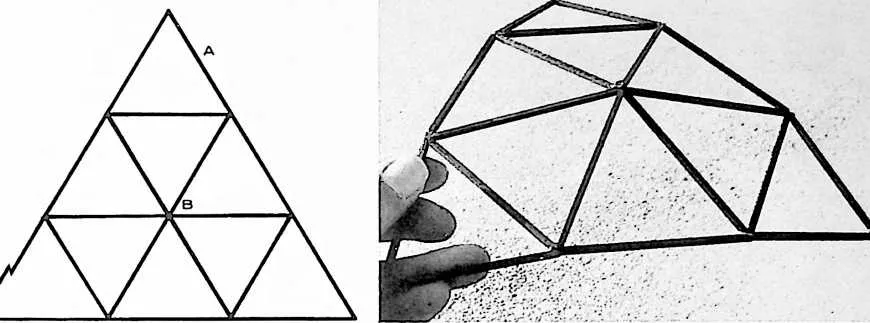
125 Subdivided triangle (Hat)
126 Curved triangle
127128in the three-dimensional world. It is stable even if all the joints are rubber. This is a simple Geodesic Dome. (Aren’t you glad you stayed?)
129Poseidon Earthshaker would have had his work cut out for him, shaking down one of those. Every single triangle would resist deformation, and by the synergetic behavior of Whole Systems they would unexpectedly strengthen one another, since unpredicted rings now contain the stresses. But of course Poseidon’s worshippers built in stone, which would have been an unsuitable material. (How to join all those stone blocks, leaning inward?) So it’s perhaps not surprising that no Greek thought of it, though they had the geometry almost within their grasp.1 If you’re convinced that you must build out of stone you have no ultimate recourse against earthquakes. Discerning no good
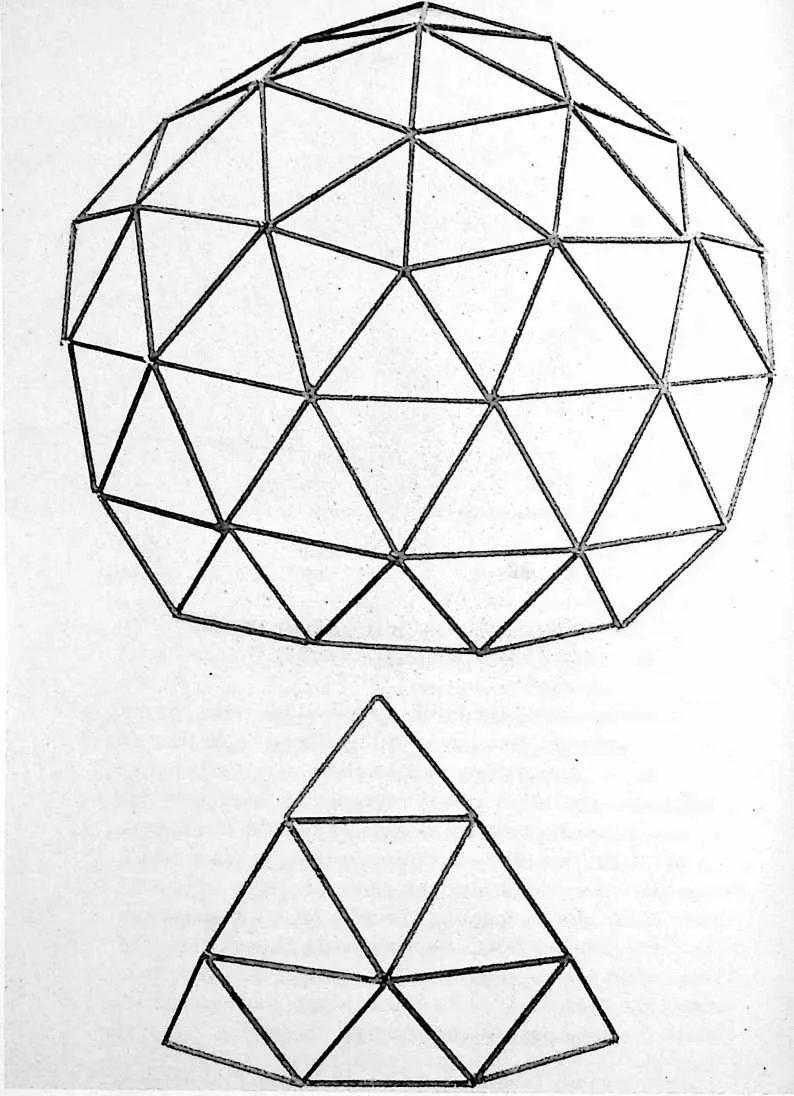
134135Curved triangle and dome
136 reason why temples need be o£ stone, we are entitled to call stone a Greek hang-up. It helps us not to notice hangups of our own.
137 One of these is the cube, as we shall be learning.
138 Meanwhile, we’ve isolated a useful notion: the idea of a strength that’s designed in, to be distinguished from strength the carpenter hammers in. Design solves problems elegantly, but force imperfectly. Design is weightless; it costs no nails, it costs no wood; it’s pure conformity to principle. We do not make ‘‘things’’ out of ‘‘materials’’; we arrange preferred patterns (and we may learn which patterns work by studying molecules). Design is like jiu- jitsu, using the opponent’s strength instead of fighting him. Design takes the air that rushes under the wings and uses it to lift the plane (the plane is in motion; there are no cables, no skyhooks). Design lets the very weight of the keystone maintain the integrity of the arch that supports the keystone. If Cleopatra must be played by a boy, then design the transformation of boy to queen as a high point in the play’s arc:
139140Give me my robe; put on my crown; I have Immortal longings on me. . . .
141 If a corpse must be borne off stage because you have no curtain, then design a ceremonious climax:
142 Let four captains
143 Bear Hamlet, like a soldier, from the stage. . . .
144 (Yes, the actor even says ‘‘stage.’’)
145 ‘‘Don’t fight forces, use them,’’ Bucky was saying as long ago as 1932. And when someone wants to learn, by all means let him. It’s easier than ‘‘teaching’’ him later.
146 There is much, much more, but never what anyone expects. In Africa, in 1958, thirty-five senior architectural students from the universities of Natal and Capetown waited two days with pencils and notebooks ready for data on the building project they were to do with Buckminster Fuller. ‘‘In which time of continuous lecturing,’’ their report runs, ‘‘we found ourselves making copious notes, not on architecture or engineering, but on nautical history, evolutionary patterns of the progress of man and his travels across the earth, mathematics as a science of space, juvenile delinquency, the processes of industry and mass production, his own experiences of automobile and aircraft design. . .
147148They then learned that their ‘‘project’’ had been sitting right in front of them for those two days. "The reason he could see it and we could not was the clearest example of the vision that has marked him from other men.’’
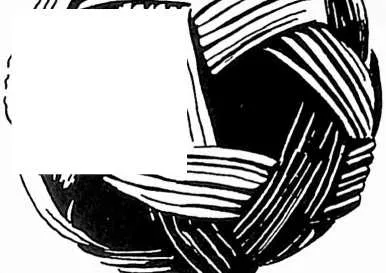
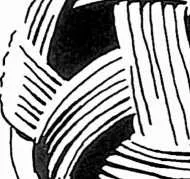
149It was the world’s oldest known toy, a small ball of interwoven bamboo. Youngsters have played with it for thousands of years. Bucky picked one up in Burma en route to South Africa, and immediately perceived a geodesic variant. Inspired by that, and by native architecture, he proposed that the students design and build (good grief!) a corrugated aluminum geodesic Zulu hut, interweaving the sheets. And they did, though the Zulu go on using grass.
150He may have hoped to free the Zulu a little. Zulu houses die as grass rots, or can be .burned down by a spark. Then grass must be again harvested, again woven. Meanwhile cattle were eating up the grass. Such a people spend a large part of their days maintaining their bodies and their shelters. Long ago men perceived that they might forcibly delegate a good part of this work to other men, called slaves, thus freeing a few to devise, for instance, geometry. The custom persisted, and the 1810 American census tallied one million families, also one million slaves. Though
152 Woven bamboo toy
153 many families had no slave at all, one per family was the average. Each family lived in a house of wood or brick, and the house was worth about $350 but the slave about $450. That was sensible, really, to set more value on directable energy than on a shell.
154 The energy slaveholders commanded is surprising. Using figures gathered by armies, which need to know how hard men can be pushed, Bucky once figured what a man can do with his muscles in an eight-hour day, in addition to keeping alive. Set him at building pyramids or hoeing cotton for 250 days a year (52 Sundays off, and some 50 more days for sickness and bad weather), and we get thirty-seven- and-a-half million foot-pounds of work out of him.
155 That’s a kind of energy norm, and about 1940 Bucky used it to measure what we’re doing for ourselves by design science. Periodically he updates the calculation. He sums the annual energy man is deriving worldwide from his fuels---the coal, the oil, the waterpower, the nuclear reactors; assumes that fully 96 percent of it is squandered by friction, bad design, and general fecklessness; surveys the rest of it moving us from place to place, carrying our mes
156 sages, roasting our popcorn; and dividing the total by thirty-seven-and-a-half million he can tell us how many human slaves we should need to do all that. These are world energy slaves. At present (1972) each person on earth has 200 of these available---say 1,000 per family, to compare with the single slave per American family in 1810. Obviously, Asians aren’t getting their quota; obviously, North Americans have much of the supply cornered. Obviously, ‘‘making the world work’’ will mean making energy slaves uniformly accessible world-round. This needn’t mean enriching Cambodians by depriving Americans, since the pool of energy slaves has never stopped increasing. In 1950, with a smaller world population, there were only thirtyeight per person. Not only are more energy supplies tapped, conversion efficiency has been slowly increasing, and these factors together have been growing faster than the population of the world.
157 This may prompt Bucky’s cadenza on inefficiencies, one feature of which is his vision of a million cars at any given moment, standing at red lights with their motors running. He assures us this is a reasonable United States figure. And back in the heady days of the Horsepower Race, how many horses were there under all those hoods, performing with all their might an invisible tap dance while a million drivers got nowhere? Quite possibly 200 million horses, from which national stable a little of the nonsense is subtracted every time a freeway bypasses a stoplight. Throwing less energy away, that’s just like tapping more of it. ‘‘Pollution’’ is just inefficiency: something you could use, thrown into the air or Lake Erie.
158 The energy slaves, ever multiplying, ever more equitably distributed, the energy slaves will build the New Jerusalem, containing moreover no Dark Satanic Mills. Bucky’s voice has been slowly mounting in pitch, the syllables tumbling faster but defined more sharply. Chopping his hands inward, he invokes a workable world, within the grasp, he says, of the technology we know today.
159 ‘‘With known technology, we can take care of every human being. We can make man a success in the universe. We can bring to every human being levels of satisfaction no one has ever dreamed of. We can do it by 1985. And don’t say we can’t afford it!’’
160 As though a force field had suddenly collapsed, it is clear that he has ended. Assailed by the mounting ovation, he is giving his attention to the microphone, feeling for the fastener to unclasp it. He is suddenly minute and vulnerable. Rows of people are standing, their faces alight, applauding. Preceded by a sponsor, he limps offstage.
161 His back is tormenting him. Can he just get to the car and sit down? If he can’t sit periodically during his talk, on a chair, on a table, anywhere, the pain starts part way into the second hour. . . . ‘‘One of my legs is shorter than the other’’: an apparent fault in design.
162 The quick walk to the car is dogged by a garrulous man stymied in his own effort to save the world. The government. . . . Detroit. . . . He scampers a little ahead, turning round trying to face Bucky and harangue him, preferably detain him for genius-to-genius summitry. ‘‘A hundred thousand people a year,’’ and, ‘‘You can’t patent it, they block the patents, and meanwhile all those people . . .’’ Never mind patents, says Bucky, never-mind maneuvering. Publish your findings. If you are right it will be accredited to you, otherwise forgotten. It is not a satisfying answer, entailing as it does the option of being forgotten. Bucky settles into the car, relaxing as the strain comes off his back. ‘‘It takes just a few minutes . . . Better already.’’
163 Anxieties. ‘‘My slides.’’ Anne has his slides, returned to her by the projectionist. He reaches back for them.
164 ‘‘Wouldn’t they be safe here in my bag?’’ ‘‘In my inside pocket,’’ Bucky specifies, ‘‘I have a special envelope for them.’’ They are handed over. And, ‘‘What about my overcoat?’’ A rapid recheck; someone has retrieved it.
165 Half an hour before midnight, the waitress who had just brought his bedtime steak is back with a small bottle of champagne, ‘‘Greetings from The California Time Machine.’’ The CTM, who or whatever they are, seem to be hidden in a darker part of the roadhouse, behind a screen of latticework and greenery. Some is poured for Mrs. Fuller, some for the friends who are driving them to their motel. Bucky instructs the waitress to convey his appreciation, and not to divulge that he himself is not drinking. He then spreads out a paper napkin and with a felt-tipped pen commences to tabulate the rudiments of the Coordinate System of Nature. Pythagoras had intuitively focused on the right-angled triangle, but had unhappily compromised the insight with talk of squares, such as the famous one on the hypotenuse. Only occasionally, as you work with squares, do things---accidentally---come out in whole numbers. He sketches a quick square, subdivides it, and numbers the subsquares: 1, 2, 3, 4. ‘‘We divide the sides into two parts, we get four smaller squares, and then we say that 22 is ‘two squared.’ But’’---he sketches a triangle---‘‘the second power has nothing to do with squares. We divide each side into two parts in the same way. . . . Count the small triangles: 1, 2, 3, 4.’’ He numbers them rapidly. ‘‘Two to the second power, not two squared. Four is simply two to the second power. Nothing to do with squares.’’
166 Another bottle of champagne arrives; from their mysterious privacy the California Time Machine are playing deus ex machina to genius. Bucky’s brow is furrowed with mild distress. How not to do them the discourtesy of a rebuff, and yet not let them suppose they may send more and more? Can the waitress and perhaps a friend use the champagne? Yes, they will be off duty at one. And can she, very tactfully, while thanking them . . . Wait, what can he send the Time Machine in return? A sketch of a Dome is suggested. On a fresh napkin, Bucky limns in one gesture a surprisingly symmetrical freehand circle, subdivides it with practiced arcs, and notes, above his signature, that this is the eve of his wife’s birthday. The waitress slips off with this bulletin from the twenty-first century and Bucky resumes his exposition where he had interrupted it in midsentence.
167 The third power, likewise, has nothing to do with cubes. From the habit of taking a cube (based on the square) as the element to be subdivided, men have gotten into saying that eight is two cubed. But if we take the tetrahedron, based on the triangle---he sketches one---and subdivide each of its edges into two, the lesser tetrahedra we obtain will each of them have one-eighth the volume of the one we started with. . . . The drawing is a difficult maze of crisscrossing lines. ‘‘It’s easier to see with a model.’’ Here are four of these lesser tetrahedra, one at each corner of the parent tetrahedron, and a volume equal to four more of them is accounted for by the octahedron that has appeared at the center. The octahedron is nature’s second primary system. And two to the third power, not two cubed, gives us a volume of eight. . . .
168 The waitress is back, with the Time Machine’s newest offering, a candle inserted in a single slice of cake, and a napkin on which has been drawn a plain cubical house with smoke curling from its kindergarten chimney. Other late snackers catch sight of the cake, and amid an informal chorus of ‘‘Hap-py Birth-day’’ the white-haired lady blows out the candle. Bucky, grinning, initials the napkin dia-
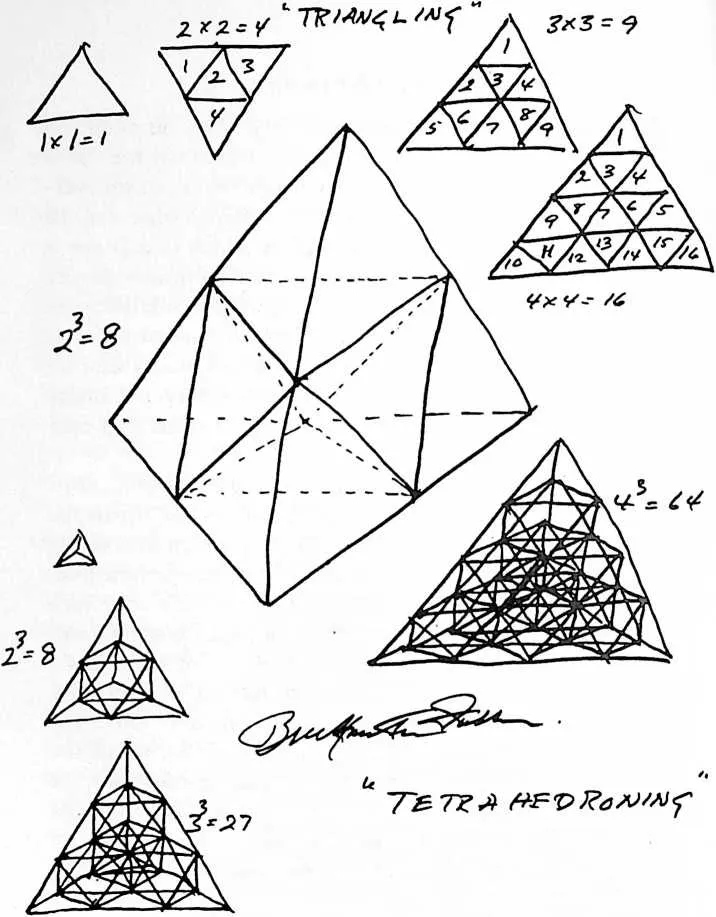
170 Bucky's drawings of (top) subdivided triangles, showing that second power doesn’t depend on squares; (bottom) subdivided tetrahedra, showing that third power doesn't depend on cubes. Counterclockwise from 9 o'clock: (i) A small tetrahedron. (2) Tetrahedron with edges divided in two; four small tets appear.at corners, and octahedron in center has a volume of four more, totaling eight. Large center drawing is same thing in a different perspective. (3) Tet edges divided in thirds; at the center of the maze is vector equilibrium, explained in Chapter 4; total volume is 27. (4) Tet edges divided in fourths; interpenetrating octahedra and vector equilibria can be sorted out to yield total volume of 64.
171 grams ‘‘B.F.’’, and as the party rises makes sure he has the overcoat from which his preoccupation is constantly getting him separated. He slips back toward the bar for a few private words with the California Time Machine. Later he does not describe them, except that they were young men, musicians apparently.
172 Settling into the car still aglow from the encounter, he quickly outlines the geometry that restricts the turning angle of front wheels to, at best, 34 degrees, ‘‘and usually much less because the frame interferes.’’ By alloying the frame, thus thinning it without weakening, one or two makers, notably Mercedes-Benz, get more of that 34 degrees than does run-of-the-mill design. But front-wheel steering is inherently faulty, since the turning car is trying to lift its nose off the road. (‘‘A holdover from the buggy, which pivoted where the horse was.’’) Mrs. Fuller recalls how the Dymaxion car swung its rear end into parking spaces. That, says Bucky, was because its single turning wheel---aft---could turn without limit. And the car---it was back in 1933---could execute a complete circle around the cop in the middle of the intersection, grazing his uniform all the way. Bucky did that once with a carload of magazine editors, and the cop on duty at every intersection from Fifty-seventh Street down to Washington Square demanded a repeat performance.
173 ‘‘I am not a genius,’’ he says, ‘‘but I am a terrific package of experience.’’ He has known Nehru, and also Al Capone, and seen his choreography executed at Spoleto, and had his name mispronounced by Nikita Khrushchev. No other design scientist can claim as much. The experience draws on some 28,000 days, several thousand of them very much like today. This has been a good day. They mostly seem to be, now.