
4 The Birth of DYMAXION
2Once he had decided to remain alive, Buckminster Fuller began to prepare for his self-appointed task in earnest. He spent hours reading in libraries. What were the newest advances in scientific thinking? What was the impact of this thinking on invention and industry? How much were industries in the United States and all over the world producing? Bucky sought the answers to these questions and more. Along with his reading went more hours of solitary thinking.
3 He realized that the new concepts in physics and chemistry, the new ideas about how nature worked, formed the real basis for change and invention in the world of machines. And the world of machines was the world of large-scale industry and manufacturing. There the old problems of production were being solved by new, efficient methods such as the moving assembly line. Workers in a factory did not have to rush from one corner to another to put together the different parts of an automobile; the auto was assembled as it moved from place to place along a line of workers, each of whom stayed in his place.
4 The one problem to which this new kind of industrial efficiency had not been applied was that of building shelters for human beings. The planning and construction of individual houses consisted of a series of slow, awkward, and very expensive operations. An architect generally tried to design each of his houses to be quite different from the next. Contractors were still using building techniques that had not changed in hundreds, even thousands, of years.
5 Why didn’t architects and builders think in terms of assembling houses like automobiles or airplanes?
6 Bucky decided that the shelter industry was prevented from making such a change by the complicated network that had been woven through the ages between banker, builder, and occupant when a house was built. Houses cost so much that the individual house buyer could not afford to pay the entire cost at once. A buyer had to go to the bank for a loan; the banker called this a mortgage, and arranged for the buyer to pay off his mortgage in small parts, like a monthly rent. Of course, these small payments included not only part of the actual cost of the house, but also interest on the loan. Over a period of years, while the mortgage was being paid off, a house buyer would be paying thousands of dollars extra to the banker. Any kind of planning that would make houses inexpensive might break down this loan system.
7 Another problem was that of the actual weight of materials that went into building a house. When Bucky asked architects how much their houses weighed, they regarded him as though he were mad, shrugged, and went away. Who cared how much a house weighed? After all, it just sat there on the earth. The earth was certainly strong enough to support the heaviest house man could produce! Bucky was reminded of the reaction of his math teacher at Milton Academy to his question about the weight of a cube.
8 Why should houses have to be heavy, cubic objects bound to the surface of the earth by the weight of their materials?
9 Why couldn’t a house be made of some material that was as strong as steel or concrete, yet much lighter? Why couldn’t a house be strong enough to withstand the buffeting of winds or storms, yet be as light as an airplane?
10 Bucky thought about the new kind of aircraft called zeppelins (after their inventor, Count Zeppelin of Germany) that had been developed during the First World War. In America, they were called dirigibles. These aircraft were rigid, lighter-than-air, and shaped like a cigar. A zeppelin had a framework of light girders filled with gasbags, and covered with a cloth skin. The gasbags were filled with enough hydrogen gas to lift the zeppelin up through the air. Power to move forward was supplied by gasoline engines that turned propellers. At that very moment, in 1927, the Germans were building the largest dirigible of all time, the Graf Zeppelin, eight hundred feet long and one hundred feet across. The Graf was designed to carry fifty passengers and their baggage, plus the crew, across the Atlantic Ocean. As a matter of fact, it was designed to be able to fly completely around the world.
11 But what was a dirigible? Why, it was really a long, floatable house. And like a ship at sea, this floating house was self-sufficient; its power and disposal units were all built-in. Slowly, the plan for a light, movable house began to form in Bucky’s mind. Tip the dirigible up; then, divide the long cylinder into sections, each section a floor, or deck, of the house.
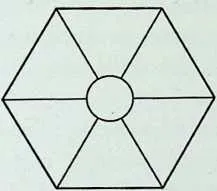
12 He began to scribble designs on a pad of paper. First, each upright section would be a hexagon:
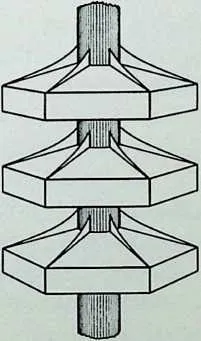
14 Then, the hexagons could be piled up, one atop the other, hanging from a strong, central mast:
16 In a conventional house the parts were supported by the combined forces of an upper part pushing downward (like a brick in a wall) and a lower part pushing back up (the brick beneath). Architects called this kind of pushing compression. Thus the walls of a house stayed up because of the compression of their parts. If a different force (for example, an earthquake) moved part of the wall sideways, compression made the house fall down.
17 But a dirigible was built in a different way. The metal spars were tied together, so that they pulled against one another in places. This kind of pulling was called tension. In a dirigible, certain parts were pushed together, or compressed, and other parts were stressed to support each other by pulling, or tension. Strong metal cables could be tensed to support tremendous weights or forces, much greater than what could be supported by typical house walls.
18 Were there metals strong enough to support his dirigible house? Bucky read through the latest publications of metals research scientists. He found that metallurgists in the airplane industry were on the track of new combinations of metals, called alloys, that might result eventually in the production of materials of tremendous strength.
19 It was true that steel was strong, but it was heavy. What Bucky wanted was the lightest possible material that could support the greatest possible weight. The success of his ideas would be based upon using the least to accomplish the most. Bucky found the one word that expressed what he expected technological research to do for the housing industry.
20 That word was synergy.
21 Synergy was a word that you might not find in everyday conversation, but it was a word well-known to chemists. It meant the behavior of a whole system that could not be predicted by the behavior of any of its individual parts. For example, chemists knew that there were two chemical elements, sodium and chlorine, that differed not only in their appearance, but also in their individual behavior. Sodium was a soft, silvery metal that burst into flame the moment it touched water. It certainly could not be eaten without burning and poisoning the eater. Chlorine, on the other hand, was a heavy, greenish gas, also very poisonous to man. But if these two elements were allowed to come together and react, the result was a white-appearing crystalline substance called sodium chloride. And this stuff was far from poisonous; it sat on the tables of most American families in saltshakers! Thus, the whole system called sodium chloride had neither the appearance nor properties of its two individual components.
22 Bucky saw that man had to begin thinking in terms of synergy; that is, if man wanted to use science and technology to the best advantage. It was not the individual parts of nature that were necessarily most important; it was the integrated behaviors of these parts. He realized that there were many blessings of synergy waiting to be discovered: new metal alloys which could lead to the manufacture of new machines and engines; new ways of using radio waves and radio circuits. Why couldn’t light energy be changed into electrical energy that could be used to open doors or control machinery?
23 There was plenty of useful energy in the universe, energy that existed in many different forms. When you rubbed your hand against a table, your hand became warm; that was mechanical energy being changed into heat energy. Growing plants were always changing the sun’s radiant energy into the chemical energy of growth. In radio stations, sound energy was being changed first into electrical energy and then into electromagnetic energy. Radios that caught that electromagnetic energy in their antennas simply reversed the energy transformation.
24 The more Bucky thought about changing light energy into electrical energy that could be made to do mechanical work, the better the idea seemed. Was it possible? He dashed off a letter to his brother, Wolcott, who was working as an engineer for the General Electric Company. Did they manufacture any kind of radio tube that was sensitive to light? Could such a tube be hooked up to an electromagnetic relay that would activate switches?
25 Wolcott’s return letter was devastating. There was no such tube. And with great humor, Wolcott had concluded his letter with, ‘‘Bucky, I love you dearly. But can’t you make it easier for your relatives and friends by not including preposterous ideas?’’
26 Bucky received somewhat the same reception when he went to a company that manufactured aluminum metal for industry. He questioned the engineers about the possibility of a strong aluminum alloy that could be used as a framework for houses. He wanted to use such an alloy in his dirigible house.
27 But the engineers shook their heads. Strong aluminum alloys to be used in house-building? It was a preposterous idea! Aluminum was good for making coffeepots and souvenirs. It was a soft metal, and would always be used only where soft metals were useful. When Bucky began to talk to them about synergy and the chances of finding his alloys, the engineers became coldly polite and said good-bye.
28 Bucky was undismayed by such failures.
29 He kept planning his dirigible house. The decks would be held in place by tension cables, yet the whole house would be light enough to be lifted up and moved by a zep- pelin. After all, the rapid progress of aviation was bound to change man from a stationary, root-putting-down condition to a mobile, ‘‘to-ing and fro-ing’’ state. If the airplane was shrinking the earth in size year by year, then a man should not have to be bound to a specific stationary dwelling in a specific place.
30 What man needed was a home that could be transported by air and put down anywhere on earth, at the North Pole or in the Sahara Desert. Such a house would have to be self-sufficient, carrying its own power, water (which would be reusable), and disposal units. Bucky thought of the earth as the ‘‘Air Ocean World,’’ where air travel could make it possible for man to locate himself in places that had always been considered inaccessible. Synergetic discoveries would provide ways for man to control hostile environments that were too cold, too hot, or too stormy. It was time to begin thinking of a universal shelter that could be used by anyone anywhere.
31 Of course, the kind of conventional house designed by architects could not be moved at all, or at least not without great difficulty. That kind of house was far too heavy. But a dirigible house, lightweight and mass-produced like an airplane, was another matter. Bucky sketched out a twelve-deck house, hung by tension cables on a central hollow mast. The top of this mast could be hooked onto the nose of a dirigible and carried away. It would take only one day to produce such a house, since the parts would be prefabricated and interlocking.
32 Bucky’s imagination soared further. A dirigible could carry the finished house to any spot on the face of the earth. First, a small dynamite bomb could be dropped to make a hole in the ground. Then, the lower part of the mast could be lowered into the hole. Finally, cement would be poured around the mast to form a solid supporting base. The dirigible house was planned to have its own electric power plant, heating system, and sewage disposal all built-in. There would be no necessity to tie into existing city electrical and sewage systems. In order to make the transportation of his house more efficient, Bucky designed a streamlined plastic shield to be placed about the house. The shape of the shield was the same that he had designed for his jet plane during his Navy days.
33 Bucky even figured out the cost for his twelve-story tower house. Once mass production had been achieved, it would be possible to sell and deliver such a house for only $10,000. This was a fraction of the cost of a conventional house with the same features. Bucky’s house had such luxuries as a gymnasium and swimming pool all built in. However, when he showed his design to architects, they told him that he was a wild, impractical
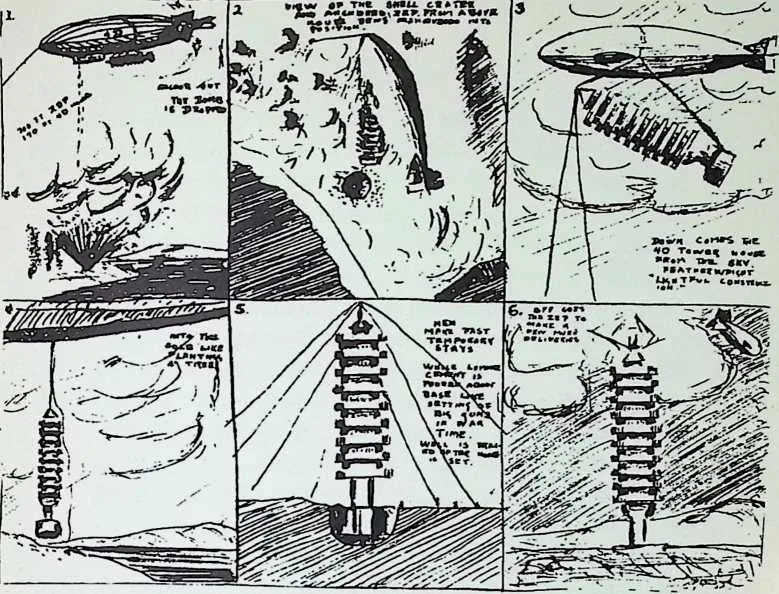
3536Sketches of dirigible transporting a ten-decker
37 dreamer. In fact, most of them resented the nerve of this young upstart who dared to design houses without having ever attended a school of architecture.
38 But the dirigible house was only a beginning for Bucky, a kind of mental practice that laid the groundwork for more practical thinking about shelters. His fantastic, twelve-deck house became a single-floor dwelling that could be turned out easily on an industrial assembly line.
39 Bucky called this plan the 4-D, or fourth dimension, house. With this name, he was paying homage to Einstein’s theory of relativity. When we want to locate a point in space, we have to measure from some beginning
40 point in three directions that are at right angles to each other. To these three dimensions of measuring, Einstein had added a fourth: time. Thus, 4-D represented the time dimension, the new dimension.
41 Bucky worked out the details of his 4-D house with painstaking precision. He dreamed up things that had never been heard of by the housing industry. In the first place, the house had no windows! Instead, the walls themselves were made of glass —two plates of glass with a vacuum in between for each wall. This kind of construction would insulate the house more efficiently than ordinary insulating material, so that the house would be warm in winter and cool in summer. Of course, such glass walls had not yet been invented.
42 In order to insure privacy, Bucky’s house was fitted with shutters that could roll down over the walls at the touch of a switch. Space inside the house was simply divided in terms of the equilateral triangles that made up the whole hexagon floor plan. Two of the triangles served as bedrooms, one for the kitchen and utility room, one for the library and study, and the final two could be combined into a diamond, or rhomboid, shape to be a large, comfortable living room. Each bedroom had its own bathroom attached, and here Bucky had worked out a very unusual system.
43 The bathroom fixtures were made to be independent of city water and sewage systems, since this was to be a house that could be erected anywhere in the world at a moment’s notice. It took only a quart of water for the complete operation of a bathroom! The shower was what Bucky called his ‘‘fog gun.’’ During his Navy experience, he had learned that a man could come up on deck from the engine room with his face all dirty and grimy, and just by standing watch in a fog that face would become as clean as a whistle. There was something about the way that fog particles struck while the ship was in motion that made the fog act like a combination shower and scrubbing brush. A compressor, then, could be used to spray the water out like a fog in Bucky’s shower compartment. Then, the used water could be collected, filtered clean, returned to a storage tank, and be used again.
44 As for the other parts of the bathroom, wastes could be packaged and disposed of by chemical means. An exhaust fan removed unpleasant odors. In short, Bucky was taking advantage of scientific and technical knowledge to design ways of washing and heating the human body as efficiently as possible. The 4-D house made his point clear. A shelter for man had to make him able to cope with his natural environment as easily as possible.
45 There was no wasted space in Bucky’s house. The different living areas were separated by partitions which were actually movable shelves, hangers, or laundry units that went from floor to ceiling. Doors between these areas were actually curtains that could be opened or closed by compressed air controls. All the dusting in the house was done mechanically by compressed air and vacuum systems.
46 He figured out the cost of such a house in terms of being able to manufacture it on a factory assembly line. The weight of the entire house came to 6000 pounds. From the cost of materials and labor, Bucky arrived at a sales price of twenty-five cents per pound. If it had been possible to produce a 4-D house right there and then, it would have cost a home buyer only $1,500! Bucky visualized the parts of his house being turned out by the thousands. The 4-D house would be a new kind of machine that would help break the chains that had bound homeowners to specific communities. He made up a new name for those people who would be living in portable, independent, 4-D homes everywhere in the future: a world citizenry.
47 Across the ocean, in Europe, a group of young architects, led by a man named Walter Gropius, had begun a new movement in architecture called the Bauhaus. These people began to create new house designs based upon simplicity and streamlining. They used concrete in new ways to make wall shapes that were excitingly different from what had been done before.
48 Bucky had read about the Bauhaus school of architecture, and he admired their decision to revolt against old- fashioned techniques of designing houses. But he decided that they had not gone far enough in making changes. Their houses were startlingly different in artistic style; but they still used steel girders within the brick and cement walls for support. The Bauhaus architects did not plan their houses in terms of the revolutionary progress that was going on in science and technology. They did not think in terms of the industrialization of house-building in the same way Bucky did. The new homes they designed were still individually different, and they were expensive to build.
49 For Bucky, the Bauhaus movement did not mean real progress in housing; he saw the movement as a kind of popular and appealing fad of the moment. Their houses were the same heavy cubes; after all, not even the new young architects cared about how much a house weighed. And like houses of old, their houses had to be tied to city powei- lines and sewers. Their houses could not be lifted and moved about easily. In short, while new ideas about the planning and building of houses were emerging, the 4-D house was really the only one that had been designed to house all people everywhere at minimum cost. And it was the only house that had built into it materials and devices that had not yet been invented!
50 Then Bucky’s prediction of things to come began to come true. Many of the materials he had imagined, the nonexistent ones, were slowly beginning to be found in research laboratories. Even his dream of a door you could open without touching a doorknob came true in 1928. He received a telegram from his brother Wolcott: YOU CAN NOW OPEN YOUR DOOR BY WAVING YOUR HAND
51 AFTER ALL STOP WE HAVE DEVELOPED PHOTOELECTRIC CELL AND RELAY STOP SEVENTY TWO DOLLARS FOR THE SET.
52 Bucky managed to borrow materials and money enough to make a scale model of the 4-D house. The different parts were fashioned exactly as they would have been made in a factory for assembly. The model was about three feet across. Through the double glass walls you could see miniature furniture in the rooms. In the living room, Bucky placed on a miniature sofa a little doll that had no clothes.
53 ‘‘Oh, Bucky!’’ cried Anne when she saw the doll.
54 ‘‘What will people think? Are you trying to shock them?’’
55 ‘‘No, no,’’ laughed Bucky. ‘‘The point I want the doll to make is that the Fuller 4-D house makes it possible to control temperature and humidity. My house can be so warm and comfortable, the people inside won’t even have to wear clothing for protection.’’
56 ‘‘Hmmm,’’ muttered Anne to herself. ‘‘I hope everyone understands that!’’
57 In May of 1928, Bucky decided to bring his house to the attention of American architects in a dramatic way. He asked Anne’s father, Mr. Hewlett, to tell the American Institute of Architects that he, R. Buckminster Fuller, was prepared to assign to the Institute full rights to all patents for the 4-D house.
58 Bucky had taken the precaution of patenting all of his 4-D plans; his experience with the patents for the Hewlett concrete brick had taught him how to do this. Anne’s father was now vice-president of the Institute, which was the most prominent professional organization in the architectural field. But Mr. Hewlett cautioned Bucky not to expect too much. ‘‘I’ll be glad to do what you ask, but architects are a very conservative group. I don’t know how they will will respond.’’
59 What they said in very blunt fashion was no. In fact, the Institute members were so outraged by Bucky’s offer that they passed a resolution saying, ‘‘. . . the American Institute of Architects is opposed to any kind of house designs that are to be manufactured alike as peas- in-a-pod!’’
60 And then recognition came in a different way. The art editor of a Chicago newspaper, the Evening Post, heard about the 4-D house. He came to see it, was impressed by Bucky’s vision, and wrote a feature article that the Post printed. Some months later Bucky received a call from the publicity department of one of the most famous department stores in the world, Marshall Field and Company in Chicago.
61 ‘‘Mr. Fuller, we’d like to display your modem house in our furniture department. We have purchased a shipment of the latest designs in modem furniture from Paris. We think your model is just the thing to set that furniture off.’’
62 Delighted that someone had taken notice of his work at last, Bucky agreed. In a few days, he received a visit from one of the advertising specialists.
63 ‘‘Mr. Fuller, your house is a marvelous invention! But I must admit that as an advertising man I am not happy about the name. 4-D . . . 4-D . . . why, that could mean anything from a failing mark in the fourth grade to a four-story apartment house. It won’t do. We’ll have to think of something else.’’
64 Bucky was dismayed. ‘‘But that’s the whole point. 4-D stands for the fourth dimension —the one in Einstein’s theory!’’
65 The man shook his head. ‘‘Not many Americans will understand that.’’ He seemed to notice Bucky’s discomfort and changed the subject. ‘‘Look here, I have an idea. Why don’t you just talk to me about your house —what it means to you, what it stands for. Now I’ll just listen and write down what I think are key words. Perhaps we’ll find something.’’
66 Bucky began to talk, while the advertising man scribbled notes. Finally, he interrupted Bucky in the middle of a sentence.
67 ‘‘Look here, Mr. Fuller, your talk is full of scientific terms. But I notice that there are some words that turn up over and over. Here are three of them: dynamic, maximum, ion. I know what the first two mean, but what’s an ion?’’
68 ‘‘That’s an atom that has gained or lost electrons and has become an electrically charged particle.’’
69 ‘‘Hmm, ion —well, that’s scientific enough. What if I put together the first syllables of dynamic and maximum, and then add ion. Dy-max-ion —by golly, that’s it!’’ He pounded a fist into his other hand in excitement. ‘‘There’s the name for your modem house —the Dy- maxion House!’’
70 Bucky’s eyes gleamed behind his thick glasses. He tasted the word on his tongue. It had a fine futuristic sound. Dymaxion. He shook his head vigorously up and down, saying yes. It was a perfect name.
71 The pleased advertising specialist shook Bucky’s hand. ‘‘It’s your word, Mr. Fuller. I’ll see that Marshall Field and Company patents it in your name.’’
72 A warm glow spread through Bucky’s body. Finding the new name was a good omen. He did not yet know that all his future work would be stamped with the Buckminster Fuller trademark —DYMAXION.