
8 Nature’s Own Geometry
2Ever since his elementary school years at Milton Academy, Bucky Fuller had thought about geometry. He remembered how difficult it had been for him to accept the kind of geometry he had been taught. What nonsense it was for a teacher to talk about nonexistent points, lines, and planes as though they were real!
3 Was this geometry made up by man actually the geometry of nature herself? Or did nature have a special kind of geometry, a collection of basic forms, upon which man had yet to stumble?
4 All through the years that followed his graduation from the ‘‘ninety-day wonder’’ ensign class at the Naval Academy in 1917, Bucky had managed to spend some time thinking about the geometry of nature. Over and over again, he asked himself why man’s geometry seemed to come out with such strange, never-ending constant numbers like pi. Chemists carried on their science on the assumption that chemical elements always combined in terms of simple whole numbers. Could it be that the geometry of nature was basically as simple as the combining of atoms?
5 Inevitably, he turned to the subject that was always uppermost in his mind —energy.
6 From his observations, Bucky began to build in his mind a kind of model of how energy existed in different structures. It seemed to him that one could suppose that there were two kinds of energies: first, the energies that were related to forces that compressed, or pushed together; second, those energies related to forces that pulled apart. In nature, there seemed to be a tendency for these two kinds of energy to be balanced; that is, nature tended to keep these energies in a state of equilibrium.
7 Suppose a bridge had to be built across a river. The main problem was to achieve this kind of equilibrium in the bridge structure. But the bridge was made of metals, and the metals were made of chemical atoms. You could say that the tiny atoms were in themselves energetic structures in a state of equilibrium.
8 Was there some basic geometric form in nature that represented this energy equilibrium? Would it be the same form for large structures as for atoms?
9 Bucky began to play a strange game during the evenings. He used a number of small spheres, all the same size. The game was to see how the spheres could be stacked together as closely as possible about a central sphere. First, he would put down one sphere:
10 Then around it could go six more, each touching the first:
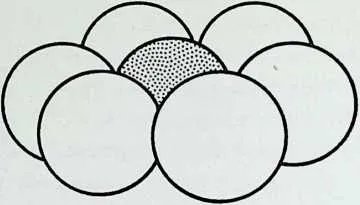
12 But only three more on each side could be added to touch the center sphere:
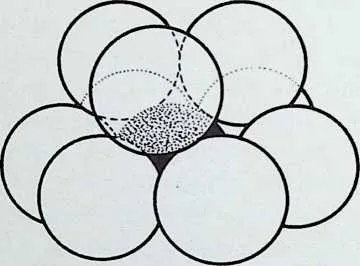
14 The outside layer, then, was always composed of twelve spheres.
15 Bucky felt that somehow he had stumbled across a law of nature. This pattern of crowding together was one that always occurred in the universe, where all matter was built out of atoms that were crowded together in the same way. He experimented further and discovered that a second layer of spheres, put down to cover the first completely, always had exactly forty-two spheres. The third layer took ninety-two to complete.
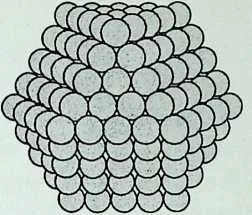
17 What name could he give to this pattern of spheres? Bucky decided that the most obvious name would be ‘‘the closest packing of spheres.’’ He did not know that many years before, about the time he was born, a scientist named Barlow had already suggested this principle as one way of describing how atoms were structured in common salt, and in other crystalline forms of matter. Nor did Bucky know that at about the same time he was beginning his sphere-packing game an English physicist named Sir William Bragg had shot x-rays through crystals in an effort to uncover crystalline structure. Bragg had found the same kind of patterns as had Bucky. Of course, the English scientist knew nothing of a wild-eyed American inventor named R. Buckminster Fuller. But Bragg chose Barlow’s description of closest-packing for the atomic arrangements he found in crystals.
18 Playing his game further, Bucky discovered that he could predict the number of spheres in a closest-packing model by using a simple mathematical formula:
19 10 X (the number of layers)2 + 2 = the total
number of spheres.
20 Thus, for the first layer:
21 10 X (I)2+ 2 = 12,
22 for the second:
23 10 X (2)2 + 2 = 42, and so on.
24 This seemed like a beautiful kind of natural number magic to Bucky. He kept looking for ways in which he could link this idea of closest packing to nature itself.
25 He tried imagining geometrical plane surfaces that would be just touching, or tangent to the spherical outer
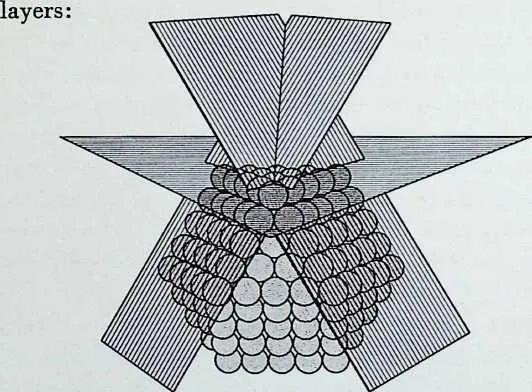
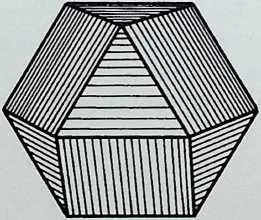
27 To his surprise, the planes did not form what he had expected —a regular solid figure. Instead, the planes met to form a fourteen-sided polyhedron, made up of eight triangles and six squares.
29 Bucky sat up for many nights, trying to puzzle out the meaning of such a strange polyhedron.
30 One night he found his first clue.
31 The sides of each of the fourteen faces were all the same length, whether they bounded triangle or square. The lines met in twelve points, or vertices, of the polyhedron. And the lines from each of the vertices to the inner center of the figure were all equal to the lines that formed the external faces! What did that mean?
32 Bucky began to think about his fourteen-sided figure in terms of forces —pushes and pulls, stresses and strains. He knew that in physics, a force was defined as a measurable quantity. In fact, in order to measure a force completely, you had to know two things about it: how strong it was, and in which direction the force was pointed. Such a two-measurement quantity was called a vector.
33 It seemed to Bucky that he could think about this geometrical figure in two ways. First, it was being ‘‘held in’’ by all the equal outside lines that joined the vertices:
34 Then, it was also being ‘‘pushed out’’ by all the equal lines that radiated from the inner center to the vertices:
35 Since all these ‘‘holding in’’ and ‘‘pushing out’’ lines were exactly the same length, you could say that this figure represented a kind of stalemate of forces, or an equilibrium. Yes, that was it. His closest-packing polyhedron really represented a vector equilibrium in nature.
36 But there was still more to uncover.
37 What would happen to the closest-packed spheres if you took out the center sphere? Bucky tried it.
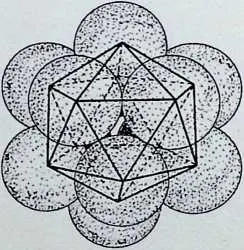
38 The vector equilibrium changed. As the spheres readjusted their position to the creation of a center vacancy, more polyhedral planes could be formed. Six more sides were added; what was more strange, each of the sides was now an equilateral triangle. The vector equilibrium had become an icosahedron — the twenty-sided figure that was one of the five known regular polyhedrons.
40 Now, suppose the icosahedron could be changed by taking some more spheres from the center. The radial forces pushing out would be weakened. What would happen?
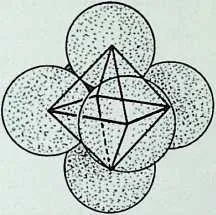
41 To Bucky’s surprise, the icosahedron shrank. It became another regular solid figure —the octahedron. This was made of two pyramids with their bases joined:
43 But there was yet another change that could take place. By more radial weakening, the octahedron collapsed into the simplest of the regular solid polyhedrons —the four-sided tetrahedron.
44 Here was rock bottom. Bucky felt, he knew, that he had arrived at the most fundamental geometric form in nature.
45 It took a long time for him to work out his system of nature’s geometry. There were all the interruptions of living —taking care of Anne and Allegra, designing his Dymaxion House and Automobile, surviving all the failures, working for Fortune and Phelps Dodge and the federal government. There was the awful world war and the disappointment of the Wichita House.
46 But during his spare moments, during many of the hours on Bear Island when he could relax and just think, Bucky worked out the details of what he considered to be the real geometry of the universe.
47 As he read up on physics and chemistry, he found echoes of his geometry in those sciences. In his formula for predicting the total number of spheres the number of layers appeared as a square — the number times itself. Was this squared number related to other important squared numbers in physics? Newton’s law of gravity related the force of gravity to the square of a radial distance.
48 T3_Gm1m2
49 F R2
50 And Einstein’s great discovery of the equality between mass and energy also had a squared number in it —the square of the speed of light:
51 E = me2
52 Measuring speed implied measuring distance; so, that formula, too, was concerned with the square of a radial measurement. More important, scientists were now getting a deeper insight into the way atoms combined to form molecules of matter. It looked as though the basic geometric formations of such molecules were the tetrahedron, the octahedron, and the icosahedron!
53 Encouraged, Bucky began to write down the basic rules of his geometry.
54 ‘‘The tetrahedron is a basic structural system, and all structure in the universe is made up of tetrahedronal parts.’’
55 What did he mean by the word system? Well, that was easy. Since Bucky wanted to have a practical geometry, not an idealized, abstract one like the geometry he had been taught in school, he decided to assume that a system was simply a closed pattern of vectors. The system always had an inside and an outside, or an internal and external part. In Bucky’s geometry there was no such thing as an imaginary, infinite plane that extended on and on forever in all directions. If you chose any corner, or vertex, of a system, the angles around it had to be concave or convex, depending upon whether you were inside or outside the system.
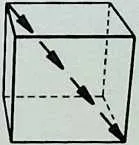
56 In Bucky’s geometry, the triangle is the figure that supports itself most rigidly with the least amount of effort. Therefore, whatever system you have, the pushes and pulls —we can call them the ‘‘energies’’ —will always move along triangle lines. If you have a cubic system, for example, the energy will move along the diagonals of the cube.
58 When Bucky made little models of his solid figures from nonrigid plastic straws, he found that his prediction was correct. The tetrahedron, the octahedron, and the icosahedron were the only three absolutely stable figures.
59 His next investigation was to find out what happened if you pushed the sides of these three basic polyhedrons outward. By making more and more triangles out of each side, Bucky found that each of them finally approached the perfect solid figure called a sphere.
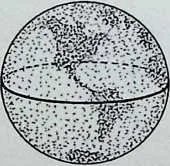
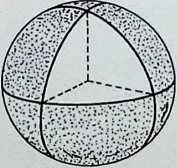
61 The vertices of the tetrahedron became points on the surface of the sphere. Through these vertices he could draw great circles on the surface. A great circle was one whose radius was the radius of the sphere itself. For example, you could consider the equator to be a great circle on the surface of the spherical earth.
63 Now Bucky began to translate this change from polyhedron to sphere into the way forces would act in such a system. He saw that the great circle bands between vertices represented the largest amount of pushing out by the internal vectors of the system: j
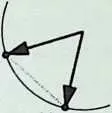
6566v2
67 But if you drew the straight-line chords between these vertices, you were then representing the largest amount of pushing in by the external vectors of the system:
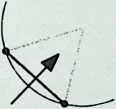
69 v2
70 If the external vectors were greater, your sphere got pushed back into the shape of a tetrahedron. Then, you wound up with the solid figure that had the least amount of space, or volume, and the greatest amount of surface.
71 If the internal vectors were greater, your tetrahedron was blown out into spherical shape. Then, you had the solid figure with the greatest amount of space, or volume, and with the least amount of surface.
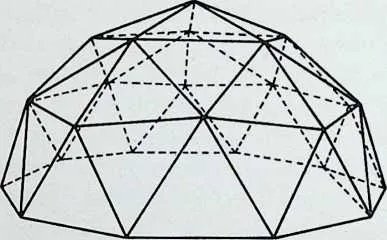
72 Bucky concluded that systems that were built up out of combinations of symmetrical triangles provided the best conditions for distributing energy. You could make these triangles out of great circle chords joining vertices on the surface of a sphere. By subdividing such triangles into smaller and smaller ones, you could reach the point where your system provided the greatest possible resistance to inside or outside forces.
73 Bucky named the structure built up by this process a geodesic structure. The word geodesic actually meant ‘‘having to do with measuring the earth.’’ But mathematicians had attached a different meaning to it; for them, any part of a great circle was a geodesic. So, in terms of the geometry of a sphere’s surface, a geodesic was simply the shortest distance between two points on the surface. Albert Einstein had given a different meaning to the word. In his theory of relativity, he had called the paths of the planets about the sun geodesics; in general, the shortest curved path between two points taken by any body moving under the influence of a gravitational force could be considered a geodesic.
74 But what Bucky found most striking about his vectoi' geometry was that irrational numbers like pi did not appear in it. He could combine up to twenty tetrahedrons to make up the other regular polyhedrons. Three tetrahedrons made up a cube. Four made up an octahedron. And twenty tetrahedrons made up the Vector Equilibrium! In fact, any and all polyhedron volumes could be calculated in combinations of tetrahedrons. So, such volumes were always a whole number times one tetrahedron. There was no need for a strange constant like 3.14159…
75 You could really consider the tetrahedron a kind of ‘‘smallest possible lump’’ of space. All other spaces could be considered whole number multiples of this basic ‘‘lump.’’ Physicists had already discovered that in nature all energy came in such ‘‘smallest possible lumps’’; these energy ‘‘lumps’’ were called quanta (from the Latin word quantum, meaning a bundle}. Bucky decided that the tetrahedron could be considered a space quantum that was equivalent to an energy quantum.
76 The year was 1947. Bucky felt that he was on the verge of making some kind of tremendous discovery. There was one gnawing question in his mind. Had he come upon a way to account for all the energy patterns of the universe?