
5 Great Ideas, but Bad Luck
2Despite the exhibition of the Dymaxion House model in the great Chicago department store, there were few architects or builders who expressed interest in that new design for the future.
3 The year was 1929. Bucky decided that two years in Chicago were enough; it was time to depart. Carrying Allegra and a large supply of diapers, he and Anne boarded the train going east. It was summer, and the natural place to go was to The Big House on Bear Island.
4 Standing on the rocky beach with Allegra in his arms, Bucky felt he had come home. The wind flung salt spray in his face. Overhead sea gulls turned and drifted on outspread, white wings. He carefully put Allegra down on the beach. While she picked up and threw little stones, laughing to see them bounce, Bucky put on the old tennis shoes that would protect his feet from the sharp spines of sea urchins on the ocean floor. Then, he picked up his daughter and dashed into the sea.
5 Penobscot Bay waters were ice-cube cold; but Bucky had found a way to have cold-water fun. His method consisted of rushing in up to his chest and falling forward
6 with a great splash. A moment later he would dash back to the beach, warm up in the sun, and then back into the water. Allegra loved to be part of this game. She did not seem to mind the cold, and greeted each rush to the sea with screams of joy.
7 All too soon the summer was over. It was time to secure the Island for the winter and leave. Bucky decided that he would settle his family in New York City. But where? Anne’s father came to the rescue; he invited them to live on the Hewlett estate on Long Island. Bucky accepted at once. He knew that in the home where she had grown up Anne would feel secure and happy. But he had no thoughts for his own security and happiness. He cared only about his ideas for changing the world; day and night, these thoughts boiled about in his mind.
8 The early fall of 1929 seemed a happy time for Americans. There were jobs for almost everyone who wanted to work. More men acquired riches than ever before. Business was good; factories all over the country were turning out hundreds of different products for people to buy.
9 It was true that some people were not sharing in this prosperity, mainly farmers, coal miners, and textile workers. But the general increase in the profits of large business organizations and in the wages of workers caused a kind of craziness in people. Everyone seemed to feel that it was easy to become rich. Moreover, it became easier for a person to get things without spending money. Almost everything for sale, from a fur coat to a house, could be bought on credit —a small payment at first, and then a few dollars a week for a year or years.
10 And the average American had found a new money game to play, a game called buying and selling common stocks in the stock market. Before this, for most people, the stock market had been a kind of mysterious operation in which only rich businessmen took part. Actually, it was not so mysterious. In order to acquire cash to carry on or expand its business, a corporation could issue shares of common stock to be made available for sale to the public. At the New York Stock Exchange, trading for the stock would go on every day. If a certain stock seemed attractive to buyers, active trading would send the price per share of stock up. But if too many shareholders decided to sell their shares, the price would fall. So, the daily price of any stock depended upon the number of shares available and the demand for those shares.
11 During the prosperous months of 1929, more and more people began to buy stocks on speculation; that is, in hopes that the price of the purchased stock would increase very quickly. Then the shares could be sold at a large profit. Some people were lucky; shoeshine boys were able to buy expensive cars, and factory girls wore costly mink coats. Many people withdrew their life’s savings from banks and invested the money in stocks; often the same people borrowed more money from their banks to buy more shares. While some were satisfied to sell at a fair profit, most people were dazzled by the money they seemed to be making ‘‘on paper’’ —that is, while they were still holding on to their stocks. The craze for speculating in stocks was so widespread and great that even bankers, who ordinarily never took such risks, were urging their customers to take a chance in the stock market. And in that market, the prices of stocks rose to fantastic highs.
12 There were some warning signals for those who had sense enough to see them. This state of affairs could not last. Unemployment was slowly increasing, because the growing use of new machines in factories was putting people out of jobs. Business slowed down, and it began to be evident that products were being created for people who could not afford to buy things any more.
13 On a never-to-be-forgotten day in October, the 25th, the high prices of most stocks began a downward slide that could not be stopped. Thousands of desperate investors, trying to save whatever money they could, dumped over sixteen million shares for sale on the market. For once, there were far more sellers of stock than buyers. The usual excitement of daily trading on the floor of the Stock Exchange gave way to panic, as only selling orders flooded in.
14 So began the period in American history known as the Great Depression. Factories dismissed their employees and closed their doors. Rich men became paupers overnight. Millions of people lost their jobs; thousands were homeless. Neither businessmen nor the heads of government could find a ready way to return to the prosperity that had existed before the market crash. Into the years 1930 and 1931, the downward slide of American business continued. People had to live on meager savings. There were not enough salaried jobs to go around.
15 It was in 1930 that Bucky decided to move his family from the Hewlett house right into the heart of New York. He found a small apartment in that section of lower Manhattan known as Greenwich Village. In those days, the Village was filled with struggling young artists and writers, most of them living on very little money. When they were not painting or sculpting or writing, they loved most of all to meet in small groups and talk. It did not take Bucky Fuller, a great lover of conversation, long to discover such a group of companions.
16 Most evenings would find him home or at a small cafe called Romany Marie’s, discussing architecture, art, the Depression, and all about life in general with his friends. There were two whose friendship he valued very much: a writer name Christopher Morley, whose books had already brought him fame, and a young sculptor, Isamu Noguchi, whose superb talent had not yet been recognized.
17 Besides drinking and talking with his friends, Bucky spent the days writing down his ideas about city planning and house designing and spreading these ideas about town. He talked to any architect who would listen about his Dymaxion House. Some expressed excited interest, others declared the Dymaxion principle to be utter nonsense. Most simply couldn’t have cared less. These indifferent people infuriated Bucky the most. After futile efforts to impress them, he would stomp away feeling like one of the prophets of the Bible disdained by his own people. Many architects felt that since he was not a graduate of a school of architecture, he had no right to tell them anything about design. But Bucky did not let their snobbishness stop him. He went right on talking to anyone who would listen about how man ought to plan for his future.
18 There were many days when Bucky forgot to eat and many nights when he worked on without sleep. He drank more than was good for him and smoked cigarettes incessantly. Anne worried about him terribly. But she understood the fire that burned inside him, and she did not stand in his way. Somehow, Bucky’s physical strength pulled him through and made him able to carry on his work.
19 As time went on, Bucky began to find more and more people who took his ideas seriously. Many of these were scientists and engineers who were members of a group called technocrats. They believed that the Depression had been caused by the misuse of modem technology, that machines had been used to overproduce too many things that then could not be sold. Moreover, no provisions had been made for the workers who were being replaced by machines.
20 The theory of technocracy called for complete industrial planning for the future, along with government control of such planning. A leading technocrat had worked out a comparison of all the countries in the world based upon the amount of energy available for industrial use; by this he meant such energy as waterpower, coal, petroleum, electric power, and human muscle power. The kinds of energy available to different nations was not always the kind of energy they actually put to use. The so- called backward nations of the world used more human muscle power than electric power. So, the clue to easing much of the world’s misery lay in the proper development of energy sources all over the world. And just as the technocrats were concerned about the proper uses of energy, Bucky became more and more concerned with the proper uses of scientific principles in architecture.
21 He seemed to become involved in a dozen different activities at one time. He cashed in his Navy life insurance policy in order to finance a magazine in which his ideas could be published. The name of the magazine was Shelter, and in the year or so it survived, Bucky tried to show that home building in the United States was a disorganized kind of industry, dominated by the desires of various manufacturing interests. The lumber people tried to persuade builders to erect wooden homes, the cement manufacturers plumped for all-cement houses, and the steel makers, of course, wanted all building to be done with steel. The architects were equally guilty of holding back progress in housing. They were tied to ideas that were a hundred years old, and had refused to accommodate themselves to the new world of science and technology. What was the future in housing? Bucky had the answer to that question: the Dymaxion House, the House of the Future.
22 With a few friends who understood the nature of his message, Bucky formed a group called the Structural Study Associates, or SSA. This group met formally to discuss the merging of science and architecture. They agreed that any inventions resulting from their discussions should be patented in the name of the group.
23 The general reaction to Bucky’s articles on the scientific approach to architecture and house-building was easy to predict. Young architects who were nobodies (and often jobless) were fascinated. Older architects who were influential found, in general, that Bucky’s writings seemed to be nonsensical gibberish. They wrote letters to Shelter complaining about the language Bucky used to explain his ideas: ‘‘What in the devil does ‘radi- onic-time-growth-factor composition’ mean?’’ ‘‘Can anyone tell me what is the angular modulus of unification?’’ ‘‘Does Mr. Fuller really understand what Mr. Fuller is saying?’’
24 And one famous architect summed up his opinion of Buckminster Fuller by writing simply, ‘‘Mechanical civilization is spinach!’’
25 The years of 1932 and 1933 were the worst years of the Great Depression. The value of the dollar had been deflated to the point where the actual buying power of a single cent was tremendous. Bernarr McFadden, a physical health enthusiast and publisher of many magazines, opened a chain of One Cent Restaurants in New York City. The menu was a poor man’s dream come true:
26 Split Pea Soup It
27 Vegetable Stew 2t
2829Beef Meatcakes 2 for 5t Rice & Raisin Pudding 2t
30 Whole Wheat Apple Pie 2t
3132Coffee .... H Sweet Milk .... 2t Cream for Coffee 1
33 Sugar for Coffee It
34 Homeless men and women were sleeping in the public parks of all the large cities. Many of the men were veterans of World War I who had lost their jobs, and who had left their families to come to the cities in a desperate search for work, any kind of work. In New York City, the
35 homeless were everywhere to be seen. Many of them were people whose houses and farms had been lost because there had been no money to pay off the mortgages. Bucky was horrified by the stories of families being cast out of their homes by ruthless sheriffs who complained that they were only doing their jobs. Scornfully, he wrote in Shelter:
36 Dear Hungry Mother,
3738Weep no more, The kindly Sheriff’s At the door. . . .
39 In New York City, Bucky began to organize a way of providing temporary shelter for homeless men. He discovered that there were many unoccupied tenement houses and office buildings that had simply been closed and boarded up by the banks who held mortgages on them. Why should houses be sitting empty, when there were people sleeping in the streets? Bucky’s plan was to fix up a group of deserted tenements on New York’s East Side to provide shelter for at least 10,000 veterans during the approaching winter.
40 Bucky spent many hours running about, getting various companies to donate wood, plaster, and other materials to the project. Then, he rounded up a group of unemployed men who were more than willing to work for their shelter. He received permission from the bank owners of one of the old, unused houses to go in and make repairs. Under Bucky’s active direction, the men were inspired to work like demons. In a few days, one floor of the old, dirty and decaying tenement was transformed into a new, clean dormitory where forty men would be able to eat and sleep in comfort.
41 But just as the work was finished, Bucky was informed that the men would not be allowed to sleep in the building. The companies that held insurance policies on the building had declared that there was a fire hazard in having so many people on one floor. Bucky was furious, but there was no way to change the minds of the adamant officials. His project had been made to fail. His veterans went back to sleeping in the streets and subways of New York.
42 Then, in the midst of failure came a stroke of luck. One of Bucky’s friends and admirers, a businessman who had managed to keep his head and his money during the market crash, offered Bucky a few thousand dollars to be invested in any of the Dymaxion ideas.
43 In a flash Buckminster Fuller was changed from pauper to millionaire. But what to do with the money?
44 His head was full of plans. Could he begin to manufacture the 4-D house? No, that would take more than a million dollars to begin. What then?
45 One of the designs upon which Bucky had been working was called the Dymaxion Transport, an outgrowth of his original idea for a turbine jet airplane. He had conceived the plane as having two turbine engines mounted on gimbals in the wings. Because of the gimbals, the engines could be tilted at any angle, and their power could be utilized to lift the plane up, as well as to drive it forward. His imagined airplane was meant to be as versatile as a bird, to drive along the road as an auto and then leap upward into flight.
46 Bucky’s first thought was to use the sudden wealth he had acquired to develop this airplane. But he knew that the metal alloys needed to resist the heat of the jet engines had not yet been developed. Then, the thought came to him.
47 Why not develop the body of the jet airplane as a streamlined automobile?
48 The automobiles that were being built and sold in 1933 had bodies that were just boxes on wheels. No one thought or cared about the problem of air resistance at high speeds. Bucky knew that the air resistance of a moving object increased as the square of the speed; that is, if the speed of a car was tripled, the air resistance would be nine times greater. At 25 miles an hour, the problem of overcoming air resistance to a car’s motion was not very important. But the closer you came to 60 miles an hour, the more the power of the car’s engine was wasted in pushing the atmosphere apart. Past 60 miles an hour, air resistance became a tremendous opposing force.
49 It was the teardrop concept that Bucky had in mind. Instead of the typical shape of an auto in the streets:
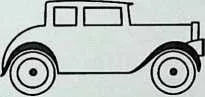
51 the shape that Bucky began to sketch in his notebook was more like this:
52 After making inquiries, Bucky discovered that he could rent one of the machine-shop buildings of the Locomobile Company in Bridgeport, Connecticut, very cheaply. This building had been standing idle for some time; the Locomobile Company was one of the many automobile companies that had failed after the stock market crash. The gift money was enough to cover not only the rent of the building, but also the hiring of skilled mechanics and engineers to work on the car. The city of Bridgeport was full of such men who had been out of work for a year or more, and Bucky soon had a competent crew working in his factory.
53 Now for the first time Bucky felt the thrill of actual accomplishment. He was really going to build the first Dymaxion automobile! He invited one of the most famous aeronautical engineers in the world, Starling Burgess, to take charge of the enterprise. At first, Burgess was wary. But one look at the plans for the Dymaxion Car of the future convinced him, and he accepted. In short order, pulleys and belts began to hum and whirl. Draftsmen bent over their drawing tables, intent on turning out scale diagrams of various parts of the car.
54 While the car was being assembled, Burgess, who had also achieved fame as a naval architect, kept Bucky busy on another project. It seemed that Burgess had promised someone else that he would build a racing sloop by July of that year. In order to get Burgess to work with him, Bucky had to agree to work on the sloop himself. Of course, Bucky knew enough about boats to do a competent job. And the two timetables coincided perfectly. When
55 the first Dymaxion car rolled out of the factory on July 12, 1933, for its road test, the racing sloop was ready to be shipped to its owner.
56 Imagine an automobile shaped like the front end of a sleek, modem jet airliner! Imagine an automobile that ran on three wheels, two in the front and one in the rear! Imagine a fat automobile with windows that went all the way around, and that could hold ten people and a driver comfortably! Imagine an automobile that could be rotated in a complete circle about its tail wheel! That was Bucky’s Dymaxion Car.
57 Using an ordinary, stock V-8 engine purchased from the Ford factory, the Dymaxion Car reached speeds up to 120 miles an hour without difficulty. It would have taken an engine with more than three times that horsepower to accomplish the same feat with any other 1933 car! And what maneuverability the Dymaxion had! It was over nineteen feet long (a good four feet longer than a Ford), but it could be parked in a much shorter curb space than the average car. All you had to do with the Dymaxion Car was to head directly into the curb, and then roll the tail section in sideways on the single wheel. When Bucky did this one day in midtown Manhattan, he stopped traffic with the crowd that collected to watch.
58 Bucky felt it in his bones; finally he had achieved success. He had been able to make a part of the future world believable to the world of the present. He had no doubts about this, and many agreed with him. The Dymaxion Car would push every other existing car model back into ancient history.
59 One of the greatest reactions to the unveiling of the Dymaxion Car came from overseas. A group of Englishmen, interested in autos in general, wrote to ask Bucky to make a second Dymaxion Car that could be exhibited in England. And the group asked if they could send a representative to test-drive the first Dymaxion Car in the United States.
60 Bucky agreed with excited pleasure. Reactions to the Dymaxion Car on every side had been more than enthusiastic. An Englishman named Colonel William Forbes- Sempill cabled that he would be crossing the Atlantic on the famous dirigible, the Graf Zeppelin. Unfortunately, the Graf was not going to land in New York as usual, but would be going on to Chicago, where the 1933 World’s Fair had opened. Could the Dymaxion Car be taken to that city?
61 The first car had already been sold to a well-known American aviator, Captain Alford Williams. At Bucky’s request, Williams had a racing driver named Turner drive the car from Pittsburgh to Chicago.
62 The English colonel was delighted with the performance of the Dymaxion Car. He was sure that his group would want to order one. After he finished examining the car, he asked Turner to drive him in it to the Chicago airport, where he was to catch the plane to Akron, Ohio. The Graf Zeppelin was waiting for him at the large American dirigible base there.
63 Once again on the threshold of success, Bucky suffered a cruel defeat. On the way to the airport, a car driven by a petty official in the Chicago city government crashed into the Dymaxion Car. Both Turner and the other driver were killed, and the English visitor was badly injured.
64 Police acted quickly to remove the official’s car from the scene. When newspaper reporters arrived there was the Dymaxion Car by itself, smashed and bloody. The news accounts, then, placed the blame for death and injury on the Dymaxion Car alone, two zep riders killed as FREAK CAR crashes, blazed one headline, three wheeled car kills driver, read another. Public opinion was molded by these stories.
65 A cable from England told Bucky that the group there was no longer interested in an automobile that had proven to be a death trap. In vain, Bucky and Captain Williams presented evidence to show that the Dymaxion Car had in no way been the cause of the accident. No one believed them or seemed to care.
66 To make matters worse, the Chrysler Corporation in 1934 unveiled a new model —the Airflow Chrysler. This streamlined car was nothing like the Dymaxion Car. As a matter of fact the Airflow car was popular only for a short time, then Chrysler returned to standard forms of the auto body. But again, the timing was just right to make all other auto manufacturers lose interest in the possibilities of the Dymaxion design.
67 Bucky did manage to turn out a second Dymaxion Car, and finally a third one. Both were sold. But no one in the industrial world seemed to care any more for Bucky’s design for the future.
68 His money was gone. Once more, R. Buckminster Fuller, the successful failure, had to turn and face the reality of a world that was not ready to accept him or his ideas.