
6 The Corncrib That Became a House
2In 1936, Bucky Fuller found himself without money and without a job.
3 But the Great Depression had eased, though the crisis was not completely passed. Slowly the federal government, under the leadership of President Franklin D. Roosevelt, began to restore the sick economy of the country. Many different federal projects gave new hope to men who thought they would never work again. The nation’s factories were coming alive once more.
4 Now there was more protection for the American citizen against the possible recurrence of such a national calamity. A Social Security Act had been passed by the Congress, giving pensions to all citizens past the age of 65. The federal government began to take a hand in controlling the extremes to which businessmen could go in making profits. A Securities and Exchange Commission was created and given power to prevent wild speculation in the stock market.
5 The Dymaxion Car, despite its lack of acceptance by the motor industry, had made Bucky’s name known to manufacturers all over the country. So, after the third
6 Dymaxion Car was finished and sold, he had no trouble finding a job. He was hired by the Phelps Dodge Corporation, a large industrial group specializing in metal products. Bucky was asked to create a Department of Research and Development, where new ideas for inventions could be explored. American industry was just beginning to wake up to the fact that such a department would eventually become the brain center of an entire industrial complex. Before this, research was thought of as something that went on in college laboratories, not in manufacturing plants.
7 Anne Fuller was certainly pleased at the thought of a steady, weekly salary coming into the house. But she knew Bucky well enough to realize that money could only play a secondary role in their lives. The Phelps Dodge position was going to give Bucky a chance to use his imagination and his ideas —that was far more important to her than his paycheck. Still, with Allegra growing up, the money was going to be useful.
8 Bucky proved useful to the Phelps Dodge Corporation also. He invented a new kind of brake for automobiles, using a brake drum made of bronze instead of steel. One of the difficulties that had been plaguing the company was the intense heating up of steel brakes during the act of hard and rapid braking. This heating caused brakes to grab, or to slip. Bucky’s bronze drums were arranged to carry heat away very rapidly. Thus the stopping time of a brake could be reduced tremendously without losing efficiency. Another Fuller invention was a method of processing a particular ore of the metal, tin, that had resisted all previous efforts to melt it down.
9 While he was doing this kind of inventing for Phelps Dodge, Bucky was doing other things at home. He began writing a series of essays in which he looked at the inefficiency with which the world was run. In the essays he proposed ways of using the available energy of the universe to provide all the necessities of life for every man, woman, and child on the earth. He wrote about his ideas for changing the housing industry into an efficient industrial machine that would turn out houses to sell as cheaply as cars. In angry, sarcastic language, he quarreled with the businessmen and bankers who were afraid to face up to the changes that scientific and technological progress had made necessary. These people, now in power, would have to realize that the real wealth of the world was energy, and not gold. The world was going to have to change its ways.
10 Bucky called his collection of essays Nine Chains to the Moon. He chose this title from the simple, statistical fact that if all the people in the world were to stand upon one another’s shoulders, they would form a human chain 2,160,000 miles long, a chain that would go back and forth between earth and moon nine times. ‘‘If it is not so far to the moon, then it is not so far to the limits of the universe —whatever, whenever, or wherever they may be,’’ Bucky wrote.
11 He was able to interest the New York publishing house of J. B. Lippincott in his manuscript. In 1938, Nine Chains to the Moon appeared in the bookstores. A review of the book in the popular magazine, Newsweek, declared: ‘‘Imagine a three-ring circus —high wire acts, blaring bands, clowning and all —with one man as the whole show . . . this book is at once a guide book and dream book of the future, a purge of the past, a debunker of architecture, economics, politics . . . this ruddyfaced, gray-haired inventor is no nut! It’s great stuff!’’
12 Other reviews were lukewarm. Most readers complained that Bucky used an outlandish kind of language to express his ideas. For example: ‘‘Thus genius has the ability to ‘fix’ events by the convergent angle of two or more sight ‘lines,’ not only in time (or space) past, but, also, in time (or space) ahead, from the central perspective of self-NOW.’’ What in the name of all that was holy did that mean? What Bucky was saying in his explosive, dramatic way was that any genius can see relationships between things that are invisible to ordinary men.
13 Nine Chains to the Moon made only a ripple in the book market. But in it, bold and clear, was R. Buckminster Fuller’s challenge to the world.
14 Meanwhile Bucky had been able to interest his superiors at the Phelps Dodge Corporation in one of his earlier creations —the Dymaxion Bathroom. This was the bathroom he had created for the 4-D house, the one-piece, efficient room that operated on only one quart of water.
15 Here at Phelps Dodge were great metal presses, easily capable of stamping out parts for the Dymaxion Bathroom. The research staff, under Bucky’s direction, worked out new and more efficient ways of mass- producing these bathrooms, complete with ventilating, lighting, heating, and plumbing equipment. There were two major sections: the tub-shower component, and the lavatory-toilet component. The whole bathroom was stamped out of four pieces of steel which were then welded together to look like a single surface. There were no sharp corners, only smooth and graceful curves.
16 The entire bathroom covered an area five feet square! And every bit of space was used so efficiently that there was even room for a medicine cabinet large enough to hold a five-gallon bucket.
17 There seemed to be universal approval of the Dy- maxion Bathroom. Even the plumbers appeared to like it. An article praising Bucky’s invention appeared in the official magazine of the New York Plumbers Association, The Ladle. Preparations went ahead full steam for production of the units. Twelve complete bathrooms came off the assembly line. Bucky’s novelist friend, Christopher Morley, bought two of them for his Long Island home. A man who had once been Secretary of the Navy, John Nicholas Brown, had two installed in his house.
18 And then production of the Dymaxion Bathroom was stopped.
19 When Bucky tried to find out what had happened, he was referred to a more important executive in the chain of command. Finally, he discovered that one of Phelps Dodge’s best customers, Standard Sanitary-American Radiator Company, makers of bathtubs, sinks, and toilets, were very worried about unfavorable reactions of the plumbers’ unions all over the country to the Dymaxion unit. The Phelps Dodge executives had not been willing to produce an item that might result in the refusal by plumbers to place any of their products in homes.
20 Bucky tried to point out that these fears were un-
21 founded. Hadn’t the plumbers themselves praised the Dymaxion Bathroom in their magazine? Didn’t they realize that this kind of bathroom meant more work for plumbers, and not less? After all, bathrooms were permanent fixtures. Once a plumber had put in a bathroom, he was through with it —except for occasional repairs. But the Dymaxion Bathroom had been planned to go along with people who moved, like furniture. Plumbers would be called in to plumb the bathroom, just as electricians had to be called to wire appliances. And this would happen every time a family moved. But the minds of those who controlled production had been made up; Bucky’s arguments went unheeded.
22 Again, the Fuller luck had run out. Another attempt to make man’s living on earth simpler and more efficient had been frustrated. More in sadness than in anger, he left his position with Phelps Dodge in 1938 and sought work elsewhere. This time, he found a new kind of job.
23 In 1930, the successful publisher of a news magazine called Time, Henry R. Luce, had started another magazine which he called Fortune. Already a hit by 1938, Fortune was a rather expensive-looking magazine, with deluxe paper and illustrations, which devoted itself to news and problems in the world of business.
24 Bucky’s new ideas and inventions were appealing to the editors of Fortune, and they offered him the position of science consultant and editor. Bucky accepted quite readily. Here was a chance not only to get his ideas into print, but also to have them read by virtually every important businessman and manufacturer in the world.
25 During the two years he worked for Fortune, Bucky was able to accomplish what he considered to be a most important task. No one had ever really added up all the energy resources of the world. This information was vital, if science and technology were to be used to their best advantage for man’s progress. He persuaded the editors that he was the man to do this job.
26 The first thing he did was to use all possible means —libraries, universities, government offices —to gather information about all the countries in the world. He was interested in items like the number of tons of coal or barrels of petroleum used for industrial power every year. He wanted to know how many kilowatt-hours of electrical power were being used, and how many gallons of water flowing per second were needed to generate that power. He checked and double-checked the population statistics of all the countries on every continent.
27 At that time the world population distributed itself over the globe in this fashion: Asia had about 50%, Europe about 24%, and Africa about 12%. The rest of the population was divided between North America (8%), South America (4%), Central America (1%), and all other countries (1 % ).
28 Then Bucky devised a unit that he called the ‘‘energy slave.’’ The calculation of such a unit was rather complicated ; but the energy slave unit showed most clearly the difference between those parts of the world that were technologically advanced and those that were not. In the science of physics, mechanical energy can be defined in terms of how much of it is needed to move a weight against the force of gravity. For example, the energy used to move a weight of one pound up through a distance of one foot is one foot-pound.
29 Bucky calculated that all the countries in the world were using something over 80 quintrillion (80,000,000,- 000,000,000,000) foot-pounds. But only about l/25th of this was being converted into useful work by man, making a total of about 3% quintrillion foot-pounds of efficiently used energy. In one eight-hour day a single man was capable of doing about 15,000 foot-pounds of useful work. In a work year of 250 days, then, a man would accomplish 37,500,000 foot-pounds.
30 If you then divided the total amount of efficiently used energy in the world by the total work-year’s energy used for work by one man, you arrived at a figure equal to about 8514 billion (85,500,000,000) foot-pounds. This was the amount of energy Bucky thought of as being enslaved by man for useful work; this was one ‘‘energy slave.’’
31 When he had figured out the number of energy slaves per inhabitant for each country, Bucky was able to show a fantastic discrepancy between the continents of the world. Asia, the most populous, had only two energy slaves for each person who lived on that huge continent. And the continent of North America with only 8% of the total population had 347 energy slaves for each inhabitant! South America and Europe were about even; the first had 28 energy slaves, the second, 27. Africa had only 13 energy slaves per inhabitant. Now Bucky could demonstrate without any doubt that it was a lack of useful energy —energy that only technological progress could supply —that was keeping many nations from catching up with the twentieth century.
32 Another creation of Bucky’s at this time was what he called his World Energy Map. He divided the surface of a sphere into squares and triangles in a very special way. If this were done to a globe of the earth, and then if the skin of the globe (that is, the map of the world) were removed and stretched flat, the earth became divided very neatly into continents that were linked together, with the oceans all around on the outside. Bucky’s map showed the earth was made up of two distinctive parts, a land grouping and a water grouping.
33 Two years later, Bucky was asked to develop this kind of map even further for Life, the widely read picture magazine of the Time-Fortune group. He needed no urging. Within a few months he turned out a new version that he called the Dymaxion Map.
34 With the spherical surface of the earth sliced into various combinations of squares and triangles, Bucky’s map could show all the geographical data of the world without any breaks in the contours of the continents. Moreover, unlike maps based on the most common method of projecting the spherical world on to a flat surface, the Dymaxion Map had no distortions.
35 In the Mercator method of projection, the skin of the globe is unrolled like a cylinder, so that
all the lines of longitude become parallel north and south lines. Of course, these lines really all
stretch between the North and South Poles. The result of such a projection is that the Arctic and
Antarctic areas are distorted from their natural size. Thus, the Mercator projection map is
fine
for short-distance nagivation, but quite disastrous for global flying or course planning for
intercontinental rockets.
36 Life published the Dymaxion Map in March of 1943. Once more, the name of R. Buckminster Fuller was signed to a notice to the world: be ready for change! Whether it was autos or maps, Bucky was determined to keep this message before the eyes of mankind.
37 Another great opportunity came for Bucky in 1940 —a chance to do something with the plans for the Dymaxion House. While driving with his friend Christopher Morley through the farmlands of Missouri, Bucky pointed out the cylindrical steel bins in which farmers kept their grain and corn.
38 There was an efficient kind of house for you! It could be manufactured on an assembly line as a prefabricated house; that is, the factory could turn out a few large parts that could easily be assembled to make a house. It would cost less than a dollar for each square foot of floor space to house a family in such a ready-made house! What was the secret?
39 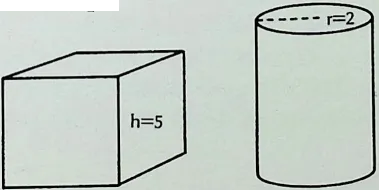 There was no secret. It was simple high-school geometry. If you took a cube, where you
have six square walls each the same size, and change it into a cylinder, the same wall area
encloses more space. While Morley drove on, Bucky scribbled some diagrams and calculations on
the back of an envelope:
There was no secret. It was simple high-school geometry. If you took a cube, where you
have six square walls each the same size, and change it into a cylinder, the same wall area
encloses more space. While Morley drove on, Bucky scribbled some diagrams and calculations on
the back of an envelope:
40 a=3.7
41 CUBE
42 CYLINDER
43 Suppose a cylinder has a base radius of 2 and a height of 5. The area of the surface of the cylinder involves the radius, the height, and the constant number, pi, which can be written as 22/7 for simplicity. Then:
44 Area = (2) (pi)r(r + h) = (88/7) (7) = 88.
45 Now a cube with a side equal to some unknown number, a, has a surface area = 6a2. So, if we set the area value 88 equal to this and solve for a, we get a value of about 3.7. The volume of a cube is found this way:
46 Volume = a3 = (3.8) (3.8) (3.8) = about 55.
47 But the volume of a cylinder is found by:
48 Volume = (pi) (r2) (h) = (22/7) (4) (5) = about 63.
49 So, the cylinder contains much more useful space than the cube! Not only that, but the circular base of the cylinder takes up less ground space than the square base of the cube.
50 Having proved his point, Bucky went on to describe how he would build his cylindrical house. There would be no need for internal supports, nor for external bracing. Such houses would be easier to heat and to keep cool. Morley was impressed. Why didn’t Bucky go ahead and build them?
51 Bucky had the answer to that on the tip of his tongue. Money. Money that would give him time to work out plans, that would take care of little, but important details, like travel and hotel expenses. Money always seemed to be a basic problem.
52 But Chris Morley was a true friend. He had just written a new novel called Kitty Foyle. Perhaps it would become popular and make money. And, if Bucky would permit the favor, he would donate the profits from the book toward the manufacture of Buck’s cylinder houses.
53 Kitty Foyle was not only a best seller; it was also sold to a motion picture company. Morley was true to his word. Bucky could begin whenever he was ready.
54 It took many weeks to prepare careful plans for the cylindrical house, which Bucky named the Dymaxion Deployment Unit. Now the problem was: where could the house be manufactured? The answer came at once. Why not have the Dymaxion Unit made by the very people who manufactured the storage bins they had seen in the fields?
55 That company was the Butler Manufacturing Company of Kansas City. Since their machinery was all geared for the production of steel cylinders, very few changes would have to be made to produce Bucky’s house. After a few weeks of conversation, the company officials were favorably impressed. They agreed to manufacture the Dymaxion Unit.
56 The major departure from the corncrib shape in Bucky’s design was the roof. Atop the steel cylinders made by the Butler Company, the roof was a simple, sharp-pointed cone. Bucky curved the bottom rim of the cone into rounded eaves that fitted onto the top of the cylinder. His first intention had been to make the appearance of the house more graceful. However, he soon discovered that curving the eaves in this fashion added great strength to the entire structure.
57 The cylinder that formed the walls of the house had a diameter of twenty feet, which made for a floor area of a little over three hundred square feet. By this time many of the new materials envisaged by Bucky had been invented and were being sold on the market. One of these was a new kind of wool-like material actually made from fine filaments spun out of molten glass and called fiber glass. This protective layer between the outer steel wall and inner wallboard served to keep the heat inside in winter and outside in summer. Under the ceiling, he placed a three-inch thickness of fiber glass. This wonderful new stuff turned out to be excellent for absorbing sound, as well as for insulating.
58 How do you make windows in a cylindrical wall that curves at every point? Bucky solved this problem by calling upon his experience in the Navy. He had round portholes cut into the sides. More natural light was made available by adding a skylight and ventilator at the top of the roof cone. Rooms were fashioned out of the cylindrical space by sections of weighted curtains that could be easily pushed aside to merge rooms into a single space. This was an idea that Bucky had worked out for the original 4-D house.
59 Assembling the Dymaxion Deployment Unit was a simple task. First, the conical roof was assembled and hoisted into the air on a mast. Then, the cylindrical walls were assembled beneath the cone. This part of the assembly could be done by men standing comfortably on the ground. Finally, the roof was lowered slowly over the top of the cylinder, until the curved eaves made a tight fit.
60 One unusual incident made the engineers of the Butler Company keenly aware of Bucky’s understanding of scientific principles. On a hot August day in 1940, a group of them came out to see the first Dymaxion Unit. The Unit was hoisted on its mast slightly above the prepared brick and earth floor on which it was to rest. When Bucky invited them to enter the house, the engineers balked. If it was over a hundred degrees outside, they said, surely the inside of that metal house baking in the sun would be like the interior of a blast furnace.
61 Bucky smiled. No, he disagreed, that wouldn’t be the case. As a matter of fact, the inside of the house would be much cooler than the outside atmosphere. Did he notice a look of doubt on their faces? Well, then, why didn’t they go in?
62 The engineers were unprepared for the shock. The house was as cool as though it were air-conditioned! But there was no air-conditioning machinery to be seen. Was it magic?
63 Bucky assured them that they were observing a basic behavior of gases known to any physicist. The engineers lighted cigarettes; the movement of the smoke would give them a clue to what the air inside the cylinder was doing. In a few moments, they had the answer: the air was rushing down from the top ventilator hole and going out through the space between the brick floor and the walls.
64 It all seemed unreal. Hot air was supposed to rise —everyone knew that. But here the air was doing exactly the opposite.
65 Bucky explained. The ocean of air around us can be full of currents, like the sea. And the temperature of these currents depends really upon the energy of the gases in the different spots. After all, the Gulf Stream in the Atlantic is a warm current flowing through a much colder ocean.
66 All around the walls of the Dymaxion House, the air was being heated by the sun. And this very hot air was indeed becoming lighter and was rising. How does this rising current keep supplied? Why, by pulling out more air from under the Dymaxion House. And this pulling out caused a downflow of air inside the house, a downflow containing a cold draft. The engineers were amazed. Here was a house being cooled without the use of fans.
67 Now Bucky was convinced that his venture would be successful. Interest in the Dymaxion Deployment Unit spread rapidly. And for the first time an interest in Bucky’s work was shown by certain units of the American armed forces.
68 In 1939, the democratic nations of the world had begun to awaken to the fact that a major portion of the earth was being governed by men who were threatening to put an end to democracy everywhere. By 1940, Japan had established points of attack on the Chinese mainland. Not satisfied with conquering China alone, the Japanese leaders had ordered an advance into French Indochina. It looked as though the samurai were setting out to conquer the world.
69 When Hitler marched into Poland, England and France declared war against Germany. But these two democratic nations had not prepared for war as well as had their enemy. The army Britain sent into France was smashed and defeated by June of 1940. By a great miracle, the famous rescue of British and French soldiers from the beach at Dunkirk in northern France had saved over 300,000 fighting men. But on the twenty-second of June, France gave up. England faced the German conqueror of Europe alone.
70 In the United States, the people and the government watched events in Europe and Asia with mixed feelings. Some felt that America, with a large ocean on either side, was comparatively safe from invasion. Others insisted that England ought to be helped. Still others urged the government to aid the persecuted Jews of Europe. There were also many who felt that Hitler was a fine leader who had prevented Germany from becoming a Communist country. The ability of the Nazis to move swiftly and seize power was admired by many Americans. Some pointed out that sooner or later Hitler and Stalin would destroy one another, and that Americans would be better off for not interfering in Europe’s affairs.
71 In the autumn of 1940, Hitler launched an all-out attack on British cities from the air. Hundreds of German bombers filled the skies over England in an effort to wipe out the Royal Air Force. But thanks to a new electronic invention called radar, the British were able to anticipate these raids and shoot down many bombers. Then followed awful nights of bombing over all large cities in England. It was clear that Hitler was determined to terrorize the English into submitting. But the English people held fast, and Hitler did not succeed.
72 Now the armed forces of the United States began to be interested in the new inventions being used by the British. When Hitler made the decision to invade the Soviet Union in June of 1941, the American government began to see that it would be necessary to come to the assistance of both England and Russia. Yet Germany seemed reluctant to declare war on the United States, even when supplies began to flow to her enemies from America.
73 This was when the Army Signal Corps representatives came to see Buckminster Fuller’s Dymaxion Deployment Unit at the Butler Company in Kansas City, Missouri. The Signal Corps was badly in need of some kind of light, easily transported, easily assembled hut in which radar equipment could be set up and operated. The military men were impressed by the efficiency and low cost of the Dymaxion Unit. Bucky had figured the cost of one Unit, fully furnished and with attached cylindrical bathroom, at only $1,250. And this price included an icebox and stove that were both operated by kerosene.
74 Bucky explained to the Army visitors how his Dymaxion Unit fulfilled the idea of doing more with less. He showed them how he had employed new materials in new ways. For example, the porthole windows were not made of glass. For these he had used a new transparent acrylic plastic which had previously been used only for the canopies of war planes. The floor onto which the Unit was lowered was made of flat steel sheets which served as a moisture barrier. Over these were placed rectangles of a hard, pressed wood material called masonite. Nothing was glued or nailed together. But Bucky had found out that masonite tended to curl in such a way that one side —the shiny side —was arched outward. He had laid the sheets shiny side up, so that the pull of gravity kept the whole floor perfectly flat.
75 Architects, too, heard about Bucky’s strange new house, and came to see and test it. One of the Units was installed in a Washington, D.C., park for study by officials of a government housing agency. Another became a special garden exhibit in the garden of the Museum of Modern Art in New York City.
76 Orders for hundreds, and soon some thousands, of Dy- maxion Deployment Units came from both the Army Signal Corps and Army Air Corps. One major area in which these houses were most useful was on the coast of the Persian Gulf. This was a transfer point where American fighter planes were delivered to Russian pilots. The Dymaxion Units served as dormitories for American pilots and mechanics. In a few months, Bucky’s live-in cylinders were being erected in different parts of the earth, as the United States Army began to place radar stations in strategic places.
77 On the morning of December 7, 1941, the Japanese warlords made their bid for supremacy of the Pacific Ocean by bombing the American Fleet at Pearl Harbor. Now, the United States could no longer be ‘‘officially’’ neutral. She joined Britain and the Soviet Union as partners in war against the Axis, the name given to those countries that had united to bring death and destruction to the world.
78 It seemed strange that during the previous ten years when the United States had been at peace, few people had paid attention to Bucky’s plans for solving the shelter problems of man. Now the rage and destruction of the Second World War, the struggle between the powers that wanted to enslave man and those that wanted to keep him free, had changed everything. His Dymaxion House was not just a dream of the improbable future —it was a real invention that had proved its usefulness. The name of R. Buckminster Fuller was being mentioned in high government circles. He was no longer being written off as an eccentric inventor who talked endlessly about things no one understood.
79 It was 1942. America was in the throes of trying to stop the Japanese from taking over the Pacific Islands. The need for thousands of guns and millions of bullets and shells was making steel a very scarce item. The Butler Manufacturing Company could not get enough steel to keep making the Dymaxion Units. Soon they had to be scratched from the production list.
80 But the stopping of production did not spell failure for Bucky. The war had changed his life in other ways. He decided to give up his bad habits of drinking and smoking; in fact, he cut these out completely from his life. He realized, he told Anne, that a man could not drink and be a prophet of the future at the same time. People tended to dismiss his talk as the babbling of a drunkard. Now that the acceptance of the Dymaxion Unit had given him a start, Bucky was determined to keep moving forward.
81 His first action in this direction was to accept the job that had been offered to him in Washington, D.C. He became Director of the Mechanical Engineering Section of a new, important government agency —the Board of Economic Warfare.
82 He was now forty-seven years old.