
9 Geodesic Domes for the World
2With the stopping of production of the Wichita House, Bucky Fuller had vowed never again to put his plans entirely in the hands of industrial corporations. Instead, he arranged his affairs so that industry would have to come to him.
3 In 1946, he organized and incorporated the Fuller Research Foundation. This gave him a legal means of protecting his ideas and inventions. All his research could be done in the name of the Foundation, and all copyrights and patents could be protected by it. Now he was ready to apply the principles of his synergetic-energetic geometry to the real world.
4 What excited him most were the possibilities of the geodesic. If you could construct a sphere made of the triangles formed by intersecting geodesics, each triangle would represent a tetrahedral structure of minimum surface and maximum strength. What if you sliced such a sphere in half? Then you would have a kind of covering, a covering in the shape of a dome, that would behave in an extraordinary way.
5 The architectural structure called the dome had fasci
6 nated Bucky for many years. There were domes everywhere in nature —in caves, in bubbles, even in the faceted eyes of insects. Eskimos lived in dome houses shaped from snow blocks. In the Middle Ages, Europeans had worshipped God in a dome house called a cathedral. One of the most important dome structures in architecture through the ages was the stone arch, where one stone —the keystone —served to distribute the weight of the arch stones properly.
7 One could make a play on words with dome. Look at how many different ways there were of taking the two letters om and adding front and back letters. Dom meant house in many languages. Replace the d with an h and add an e — there was home. When you died, you were placed in the tomb. And when you were born, you came out of the womb. Bucky felt that the idea of a dome was an important one in the entire lifespan of mankind.
8 Now, suppose you created a dome whose surface was a number of joined-together tetrahedrons. It would be easy enough to interlock the tetrahedron sides about geodesic points as vertices. Then, you would have a multiple tetrahedral structure of least volume. But least volume was the same as saying least weight. And along with least weight, the structure would have maximum strength. Any great load you would place on this dome would be spread evenly out over the surface. The kind of material out of which you built such a structure was, in a sense, unimportant. The dome could be made of paper; yet it should not collapse under a heavy accumulation of snow, nor should it blow down in a heavy gale.
9 It seemed to Bucky that he had finally realized one of his earliest goals: to do the most with the least. That was the message that was loud and clear in nature’s own geometry.
10 From this Dymaxion geometry (Bucky stamped it with his own trademark), he arrived at another prediction about the behavior of a system. This prediction was related to his early vision of the dirigible house, where the different decks were supported by compression and tension forces. Why couldn’t tetrahedrons be supported, one against the other, in the same way?
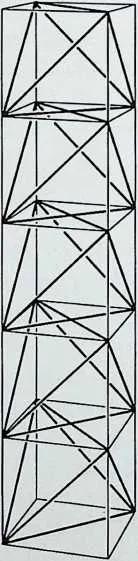
12 Slowly, the geometrical rules for such a compressiontension combination began to be worked out in his mind. You started with cubes, whose diagonals formed tetrahedrons that were pointing in the same direction.
13 The ‘‘weight’’ of each tetrahedron would be balanced exactly at the point called the center of gravity. For each tetrahedron you could imagine two radii going from the center of gravity to two of the vertices. You could also imagine that at each center of gravity, the radii were connected by a kind of ball bearing, so that they were free to swing together or pull apart.
14 Now Bucky could imagine one tetrahedron moving toward another one below it, with the centers of gravity connected by a ‘‘tension line.’’ This line tended to pull center A toward center B and to pull center B toward A at the same time.
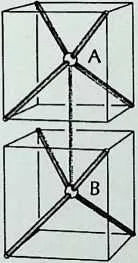
16 The radial lines from center A to vertices 3 and 4 in the upper tetrahedron then became like
two legs that were
being forced apart by the tension. The same thing was happening to the two radial lines that
connected center B to vertices 1 and 2 of the lower tetrahedron. But these four radial lines could
be kept from flying apart by connecting all the vertices to the centers and to each
other.
17 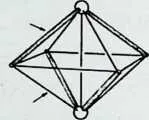 Compression
1819Tension
20 Bucky imagined an entire stack of such tensed and compressed tetrahedral radii, held together and, at the same time, kept at a minimal distance from one another.
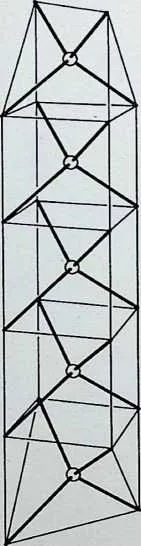
22 Could such a geometric structure be translated into real materials? He tried it with sticks (the radii from the centers of gravity) and string (the tension-compression lines).
23 It worked! The system could be arranged in a straight- line pattern, like a mast, or in a spherical dome shape. It was almost like magic. The wooden struts hung suspended in midair, kept in place by the balancing, unseen forces.
24 Bucky called this part of his geometry, tensegrity.
25 A third practical result of his geometry was the invention of the octet truss. This structure was Bucky’s answer to the problem faced by architects and engineers when they had to use beams or struts of various kinds to support loads. Normally, such struts were laid parallel to one another on supporting walls:
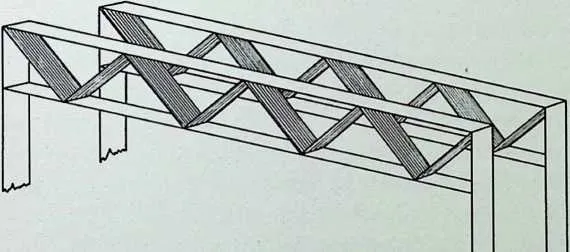
27 Thus, the ordinary truss, or framework to support some kind of load (as a roof), consisted of struts that supported independently of one another. One strut got no help from the next.
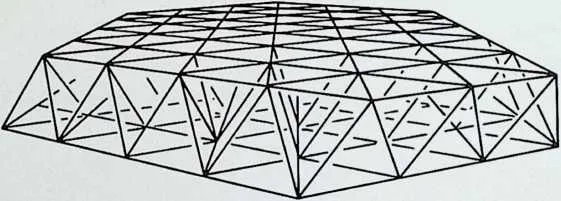
28 Bucky’s truss consisted of tetrahedron or octahedron patterns combined into struts in such a way that they ‘‘curved back’’ into the whole system. Every strut ‘‘helped’’ the adjoining struts around it. The result was that any load on the octet truss was distributed evenly in all possible directions over the combined struts.
30 Bucky now turned away from industry and looked to the academic world for help. Beginning in 1948, he visited many colleges and universities, trying to interest professors and students in his new kind of geometry and construction. Not many professors would listen to him. The architects, as usual, considered him an outsider and not a professional. When he tried to explain the unusual results of his Dymaxion geometry to mathematicians, they smiled and said, yes, well, that was very interesting, but. When he tried to show physicists how his notion of internal and external energies were based upon clues
31 that could be found in nature herself, they smiled and said, yes, well, that was rather clever for a nonphysicist, and wasn’t he using words a bit too loosely.
32 But the artists and designers at many of these colleges were fascinated by what they heard. They listened to Bucky. And some of the younger architects and scientists began feeling a kinship with this short, heavy man who had the face and smile of a Dutch uncle, and who never seemed to tire of talking about the marvels that science and technology had in store.
33 Bucky managed to get himself invited to stay for a while at some of the colleges. At Chicago, he showed students of the Chicago Institute of Design how to make geodesic domes out of wooden sticks. He taught them to make prefabricated parts, triangles, pentagons, and hexagons, and to put these parts together to make domes.
34 In 1949, he was a guest of honor at Black Mountain College in North Carolina. This was a school where students performed manual labor while they learned. Later, he visited North Carolina State College at Raleigh. At both of these schools, eager young undergraduates worked with Bucky on model tetrahedron domes and ten- segrity structures. There were many amazing variations that could be worked out for domes. Bucky made one that could be folded, like a butterfly’s wings, into a light, flat package. When the package was opened and its circular base pulled taut, up popped a dome of great strength. Only about seven feet in diameter and made of flexible cable joined at the vertices, Bucky’s dome could support the weight of more than eight people clinging to the top and sides.
35 No matter where Bucky went, it was the young people who clustered about to hear him talk about domes and the future of man’s shelter problems. These students never seemed to tire of listening to him; and Bucky never seemed to grow weary of talking with them.
36 While Bucky was moving among colleges, his lawyer was preparing the patent applications for his new invention, the geodesic dome. Under the heading of Building Construction, the application began with these words:
37 ‘‘My invention relates to a framework for enclosing space.’’
38 Who would have thought that such a thing was patent- able? A way of enclosing space! How could it be done? After all, almost any hollow body was a space encloser!
39 But Bucky knew that his way of enclosing space was different from any other way than had even been invented by man. He had seen the space of the universe from a different point of view. And that point of view was patentable! The patent laws of the United States would give him the right to keep others from using his techniques without permission.
40 Little by little, Bucky’s traveling and demonstrating began to have an effect. Fuller’s domes began to be talked about wherever architects gathered to discuss ideas. Some in the profession were suspicious; most merely unbelieving. Yet, in all this talk that went on there was this common thread: a fellow named Buckminster Fuller had gotten hold of something new, something that might turn out to be important.
41 A few young and talented ‘‘believers’’ came to stay with Bucky and to work with him on geodesic designs. Of course, he had no money to give them for their time and work. These devoted young people all faced the same decision this time that Bucky had had to face long before. What was more important to the person who felt he had something to offer to mankind, making a living or dedication to one’s ideals? Bucky told them of his decision during that fateful year of 1927; a dedication to one’s own felt genius came before all else. Somehow, you survived. And look, he, Bucky Fuller, had survived to fulfill his destiny. Some young people believed him and stayed on. Others felt that supporting a wife and children was their first obligation; unwillingly, these young men left Bucky to take secure jobs.
42 In 1952 came the first incredible stroke of luck. The Ford Motor Company was planning a new building at the River Rouge plant in Dearborn, Michigan. This building was to be an office building and showplace; it had been designed as a very modern ‘‘rotunda’’ —a cylindrical structure with fluted sides. Part of the design was a translucent dome that was to fit like a skylight over the top of the rotunda. There were not enough supports to carry the weight of a steel skylight framework. Somehow, word of Bucky’s experiments came to the ears of Ford officials. They sent him their problem to solve.
43 Bucky’s solution was an octet truss dome with a translucent plastic skin. He pointed out that whereas a conventional steel dome of the required ninety-three-foot diameter would weigh one hundred and sixty tons —far more than the building could support —his geodesic dome made of aluminium would weigh only eight and a half tons. Bucky’s design captured the imagination of Henry Ford II. The octet truss was just what he was looking for.
44 Since Bucky’s application for a patent was already filed, the Ford Motor Company could not build the dome without permission. This meant that they had to pay Bucky whatever he asked as a royalty, or licensing fee. They received the first license to make a geodesic dome. And it was the first time that Bucky could really control the use of his ideas.
45 Once the dome had been planned, Bucky oversaw its installation. This took only four months, a record for that kind of construction. Finished in 1953, the Ford Rotunda Dome was an instant success with the American public. People drove from everywhere in the United States to see the building with Bucky’s dome. It was the first time a large number of people were able to visit and see a large geodesic dome ‘‘in action.’’ The effect of the sunlight coming through the curved honeycomb of small and large triangles was startling to the eye. Bucky began to receive questions from people everywhere, asking about his geodesic dome. Architects were clearly affected by the success of the Rotunda Dome. The May 1953 issue of the professional magazine, Architectural Forum, carried an article entitled, ‘‘Bucky Fuller Finds a Client; Young Henry Ford Translates the Geodesic Dome into Aluminum and Plastic.’’
46 Bucky’s next action was to form two corporations: Synergetics, Inc., and Geodesics, Inc., both in Raleigh, near the college that had shown so much interest in him. He hired some of his younger disciples as managers, designers, and planners. Anyone in the United States who wished to build any kind of geodesic structure would have to apply to these two companies for licensing and consulting. And Bucky had a feeling that plenty of business would soon be coming his way.
47 By the early fifties, the United States and the Soviet Union had settled into the political impasse known as the ‘‘cold war.’’ After the Second World War, Russia had seized as much of the territory of Western Europe as she could get, including Poland, Czechoslovakia, Hungary, and a large chunk of Germany.
48 To counter this threat, the United States had built up a military alliance with England, France, West Germany, Turkey, and Greece known as NATO (North Atlantic Treaty Organization). It began to appear as though the civilized world was divided into two camps —the ‘‘free’’ nations led by the United States, and the Communist dictatorships led by the Soviet Union. These two powers controlled whatever atomic weapons existed at the time, and each knew that actual warfare might now mean the end of man on earth. Yet, the stresses and strains of two opposite philosophies of governing and living were almost like a real war.
49 In order to cope with the possibility of sudden atomic attack by bomber or rocket missile, the Defense Department in Washington decided to set up a radar warning line along the Arctic Circle in Alaska and Canada. The code word for this project was DEW (Distant Early Warning). But there were some serious problems to be overcome. The weather was the enemy -—harsh, freezing cold that persisted for most of the year, and gales that generated 200-mile-per-hour winds. Also, houses built to withstand the weather had to be made of materials through which shortwave radar signals could pass. This meant that there could be no metal in their construction.
50 The problem was referred to Bucky. He worked out a plastic radar dome (later shortened to ‘‘radome’’) that was fifty-five feet in diameter and stood forty feet high. These could be delivered by plane in knocked-down form and assembled in only fourteen hours, six hours less than the maximum time established by the Defense Department. A wind that blew at over 220 miles an hour could not budge Bucky’s plastic radome.
51 Another customer, the Marine Corps, became interested in the radome, and they sent people down to ask Bucky questions. Could such domes be used as temporary shelters? If so, how easily could they be transported from one place to another?
52 Bucky’s answer was to design a geodesic dome made of wooden frame and plastic skin with a thirty-foot diameter. Then he suggested to the Marines that the dome could simply be picked up by helicopter and hauled anywhere. This was an unusual idea, but it appealed to the Marine agents. For Bucky, of course, it was an old idea that had finally been translated into action. A form of the movable dirigible house had finally arrived —a dome home that could be moved from place to place by aircraft. With the invention of the helicopter, this idea had become a practical one.
53 The first airlift of a Fuller dome by helicopter took place in February, 1954. The dome was picked up and, as Bucky had predicted, flown without damage to another spot. The streamlined shape of the dome minimized the drag of the air; the pilot did not feel his ship pulled to one side or the other. Cruising at a speed of about sixty miles an hour, the pilot returned the dome to its original resting place.
54 Now the Marines were really interested. How long would it take a group of Marines to erect such a dome from scratch on a beachhead? Why not let them do it and see, suggested Bucky. It took them about two hours and a quarter. Why waste all that time, they asked, couldn’t the dome be erected on the deck of a carrier and flown completed to the beach? Good idea, said Bucky, let’s try it. In fact, let’s make a dome large enough to be a hangar for an aircraft and fly that to the beach.
55 It was done during a simulated attack on a beachhead and worked perfectly. As a result, the Marine Corps purchased more than three hundred of Bucky’s domes and used them in many different parts of the world, even as far away as Antarctica.
56 In Italy, that year, the Tenth International Design Exhibition, known as the Triennale, was to be held. Architects and industrial designers from all over the world competed for prizes at this exhibition. But in 1954 the United States did not have an entry.
57 Bucky persuaded the Container Corporation of America to back him financially for the submitting of two paper geodesic domes to the Triennale contest. The domes, made of paperboard hexagons and an outer plastic skin, were assembled in the Sforza gardens in the city of Milan. And on the first night of the Triennale, when the lights were turned on inside one of the domes, the beauty of the geodesic pattern made visitors stop, mouths open in wonder.
58 Bucky’s paperboard domes won the Grand Prize in Milan.
59 Now officials in both industry and government became aware of the power of the geodesic dome. Bucky received a letter from the Department of Commerce, asking if he could set up a dome for the United States Pavilion in the 1956 International Trade Fair to be held in the city of Kabul, Afghanistan. The dome he designed was one hundred feet across and thirty-five feet high. The speed with which illiterate native workers were able to erect it was stunning.
60 The Kabul Dome was the hit of the Fair. Not long after, similar domes began to appear at international fairs everywhere, from Poland to Japan. In different languages spoken all over the world, the word for dome began to be used more often. And usually spoken with the word for dome was the name Fuller.
61 At about the time that the Kabul Dome was being admired, an even greater success was in the making for Bucky. The famous industrialist Henry J. Kaiser, owner of one of the greatest aluminum companies in the country, decided that a hotel complex he owned in Honolulu, the Hawaiian Village, needed a concert auditorium. Hearing about the geodesic dome from one of his executives, Kaiser was impressed enough to ask Bucky for a license to manufacture a dome large enough to cover a 2,000 seat concert hall. In fact, Henry Kaiser became so excited about the possibilities of the geodesic dome that, with Bucky’s permission, he tooled up an assembly line in his West Coast plant to manufacture aluminum domes.
62 Bucky designed a hundred-and-forty-five-foot-diame- ter dome for Kaiser and shipped the sections to Honolulu in February, 1957. Kaiser was most anxious to witness the erection of the dome. On the day that assembly was scheduled, he drove to the San Francisco airport and boarded a plane for Honolulu.
63 He was too late! To his great surprise, the first Kaiser dome was already raised and in place. That night, only twenty-two hours after unpacking, the Dome was filled with a capacity audience listening to a symphony concert!
64 After the news of the Hawaiian Dome spread through the building world, the Kaiser plant began to get calls for domes of all sizes. These became banks, theaters, and restaurants. One of their largest domes, about two hundred feet across, was sent to be the United States exhibit at the 1959 World’s Fair in Moscow. It was the hit of the show. Nikita Khrushchev, then head of the Communist Party in the Soviet Union, made headlines with a famous blooper in which he mixed up Bucky’s name. After expressing his delight over the Dome, Mr. Krushchev said to reporters, ‘‘I want Mr. J. Buckingham Fuller to come to the Soviet Union to teach our engineers!’’
65 June 29, 1954, was the date that marked the real change in Bucky’s career. On that day, the United States Patent Office issued Patent No. 2,682,235 in Bucky’s name, putting him in control of the manufacturing of all geodesic structures in the country.
66 His days of struggle and failure were over. All obstacles to success were gone. Now he would be able to repay Anne for her long years of doing without and making the best of things. Now he could repay his family and his friends for their help and support in the past.
67 At last the world seemed to be aware of this sixty-year- old man, this impossible dreamer of things to come, this writer of incomprehensible words, this college dropout —
68 This Buckminster Fuller had achieved instant genius!