
10 ephemeralization and history
2'About five years ago I used to work at the Holiday Inn at 36th and Chestnut I was working there at night and going to nursing school during the day. Most of the waiters and waitresses tended to avoid old people because they're not usually good tippers. But this little old man particularly…I don't know what it was about him that attracted me. For one thing, I thought he looked lonely. I must have waited on him at least eight times while I worked there He'd always order tea with lemon, and sometimes he's ask for sherbet too. I never knew his full name. He just said 'Call me Bucky' and that was what I called him. He gave me this little card that said 'Cable address Bucky’…He used to make these little drawings for me on ordinary notepad paper. And he'd sign them 'Bucky' and write the date too. He once told me ‘Hold on to these, you never know, they might be worth something someday'.'
3 The Buckminster Fuller Institute Newsletter, October 1983
4 Recognition was a problem Buckminster Fuller faced all his life. Sometimes he called himself a machinist, sometimes an engineer, sometimes a sailor, sometimes grandiosely an astronaut from Spaceship Earth, sometimes simply a ‘trim-tab’, after the tiny adjustable control surface that can swing a rudder or an elevator and thus change the direction of a mighty ship or aeroplane.
5 Recognition is part of a larger problem too. It is part of the crisis of identity of transitory lives in a mass society on a densely populated planet, and part of the crisis of identity of transitory designed objects in a massively duplicating and continuously evolving technology.
6 The significance of the passage of time and the redundancy of people and things was printed right through Buckminster Fuller’s world view. It extended from his interest in the ancient art of rhetoric—through which pre-industrial men had come to understood that the minimum number of words and gestures achieved the maximum effect—to his concern with the engineering challenge of designing the most with the least in a world of indiscriminate production. These apparently disparate matters, and the connections that he saw between them, were part of his most important theory—the theory of ephemeralization.
7 Unlike the early masterpieces of his architect contemporaries Frank Lloyd Wright, Le Corbusier, Mies van der Rohe and others, Buckminster Fuller’s designs -the Dymaxion house, the Dymaxion Deployment Unit, the Wichita house, the geodesic and tensegrity domes, and the giant projects of the 1960s—were all steps towards the ephemeralization, or rendering insignificant, of the problem of shelter, rather than works of architecture. In this sense they were simply tools, but in another sense they transcended the timescale of mere usefulness and attained another scale of value altogether. Today they are in a literal sense anachronisms -timeless achievements in an age of continuous technical development that ruthlessly gives a shelf-life to even its finest manufactures.
8 This ‘shelf-life’ is the product of a general acceptance that industrial civilization really is endless. That because scientific and technical development is continuous, no single invention can dawdle in the limelight, but must vacate it swiftly in favour of something cheaper and better, or become part of another composite element in a general process of synergetic fusion into a greater whole.
9 Buckminster Fuller, the philosopher of industrialization ■ in the form of the bust by Isamu Noguchi.
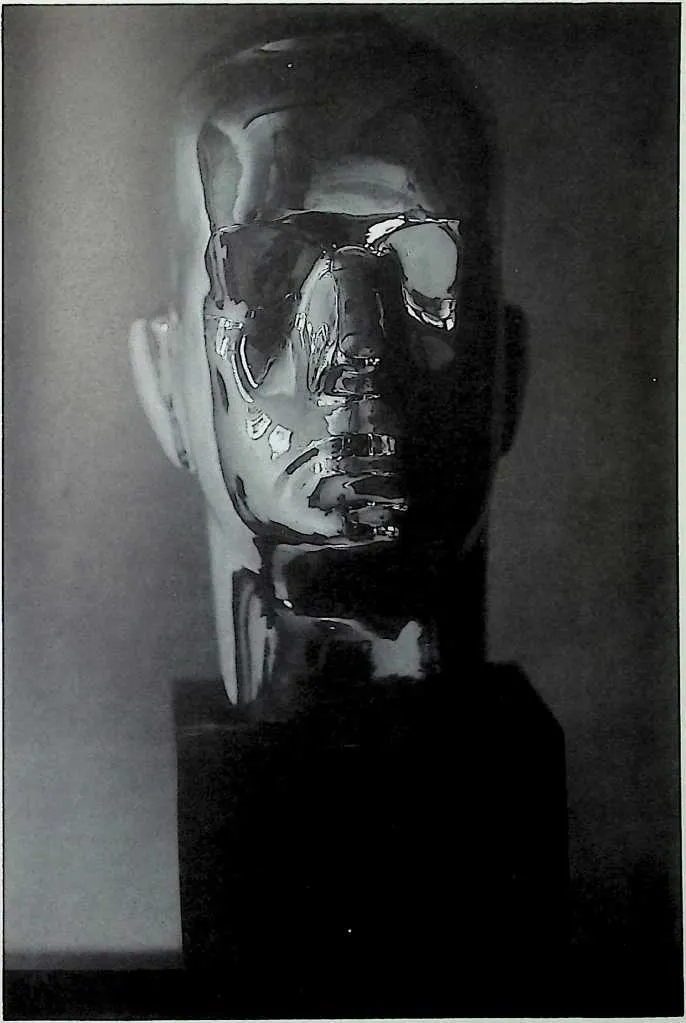
11 It was Richard Buckminster Fuller who originated the concept of cumulative technical advantage that is called synergy, and he too who gave the whole evolutionary process of which it is a part the name of ‘Ephemeralization’ from the Greek ephemeras meaning ‘lasting only a day’. For him the idea that the intractable limitations of nature would yield, one by one, to the power of the human mind, explained and justified the transformation of the 18th century craftsman’s priceless timepiece into the 20th century’s mass produced quartz watch—a device that is not only infinitely smaller, lighter and more accurate than its hand-made predecessor, but is also just as priceless—in the sense that it has become so universally available as to be almost without value.
12 For Fuller the watch; the pen; the telephone; the calculator; the camera; the bicycle; electric power; water supply; artificial heat and cold; transport and shelter were all goods or services ephemeralized or destined for ephemeralization. He saw all of them and thousands more as once untamed elements, dangerous or inadequate aspects of the human environment, that were by patient design science slowly being merged into mankind-serving cycles of reproduction and decay like the carbon cycle of living things. He believed that all the deficiencies of human society and all the dangers it feared, could be overcome, resolved and miniaturized into a vast and seamless man-made service technology: a second, organized surface of the earth.
13 Before he died Fuller saw this grand process of ephemeralization coming true before his eyes. From small indicators he drew large conclusions. Today there is no car without a clock; so telling the time is no longer an appropriate function for a single mechanism, but a subordinate function of almost any enclosure, including a car. Soon there will be no car, no train and no aeroplane without a telephone so long distance communication too will cease to command its own enclosure—the absurd anachronism of the telephone box—and become instead another subsidiary function of all modes of transport. Today there is no building without water and electric power; soon there will be no buildings without automatic climate control. By then the term ‘comfort’ will have become an unconsidered adjunct to ‘insideness’, perhaps eventually to encompass the entire distinction between ‘insideness’ and ‘outsideness’ including the availability of information and communication. In a subliminal return to the mid-20th century train of thought that led Buckminster Fuller to the geodesic dome itself, the component parts of this ‘comfort’ will not even be called buildings.
14 One of the things that this theory of ephemeraliza-tion shows us is how to approach the serious
purpose of design, as opposed to the triviality of mere styling, in the context of human survival.
In Buckminster Fuller’s formulation of the need for a ‘Design Science’ we can see how, amid a
cascade of innovations that diffuse and coalesce with bewildering speed, there can still be
individual feats of design that can become metaphorical objects of pilgrimage, even if they are
never made or built. As the Dymaxion house, the Dymaxion Deployment Unit and the
dome over Manhattan demonstrate, it is by truly extraordinary feats of ephemeralizing
design—not by tricks of fashion or the luck of production success—that evolving complexes of
environmental technology achieve recognition and survive in human consciousness.
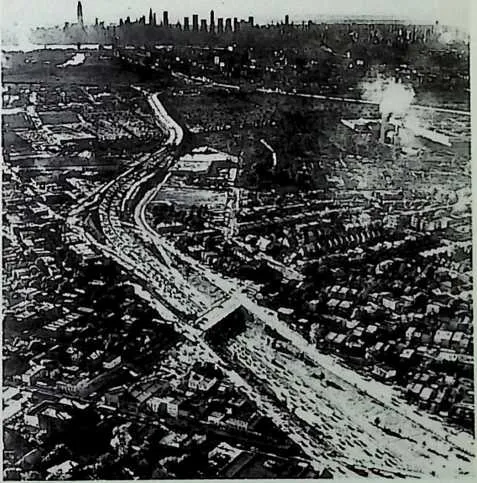
15 The chaotic urban world of the 20th century as portrayed by Fuller.
16 Design work that conforms to the long term multifold trend towards ephemeralization retains its identity because it fits into a recognizable framework, a pattern of mankind-bettering technological advance, instead of an endless spiral of shocks and sensations. Fuller’s works in this genre have already become mythological because recognition of their separate identity is necessary if we are to continue to be able to believe in order working itself out—as opposed to chaos closing in. In a phrase the design achievements that are the building blocks of ephemeralization are landmarks on the map of synergy; and without such landmarks to direct product evolution, design dissolves into the abstract powerlessness of art.
17 Art history finds it difficult to deal with a design like the Dymaxion house, which never really existed but is nonetheless a landmark in technological evolution. Art history cannot grant it the status of ‘timelessness’ that it freely awards to the great artistic and architectural achievements of the past—which are worshipped as objects of value irrespective of their usefulness (or lack of it) or their relevance (or lack of it) to present ways and means. A complex design process that produces a simple product-idea, like a factory-built home, is not art because it belongs to another kind of history.
18 The same impasse is presented even if the objects that emerge are real. A physical product like the ‘Wichita’ house of 1946, or its contemporary, the British AIROH aluminium prefabricated house: a pioneering car like Vittorio Jano’s independent suspension, front wheel drive 1937 Lancia Aprilia; or even a 75 year-old aeroplane design like the corrugated duralumin Junkers D-l, the first all-metal monocoque cantilever monoplane—all these objects displayed the first and best resolution of so many functional demands and creative insights that, although they are not ‘art’ they remain alive in the minds of designers long after they have ceased to be new. Art history or no art history, under the rules of ephemeralization they will retain ‘classic’ status until the concept ‘building’, the concept ‘automobile’ or the concept ‘aeroplane’ cease to possess any useful meaning.
19 To a degree the steel frame buildings of Mies van der Rohe, the Usonian houses of Frank Lloyd Wright and the concrete villas of Le Corbusier possess this unique combination of rich invention and technical completeness that is immune to the vagaries of fashion. No student of the evolution of the modern house can ignore the Farnsworth house, Falling Water or the Maison Savoye, for these three works of architecture too embody formal and structural relationships that are not the ordinary outcome of fashion or the display of wealth. They too stem from the exercise of a creative genius. But they have a crippling weakness that their creators can no longer do anything about. It is a weakness that is in the eye of the beholder, because our way of looking at them has been chained to the classificatory system of art history.
20 The art historical system perpetually endeavours to lever invention away from the restlessly evolving vocabulary of art and science in the service of man—the language that Buckminster Fuller spoke—back into the passive world of scarcity and value judgement that he correctly identified as the greatest enemy of human success. We should be in no doubt that the incompatibility of these two world views is absolute. We need only consider a simple example: the contrast between Fuller’s 1940 adaptation of thousands of standard steel grain bins into a globally-distributable emergency housing system—and the proposal by architect Bruce Goff a decade later to use four of the same grain bins as bedrooms in a private house for a wealthy client.
21 The distinction between these two value systems illuminates the convention that has grown up
in the history of Modern Architecture that Buckminster
Fuller’s ‘4-D’ and ‘Dymaxion’ projects, his domes and his megastructures as somehow outside the
main line of serious development, almost an irrelevance to it.
22 That there is a ‘main line’ of Modern development in historical terms is indisputable, even if we ignore the dubious claims of some alleged 19th century antecedents. No historian would argue against the existence of a palpable progression from Adolf Loos’s Steiner House of 1910 to, say, Moshe Safdie’s 1967 ‘Habitat’. Into this Modern bloodstock line we would expect, if only through their dates and the publicity that surrounded them, Buckminster Fuller’s projects to find their place. But they do not.
23 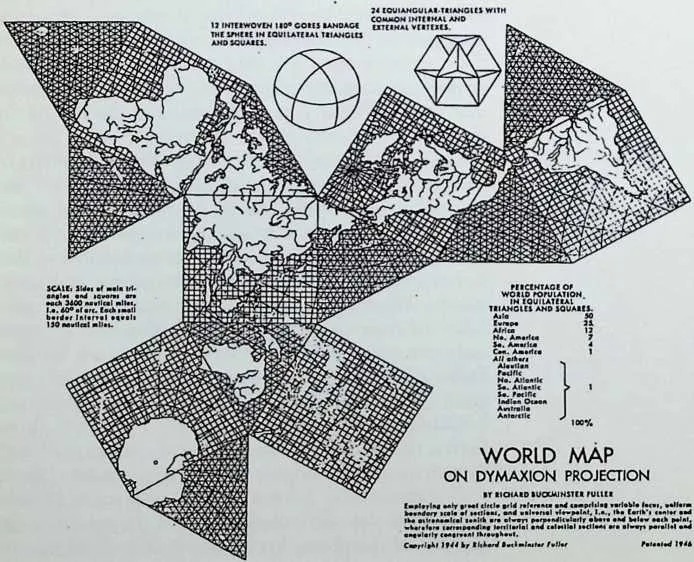 Consider the case of the 1929 Dymaxion house model, based on drawings made three
years before Le Corbusier’s Les Heures Claires and nine years before Frank Lloyd
Wright’s ‘Falling Water’. Photographs of it have been published regularly since 1932, yet
still
Consider the case of the 1929 Dymaxion house model, based on drawings made three
years before Le Corbusier’s Les Heures Claires and nine years before Frank Lloyd
Wright’s ‘Falling Water’. Photographs of it have been published regularly since 1932, yet
still
24 The first two stepping stones on the path to ephemeralization First the Dymaxion World Map (below), seeing the world in a new geometry, patented in 1946. Second the 1952 chart of the 20th century, and graphic proof that 'design science' can extract more from less and make the majority of the world's population 'haves' instead of 'have nots’ (right).
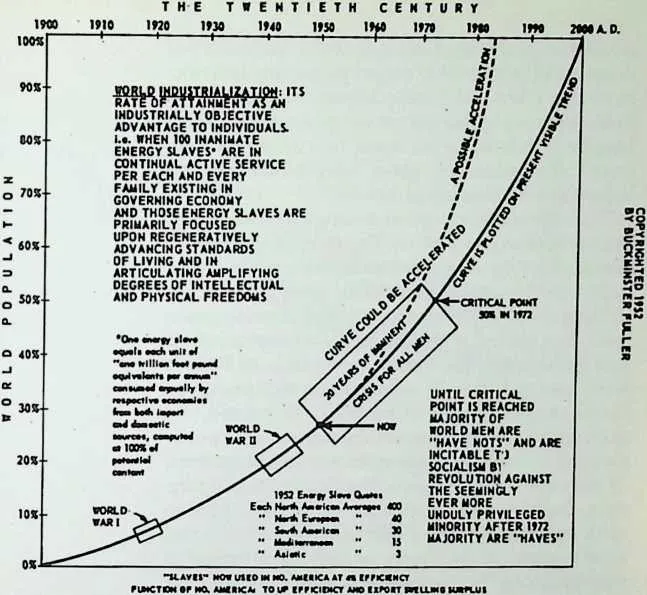
26 EST. AT 2.300,000,000 IN 1940 AHO INCREASING AT RATES OF I* PER YEAR THUS APPROACHING 3,000,000,000 BY 2000 A. D.
27 it does not slot as easily into the history of Modern Architecture as it should. So much so that despite being published regularly in the lay and business press, none of the principal historians who wrote contemporaneously with the ascendancy of the Modern Movement even mentions it—nor any of the images of Dymax-ion dwelling units, single or multi-storey, that emerged during Fuller’s first period of public notice.
28 Niklaus Pevsner does not mention Buckminster Fuller at all. Nor does James Richards. Henry
Russell Hitchcock and Philip Johnson do not mention Fuller. Writing two decades later, Vincent
Scully mentions only the geodesic dome, remarking disparagingly; ‘it can only do one thing and
make one shape’. And writing later still William Curtis make an equally dismissive bow in a
footnote; ‘the Dymaxion house as an aesthetic arrangement…was scarcely inspiring’.
Contemporaneously with Curtis, Kenneth Frampton
acknowledges the significance of Shelter magazine and does set Fuller aside as a ‘rugged
pioneering individualist’, but a less enthusiastic assessment is to follow. Fuller becomes
‘utilitarian yet complacent’ and before long he is reduced to the status of a Mechanix Illustrated
do-it-yourselfer, good with blowtorch but untroubled by intellectual hoo-ha.
29 The only noble exception among art historians is Reyner Banham. In 1960, in Theory and Design in the First Machine Age, Banham does experimentally project Fuller into his rightful place as the most farsighted of all the modern functionalists of the pioneering generation. But, looked at closely, Banham’s enthusiasm is only half-hearted. He clearly knows little of Fuller’s early years and carefully confines him to a passage or two in the last chapter of his book. Worse still, the quotation that he provides to substantiate Fuller’s early dismissal of Bauhaus Modernism was actually written 28 years later than he claims. But despite these limitations, Banham does see that the pioneers of Modernism and Buckminster Fuller correct two different value systems. If the theory of ‘ephemeralization’ is represent, then ‘functionalism’ is at best a small part of it, not an alternative theory.
30 Because of his transcending theoretical position, Buckminster Fuller did not follow the same rules of technology and image transfer as Le Corbusier, Walter Gropius and Mies van der Rohe. Blessed as he was with wartime experience in the US Navy and years as a building material producer, in both of which fields he had been required to familiarize himself with the most advanced technology extant, Fuller possessed a far more impressive technical background than the society of millionaires and art collectors gave to the non-combatant Le Corbusier; or a commission in a cavalry regiment during the Great War awarded Walter Gropius; or even the humble duty of guarding railway lines in the same conflict gave to the private soldier Ludwig Mies. For Fuller the Navy was not a technical world evolving towards ‘pure types’, but a prototype maelstrom of restless and endless change. It was constantly moving; ‘from the wire to the wireless, the track
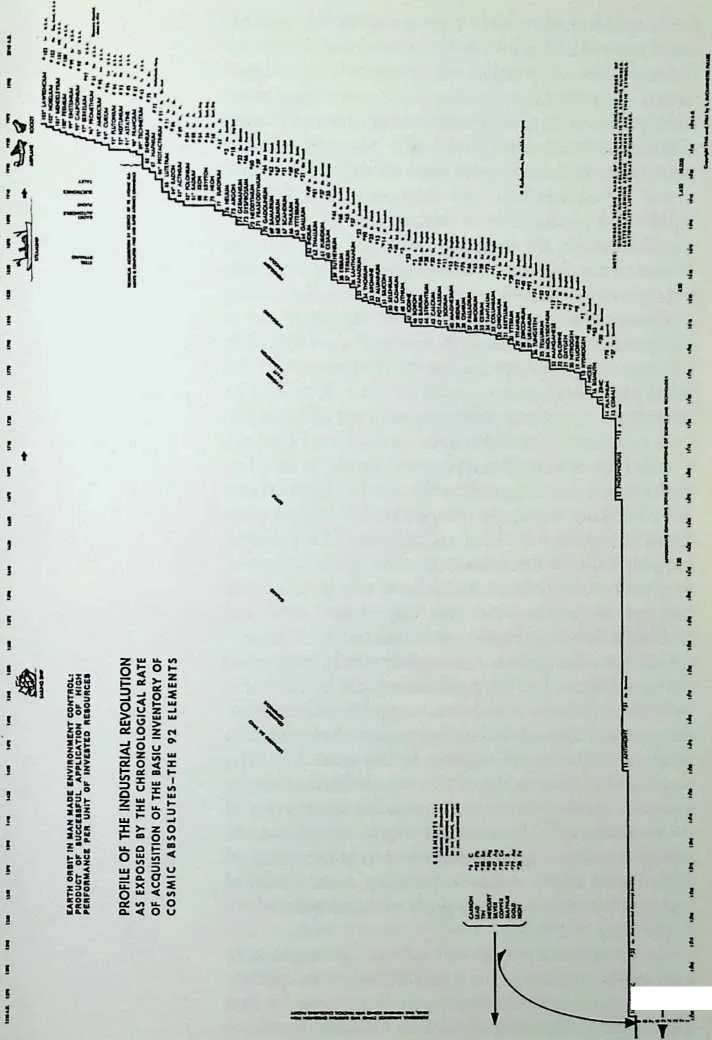
31 Thirdly there is the 1964 chart ol the industrial revolution showing the exponential increase in the rate ol discovery of elements.
33 to the trackless, the visible to the invisible, where more and more could be done with less and less’. Above all it was a practical world in which responding to innovation was a routine procedure, not an exciting event indulged from time to time for its intellectual frisson.
34 When, a decade after he left the Navy for the last time, Fuller explained in the pages of Shelter the origins of the Dymaxion house in the cantilevered wooden lighthouses of the coast of Maine, and the source of the Dymaxion Deployment Unit and the Wichita House in the production-model gas holders and grain bins of pre-war America, he was not post-rationalizing a photographic resemblance in order to create an art historical past for himself. Nor was the relationship between the power pylons that he illustrated, and the subsequent development of the geodesic dome and its related space frames, an aesthetic analogy, like Le Corbusier’s aping of interplane struts in the form oipilotis.
35 Fuller knew that all the standard products he illustrated were made using techniques that had been arrived at by breaking seemingly insuperable fabrication tasks down into manageable man and machine jobs. Proceeding practically he first found out what those tasks were so that he could understand how things were put together—over the years this contributed to a vast mental and physical library of curiosities (the ‘Chronofile’) that was his greatest resource—and only later when the practicalities had been filed away did he make his ‘4-D’ contribution, which was to propose that something else, more useful to humanity than the first product, might be put together in the same way. The most perfect illustration of this whole methodology, indeed a transformation that embodies the essence of what wonders can be achieved by the simplest technology transfer, is again the conversion of the standard Butler grain store—which was already mass-produced—into the far more necessary prefabricated house which at the time was not.
36 The art historians who still rule our perception of architecture and design, men and women who quickly came to terms with the process of image transfer that led Amedee Ozenfant and Charles-Edouard Jeanneret to design reinforced concrete buildings that looked like the white-painted steel superstructures of ocean liners standing on the tapered interplane struts of biplane aircraft, have never made an analogous effort to understand the pure technology transfer of Fuller’s work. Was this because Fuller consistently and unrestrainedly abused them, as we have seen. Or was there another reason? It cannot have been because Fuller was a dreamer who actually built very little, for this is neither fair nor true. The Italian Futurists Sant ‘Elia and Chiat-tone, Eke the Russian Constructivist Leonidov, built nothing at all, yet their names are found in even the most cursory histories of Modern architecture. In any case, although historians apparently refuse to recognize what contemporary practitioners dismissed as ‘peas-in-a-pod designs’, the architect of the Dymaxion House did actually build more buildings than Le Corbusier, Walter Gropius and Mies van der Rohe.
37 There were only three Dymaxion cars ever built, of which one survives, and only two Wichita Houses, later clumsily combined into the single survivor; but between 1923 and 1927, 240 buildings were erected using the ‘Stockade’ compressed wood-shavings block system, and the production of the blocks for these buildings was carried out on machines that Fuller designed. Fifteen years later, according to John McHale, the rate of production of Fuller’s ‘Dymaxion Deployment Units’ reached 1,000 a day before strategic real-locations of steel terminated it. And finally no less than 300,000 geodesic domes based on Fuller’s patents were erected between 1954 and his death in 1983.
38 In the end we come by a process of elimination to what must be the real reason for Buckminster Fuller’s anomalous position in the history of Modern Architecture: the paucity and weakness of his early writings. Unlike Le Corbusier, whose early career was immensely aided by the publication of two important and widely translated books—Amedee Ozenfant’s Foundations of Modem Art and his own Towards a New Architecture—Buckminster Fuller was hampered by a lack of accessible publications, an absence of convincing imagery, and by his own impenetrable writing style.
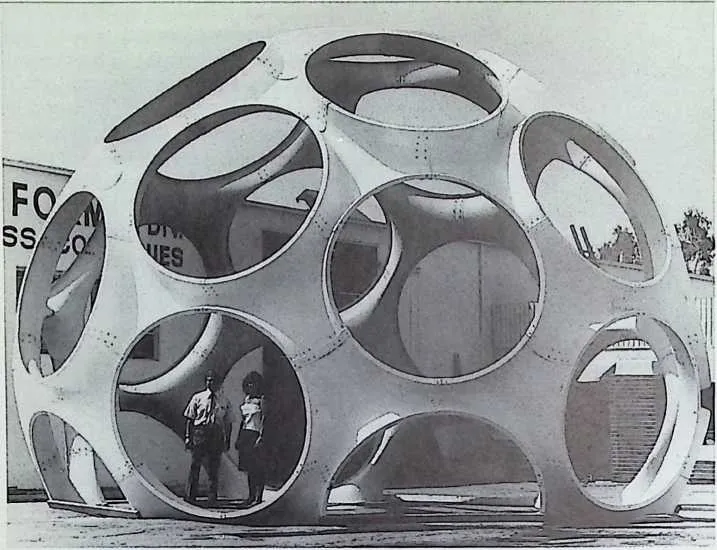
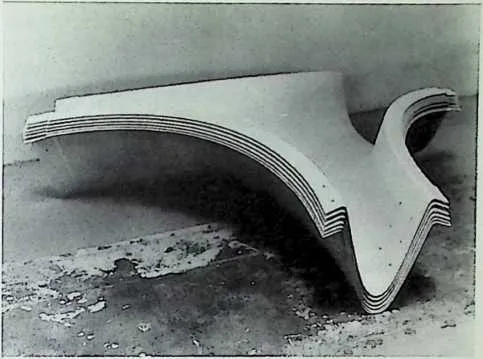
42 Three exercises in ephemeralization. The 'Monohex' or 'Fly's Eye' dome (left S right), first patented in 1965 as a method of reducing the structural weight • and thus the cost—of a simple dwelling to the lowest possible level. Fuller developed it in various materials including steel, aluminium, and glass fibre until 197& Constructed from a single-shape component this represented the last and simplest of all Fuller's approaches to mass production low-cost housing.
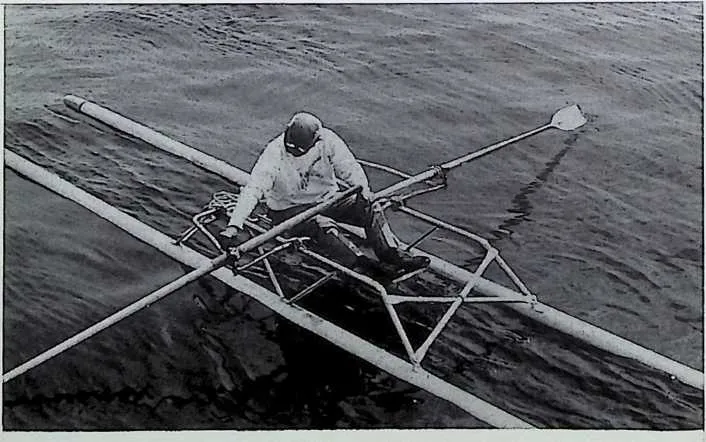
43 The tubular catamaran rowing shell (tell) that Fuller designed in 1947 shows the same development. Each bow and stern end is socket-assembled in lengths of light aluminium tube The oarsman sits in a light plastic nacelle and the width can be adjusted Io suit. Unique advantage of catamaran form is stability. Lone oarsman can climb back aboard unaided.
4445Where Le Corbusier’s writings—and above all Ozenfant’s illustrations—made the derivations and principles of the New European Architecture crystal clear from 1921 onwards, at first in magazine articles in L'Esprit Nouveau, and later in books and actual buildings, Fuller’s early work is confusingly under-recorded. In his case the national newspaper press cuttings and interviews exist, and have been tirelessly republished, but the convincing images in professional magazines do not begin until 1932 and the seminal book, or manifesto, despite many efforts, does not appear until a determined co-writer, Robert Marks, forces it through far too late in 1960.
46‘4-D’, chronologically Fuller’s equivalent to Towards a New Architecture, the work of which Anne Hewlett Fuller sketched him completing the manuscript, was ‘published’ in Chicago in 1928—in a hand bound ‘edition’ of 200 copies—virtually all of which were, as we have seen, wasted (for historical purposes) on friends, relatives and prominent people. l4-D’ was not destined to be printed again until 1970—by which time Towards a New Architecture had been reprinted eleven times in its English translation alone. Even when '4D Timelock', as l4-D' was retitled, finally did appear, it was not only altered and provided with new illustrations, but humiliatingly prefaced by its New Mexico publishers with the warning; ‘Today some of the book makes sense and some of it doesn’t make sense.’
47 Worse still, the same uncertainty ultimately surrounds what is generally described as Fuller’s own magazine, the Philadelphia published Shelter (formerly T-Square Club Journal and T-Square}, which appeared under one title or another in 1931 and 1932. The ‘cleanup’ design for the Dymaxion house—the design always illustrated today—was first published in a professional architectural magazine in March 1932 \n Architectural Forum, and only subsequently in Shelter. If, as we have noted, Fuller and his biographers, even the most recent, Lloyd Steven Sieden, claim that he owned and published Shelter himself and that it made a profit—without advertising—on a circulation of 2,500 and a cover price of $2.00, why did he not publish his own design himself? Perhaps the answer to this question is to be found in the surviving copies of Shelter (May to November 1932), where the editor is cited as Maxwell Levinson; the Associate Editor as the architect George Howe (of Howe and Lescaze), and the Managing Editor as Leon Levinson.
48 Another fundamental question about Shelter magazine concerns the authorship of its articles. The same surviving copies show that most though not all of them are unsigned, and although these include many, like the important ‘Streamlining’, that were very probably written by Fuller, there is no incontrovertible proof that they were his work alone. This very un-European indifference to authorship and bibliographical exactitude makes it particularly difficult to use the ideas and images attributed to Fuller in Shelter magazine as tools to rewrite the history of Modern Architecture and challenge its dominant value system.
49 There remains the text of Fuller’s book Nine Chains to the Moon, published by a reputable publisher, Lipin-cott of Philadelphia and New York in 1938. Nine Chains is a book that even at that late stage might have been Fuller’s seminal work. Like ‘4-D’ however it is virtually unillustrated—certainly its child’s sketches of ‘BOZAR’ versus ‘MODUN’ houses cannot be considered influential images—and it is still convolutedly difficult to read. Indeed where the Shelter articles generally attributed to Fuller show the pedigree of his ideas with startling clarity, the 1938 book that should have assembled and codified them, only buries them once again in that abstruse geopolitical knowingness that clouded his earlier writings.
50 There is a further problem with Nine Chains to the Moon that, like the transformation from ‘4-D’ to '4-D Timelock', concerns authenticity. At its first publication Nine Chains to the Moon was endorsed by Albert Einstein, who also endorsed Le Corbusier’s Le Modular a few years later, but its sales were minimal. It was out of print from 1939 until the University of Southern Illinois, followed by Doubleday, reissued it in the wake of the successful 1960 publication of Robert Marks’ The Dymaxion World of Buckminster Fuller. This second edition was abridged by 60 pages, including the removal of all appendices and charts. Furthermore an important list of 22 events or inventions that Fuller had said were certain to come about ‘between July 12th 1938 and July 12th 1948’ was dispensed with, presumably because so few of them had happened, even by July 12th 1963 when the book was reprinted. Since one of the discarded predictions was ‘The main system of general education instruction to go on the air and screen’; another was the ‘Inception of the completely mechanized stock exchange and world-wide repeater-linked popular employment thereof; and a third was the ‘evolutionary abolition of the terms ‘unemployed’1’ and ‘on relief and the substitution therefor of ‘‘Social Reserve’’ and ‘Industrial Reserve’, these excisions were certainly ill-advised. The fact that they were made without notice in the reprint is doubly disturbing.
51 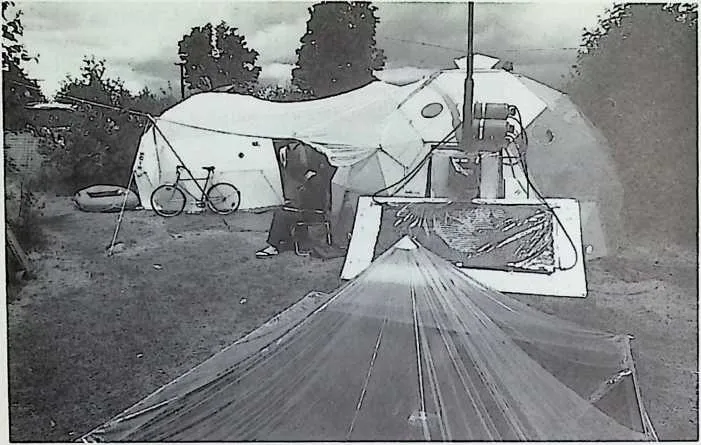 One way or another this tradition of lost opportunity in Fuller’s writings was to persist for
the rest of his life, even though he eventually became so famous that his books commanded large
advances and sold well whether they could be understood by their readers or not. More
than 30 years after the publication of Nine Chains to the Moon, his massive tome
Synergetics, published after seven years of work by a dedicated collaborator and editor,
Edward Applewhite, has no index and is virtually unreadable as narrative—the latter a
state of affairs barely remedied by its rapidly produced sequel Synergetics II, which
incorporates an index to both volumes. Critical Path too, which was published in
1981, his last major book before his death, suffers from this same weakness. Though
narrative rather than mathematical, it is jaggedly discursive and consists largely of
transcribed lectures and ghost writing by Kiyoshi Kuromiya that wanders back and
forth through some of the same themes as Nine Chains at a distance of fifty years.
Like all Fuller’s books, its length too is bulked out by an unnecessarily detailed and
Quixotic chronology of world historical events placing the inventor’s actions in a cosmic
context.
One way or another this tradition of lost opportunity in Fuller’s writings was to persist for
the rest of his life, even though he eventually became so famous that his books commanded large
advances and sold well whether they could be understood by their readers or not. More
than 30 years after the publication of Nine Chains to the Moon, his massive tome
Synergetics, published after seven years of work by a dedicated collaborator and editor,
Edward Applewhite, has no index and is virtually unreadable as narrative—the latter a
state of affairs barely remedied by its rapidly produced sequel Synergetics II, which
incorporates an index to both volumes. Critical Path too, which was published in
1981, his last major book before his death, suffers from this same weakness. Though
narrative rather than mathematical, it is jaggedly discursive and consists largely of
transcribed lectures and ghost writing by Kiyoshi Kuromiya that wanders back and
forth through some of the same themes as Nine Chains at a distance of fifty years.
Like all Fuller’s books, its length too is bulked out by an unnecessarily detailed and
Quixotic chronology of world historical events placing the inventor’s actions in a cosmic
context.
52 The ‘Now House’ designed for the United Nations Habitat exhibition in Vancouver in 1976. Two fabric domical rooms joined by a rectangular vestibule.
53 In the end it is perhaps in the nature of the creative life of Richard Buckminster Fuller that the search for an unadulterated early text should be fruitless. Designing machine-made objects that have become part of the alphabet of technological ephemeralization is a rare accomplishment; as rare as the life of an individual whose creative energies did not wane with age, the corruption of failure, or the distractions of success. And yet, alongside the role of the unnamed women Fuller described to Anwar Dil, we must remember the role of the other phantom collaborators, the names of so many of whom have vanished into the penumbra surrounding his own shining reputation.
54 The creative life of Buckminster Fuller was such a tremendous unfolding of applied intellectual energy that it is and must remain primarily a visual and aural legacy, best absorbed through the contemporary media of film, video, photography, tape recording, transcription and recollection. In this as in so many other ways, Fuller shows us that he really was a citizen of the future. For behind the art historical neglect, the confusion of dates and the uncertainty of collaboration that dog his achievements, lies his triumphant refusal, even after death, to be confined to a wheelchair as yet another 20th century intellectual artefact.