3 introduction
23Making the world’s available resources serve one hundred per cent of an exploding population can only be accomplished by a boldly accelerated design revolution to increase the present performance per unit of invested resources. This is a task for radical technical innovators, not political voodoo-men. —Richard Buckminster Fuller 1970
4Although he was never an architect, the work and ideas of Richard Buckminster Fuller found an audience in the architectural profession for most of his life. This association began unpropitiously in 1928 with the American Institute of Architects’ unceremonious rejection of the gift of the patent rights in his revolutionary *4-D’ prefabricated house. For a time it continued as a love-hate relationship, with Fuller occasionally painfully sarcastic in his dispraise, as in this 1966 gem from the American magazine Architectural Forum-, ‘The architect is a slave; the client says ‘I am going to build a building on that corner; this what the building codes and labor unions say you have to do; I want my relative’s materials used, and my wife wants it to look like this.’ And it ended 50 years later in reconciliation, following the award of uncounted honorary architectural degrees, professional fellowships, medals and titles, and an almost legendary status amongst architects and architectural students all over the world. A tireless public speaker, in the year of his death at the age of 88 Fuller twice circumnavigated the globe, lecturing to packed campus audiences in universities and schools of architecture.
5 Born of patrician New England parents, Fuller broke a tradition of more than century by failing to graduate from Harvard university. In later life he attributed what technical training he possessed to his service as a junior officer in the US Navy during and after the Great War. Following that conflict he worked for many years in the construction industry, gaining bitter experience of the limitations governing the machine production of building materials and their public acceptance at that time. Like many others he dreamed of emulating the automotive and aviation achievements of Henry Ford, first by producing a revolutionary car called the ‘Dymaxion’—DYnamic + MAXimum + IONs—and later by applying the methods of the automobile and aircraft industries to the production cr housing.
6 Fuller was the first pioneer of prefabricated housing to understand that cost-effectiveness in this field depended entirely on a drastic reduction in the weight of the product. His 1929 project for a steel, duralumin and plastic ‘Dymaxion House’ was for years illustrated in newspapers and magazines as the prototype for the mass-production dwelling of the future. An early variant was even proposed as a lightweight, multi-storey apartment tower for air-delivery anywhere in the world by Zeppelin.
7 In World War Two Fuller’s expertise in the field of lightweight demountable housing was enlisted by the US government. It led not only to the construction of thousands of steel ‘Dymaxion Deployment Units’ (emergency USAF aircrew accommodation modified from steel grain bins), but eventually to the famous 1946 ‘Wichita’ house, a full-size family dwelling weighing only 4 tonnes that was designed to be assembled on wartime bomber production lines. The prototype ‘Wichita’ is the most important prefabricated house design of the 20th century, and certainly the greatest lost opportunity of the years of post-war building recovery.
8 These early failures are dealt with in some detail in this book as part of an effort to combine the usefulness of a short biography with a critical evaluation of Fuller’s best known inventions and theories, from the ‘Dymax-ion House’ to the concept of ephemeralization. An additional function that they serve is to shed some light on the long psychological battle that Fuller’s own fertile and boundless imagination enabled him to fight against failure and critical rejection.
9 Fuller’s only great commercial success, and his best known invention was the geodesic dome, a triangulated space-enclosing technology that was domical in shape in order to enclose the maximum internal volume with the minimum structure. Patented in 1954 no less than 300,000 Geodesic Domes were built over the next 30 years, for purposes ranging from sports arenas to subtropical housing and the construction of a permanent American base at the South Pole. Projected dome structures included mile-diameter flying spheres and floating cities. The last in a long line of Fuller’s dome refinements, the revolutionary ‘Fly’s eye dome’ also intended as a cheap dwelling enclosure, was still under development two years before his death.
10 But despite this last great victory, for most of his life Fuller remained not only outside the mainstream of American industrial production, but outside the mainstream of accepted design culture. His revolutionary ‘Dymaxion Car’—unique in being rear engined but front-wheel driven, and intended to speed along roads like a taxiing aeroplane—was toyed with by the United States motor industry for more than a decade, but its ideas were never taken up in the form in which he introduced them. His even earlier predictions of the feasibility of ‘jet-stilt’ air-cushion vehicles,played no part in the subsequent development of the helicopter or the hovercraft.
11 As well as being a futuristic and prophetic designer, Buckminster Fuller was author, co-author, or a major contributor to over 50 books, and the subject of thousands of newspaper articles and interviews. In all of them he proselytized tirelessly for the creation of a world design science to avert ecological catastrophe and promote resource conservation, notions that were a generation ahead of their time.
12 Today, less than a decade after his death, Fuller’s reputation is poised uneasily between oblivion and cult status. It fits somewhere between the heaped honours of an architectural profession that has already largely forgotten him, and a growing environmentalist opposition to all uncontrolled industrial production. This balance is so delicate that, while ecologists and environmentalists in their new Green political prominence could do no better than to seek a framework for their ideas in the collected works of Buckminster Fuller; the withdrawing forces of industry too—under attack from every quarter for exhausting resources and polluting the environment—would also find a ‘blueprint for survival’ in those same pages of ideas and inventions.
13 For the master of ‘more for less’, if he were still alive, there might be something gratifying in this pregnant symmetry.
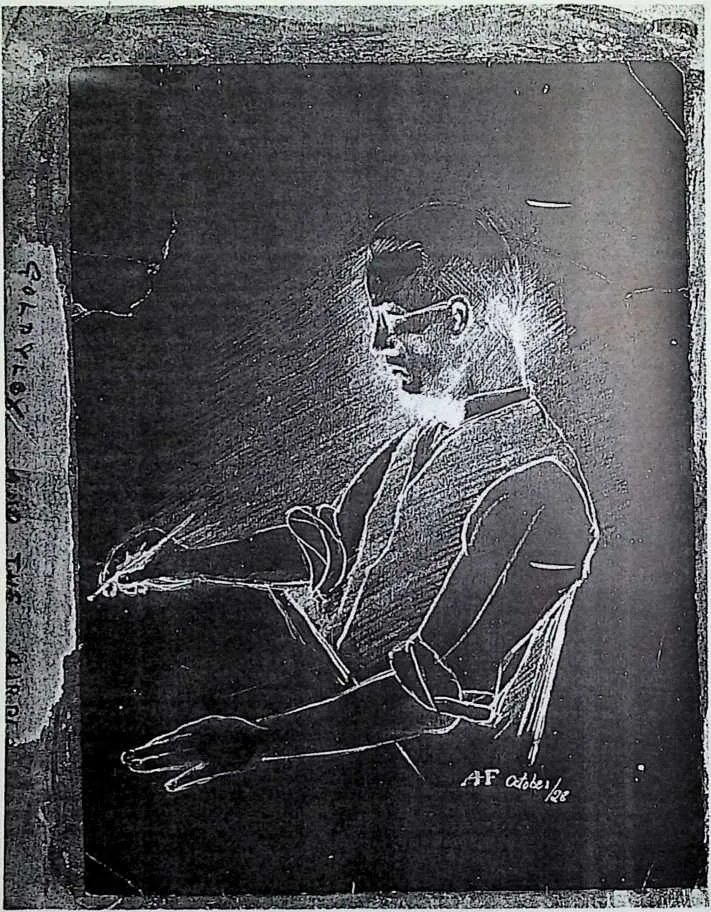
14 'Goldylox and the Airplane1: a portrait of Fuller drawn by his wife Anne Hewlett Fuller in 192a