
4 brief encounters
23I asked myself, '(1) Can you trust yourself never to turn to your own exclusive advantage the insights entrusted to you only by the realization of benefits for all humanity and the Universe itself? (2) Can you also be sure that you will never exploit your insight by publicly declaring yourself to be a special 'son of God’ or a divinely ordained mystic leader? (3) Can you trust yourself to remember that you qualified for this functioning only because you were an out and out throwaway? (4) Can you trust yourself to reliably report these facts to others when they applaud you for the success of the experiment with which you were entrusted?
4Fortunately, I can, may, and do report to you that I have never broken that trust nor have I ever been tempted to do so.’
5—Richard Buckminster Fuller 1983
6Over the years of his life, thousands of writers and journalists interviewed Buckminster Fuller. There is no record of all the interviews he gave. A ‘Basic Biography’ published by the Buckminster Fuller Institute in March 1983 reproduced the titles contained in the cuttings file of the New York Times from 1922 to 1982, and revealed 520 items. Assuming that only one quarter of them involved interviews of one kind or another, and taking into account perhaps another 50 major newspapers and magazines world wide, we can see that Richard Buckminster Fuller might have been interviewed 5,000 times.
7 Among the last of these countless interviews was one carried out by Fuller’s admirer Dr Anwar Dil, the co-writer of the book Humans in Universe published in the year of Fuller’s death. As a document Dil’s interview is long and predictable for the most part, but suddenly, in the midst of an exhaustive discussion of what the sage’s final message to the parents and children of the world should be, Fuller says—and in the light of the statistics given above we can be sure that he is telling the truth—‘Everything I have said to you, I have written or said before.’
8 ‘Would you at this point make a statement that you have not written before? What would that be?’ Says Dil.
9 Fuller thinks. Then he replies; ‘One of the things that interests me is something strange that occurs on every occasion of my making a scientific and socially advantageous discovery and a special-case technological invention therefrom, in general support of my attempting to solve human problems with technology.’
10 ‘Whatever the discovery and invention may be, I have always had the experience of some enchanting female coming into my life concurrently with the scientific discovery. You, Anwar, have brought my darling wife into our discussion, despite flirtations and sex with others, I have never stopped loving my wife above all others. What I am getting at here is the Iliad and the Odyssey or Aeneid like sirens or other females’ interceptions of the explorer’s route. This has repeated itself a number of times in my life. Every time I am about to make a discovery and I am developing a high sensitivity of thinking, along comes a, to me, exceptionally charming female with whom I find myself tending to fall in love. Only when I have successfully restrained myself from falling further and have applied myself exclusively to the discovery or inventing, and only then, do the critically relevant conceptions occur which secure my comprehension of the significance of the discovering and/or inventing and what my responsibilities are in making the discovery and inventions effectively available to humanity.’
11 ‘At any rate, that is something I have never written before. I suspect it may be importantly true.’ Unlike Anwar Dil, I only ever had one face to face encounter with Richard Buckminster Fuller. It took place thirteen years before the occasion on which I last heard him lecture, ten days before his death, when he spoke at the Royal Institute of British Architects in London on the occasion of the award of the Royal Gold Medal for Architecture to his former collaborator and friend Norman Foster. Foster was, at that time, designing a complex double geodesic home for Fuller that was to have been erected on a site in Los Angeles. On the earlier occasion thirteen years before, I had been sent to interview Buckminster Fuller for one of the first issues of the magazine Building Design. Prior to that encounter I had only an abstract impression of him, formed by seeing his name and his projects, chiefly domes, in books and magazines. The idea of his role and personality that I had gathered was negative. Fuller, I believed, was a kind of mathematical huckster, in some suspicious way connected with American foreign policy. He was, I thought, a dangerous technocrat, trying to remove the subjective, creative element from architecture and replace it by universally applicable geometrical formulae. Notorious for lecturing student audiences for four and five hours at a time, Fuller seemed to me to be a heartless, totalitarian figure, crucially lacking in human values.
12 Years before the interview that was to transform my perception of the man, I had put this unfounded prejudice in writing. In the early 1960s I was a member of a dissident student group at the Oxford School of Architecture called the ‘Progressive Architecture Movement’ which had leafleted the audience at a British Architectural Student Association (BASA) conference addressed by Fuller. The leaflets, which I had composed, bore (to my eternal shame) a suitably modified picture of the sage’s head with the slogan; ‘Come off it BASA! Buckminster Fuller’s head is a geodesic dome. Inside it is a copy of the Reader’s Digest ’.
13 So grandly are the paradoxes of life arranged that twenty years later it was an excellent article about Buckminster Fuller by Emily and Per Ola d’Aulaire in that very magazine that confirmed my desire to study the story of his life and write this book.
14 On February 28th 1970, the day that I interviewed him, Richard Buckminster Fuller, then aged 75, was staying at the Stafford Hotel in St James’ Place, London, a quiet cul de sac near Piccadilly. With him during the interview was Shoji Sadao, his longtime Japanese collaborator who is today curator of the Isamu Noguchi gallery in New York. Fuller and Sadao were in England to discuss the proposed, but later abandoned, Samuel Beckett Theatre in Oxford. This project was to have been carried out in association with an admirer of his, that same later RIBA Gold Medallist, the architect Norman Foster.
15 My plan for the interview was simple. Filled with the overweening confidence and scepticism of youth I was determined to show Richard Buckminster Fuller and the readers of Building Design that I for one would not be put off by two hours of autopilot geometrical and algebraic nonsense about the universe like all the other Fuller groupies. I wanted to make Buckminster Fuller talk about the housing problem (a subject I believed that I knew something about) and not about domes or icosahedrons. The next two hours were not a success from the standpoint of this plan.
16 For a start Fuller was late for our two o’clock appointment. I and the staff photographer had to watch horse racing in the television lounge for ten minutes before he and Sadao arrived at the hotel and led me up to his small room on the fifth floor. Once there Fuller ordered a fruit salad and a pot of tea from room service and we all sat down. At 75 he was stiff of movement and clearly hard of hearing, but his energy was surprising—as when he sprang up to open doors, pulled up chairs and indulged in elaborate mimicry to make a point. I later learned that he had been taught these athletic movements, as well as his extravagant lecturing mannerisms, by his daughter, the dancer Allegra Buckminster Fuller.
17 After the photographer had left, I moved in with my first question. It was a killer. ‘Mr Buckminster Fuller, forty-three years ago you announced that a world housing industry using advanced technology was inevitable, yet every one of your efforts to bring such an industry into existence, before, during and after the Second World War has been a total failure. Why do you suppose that is?’
18 Fuller’s astronaut-stubbled head stared at me with what looked like unseeing eyes through pebble glasses whose frames incorporated stereo hearing aids. His whole body, reshaped by his stiff suit, collar and tie as are those of most thin old men, was immobile, his brain working like a computer sorting something out. ‘I would contradict that completely’, he replied evenly. ‘In the first place because no world housing service industry can ever be based on products that people can buy. It is a whole process. If people had to go to a market to buy all their own guts, with them hanging up all around, nobody would buy them at all. There’s not any part of a human being that anyone would buy if they did not already have it anyway’.
19 I felt myself losing the initiative. This reply was tangential but not perhaps totally irrelevant. I temporized.
20 ‘What about brains. Wouldn’t they buy brains?’ ‘What those awful things!’ Fuller laughed. He had figured me out. ‘OK, so that’s where you start’.
21 From then on he went on to explain what he meant by a process instead of a product, using the story of how the telephone system had been successful precisely because the instruments had never been sold, only rented. In the interests of recording a minor comment on the present state of the telephone industry it is worth noting that he predicted exactly what has happened now that telephones are sold. ‘If they ever sell telephones’, he said in 1970, ‘before long you will get a Christopher Wren telephone, a Louis XIV telephone, a World War One trench-type telephone, then an alligator telephone…All this horrible equipment you will pay a terrible price for and it will stop development of the service itself’. Then he resumed his narrative.
22 ‘The lesson of the telephone taught me back in 1927 that housing was going to have to be a service industry, not a product industry. A truly logical complement to life embodying the principles of nature, recognizing entropy and the inevitability of change. A bird picking up twigs to make a nest turns the whole action into a complement of its life. A spider makes a web, a mole makes a tunnel. They alter their environment in preferred ways. Human beings do that too. They are not unusual in that, only the extent to which they do it’.
23 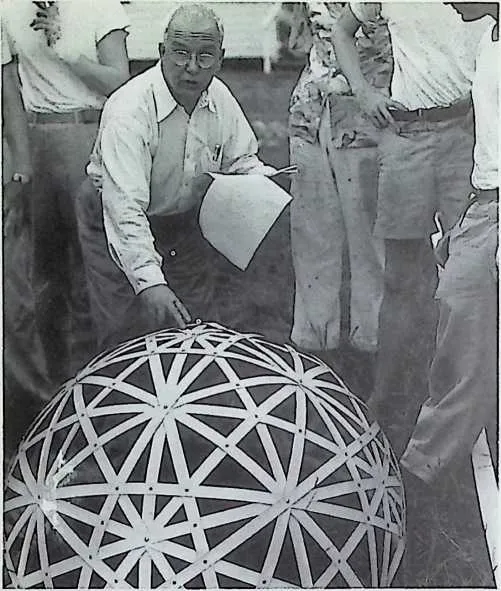 'Notorious lor lecturing student audiences lor four and five hours at a time,’
Buckminster Fuller at Black Mountain College. North Carolina in 1948 with lhe prototype
Venetian blind dome (left). Seven years later an audience ol English scientists who
worked on lhe Cambridge DNA/RNA discoveries (below left) endures a Fuller lecture on
synergy.
'Notorious lor lecturing student audiences lor four and five hours at a time,’
Buckminster Fuller at Black Mountain College. North Carolina in 1948 with lhe prototype
Venetian blind dome (left). Seven years later an audience ol English scientists who
worked on lhe Cambridge DNA/RNA discoveries (below left) endures a Fuller lecture on
synergy.
24 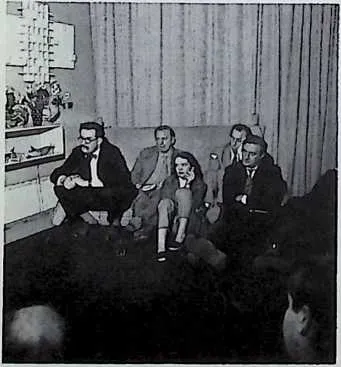
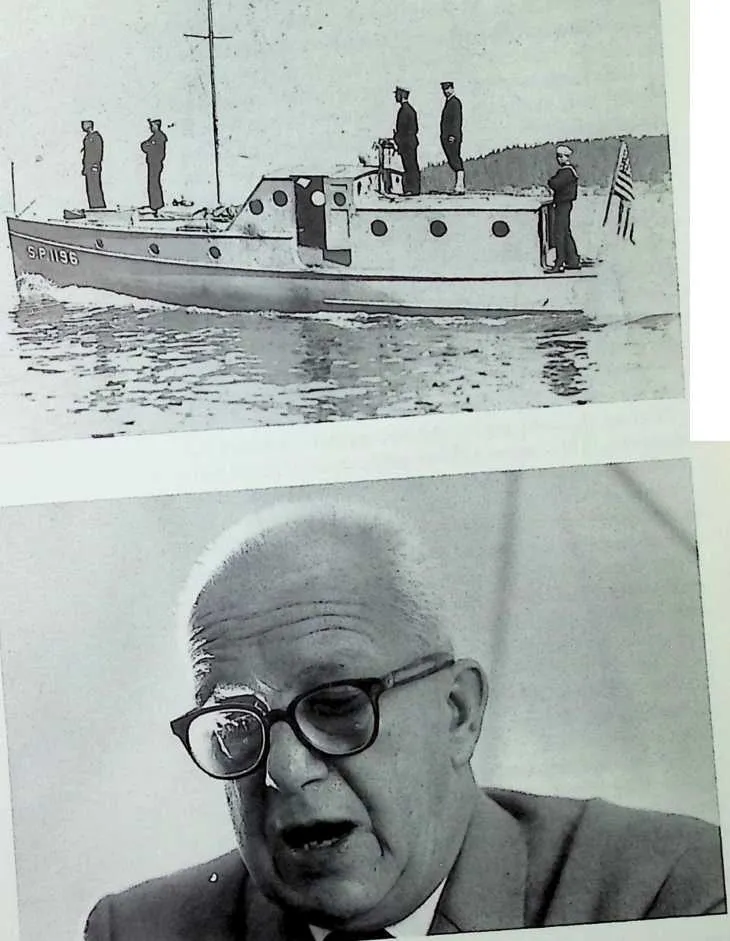
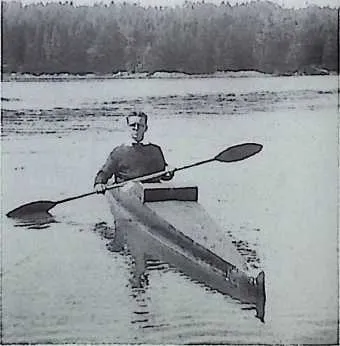 Fuller the explorer (below) in a kayak oil his family's ■ later his own • summer
home on Bear Island, Maine in 1911; Fuller the sailor (right), at the wheel of the
family boat Wego, volunteered for United States Navy patrol duly at the entry of
America into the Great War. Fuller the talker (below right) holding forth in New York in
1947.
Fuller the explorer (below) in a kayak oil his family's ■ later his own • summer
home on Bear Island, Maine in 1911; Fuller the sailor (right), at the wheel of the
family boat Wego, volunteered for United States Navy patrol duly at the entry of
America into the Great War. Fuller the talker (below right) holding forth in New York in
1947.
26 ‘I say that housing has to be a service. It should be. When you use your house and think about it as we do today, as a castle full of treasure, to say; ‘You’re supposed to die! You stay outside my walls!' He rose suddenly to his feet with a menacing gesture—‘I can roar like a lion!'–and then sat down again and lapsed into a short, ruminative silence. Then he looked up. ‘By this time you are supposed to be scared to death. Housing as an advertisement for how great you are is not what I am talking about at all’.
27 ‘Yes, but housing policy…’ I interjected. Fuller waved his hand, he was coming to that.
28 ‘Now I said earlier that I would contradict you completely and I will. After the First World War I was horrified by the progress of the automobile industry in America. There were 125 car companies in 1919, but between then and 1926 they were reduced to eight companies. It was the most immoral thing I ever saw, all those automobile companies going bust, and yet it was the most successful period in automobile development—the price of Ford cars dropped by 30 per cent. That such a success should have been accompanied by bankruptcy after bankruptcy seemed to me to mean that our society just didn’t understand proper accounting. I looked into it and found that the accounting system we were using was invented solely for agriculture. That was because it was the main business of man for centuries’.
29 ‘Now crops are an annual thing. Either they come in or they don’t. So you get annual accounting in agriculture because it makes sense. But I realized that the gestation rates of industrial undertakings were not annual like agriculture, even though everybody was investing in them as though they were. If a productive industry had a bad year, all its stocks went down and so on. I saw that we were not thinking in the right bracket and I understood that that had accounted for the bankruptcies. It was then that I started trying to work out the real gestation rates for different industries taking this basic failure into account. Would it be a thousand years before man’s productive thinking could be catalyzed in a better way? In which case nothing I could do would have much effect at all. Or would the timescale be much shorter?’
30 ‘Well, by cataloguing all the known inventions and scientific events, logging the rate at which scrap metal came back on the market as a raw material, I found that in electronics—then a very new industry, an invisible world in which you couldn’t see the waves and they were handled mathematically so that you could prove them mathematically without too much argument—things happened quite fast. The gestation lag between invention and use in electronics was about two years. I found in the airplane industry there was a five year lag. In the automobile industry the lag was ten years. Railroading about fifteen years. Skyscraper building, a much different technology from housing, had about a twenty-five year lag. In the housebuilding business the lag was between forty and fifty years’.
31 ‘Much as I was interested in developing a new housing concept as a young man, I knew then that I had to count on half a century between intention and industrial production. If I wasn’t ready to wait forty or fifty years…Don’t tackle it. I knew in 1927, 1928 that anything I did during those fifty years would be premature for production, and I was right. But since that time everything has been coming in on schedule and the industrialized dwelling will be coming in too, right on the nose, between 1972 and 1975, and the new industrialized houses will look an awful lot like the Dymaxion House too’.
32 This was an impressive theory, but I was still prepared to stick to my guns. ‘Surely’, I ventured, ‘there is less sign of an industrialized housing industry now than there was twenty years ago. Today we have a crisis in housing…’
33 ‘If we have a crisis in housing it is because old style housing is just about stopping’, he replied quickly. ‘It is in the United States anyway. In 1927 I wrote a book pointing out how the government was getting involved in housing because private industry had dropped it—not just because it was unprofitable, but because it was completely obsolete. Since that time our government and yours have got involved deeper and deeper. In the United States they have had to take over all the mortgages. We have been underwriting obsolescence for forty years. We have been trying to revive a dead man! We have got a corpse on our hands and it’s taken nearly fifty years for anyone to realize that it’s dead!’
34 Buckminster Fuller paused dramatically. His voice in the small room had risen to a boom not far short of lecturing strength. His fruit salad was unfinished, his tea undrunk, and mine too. Whenever I interjected, he seemed to get more angry: but if I did not interrupt him there was no telling where all this might lead.
35 ‘‘But I’m concerned about all the political changes…’’ I tried again.
36 ‘‘And I’m concerned that you started off by calling me a failure’ he thundered back. ‘Failure is a word invented by men, there is no such thing as a failure in nature. Man’s confidence in his judgement has failed, nature never fails. Don’t talk to me about failure, it’s a word like pollution invented by ignorant men. There is no such thing as pollution. Nature invented beautiful chemistry and men have pulled out some here and left in some there…All we do when we pollute is make recovery and recycling difficult by spraying the waste products from one process into the air or the sea where it’s difficult to get them back again, that’s all. All the young people are going wild today because they know the old people have been asleep at the switch! The whole housing mess we’re in comes from the ignorance and fear of financiers. The governments of the world have had fifty years to prepare for a HOUSING SERVICE INDUSTRY and they have done nothing at all!’’
37 A thunderous silence fell across the room. Sadao sat silent at a small table. I sat in my chair. Fuller was standing, striding, limping slightly about the pathetically little space left in the hotel room.
38 ‘But don’t we lose something important if we lose the idea of possession and ownership,’ I tried finally, ‘These things are ancient traditions…’
39 ‘You never did own a thing so you can’t lose a thing’, he growled in reply. ‘You’re losing a stupid notion that’s all. You don’t own anything or anybody. You don’t have to own the ocean to have a boat. You don’t have to own the sky to have an airplane. You won’t have to own anything to have a really good dwelling service around our universe. My revolution is to make the old thing obsolete, not to attack it. The old method of housing will soon be too expensive, too slow, too cumbersome. Land ownership will go the same way, it will become a liability. These things are already happening. In the United States people buy house with loans every forty years and then leave town every four years. They buy cars over three years, and then trade them in as soon as they own them. Ownership is already out of date. Ownership is absolutely fallacious’.
40 Transcribing these words twenty years later, I can still feel their force, but now I can understand it better. I had thought myself daring to call Buckminster Fuller a failure, but in fact my performance had been a flea bite alongside the travelling hornet’s nest of detractors of.whom I knew nothing who had been saying the same of him for twice as long as I had been alive.
41 In later years, when I learned more of his life, I think I came to understand what being called a failure must have meant for him. Richard Buckminster Fuller had suffered mocking, cowardly, inadequate commentators stretching back before the day I was born to the very physical failure that would have pre-empted all failures for any lesser man. For he was a small and inadequate child born to a proud New England family that traced its ancestry back eighteen generations to Thomas Fuller of London, born in 1420.
42 When he grew to manhood Richard Buckminster Fuller was only five foot two inches tall, his head was unnaturally large and his left leg more than an inch shorter than his right, giving him a gait ‘like a penguin’.
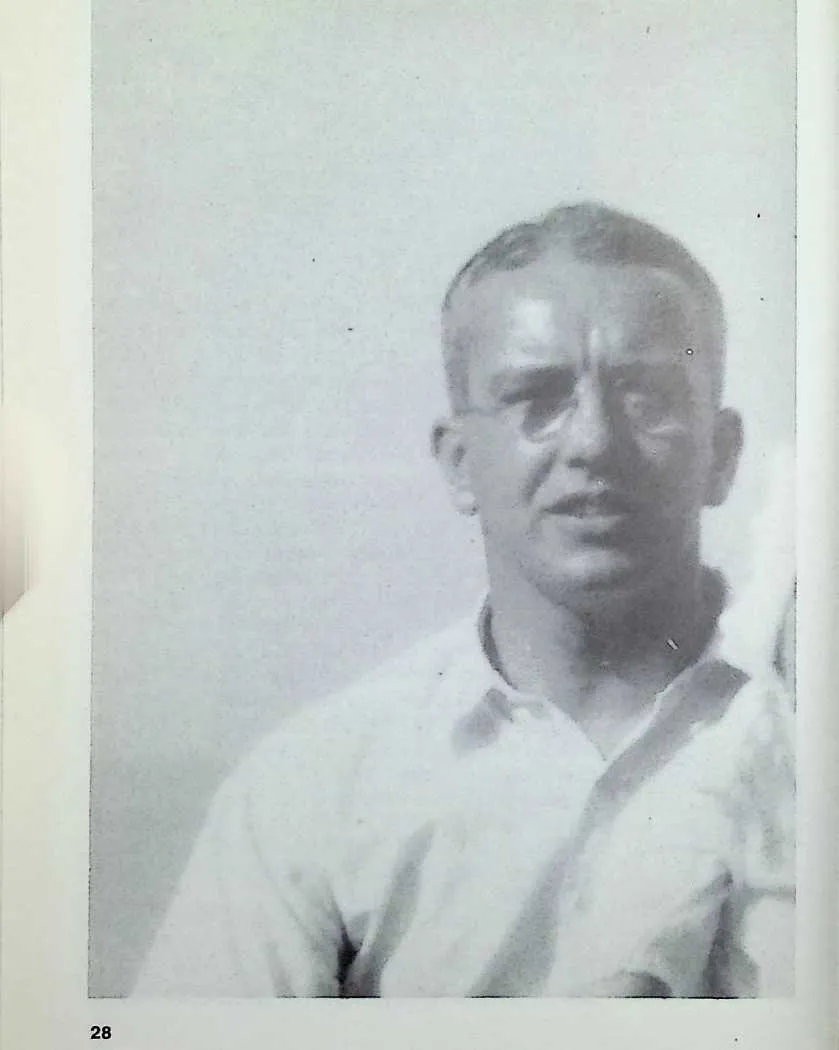
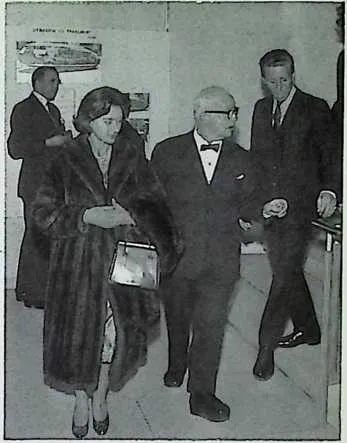
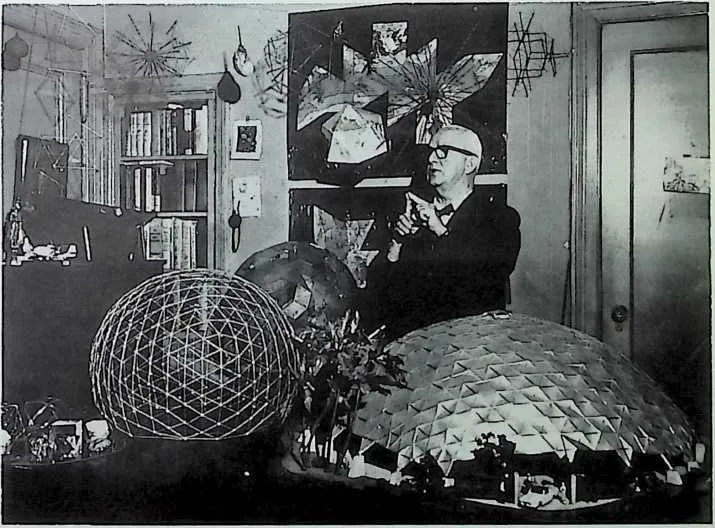
45 Other portraits: Fuller the lone genius (left) in a Greenwich Village studio in 1929 with a frame model of his '4-D' mast-supported house; Fuller the ambassador (right) guiding HRH Princess Margaret and Lord Snowdon around a 1962 exhibition of his work at the United Slates Embassy, London; Fuller the philosopher (below) in 1967 surrounded by geodesic models in his study al the University of Southern Illinois.
47 As a child he was cross-eyed, unpopular, badly behaved and bullied at school. He was sent down from Harvard, where every male Fuller since 1760 had graduated. He was bankrupted in business, where his father had been a model of probity. He was fired from jobs and ridiculed by his peers in engineering, architecture and construction. In 1927 he was sacked from his post as president of ‘Stockade Building Systems’ after five years. In the same year he was shattered when his three year-old invalid daughter died in his arms and her last words were; ‘Did you get me the cane, Daddy?’—a reference to the walking cane he had promised to buy her when he had left the house to go to a collegiate football game—and had unfortunately forgotten.
48 One year later he offered the patent rights in his revolutionary ‘4-D’ house to the council of the American Institute of Architects, whose then vice-president was his father-in-law, and the Institute not only rejected the gift but caused the gratuitous insult; ‘Be it resolved that the American Institute of Architects establishes itself on record as inherently opposed to any such peas-in-a-pod-like reproducible designs’, to be read into the minutes of the meeting held to discuss the matter.
49 At least twice Buckminster Fuller’s failures were so notorious as to lead to his being pilloried by the press: in 1934 when an accident with his revolutionary Dymaxion car resulted in an outcry over the death of the driver; and again in 1946 when his prefabricated housing company ‘Fuller Houses Inc’—for which thousands of dollars worth of stock had been sold on production targets of 20,000 units a year, and upon which the job prospects of 20,000 wartime aircraft workers depended–was liquidated through his own stubbornness.
50 The Richard Buckminster Fuller of that day in the Stafford Hotel knew what failure was, he had been called a failure by experts. In fact, although I did not know it, his success, his reputation, his immortality rested upon a structure of failures so vast and ambitious that only a man of superhuman courage and determination could have supported it.
51 This much I did not realize at the time, but I did understand that the end of my interview with Richard Buckminster Fuller had arrived. I had asked only one of the ten questions I had prepared, but the emotional intensity in the hotel room was too powerful for me to speak, and for Fuller, further elaboration of what he had already said would clearly have been superfluous.
52 As I put my tape recorder and notebook away and put on my coat. Buckminster Fuller addressed me in a different tone that showed that his anger had either been simulated, or had quickly abated. ‘I hit you hard that time because I want you to remember what I said. I’m an old man and I won’t be around forever’.
53 I shook hands with Fuller and with Sadao, who had said nothing throughout the interview, and I left the hotel. I went back to my flat in Paddington and began to transcribe the key parts of the tape. The published version was necessarily incomplete, but the essence of the encounter was there. The only important omission was Fuller’s message to me as I left.
54 As an interview subject, especially towards the end of his life, Fuller was for the most part, as he confessed to Dil eleven years later, ‘saying all the things that he had said or written before’. And today I know that the verbal counter attack, the practiced rage, and the final gruff conciliation that he employed to such effect on me—like the theatrical gestures taught him by his daughter–had all been used before.
55 The significance of his remark to Dil about women is less clear, it might be completely innocent, or it might represent a chink in the armour of a private man who would normally only speak of his private life as a historical thing. There were women whose names occur in the long story of Buckminster Fuller’s career; Romany Marie, who kept the bar he frequented in New York City in the 1930s; Cynthia Lacey, generally described as his personal assistant, whose face makes an enigmatic appearance in most of the magazine stories about the Wichita House; Katherine Dunham, the black dancer who played such an important part in raising community support for the Saint Louis ‘Old Man River’ project. But outside his family and his associates little or nothing is known about them or their relationship with Richard Buckminster Fuller.
56 In the beginning, as at the end of his adult life, there was only really Anne Hewlett Fuller, his wife. The permanence and unknowableness of their relationship is attested in a million ways, but one of them is accessible. In the Buckminster Fuller archive in Los Angeles there is a scraperboard drawing of the polymath, seated with pen in hand at a desk. On the back of it is an inscription that reads; ‘Buckminster Fuller by Anne Hewlett Fuller, his wife, sketched in their Belmont Harbour, Chicago apartment in 1928 as he completed the manuscript of ‘4-D’, and the invention of the Dymaxion House, as an objectification of his philosophy of industrialization’. On the front, in the margin is written enigmatically; ‘GOLDYLOX AND THE AIRPLANE’.
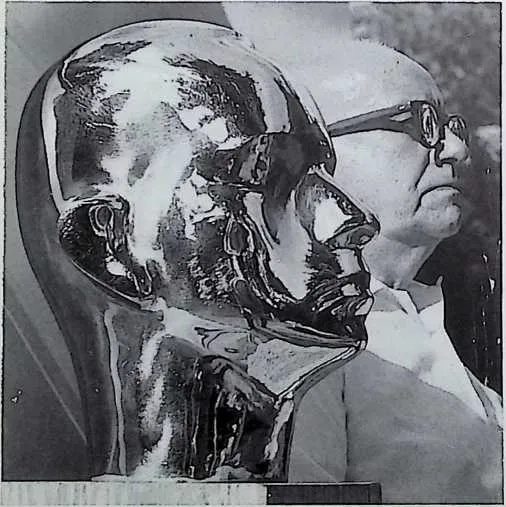
58 Fuller the immortal, alongside a bust of himself cast by his friend the sculptor Isamu Noguchi.