
10 Necessary Beauty: Fuller’s Sumptuary Aesthetic
2Jonathan Massey
34Beauty rests on necessities. The line of beauty is the result of perfect economy…There is not a particle to spare in natural structures. In rhetoric this ART OF OMISSION is the chief SECRET OF POWER.
5Ralph Waldo Emerson
6 Buckminster Fuller’s many designs and inventions have long been celebrated for the ethical virtues of their efficient engineering and production. The aesthetic appeal of these designs, on the other hand, has often been considered a circumstantial feature—fortuitous confirmation of their fundamental rationality.1 This perception, bolstered by Fuller’s own insistence that aesthetic considerations were strictly secondary to efficiency criteria, has distorted our understanding of his work. Aesthetic strategies were essential to Fuller’s pursuit of an ethically superior society through efficient design. The regular geometries that Fuller used to optimize the performance of structures and machines also lent them a distinctive beauty that convinced investors and consumers to finance and buy them and so to enlist in a voluntaristic social reform project. Fuller’s exploitation of geometry for its rhetorical power is manifest in many of his key projects, including the geodesic domes for which he is best known. Their genesis lay in his 1928 development of the 4D house, better known as the Dymaxion house (fig. 7.1).
7 Fuller’s use of regular geometry to construct sturdy and efficient structures was inspired by the practices of engineers, especially the efficiency engineers who followed Frederick Winslow Taylor in applying scientific management principles to industrial production and other social processes. Yet Fuller’s use of geometry exceeded the requirements of structural and manufacturing efficiency, taking on a rhetorical role that was shaped by the work of architects, particularly that of Claude Bragdon, a modernist who in 1915 developed a system of universal ornament to integrate architecture, art, and design. Fuller synthesized aspects of these two distinct traditions through the conceptual rubric of the fourth dimension. He associated the Taylorist use of time controls in the manufacturing process with Einstein’s theory of relativity and the concept of a temporal fourth dimension. By reducing the time needed for both the production of housing and its maintenance by occupants, Fuller incorporated ‘‘four-dimensional’’ time efficiencies into his designs. Bragdon’s
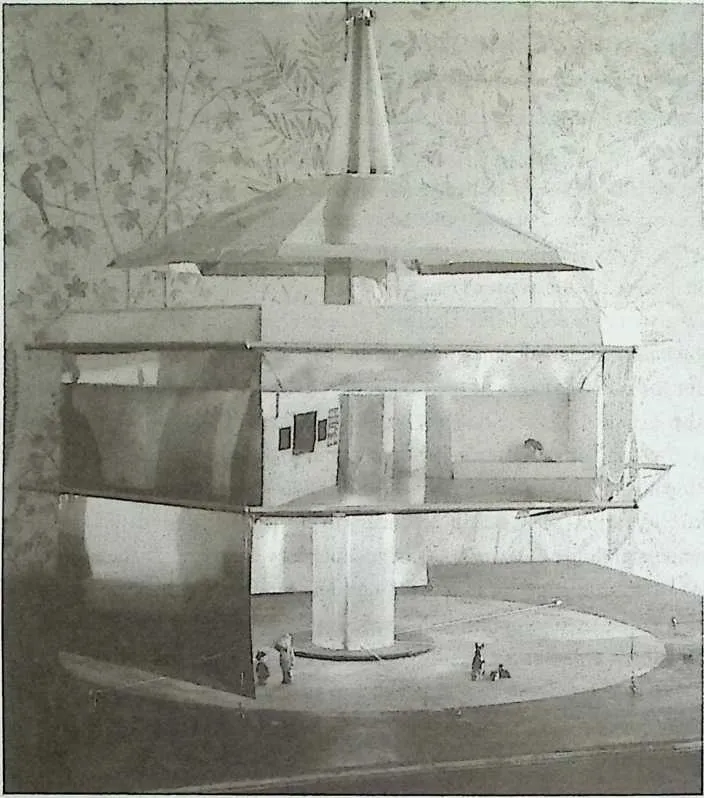
9 Figure 7.1
10 One of Fuller’s 4D-house models, ca. 1929.
11 © Estate of R. Buckminster Fuller. All rights reserved. Used by permission. Source: Special Collections, Stanford University Libraries.
12 system of ornament, on the other hand, had been based on an older concept of a spatial fourth dimension that carried with it ethical imperatives for altruistic behavior. Projecting four-dimensional shapes into three- and two-dimensional patterns, Bragdon had enlisted the beauty of geometric order to regulate design and consumption in what he considered socially beneficial ways. By adapting the geometries with which Bragdon had expressed his fourdimensional ethical code and sumptuary ethos, Fuller incorporated Bragdon’s rhetorical use of beauty into his housing reform project. By linking technocratic production efficiencies to aesthetic strategies for using geometry to modify consumption, Fuller was able to reconcile technocratic faith in a single best pattern of social organization with his libertarian commitment to individual self-determination.
13 Comprehensive Design
14 Over the course of several months in 1928, Fuller outlined a system of industrialized housing that promised to transform human society by releasing parents from unnecessary labor and giving children the benefit of an improved home environment. In May of that year he privately published these ideas in a manuscript, called 4D Time Lock, that combined attributes of philosophical treatise, mystical statement, reform manifesto, and business prospectus. The Time Lock outlined Fuller’s vision of a world integrated by increasingly efficient manufacturing and transportation systems that would free up time, energy, and material so that families could enjoy lives of nomadic leisure. The manuscript invited readers to invest in an association, called the 4D Control Syndicate, dedicated to manufacturing and renting prefabricated houses. Fuller designated these projects ‘‘4D’’ to mark the central role the fourth dimension played in his reform vision.2
15 As he wrote the Time Lock, Fuller was developing designs for a lightweight, centrally supported metal house suitable for mass production. His initial design featured a square structural core that contained plumbing, services, and ventilation equipment while also supporting rectangular cantilevered floors. During the next few months Fuller redesigned the core as a slender mast from which floors hung by tension cabling and gave the house a hexagonal floor plan on a triangular module. Fuller drew the house in many different configurations, including both a single-family version and multistory apartment dwellings. By September 1928, Fuller’s single-family house design had crystallized into a hexagonal one-story structure, suspended above the ground on a central mast, anchored to the ground by metal cabling, and furnished with a roof deck. Airlifted from factory to building site by a zeppelin, its mast anchored in a bomb-crater excavation, this ‘‘autonomous dwelling unit’’ would be installed virtually anywhere that its nomadic family found the best opportunities for work and for leisure. In Fuller’s imagination the house would liberate families from geographic constraints and local allegiances, enabling them to take the best advantage of the opportunities afforded by the global market for labor. Mobile dwellings would stabilize the economy by creating a self-regulating labor market in which workers followed jobs. Fuller began exhibiting and publishing this project, which he called the 4D house, in fall 1928. He refined it in drawings and models over the next several months, adding secondary features such as exterior louvers and built-in furnishings and appliances. In April 1929, renamed the Dymaxion house by adman Waldo Warren, Fuller’s design was exhibited at the Marshall Field’s department store in downtown Chicago and publicized widely in the press, launching Fuller’s remarkable career as an inventor, designer, author, and educator.
16 The Time Lock laid the groundwork for Fuller’s later books and lectures. Similarly, the 4D house contained the germ of most of Fuller’s subsequent design work. The principles of lightweight metal construction, industrial mass production, tension cabling, and geometric ordering that characterized the 4D house informed designs for the Wichita House, geodesic domes, ‘‘geoscope’’ information displays, tensegrity structures, and many other projects. Fuller’s transportation and cartographic designs, such as the Dymaxion car, Autonomous Wing, and Dymaxion air-ocean map, meanwhile, were tools of mobility for a nomadic global society. By using design to increase efficiency and rationalize the labor market, Fuller aspired to reduce waste, including both inefficient production and what he considered unnecessary consumption. Fuller was inspired primarily by the abundance and harmony that could result from maximizing the benefits of industry and distributing them equitably in what he called ‘‘the socialization of essentials and plenitudes.’’3 This process would increase individuals’ life expectancy and standard of living by providing better nutrition, housing, and recreation. In doing so, Fuller believed, it would help the human species as a whole avoid self-destruction by relieving the scarcity pressures that stimulated competition, class strife, and warfare.
17 The implementation strategy of Fuller’s social reform project eschewed both autocratic solutions and electoral politics in favor of market-based approaches. Fuller proposed a worldwide technological evolution to be carried out by individuals and corporations working to design and market better machines and products. He came to call this practice ‘‘design science’’ and envisioned it being practiced by ‘ ‘‘comprehensive designers’ who would coordinate resources and technology on a world scale for the benefit of all mankind, and would constantly anticipate future needs while they found ever-better ways of providing more and more from less and less.’’4 By progressively increasing the efficiency of human resource use, comprehensive designers would relieve the survival pressures placed on individuals and the species by resource limitations.
18 Self-discipline
19 Fuller’s work falls within the tradition of sumptuary regulation, the regulation of consumption in the service of social and political goals. Since antiquity, sumptuary codes have maintained particular aspects of social order by guiding the choices individuals make in purchasing and displaying goods.5 By identifying some desires as excessive or luxurious, and so as illegitimate, they have regulated expressions of private desire in the name of the public good. From the Middle Ages through the seventeenth century, sumptuary regulation was frequently enforced through laws that specified what individuals wore and ate, what furnishings they possessed, and how they conducted funerals and weddings. In modern society sumptuary regulation has more often operated through economic incentives, such as those embedded in tax code provisions, and aesthetic codes, such as those promoted by modernist architects, than through outright prohibition. By making the individual responsible for his or her own self-regulation, modern sumptuary codes have replaced the old externally imposed limitations with a set of internalized disciplines.6
20 Disciplining desires—his own and those of others—was a major preoccupation for Fuller, who characterized his entire career as a series of ‘‘self-disciplines’’ of broadening scope.7 While Fuller’s career, devoted to using design to bring individual desires into alignment with one another, had roots in both the Technocracy movement and Bragdon’s projective ornament, its development was spurred by the tensions in his own personality between appetite and duty. Fuller’s 1928 outpouring of innovation was catalyzed by a delayed reaction to the death of his first daughter, Alexandra, who had succumbed to polio in November 1922 after surviving earlier bouts of influenza and spinal meningitis. Fuller blamed Alexandra’s death on World War I, which had diverted resources from life-enhancing purposes such as public health services, resulting in such calamities as the 1918 influenza epidemic that struck the infant Alexandra.8 At the same time, Fuller blamed himself, feeling that his daughter’s death had resulted in part from his frequent absences from home due not only to work obligations but also to his self-centered appetite for drinking, gambling, and other bachelor pleasures. The birth of a second daughter, Allegra, in 1927, reactivated in Fuller the emotions associated with Alexandra’s death. His new fatherhood coincided with a personal economic crisis: his removal from leadership of the Stockade Corporation by the new majority shareholders when his father-in-law sold off shares in the company. Fired from a company he had helped to found and build, Fuller felt himself—and his newborn daughter—victimized again, this time not by war but by finance capitalism.9
21 Offered a second chance as husband and father, Fuller contemplated the possibility that he would be a better provider dead than alive. Facing these anxieties in an existential crisis on the shores of Lake Michigan in fall 1927, Fuller considered drowning his sorrows and feelings of guilt in the icy lake, leaving his wife and new daughter to collect insurance money and allowing Anne to take a more suitable second husband. As he contemplated suicide, however, Fuller experienced a revelation during which, he later recalled, time stopped, he levitated, and a disembodied voice addressed him. ‘‘You do not have the right to eliminate yourself,’’ it said, proclaiming it Fuller’s duty to devote his knowledge and ability to ‘‘the highest advantage of others.’’10 This mystical encounter convinced Fuller to dedicate himself to serving humanity as experiment ‘‘Guinea Pig B,’’ beginning with a term during which he vowed not to speak to anyone else. Channeling his frustration and self-hatred into an intense productivity enhanced by this monastic discipline, Fuller devoted himself to reforming society by eliminating the ‘‘chaos’’ caused by war and market capitalism, both of which denied men, women, and—most painfully—children the benefits of the scientific and industrial revolutions. Projecting his commitment to personal reform outward onto the society around him, Fuller set out to redeem himself by saving children through better design of housing and other amenities.11 Fuller’s passion for taming his own ‘‘bestial self’’ carried over into his work as a lifelong campaign to regulate the consumption of others by reorganizing the ‘‘mechanical arrangement’’ of society so that individual selfishness would make the individual ‘‘inadvertently selfish for everyone.’’12
22 Fuller’s Fourth Dimension
23 Fuller frequently attributed the efficiency and elegance of his designs to their distillation and replication of principles evident in nature. While this claim recurred throughout his career, the specific terms in which Fuller understood nature—and with them, the ways he claimed to replicate natural principles in his designs—changed over time. In the 1970s, for instance, Fuller liked to illustrate his claim that geodesic domes were based on natural principles with drawings of radiolarians, single-celled oceanic protozoan organisms. While nineteenth-century biologists such as Ernst Haeckel had documented many types of radiolarians in a variety of shapes, Fuller selectively featured radiolarians that took the form of faceted spheres, like his geodesic structures. When promoting the 4D house in the late 1920s, however, Fuller had compared its mast to the trunk of a redwood tree and its pneumatic rubber floors to ‘‘the life cell,’’ nature’s ‘‘primary structural member …a globule in which elements in their liquid and gaseous states are compressively enclosed by elements in their solid and tensed state.’’13 Fuller’s ‘‘nature’’ was a moving target that mirrored the technology with which he happened to be working. It was fundamentally a rhetorical tool lending the authority of ‘‘necessity’’ to Fuller’s designs.
24 The fourth dimension was a recurring theme throughout Fuller’s career. As with his other concepts of nature, Fuller’s understanding changed over time, oscillating between—and sometimes combining—differing concepts of the fourth dimension as space and as time.14 This ambivalence as to whether the fourth dimension was spatial or temporal reflected his familiarity with two disparate concepts of the fourth dimension. The concept of the fourth dimension of space had gained prominence following the 1868 publication of G. B. F. Riemann’s theory of n-dimensional space.15 By demonstrating mathematically that space could possess a variable and potentially infinite number of dimensions, Riemann suggested that the universe might contain spaces of more than three dimensions. After World War I the new concept of the fourth dimension as time, formulated by mathematician Hermann Minkowski in 1907 and incorporated into Einstein’s General Theory of Relativity, eclipsed the idea of higher spatial dimensions.16
25 For a half century after its publication, Riemann’s work inspired speculation as to the potential reality of higher-dimensional spaces, including a large para-scientific literature that posited a fourth spatial dimension as the explanation for occult phenomena and mystical experiences. In the new genre of ‘‘hyperspace philosophy’’ Riemann’s discovery became a vehicle for social critiques and religious convictions, ranging from the social commentary of E. A. Abbott’s satire Flatland: A Romance of Many Dimensions (1884) to the mystical doctrines of theosophy, the ‘‘spiritual science’’ that sought to reconcile modern Western science with ancient Eastern religious principles from the Bhagavad-Gita and the Upanishads. According to most hyperspace theories, the fourth dimension was a real space beyond the range of normal human perception, awareness of which had existential, epistemological, and ethical consequences. In the late 1870s, for instance, Leipzig physicist and astronomer J. C. E Zbllner developed a theory of ‘‘transcendental physics’’ that explained spiritualist phenomena, such as clairvoyance and the materializing of objects within sealed enclosures, as fourth-dimensional phenomena. From the early 1880s to his death in 1904, English mathematician Charles Howard Hinton made the principle of a four-dimensional intelligence looking down into an exposed third dimension the basis of an altruistic ethical code. Hinton encouraged his readers to cultivate four-dimensional vision so that they might ‘‘cast out the self’’ and achieve transcendent unity with higher-dimensional cosmic being. In Russia, P. D. Ouspensky’s Tertium Organum (1911) drew on Zbllner, Hinton, and other sources to develop a mystical cosmology characterizing the evolution of consciousness as a conquest of successively higher spatial dimensions. In Rochester, New York, meanwhile, Claude Bragdon synthesized ideas from Hinton and other hyperspace sources in articles and books that identified the fourth dimension as the future home of perfected humanity. By overcoming their materialism and transcending their egotism, Bragdon argued, individuals could gain access to a four-dimensional New Jerusalem where millennial dreams of abundance and harmony would be fulfilled. Bragdon disseminated these ideas in his books Man the Square (1912), A Primer of Higher Space (1913), and Four-Dimensional Vistas (1916). When he translated and published Tertium Organum in 1920, Bragdon also introduced Ouspensky’s four-dimensional cosmology to English-speaking audiences, who devoured the book in new editions issued almost annually.
26 Fuller combined aspects of both the spatial and temporal fourth dimensions, especially in his early career. Although he associated the 4D house and 4D Time Lock with Einsteinian relativity, Fuller fused this temporal fourth dimension with ideas and representational strategies from hyperspace philosophy. He understood Einstein’s theory to describe a ‘‘time-rate world’’: a universe in which energy moved bodies of varying mass at differential rates of speed.17 Fuller’s grasp of Einstein’s theory was hazy, as he admitted to his father-in-law.18 For the most part, he filtered relativity through his intuitive familiarity with the interrelationship of mass, energy, and velocity acquired summering at the Fuller family’s Bear Island, then serving in the Navy during World War I. In Nine Chains to the Moon, for instance, Fuller described Einsteinian relativity as ‘‘a concept of the universe, all parts of which are in constant motion, as powered by unit energy in relative rates of speed of motion proportional to the frictional relationships of all the parts.’’19 Fuller seems to have concluded from relativity that lowering the mass of buildings, vehicles, and other artifacts would increase the speed of production and free up energy for reinvestment in increased production. Even as he oriented his work toward this ‘‘time-rate’’ logic, though, Fuller invested the fourth dimension with the existential meanings and ethical imperatives that had accrued to the fourth dimension of space in the writings of Hinton, Ouspensky, Bragdon, and others. Fuller described the aim of his work as ‘‘the complete subjection of materialism to the will of the unselfish or spiritual man,’’ and he claimed that the 4D house represented ‘‘harnessed—not worshiped materialism—true mind over matter—on the road from the complete, stony, compressive darkness of selfish materialism to the infinity of lightful, abstract, harmonic unselfishness.’’20
27 Technocracy
28 Fuller’s 4D concept owed more to Henry Ford’s system of mass production than it did to Einsteinian relativity. Fuller saw Ford as having translated Einstein’s concept of a ‘‘time-rate world’’ into industrial practice to achieve great improvements in manufacturing efficiency. By standardizing the time in which workers performed automotive assembly operations, Ford was able to synchronize nearly the entire production process to run on a continuous assembly line. Fuller credited Ford with rationalizing automobile production based on ‘‘a TIMING system, a time-coordinated planning,’’ to achieve unprecedented efficiency. The fourth dimension summed up the promise of industrialization withheld by such obstacles to progress as war, vested business interests, and government regulation. Referring to the Murphys, the Everyman family Fuller used as a rhetorical foil throughout Nine Chains to the Moon, he explained: ‘‘Einstein’s ‘relativity’ reached the Murphys through Ford.’’21
29 In creating 4D housing, Fuller sought to apply Ford’s timing system to the shelter industry. Given the central role played by time in nature and industry, he argued, ‘‘progressive design must be time saving.’’22 By framing his work as the application of relativity theory to house design, Fuller characterized his ‘‘universal architecture’’ as an extrapolation of natural principles. In this he followed and deliberately echoed Taylor’s discipline of scientific management. Taylor viewed himself as a scientist determining the principles of natural efficiency in order to apply them to industrial process. By identifying the ‘‘one best way’’ to solve any problem or perform any task, he argued, scientific management distilled, systematized, and replicated natural efficiencies.23 Fuller adopted Taylor’s philosophy, using the rhetoric of scientific management to naturalize his 4D architecture. ‘‘Nature,’’ he explained in the Time Lock, ‘‘has in the course of time solved every mechanical problem’’ by segregating and solving functions. ‘‘Slowly nature has centralized production through industry, and taken the one best mechanical way of doing something…and made it available to all who will’’—through devices ranging from razors and cars to hats, shoes, and stockings. ‘‘The home is the same,’’ he concluded; ‘‘the house and all its functions are material and therefore solvable in but one best way.’’24 The fourth dimension provided Fuller with a vocabulary for describing the application of scientific management time control to all of human society to realize the millennial dream of restoring humanity to an Edenic state.
30 Fuller based his ideas about time planning and mass production not only on the work of Taylor and Ford but also on the arguments of engineers in the Technocracy movement, a movement that sought to place engineers and other technical experts in charge of production and consumption decisions. Initiated during World War I by scientific management experts from Taylorist societies, and inspired by the writings of sociologist Thorstein Veblen and engineer Henry L. Gantt, the Technocracy movement was an outgrowth of Progressive Era social and political reform ideals.25 Its advocates believed that new industrial methods had made possible levels of production sufficient to create an economy of universal abundance. This potential, however, was withheld by the selfishness of finance capitalists, who sought to maximize their own profits rather than to distribute the benefits of new technology as widely as possible, and by politicians, who served the interests of owners before those of consumers. This interpretation was amplified into a social program by a second generation that included Walter Rautenstrauch, a Columbia University engineering professor; Howard Scott, a technician; and Stuart Chase, a journalist. These technocrats saw engineers and other technical specialists as disinterested parties who, if given control of the production system, could reorganize and rationalize it for optimal production. By establishing a centralized command economy to coordinate production and consumption, these men aspired to eliminate the social unrest created by scarcity and resource competition. They envisioned a shift ‘‘from arbitrary power to scientific administration’’ that would yield ‘‘social harmony through…‘the organization of human affairs in harmony with natural laws.’ ’’26
31 Scott was especially important to the elaboration of technocratic theory. As founder and chief engineer of a group called the Technical Alliance, which existed from 1919 to 1921, then again as a leading figure in the Committee on Technocracy, a research group established at Columbia University by Rautenstrauch in 1932, he declared that the potential for technologically produced abundance rendered obsolete all existing economic and political systems because they were based on scarcity. Scott conducted an energy survey of North America that analyzed the history of three thousand industries using a system of energy accounting that measured productivity and efficiency in terms of ergs, the basic unit of work, rather than in monetary terms. When the Committee on Technocracy split into two separate factions in 1933, Scott established Technocracy, Inc., through which he outlined proposals to transform the North American continent into an integrated command economy coordinated by an all-powerful hierarchy of experts called a ‘‘Technate.’’27
32 Fuller drew extensively from technocratic analyses in developing his own ideas and methods during the formative period of his career in the late 1920s and 1930s. In Nine Chains to the Moon he extrapolated his 4D theory of industrialism into a full-fledged technocratic theory of society and history. Fuller adopted most aspects of technocratic thinking, including the conviction that industrial potential was withheld by finance capitalists and politicians. Particularly influential on Fuller’s thinking was Scott’s theory that the efficiency with which a society converted energy from natural resources was the key index of human progress. The ‘‘Dymaxion Charts for Economic Navigation’’ appended to Nine Chains to the Moon were only the first of many projects in which Fuller adopted Scott’s practice of industrial survey and energy accounting. They led to his eventual establishment of the World Resources Institute and sponsorship of the World Design Science Decade, 1965–75. With the infusion of technocratic theory and terminology, Fuller’s 4D rhetoric acquired a greater degree of substance and scope, becoming a macrohistorical theory of society based on energy and industrialization.
33 Fuller encountered technocratic thinking through personal relationships with leading technocrats, including Scott, Chase, and the Committee on Technocracy member Frederick Ackerman, as well as with their less prominent associates such as the engineers Clarence Steinmetz and Irving Langmuir. He may also have read Veblen’s articles in The Dial, the magazine cofounded by Emerson and Fuller’s great aunt, Margaret Fuller Ossoli.28 Fuller would later characterize himself as ‘‘a life long friend of Howard Scott and Stuart Chase’’ and explain that although never a member of Technocracy, Inc., he was ‘‘thoroughly familiar with its history and highly sympathetic with many of the views of its founders.’’29 He drew on technocracy not only for its social theory but also for its model of professional organization. In 1932, as the Committee on Technocracy was garnering extensive press coverage and Scott was expounding its principles at Romany Marie’s, the Greenwich Village restaurant at which both he and Fuller frequently dined together, Fuller founded a group of New York architects and housing reformers called Structural Study Associates, or SSA. Structural Study Associates was an architects’ organization parallel to the Committee on Technocracy, as well as to the many other technocracy organizations founded in 1932 and 1933 throughout the United States and Canada. Devoted to increasing efficiency in the housing industry, SSA and its journal, Shelter, advocated technically sophisticated visions of industrial architecture for a high-technology society.30
34 Fuller’s maturing vision of a 4D or Dymaxion society was in many respects an architect’s reply to technocratic proposals for government by engineers. While Fuller shared the technocratic conviction that there existed only ‘‘one best way’’ to organize society for maximum production, he was too much of a libertarian to accept Scott’s proposal that North America be ruled by a Technate empowered to determine everything from what would be produced to when a given employee would go to work. By the late 1930s, Fuller had repudiated Technocracy, Inc., calling it an ‘‘autocracy of engineers’’ and arguing that it was doomed because it allowed no room for individual speculation and initiative.31 ‘‘There is a ‘best’ geometrical pattern and order constantly evolved in a scientifically unified establishment,’’ he asserted in 1932, ‘‘without in any way detracting from the chances of life or the individual development of man.’’32 Fuller’s proposals for industrial design sought to reconcile his faith in ‘‘one best way’’ with his libertarian ethos. He set out to create ‘‘a whole new world industry concerned only with man’s unavoidable needs and implementation of his inherent freedoms.’’33
35 Marketing Rationalization
36 In lieu of a technocratic command economy, Fuller envisioned a market-based social transformation driven by consumer demand for more efficient products and technologies. He aspired to bring to market a wide range of industrial products that would objectify technocratic social reform through mechanical technology. Fuller believed that under the right circumstances consumers would voluntarily buy into the project of rationalizing the housing industry, just as they had bought into automobility once Ford had made car ownership affordable and easy. Fuller’s shorthand for this principle was the slogan ‘‘new forms rather than reforms.’’ Rather than try ‘‘to reform man,’’ he later recalled, ‘‘what I would do was try to modify the environment in such a way as to get man moving in preferred directions.’’34 Fuller used beauty to stimulate consumer desire for products that would rationalize energy use. ‘‘I never work with aesthetic considerations in mind,’’ he once explained, ‘‘but I have a test: If something isn’t beautiful when I get finished with it, it’s no good.’’35 By using geometry to endow his designs with aesthetic appeal, Fuller put the persuasive power of beauty at the service of his social principles and cosmological convictions.
37 Fuller was committed to the rhetorical power of geometric regularity in ways that could distort his pursuit of efficiency. His major claim for the efficiency of geodesic structures, for instance, was that they enclosed the greatest volume of space with the least amount of material. This arbitrary criterion helped to preserve the visual and formal integrity of his spheres and hemispheres, but it had little relation to the overall efficiency of a building. In some cases Fuller’s commitment to this narrow conception of efficiency led him to espouse significant inefficiencies of other kinds. A 1958 design-build studio at the University of Natal in Durban, South Africa, for instance, demonstrated Fuller’s conviction that industrialized aluminum dome housing was a suitable global solution to human shelter needs. Fuller led a group of students in building a dome-shaped shelter out of aluminum sheets to replace the indigenous woven-grass indlu as a housing type for South Africa’s Zulu population. Given the low cost of South African labor relative to industrial products, however, the aluminum shelter made little economic sense. Not only did it cost substantially more than its indigenous counterpart; it also performed poorly as an environmental control valve, averaging significantly higher interior temperatures than the breathable indlu in Natal’s hot, dry climate.36 A month-long architecture studio at North Carolina State College in 1952, where Fuller had led students in the design of an automated cotton mill, had yielded a similar outcome. Because the resulting project contained the entire production process within a geodesic dome, automated production lines had to snake up through a series of several floors of varying size, then back down to the trucks that distributed the baled cotton. The ‘‘90% Automatic Cotton Mill’’ exemplifies the way Fuller’s commitment to structural efficiency and formal rationality could trump his commitment to economic rationality and production efficiencies. In studio after studio during these decades, Fuller led students in studying a problem and developing a solution—which invariably turned out to be a geodesic dome.37 These pedagogical encounters tested the range of constructional possibilities offered by the geometries and structural principles Fuller was investigating more than they did the ways to optimize the benefits of industrialization for a worldwide human population.
38 Fuller’s discovery of the rhetorical power of geometry dated from 1928, when he redesigned the 4D house from a rectilinear shape that echoed familiar housing types to its novel hexagonal form. Fuller did not publish these early designs with his Time Lock text, as he wanted to retain proprietary control over his innovations while he pursued patent registration. But he soon began to capitalize on the formal distinctiveness of the house, building models and producing drawings for exhibition that highlighted the design of the house more than its relation to his larger vision of a global ‘‘shelter service.’’ After a sketch of the ‘‘Hexagonal House’’ was displayed at a Chicago restaurant and published in the Chicago Evening Post, Fuller arranged for a model to be exhibited at the flagship Marshall Field’s department store. Rebranded as the ‘‘Dymaxion House,’’ Fuller’s design became a sensational attraction, in the tradition of other art and museum displays that helped to draw shoppers to department stores. A year after its development, the 4D house had become a marketing device for increasing sales of hats, shoes, and stockings—the standardized industrial products that had helped to inspire its creation. From its exhibition at Marshall Field’s, the Dymaxion house moved into other media and display contexts. Shortly after its department store debut, the house was exhibited at the Harvard Society for Contemporary Art, then at the Architectural League of New York and other venues.
39 Fuller’s redesign of the 4D house from a rectangular to a triangulated hexagonal plan had
structural advantages. It standardized the radial members branching off the central mast while
also exploiting the stability of the triangle. Fuller also claimed that users would benefit from his
hexagonal plan, suggesting that this radial layout facilitated rapid movement through the
house.38 One diagram of the 4D house even analyzed its plan according to a geometry of time.
Beyond these structural and layout efficiencies, however, the geometry of the 4D house
distinguished it from competing proposals for prefabricated housing by giving it the aesthetic
appeal that permitted its exhibition in art galleries and architecture magazines.3 The
triangular module carried over from the plan and cable stays to the pattern of window
mullions on the facade, where it lacked either structural or temporal rationale. In one of
Fuller’s widely reproduced drawings, this triangular module carried over even into
the
layout of the caption, where it served not efficiency but aesthetics (fig. 7.2). Fuller used geometry
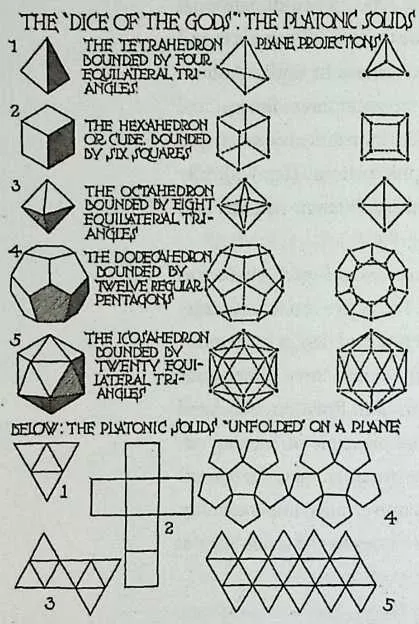
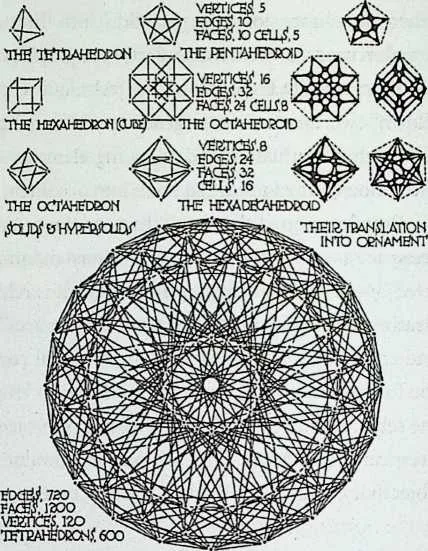
to achieve not only structural and planning efficiency but also formal consistency and aesthetic
power. Through its use in virtually all of Fuller’s designs, the triangle came to symbolize the
liquidation of conventional buildings, vehicles, maps, and cities by his industrially optimized,
globally integrated 4D solutions.
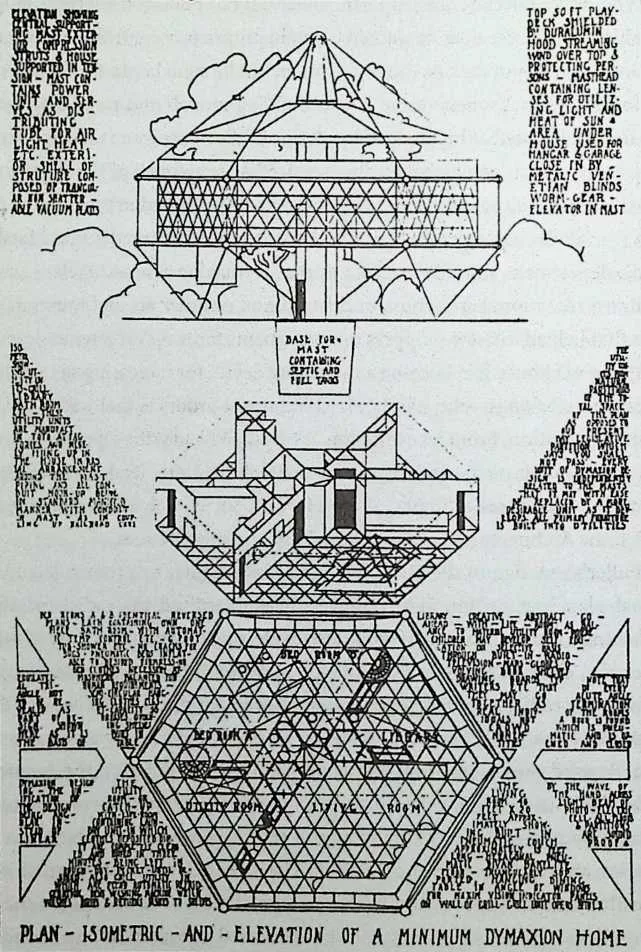
41 Figure 7.2
42 Elevation, isometric, and plan of the single-family 4D house after its redesign based on a triangular module. ©Estate of R. Buckminster Fuller. All rights reserved. Used by permission. Source: J. Baldwin, BuckyWorks: Buckminster Fuller's Ideas for Today (New York: John Wiley, 1996).
43 Sumptuary Design
44 Ford is famous for having said that the customer could have any color Model T as long as it was black. Fuller took a similarly restrictive approach to variety in housing design. Within Fuller’s four-dimensional political economy, the greater human freedom permitted by technological optimization more than offset the limits to individual choice entailed in the standardization of housing. Freed from the necessity of working by increasingly efficient industry, and freed from the burdens of housekeeping by the rationalized house, women and men would find themselves with copious time for creative pursuits. ‘‘As we save time, and conserve it by shorter and more lasting methods and materials, we make time available to all the world, in the form of light, music, leisure for philosophic enjoyment; or …for the housing of our ever developing, finer, more creative selves.’’40 The 4D house, Fuller predicted, would become ‘‘a place in which to live free from worry, free to explore, free to devise, include, refine, free to compose and synchronize.’’41
45 Fuller anticipated that his house design would change its occupants’ purchasing patterns in other economic sectors, too. He incorporated into the Time Lock a long letter to George N. Buffington, a banker with whom he frequently discussed his ideas, recounting his visit to the opening of a new Woolworth store in Chicago.42 The eagerness with which customers purchased frivolous items at the five-and-dime, Fuller explained, was ‘‘a result of a starved and ‘don’ted’ childhood in too close living quarters, with no other outlet for activity, amongst people whose minds have been purged of creative thought, as children.’’ Fuller’s 4D housing would eliminate this practice of consuming as a sublimated expression of creative energies stunted by childhood deprivation. ‘‘All the junk and temptation with which our store windows are crammed, furniture dealers, picture dealers, bird cage dealers, etc., etc.,’’ Fuller asserted, ‘‘will vanish with 4D housing established. Purchase of this ‘riffraff’ will then be as out of the question as purchase of Morris chairs for Fords.’’43 Instead of these ‘‘time wasting’’ objects, people would purchase the instruments of creativity. ‘‘Photographic supplies, sports equipment, tools, laboratory equipment, musical instruments, art supplies and any adjunct of creative or rhythmical activity will ever increase in sale.’’ Fuller’s industrial shelter service was a project of sumptuary regulation designed to change behavior not only in housekeeping and child rearing but also in home decorating, furnishing, and consumption more generally. The primary significance of the triangular module pervading the 4D house may well have been that it left no room for occupants to add home furnishings and decorative accessories expressing their personal taste. Fuller’s design redefined personalized decoration as wasteful consumption.
46 The potentially intrusive nature of Fuller’s sumptuary vision emerges in an early draft of the Time Lock as ‘‘Fuller’s Law of Economics.’’ This section, cut from the manuscript before it was mimeographed and sent out to potential sponsors and investors, suggests that individuals should receive monetary credit to the extent that their work saves time for others, but, conversely, they should be charged for any indulgence of personal appetite lacking socially redeeming purpose. Fuller called such self-indulgence ‘‘bestial’’ and associated it with the stomach. He envisioned his 4D world operating according to a ‘‘specific economy’’ of moral behavior that punished selfishness but rewarded the practice of working toward ‘‘acquisition of harmony.’’ Through a complex monetary reward structure, he hoped to incentivize people to optimize the social value of their time usage. ‘‘When we have learned complete mastery of our selves to the extent of complete unselfconsciousness and unprocrastination in fulfillment of true duties as revealed,’’ Fuller explained, ‘‘then we can control all other matter.’’ It was just a matter of ‘‘licking the bestial self.’’44
47 Projective Ornament
48 The role that the beauty of regular geometry played in Fuller’s regulation of consumption through design reflects his adaptation of strategies that Bragdon had developed in creating his system of projective ornament. An architect and critic with a substantial practice in Rochester, New York, Bragdon created projective ornament to serve as a universal ornamental language suitable to the full range of modern programs and contexts.45 Troubled by the class antagonisms of industrial society, Bragdon criticized liberal modernity for being excessively individualistic and materialistic. His 1918 book Architecture and Democracy, for instance, condemned the new feudalism of industrial society for a pervasive lack of unity and beauty in American cities. In response, he enlisted architecture in the construction of a common culture. By integrating a society divided by distinctions of class, language, and national origin, projective ornament would turn architecture from a technique of differentiation and distinction into one of integration.
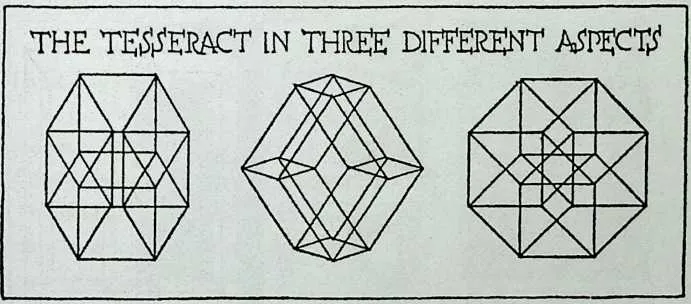
49 Bragdon turned to mathematics, and its formal expression through geometry, as the basis for a
universal, orderly, and impersonal design language. Taking the fourth dimension as a newly
discovered key to correct understanding of nature, he argued that four-dimensional geometry
should replace both ornament based on the historical architectural styles and the novel
ornamental motifs based on nature that were being used by midwestern progressives. To
generate ornament from four-dimensional mathematics, Bragdon adapted the traditions
that mathematicians had developed for representing elusive four-dimensional shapes
such as the tesseract, the four-dimensional extrapolation of the cube. He unfolded
cubes,
tetrahedrons, icosahedrons, and other Platonic solids to generate two-dimensional figures, and he
employed a variation on this technique to ‘‘unfold’’ tesseracts and other four-dimensional
‘‘hypersolids’’ into three dimensions. In similar fashion Bragdon used axonometric projection to
graphically represent three-dimensional solids graphically, then adapted the technique
to project four-dimensional shapes ‘‘down’’ two dimensions to generate additional
graphic patterns (fig. yj).46 By selectively accentuating and repeating elements of
these different patterns and projections, Bragdon turned them into ornament (fig.
7.4).
50 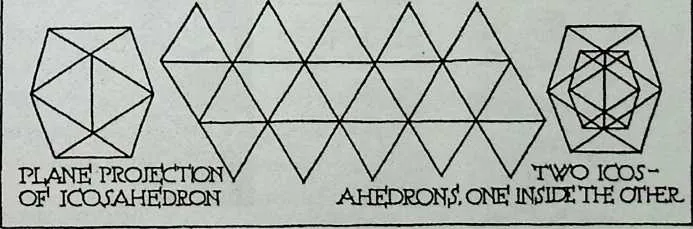 Bragdon hoped that projective ornament patterns would teach viewers to see space
as a Riemannian n-dimensional manifold. Projective ornament translated Bragdon’s
hyperspace philosophy into architecture and design by demonstrating the relation
between the ‘‘lower spaces’’ of two and three dimensions and the ‘‘higher space’’ of
four-dimensional communion. Bragdon associated the fourth dimension with Charles Howard
Hinton’s principle of ‘‘casting out the self,’’ and the crystalline geometries of projective
ornament gave formal expression to such ‘‘four-dimensional’’ social values as universality,
impersonality, objectivity, and order. By disciplining sinuous arabesques to the strict lines
of
Bragdon hoped that projective ornament patterns would teach viewers to see space
as a Riemannian n-dimensional manifold. Projective ornament translated Bragdon’s
hyperspace philosophy into architecture and design by demonstrating the relation
between the ‘‘lower spaces’’ of two and three dimensions and the ‘‘higher space’’ of
four-dimensional communion. Bragdon associated the fourth dimension with Charles Howard
Hinton’s principle of ‘‘casting out the self,’’ and the crystalline geometries of projective
ornament gave formal expression to such ‘‘four-dimensional’’ social values as universality,
impersonality, objectivity, and order. By disciplining sinuous arabesques to the strict lines
of
51 Figure 7.3
52 Diagrams demonstrating how three- and four-dimensional shapes could be represented on the two- dimensional page using unfolding and isometric projection. Source: Claude Bragdon, Projective Ornament (Rochester: Manas Press, 19151,29,43.
54 REGULAR ICOSAHEDRON UNFOLDED IN A PLANE
55 EMUl/di PQLYHEDECW CF FOUR DMNONALAdE IN PLANE' PBOlECTiOH. COEPELATIVE,!' CF THREE PDWNK!
56 PLANE! PROJECTION O' THE 600 HEDPO1D
57 ORNAMENT FIJOM MAQ1C LINE,? IN MAQIC JQLMJE,?
58 VARIOUS ORNAMENTAL RATTED '.THEIR DERIVATOR
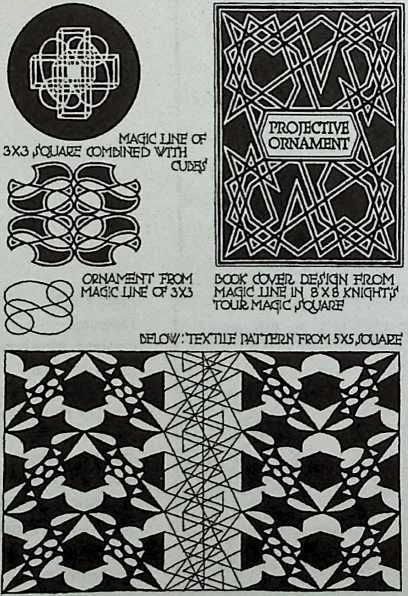
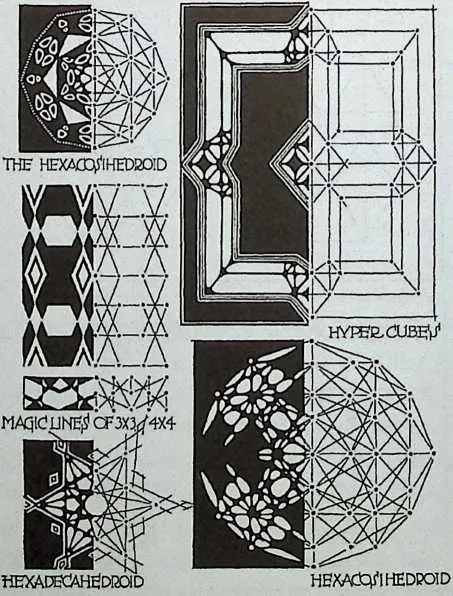
60 geometric crystals, Bragdon allegorized the individual’s willing submission to the demands of a higher necessity. Embracing the association that the English critic John Ruskin had made between regular geometry and servility, Bragdon used ornament to promote a sumptuary ethos. By emphasizing the capacity of crystalline geometry and repetitive all-over patterns to create a consistent and orderly aesthetic totality, Bragdon advocated what he called ‘‘exquisite acquiescence’’: the beauty of individual submission to the demands of ‘‘beautiful necessity,’’ an Emerson phrase that Bragdon adopted as a mantra.47 Because its patterns could be equally well realized in two or three dimensions, projective ornament also formed a bridge between architecture and design in other media, including typography, advertising, textiles, painting, and film. Bragdon’s illustrations of how his ornament could be applied to design, meanwhile, emphasized its capacity for creating aesthetically unified environments (fig. 7.5).
61 From Projective Ornament to Comprehensive Design
62 Bragdon’s writings were a major source of Fuller’s hybrid fourth dimension. Fuller probably discovered Bragdon through The Dial, which from 1917 into the 1920s published his essays, reviews, and projective ornament designs.48 When he mailed out copies of the Time Lock manuscript in 1928 to key figures in industry, education, architecture, literature, and criticism, Fuller sent one to Bragdon, along with a letter explaining that Bragdon’s ‘‘books …, researches and associations with the matter’’ addressed by the manuscript made his ‘‘study and comment on it’’ imperative.45 Fuller’s letter specifically mentioned Architecture and Democracy, along with Bragdon’s translation of Ouspensky’s Tertium Organum. Architecture and Democracywas also the third item on the handwritten ‘‘List of References’’ that formed an appendix to the Time Lock.
63 Fuller adapted the ethics of the fourth dimension of space as developed by Hinton, Bragdon, and Ouspensky to a relativistic understanding of the fourth dimension as time. His vision of social harmony through time controls updated Bragdon’s pursuit of social harmony through space controls, much as his characterization of art as ‘‘an harmonic division, composition, and projection of time’’ reformulated Bragdon’s characterization of architecture and design as ‘‘rhythmic space subdivision.’’50 Traces of hyperspace philosophy occur throughout Fuller’s work. One is Fuller’s description, in Nine Chains to the Moon, of the mind as a ‘‘phantom captain’’ that exists independent of the body (its ship) and possesses an intuitive ‘‘awareness of perfection’’ against which to measure phenomena. This closely followed Hinton’s and Bragdon’s characterizations of consciousness as a four-dimensional captain piloting the ‘‘battleship’’ of the body.51 Another is Fuller’s use of Emerson to describe the rhetorical power of
64 Figure 7.4 (opposite) llustrations summarizing Bragdon’s system of projective ornament by showing how projections and unfoldings could be turned into ornamental designs. Source: Claude Bragdon, The Frozen Fountain, 0–1932 and 1960 by Henry Bragdon. Used by permission of Alfred A. Knopf, a division of Random House, Inc.
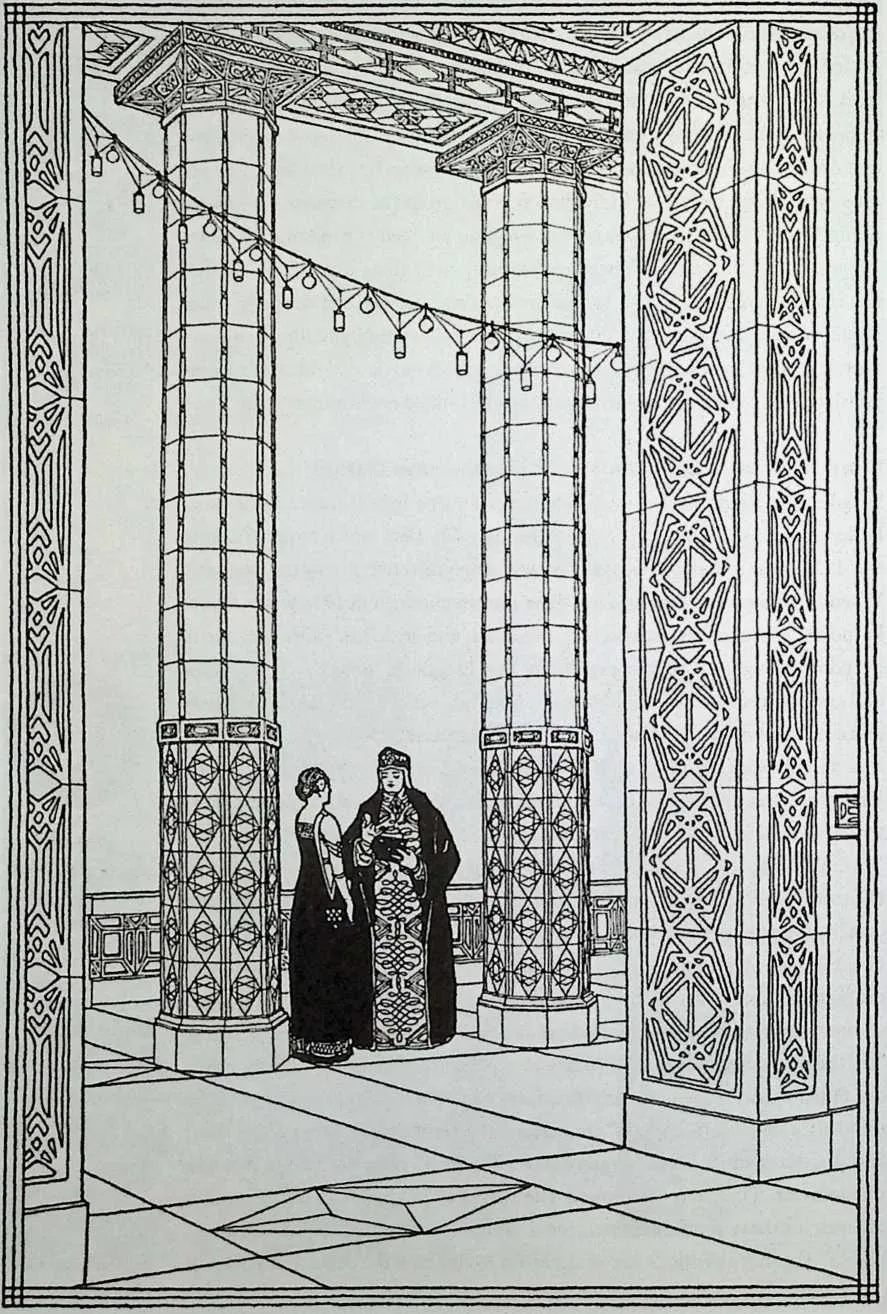
66 Figure 7.5 (opposite) Illustration showing how projective ornament can integrate buildings with furnishings, textiles, and even clothing.
67 Source: Claude Bragdon, Projective Ornament (Rochester: Manas Press, 1915), 14.
68 Figure 7.6
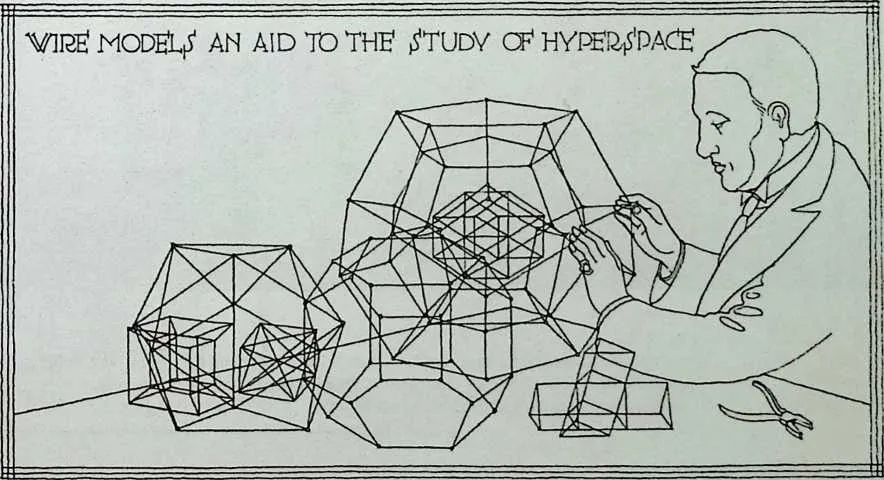
69 (below) Self-portrait showing Bragdon using wire models to study the relation between three- and four-dimensional shapes.
70 Source: Claude Bragdon, The Frozen Fountain, © 1932 and 1960 by Henry Bragdon. Used by permission of Alfred A. Knopf, a division of Random House, Ina, 106.
71 ‘‘necessary’’ beauty, which echoed Bragdon’s Emersonian rhetoric of ‘‘beautiful necessity.’’ Fuller adapted Bragdon’s disciplining of arabesque to crystal in an illustration from Nine Chains to the Moon that shows the progressive straightening of a bent line, representing the individual motivated negatively by fear, into a tautly ‘‘tensed’’ line, representing the individual motivated instead by positive longing. Fuller even referred obliquely to Bragdon’s system of projective ornament in the Time Lock when he observed: ‘‘It is a strange paradox that the world turns up its nose at the artist’s projection of natural or fourth dimensional matter in three dimension or cubistic form, and yet goes on designing its houses about itself in this same limited cubism.’’52
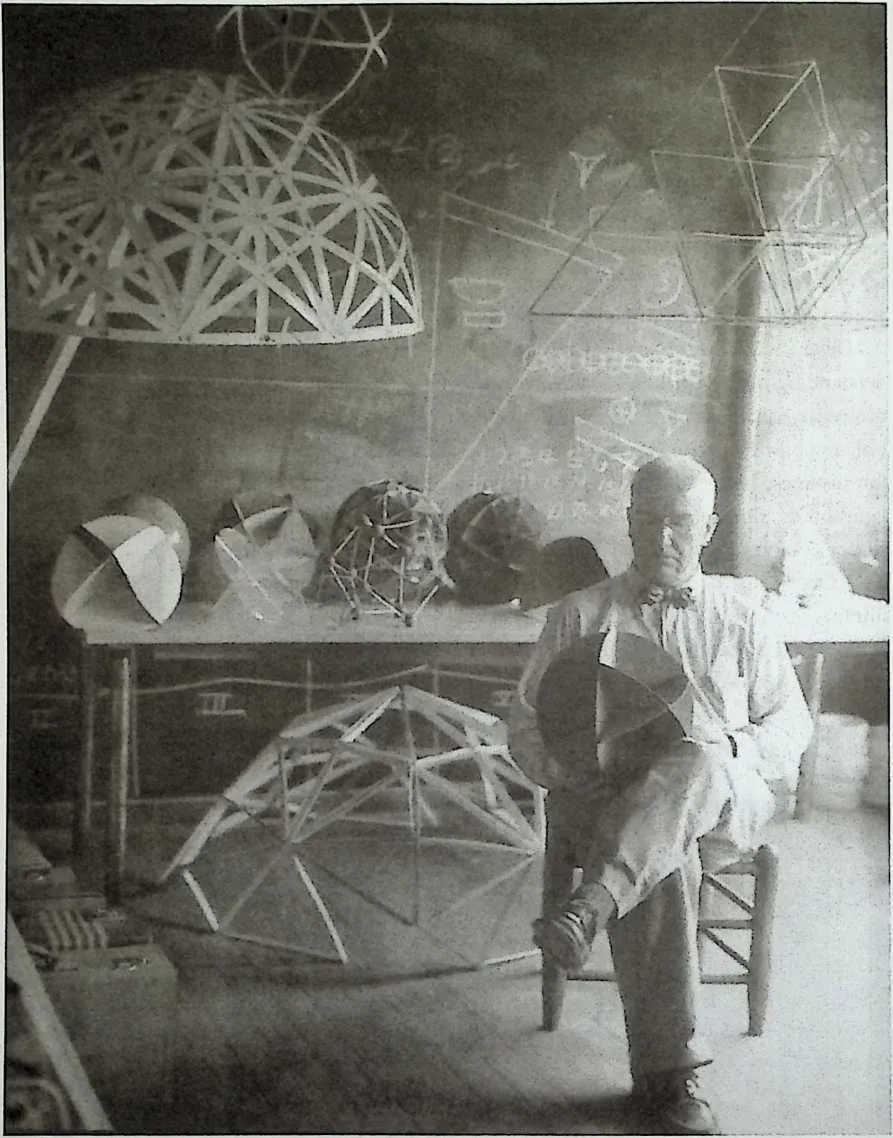
72 Given that Bragdon’s writings were a significant source of Fuller’s understanding of the fourth dimension, it would be surprising if his system of projective ornament played no role in shaping Fuller’s thinking about the socializing power of geometry and beauty. Fuller suggested a number of sources for his mast-hung, tension-cabled hexagonal aluminum house, including lighthouses, ship masts and conning towers, pagodas, octagon houses, and suspension bridges. The Swiss architect Le Corbusier’s modernist houses, published in his book Towards a New Architecture, probably suggested additional features of the 4D house, such as the carport, roof deck, and horizontal window bands. The geometries Fuller employed in the house and in subsequent projects, as well as the techniques he used to manipulate those geometries, however, duplicated those that Bragdon had used to represent nature in generating projective ornament patterns (figs. 7.6, 7.7). Unfolded
7576Figure 7.7
77In developing the principles of geodesic structure at Black Mountain College in 1949, Fuller experimented with models made of cardboard, Venetian blinds, and other materials.
78Source: Special Collections, Stanford University Libraries.
80 Figure 7 A
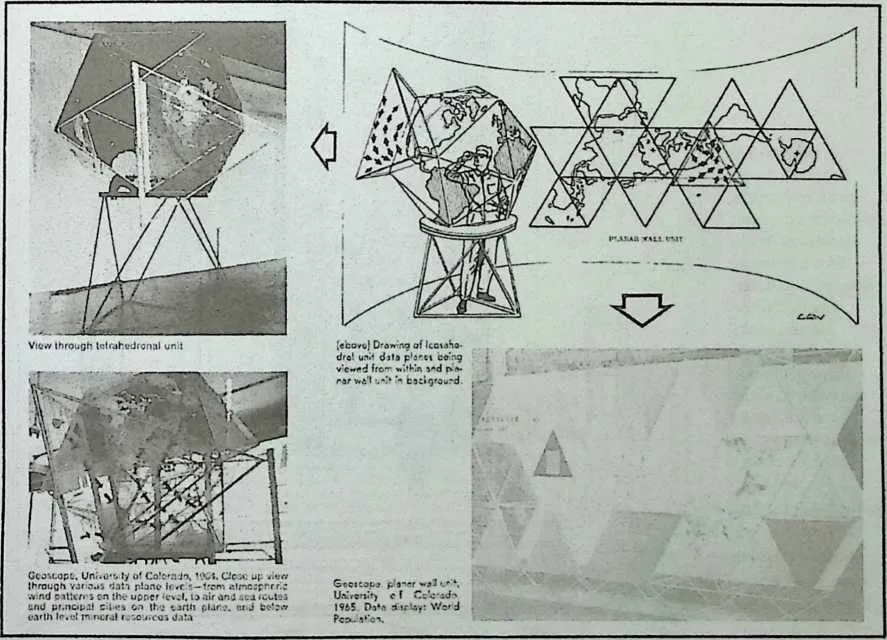
81 Drawing of the icosahedral geoscope built in 1964 by students of John McHale at the University of Colorado, Boulder, based on the Dymaxion air-ocean map projection, in which the globe is mapped onto an icosahedron and then unfolded.
82 Source: John McHale, World Design Science Decade 1965–1975 Phase I (1965) Document 4: The Ten Year Program (Carbondale: World Resources Inventory, Southern Illinois University, 1965).
83 and projected solids and hypersolids in Bragdon’s books, such as a projection of the four-dimensional ‘‘hexadekahedroid’’ in Architecture and Democracy or the triangular and tetrahedral patterns throughout Bragdon’s work, are likely sources of Fuller’s shift from rectangular to hexagonal planning in the 4D house. Bragdon’s many diagrams showing how to translate three-dimensional volumes into two-dimensional images reappeared in Fuller’s system of Dymaxion projection and in the geoscopes that Fuller constructed with John McHale during the 1950s and 1960s (fig. 7.8). Bragdon established the association between geometric projection and four-dimensional discipline that informed much of Fuller’s work.
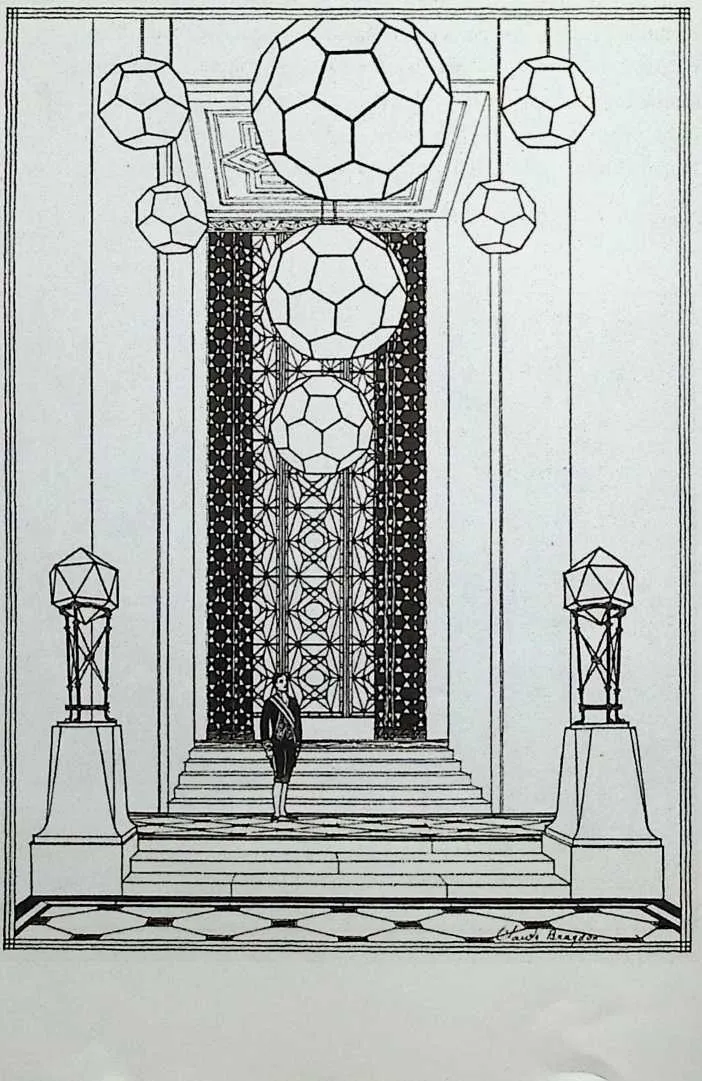
84 Bragdon continued during the late 1920s and early 1930s to explore the symbolic meaning of geometry in ways that anticipated Fuller’s later designs. His 1932 treatise The Frozen Fountain featured polyhedra that would become central to Fuller’s later work, including the soccer-ball shape that would come to be called a ‘‘buckyball’’ because of its geodesic properties (fig. 7.9). The Frozen Fountain endpapers were even decorated with a drawing showing the
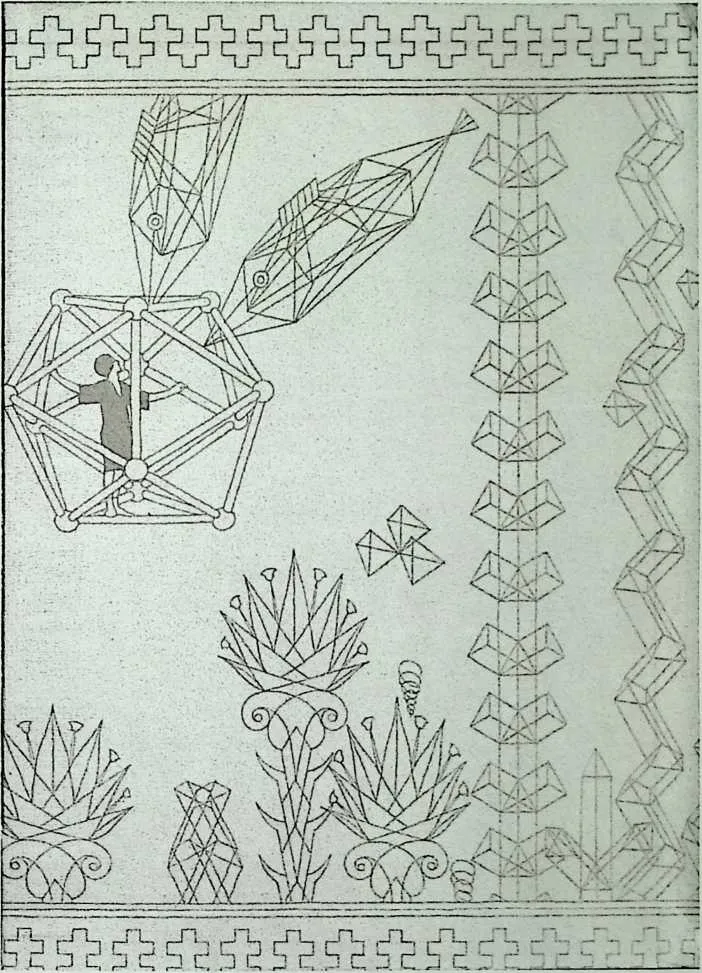
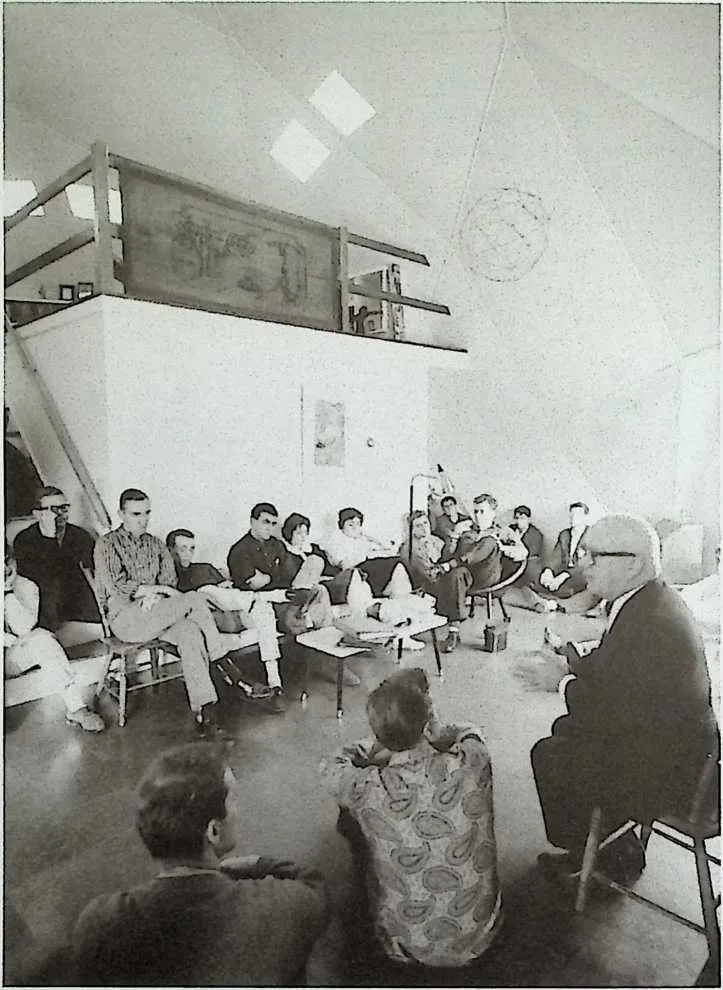
85 allegorical figure of Sinbad, who represented the creative artist, taking shelter in an icosahedral cage constructed of struts and ball connectors—yet another anticipation of geodesic structures (fig. 7.10). Fuller’s evolving exploration of the structural, cosmological, and aesthetic potential of geometry may have been informed by these drawings or by others that Bragdon exhibited in a 1941 New York gallery show under the title ‘‘Mathematical Abstractions.’’ Fuller even decorated the dome home he and Anne shared in Carbondale, Illinois, with what can only be called projective ornament (fig. 7.11).
87 Figure 7.9
88 Bragdon’s design for an entryway in projective ornament, published in The Frozen Fountain, featured icosahedral and polyhedral lanterns in the soccer-ball form that would come to be known as the ‘‘buckyball,’’ along with patterned glass, curtains, ceiling, and floor. Source: Claude Bragdon, The Frozen Fountain, © 1932 and 1960 by Henry Bragdon. Used by permission of Alfred A. Knopf, a division of Random House, Inc.
90 Figure 7.10
91 The endpaper of The Frozen Fountain featured Sinbad, an allegorical figure representing the architect or artist, taking shelter in an icosahedral ball-and-strut shark cage. Source: Claude Bragdon, The Frozen Fountain, © 1932 and 1960 by Henry Bragdon. Used by permission of Alfred A. Knopf, a division of Random House, Inc.
92 Despite the great differences in scope between Bragdon’s projective ornament and Fuller’s designs for houses and geodesic structures, there are substantial continuities between these two bodies of work, both of which used geometry to translate a four-dimensional sumptuary ethos into design. Fuller’s commitment to geometry for a combination of structural, planning, and aesthetic reasons was based on its potential for effectiveness in rationalizing production and consumption through the liberal mechanisms of
94 Figure 7.11
95 Fuller hosting students inside his Carbondale dome home in 1961, with a polyhedron projection ornamenting the ceiling.
96 Source: Special Collections, Stanford University Libraries.
97 democratic polity and a market economy. From 1928 his work combined a technocratic commitment to efficiency and planning with an architectural tradition of sumptuary regulation through ornamental pattern. By synthesizing these strategies through geometry in the 4D house, Fuller aimed to show how the industrialization of housing could discipline selfish consumption and so ‘‘validate the libertarian principle without recourse to the temporary efficiencies of dictatorship.’’53