
11 Backyard Landing: Three Structures by Buckminster Fuller
2Maria Gough
3 ‘‘Let me first congratulate you on the perfectly splendid showing at the Museum of Modern Art,’’ enthused Time magazine’s architectural critic Cranston Jones in a letter to R. Buckminster Fuller of September 23,1959. ‘‘Space structures for the twentieth century never looked better than in the sculpture garden.’’1 The critic was referring to Three Structures by Buckminster Fuller (fig. 8.1), which had opened the day before and would run for more than a year without anybody quite intending, finally closing in November 1960. Installed on what was then an empty lot adjacent to the museum’s sculpture garden, the exhibition comprised demonstration models of three spectacular structures: the Octet Truss, Tensegrity Mast, and Geodesic Rigid Radome. Common to all three was a stability derived from geometry rather than mass; this geometry was based on triangulation rather than on the square or the cube, the Bauhausian building blocks that Fuller reputedly despised.
4 While Three Structures was not Fuller’s first engagement with MoMA’s empty lot—his unusual Dymaxion Deployment Unit had appeared there in 19392—it was nevertheless the museum’s largest ever commitment of space and time to the exposition of his work. This commitment came at an important transitional moment in Fuller’s career. With considerable commercial success to his name, due to military and government contracts in the 1950s, Fuller was now searching for potential applications for the three exhibited structures. It was also an important moment in the life of the museum’s Department of Architecture and Design, the critical orientation of which was undergoing a pluralization if not a sea change with a newly appointed young director, Arthur Drexler, now at the helm. Having been a major institutional propagandist for modernist architecture ever since its first director, Philip Johnson, collaborated with Henry Russell Hitchcock on the groundbreaking International Exhibition of Modem Architecture in 1932, the MoMA department was now beginning to move in new directions.
5 Despite the historical significance of Three Structures for the designer and the museum alike, the exhibition has never been revisited. Drawing predominantly
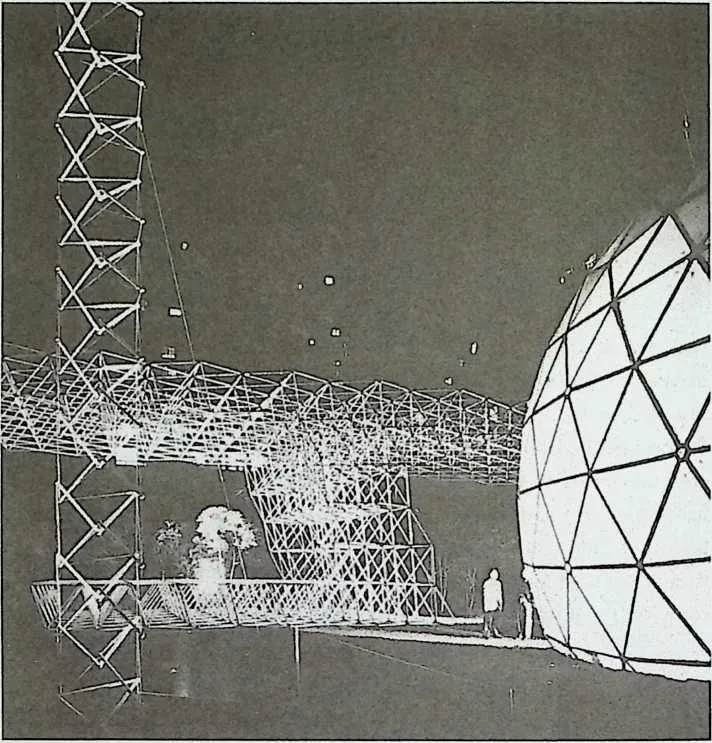
7 Figure 8.1
8 View of Three Structures by Buckminster Fuller, Museum of Modern Art, New York, 1959–60.
9 Source: Special Collections, Stanford University Libraries.
10 on archival materials, I examine MoMA’s mediation of public understanding of Fuller’s design science with respect to two major problems. First, I address the ways in which Three Structures reconceptualized function, a crucial issue in the study and practice of modern architecture and design, within a new discourse of futurity. Second, I take up the complex problem of authorship in Fuller’s enterprise by foregrounding the existence and significance of a much less well known exhibition, Buckminster Fuller: Supplementary Exhibition of Models, Photographs, and Drawings. Also held at MoMA in 1959, this companion exhibition thickened the plot of Three Structures by including the work of Fuller’s collaborators and former students.
11.1 I
11For a couple of decades at mid-century, the Museum of Modern Art ran an innovative exhibition program right in its own backyard, inviting major architects and designers to build full-scale demonstration models of current projects. The hope was that by affording visitors direct, phenomenological experience of built forms, the museum would facilitate greater popular understanding of architectural space than that provided by photographs, drawings, and scale models alone.3 One of the first projects, an elegantly functional modernist house for a suburban middle-class family, was designed in 1949 by Marcel Breuer, an expatriate Hungarian architect with the impeccable Bauhaus credentials most prized by the department’s then directors, Johnson and Peter Blake. Functionality and the potential for immediate application were major curatorial concerns: ‘‘Had MoMA commissioned …[Buckminster] Fuller …to design such a house,’’ Blake later mused, ‘‘critics would have accused it of being …out of touch with reality.’’4 Thriving in the interstices of architecture, engineering, geometry, philosophy, and neologism, Fuller was too far out for such a mainstream brief. Yet, just ten years after Breuer’s house in the garden, Fuller was busy on the very same midtown site.
12 If Johnson and Blake had foregrounded the functionality and feasibility of Breuer’s demonstration model, Drexler considered the function of Fuller’s structures in a much more open-ended, speculative fashion. According to a press release issued a month before the opening, the purpose of Three Structures was ‘‘to illustrate the extraordinary strength and lightness of Mr. Fuller’s method of construction which utilizes the forces of tension and compression in an unconventional way and which may in time change the appearance and character of our buildings.’’5 As such, Three Structures showcased neither specific functions nor even buildings but rather new structural systems and construction methods that seemed to promise the future of architecture. Drexler’s introductory label informed exhibition visitors that Fuller ‘‘believes that the designer’s real responsibility no longer is the creation of individual buildings or objects, but rather …the interrelating of physics, mathematics, and [humanity’s] well-being.’’6
13 Designed especially for the exhibition, Fuller’s super-scaled one-hundred-foot-long, thirty-five-foot-wide, and twenty-four-foot-high space frame dominated the MoMA site (fig. 8.2). The arrangement of its gold anodized aluminum tubes into octahedrons (eight-sided figures) and tetrahedrons (four-sided figures) lent the structure its invented name, Octet Truss. From a single off-center support, the truss cantilevered sixty feet in one direction and forty in the other. Drexler alerted visitors to the fact that the Octet Truss was ‘‘not an actual ‘building’ ’’ and thus had no specific function as such. Nevertheless, he continued, ‘‘its structural principle can be used wherever it is necessary to make large uninterrupted roofspans: concert halls, factories, museums, train sheds,
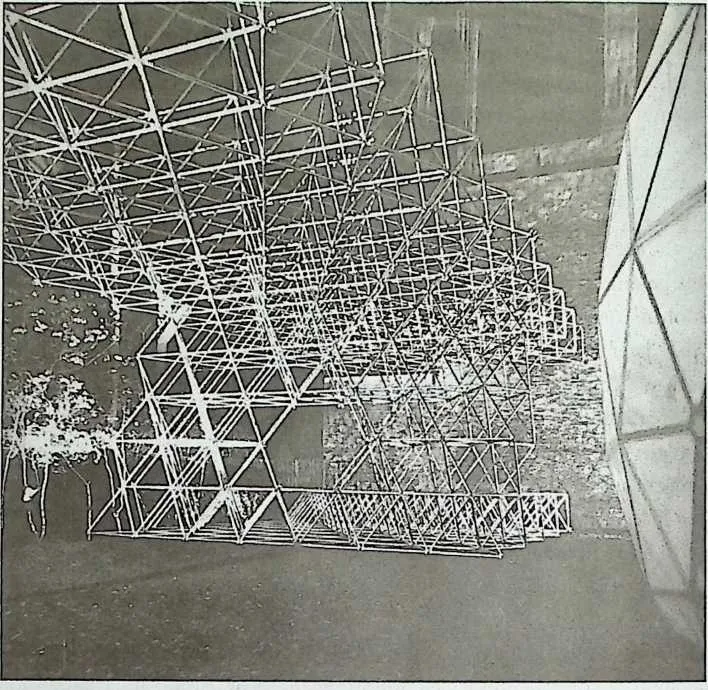
15 Figure 8.2
16 R. Buckminster Fuller, Octet Truss, Museum of Modem Art, New York, 1959–60. Photo by Alexandre Georges. Source: Special Collections, Stanford University Libraries.
17 airplane hangars.’’ Furthermore, ‘‘the nature of [its] structural system suggests that we may ultimately learn how to ‘weave’ enormous buildings that will differ in every way from what we now call architecture.’’
18 Also designed especially for the exhibition was the Tensegrity Mast (fig. 8.3), a thirty-six-foot
tower of aluminum tubes and thin monel rods that demonstrated a novel structural system of
discontinuous compression and continuous tension. Whereas in the truss the aluminum tubes
handled both tensile and compressive forces, in the mast these same tubes carried
exclusively those of compression, with tensile forces residing in its remaining members. The
compression members thus became small islands in a sea of tension, as Fuller liked to put
it. (The term tensegrity was a neologism he formed by contracting his original term
for the system, ‘‘tension-integrity’’) The startling achievement of the discontinuous
compression-continuous tension system was its suspension of rigid elements in space by means of
tension alone. ‘‘Although each unit appears to be carrying the one above it,’’ Drexler wrote,
‘‘they are more accurately described as holding each other apart.’’7 (Popular reports
re
peatedly described the mast as an engineer’s version of the Indian rope trick.) While the
Tensegrity Mast had ‘‘no practical application,’’ it was, Drexler asserted, ‘‘theoretically possible
to use this system in construction building of enormous scale.’’8
19 The third structure was a fifty-five-foot diameter greenish-yellow translucent plastic and fiberglass Geodesic Rigid Radome (fig. 8.4), a special-case iteration of the dome structure with which Fuller was to become ubiquitously associated. The radome was assembled by bolting adjoining panels together so that skeleton and skin were one. Of the three structures on display, the Geodesic
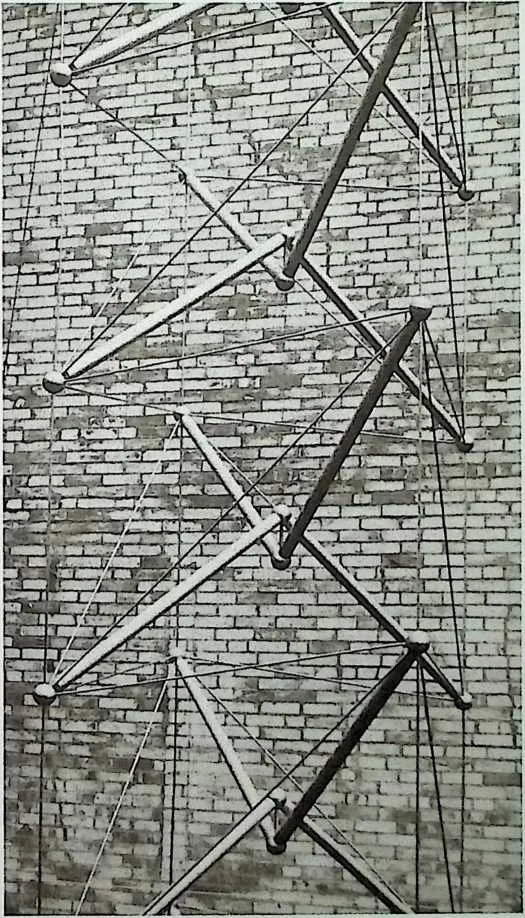
21 Figure 8.3
22 R. Buckminster Fuller, Tensegrity Mast, Museum of Modem Art, New York, 1959–60. Photo by Alexandre Georges. Source: Special Collections, Stanford University Libraries.
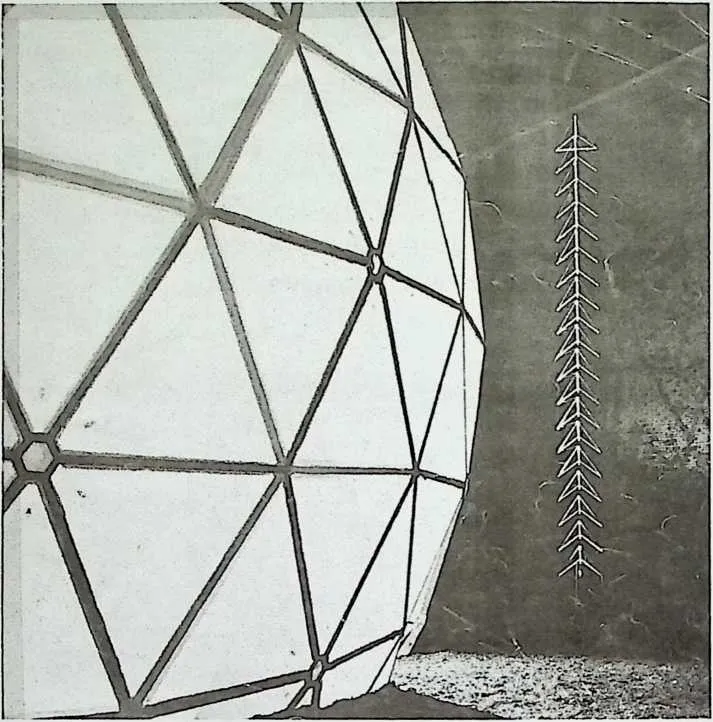
24 Figure 8.4
25 R. Buckminster Fuller, Geodesic Rigid Radome, Museum of Modem Art, New York, 1959–60.
26 Photo by Alexandre Georges. Source: Special Collections, Stanford University Libraries.
27 Rigid Radome was the most controversial with respect to function. Drexler’s wall text noted that ‘‘this particular dome is used to house radar installations on the Artic Distant Early Warning Line,’’ where it withstands Artic winds of up to two hundred miles an hour despite weighing only twelve hundred pounds.9 The DEW Line was a vast radar surveillance system built in the 1950s and stretching three thousand miles from the northwest coast of Alaska to the eastern shore of Baffin Island opposite Greenland, whose purpose was to warn Canada and the United States of impending air strikes from the Soviet Union. The great success of this and other military applications of the radome played a crucial role in the development of Fuller’s design science because government royalties provided the polymath with substantial means to fund other, more speculative projects: According to Yunn Chii Wong, the radome was the most profitable of Fuller’s dome enterprises, earning the designer an estimated two million dollars in royalties between 1954 and 1961.10 But Drexler was not especially concerned with the radome’s historical function as a defensive weapon of the cold war nor with how it had helped to advance Fuller’s career. Instead, he emphasized the radome’s potential future in the form of, for example, ‘‘TV. studios, ball park coverings, swimming pools, houses, [and] bomb shelters,’’11 thereby realigning it with the as-yet-unrealized functional potential of the other two structures on display.
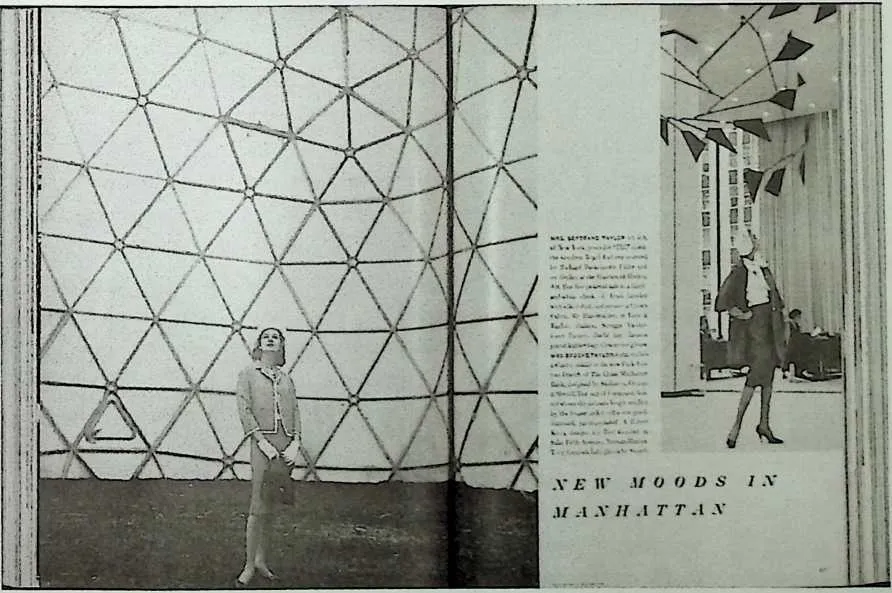
28 On the MoMA lot the radome came to fulfill a variety of more modest functions, such as an outdoor shelter for the museum’s annual Children’s Carnival, and as the location for a Town & Country magazine fashion shoot in which the New York philanthropist Mrs. Bertrand Taylor III sported a Handmacher suit, Lilly Dachhat, Crescendoe gloves, and a Lennox patent leather bag (fig. 8.5).12 During the winter of 1959–60 the radome also served as an unheated studio workshop for the Swiss artist Jean Tinguely’s preparation of Homage to New York, a one-time performance event that took place in MoMA’s garden in March 1960 (fig. 8.6). Involving as it did Tinguely’s laborious construction of an elaborate junk machine that then destroyed itself during the performance, this last usage was particularly choice: nothing could be more antagonistic to Fuller’s optimistic technophilia than Tinguely’s nihilistic Homage. At one point Drexler even proposed using the radome as a screening
29 Figure 8.5 ‘‘New Moods in Manhattan.’’
30 Source: Town and Country Magazine, March 1960.
32 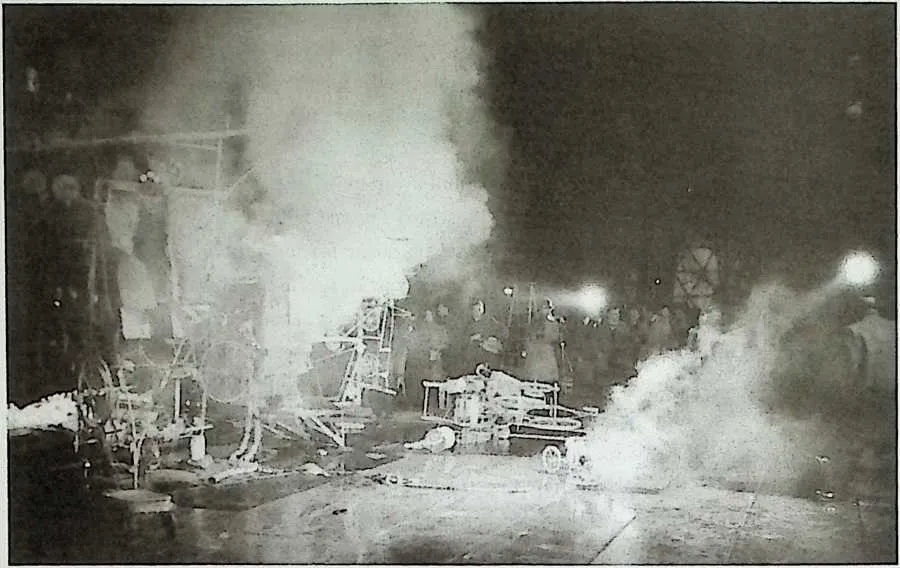 room for Charles and Ray Eames’s film Glimpses of the USA, which had made a
big splash in Moscow just the previous summer when it was projected in one of the
U.S. pavilions, an aluminum Fuller dome. Such elasticity of function was embraced by Fuller for
both philosophical and pragmatic reasons. But these sundry functions in MoMA’s
backyard were largely serendipitous and coincidental to Drexler’s deeper curatorial
purpose.
room for Charles and Ray Eames’s film Glimpses of the USA, which had made a
big splash in Moscow just the previous summer when it was projected in one of the
U.S. pavilions, an aluminum Fuller dome. Such elasticity of function was embraced by Fuller for
both philosophical and pragmatic reasons. But these sundry functions in MoMA’s
backyard were largely serendipitous and coincidental to Drexler’s deeper curatorial
purpose.
33 Figure 8.6
34 Jean Tinguely, Homage to New
35 York, Museum of Modern Art, 1960.
36 Fuller’s Geodesic Rigid Radome is visible in the right background. Source: Special Collections, Stanford University Libraries.
37 A sense of Drexler’s purpose may be gleaned from the exhibition’s catalog, Three Structures by Buckminster Fuller in the Garden of the Museum of Modern Art, New York (fig. 8.7), which consists of a single sheet measuring thirty-six inches by twenty-four inches. Folded in half lengthwise and then again in three, the sheet provides six twelve-inch square pages for the reproduction of installation shots by the architectural photographer Alexandre Georges, elevation drawings and photo collages by Fuller, and commentary by Drexler. In its very design, this slim catalog thus tropes the modularity, seriality, and less-is-more ingenuity of the structures it accompanied. What is most interesting about the catalog is not so much Drexler’s commentary, which was recycled from his wall texts and other exhibition-related publicity, but his selection of installation photographs. Georges had taken both day and night shots of Three Structures, but it is his spectacular night photographs that have the lion’s share of space in the catalog.
38 If one unfolds the catalog fully, the entire verso of the sheet consists of a single nighttime mise-en-sc&ne, in which a suited man is staged within the space of the exhibition (fig. 8.8). The dramatic contrast of raking light and deep shadow at firsts suggests film noir. Unlike a film noir character, however, the solitary figure does not lurk in the shadows but stands directly in the path of the light flooding from the dome, which glows like a giant silkworm, rendering the true genre of this scene science fiction. Standing just outside the dome’s entrance, the man contemplates the superskeleton cantilevering overhead, which casts a geometric maze of shadows on the apartment building across the road. Spotlights punctuate the darkness; trees are ablaze with tea-lights. Henri Matisse’s bronze Backs retreat to dark slabs on the rear wall. A modest wooden fence and gate is all that separates this would-be film set from 54th Street, which fronts MoMA’s backyard as it existed then. Georges’ architecture of the night withdraws the radome from the cold war reality that had fostered its production in order, instead, to spectacularize Three Structures as science fiction.
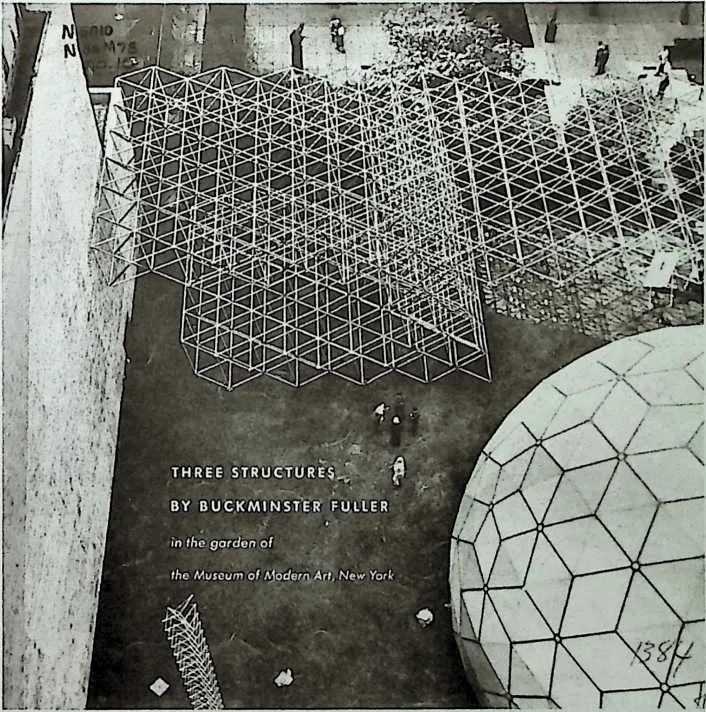
40 Figure 8.7
41 Front cover of Arthur Drexler, Three Structures by Buckminster Fuller (New York: Museum of Modern Art, 1960). Source: Special Collections, Stanford University Libraries.
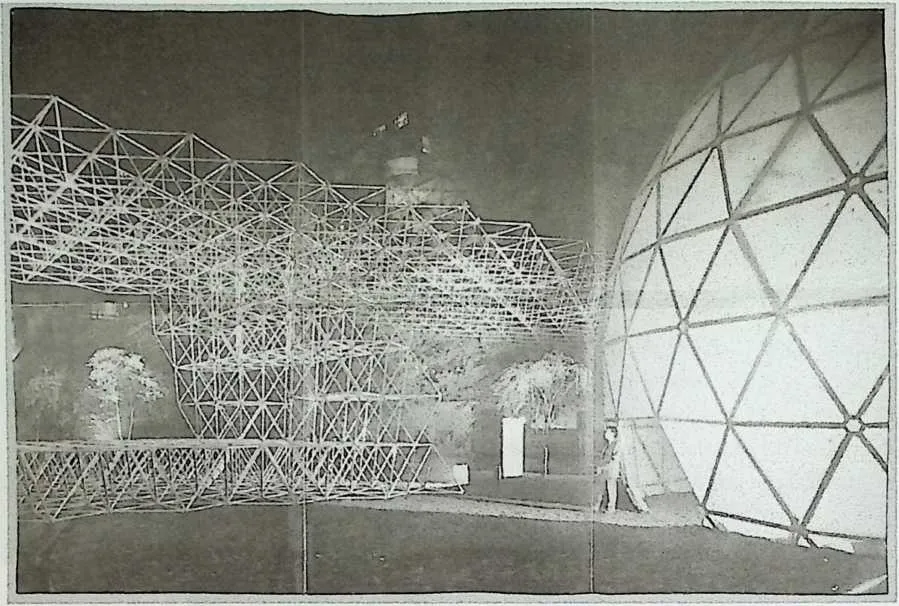
43 Figure 8.8
44 Verso of unfolded Three Structures by Buckminster Fuller exhibition catalog (New York: Museum of Modem Art, 1960).
45 Photo by Alexandre Georges.
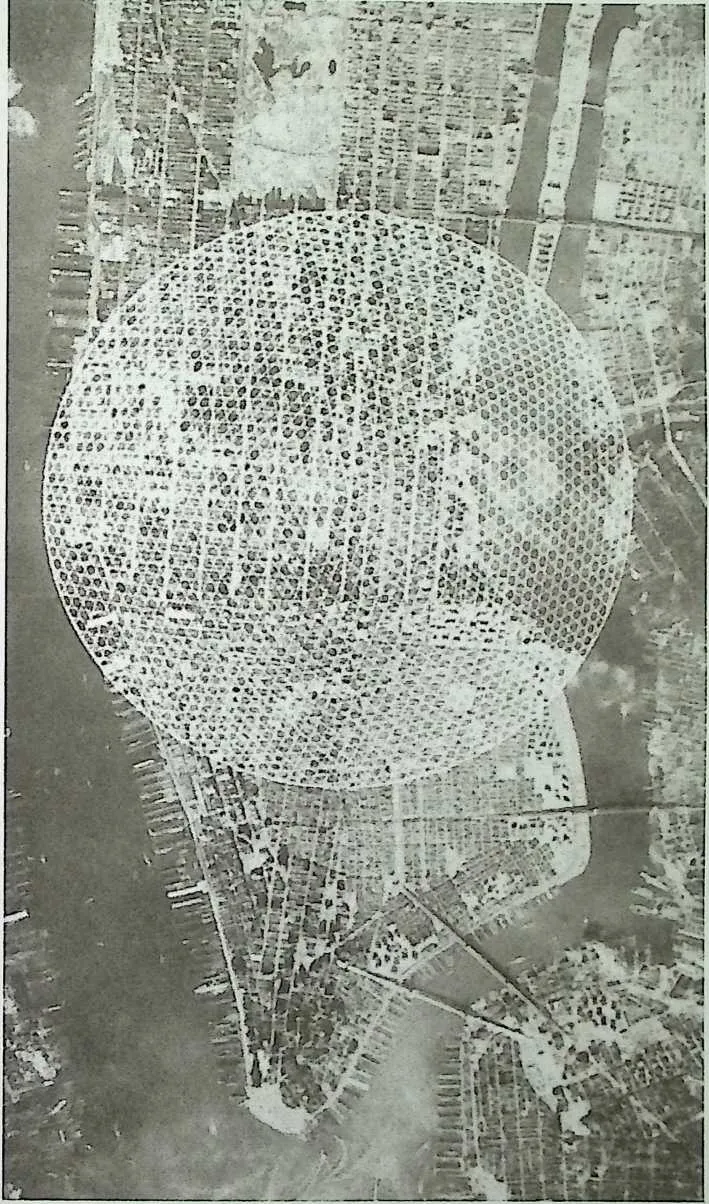
46 Staging the scene of the exhibition as sci-fi fantasy was not idle speculation on the photographer’s part but rather a prescient interpretation of Fuller’s then-contemporary concern to relaunch the geodesic dome, already a leading protagonist within the military and trade-fair circuit, within a new discourse of futurity. The designer’s ‘‘future [dome] projects include sky islands for use as launching platforms for missiles, underwater islands as bases for submarines, oil drillers for oceanographic surveys,’’ the museum’s publicity informed the press. ‘‘Domes might also be used to enclose whole cities on earth or the moon,’’ read the wall text.13 Fuller’s most fantastic projection along these lines was the Manhattan Island Dome, which he was working on in 1959, concurrently with the preparation of Three Structures. Fuller presented his idea of superimposing a two-mile-wide geodesic dome over part of Manhattan in a photo collage (fig. 8.9) that had a prominent place in the supplementary exhibition14 and was also reproduced in the catalog for Three Structures with the following caption: ‘‘The plan of a dome superimposed on part of Manhattan Island illustrates a possible use for large-scale structures. By enclosing so great an area it would become possible to dispense with much weatherproofing and protection now necessary for individual buildings. A dome of this size might be constructed
48 Figure 8.9
49 R. Buckminster Fuller, Manhattan Island Dome, ca. 1959.
50 & Estate of R. Buckminster Fuller. All rights reserved. Used by permission. Source: Special Collections, Stanford University Libraries.
51 on the principle of the tensegrity mast, the tubes and rods being arranged in a configuration resembling that of the octet truss.’’15 Glossed as such, the Manhattan Island project was presented to visitors as a fantastic summa of the three demonstration structures rolled into one.
52 ‘‘Looking far ahead, the museum visualizes a fantastic new world,’’ reported Ada Louise Huxtable, the New York Times architectural critic, who quoted Drexler at length in her review of Three Structures: In Fuller’s hands ‘‘buildings might no longer be a series of separate boxes with people moving from one to another,’’ the curator had asserted. ‘‘The infinite clear spans suggest a new kind of shelter—vast domes enclosing entire communities, permitting continuous control of the environment. In effect, the city would be one building, with its necessary functions accommodated quite differently than they are today. We could climate control and reclaim whole areas of the Sahara, or of the Artic.’’16 Over the next few years Fuller proposed a series of megastructures spinning off from the Manhattan Island dome, such as giant spheres one mile in diameter in which thousands of people would travel around the world, occasionally anchoring themselves atop mountains (Cloud Nines [1961]) and a giant floating tetrahedron that could be anchored anywhere its inhabitants chose (Tetrahedronal City [1965]).17
53 That the curatorial purpose of Three Structures was in part to present Fuller as a futurist rather than a functionalist is further supported by the fact that Drexler sought to include the designer in Visionary Architecture, an international group show on which he was working contemporaneously with his organization of Three Structures.'8 In a ‘‘long overdue’’ letter of February 1960 to Fuller’s company, Synergetics, Inc., Drexler returned to the subject of the proposed Visionary Architecture exhibition, which he had first raised ‘‘many months ago.’’ His ambition was ‘‘to call attention to a kind of underground history of architecture.’’ To this end ‘‘projects [would] be selected on the basis of their being unbuildable? whether owing to technical difficulties or to the absence of a ‘‘social program to justify the architect’s vision.’’ Drexler argued that it was the ‘‘inability to define what would be socially desirable, let alone facilitate it’’—and not technical limitations per se—that had prevented twentiethcentury visionary projects from coming to fruition.19
54 Like his predecessors in the department, Drexler sought to encourage the museum visitor’s
phenomenological experience of architectural form but, in this case, of the unbuildable kind: ‘‘I
would like to end the exhibition with a model so large that the public can walk through it. Such
a model would occupy roughly a space 22 feet square. The floor or ground level of the
model would be at chin height and the public would walk through a narrow trench. It
might
thus be possible to create the illusion of enormous distances and give to even the most visionary
of projects a kind of Alice-in-Wonderland quality.’’ Drexler welcomed suggestions from
Synergetics as to how to accomplish this full-scale model of the unbuildable, providing their
suggestions were ‘‘what the uninitiated would call crazy.’’ He closed his letter with an apposite
reference to Three Structures as ‘‘the vision in our garden.’’20
11.2 II
56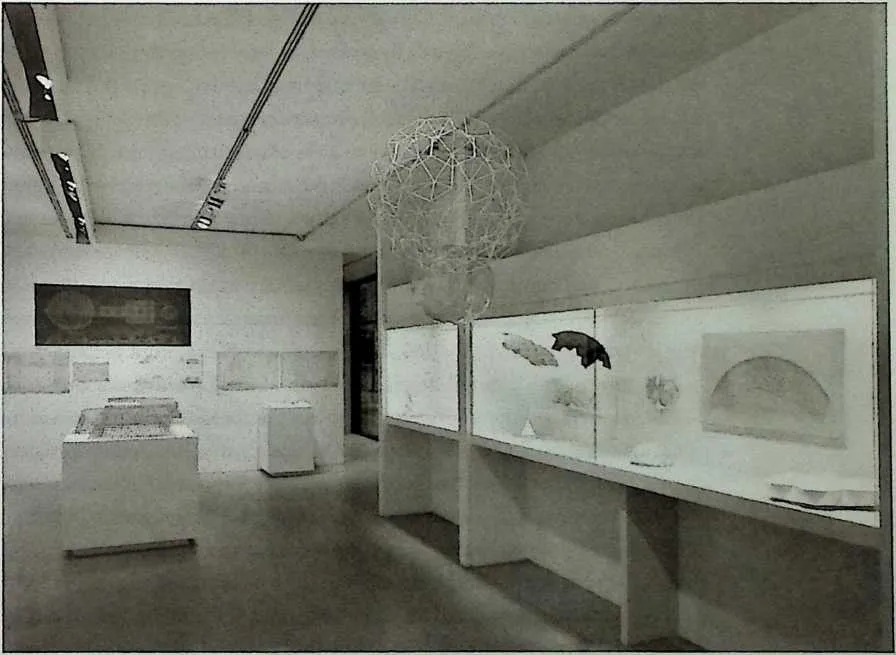 Buckminster Fuller: Supplementary Exhibition of Models, Photographs, and Drawings
opened on October 28, 1959, in the MoMA’s Far West Gallery and closed a little shy of a month
later on November 23, 1959 (fig. 8.10). Also curated by Drexler, the exhibition was designed by
the department’s assistant director, Wilder Green. Fuller seems not to have been directly
involved in its organization, at least not personally, since he requests information about it from
the museum’s publicity director: ‘‘I am eager to hear about and receive photographs and
mimeographs of the room inside the Museum being organized with models, etc., of the work of
my associating companies and individuals,’’ he writes on October 21, 1959.21 No checklist of the
exhibition appears to have survived, but an excellent sense of its contents may be derived from
some ten installation photographs by Kenneth Snelson that are preserved in the museum’s
archives.22
Buckminster Fuller: Supplementary Exhibition of Models, Photographs, and Drawings
opened on October 28, 1959, in the MoMA’s Far West Gallery and closed a little shy of a month
later on November 23, 1959 (fig. 8.10). Also curated by Drexler, the exhibition was designed by
the department’s assistant director, Wilder Green. Fuller seems not to have been directly
involved in its organization, at least not personally, since he requests information about it from
the museum’s publicity director: ‘‘I am eager to hear about and receive photographs and
mimeographs of the room inside the Museum being organized with models, etc., of the work of
my associating companies and individuals,’’ he writes on October 21, 1959.21 No checklist of the
exhibition appears to have survived, but an excellent sense of its contents may be derived from
some ten installation photographs by Kenneth Snelson that are preserved in the museum’s
archives.22
57 Figure 8.10
58 View of Buckminster Fuller: Supplementary Exhibition of Models, Photographs, and Drawings, October–November 1959.
59 Photo by Kenneth Snelson. Used by permission. Source: Special Collections, Stanford University Libraries.
60 The supplementary exhibition served to contextualize Three Structures in important ways. First, it situated Fuller’s ‘‘vision in the garden’’ within the overall trajectory of his work. To shed light on the designer’s inventions before the advent of the geodesic dome in the late 1940s, Drexler displayed the aluminum and plastic scale-model of the Fuller house (a.k.a. Dymaxion Dwelling Machine, Wichita, Kansas [1944–46]) from the museum’s permanent collection, along with photographs of, for example, his three-wheeled Dymaxion car. A number of wood, plastic, and paper models pertaining to Fuller’s explorations in the realm of geodesic geometry in the late 1940s and 1950s, like the Wooden Hex Pent Trussed Geodesic Sphere, were suspended from the ceiling or arrayed in vitrines. Documentary photographs showed earlier incarnations of the geodesic dome, such as the cardboard version designed for the Marine Corps, and of the Octet Truss, the structural system of which had first been used (though covered) in 1958 in the Union Tank Car Company dome in Baton Rouge. The Octet Truss was itself represented by a scale model, while one potential application of its principle was suggested by an intricate wooden model of a proposed Airplane Hangar (1955, visible in the left middle-ground of fig. 8.10). The photo collage for the Manhattan Island Dome project enjoyed its own wall.23 Another section of the gallery documented the process of constructing the demonstration structures on display outside. Overall, the Far West Gallery gave the visitor a much broader understanding of Fuller’s purpose in Three Structures than that afforded by the outdoor show alone.
61 Second, and controversially, the supplementary exhibition drew attention to the extent to which Fuller’s process of invention was a collaborative one. As Alex Soojung-Kim Pang writes, ‘‘No inventor works without collaborators or in isolation from society.’’ Despite the myth of the lone inventor on which Fuller’s reputation thrived, his inventions were produced within a ‘‘network of consulting firms, industries, and universities that provided him with projects, resources, and labor.’’24 In the organization of Three Structures Drexler was fully aware of this network. For example, in a letter to J. A. Vitale regarding the loan of the radome to the museum, Drexler confirmed that ‘‘signs in the exhibition and attendant pubhcity releases will bear the information that the radome structures were developed and tested by MIT Lincoln Laboratory for the U.S. Air Force.’’25 True to his word, Drexler saw that all the exhibition publicity for Three Structures mentioned the constitutive role of Lincoln Labs in moving Fuller’s design off the drawing board and into production. Similarly, Drexler acknowledged that the Canadian company Aluminum Limited, who had acted as consulting engineers for the Octet Truss, had ‘‘contributed’’ or ‘‘co-sponsored’’ its design, while the Tensegrity Mast, he informed visitors, was ‘‘built’’ by Shoji Sadao and (the lighting designers) Edison Price, Inc.
62 But the matter of collaboration in Three Structures was more complex than merely one of fabrication. By the time of the exhibition, the proper name Fuller referred as much to a corporation as to an individual. Headquartering his operations in Long Island, Fuller had opened franchises (‘‘Fuller Research Foundations’’) in Chicago, Detroit, Montreal, and North Carolina by the early 1950s, and in 1954 he had created two companies, Synergetics, Inc., which handled civilian contracts, and Geodesics, Inc., which took care of military and government contracts (the latter became Geometries, Inc., in 1956). But the franchises and companies, to which Fuller typically granted nonexclusive licenses in exchange for royalties, were staffed primarily by his former students, who were not always properly credited for their often fundamental role in his design innovations. Intellectual property disputes, disappointments, and disillusionments abounded.26
63 Three Structures was no exception on this front. Fuller had taken careful measures to protect his intellectual property by applying for patents for each of the structures on display. His patent for the geodesic dome had been granted in June 1954, while his applications for the Octet Truss and the Tensegrity Mast were still pending at the time of the exhibition (the latter applied for as late as August 1959, just a month before Three Structures opened). In the meantime Fuller buttressed his claims to priority of invention by linguistic means, developing the art of neologism to an unprecedented degree. (In this regard Fuller’s case completely substantiates a theory of invention as but an act of naming.) But Fuller’s recourse to patent law and his facility for neologism did not prevent informal challenges to his assertion of intellectual property over the three structures on the MoMA lot. For example, we know from Drexler’s correspondence with the two leading principals of the Raleigh branch of Synergetics—James W. Fitzgibbon and Thomas C. Howard—that the company was intimately involved with the installation of the Octet Truss.27 There were those who believed that Howard should have been credited not only with the installation of the MoMA demonstration model, however, but also with its very ‘‘conception.’’28 Sadao, for his part, once claimed that he was the ‘‘co-designer’’ (with Fuller) of the Tensegrity Mast, not merely its fabricator.29 More recently, Bernie Kirschenbaum (formerly of Geometries) has asserted that Fuller made a ‘‘grievous omission’’ in failing to credit Kirschenbaum and William Wainwright (a principal at Geometries) with the MoMA radome.30 According to Wong, most of Fuller’s collaborators have claimed that he did not play a major role in the development of the radome’s prototype; according to Wainwright, Fuller once even told his own patent lawyer: ‘‘I don’t know if this is a Bill Wainwright radome or a Bucky Fuller radome or what it is.’’31
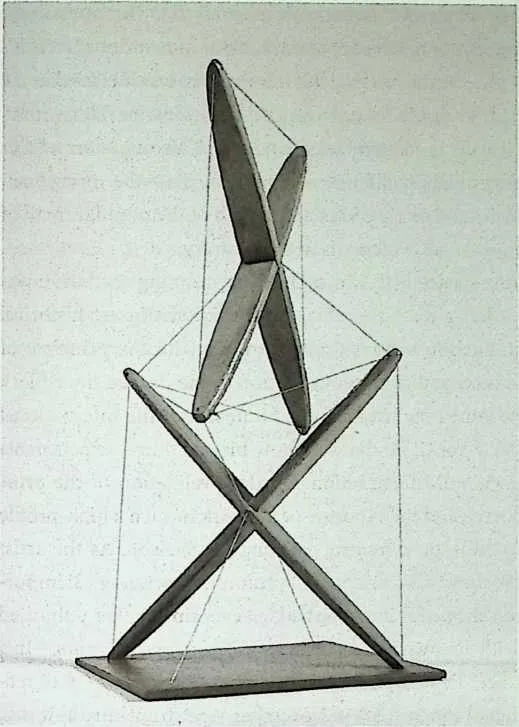
64 Whatever their individual merits, the existence of such claims foregrounds the complexity of the problem of authorship with respect to Fuller’s design science. In the Far West Gallery Drexler addressed this problem by informing visitors about the vital role of Fuller’s franchises, companies, and former students in both the design and execution of his inventions by including examples of their work, such as a model for an athletic center based on the principle of the Octet Truss, which was labeled ‘‘designed by Synergetics.’’32 But Drexler’s most significant contribution to the problem of authorship was the vitrine he devoted to the contributions of Kenneth Snelson. The presence and function of this vitrine within the Far West Gallery was altogether distinct from the other materials on display there. Though Snelson had been a student of Fuller’s at Black Mountain College, he had never really joined the corporation. Comprising four sculptural articulations of the principle of discontinuous compression and continuous tension, the vitrine concretized in a very material way Drexler’s assertion in his wall text and catalog for Three Structures that it was in fact the young Snelson who had discovered the principle on which Fuller’s Tensegrity Mast was based: ‘‘The principle involved in the tension integrity mast was first discovered by …Snelson in 1949, following his studies at Black Mountain College with …Fuller. The mast in the [outdoor] exhibition is based on the same principle but employs a different configuration of parts.’’ Further on in the same texts he referred to Snelson’s discovery as ‘‘perhaps the most dramatic development to grow out of Fuller’s theories,’’ thereby deftly and tactfully acknowledging also Fuller’s contribution to that discovery.33 At the far left of the vitrine was a Tensegrity Structure (Early Study)—now known as Early X Piece (fig. 8.11)—composed of two rigid members (wooden ‘‘X’’ forms) that are suspended without touching one another for support in a matrix of nylon tension lines. A reconstruction of an original work dating back to 1948–49, it was this model that established Snelson’s priority of invention in Drexler’s mind. Adjacent to it was a model of a Tensegrity Mast and next to that a model of a component part of the latter. At the right was a larger model of a more complex Tensegrity Structural System?*
65 The museum held a press preview the day before the supplementary exhibition opened, at which it released a statement that singled out from among
67 Figure 8.11
68 Kenneth Snelson, Early X-Piece, 1948–49.
69 Photo courtesy of Kenneth Snelson.
70 the ‘‘models illustrating various structural systems developed by Fuller and his students,’’ one Snelson model in particular that was ‘‘similar’’ to the Tensegrity Mast in the garden but ‘‘more dramatic’’ in its demonstration of the tension-compression principle.35 But despite the museum’s publicity efforts, the supplementary exhibition attracted almost no media attention. The sole press references to it seem to be two tiny notices that appeared in the New York Sunday News and the New York Post, and a brief mention in a review of the outdoor exhibition in the St. Louis Post-Dispatch.36 This was in sharp contrast to Three Structures, which was very widely reviewed in everything from art, architectural, engineering, plastics, and metal-industry magazines, to general-interest magazines, to metropolitan and local newspapers. No doubt the indoor exhibition’s short run and much less spectacular appearance had something to do with this disparity. Most of the reviews of Three Structures marvel at the Tensegrity Mast—the New York Times art critic John Canaday calls it ‘‘the star of [the] triple show,’’ while Huxtable deems it ‘‘Mr. Fuller’s most remarkable innovation.’’37 But not a single one of the dozens of reviews or notices about the exhibition mentions Drexler’s attribution to Snelson, despite the fact that this information was included in the publicity materials made available to the press at the preview for Three Structures (though not, it is true, in its press release per se). This omission tells us much about the celebrity function of Fuller within the media—the young Snelson was as yet unknown—and of the enduring strength of the popular myth of the lone inventor, even when all evidence is to the contrary.
71 Notwithstanding the silence with which Drexler’s stunning revelation was greeted in the press, it was a revelation that was to have major art-historical significance. Although Snelson had continued to work with the principle of discontinuous compression and continuous tension in the decade since Black Mountain(while at the same time working as a filmmaker at the International Film Foundation in New York), he did not show his sculptural experiments publicly prior to Fuller’s MoMA exhibition. Drexler’s validation of the principle as Snelson’s discovery, and the exposure of his work in such a high-profile forum as MoMA, proved to be extremely enabling for Snelson. As the artist himself tells it, the 1959 show was a moment of profound psychological importance, helping to redress the betrayal that he had felt ever since Fuller published the principle as implicitly his own in a 1951 issue of Architectural Forum.M In a later letter to the engineer Ren£ Motro, Snelson recalls: ‘‘That moment of recognition at the Museum of Modern Art in November 1959, transitory as it was, was quite fortifying and enabled me to once again pick up my absorbing interest in this kind of structure with the feeling that I was free and on my own.’’39
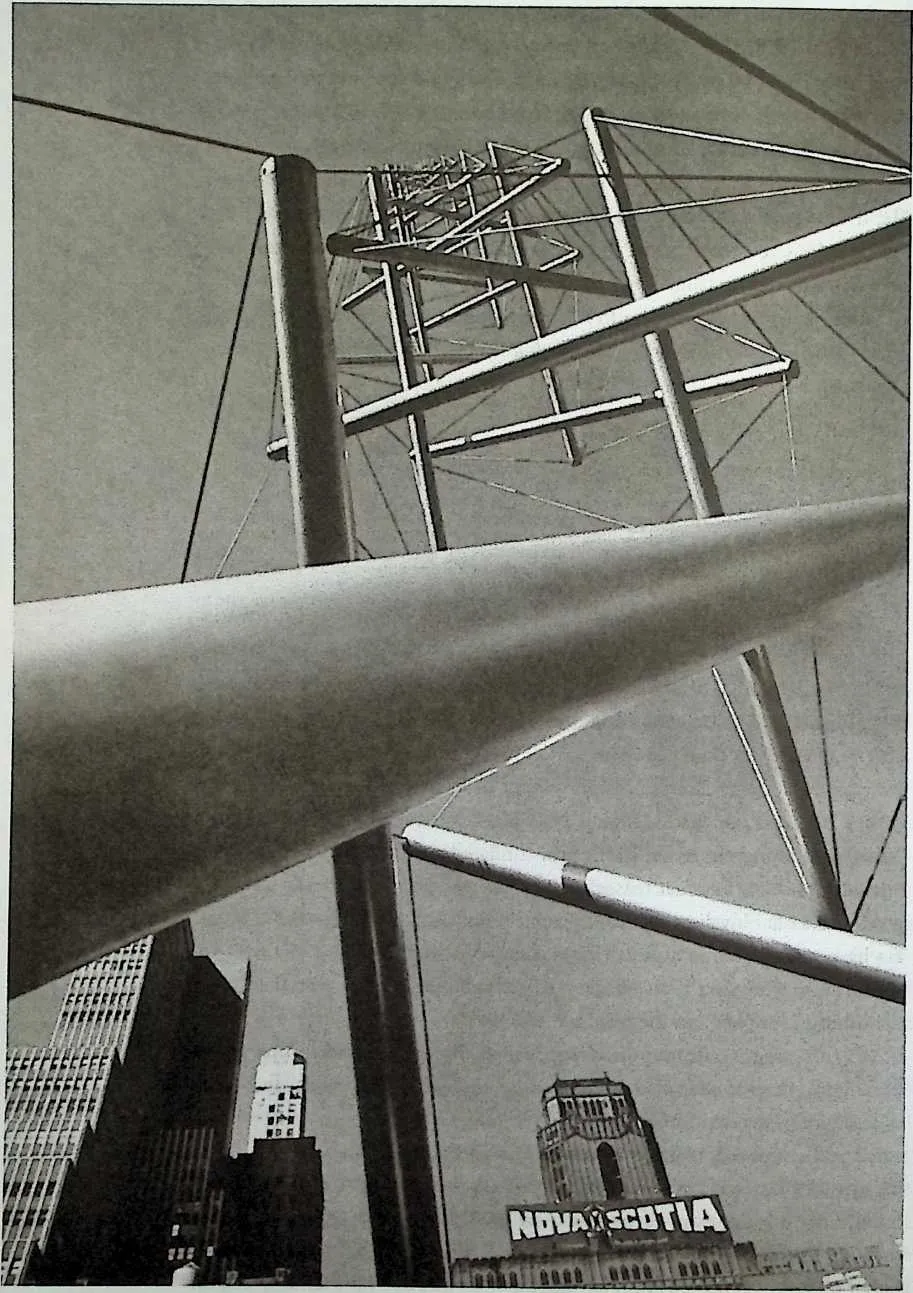
72 Returning to experiment again with the X-module that had been under wraps for the past decade chez Fuller (who favored instead tetrahedronal articulations of the principle), Snelson was able to create modular extension or growth ‘‘along all three axes, a true space-filling system, rather than only along a single linear axis,’’ this last being a major limitation of the MoMA Tensegrity Mast.40 Snelson applied for a patent for his discontinuous-compression and continuous-tension structure in March 1960 (which was granted in 1965), had his first solo show at the Pratt Institute in Brooklyn in 1963, and had a groundbreaking show at the Virginia Dwan Gallery in New York in 1966. In the midst of a very favorable review of the latter for the New York Times, Canaday remarked that ‘‘the large sculptures cry aloud for spots in any open area in the city.’’41 Two years later, as it happened, Snelson mounted a spectacular installation of five superscale floating-compression structures in midtown Manhattan’s Bryant Park (fig. 8.12). (‘‘Floating compression’’ was Snelson’s preferred term in place of ‘‘tensegrity,’’ which he felt ‘‘always sounded …like some rather mealy-tasting
73 breakfast cereal.’’)42 In the present context it is hard to resist seeing Snelson’s spectacle in Bryant Park as also something of a brilliant decade-in-the-making riposte to Three Structures. In any case, what was to be Snelson’s lifelong preoccupation with floating-compression structures was now well under way. ‘‘It is necessary for me to work it out pretty much on my own,’’ Snelson wrote to Fuller in 1972 in the midst of preparing for a series of major European shows, ‘‘ [and] it’s best for me to do this in the framework of the art world which [has] permitted me to squeak under the fence. It is clear this would never have happened in the Science Club.’’43
74 What was Fuller’s response to Drexler’s attribution of the discovery of the tensegrity principle to Snelson? He felt that he had been ambushed:
7677You poisoned Arthur [Drexler] against me amidst a crowd at the opening of my [1959] show at the Museum of Modern Art, when I was so busy answering greetings and questions that I had no opportunity to defend myself against your utterly unexpected attack. You told Drexler that the mast I was exhibiting was yours—it was fabricated by …Shoji Sadao. It was not your sculpture, or a replica of your sculpture. It was the tetra-mast I had invented to show you another realization of the principle. With the crowds around me at the time, I had no time to elucidate to Arthur the facts.44
78 But Fuller fought back by other means. Shortly after Three Structures closed, he published his fullest exposition of the tensegrity principle to date in a 1961 article in Portfolio & Art News Annual.45 Among other things, this article attempted to counter Drexler’s endorsement of Snelson’s assertion of his discovery. Where Fuller had formerly described his tetrahedronal mast as but a ‘‘companion’’ piece to geodesics, he now conflated it with the latter. The upshot of this conflation was that tensegrity was henceforth presented as a theory of geodesics. Fuller loyalists have always upheld this conflation, but various scholars have more recently argued that no such connection existed. Drawing on the testimony of an early collaborator, Duncan Stuart, Wong argues that ‘‘there is nothing immanent in the geodesic experimentation that would lead from or …to tensegrity. Conceptually and technically, they ensued from separate paradigms, despite sharing a common field and geometrical basis. Tensegrity as a theory of geodesic structures is, for all intents and purposes, totally fabricated and employed by Fuller to advance an appearance of cohesiveness to his life-work.’’46 Indeed, in the very same 1961 article Fuller began his practice of backdating his discovery of tensegrity to 1927: ‘‘For twenty-one years before meeting Kenneth Snelson, I had been ransacking the Tensegrity concepts.’’47 Fuller maintained this position for the rest of his life: In a 1982 letter to a Brian
80 Higgins, he wrote bluntly: ‘‘Snelson did not pioneer tensegrity. I did so before [he] was born…All my structures from the Dymaxion House of 1927 and all the geodesic domes are tensegrity structures.’’48
81 Figure 8.12 (opposite) View of Kenneth Snelson’s exhibition in Bryant Park, New York, 1968.
82 Photo by Kenneth Snelson. Used by permission
83 Drawing large crowds and attracting much publicity, MoMA’s Three Structures gave top-drawer museum exposure to Fuller’s visionary reach into the future, thereby laying part of the groundwork for the mainstreaming of his design science for broader public consumption during the 1960s. Organized as it was early in Drexler’s tenure at the museum—he joined the department in 1956 and remained there until his death in 1987—Three Structures also signaled the beginning of a diversification of the museum’s Department of Architecture and Design away from its historically more singularly modernist origins and preoccupations. ‘‘Being …out of touch with reality,’’ as Blake once ventriloquized the critics, was henceforth wholeheartedly embraced. And if a major art-historical significance of the companion exhibition, Buckminster Fuller: Supplementary Exhibition of Models, Photographs, and Drawings, was that it helped to jumpstart another artist’s lifework by opening a psychological and professional space in which he could return to his original exploration of floating compression, on a meta-level it also affirmed the value of the material, and specifically the artistic, object as itself a site of knowledge production. In doing so, the supplementary exhibition challenged Fuller’s paradoxical but deeply rooted ambivalence about the significance of the material world. The issue is not his apparently legendary lack of technical expertise but rather his assumption that the materialization of a structure or an object was essentially secondary to its ideation. Pang puts it well: As far as Fuller was concerned, his students ‘‘had only [ever] built what he had already imagined.’’49 This assumption lay at the root of many of Fuller’s conflicts over authorship, including that with Snelson. Fuller insisted that Snelson’s Early X Piece was but a ‘‘special-case demonstration’’ of a generalized principle for which only he (Fuller) had been searching for decades. In a rambling twenty-nine-page letter of rebuttal to Snelson, which cannibalized his own publications and manuscripts in order to stake out his claim to priority, Fuller wrote: ‘‘No one else in the world but I could have seen the significance I saw’’ in Early X Piece. ‘‘I am confident that the only individual alive in 1949 who could have seen what I saw was myself.’’50 In the Fuller world the polymath’s prior ideation trumped the artist’s discovery through making. By including Early X Piece in the 1959 supplementary exhibition, Arthur Drexler turned this most Fullerian assumption completely on its head.
84 R. Buckminster Fuller
85 A Technocrat for the Counterculture
86 Fred Turner
87 In 1965 R. Buckminster Fuller was seventy years old. Short, plump, bespectacled, and, when he spoke in public, often clad in a three-piece suit with an honorary Phi Beta Kappa key dangling at his waist, Fuller looked like nothing so much as an early twentieth-century plutocrat. When he took the stage, he filled the air with hours of technocratic talk, much of it of his own design. Industry! Technology! The Space Program! Leaping from topic to topic across sentences decorated with his own fabulously recondite vocabulary, Fuller spun a cotton-candy of machine-age dreams. New chemicals, new alloys, and new ways of measuring the ever-more massive output of international industry—like the most visionary corporate executive of the high industrial era, Fuller urged his listeners to imagine a world made good by machinery, management, and design.
88 Yet for all his obvious allegiance to the ideals of the industrial world, Fuller was also a hero to the young members of the American counterculture. Two of his books—Ideas and Integrities (1963) and Operating Manual for Spaceship Earth (1969)—became staples of hippie libraries across America. His lectures became magnets for the young, and his geodesic domes became the preferred housing of many rural communards. In 1968 his writings became the inspiration for the publication that has long been seen as the Bible of the back-to-the-land movement and a signal document of the counterculture, the Whole Earth Catalog. To all those who had wandered off into the plains of Colorado and the hills of New Mexico to build new communities, and to all those who dreamed of making such a move, R. Buckminster Fuller was an inspiration.
89 But why? What was it about this aging designer and engineer that made him so attractive to a movement that ostensibly rejected industry, technology, and the advice of anyone over thirty years old?
90 To answer these questions requires cutting both the American counterculture and R. Buckminster Fuller free from the tangle of myths that have grown up around them. Since the late 1960s, scholars and journalists alike have tended to read the American counterculture in terms set by its proponents at the time. Then and now, analysts have argued that the counterculture represented a collective turn away from the technologies and organizational forms of cold war America. Likewise, thanks in part to his own ability to turn his own life into compelling copy, R. Buckminster Fuller has often been depicted as a sui generis genius, a tinkering autodidact in the tradition of Thomas Edison and Alexander Graham Bell. Yet, despite their respective claims to the contrary, neither Fuller nor the American counterculture emerged entirely outside the orbit of the era’s military-industrial complex. On the contrary, Fuller and his theory of ‘‘comprehensive design’’ offered many in the 1960s a way to embrace the technologies, the technocratic politics and the flexible, collaborative work styles of the cold war military and industrial worlds even as they built their own alternative communities.
11.3 Between Nuclear Holocaust and Consumer Cornucopia
92To make sense of the countercultural turn toward technology and Fuller, we need first to remember that Americans in the 1950s, and especially American children, lived under the imminent threat of nuclear Armageddon. In 1967 social psychologist Kenneth Keniston interviewed a group of young men and women who had taken part in a series of anti-Vietnam War efforts. Hoping to uncover the roots of their activism, he asked them to recall their earliest memories. One young woman described the day an encyclopedia salesman sold her mother volume A of the Encyclopedia Britannica: ‘‘I remember reading it and seeing a picture of an atomic bomb and a tank going over some rubble. And I think I became hysterical. I screamed and screamed and screamed.’’1 This young woman was hardly alone. For those who were children at the height of the cold war, the possibility of a nuclear holocaust felt very real. In elementary school they had been taught to ‘‘duck and cover’’ under their desks if they should happen to see a nuclear flash. They had been shown government-sponsored films in which children their own age sprinted through neighborhoods that had been reduced to atomic rubble, hunting for the local fallout shelter.2 Ever since the Soviet Union had first tested an atomic bomb in 1949, Americans had suffered under a thick cloud of nuclear anxiety. Would the devastation that the Enola Gay had wreaked on Hiroshima somehow visit American cities? Would New York someday look like Nagasaki?
93 By the late 1950s, many Americans had begun to fear that the bomb had become a way of life. The military agenda of the nation at the time seemed to lock adults into a particularly constrained way of life, a way of life that the youth of America would presumably be forced to lead as soon as they grew up. As Elaine Tyler May has pointed out, the dominant social style of the middle and upper classes during the postwar years could be described as ‘‘containment.’’3 Much as military and government planners sought to ‘‘contain’’ communism, the men and women of middle America sought to constrain their emotions, maintain their marriages, and build safe, secure, and independent homes. Like the Air Force soldiers who scanned America’s borders for incoming Soviet bombers, many Americans took to monitoring the boundaries of their own lives.
94 Containment was the order of the day in the workplace as well. For critics on the left in particular, society seemed to be increasingly dominated by pyramidal organizations run by buttoned-down, psychologically fragmented men. ‘‘As the means of information and of power are centralized,’’ wrote the sociologist C. Wright Mills in 1956, ‘‘some men come to occupy positions in American society from which they can look down upon …and by their decisions mightily affect, the everyday worlds of ordinary men and women.’’4 Under the controlling eye of this ‘‘power elite,’’ Mills argued, ordinary Americans found themselves trapped in corridors and offices, unable to envision, let alone take charge of, the entirety of their work or their lives. Ordinary people lacked the ability to ‘‘reason about the great structures—rational and irrational—of which their milieux are subordinate parts,’’ he explained.5 So, too, in a way, did the men at the top. For critics like Mills, both the masters of bureaucracy and their minions suffered from a paring away of emotional life and a careful separation of psychological functions. In the wake of World War II, wrote Mills, rationalization had begun to give rise to ‘‘the man who is ‘with’ rationality but without reason, who is increasingly self-rationalized and also increasingly uneasy.’’6 This man, wrote Mills, was a ‘‘Cheerful Robot.’’7
95 Alongside the twin threats of the bomb and of a stultifying, mechanical adulthood, however, the young Americans of the 1960s also enjoyed an unparalleled level of affluence and, with it, a cornucopia of consumer goods. At one level these goods, too, were part of America’s cold war military tool kit. In 1959, for instance, Vice President Richard Nixon found himself facing down Soviet premier Nikita Khrushchev in a model kitchen at the American Exhibition in Moscow. Nixon proudly told the scowling Khrushchev, ‘‘There are 44 million families in the United States…Thirty-one million families own their own homes and the land on which they are built. America’s 44 million families own a total of 56 million cars, 50 million television sets and 143 million radio sets. And they buy an average of nine dresses and suits and 14 pairs of shoes per family per year.’’8
96 Yet, for the children of the 1950s who would become the rebels of the 1960s, cars, TV sets, and radios also offered an escape from the shadows of the cold war. Teenagers found themselves surrounded by appliances and automobiles and opportunities for education and employment that their parents, growing up in the Depression, could hardly have imagined. As many commentators remarked at the time, this affluence transformed adolescence into a true interregnum between the freedom of childhood and the employment and family demands of adulthood.9 For the ever-increasing numbers of middle- and upper-class youths in particular, adolescence became a time for personal exploration.
97 By the late 1960s, then, young Americans confronted a dilemma. On the one hand, the world of military and industrial bureaucracy and the technologies associated with it threatened to end their lives, either by destroying the earth in a nuclear holocaust or by demanding that as they became adults, young men and women transform themselves into ‘‘Cheerful Robots.’’ On the other hand, however, that same bureaucracy had endowed their lives with all sorts of technologically supported pleasures, including music, television, and travel. Moreover, thanks to the power of postwar industry, the college graduates of the 1960s would have no trouble finding jobs. But would those jobs provide the same sorts of satisfactions that adolescence had offered? Many had their doubts. ‘‘There are models of marriage and adult life, but…they don’t work,’’ recalled the same young woman who had discovered the atom bomb in the encyclopedia. ‘‘There is that whole conflict about being professional, leading a middle-class life which none of us have been able really to resolve. How do you be an adult in this world?’’10
11.4 Comprehensive Design as a Way of Life
99It was with this question in mind that many turned to R. Buckminster Fuller. If the politicians and CEOs of mainstream America were distant and emotionally reserved, Fuller was playful and engaged. And like his young audiences, he displayed a highly individualistic turn of mind and a deep concern with the fate of the species. But it was not simply Fuller’s character that drew his audiences to him. Rather, it was the resolution he offered to the paradox that confronted the young adults of the 1960s. As he moved from university to university, collaborating with college students, giving speeches, and designing new technologies, Fuller exemplified a way of making a living alongside the academy and industry without becoming in any way a bureaucrat. Moreover, his rhetoric and his theories of technology seemed to integrate the most microcosmic aspects of daily life and the most macrocosmic forces shaping human survival. For Fuller, design could be more than a stage of manufacture associated with cold war industry; it could be a world-saving way of life.
100 In a 1949 essay that he later expanded and reprinted in Ideas and Integrities, a volume that circulated throughout the counterculture, Fuller codified that vision as an expression of his own professional goals and beyond them, of a new professional category, the ‘‘comprehensive designer.’’11 In Ideas and Integrities Fuller located the origin of his vision squarely in his personal experience. During World War I, he wrote, he had watched his four-year-old daughter, Alexandra, die of infantile paralysis, in part, he believed, because the family’s home was badly built.12 At the time, he was working as a contractor with the Navy. As a former junior officer, he had seen how, with proper coordination, extraordinary industrial resources could be mustered to solve military problems. In his view his daughter had died directly from a disease but indirectly from a failure to distribute the world’s resources appropriately.13 This conviction grew during World War II and the early years of the cold war, where once again Fuller saw the full scope of industrial production at work, as well as the inequality with which those resources were distributed. In Fuller’s view the natural world was governed by a series of laws that kept it in harmonious balance. In his experience, however, the mid-twentieth-century social world was one in which the material goods created in accordance with those laws were not being evenly distributed and where children were dying as a result. Politicians, generals, corporate leaders—each put the needs of his own organization first when it came to resources. What humankind required, he argued, was an individual who could recognize the universal patterns inherent in nature, design new technologies in accord with both these patterns and existing industrial resources, and see that those new technologies were deployed in everyday life.
101 This individual he explained would be a ‘‘comprehensive designer.’’14 According to Fuller, the comprehensive designer would not be another specialist, but would instead stand outside the halls of industry and science, processing the information they produced, observing the technologies they developed, and translating both into tools for human happiness. Unlike specialists, the comprehensive designer would be aware of the system’s need for balance and the current deployment of its resources. He would then act as a ‘‘harvester of the potentials of the realm,’’ gathering up the products and techniques of industry and redistributing them in accord with the systemic patterns that only he and other comprehensivists could perceive.15 To do this work, the designer would need to be able to access all of the information generated within America’s burgeoning military-industrial bureaucracy yet at the same time remain outside it. He would need to become ‘‘an emerging synthesis of artist, inventor, mechanic, objective economist and evolutionary strategist.’’16 Constantly poring over the population surveys, resource analyses, and technical reports produced by states and industries, but never letting himself become a full-time employee of any of these, the comprehensive designer would finally see what the bureaucrat could not: the whole picture.
102 This vision would allow to him to realign both his individual psyche and the deployment of political power with the laws of nature. If, as so many in the 1960s had begun to suspect, the bureaucrat had been psychologically broken down by the demands of his work, the comprehensive designer would become whole again. Neither engineer nor artist, but always both simultaneously, he would achieve psychological integration even while working with the products of technocracy. Likewise, where bureaucrats applied their power by means of political parties and armies, and in Fuller’s view, thus failed to properly distribute the world’s resources, the comprehensive designer would apply power systemically. That is, he would analyze the data he had gathered and attempt to visualize the world’s needs, now and in the future. He would then design technologies that would meet those needs. The technologies would so reshape the environment within which people worked as to reorganize society itself. This new society would see its resources distributed not in keeping with the demands of politicians but with the natural laws that already kept the world system of nature in balance. Agonistic politics, Fuller implied, would become irrelevant. What would change the world was ‘‘comprehensive anticipatory design science.’’17
103 With the notion of comprehensive design, Fuller offered his readers a way to embrace the pleasures and power associated with the products of cold war industry even as they avoided becoming bureaucratic drones. Moreover, Fuller implied that the reshaping of the individual life and its reorientation around principles of comprehensive design could save not only the individual but the species. As he put it in Ideas and Integrities: ‘‘If man is to continue as a successful pattern-complex function in universal evolution, it will be because the next decades will have witnessed the artist-scientist’s spontaneous seizure of the prime design responsibility and his successful conversion of the total capability of tool-augmented man from killingry [sic] to advanced livingry [sic]—adequate for all humanity.’’18 In Fuller’s view the comprehensive designer not only didn’t need to don a gray flannel suit when he went to work—he actually needed to become an artist and an intellectual migrant. To a generation preoccupied with the fear of becoming lock-step corporate adults, R. Buckminster Fuller offered a marvelously playful alternative, but one that was not mere play. It was a way to preserve the human future.
104 Despite Fuller’s claims to have coined the term in response to his unique biographical conditions—a claim that reinforced the notion that his own life should serve as an example for his readers—Fuller’s vision of the comprehensive designer carried with it intellectual frameworks and social ideals formulated at the core of military research culture. Foremost among these was Fuller’s notion of the world as an information system. In his numerous autobiographical writings Fuller traced the origins of his ideas about the world as a system to his great aunt Margaret Fuller’s involvement with the transcendentalists and especially to his time on board ships—which he considered closed systems—when he was a naval officer.19 Yet his writings also bear the imprint of cold war-era, military-industrial information theory. For Fuller, as for the information theorists of World War II and the systems analysts of later decades, the material world consisted of information patterns made manifest. These patterns could be modeled and manipulated by information technologies, notably the computer. The computer in turn could suffice as a model for the human being.20 After all, while Fuller’s comprehensive designer promises to be psychologically integrated as specialists are not, that integration depends on the designer’s ability to process vast quantities of information so as to perceive social and technological patterns. Fuller’s comprehensive designer is, from a functional point of view at least, an information processor, and as such, as much a descendent of cold war psychology and systems theory as a child of Fuller’s own imagination.21
105 Even Fuller’s seemingly unique work style echoes the collaborative ethos of World War II research. According to Fuller and, later, to his countercultural admirers, the comprehensive designer came by his comprehensive viewpoint only by stepping away from the industrial and military institutions in which specialists had long been trapped. Only the freestanding individual ‘‘could find the time to think in a cosmically adequate manner,’’ he explained.22 By scanning the horizon of specialties and moving from institution to institution, Fuller argued, the comprehensive designer could glean enough information to see the entire ‘‘system.’’ Fuller himself lived according to this ethos: for most of his career he migrated among a series of universities and colleges, designing projects, collaborating with students and faculty—and always claiming the rights to whatever these collaborations produced. By the early 1960s, Fuller was traveling more than two-thirds of every year.23 In his writings Fuller offered his travels as a model of the proper behavior for a comprehensive designer and suggested that such a life was genuinely new. Yet a quick glance back at the laboratories of Los Alamos or MIT’s Rad Lab during World War II would have reminded Fuller’s audiences that interdisciplinary migration and multi-institutional collaboration were key features of the military research world. They were, in fact, the social processes for which cybernetics and systems theory had served as a universal discourse.24 Even as Fuller claimed to be a sui generis intellectual, and even as his audiences celebrated his ideas and his lifestyle as harbingers of the future, Fuller’s allegiance to systems theoretical perspectives, his faith in information as the substrate to experience, and his collaborative work style all carried with them links to the very military-industrial complex that the youth movements of the 1960s claimed to want to overthrow.
11.5 Comprehensive Design and the Politics of Consciousness
107Yet, strangely enough, it was these links that helped make Fuller so attractive to so many at the time. Today, Americans often remember the youth movements of the 1960s as a single mass attack on institutions and cultural styles of cold war America. However, while they did share aversions to the Bomb and to the suburbs, members of those movements tended to adopt one of two quite different postures toward social change. In the early 1960s, alongside the civil rights movement in the South and the free speech movement at Berkeley, students began to organize into a political movement that would become known as the New Left.25 For these activists the key to social change lay in political action. Accordingly, its members formed new parties (such as Students for a Democratic Society, or SDS), staged conventions, issued manifestos and marched against the Vietnam War. If elements within the New Left began to experience forms of solidarity like those they helped to build into the world outside the movement, they did so as an aftereffect of their own organizing. Within the New Left, true community and the end of alienation were usually thought to be the result of political activity, rather than a form of politics in its own right.
108 The reverse was true among what I will call the New Communalist wing of the counterculture.26 If the New Left had grown up out of cold war social struggle, the first stirrings of New Communalism appeared within the artistic bohemias of cold war Manhattan and San Francisco, among the peripatetic Beats, and finally, among the mystics and acid heads of the San Francisco Bay Area in the early 1960s. For the New Communalists the key to social change was not politics but mind. In the 1969 volume that first popularized the phrase ‘‘counter culture,’’ Theodore Roszak spoke for many New Communalists when he argued that the central problem underlying the rationalized bureaucracy of the cold war was not political structure but the ‘‘myth of objective consciousness.’’27 This state of mind, wrote Roszak, emerged among the experts who dominated rationalized organizations and was conducive to alienation, hierarchy, and a mechanistic view of social life. Its emblems were the clock and the computer, its apogee ‘‘the scientific world view, with its entrenched commitment to an egocentric and cerebral mode of consciousness.’’28 Against this mode Roszak and others proposed a return to transcendence and with it, a simultaneous transformation of the individual self and its relations with others:
110111This…is the primary project of our counter culture: to proclaim a new heaven and a new earth so vast, so marvelous that the inordinate claims of technical expertise must of necessity withdraw in the presence of such splendor to subordinate and marginal status in the lives of men. To create and broadcast such a consciousness of life entails nothing less than the willingness to open ourselves to the visionary imagination on its own terms.29
112 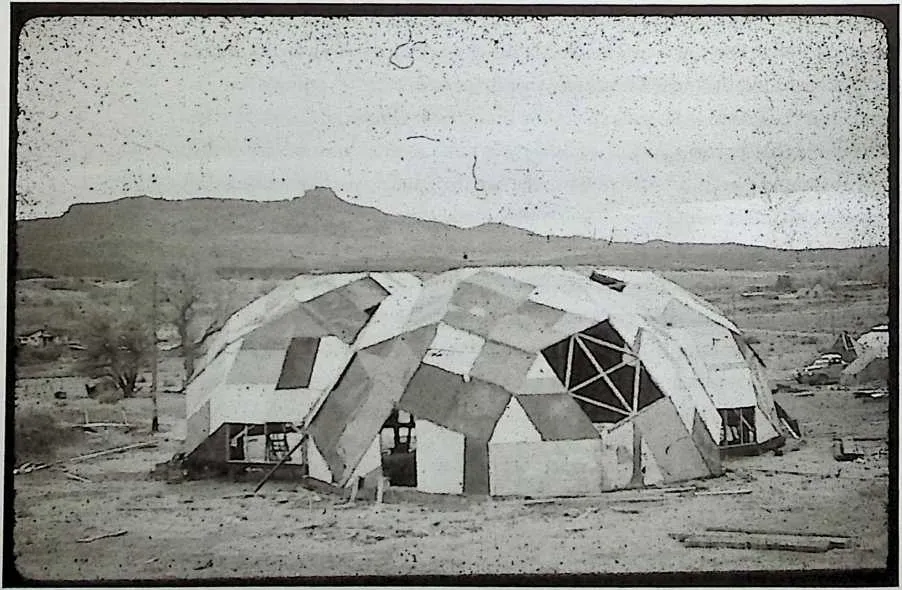 In the mid-1960s this new consciousness became the basis of the largest wave of
communalization in American history. In the two centuries before 1965, historians and
sociologists have estimated that Americans established more than six hundred communes.30
Between 1965 and 1972 journalists and sociologists have estimated that somewhere between two
thousand and six thousand communes were created, with most appearing between 1967 and
1970.31 Virtually all of these communities were built by young, white, middle- and upper-class
youths, and with few exceptions, they had little to do with the New Left. Rather, the
communards of the late 1960s aimed to organize themselves around the pursuit of a shared
consciousness and with it, a leveled social structure that would obviate the need for
conventional politics. One of the earliest such communes, Drop City, blossomed in a cluster of
geodesic domes on the plains of Colorado in 1965 (fig. 9.1).32 As cofounder Peter
Douthit, better known as ‘‘Peter Rabbit,’’ explained at the time: ‘‘There is no political
structure in Drop City. Things work out; the cosmic forces mesh with people in a strange
complex intuitive interaction…When things are done the slow intuitive way the tribe
makes sense.’’33 At Drop City individuals were free to come and go whenever they
liked and to pursue what interested them moment to moment. This freedom they
believed would lead to a greater state of collective harmony, with one another and with
unseen forces in the universe. ‘‘We dance the joydance [sic], we listen to the eternal
rhythm, our feet move to unity…live-lovejoy-energy are one,’’ wrote Rabbit. ‘‘We are all
one.’’34
In the mid-1960s this new consciousness became the basis of the largest wave of
communalization in American history. In the two centuries before 1965, historians and
sociologists have estimated that Americans established more than six hundred communes.30
Between 1965 and 1972 journalists and sociologists have estimated that somewhere between two
thousand and six thousand communes were created, with most appearing between 1967 and
1970.31 Virtually all of these communities were built by young, white, middle- and upper-class
youths, and with few exceptions, they had little to do with the New Left. Rather, the
communards of the late 1960s aimed to organize themselves around the pursuit of a shared
consciousness and with it, a leveled social structure that would obviate the need for
conventional politics. One of the earliest such communes, Drop City, blossomed in a cluster of
geodesic domes on the plains of Colorado in 1965 (fig. 9.1).32 As cofounder Peter
Douthit, better known as ‘‘Peter Rabbit,’’ explained at the time: ‘‘There is no political
structure in Drop City. Things work out; the cosmic forces mesh with people in a strange
complex intuitive interaction…When things are done the slow intuitive way the tribe
makes sense.’’33 At Drop City individuals were free to come and go whenever they
liked and to pursue what interested them moment to moment. This freedom they
believed would lead to a greater state of collective harmony, with one another and with
unseen forces in the universe. ‘‘We dance the joydance [sic], we listen to the eternal
rhythm, our feet move to unity…live-lovejoy-energy are one,’’ wrote Rabbit. ‘‘We are all
one.’’34
113 Figure 9.1
114 Two domes at Drop City soon after construction.
115 ©Estate of R. Buckminster Fuller. All rights reserved. Used by permission. Source: Special Collections, Stanford University Libraries.
116 For the Droppers, as for thousands of other young communards, consciousness formed the foundation of a new kind of sociability—holistic, collaborative, antibureaucratic. Small-scale technologies in turn opened the doors to consciousness and, thus, to this new social world. LSD, water pipes, stereo gear, books such as the I Ching, Norbert Wiener’s Cybernetics, and especially, the writings of R. Buckminster Fuller—for the New Communalists, each of these items served as a tool with which to remake the self and, with it, the group. They also served as bridges between the industrial world that the New Communalists had left behind and the postindustrial future they hoped to build. Fuller had patented the geodesic dome, for instance, in 1951; between 1954 and 1957 the American military deployed hundreds of these domes to house radar installations across a three-thousand-mile early warning line built in Canada.35 During those same years, Fuller’s domes were exhibited worldwide at trade fairs and expositions as evidence of American technological ingenuity. Yet even though they had served as emblems of America’s military-industrial might, at Drop City they also became emblems of an America transformed. The multicolored panels of the geodesic domes at Drop City for instance, were made from the roofs of junked automobiles. The commune’s long-haired founders had spent days chopping the roofs out of old cars with hand axes and electric saws and then bolting them to wooden frames. In the process they turned an industrial artifact into an occasion for hand craft and collective labor. The houses they built in turn became emblems of a new mind-set. As one Drop City resident put it, ‘‘The domes have a sort of cosmic guidance. All those triangle sections coming together to make a single dome, a self-supporting thing. It’s like a community can be.’’36
117 In that sense the builders of Drop City’s domes had become comprehensive designers. As they chopped up the roofs of old cars and bolted them together into complex geometric patterns, the communards of the back-to-the-land movement embraced the intellectual and material output of American industry, as well as the collaborative, freelance work styles of military-industrial research. At the same time, they disassociated themselves from the Bomb and the bureaucratic professional culture that they imagined had produced it. In this way they both rejected their parents’ world and, ultimately, found a way to make their own place in it.
118 The New Communalists also set a Fulleresque example for a generation of young Americans. In 1968, San Francisco-based multimedia artist and entrepreneur Stewart Brand and his wife, Lois, published a sixty-one-page guide to books, mechanical devices, and outdoor gear that they hoped would be useful to those heading back to the land, the Whole Earth Catalog (fig. 9.2). Over the next four years the Cata/ogwould grow to more than four hundred pages, would sell more than a million copies, and would win the National Book Award. To some who lived on the land, and to many who didn’t, the Catalog became a primer in comprehensive design. As Brand put it in his introduction to the Catalogs first section, ‘‘Understanding Whole Systems,’’ ‘‘The insights of R. Buckminster Fuller initiated this catalog.’’37 Sized somewhere between a tabloid newspaper
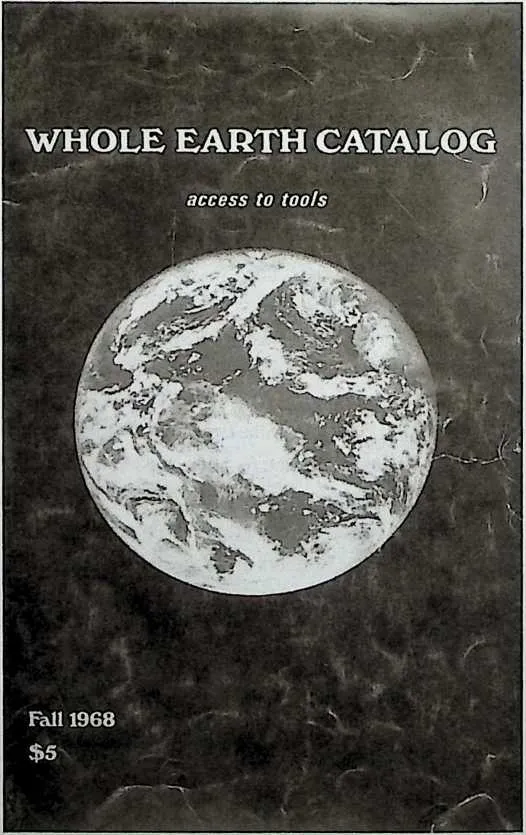
120 Figure 9.2 The cover of the first Whole Earth Catalog (1968). Photo courtesy of Stewart Brand. Source:
121 Special Collections, Stanford University Libraries.
122 and a glossy magazine, the Whole Earth Catalog, like Fuller’s own writings, offered readers a vision of technology as a means by which to escape industrial bureaucracy while living synergistically off its fruits. Consider the Catalogs opening statement. On the inside cover of every edition, Stewart Brand defined the Catalogs ‘‘PURPOSE’’:
124125We are as gods and might as well get good at it. So far, remotely done power and glory—as via government, big business, formal education, church—has succeeded to the point where gross defects obscure actual gains. In response to this dilemma and to these gains a realm of intimate, personal power is developing—power of the individual to conduct his own education, find his own inspiration, shape his own environment, and share his adventure with whoever is interested. Tools that aid this process are sought and promoted by the WHOLE EARTH CATALOG.
126 Brand’s definition clearly states the counter-cultural critique of hierarchical, establishment institutions as emotionally and geographically remote from the lives of citizens and, on the whole, destructive. At the same time, he intimates that he and the reader are like gods in at least two senses, one local and one global, and both familiar from Fuller’s Ideas and Integrities. On the local level the individual reader is like a god in that each person has the power to conduct life as he or she wishes, as long as he or she can find the appropriate tools. For Brand, as for Fuller, the system of the universe is complete—it is not something we can put together but something that is together in its own right. At the local level our job is to turn its energies and resources to our own purposes. In keeping with the counter-cultural critique of bureaucracy, we must pursue our own individual transformation and, with it, the transformation of the world.
127 These transformations depend, however, on our understanding the world as a system of invisible forces. At the global level, like Fuller’s comprehensive designer or perhaps a cold war systems analyst, Brand’s reader enjoyed the power of a god to survey the whole earth below him. The front cover of many editions of the Whole Earth Catalog featured an image of the earth seen from space. Simply by picking up the Catalog, the reader became a visionary of a sort. This vision, though, had been made possible by the cameras of NASA and, more generally, by the fact that the reader was a member of the most technologically advanced generation on Earth. In the Whole Earth Catalog the same technocracy that had spawned the world of the white-collar worker and the war in Vietnam had granted those who rejected both the power to see the world in which they lived as a single whole.
128 In this sense the Catalog suggested that its readers could become comprehensive designers as they read. As soon as they opened the book, their eyes could roam across what looked to be a whole planet’s worth of goods: books, tepees, handsaws, radios, motorcycles—you name it. Simply by thumbing through the Catalog, readers could imagine themselves as masters of a universe of information and designers of their own lives. The Catalogs offerings served in turn as tools with which the reader could deploy the principles of comprehensive design in everyday life. In the pages of the Catalog, as on the rural communes it was created to serve, a backpack or a tent did not simply offer a means of escape into the woods. It offered readers a chance to join an invisible community of nomads, to act in accord with the ancient energies of nature and to become a more ‘‘whole’’ person in the process. That is, these goods would help transport the reader into an environment in which he or she might be able, at the global level, to spot and, at the local, personal level, to act in accord with, the laws of nature. In that way the Catalogs small-scale technologies, its backpacks and tents, and, of course, geodesic domes—a staple of the Catalog, as well as of many communes—were not so much tools for action as tools for vision. They offered readers the means to transform the products of high-technology industry into a way of seeing the world as a whole. Having grasped that vision, these comprehensive designers could create new communal worlds of their own and by their example, individual and collective, save the world as a whole from the perils of bureaucratized industry.
129 Conclusion
130 For the young of the 1960s the logic of comprehensive design embodied a dizzying set of analogies that placed their own lives at the center of the universe. The individual life, the new community, the world as a whole—as glimpsed in the pages of the Whole Earth Catalog or lived on a communal farm, each was an emblem of one another and all constituted an indissoluble whole. Equipped with the proper tools, the young American could scan the whole globe, perceive its hidden patterns, and act in his or her own—and, presumably, the world’s—best interests. If the cold war bureaucrat sat huddled in his office, glimpsing only the most partial fragments of the human enterprise, the comprehensive designers of the back-to-the-land movement positioned themselves at the fringes of American society and thereby sought to take in a wider view. Having forsaken the bureaucratic towers of technocracy, they could take up its many technological products and turn them to a new end: the transformation of the individual consciousness and with it the founding of a new society. At the same time, they could escape the conundrums of adulthood that beset their generation. After all, what could be more important or more fun than building a new society?
131 R. Buckminster Fuller’s own life seemed to prove the point. As they read his books and flocked to his lectures, many middle- and upper-class youths hoped to harness the economic power of American industry to build independent, flexible lives and to grow up to enjoy them as much as he did his. Yet, to the extent that they tried to build those lives on communes, most failed. By the mid-1970s virtually all of the communes built over the preceding decade had disappeared. While the vision of communities founded on shared consciousness alone held enormous appeal in theory, it crumbled in the face of the material realities of rural farming and the complexities of collective life.
132 For the young of the late 1960s, R. Buckminster Fuller’s vision of comprehensive design had seemed to offer an escape from the need to enter institutions, to confront other individuals, to struggle over the distribution of resources and the proper organization of life. In the coming years Fuller’s hope for a world of individuals equipped with vast databases of information and the capacity to see—and manage—the world as a whole would animate the rise of the personal computer and the introduction of the Internet. Yet, even as the theory of comprehensive design has lingered in the cultural atmosphere and, with it, the hope for a social life built on interpersonal harmony, free commerce, and a lack of bureaucracy, so too has the failure of the communes. In 1973 the founders of Drop City sold the commune’s land and left their geodesic domes to collapse under the incessant Colorado winds.38 As they had learned, tools alone could not sustain community, nor could careful attention to design replace the nitty-gritty, everyday work of politics.