
13 Fuller’s Futures
2Reinhold Martin
3 Often enough, one of the reasons given for revisiting the work of a figure such as R. Buckminster Fuller, whose historical significance is well established, is to draw lessons for the present or, indeed, for the future. Such is potentially the case here, with the celebration of an archive that promises, in effect, to keep Fuller’s future-oriented memory alive for us in all of its complexity. But we also know that to remember is to forget, in the sense of the spatial phenomenon called fetishization, whereby fixation on certain memories necessarily screens out other, competing ones. Remembering can also bring on the temporal phenomenon called reification, whereby the fluid dynamics of history seem to be consolidated once and for all. In other words, the very act of archiving knowingly risks a Fuller frozen in space-time.
13.1 Fuller’s Place
4Having never made it into Siegfried Giedion’s epic tale of modernism’s historical voyage in Space, Time, and Architecture (1941), Fuller would seem somewhat immune to such a fate, which is normally reserved for modern architects proper as the traces they leave on history calcify over time. In the aftermath of world war Giedion himself would, in effect, write these heroes out of the story, in the ‘‘anonymous’’ dark history he called Mechanization Takes Command (1948). There, as if to make up for his absence in Space, Time, and Architecture, Fuller does make an appearance, as the least anonymous among the book’s many supporting characters. Between its lines, Giedion’s Mechanization Takes Command describes a state of affairs in which modern architects found themselves in a kind of free-fall down the wind tunnel of progress. Still, these architects remained the very embodiment of a mythic—if now tragic—modernity, figured in Giedion’s imagination as a forward-looking engineer. Just prior to the war, in a famous formulation, Walter Benjamin (himself a careful early reader of Giedion) would face a related figure backward to survey the debris-field of ‘‘progress’’ piling up in his wake and call him an angel: the angel of history.1
5 In the decades following that calamity—the scope of which Benjamin could only have guessed at—Fuller would, in turn, turn history’s angel back around to face forward again, calling him (or her) an astronaut, the pilot of Spaceship Earth.
6 To the degree that Earth’s astronaut was also a cosmonaut, the future posited by Fuller in his Operating Manual for Spaceship Earth (1969) and related works can seem decidedly post-political when seen against the backdrop of the cold war, in which Fuller himself was an active participant.2 And, indeed, it does share a certain family resemblance with such ventures as Daniel Bell’s ‘‘end of ideology’’ and the coming of a ‘‘post-industrial society,’’ despite Fuller’s protestations at being labeled a technocrat.3 Still, for reasons that I hope will become evident, I would like to approach the question of the future as it appears in Fuller’s later work from a slightly different angle. That angle is generously afforded by an otherwise preposterous question: Was Buckminster Fuller a postmodernist?
7 This question, at minimum, is authorized by a quirk of chronology, since Fuller’s prodigious career spanned the time periods generally associated, in architecture, with high modernism (marked, say, by his Dymaxion house of 1927) and then with postmodernism (said by Charles Jencks to have begun on July 15, 1972, at 3:32 p.m., with the demolition of Minoru Yamasaki’s Pruitt-Igoe housing complex).4 Technically, this makes the post-World War II Fuller of the geodesic domes a ‘‘late modernist’’ in Jencks’s eyes. The stylistic marker found in his work (one of many possible ‘‘late modernist’’ traits, according to Jencks) is an extreme repetition—‘‘the sizzle of incessant space frames’’ shared with Philip Johnson and Cesar Pelli among others, and synchronic with both the ‘‘wet look’’ of James Stirling at Olivetti and the ‘‘slick skins’’ of Norman Foster, again among many others.5
8 Following in the footsteps of Jencks, Fredric Jameson, a signal theorist of cultural postmodernism (or what he calls the ‘‘cultural logic of late capitalism’’) has described such ‘‘late moderns,’’ in architecture, literature, and elsewhere, as transitional figures. For Jameson the category of the ‘‘late modem’’ would initially contain ‘‘the last survivals of a properly modernist view of art and the world after the great political and economic break of the Depression.’’6 Later, it would come to mean the international artistic ideology of the cold war, epitomized by the post-utopian ‘‘American’’ formalism of Clement Greenberg, which sought definitively to separate art from politics and, most of all, from a vulgarized culture industry.7 All of this seems a for cry from Fuller, whose profile as a self-proclaimed artist, engineer, ecologist, and ‘‘comprehensive designer’’ hardly fulfills the imperatives of a Greenbergian autonomy of art, which Jameson sees as an immediate precursor to a fully post-utopian—that is, a post-historical, post-political—postmodernism. On the contrary, Fuller’s synthetic, ‘‘synergetic’’ efforts to map the entire ‘‘world-around’’ system in a manner adequate to its pilot’s navigational and cartographic requirements would seem to place him on the other side of a fragmented, postmodern division of labor in which everyone merely does his or her own job without access to what Jameson calls cognitive maps.
9 Jameson extrapolates his analytic of cognitive mapping from Kevin Lynch’s Image of the City (1960), a work devoted to analyzing different forms of what Lynch calls ‘‘imageability’’ at the urban scale. In this context a cognitive map is a mode of representation that allows the inhabitant to grasp the totality of the city and discern his or her place within it. Jameson extends Lynch’s model to apply to the world system of late capitalism in general—an intensely disorienting space lacking familiar guideposts and thus requiring new mental ‘‘maps’’ to grasp its scope and its momentum.8 A similar cartographic impulse, arising out of an effort to deal with an increasingly complex and abstract global environment, might well be attributed to Fuller—for whom such maps would be indispensable to any effort to ascertain the direction in which Spaceship Earth is heading and to correct its course.
10 However, to the degree that Fuller also replaces the starkly ambivalent choice offered by Le Corbusier—‘‘Architecture or Revolution’’—with an even starker if far less ambivalent one—‘‘Utopia or Oblivion’’—his overall project would seem to signal something like the exaggerated persistence of a utopian ‘‘high modernism’’ (born, like Fuller, in the late nineteenth century) within the very fabric of that disorienting hall of mirrors called postmodernism. From both a historical and an epistemological perspective, this impulse corresponds most closely to what Jameson views as the symptomatic nature of 1970s science fiction. When not subjected to an unsentimental shredding in the hands of a Philip K. Dick or a J. G. Ballard, the utopianism characteristic of much science fiction at the time was frequently modeled on the secessionist politics of the 1960s counterculture. Two examples of this were Ursula K. Le Guin’s The Dispossessed (1974) and Ernest Callenbach’s Ecotopia (1975). Both novels described the production of parallel mirror worlds in which were reflected negatively the excesses of consumer society, through a Fulleresque harnessing of postindustrial knowledge (to different degrees) for the equitable, sustainable redistribution of resources. In Le Guin’s The Dispossessed, the mirror world took the form of the moon Annares, a barren anarchist satellite orbiting the Earth-like Urras. Callenbach’s Ecotopia names a breakaway republic consisting of what was once Northern California, Oregon, and Washington, now devoted to a life lived in systematic, unrelenting harmony with nature.
11 Jameson sees the value of such visions to lie not in the dubious and often ambiguous alternatives to the postmodern status quo they offer but in their ability to sponsor a negative dialectic in which their opposite number’s ideological trappings are fully exposed.9 In these negative mirror worlds, the motives and protocols observed by those at the helm of Spaceship Earth below or beyond are revealed to be grossly unjust. So, too, does the present get reflected in Fuller’s own future worlds but in a slightly different way. By the 1970s, that is, Fuller was given not so much to projecting ideal futures as to playing games with them.
13.2 World Games and Their Rules
13For example, in Fuller’s World Game (begun in 1965), we see a technical, cartographic instance of what Jean-Francois Lyotard, another central theorist of postmodernism, calls ‘‘language games.’’ For Lyotard (following Ludwig Wittgenstein) a language game is an experimental game played with linguistic codes and protocols at various levels. To speak or write either denotatively or prescriptively is to play such a game, and to violate its codes (or to tell a different kind of story) is to innovate.10 From this perspective we might notice that the World Game turns technocratic positivism into a playful experiment with a series of different narrative scenarios, where the more radically a given scenario rearranges global technoeconomic assumptions, the more likely it is to offer an alternative to the status quo. However, what differentiates it from Lyotard’s effort to replace overarching, modernist master narratives with a plurality of competing petits-recits (small stories) is that the World Game is premised on the abilities of its players to grasp—and thereby to manage and to direct—the totality of the dynamic world system with the help of maps. In the balances of trade and other quantitative assessments measured and rearranged in the World Game, what is being contested is not this or that micronarrative corresponding to what Lyotard calls (after Rend Thom) an ‘‘island of determinism’’ in the heaving, directionless postmodern sea.11 Rather, the World Game posits a set of competing master narratives that tell the story of the global future as such.
14 In that regard Fuller’s futures surely reflect the totalizing futurology of the general systems theory that lay behind them, which Lyotard would condemn at the end of the 1970s.12 But the World Game is a game played with the possibility of reimagining the future as such, as well as a game of possible futures. Therefore, Fuller’s project is not reducible to an enterprise that, as Lyotard warns about systems theory, merely proposes ‘‘a ‘pure’ alternative to the system’’ that ‘‘would end up resembling the system it was meant to replace.’’13 Instead, Fuller’s project reorients the ‘‘system’’ from within by playing games with the very idea of a graspable, collective future.
15 As Fuller designed it, in the World Game individuals or teams ‘‘would each develop their own theory of how to make the total world work successfully for all of humanity.’’14 This would be done on an electronic version of his ‘‘skyocean’’ Dymaxion map originally designed (but unrealized) as a collapsible ‘‘geosphere’’ within the geodesic dome he built for the United States Information Agency for Expo 67 in Montreal. The format was modeled on the war games played by cold warriors, with the notable difference that the Manichean ‘‘Drop Dead,’’ zero-sum premises of the former (based on mathematician and computer scientist John von Neumann’s game theory) were to be replaced by the distinctly Fulleresque formulation: ‘‘Everybody must win.’’15 This was utopian, to be sure, but with a certain tautological precision. Since if the objective of the game was to devise a redistribution of resources in which everybody wins, it was nevertheless impossible to win the World Game, not because this ‘‘ideal’’ scenario was permanently out of reach but because its availability was premised on an agonistics of knowledge (playing the game to win by devising the ‘‘correct’’ scenario) that, from the beginning, cancelled the synergetic cooperation necessary for all players to win.
16 Another way of saying this is that the World Game was played on two contradictory levels at once—one intrinsic, another extrinsic. Intrinsically, it was a kind of postmodern language game, in which no one scenario had an a priori metaphysical or empirical claim over any other. Nor did it assume any power differential among the players (in other words, a politics of knowledge), in which sense it was ‘‘post-political.’’ Extrinsically, on the other hand, it remained thoroughly modernist, in the sense that it posited a space—mapped and modeled by the geodesic dome itself—in which something more than a temporary consensus could be reached, once the giant computer had, with the help of its human ‘‘players,’’ played out all the possible scenarios. At this extrinsic or external level, the World Game was a modernist game of optimization at the scale of the world system itself, rather than a postmodernist game of perpetual, competitive innovation.
17 This would also mean that, extrinsically, the World Game was not as postpolitical or postideological as Fuller liked to claim. On the contrary, it entailed a displacement of politics to the level of cartography. It was a roadmap to a utopian future but one in which the political question was, in part, that of who was in charge of the cognitive maps. For Fuller himself this was a non-question, comparable to asking who was flying the many airplanes in which he circled the globe. The ultimate arbiter in the World Game would be the mainframe computer rather than a political entity. As Fuller put it, ‘‘What I proposed was based on my observation that world people had become extraordinarily confident in the fundamental reliability of the computer and its electronically controlled processes,’’ a state of affairs verified by ‘‘the equanimity with which world-around air jet travelers now commit their lives to the computer’s reliability’’ as they come in for a night landing.16
18 This presupposed, of course, that the destination toward which Spaceship Earth ought to be headed was pre-programmed or, to put it another way, that the utopian future could be represented transparently and thereby optimized. In contrast to the high modernist utopias of Le Corbusier, for example, which were represented in panoramic aerial views and integrated master plans, Fuller’s futures were represented discursively and probabilistically, in charts, graphs, and statistics describing world-historical ‘‘trending’’ (his term). Still, it was assumed that these documents, famously archived at his ‘‘headquarters’’ at Southern Illinois University and now held at Stanford, were themselves un-contestable, in the sense that they represented objective trends rather than an ideological project. At one level this was nothing more than raw positivism. But at another it was a wager. The stakes of the World Game did not really lie in the question of whether the statistics it offered were scientifically verifiable and therefore constituted a solid foundation on which an optimal future could be constructed, whether agonistically or consensually. Instead, the stakes lay most profoundly in the conversion of modernist utopias of form (Le Corbusier) into postmodernist utopias of risk (Fuller).
19 In 1986 the sociologist Ulrich Beck coined the term ‘‘risk society’’ to describe what he considered to be a second order or ‘‘reflexive’’ modernity organized around the social relations of statistically calibrated risk. Here we can think of Fuller’s formula, ‘‘Utopia or Oblivion,’’ as designating the horizon of a regime in which, as Beck puts it, ‘‘the risks of civilization today escape perception and are localized in the sphere of physical and chemical formulas’’17 As with Fuller, many of Beck’s examples apply to environmental risks measured in charts, graphs, and mathematical formulas—rather than perceived directly—which serve as a kind of emblematic instance of the overall situation. That Beck used the phrase reflexive modernity rather than postmodernism to describe this is less important than the correspondences of his thesis with then-evolving hypotheses regarding cultural postmodernism. For example, as with Jameson’s reflections on the structural nature of speculative finance capital and risk-reward calculations under postmodernity, under Beck’s reflexive modernity the future appears as a set of probabilities:
2122The center of risk-consciousness lies not in the present, but in the future. In the risk society, the past loses the power to determine the present. Its place is taken by the future, thus, something non-existent, invented, Active, as the ‘‘cause’’ of current experiences and action. We become active today in order to prevent, alleviate, or take precautions against the problems and crises of tomorrow and the day after tomorrow—or not to do so.18
23 Thus the projection of necessarily fictional future scenarios is constitutive of, rather than opposed to, the present. In other words, in risk society, as in postmodernism, the science-fiction future is a feedback loop.
24 In this light Fuller’s defense of large-scale planning at a moment when master plans and the master narratives that authorized them were already coming under attack was not a modernist throwback. In his Operating Manual, as elsewhere, Fuller advocates thinking and planning at the scale of the universe itself:
2627We are faced with an entirely new relationship to the universe. We are going to have to spread our wings of intellect and fly or perish; that is, we must dare immediately to fly by the generalized principles governing universe and not by the ground rules governing yesterday’s superstitious and erroneously conditioned reflexes. And as we attempt comprehensive thinking we immediately begin to reemploy our innate drive for comprehensive understanding.
28The architects and planners, though rated as specialists, have a little wider focus than do the other professions…At least the planners are allowed to look at all of Philadelphia and not just to peek through a hole at one house or through one door at one room in that house. So I think it’s appropriate that we assume the role of planners and begin to do the largest scale comprehensive thinking of which we are capable.’’
29 Fuller’s version of this comprehensive perspective is given in general systems theory, which describes the ‘‘general system’’ in terms of interacting variables subject to parametric quantification. Here, we can think of the resources mapped and tracked in the World Game: population, energy, shipping lanes, railroads, transoceanic cables, airways, airports, satellites, television receivers, universities, literacy, vegetables, bread, motor vehicles, copper, earthquakes, electrical networks, and so on. If this list already seems impossibly incomplete or composed mainly of incommensurables, the issue is—again—less the capacity actually to account for, map, and accurately predict future trends than the capacity to project alternative futures based on the ‘‘fictions’’ (Beck) narrated by these maps. Further, the Fulleresque utopias conjured to avert the oblivion otherwise risked by Spaceship Earth—domes over Manhattan, Tetra-Cities, and floating geodesic ‘‘clouds,’’ to name a few—are to be appreciated not so much for their capacity to organize the future as to organize the present, that is, where Fuller’s futures are played out—in a postmodern present of which he and his work are inextricably a part but from which they are always busy planning an escape. Hardly escapist, however, Fuller’s utopian fictions, both mapped and designed, confront us squarely with our own place within the placeless universe called postmodernity. Thus, if theorists like Jameson would call for cognitive maps to help navigate our way out of its hall of mirrors, Fuller always had such maps ready at hand, in the World Game and elsewhere.
30 And so we return to the aporia of the World Game—the simultaneous staging of multiple perspectives and multiple futures intrinsically, which are to be resolved into a single perspective (that of the spaceship’s astro-cosmonaut), extrinsically. The purpose is to give direction, to steer the spaceship toward better prospects. The result, however, is to restage, again and again, what Jameson calls the postmodernist ‘‘crisis of the future’’—the apparent impossibility of imagining a way out. Despite the faith exhibited by Fuller and his fellow astro-cosmonauts in the computers guiding the ‘‘world-around’’ machines (or systems) in which we metaphorically and literally fly to this day, the question remains: Where are we going?
31 In returning to this question—which is situated somewhere between Benjamin’s angel of history and Fuller’s astro-cosmonaut—we are not done playing the ‘‘game’’ of the World Game, whether it is conceived according to a computerized calculus of universal justice or a postmodern ‘‘just gaming’’ (Lyotard).20 There is another aporia written into Fuller’s futures. This is the aporia of the ‘‘we’’ in the question just posed, the players of the World Game and especially, the figure of the ‘‘world.’’
32 Who is it that plays this game, and with what are they playing? In practice, the players were mainly students, who were nevertheless playing with the very conditions of possibility for the ‘‘world’’ itself—that is, a form of collectivity that could emerge out of postmodern, ‘‘world-around’’ dispersal and deterritorialization. Fuller’s futures were organized around the risk of ‘‘oblivion,’’ in the face of which they sought a utopian coming-together of something like a world-system, a system of systems mapped cognitively in Dymaxion triangles and geodesic spheres, that was analogized to the ‘‘universe’’ of Fuller’s special, quirky brand of systems theory—a literally universal world-system.
33 Ironically, the name of this world-system for postmodern thinkers, like Jameson, still willing to think totalities is late capitalism: a consumerist acceleration of postindustrial, informatic exchange and flexible accumulation also displaced onto the level of culture. Today it is more commonly named globalization. In architecture perhaps the most compelling figure for this ‘‘new machine’’ (as Jameson calls it)—literally, in Fuller’s case, the globe—of which ‘‘we’’ require cognitive maps in order to exit, was given in 1984 in Jameson’s reading of John Portman’s 1977 atrium-equipped Bonaventure Hotel in Los Angeles. According to Jameson, that building ‘‘aspires to being a total space, a complete world, a kind of miniature city; to this new total space, meanwhile, corresponds a new collective practice, a new mode in which individuals move and congregate, something like the practice of a new and historically original kind of hypercrowd.’’21 Let us insist, then, that Fuller’s geodesic domes, and especially his dome for Expo 67, with its proposed geoscope/World Game inside, represent another, more technical iteration of such a space, in the form of an atrium enclosed in a sizzling space frame. Remember, too, that Jameson, immediately after describing the multiple disorientations of Portman’s building, declares himself ‘‘anxious that Portman’s space not be perceived as exceptional or seemingly marginalized and leisure-specialized on the order of Disneyland’’22—or, we could add, on the order of world expositions like Expo 67 or like Disney- world, with Epcot Center as its geodesic centerpiece.
34 But more than merely mapping the globe and thereby constructing something like a global subject made up of World Game players, Fuller’s geodesic domes traversed it—often as emblems and instruments of world trade and I or geopolitics. There were, for example, the postcolonial domes erected in 1957 for the United States Department of Commerce conference in Kabul, and the Calico Company geodesic dome pavilion in Bombay of 1958 (fig. 11.1). And,
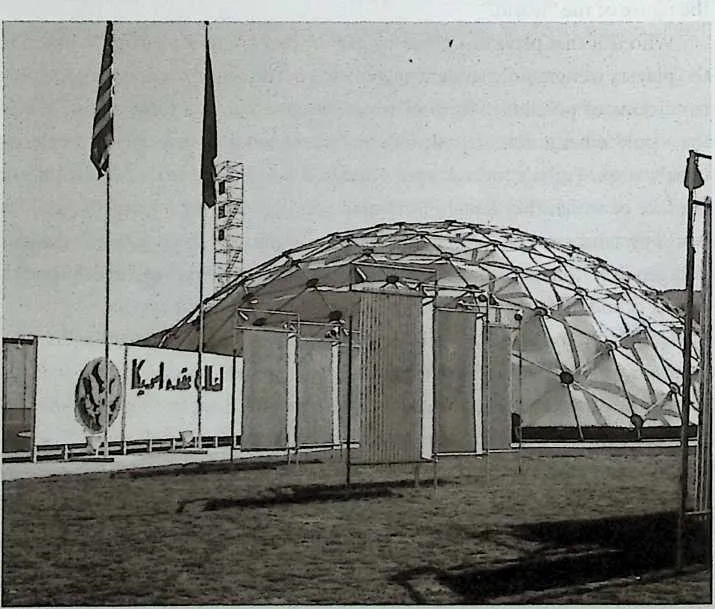
36 Figure 11.1
37 U.S. Department of Commerce dome in Kabul, Afghanistan, erected in 1965.
38 Source: Special Collections, Stanford University Libraries.
39 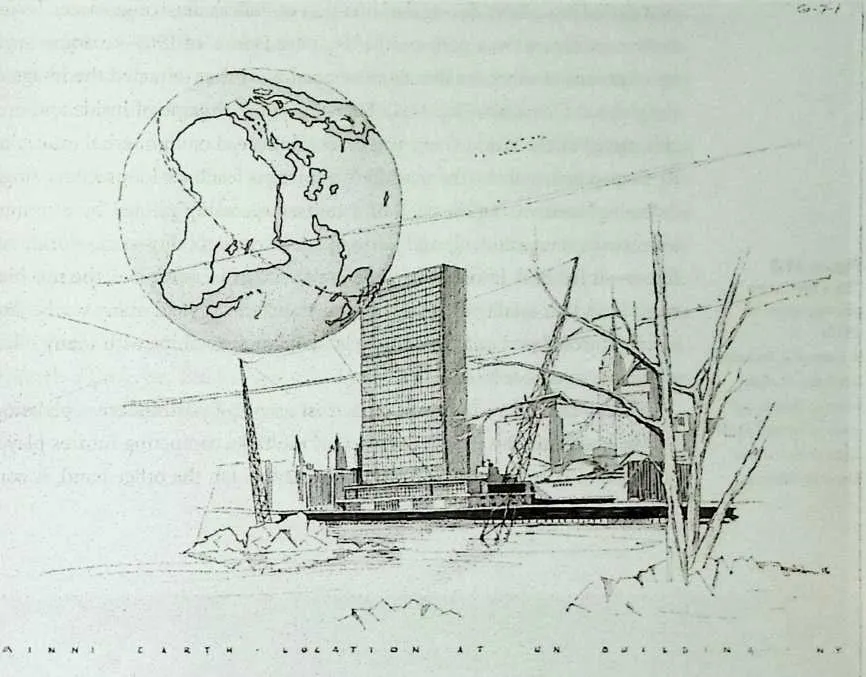 most dramatically, there was the U.S. pavilion at the American National Exhibition of
1959 in Moscow, in which was projected the sweetly propagandistic multiscreen ‘‘Glimpses of the
USA’’ by Charles and Ray Eames. All of these were precursors to the Expo 67 dome with its
projected geoscope (fig. 11.2). So the geodesic dome did not simply represent the world. Like
Fuller, it traveled across its surfaces, tracing numerous interrelated paths along the great circles
that girdled it. Thus, in contrast to the many earthbound, monocular architectural
domes—Eastern and Western—that preceded it over many centuries, the geodesic dome also
combined multiple imagines mundi with a logistics of reproduction and distribution (Fuller
patented various designs) that effectively played the game of the world by literally drawing
it out—encircling it many times, with Fuller flying alongside—in real space and real
time.
most dramatically, there was the U.S. pavilion at the American National Exhibition of
1959 in Moscow, in which was projected the sweetly propagandistic multiscreen ‘‘Glimpses of the
USA’’ by Charles and Ray Eames. All of these were precursors to the Expo 67 dome with its
projected geoscope (fig. 11.2). So the geodesic dome did not simply represent the world. Like
Fuller, it traveled across its surfaces, tracing numerous interrelated paths along the great circles
that girdled it. Thus, in contrast to the many earthbound, monocular architectural
domes—Eastern and Western—that preceded it over many centuries, the geodesic dome also
combined multiple imagines mundi with a logistics of reproduction and distribution (Fuller
patented various designs) that effectively played the game of the world by literally drawing
it out—encircling it many times, with Fuller flying alongside—in real space and real
time.
40 Spaceship Earth, the ‘‘world’’ of the World Game and of the geodesic domes, was therefore a replica of the postmodernist ‘‘new machine.’’ It, too, was a mirror world, reflected thousands of times in the thousands of geodesics
41 Figure 11.2
42 Proposed geoscope, a two-hundred-foot-diameter miniature Earth that would be suspended one hundred feet above the ground and fitted with miniature lights to provide a visual representation of real-time world data.
43 © Estate of R. Buckminster Fuller. All rights reserved. Used by permission. Source: Special Collections, Stanford University Libraries.
44 that circled its surfaces during the latter part of Fuller’s illustrious career. Its definitive monument was, perhaps, the ‘‘Fly’s Eye Dome’’ of 1965—a dome made up of dozens of other, smaller dome-shaped units that refracted the image of the globe at finer scales (fig. 11.3). Here, the aporetic game of inside and outside played by the World Game was reversed. Instead of an internal multiplicity shaped externally by the machine’s numerous feedback loops into a single ‘‘winning’’ scenario, and instead of a unitary spaceship piloted by a unitary astro-cosmonaut, suddenly and jarringly, an external totality—one world, one future—is fed back into the machine itself. And as in a fly’s eye, the machine reproduces that totality across its reflective surface, to yield many worlds and many futures played out inconclusively by many spaceships with many pilots with many eyes, side by side.
45 Figure 11.3
46 ‘‘Fly’s Eye Dome,’’ photographed in 1970s.
47 © Estate of R. Buckminster Fuller. All rights reserved. Used by permission. Source: Special Collections, Stanford University Libraries.
48 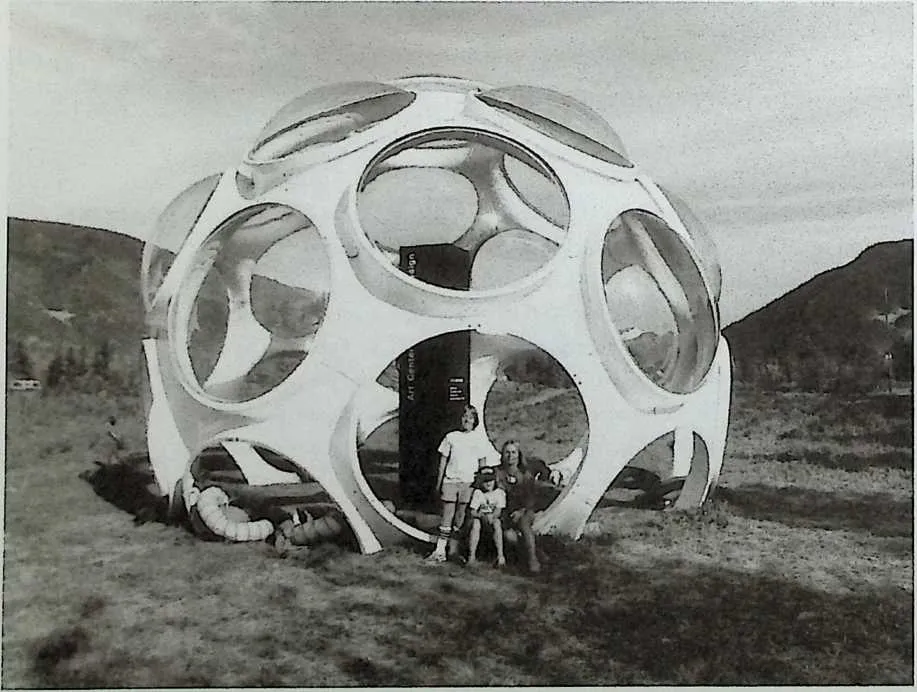 These were Fuller’s futures: a modernist utopia of postmodern replication. On the
one hand, this utopia consisted of multiple, competing futures played out inside a
spaceship-dome by multiple players. On the other hand, it consisted of a single, optimal future, a
path through outer space (or history) taken by the spaceship-dome and plotted by
the players inside. It would be a mistake to defend or dismiss such a project on the
grounds of its success or failure in synthesizing these two levels, in deriving consensus
from dissensus, or prescriptions from descriptions. As with all the geodesics, the most
challenging design problem remained where to put the windows, not to mention the door.
The question is not just where Spaceship Earth is heading nor even who is at the
helm. The question is how to escape the self-reflexive, self-contained regime of risk
management, the hall of mirrors in which the entire game is played. After all, what
is ultimately at risk here is the possibility of imagining the future as a way out—a
way out of the globe, the spaceship, the hotel atrium, the windtunnel of progress,
and the geodesic dome itself, with its sizzling space frames and its impossible World
Games.
These were Fuller’s futures: a modernist utopia of postmodern replication. On the
one hand, this utopia consisted of multiple, competing futures played out inside a
spaceship-dome by multiple players. On the other hand, it consisted of a single, optimal future, a
path through outer space (or history) taken by the spaceship-dome and plotted by
the players inside. It would be a mistake to defend or dismiss such a project on the
grounds of its success or failure in synthesizing these two levels, in deriving consensus
from dissensus, or prescriptions from descriptions. As with all the geodesics, the most
challenging design problem remained where to put the windows, not to mention the door.
The question is not just where Spaceship Earth is heading nor even who is at the
helm. The question is how to escape the self-reflexive, self-contained regime of risk
management, the hall of mirrors in which the entire game is played. After all, what
is ultimately at risk here is the possibility of imagining the future as a way out—a
way out of the globe, the spaceship, the hotel atrium, the windtunnel of progress,
and the geodesic dome itself, with its sizzling space frames and its impossible World
Games.
49 Reference Matter