
5 1927, Bucky’s Annus Mirabilis
2Barry M. Katz
5.1 I
3In the last months of 1927, walking morosely along the shores of Lake Michigan, brooding over the loss of his business and the birth of his second child, R. Buckminster Fuller underwent an experience that has all the trappings of a religious conversion. Here is a passage—drawn almost at random from his voluminous notes, chaotic manuscripts, didactic letters, interminable speeches, contentious interviews, and rambling publications—in which he captures the moment that would define the rest of his extraordinary career: ‘‘Standing by the lake on a jump-or-think basis, the very first spontaneous question coming to mind was, ‘If you put aside everything you’ve ever been asked to believe and have recourse only to your own experiences do you have any conviction arising from those experiences which either discards or must assume an a priori greater intellect than the intellect of man?’ ’’1
4 The answer to this epistemological dilemma, which recalls the Confessions of Augustine, the Meditations of Descartes, and the Autobiography of John Stuart Mill, came to Bucky in a blazing revelation. The human intellect, when coupled with the range of possible human experience, is sacred: ‘‘Apparently addressing myself, I said, ‘You do not have the right to eliminate yourself, you do not belong to you. You belong to the universe.’ ’’2
5 Fuller would return again and again to his crisis of 1927 to create a picture of nothing short of death and resurrection. At one moment he is gazing out onto the frigid waters of Lake Michigan, mired in self-doubt and seriously considering putting an end to it all. In the next he is reborn, confident of his place in the universe, rising bravely to his self-appointed, world-historical destiny. Selflessly he will abandon the pleasures of work, career, and income in pursuit of what he calculated would be a thirty-year experiment in self-actualization, ‘‘designed to become effective in 1952.’’ He will shun the worldly preoccupations of architects, engineers, and educators and commit himself wholly to the articulation of a new design science. He will renounce language itself, the proximate source of all error and confusion: ‘‘It was very tough on my wife, but I decided I was going to try to hold a moratorium on speech. …So for approximately two years I didn’t allow myself to use words.’’3 But words would return to him—with a vengeance—and they guide us toward an insight into 1927, Buck/s year of wonders, his annus mirabilis.
5.2 II
7The path that brought Fuller to his moment of crisis and redemption has been retraced by many visitors to the Dymaxion world, and he himself cultivated his personal narrative to what can only be described as mythic proportions. Indeed, it in no way detracts from the gifted inventor of the Dymaxion car and the geodesic dome to say that Bucky’s most inspired and inspiring invention was himself. The continual recitation of the events of 1927—‘‘In 1927 I committed all my productivity potentials toward dealing only with our whole planet Earth’’; ‘‘I began to look at environments in 1927’’; ‘‘In 1927 I undertook the search for a reliable means of estimating world population figures’’; ‘‘I set out deliberately in 1927 to be a comprehensivist’’—served as a template that imparted to his career the regularity of an icosahedron and the inevitability of an octet truss.4
8 Over the course of innumerable subsequent re-tellings, Fuller transformed the chaotic events of 1927 into a conscious, methodical program. Inspired by an exquisite sense of self-importance and a humbling sense of obligation, Fuller made the retrospective decision to conduct his life as a rigorous scientific experiment and to become, in effect, a fully documented living hypothesis. ‘‘One of the first things I found myself doing back in 1927 was saying that I think one of the things I ought to start off with is to make a list of everything that I can remember ever happening to a human being.’’5 This ‘‘list’’ of 1927 would grow into the 750-volume Dymaxion Chronofile that, supported by correspondence, manuscripts, drawings, blueprints, models, photographs, films, video- and audiotapes, and newspaper clippings (not to mention love letters, overdue library notices, and invoices for an immense number of unpaid bills), resulted in some forty-five tons of compulsive self-documentation. There is nothing like it in American intellectual history, and the implication is inescapable: if it is not in the Chronofile, it most likely did not happen.
9 The outlines of the story, accordingly, are pretty well known. Richard Buckminster Fuller was bom in 1895 into an old New England family and spent his boyhood summers in Maine, immersed in the marine culture of Penobscot Bay. Admiration for the design, fabrication, operation, maintenance, and underlying hydrodynamic principles of boats remained with him throughout his life and often served as a standard against which to judge other, less enlightened industries.6 Following a private secondary school education and a famously inglorious episode at Harvard—from which he was first dismissed and later expelled ‘‘for lack of sustained interest in the processes within the University’’—he found himself working in a cotton mill in Quebec and then in the meat-packing industry in New York and New Jersey. Fuller would later reassemble these experiences into logical and indeed methodological stages in the formation of a comprehensive worldview. In the mills he gained a ‘‘dawning awareness of [the] addition of value (or wealth) by manufacture’’; the packing house gave him a perspective on ‘‘broad-scale, high-speed, behind-the-scenes human relations in the give and take provisioning of men’s essential goods.’’7 Even his athletic pursuits at the Milton Academy imparted to him the ‘‘intuitive dynamic sense’’ that he viewed as fundamental to his ‘‘anticipatory design science.’’
10 Likewise, the importance of his naval service in World War I lay, for this assertively apolitical autodidact, not in contributing, however modestly, to a world made safe for democracy but insofar as his training at Annapolis left him with ‘‘an enthusiasm for scientific methodology’’ and for complex technical systems whose patterns and principles were wedded within ‘‘a reciprocating, dynamic totality.’’ With his inimitable gift for compressing a highly articulated Weltanschauung into a single sentence, Fuller summed up his wartime experience this way: ‘‘I learned the process of conscious self-attunement toward the understanding of principles and their subsequent teleologically translated anticipating effectiveness …all of which attuned comprehension of principles invariably was reduced to generalized complex equations by a process of decisive and swift differentiating-out of the problem’s complementary functions.’’8
11 Somewhat more concretely, he gained exposure during the war to radio telephony and naval aviation, and in 1917 Fuller married Anne Hewlett.
12 Anne was the daughter of James Monroe Hewlett, a prominent New York architect, muralist, and the inventor of a lightweight fiber-concrete construction block that would soon compete with her for Bucky’s attention. The first years of their marriage were difficult, punctuated by the devastating loss of their first child to meningitis. Although he experienced intense feelings of guilt at the time, Bucky gradually sublimated his grief into an intellectualized ‘‘resentment’’ at their substandard living conditions and a programmatic mission of ‘‘the housing of children, large and small.’’9
13 In 1922, in the wake of their tragedy, James Hewlett invited his son-in-law to go into business with him as president and principal sales representative of the Stockade Building System. Fuller’s business correspondences over the next five years, together with the almost daily letters from Anne written during his prolonged absences, are the source of most of what can be reconstructed of the period leading up to the crisis of 1927. Considering all that was to follow, it is remarkable how utterly unremarkable the record is. There are pages on pages of correspondence with disgruntled customers, anxious partners, and impatient contractors, all of which are executed in a mildly verbose but otherwise businesslike manner. Only the voluminous correspondence from his wife—always addressed to ‘‘Darlingest Buckie’’ and always signed ‘‘Your very own Anne’’—illuminates his inner life, but even this is notable for its startling lack of reference to the larger world: no mention is made of books read or lectures attended; of visits to concerts or museums; of current developments in science, politics, or the arts. If Spaceship Earth is operating in those years, it is on autopilot.
14 Although there is nothing particularly visionary in the Stockade system (‘‘It is the latest innovation in wall building’’), Fuller committed himself to the business and worked unflaggingly, apparently unaware that his career was about to implode. During this period he and Anne were beset by financial insecurity and strained by his extended absences, and in early 1927 Anne began to experience anxieties over her second pregnancy. From their apartment in New York she wrote repeatedly of her fears that Bucky would have an accident or a breakdown, that he was sleeping too little and drinking too much, and that ‘‘we will never be together again, happy again.’’ Nor were their periodic reunions always blissful, as suggested by ‘‘that nasty night in Chicago when you staid [sic] out so long and then sort of banged me around when you came in.’’10
15 ■ In July Fuller was abruptly forced out of Stockade in a managerial coup, and a month later their second daughter, Allegra, was born. This was, indisputably, a traumatic period, and a flurry of letters depict a man who felt in turns defeated and defiant. In subsequent reconstructions this confluence of events carried no such ambiguity, however, but became ‘‘a critical detonation point’’ and the defining moment in his life:
16 Now in 1927, when our daughter Allegra was born, we had no money, and obviously under those conditions I ought to have gone out to earn a living. But it was just at this moment that the kind of picture I have been describing was looming before me and I didn’t see how I could escape doing something about it.
17 Or again:
1920I set about [in 1927] to see what a penniless, unknown human individual with a dependent wife and a newborn child might be able to do effectively on behalf of all humanity.
21 And again:
2324In 1927 I committed myself for the rest of my life to undertaking the solutions of problems which were not being attended to by others which experience taught me would, if effectively solved, greatly advantage society and if left unattended, would bring about comprehensive disadvantage for all.
25 And again:
2728In 1927 I undertook a thirty-year series of experimentations …in relation to the individual and his functioning, and in relation to the questions of whether and how he can take the initiative in regard to various challenges.
29 And once more (this time for emphasis):
3132I saw in 1927 that there was nothing to stop me from trying to think about how and why humans are here as passengers aboard this spherical spaceship we call Earth.11
33 All that is missing from this divinely inspired comedy is the terza rima, for what Fuller would repeatedly describe is nothing short of a descent into the infernal depths of personal and professional failure followed by a miraculous rise through the purgatory of neglect to the paradisiacal heights of international celebrity. It is, by all accounts, an inspiring and even epic tale, even though it is not supported by the record that he himself so assiduously maintained. In fact, his personal and business correspondence continued throughout this period with no discernible evidence of a philosophical breakthrough or a psychological breakdown. Far from ‘‘peel[ing] off from conventional livelihood preoccupations’’ and embracing his destiny, Bucky mounted an aggressive job search and soon landed a position—at $50 per week plus commissions—as midwestern sales representative for a manufacturer of asbestos floor coverings. His boast that he at no time engaged in any self-promotion is preposterous; it’s not clear, in fact, that during this period he did anything else. He did not, in 1927–28, ‘‘renounce the use of words’’ and in fact delivered twenty public lectures during the month of April alone.12 Bucky would regularly claim that in 1927 he resolved to use himself as a measure of ‘‘how much the contemporary individual might be able to effect,’’ but the record provides no evidence that he set any such conscious agenda at the time.
34 If events were embellished by the subsequent requirements of the experimental subject he named ‘‘Guinea Pig B[ucky],’’ it is nonetheless clear that an epiphany enveloped him during these extraordinary months during which he laid the foundations of the Dymaxion worldview. He did so in a treatise, 4D Time Lock, that teetered precariously between a highly technical business plan and the ravings of a sidewalk preacher. ‘‘4D is my own creation,’’ wrote Bucky to one of his financial backers, ‘‘or rather has been revealed through me.’’13
35 Ill
36 At the risk of belaboring the obvious: Anne gave birth to Allegra in August; exactly nine months later, following an intense spasm of generative activity, the expectant Bucky brought 4D to term and proudly delivered what the title page tellingly announced as ‘‘some pregnant prognostications.’’ Having held himself responsible for the death of one child, he was determined to ensure the survival of his second daughter, no matter what it took.
37 Fuller’s five-year experience selling the Stockade Building System had turned him into a propagandist of rational building methods, and his departure from the company deepened rather than derailed that commitment. As he reported to his mother in May 1928, after swearing her to the utmost secrecy: ‘‘I will send you some time soon a very strong paper that I have been writing for many months…and which will astonish you. I know from the secret conferences to date that it is going to make considerable excitement when it is published.’’14 A few months later he wrote again, this time begging her to sell off her real estate holdings in Cambridge because ‘‘in a year or so when my 4D houses are ready,’’ the value of land will plummet. In one breath he is assuring her that he has ‘‘struck a gold-mine’’ and in the next that his motives are wholly altruistic. ‘‘The main thing I want to impress upon your mind is that this whole affair is no ‘scheme’ of mine, but merely the observance of truths which people overlook in their great rush for survival.’’ One cannot miss the messianic fervor in his voice, nor his faith in the truth he had been appointed to reveal: Echoing the prophet Isaiah (‘‘And it shall come to pass in the end of days…’’), he flatly declares that ‘‘there is no question that what I have predicted will come about.’’15
38 4D is the product of a gifted but volatile mind in the ‘‘throes of mental anguish’’ and anticipates all of the endearing, and often maddening, eccentricities for which he would later become famous—the sixteen-hour lectures, the preference for monologue over dialogue, the spontaneous neologisms, the startling logical reversals (‘‘Wind doesn’t blow; it sucks.’’). At the most prosaic level, 4D is a proposal for a new type of small house that Fuller earnestly hoped would be embraced by the building trades, the financial industry, and the architectural profession. More grandly, it is a vastly conceived rant against the organization of modern civilization. Respecting Buck/s own wishes, we must avoid any temptation to separate the two.16
39 At the heart of Fuller’s treatise is the ‘‘Lightful House,’’ which, rather than being supported by heavy, load-bearing walls, was to be suspended from a central compression mast. The mast serves as a central service unit that delivers heat, water, and electricity to the floors which radiate outward on cantilevered arms; in successive refinements this rather ungainly four-sided, cantilevered structure would evolve steadily toward the six-sided Dymaxion house suspended by cable stays, equipped (rather than ‘‘furnished’’) with standardized and industrially mass-produced ‘‘Lightfill Products.’’ It was designed to be self-contained, lightweight (three tons, to be exact), and thus easily transportable by air, and, significantly, to be assembled virtually anywhere in one day, ‘‘complete in every detail with every living appliance known to mankind built-in.’’ Going beyond Le Corbusier’s call for a house that works like a machine, Fuller proposed a house that is a machine.17
40 4D is not really about houses, however; it is a spiritual meditation on time, the supramaterial fourth dimension of experience and the true measure of industrial society. ‘‘Without legislation recognizing it, the world is now on a time standard instead of a gold standard,’’ he wrote.18 Building a house in six months as opposed to assembling it in a day; armies of architectural draftsmen each designing his own window frame; guilds of tile-setters jiggling one-inch ceramic squares into place when an entire bathroom unit could be stamped out of aluminum—such anachronisms seemed to him to be evidence of what George Bernard Shaw, according to a newspaper clipping that found its way into the Chronofile, had decried as ‘‘a terrible time-lag’’ that afflicted the public imagination. It was a short step from time-lag to Time Lock, ‘‘in which the great combination is revealed’’ (fig. 2.1).19 All that is missing are initiation rites and a secret handshake.
41 The design details of the successive Lightful, 4D, and full-blown Dymaxion houses have been closely analyzed, and it is not necessary to do so again.20 Fuller himself, moreover, sought to de-emphasize the artifact: ‘‘You must dismiss the idea that we are organizing around a material unit,’’ he wrote to a sympathetic backer. ‘‘We are organizing around service, abstract satisfaction, etc. The easiest part will be the fabrication of the house.’’21 Fuller clearly saw himself as the pioneer of a new industry, in much the same way that Thomas Edison invented not the lightbulb but the electrification of society and Henry Ford invented not the automobile but the mechanization of individual human transport. Henry Ford once estimated that a Model A would cost $43 million if he were to make just one; the secret of its accessibility is mass-production, a secret that the housing industry—‘‘the most ignorant and most prodigious of men’s fumbling activities,’’ as Fuller later put it—seemed determined not to discover. ‘‘We have industrialized all the non-essentials and the near essentials,’’ he wrote. ‘‘We are at a point when those in charge of capital must realize that we have overlooked the most essential product for industrial production—the home.’’22
42 Figure 2.1
43 Cover for 4D Time Lock, showing a combination lock superimposed on an hourglass, superimposed on a polar projection of the globe, with a gnomon planted on the North Pole.
44 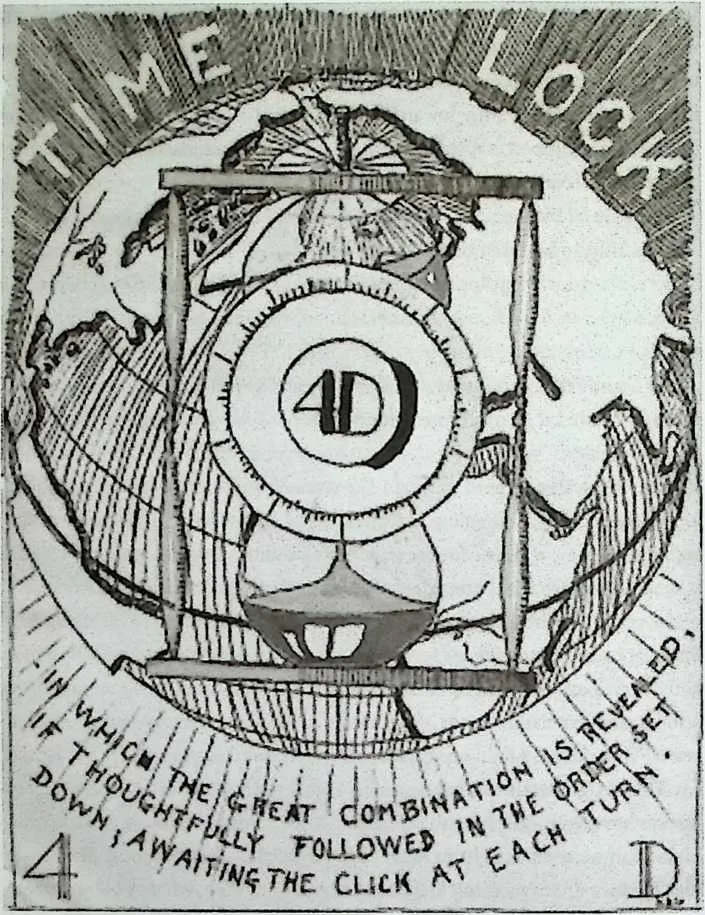 © Estate of R. Buckminster Fuller. All rights reserved. Used by permission. Source: Special
Collections, Stanford University Libraries.
© Estate of R. Buckminster Fuller. All rights reserved. Used by permission. Source: Special
Collections, Stanford University Libraries.
45 The program Fuller was attempting to articulate in this formative period suggests a man out of time. The absence of the requisite technical infrastructure—materials and manufacturing—left many of his potential backers feeling that Bucky was, at best, an ungrounded visionary, while his mystical appeals to ‘‘the Cosmic Trinity of Stability’’ (the theological counterpart to his beloved triangle) and his bizarre iconographic drawings recalled for others the secret guilds of the Middle Ages and the microcosms and macrocosms of the renaissance magi (fig. 2.2).
46 Just as his 4D houses were designed ‘‘from the inside out,’’ so he hoped to
begin with the house—‘‘the last primary area of man’s activity yet to come importantly
under the effect of the industrial equation’’—and redesign the whole of society from the
inside out. Demographic trends alone make a solution to the housing crisis imperative,
he argued, but once it is correctly addressed, Fuller blithely predicted that society’s
remaining problems ‘‘will practically solve themselves.’’ Properly understood not as a
structure but as ‘‘philosophy …mechanically applied,’’ 4D would put an end to the
drudgery of housework and ‘‘the bunkum of archaic design and assininic aesthetics’’
but
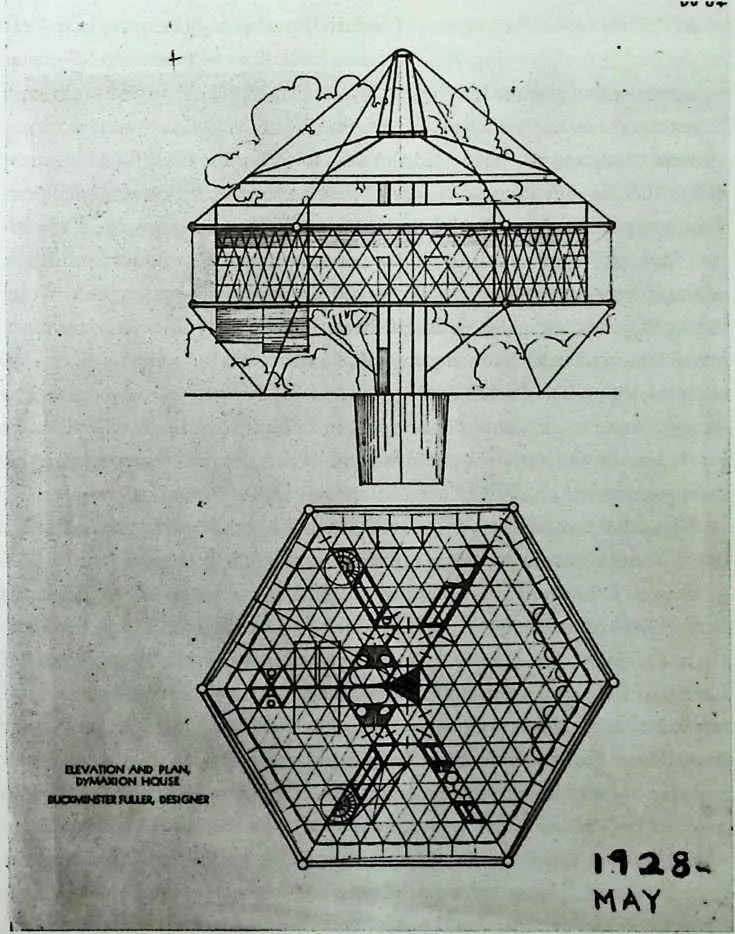
48 Figure 2.2 ‘‘Elevation and Plan, Dymaxion House’’ (1928). This extraordinary image was published by the Harvard Society for Contemporary Art some months before Fuller would deliver ‘‘my first lecture in a real auditorium’’ (R. Buckminster Fuller to Anne Fuller, March 3, 1930 [Fuller MSS, M1090:2:56:12]).
49 © Estate of R. Buckminster Fuller. All rights reserved. Used by permission. Source: Special Collections, Stanford University Libraries. also to the derivative social afflictions of unemployment, poverty and crime: ‘‘With so much time and such perfect privacy of the most minor member of the family, the minds will be turned to a more philosophical and rhythmical contemplation of life.’’23
50 Bucky labored feverishly to wrestle the two thousand pages of notes he had accumulated into presentable form and was given the incentive to do so by the American Institute of Architects (AIA), whose annual meeting was held in St. Louis in May 1928. Before a small group of eighteen attendees he alluded to Lindbergh’s conquest of the spatial universe and called for ‘‘a new spirit of individualism, delivered of its last material impediment of self-consciousness, [to] fly forth from St. Louis once more, this time, to girdle the temporal universe.’’24 Thus would the prowess of industrial technology be brought to bear on the problem of housing. His reception, by Fuller’s own estimation, was as rapturous as that given to Lindbergh the year before; as he reported to a friend, ‘‘The remarks on the philosophy, literary value, etc. as well as the subject matter were enough to arouse the old ego were it not for the frightful seriousness of it all.’’25 The official proceedings of the meeting record a rather different view, however. The president of the AIA himself felt moved to write a resolution ‘‘Against All Standardization,’’ which sought to dispose once and for all of the specter of the factory-built house. Anticipating the arguments of the Critical Regionalists in the 1980s and the anti-Globalists of the 1990s, the resolution lamented that ‘‘local characteristics are fast disappearing in this era of common thought and mechanical advancement. Communities are coming to look more and more like peas of one pod, and a certain commercialism is making itself more and more evident in the type of architecture universally enjoyed throughout the country.’’26
51 This rebuke was enough to turn the AIA, in his eyes, from ‘‘a selected group of the country’s leading architects’’ into a self-appointed clique of ‘‘feudalistic’’ potentates. Other potential allies did not fare much better. After workers in Donald Deskey’s office accidentally rammed a sofa into a model of the Dymaxion house (which had been unceremoniously relegated to a storage room), the Industrial Designers were summarily demoted from prophets of the new age to a mercenary cabal of style-driven hucksters and charlatans. Fuller distanced himself from the financial community, which became little more than a scheming plutocracy, and dismissed the American Technocracy movement as the idle daydream of a bunch of unemployed engineers.27
52 Unfazed by these mounting indignities, Fuller had his opus printed and bound and mailed it out to ‘‘some 200 men and women of high public esteem.’’ His detailed logs confirm that the vast majority of them did not respond at all, including—doubtless to his great astonishment—such intellectual soul mates as Bertrand Russell, Albert Einstein, and Henry Ford. Some at least acknowledged receiving it, including the president of Harvard University, to whom Fuller presented himself as a fifth-generation Harvard man; it was nonetheless returned the same day with the apology that ‘‘President Lowell is far too busy at this time of the year to give it the attention it may deserve.’’28 Others thanked him and promised a detailed response ‘‘at the earliest possible moment,’’ and a few—including his increasingly alarmed father-in-law—seem to have made an honest effort to get through it: ‘‘Possibly there is something in Mr. Fuller’s idea,’’ wrote a prominent advertising executive whom Bucky had hoped to enlist to the cause, ‘‘but it is so well concealed in his language that I have not discovered it.’’29
53 During this period Fuller assured his friends and relatives that he was only a few weeks, a few months, or at most a few years from single-handedly completing the final stage of the industrial revolution. His obstinacy is to his credit and may, in fact, have been the trait that saw him through this period of precarious mental instability. From ranting to his father-in-law about machinery as ‘‘the one and only Messiah’s gift…for the salvation of the spirit in mankind’’ to his unreal assurance to a correspondent that ‘‘you may count [this] as the greatest letter which you will have ever received,’’ to his unsettling boast that ‘‘the time-relativity discussion was quite equal to Einstein’s,’’ it is apparent that his personal situation was fragile in the extreme.30 In the face of public indifference and professional repudiation, he stubbornly maintained that ‘‘those who have read deeply into 4D have found their appreciation of life and its progression vastly improved, and in the void a new, fuller and happier sense of mental poise and purposefulness than they have ever had before.’’31 Obviously, Buckminster Fuller is speaking here of his own aspirations: the ‘‘fuller’’ sense of mental poise he longs for, together with his frequent warnings about the devastating effects of ‘‘buck-passing which has, through each age, selfishly retarded progress,’’ suggest the depths of his personal crisis.
54 Conclusion
55 By 1930 Bucky had regained his own sense of ‘‘mental poise and purposefulness,’’ though he remained eccentric and iconoclastic to the end32 By this time there were growing numbers of inquiries, lecture invitations, press notices, and a widening circle of friends, and it is clear that he was beginning to gain a hearing. But the long shadow of 1927, Bucky’s annus mirabilis, hung over him: it reveals itself in the unresolved tension between mechanical idea and social reality that would be at one and the same time the hallmark of his genius and the limiting factor to it.
56 There is no issue to which Bucky was more sensitive than that he had somehow ‘‘failed’’—as if this charge rekindled the feelings of self-doubt that were burned into his psyche in 1927.33 Thus his constant recitation of his accomplishments and his continual reimagining of his story. But if he was not a failure, neither was he a success by any reasonable measure—or even by his own unreasonable one! Bucky’s lifelong campaign was not to invent a new kind of house, car, or map. It was to use his ‘‘anticipatory design science’’ to complete what might be called ‘‘the unfinished project of industrialism,’’ and this he manifestly did not do.34 It is not enough to point to his collection of honorary doctorates or to three hundred thousand geodesic domes scattered about the globe, from the northern Greenland of NATO to the Moscow of Khrushchev and Nixon to the fairgrounds of Montreal’s Expo 67 to the communes hidden away in the Santa Cruz mountains. An honest reckoning would have us ask why there are no domed communities in downtown Detroit or suburban Chicago; why Americans still drive to their neighborhood grocery stores in modified military assault vehicles rather than three-wheeled Dymaxion teardrops; and why ‘‘Synergetics,’’ rather than such parochial disciplines as mechanical engineering and economics, is not taught in our universities.
57 Bucky did not suffer from a failure of vision—there is scarcely a more visionary figure to be found in the annals of twentieth-century thought. But the gap between idea and reality that opened up in 1927—and the colossal demands of what his friend and admirer Hugh Kenner delicately referred to as ‘‘Bucky’s highly mobilized ego’’35—prevented him from making the concessions that might have permitted the best of his ideas to gain traction. Bucky boasted that he had ‘‘a genius for getting into trouble and then getting out of trouble when I had been displaced and moved into an area where there was something I could get hold of, like a piece of machinery. Anything you could weigh or feel or apply yourself to was fine, but not the dealings with the patterns of arbitrary customs?36 This sounds self-servingly romantic, and it is true that literature has always favored the lone hero who stands up to custom and convention. But Bucky’s lifelong preference for the clean objectivity of machinery over the ‘‘arbitrariness’’ of human behavior must also be seen as the incapacity that prevented the revelations of 1927 from moving from a quasi-religious epiphany to an actionable plan. Kenner, attentive to the generative metaphor that runs through Fuller’s work, refers to the Dymaxion plan as ‘‘the stillbirth of an industry.’’37
58 Too much of the secondary literature—one is tempted to say all of it—reads backward from the astonishing creativity and preternatural determination that marked Bucky’s lengthy career, and he most assuredly did so himself. Reading
59 ‘‘forward,’’ however, one finds that the picture does not resolve itself so easily into tidy little hexagons. The voluminous documentation of the Chronofile simply does not support Fuller’s oft-repeated claim that in 1927 he conceived a deliberate plan to conduct his life as an experiment in ‘‘how much the contemporary individual might be able to effect.’’ To the contrary, the record suggests a period of capriciousness, confusion, and calamity. It was also, however, a period of indisputably great creativity that opened onto all that would follow. He would live the rest of his extraordinary life, like one of his own tensegrity structures, suspended between these two poles.