
4 Paper Mausoleum: The Archive of R. Buckminster Fuller
2Hsiao-Yun Chu
3 One first opens a box from the R. Buckminster Fuller archive with the voyeuristic anticipation of peeking into the personal papers of a misunderstood genius. But this expectation begins to fade as one becomes lost in a sea of ephemera: receipts, thank-you notes, business cards, form letters, and newspaper clippings. For a researcher the promise of absolute completeness quickly becomes tempered by the frustrations of excess. The Fuller archive comprises some fourteen hundred linear feet of material and seventeen hundred hours of recordings. It is by far the largest archive of a single individual ever processed at Stanford, if not in the country, and it would take years, if not decades, to go through this collection. Although it has been consulted by researchers and marveled at by visitors, the archive has not been treated in any depth as a research subject per se. Yet it is a central phenomenon in Fuller’s story, arguably the most important ‘‘construction’’ of his career, and certainly the creative masterpiece of his life.
4 Fuller had multiple reasons for organizing and maintaining his massive collection—some obvious, stated, and professional; others intrinsic, unstated, and personal. As a young man he foraged into his own family history to complete a detailed record of his ancestry; in parallel, he began to save almost every piece of paper that crossed his desk in order to construct an exhaustive chronology of his own life. The archive became a repository of technical information, a personal library that lent intellectual credibility to his unconventional design projects and helped to buffer the sting of his early intellectual failure, having been firmly expelled from Harvard as an undergraduate. Increasingly, the archive became more polyphagous, ingesting not only every piece of paper touched by Fuller, in chronological order, but newspaper clippings, recordings of speaking engagements, and student projects related to his work. By the time of his death in 1983, the archive contained tons of papers, thousands of hours of audio and video footage, and hundreds of models and assorted artifacts. By investigating the complex and changing set of reasons that compelled Fuller to maintain this huge collection across the decades of his life, often at significant cost and burden to himself, we will come to a better understanding of Fuller’s character and gain a greater appreciation for how the archive both authorized and personified its maker.
4.1 Organization of the Fuller Archive
5At the heart of the Fuller archive is the ‘‘Dymaxion Chronofile,’’ a chronological arrangement of outgoing and incoming personal and business correspondence, receipts, greeting cards, business cards, and the like. Fuller began collecting documents at an early age, including newspaper clippings, letters, and other items that evidenced ‘‘the wonders of ‘modern’ technology.’’1 He began to formally order his papers in 1917 and, some years later, would christen his collection the Dymaxion Chronofile.2 According to Fuller, his choice of a chronological arrangement was influenced by his service (beginning 1917) in the U.S. Navy, when he realized the value of keeping accurate operating records organized in a fashion that would be easily accessible? A chronological arrangement obviated the need to remember precise names or details. To find a record, one need only recall the approximate time in the past that an event had happened; by working forward and backward from that point, the information could be located fairly quickly. Time provided an unbiased, linear metric for arranging records of events.
6 Fuller presented the Chronofile as an objective and accurate file documenting the life of a human being starting from the Gay Nineties and moving forward into a very different and much faster-paced century. ‘‘I decided to make myself a good case history of such a human being and it meant that I could not be judge of what was valid to put in or not. I must put everything in, so I started a very rigorous record,’’ said Fuller in 1962. ‘‘I thought it might be interesting if I took …everything, not just culling out the attractive aspects of my life, but really keeping the whole records—most of which was not so attractive, and putting it all into chronological order.’’4 Although the Chronofile was the earliest organized portion of Fuller’s papers, over the decades his archive grew to include manuscripts, newspaper clippings, video and audio recordings, and photographs. With the exception of photographs, most of these sections were basically chronologically ordered as well.
7 The democratic way in which Fuller treated the ephemera of his life—each letter, scrap, pamphlet, and clipping—is admirable in its objectivity. Still, one wonders what compelled this man to save everything, especially considering that Fuller himself conceded that much of the material was not ‘‘attractive.’’ Furthermore, the archive seems to fly in the face of Fuller’s insistence that designers and humankind in general must move toward ‘‘ephemeralization,’’ namely ‘‘the principle of doing ever more with ever less, per given resource units of pounds, time and energy,’’ in order to reach the necessary efficiencies to support all humanity.5 How could a person who advocated stringent resource management and judged a building based on its volume-to-weight ratio justify his lifelong maintenance of a gargantuan file that was neither light nor efficient? At the time of Fuller’s death his former archivist estimated the weight of the archive to be ninety thousand pounds.6 Ironically, in all its massive glory, the archive itself suggests quite another definition for ‘‘ephemeralization’’ than that intended by Fuller—namely, ‘‘the willful construction of a seemingly vast collection of ephemera.’’
4.2 Origins of the Archive
9Professionally and publicly, Fuller presented his archive as an invaluable research collection. ‘‘The R. Buckminster Fuller collection of life’s work constitutes a vast amount of Raw Material, in many different physical forms,’’ wrote Fuller and his staff in a document describing the archives in 1965.7 ‘‘I decided in 1917 to contribute to the scientific documentation of the emergent realization of the era of accelerating-acceleration of progressive ephemeralization.’’8 According to his accounts, Fuller had undertaken this large archiving task primarily for the benefit of humanity, to create a comprehensive repository of information documenting the revolutionary changes wrought by the twentieth century. However, given that the archive is clearly specific to the life of R. Buckminster Fuller himself (as opposed to that of any other human being born in 1895), can it really be said to be objective? Embedded in the archive is the assumption that Fuller’s life per se is worth representing. The 1965 document is, in fact, woven on the warp of Fuller’s ego. ‘‘The collection could be likened to the papers of a renaissance man],] a true comprehensivist such as Leonardo Di Vinci [ sic], but for one large factor; no one knows what of Di Vinci’s papers were lost or destroyed because they were thought insignificant in an age of many comprehensivists. Everything remains of Fuller’s work because he saw to it.’’9
10 That the supposedly objective archive was clearly subjective belies one of Fuller’s peculiar attributes; the coexistence of hubris and humility. Fuller was a self-made man and a tireless self-promoter, but he tended to disarm people with his unselfconscious, even self-deprecating, style. He often referred to himself as ‘‘Guinea Pig B,’’ a test creature whose life was an experiment aimed at discovering what one individual could do to help all of humanity; yet the idea of saving every last scrap that crosses its path in order to document this experiment is a rather grandiose conception for a guinea pig. This is not to discount the value of this collection; Fuller’s archives do indeed record significant events of the twentieth century as seen through the lens of his activities, and he corresponded with many interesting people.10 Still, the idea that the archive was an ‘‘objective’’ lab notebook must be taken with a grain of salt. It is perhaps more objective to say that the archive was a (self-)conscious arrangement, formed with the understanding that every piece of paper that came into Fuller’s world must be filed and saved. The amassing of the archive was a lifelong creative act that can easily be seen as a masterpiece of conceptual art. In the end the archive is both ‘‘everyman’s’’ collection (in that it is made up of the common, mundane ephemera of twentieth-century life) and the work of a specific individual, who hallmarked the collection by the very act of creating it.
11 It is telling that the first section of the archive, in keeping with the organization imposed by Fuller and his archivists, deals with Fuller’s family history. Chronologically, it makes sense that these materials would come first; family history was an important psychological foundation for Fuller. He drew confidence from the stories of his ancestors, several of whom were notable individualists. His great, great, great, great, great grandfather, Lieutenant Thomas Fuller of the British Navy, came to America on leave in 1638 and settled in New England, excited by the possibilities of the new country.11 Fuller’s Massachusetts ancestors included four generations of Harvard men (an unbroken line until young ‘‘Bucky’’ came along), among them influential lawyers and chaplains in the Boston area. Fuller was especially interested in the story of his great aunt Margaret Fuller (1810–50), a prominent New England transcendentalist who, together with poet Ralph Waldo Emerson, founded the literary magazine The Dial. She moved to Europe in 1846 and became the first female foreign correspondent to work for a major newspaper, the New York Tribune. The family history files in the Fuller archive include letters that Fuller exchanged with archivists and local historians; photographs of portraits of his ancestors obtained from the archives of churches in Cambridge, Massachusetts; and the like. Family history remained one of Fuller’s passions throughout his life. In 1927, on the birth of his daughter, Allegra, Fuller compiled and privately published a detailed family chronology called the Record of the Direct Parentage ofAllegra Fuller, hoping to instill in his daughter the same pride of lineage that he had. In 1983, the year of his death, Fuller hired the Debrett Ancestry Research to research the life of Lieutenant Thomas Fuller in more detail.
12 On this foundation of family history Fuller began to build his paper bulwark. He began systematically saving and filing his papers and correspondence in 1917. The name Dymaxion Chronofile was likely given to this set of papers in or after 1929, when the word Dymaxion, a combination of the words dynamic, maximum, and tension, was coined for an exhibition of Fuller’s model home of the future at Marshall Field’s department store in Chicago.12 Initially the Chronofile consisted of various personal and business papers bound into handsome, leather-backed volumes.13 Eventually, it became too expensive and space-intensive to produce volumes; from about 1940 on, many of the papers were left unbound, in folders, and newspaper clippings were kept separately from correspondence. From about 1973 to 1983, carbon copies of Fuller’s outgoing correspondence were kept in a separate file. Audio- and videotapes and film reels were also added to the collection. In its current state the Fuller archive consists of twenty-three distinct series, the largest and most important of which remains the Chronofile.
4.3 The Archive as a Support
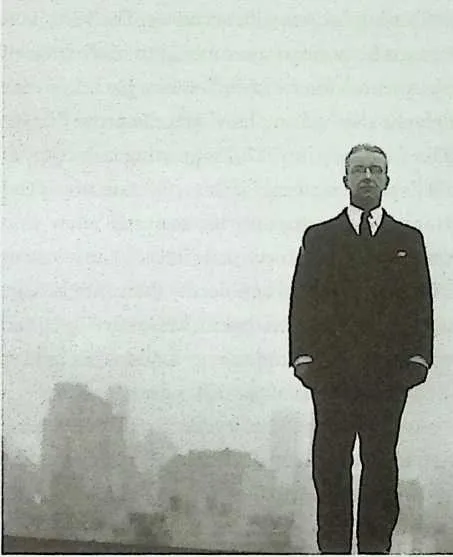
14Fuller recounted many times over the defining moment of his life. It was the winter of 1927, and he had suffered serious professional and financial failures and the death of his first daughter, Alexandra. A new daughter, Allegra, was born in August 1927. Unemployed and desperate, Fuller felt that he might be worth more to his young wife and daughter dead than alive; he had a good life insurance policy, after all. Fuller wandered to the icy shores of Lake Michigan, ready to take the last swim of his life. We may never know fully the actual details of this lonesome struggle because as the story was told and retold over the years, it attained mythic proportions. From the depths of his despair, Fuller describes being lifted several feet off the ground by an invisible force. He heard a voice telling him he had no right to eliminate himself; rather, it urged him to think the truth and follow it. In the wake of this spiritual revelation, Fuller nominated himself as the test case for an experiment aimed at discovering what one relatively average individual could do to better the world for the future. After his epiphany Fuller lunged into an almost desperate frenzy of activity to fulfill his new mission. The late 1920s were an extraordinarily prolific period of writing, sketching, and personal work, wherein one finds the seeds of much of Fuller’s later work (fig. 1.1).
15 Although Fuller rebounded from the Lake Michigan experience in a highly charged creative mode, it is important to note that the revelation that changed the course of his life emerged from an abyss of self-doubt and fear that had been with him, in varying intensities, for much of his life. Fuller was plagued by deep insecurities, in part the product of his not-so-carefree youth. Until the age of four Fuller suffered from undiagnosed but severe nearsightedness and experienced the world as a fuzzy fog of moving forms. His images of reality never matched up with those described by his siblings, so he invented colorful
17 tall tales about what was going on around him, believing that his siblings were doing the same.14 When he finally received prescription eyeglasses at age four, he experienced a completely new reality that rendered his past a false impression. In 1907, when Fuller was twelve, his father suffered a debilitating stroke, and the young adolescent watched him turn from a healthy, successful businessman to a frail, disconnected invalid. Undoubtedly, the loss of his father three years later was a traumatic experience for the young Fuller. He entered Harvard in 1913, but his first year was quite frustrating as he failed to gain entry into any of the prestigious social clubs. To compensate, Fuller tried to distinguish himself athletically and joined the football team, but a knee injury he suffered during practice took him out of the game. He was expelled from Harvard in 1914 owing to poor performance but readmitted several months later, only to be expelled for the second and final time in 1915. In 1922 his first daughter, Alexandra, died of spinal meningitis, and Fuller, who was scraping together a living, felt that he was partly to blame for failing to provide a better home environment for her. He was prone to drinking heavily over the next few years and never quite overcame his regret. In 1926 Fuller lost his job as head of the Stockade Corporation, a building firm that he had helped his father-in-law, James Monroe Hewlett, to found four years earlier.15
18 Figure 1.1.
19 R. Buckminster Fuller in New York, a 1929.
20 Source: Special Collections, Stanford University Libraries.
21 In general, Fuller was a gregarious character and seemed to bounce back from adversity time and again, offsetting failures with successes. The 1927 incident at Lake Michigan was the closest he came to succumbing to his feelings of self-doubt. Although an invisible spiritual force had pulled him back from the brink of self-destruction that night, he also had ample evidence to prove that his life had not been a complete failure. Already in 1927, his growing collection of papers had begun to assuage Fuller’s pervasive fears: ‘‘it [his collection of papers] persuaded me ten years after its inception to start my life as nearly ‘anew’ as it is humanly possible to do,’’ wrote Fuller nearly forty years later.16 The constant task of recording events about himself had served to objectify them, not as fears or successes but as part of the experimental process that he, as Guinea Pig B, had undertaken. Although in conventional social terms he may have been a failure, this became irrelevant within the larger scheme of the lifelong scientific experiment, as the conducting of the experiment itself was a success. His burgeoning laboratory notebook suggested to him that he usually achieved more when he followed his own lead rather than when he tried to conform to ‘‘everybody else’s pre-fabricated credos, educational theories, romances, and mores.’’17 Thus it was the Chronofile itself that provided evidence for him to reshape his life and reaffirm his priorities in his darkest hour.
22 Furthermore, although the Chronofile was ‘‘scientific’’ in its conception, it held for Fuller enormous personal and emotional value. After all, it contained not only business correspondence and technical notes but also love letters from his wife, photographs, and notes from dear friends. Symbolically, through papers, words, and images, it stood as a powerful monument to his own self-worth.18 As such, it was a real source of security and self-esteem.
23 Throughout Fuller’s career the Chronofile supported him not only emotionally but also professionally. In effect, Fuller was building a sizable ‘‘research library’’ around himself, which put him on par with the academic world that had once rejected him. The Chronofile lent credibility to his work and helped to validate its importance. When critics questioned his seemingly far-flung ideas about housing and transportation, he would point to his mounds of evidence, data collected, letters exchanged, and work done. Indeed, it was difficult to argue that Fuller’s ‘‘scientific’’ methods might be flawed, when he had forty-five tons of papers in tow to the contrary.
24 After 1927, knowing that he was not a success by conventional standards, Fuller chose his own metrics by which to measure his worth; he drew his own stock charts, not according to amounts of money but amounts of paper. From 1947 to 1981 Fuller’s office staff kept a ‘‘Dymaxion Index,’’ a bibliography of published news items about Fuller and his work that was updated by his office on a regular basis. The index also contained schedules showing Fuller’s lecture activities year by year and chronological lists of the projects he had worked on. The ‘‘Dymaxion Index’’ was used to create graphs such as ‘‘Major News Items About R. Buckminster Fuller,’’ which shows progressively larger peaks over time into the hundreds (fig. 1.2). Such graphs were updated regularly, based on the bibliographic entries in the ‘‘Dymaxion Index.’’ Similarly, Fuller kept charts of the ‘‘Dymaxion Chronofile Correspondence.’’ One example dating from 1975 has a solid line showing about ninety-four hundred incoming and outgoing letters in the year 1974, and a dotted line showing a cumulative lifetime total (1895–1975) of close to one hundred thousand items (fig. 1.3). Fuller’s office staff would often include copies of such charts in letters to newspapers, publishers, and universities as visual proof of his social and intellectual importance.
25 The skyrocketing ‘‘correspondence’’ totals in Fuller’s charts make an impressive point. These numbers should be revisited, though, in light of the fact that Fuller had his office staff file and reply to even the most mundane incoming letters and to keep a carbon copy of the reply. The archive contains hundreds of inquiries about where one could purchase Dymaxion maps, for example, and carbon copies of the standard responses. Alumni letters soliciting contributions to the Harvard Fund were saved, as were the thank-you notes that he received from the Alumni Association. During the 1960s Fuller’s office staff contacted literally thousands of manufacturers and suppliers to compile an inventory of the world’s resources. Each outgoing request for information, and each incoming cover letter and brochure or catalog, would be saved in the archive. In other words, the correspondence files of the archive are more impressive in number than in actual content.
26 While the early decades of the Chronofile (1920s—30s) are dominated by personal letters from his wife, Anne, and business items, the later years of correspondence (1960s—80s) contain thousands of letters that Fuller himself neither personally read nor wrote. The archive ballooned over time, as it included not only Fuller’s personal work but also projects that his office staff were working on. As such, the archive became large enough to shield not only Fuller but also his staff from the skepticism that invariably accompanied their projects. In 1970, for example, Medard Gabel, a student of Fuller’s who worked tirelessly on the World Game project, spoke passionately to his audience, ‘‘ ‘We can make everybody in the world a success by 1980 and we have the proof to back it up,’ he said. ‘So when we say that air pollution could be eliminated from Spaceship Earth by 1980, that’s exactly what we mean.’ ’’19 The ‘‘proof’’ that Gabel was
27 NUMBER OF MAJOR ITEMS EACH YEAR
28 U.S. Naval Reserve Activities Early Flying Activities
29 > Stockade Building System
30 4D Philosophy - En/Syn Geometry - Chicago
31 Dymaxion House - Art Exhibits, Lectures
32 Greenwich Village - Philosophy Testing
33 ****-~Shelter Magazine
34 Dymaxion Car - Bridgeport New York - Connecticut
35 Washington - Chicago
36 Phelps Dodge Research - Economic Charts - New York
37 Dymaxion Bathroom
38 ‘‘Nine Chains To The Moon’’
39 - Fortune Magazine - Economic Charts
40 Dymaxion Deployment Unit - Butler Mfg. Kansas City - New Board of Economic Warfare - Washington, D.C. Dymaxion Map - Life Magazine New York - Washington
41 Energetic Geometry - Industrial Brazil - Wash.,
42 Fuller House - Beech Aircraft
43 York
44 D.C. - USA
45 - Wichita, Kan;-
46 - Fuller Research Foundation - Wichita, Kansas
47 En/Syn Geometry Models - Geodesic Domes - Forest Hills Black Mountain College
48 231 University Projects around the world
49 Ford Motor Co. - Geodesic Domes U.S.M.C. and Radomes
50 U.S. Trade Fairs - Geodesics
51 Nuclear Identity
52 South Africa - Around World - En/Syn Geo Moscow Fair-Marks' Book - Professor So. Ill. World Traveling - Univ., Domes, Japan Scientist Lectures International Union of Arch. Students World Redesign proposal by BF X
53 n/Syn Geom. & Virus Identity, Harvard Chas. Eliot Norton Prof, of Poety ive of BF's books published, Economics, Philosophy, MathJ* Science-Gen Bus ine Cover Story-Saturday Review Series & Govt. Consultation
54 ch US Pavilion 1967 Montreal World’s Fair w£--New Yorker-profile,Sat.Review, cover story, eynoter to annual congresses of m?gallurgistSch01-ar P0- 4 ?e1°S SPosions' eographers, planners,medics & businessmen. ■
55 Figure 1.2
56 Major News Items about R. Buckminster Fuller, compiled by Fuller’s office staff, 1917–67.
57 © Estate of R. Buckminster Fuller. All rights reserved. Used by permission. Source: Special Collections, Stanford University Libraries.
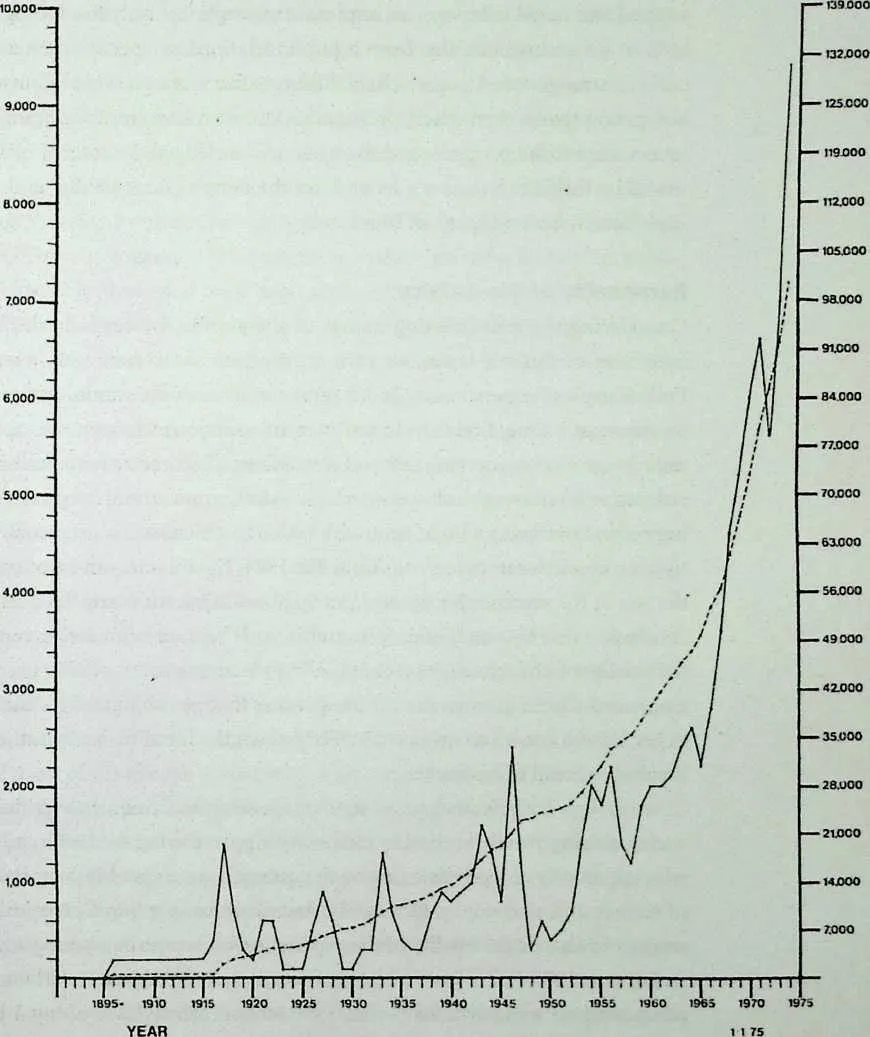
59 Individual Letters Received. Answered H Initiated Annually (solid line)
60 Figure 1.3
61 Chronofile correspondence, 1895–1975.
62 © Estate of R. Buckminster Fuller. All rights reserved. Used by permission. Source: Special Collections, Stanford University Libraries.
63 referring to here was the piles of papers generated by the World Game project and the endless files related to the inventory of world resources.
64 Fuller’s insistence on leaving a paper trail and answering every inquiry with a typed and dated letter was an important strategy, not only for adding to the bulk of his archive but also from a public relations perspective. Letters from curious strangers and eager schoolchildren alike were answered courteously and promptly—a throwback, perhaps, to Fuller’s Victorian upbringing when letters were to be properly and formally acknowledged. In return, recipients would be thrilled to receive a letter from the famous Bucky Fuller and would likely remember and speak of him fondly.
4.4 Personality of the Archive
66Considering the ever-inflating nature of the archive, particularly during the latter half of Fuller’s career, we cannot help but notice how well it reflected Fuller’s expansive personality. In his public lectures Fuller was known to speak for hours at a time, tirelessly, in a stream-of-consciousness style. His speeches mixed together engineering talk and discussions of geometry with personal anecdotes and philosophical meanderings. ‘‘Always unhurried, he gives you the impression of having a lot of time with which to articulate his perpetually multiplying ideas,’’ wrote Science Illustrated in 1944. ‘‘If you miss out on one phrase, the rest of the sentence becomes unintelligible. This leads many listeners to the conclusion that his talk is mainly nonsense, or at best, an engineering version of the stream-of-consciousness technique.’’20 Indeed, sometimes Fuller became so embroiled within his own marathon speeches that he subjugated his biological urges; he was known to urinate discreetly down the leg of his pants rather than break the thread of his musings.
67 Although Fuller’s unchained style of speaking was frequently criticized, it was surprisingly well-received by university hippies during the 1960s and 1970s, who apparently enjoyed listening to the quixotic guru spin his personal blend of science and philosophy. Ostensibly, the use of various mind-expanding aids served to enhance the totality of the experience for many of his young admirers. In January 1975 Fuller gave a series of lectures over the course of two weeks, amounting to a historic forty-two-hour session called ‘‘Everything I Know.’’ Each individual lecture lasted some four to five hours, and people would drift in and out of the auditorium while Fuller rambled on. Around the twenty-hour point, Fuller spoke of the ‘‘total experience’’ that his audience would have if they stayed for the entirety of the ‘‘Everything I Know’’ marathon. ‘‘I think we’re going to have the total experience. If we get to the end of the time, I’m quite certain that I’m not going to be withholding from you some of the things that I feel are all this important interrelatedness, because I do come into you time and again with new kinds of thrusts, and yet you find everything getting back into the same fundamental world. It really gets more and more thrilling.’’21 With similar sexual undertones Fuller describes how his expansive ideas will fertilize his audience, until eventually everything and everyone is interrelated.
68 These themes of continuous expansion and interconnectedness are hallmarks of Fuller’s ‘‘comprehensive’’ thinking. The idea that everything in the natural world is interconnected, and that by understanding local activity one can uncover the fundamental principles of the universe, is central to Fuller’s mission as a ‘‘comprehensive anticipatory design scientist.’’ Fuller described himself as a nonspecialist who addressed the universe as a whole and who had the rare ability to think objectively and on a large scale. Whereas other people concerned themselves exclusively with local projects and problems, Fuller thought in ‘‘comprehensive’’ or universal terms. His expansive speeches, which spun out to discuss integrity, humanity, and ultimately the function of ‘‘man in [the] universe,’’ seemed to transcend the mundane limits of ‘‘realistic’’ thinking. With eyes closed and hands clasped, as he often faced his audience, the stubby, impassioned Fuller resembled an oracle whose cryptic, rambling speeches suggested some connection to a larger spiritual force (fig. 1.4). Presumably, this expansive attitude also stoked Fuller’s sense of self-worth, because it claimed for him the ‘‘prerogative(s) of limitless self-extension, what we might call ‘cosmic significance.’ ’’22
69 Likewise, the Fuller archive shared the comprehensive, expansive nature of its creator, providing tangible proof of his ‘‘cosmic significance.’’ In 1965 Fuller wrote that ‘‘the subject matter of the collection covers a very broad spectrum, practically all areas of human knowledge.’’23 During the 1960s and 1970s Fuller devoted most of his time to giving lectures around the world.24 He maintained an incredibly ambitious travel and lecture schedule, pollinating the globe with his ideas and eventually becoming a household name. At home the archive likewise continued to proliferate, ingesting papers and swelling in size under the stewardship of his cadre of administrative assistants.
70 Fuller’s insistence on comprehensiveness and his time-dependent filing system amount to a totalitarian system of control over the arrangement of the archive that denies any assignment of value, in spite of the fact that a majority of the papers are of only nominal interest. At the same time, the archive seems to fulfill Fuller’s pet notion that by investigating local phenomena, one can discover universal truths. The archive takes one life and documents it as thoroughly as possible; this microcosm validates the general observation that ‘‘life is made up of a great number of small incidents and a small number of great ones.’’25
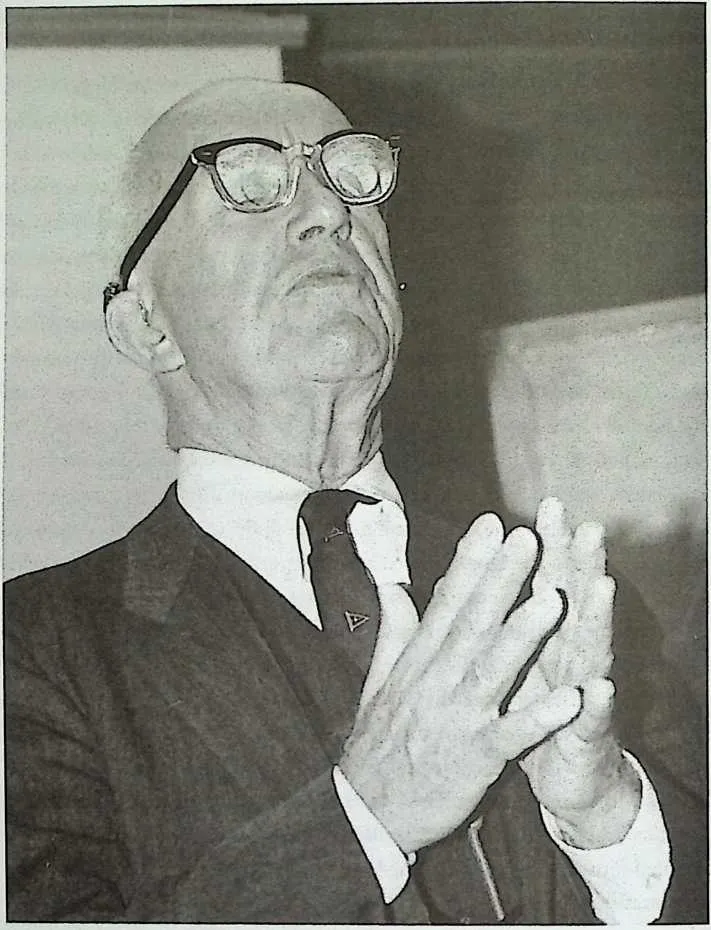
72 Figure 1.4
73 R. Buckminster Fuller lecturing. Photo by A. Mikkelscn.
74 Source: Special Collections, Stanford University Libraries.
75 Fuller’s Legacy
76 We have seen how the Fuller archive provided emotional support and academic credibility for its creator, how it embodied his expansive nature, and how his insistence on comprehensiveness led to an archive of immense proportions. Besides the professional and the personal, there were also practical considerations surrounding the collection. Throughout the years its care and feeding created considerable expenses for Fuller himself. In 1959 Fuller was invited to become a research professor at Southern Illinois University at Carbondale (SIUC) by then-president Delyte Morris. Fuller brought a certain amount of prestige to the university; divested of formal teaching responsibilities, he had carte blanche to pursue research and to travel as much as he wished. But one of the main perks of his position at SIUC, where he worked from 1959 until 1970, was to establish a home base for his burgeoning archive. The university agreed to pay for storage of Fuller’s papers and for a half-time salaried assistant to administer the collection.
77 Eventually, SIUC was supposed to become the permanent home of the Fuller collection. As early as 1960, he wrote to Dr. Ralph McCoy, SIUC’s director of libraries, that he would be willing to give to the library (1) the Dymaxion Chronofile; (2) published and unpublished manuscripts; (3) drawings and photograph files; and (4) the complete collection of all published clippings concerning his work, provided that certain stipulations were met. Among others, the conditions were that the papers be housed under lock and key in the Rare Books division of the library; that the Chronofile would not be accessible to the public (owing to the ‘‘intimate, personal’’ nature of some of the documents within) until some specified future date; and that microfilms be made of all the clippings in the collection, and a copy of the masters given to Fuller.26 The collection as described was valued at $15,000; Fuller intended to use this figure for a tax deduction after making the final gift.
78 In a letter dated May 5, 1965, Dr. McCoy confirmed that Fuller’s papers were being ‘‘housed in the vault of the Rare Book Room, which is kept locked at all times and to which only the rare book librarian has the key.’’27 Clippings were being microfilmed, and approximately eighteen hundred drawings and prints had been cataloged as of May 1965.28 Even so, Fuller’s papers extended beyond the walls of the library. Fiscal records from 1964 to 1965 show that the university was expending $3,000 per year on administrative salaries and $2,700 on space rental to accommodate Fuller’s additional papers and project files.29
79 The collection remained in SIUC’s Morris Library until 1971, but, in spite of the original agreements, it was never actually gifted to the university. In 1970 Fuller’s relations with SIUC, which had been his professional home longer than any other institution, began to sour. The Vietnam War, and especially the Kent State riots, in which four antiwar students were killed by national guardsmen, had made the students increasingly restless. Students at SIUC responded with riots of their own, forcing the chancellor to shut down the university for several days starting May 12, 1970. President Delyte Morris, who had brought Fuller to Carbondale, faced widespread criticism for having handled this emergency poorly, and he stepped down a few months later. Many of Fuller’s longtime associates, including chief counsel John Rendelman and Dean Bernard Shyrock, also retired or left the university at this time. By 1971 the new administration, which had suffered great financial setbacks because of low enrollment, did not have the discretionary funds to support Fuller’s plum research professorship.30
80 Adding insult to injury, in 1971 Fuller had a major falling-out with Tom Turner, an administrator who had been chosen by the university to oversee and administer Fuller’s projects a few years earlier. In various memos Turner commented on the ‘‘bizarre antics’’ of Fuller’s assistants and their ‘‘total disregard of or lack of understanding of academic protocol.’’31 He also wrote of Fuller’s problems ‘‘accepting guidance from administrators’’ and his ‘‘need to ‘unsettle organizational authority and structure.’ ’’32 Fuller went straight to the university’s board of trustees, asking that Turner be reassigned immediately, and was offered an apology by the board. Even so, this incident confirmed Fuller’s conviction that SIUC was now being directed by ‘‘a rump committee of tenured professors…complete strangers to me.’’33
81 In the summer of 1971 Fuller decided to move to the SIU campus at Edwardsville, some one hundred miles north of Carbondale, where he believed he would be more welcome. When Fuller left, he took his papers with him, reneging on his earlier promises to give them to SIUC’s Morris Library. There was, at that point, still some hope that the papers would be given to the library at SIU, Edwardsville. But in 1972 Fuller wrote a long letter to Dr. McCoy, formally withdrawing his papers from SIU. Fuller claimed that the university had failed to microfilm his clippings collection as promised and had stored materials inadequately; he preferred to store his materials in his own office in Edwardsville, where he could exert absolute lifetime control over his papers.34 Thus the papers were released and transferred to storage spaces near Fuller’s new office in Edwardsville.
82 Although political flaps were part of the reason why Fuller withdrew the gift of his papers from Southern Illinois University, there is evidence that his thinking had changed regarding the desirability of using the archive for a tax write-off. After all, the amount that he had invested over the course of his life to store, administer, and manage the archives was far more, dollar-wise, than he would recoup from a one-time tax break. In a 1971 letter Fuller noted that ‘‘I have on my own personal payroll one full-time and three part-time people, under Mr. Klaus’ supervision, who devote full time to the maintenance of my papers.’’35 He often paid for storage space out of his own pocket. Fuller’s income during the 1970s consisted of lecture fees, his university income, and some money from licenses and publications. These funds were quickly disbursed to pay for his staff, project supplies, rent, and travel. Although Fuller and his family lived quite well, he was by no means as wealthy as he was famous. Fuller had always posited his papers as a research collection of educational and historic value to future generations of humanity at large, but in his later years he began to think seriously about its value to a narrower subset of posterity: his own.
83 In a letter dated April 5,1971, Fuller’s assistant, Ed Applewhite, noted that Fuller was mindful of the many financial sacrifices that his family had made throughout the years; for example, he ‘‘had to borrow from his wife and has not been able to amass any capital.’’ The archive seemed to promise some recourse. Applewhite wrote that Fuller believed the manuscripts in the archive were now quite valuable. ‘‘He said one manuscript might bring in enough money to put his grandson, Jaime, through college and that he absolutely had to provide against this kind of need.’’36 In 1972, after he had withdrawn the gift of his archives to SIU, Fuller wrote, ‘‘I have invested my entire life earnings and all inherited finds in research and development initiatives. My only economically supportive legacy to my wife, daughter, and grandchildren is that of the royalties accruing to publication potentials existent in my archives.’’37 By reclaiming the archive, he also reclaimed his legacy.
84 In 1979 Fuller considered selling his archive outright, this time valuing it at far more than the $15,000 he had agreed on with SIUC some years earlier. Apparently, there had been some interest on the part of the University of Rochester Library to acquire the papers. Fuller enlisted Charles Sachs, a well-established dealer of rare documents who worked at the Scriptorium in Beverly Hills, to represent his archive, which would be sold according to Fuller’s valuation. Not surprisingly, perhaps, Fuller measured the value of his archive in terms of the weight of gold. He wrote to Sachs:
8687I first gave him a figure of $1 million in terms of the value of gold. By the time the University of Rochester Library wrote me, I had to give them a figure of $1.5 million. For the same reason, I had to give you a figure of $2 million. The fact of the matter is that the value of my archives is always increasing, not decreasing as is the American dollar. The day I was talking to you, gold was selling for $375 per troy ounce. At that rate, the price of the archives would be 5,300 troy ounces of gold, so that will remain the price I have given you.38
88 Sachs apparently had trouble working with this kind of valuation and as of six months later had not gotten a buyer. But Fuller defended himself:
9091The more the gold price, the more valuable the archives for they prove that the metaphysical ‘‘know-how’’ is more valuable than ‘‘what.’’ In due course (maybe half a century) the value of my archives—not archives in general—will be far greater than that of tons of gold for I do have the know how for humanity to make it here on board Spaceship Earth, here in the universe. Gold can’t buy that!39
92 Apparently, Sachs was unable to get bids that satisfied Fuller’s ambitions, and the papers were not sold during Fuller’s lifetime. After Fuller’s death in 1983, the bulk of his papers were boxed up and kept in a rented storage space in Santa Barbara, California. A part-time archivist responded to inquiries about the papers and would help the occasional researcher to navigate through the boxes. However, the vast majority of materials remained in cardboard boxes, occluded by other boxes, untouched for about a decade. The storage space was not air-conditioned, and there were minimal environmental controls. The cost of renting the space was a constant drain, and the staffing was not adequate to support a research archive of its size. In 1999 the collection was finally sold to Stanford University Libraries; the bulk of the money from the sale went to Fuller’s family, and the copyright remained under the control of the Estate of Buckminster Fuller, a small organization representing the Fuller family. Thus, Fuller’s hope of providing for his descendants came to pass, bringing the family a reasonable sum of money and copyright control ad infinitum. Stanford assumed the responsibility of sorting through, arranging, preserving, and cataloging every last item in the vast archive, a process that took a little over six years to complete.
93 According to the Buckminster Fuller Institute, some three hundred thousand geodesic domes have been built around the world, including the famous dome built for Expo 67 in Montreal and the 530-foot Tacoma Dome in Tacoma, Washington. Fuller built the Dymaxion house, the Dymaxion car, and numerous dwelling units for the U.S. military. But notwithstanding his engineering work, the most important, glorious, and valuable construction of R. Buckminster Fuller’s entire life was his archive. With the Dymaxion Chronofile at its heart, the archive documents every activity and every encounter of every day of Fuller’s adult life; he created the archive in his image and in his name, and after his death, it became the most accurate reflection of his history. It was his advocate and his ally; his comprehensive compendium; his life and his legacy.