
9 Energy in the Thought and Design of R. Buckminster Fuller
2David E. Nye
3 ‘‘Are you going to hear Bucky?’’ The shaggy undergraduate who asked me this in 1972 was the last person who would normally attend guest lectures. However, during the flood tide of the counterculture at the University of Minnesota, where I was then a PhD student, R. Buckminster Fuller had achieved iconic status. About a thousand people went to hear him speak in the largest lecture hall on campus. This scene emphasizes that a large number of people responded to ‘‘Bucky’s’’ ideas in the last decades of his life, and found in them an inspirational link between the humanities and design, between the counterculture and engineering. The symbols of that connection were the geodesic domes built by some communes and erected on many campuses as sturdy, usually temporary, shelters for various purposes. The undergraduates who flocked to hear him may have come away convinced that he was a fountain of original ideas. In retrospect, some, though by no means all, of this thinking can be traced to iconoclastic traditions in American thought and technological design. Yet there is no denying the forcefulness of R. Buckminster Fuller’s public speaking, which was filled with apt expressions and striking images.
4 The task here, however, is not to explore Fuller’s manifold relations to other designers or to the counterculture but to focus on the central place of energy in his life’s work. I will consider this in two sections, the first dealing with Fuller’s ideas about energy as expressed in public statements and publications, the second showing how these ideas were manifest in specific designs and projects. In his own life, of course, there was no such neat separation between thought and action.
5 soaring, in the midst of the new ecology movement that had launched the first Earth Day in 1970, Fuller’s concept of ‘‘Spaceship Earth’’ had tremendous resonance with the young. In 1969 they had learned from the Apollo lunar landing to see their world as a fragile, beautiful orb televised from the surface of the moon. The counterculture was receptive to mavericks, to idealists, and to anyone who suggested ways to decouple from massive centralized systems of power. Fuller filled the void created when the young rejected the ideas of their parents and other authorities. He too rejected the status quo. He spoke frankly and openly of considering suicide in 1927, instead giving himself over to a life project to invent ‘‘energy-effective environmental-controlling artifacts that did ever more environment-controlling with ever less pounds of materials, ergs of energy and minutes of time per each realized functioning.’’2 He wanted to make the world a safer and more energy-efficient place, and he framed his feasible design ideas in a larger system of thought that was organic, egalitarian, and democratic. Fuller also spoke of the present as a time of crisis, when humanity as a whole was taking a ‘‘final examination’’ in which Nature would discover if human beings would succeed. Would they use their intelligence on military weaponry and other ill-considered projects or on what he called ‘‘livingry,’’ the technologies that allowed people to live in efficient comfort?3 All these factors fed the enthusiasm of the thousands of eager listeners who heard his nonstop speeches at hundreds of venues and dozens of radio stations during the 1970s.
6 If Fuller’s energy ideas found a particularly receptive audience during the fuel crises of the 1970s, they emerged well before then and certainly were not formulated in response to the shortages of that time. Fuller was embraced by the hippies and radicals of the counterculture, who learned how to build a geodesic dome from the Whole Earth Catalog, but he emerged from a tradition of engineering and industrial design that was prominent in the 1920s and 1930s, and whose hallmarks were modernism, streamlining, and the idea that ‘‘form follows function.’’ Like Le Corbusier, Fuller built a compact and functional Dymaxion house that was ‘‘a machine for living in.’’ Like the early airplane designers, he was inspired by the ideal of streamlined objects built from aluminum and other lightweight materials that moved almost effortlessly through space and whose fundamental shapes mimicked natural forms.
7 Fuller’s views of energy also were rooted in an understanding of entropy as described in the second law of thermodynamics, formulated in the midnineteenth century and widely accepted by scientists by the time he was born in Massachusetts in 1895. They feared not global warming but the ‘‘heat death of the universe’’ as the sun inexorably cooled down, and they worried about the rapid depletion of forests.4 In 1900 the inventor Nicola Tesla summarized Lord Kelvin’s widely accepted view that human life on Earth was limited:
89From an incandescent mass we have originated, and into a frozen mass we shall turn. Merciless is the law of nature, and rapidly and irresistibly we are drawn to our doom. Lord Kelvin, in his profound meditations, allows us only a short span of life, something like six million years, after which time the sun’s bright light will have ceased to shine, and its life-giving heat will have ebbed away, and our own earth will be a lump of ice, hurrying on through eternal night.5
10 From this perspective, science’s urgent role was to prevent human beings from squandering the energy supplies available. Fuller certainly retained that idea, but he placed it in a new context.
11 By the time Fuller was ten, in 1905, the Newtonian world order was breaking down, as Einstein published his groundbreaking papers on relativity. Einstein’s theory was becoming widely known just as Fuller reached adulthood, and much of his life’s work could be seen as an attempt to see what E = mc2 meant for the designer. In Synergetics Fuller developed a post-Euclidian view of the world, in which lines by definition cannot be straight but rather are ‘‘energy-event traceries, mappings, trajectories.’’ Fuller concluded that ‘‘physics has found no straight lines: only waves consisting of frequencies of directional inflections in respect to duration of experience.’’6 Likewise, the apparently simple and unproblematic idea of a ‘‘point’’ had to be rethought, and ‘‘the phenomena accommodated by the packaged word point will always prove to be a focal center of differentiating events.’’ For Fuller, geometry did not describe a timeless space of pure Cartesian form but rather a universe where lines ‘‘cannot go through the same point at the same time.’’7 Once one thought in these terms, building and designing on Euclidian principles became nonsense. A square house made with all right angles was an inherently inefficient form that mimicked a false geometry, while a geodesic dome, for reasons I will return to, embodied a more accurate understanding of the universe.
12 During Fuller’s many talks and radio interviews of the 1970s, however, only the few who read his dense 870-page Synergetics could see the full complexity of his thought. As he had put it in the epilogue to Utopia or Oblivion, ‘‘The environment always consists of energy—energy as matter, energy as radiation, energy as gravity, and energy as ‘events.’ ’’8 The general public paid attention to his ideas about efficiency, design, and energy use. Such ideas expressed during that visit to Minnesota also cropped up in Critical Path, notably, the argument that ‘‘Earthians’’ should be ‘‘able to live entirely within its cosmic-energy income instead of spending its cosmic-energy savings account (i.e. fossil fuels) or spending its cosmic-capital plant and equipment account (i.e. atomic energy),’’ which Fuller compared to ‘‘burning your house down in order to keep the family warm.’’9 Fuller tirelessly proclaimed that this was completely unnecessary. As he declared in a keynote address at a conference on energy and the future of American communities: ‘‘There is no energy shortage. There is no energy crisis. There is a crisis of ignorance.’’ He was convinced that ‘‘using only the technology available already, we can produce enough energy for everybody in the world, while phasing out all fossil fuels and atomic energy.’’ With characteristic optimism he declared that ‘‘it is possible for all humanity to survive at higher standards than any have ever known while employing technologies that do no damage to the ecologically regenerative balance of the environment.’’10
13 Indeed, in retrospect one might see his life’s work as an attempt to prove that ‘‘it is possible for all humanity to prosper while employing only the natural energy income of wind, tide, sun, gravity as water power, and electromagnetics of temperature differentials.’’1 Fuller believed that recent history was the story of a ‘‘self-accelerating doing-more-with-less invention revolution’’ that could be exemplified by his own geodesic domes. They showed how much more efficient human beings could be. The ‘‘world’s prime, vital problem (to which we must apply design science) is: how to triple swiftly, safely, and satisfyingly, the overall performance realizations per pound, per kilowatt, and manhour.’’2 He estimated that the average machine was only 4 percent efficient, thus leaving enormous room for improvements, while in the average building he found ‘‘less than 1% overall structural efficiency,’’ which meant that ‘‘we could build one hundred comparably volumed and useful buildings out of the same weight-, time-, and energy resource units now ignorantly processed into one building.’’3 He was confident that the ‘‘normal rate of inventive evolution’’ would lead to a tripling of efficiency, with more comfortable and better lives for all. He called this trend of doing more with less, ‘‘ephemeralization,’’4 and it can be seen as the counterforce to entropy. As one of Fuller’s oldest friends summarized, ‘‘the law of entropy may be a foundational building block of physics, but not for the human mind. Indeed, he would remind us, as had Thomas Huxley, father of Julian Huxley, nearly a century before, that the human mind can reverse that law. It is regenerative, not only bringing order out of chaos, inventive creativity, or in Buck/s trenchant phrase, ‘Doing more with less.’ ’’15 Fuller saw energy as inseparable from the environment. At an international conference in Reykjavik in 1977 he emphasized that ‘‘the environment…must really be thought of as not things, not scenery, but environment as the energy [of] both the metaphysical and the physical universe around us. The metaphysical environment is a most powerful one, the conceptioning that human beings have of their explanations of their experience.’’16 Because he insisted on seeing energy not as fuel (or as an isolated thing in itself) but as part of a larger system, Fuller used the term synergy: ‘‘Synergy is to energy as ‘whole’ is to ‘part.’ Synergy is to energy as integration is to differentiation. Energy studies separate out—isolating particular phenomena out of the total phenomena of Nature…Synergy is the associate behavior of wholes within Nature.’’ Fuller resisted the compartmentalization and specialization of science, which dissected phenomena but often did not put them together again. On the abstract level, Fuller concluded in Synergetics, ‘‘nature uses the tetrahedron as the prime unit of energy, as its energy quantum, because it is three times as efficient in every energetic aspect as its nearest, symmetrical, volumetric competitor, the cube.’’17 To enclose space, therefore, the triangular form was quite literally the natural alternative when Fuller turned to the practical level of building the geodesic dome.
18 Both Fuller’s integrative thinking and his penchant for reasoning from nature go back to transcendentalism. A great nephew of the transcendentalist Margaret Fuller, he celebrated that connection, lamenting that, compared to Emerson, she had been forgotten, an oversight that has since been corrected.18 Like his great aunt, as well as Emerson and Thoreau, Fuller thought in holistic terms and refused to see the world as the mechanistic assemblage of its constituent elements. Rather, it was an organic whole that was greater than the sum of its parts. Fuller also inherited transcendentalism’s iconoclasm, self-reliance, and aesthetics. The sculptor Horatio Greenough (1805–52) was that movement’s seminal artistic figure. He rejected imitation of the past and praised simplicity and efficiency in design, values that would later emerge in Fuller’s work. Like many other designers and architects influenced by transcendentalism, including Henry Ford, Louis Sullivan, and Frank Lloyd Wright, Fuller prized functionality over surface decoration. The buildings of Sullivan and Wright (both widely discussed in Fuller’s early decades as exemplary American structures) broke with European architecture, adopted new building materials, and proclaimed that form should follow function. Indeed, in later life Fuller and Wright became friends.20 In short, Fuller's conceptions of energy and design flow from iconoclastic impulses (one hesitates to call iconoclasm a tradition) that have long been encouraged and justified by transcendentalism. II * * * buildup, it is time to look at the place of energy in the projects he either built or proposed. Fuller believed that the process of electrification was a fundamental sociotechnical transformation of human relations and called for the erection of a globe-spanning power network. As he put it in Critical Path: ‘‘The development of our omni-world-integrating electrical-energy network grid which will realistically put all humanity on the same economic accounting system and will integrate the world’s economic interests and value systems and lead most swiftly to the realistic elimination of the 150 sovereign-nation systems, needs only a relatively few geographical interlinking operations. It does not need the invention and development of new technologies.’’21 Fuller’s proposed electrical grid would circle South America, link it with North America, and cross the Bering Strait from Alaska to the Soviet Union, and from there cross Asia to Europe, and then swing down to Africa. This ‘‘Global Energy Network International’’ (GENI) would make the most efficient use of generating capacity, sending surpluses in one part of the world to satisfy demands elsewhere. Rather than a balkanized system of local power plants, where every community built capacity well beyond the average demand in order to deal with peak demand, a worldspanning system would not have sharp peaks in average demand, as it smoothly transferred electricity wherever needed. Note, too, that Fuller expected the construction of such a system to weaken nationalism. The famous General Electric scientist Charles Steinmetz had argued in the 1910s that full electrification would force societies to evolve away from competitive capitalism to cooperative socialism.22 However, the long-distance transmission capabilities of that time made a world electrical grid impossible. But in the second half of the twentieth century, long-distance power transmission technologies more than doubled the distance they could cover, and the reasons such a system were not built became increasingly financial and political. Both Fuller and Steinmetz expected a universal electrical grid to undermine nationalism and to teach human beings that they were interconnected. An institute still devoted to realizing this goal credits Fuller with the idea and explains the fundamental idea on its Web site: ‘‘All the earth’s resources were catalogued, and human survival needs were assessed, giving world planners the potential for global thinking and solutions. Upon realizing that electricity was the common denominator of all societal infra-systems: food, shelter, health care, sewage, transportation, communication, education, finance—the priority of delivering sufficient power to every human was established. Access to electricity for everyone is a primary measure of a modern society.’’23
19 Like Marshall McLuhan, also widely influential in the 1960s and 1970s with his idea that changes in media shape changes in society, Fuller at times seemed to believe in a form of technological determinism, in which social change would automatically flow from alterations in the infrastructure. Fuller, however, was hardly a determinist in practice. National governments did not rush to adopt GENI or most of his other ideas. He knew that many people and institutions resisted unfamiliar designs and that energy efficiency was not automatically adopted. Therefore, he called on his audiences to get involved in what is today called ‘‘the social construction of technology.’’ For example, at the University of Ohio he inspired and advised a group of students interested in windmill design, who worked for several years under the direction of a faculty member.24 On a larger scale, he instituted a ‘‘World Game,’’ which annually took place on a college campus, including the University of Massachusetts and the University of Pennsylvania. Unlike the conventional conference where a few speakers lecture and most people listen, the World Game involved all participants interactively in thinking and planning for the future.
20 Fuller had planned for the future all his life. When he came of age, the world of manufacturing was in the throes of rapid change. By the time Fuller was twenty, in 1915, Henry Ford had amazed the industrial world with his assembly line, which literally drew crowds at the San Francisco Panama Pacific Exposition, while industrial tourists kept a permanent staff busy showing off the Ford factories in Detroit.25 The budding inventor soon sought to apply Ford’s ideas to architecture, in the form of mass-produced, mobile housing. This interest found full expression in his 4D house. In 1927 he mimeographed two hundred copies of the design and circulated them as a call for inexpensive mass-produced housing. The idea caught the eye of executives at Marshall Field & Co., who asked him to build a scale model for display at the company’s main store in Chicago. It attracted interest but not investors. Lacking funds to build a prototype, Fuller turned to other tasks for a decade, notably the Dymaxion car. Its streamlined, teardrop design was not uniquely his own, as others worked in the same vein, notably Norman Bel Geddes, who also visualized and built such automobiles. Indeed, because its form promised energy efficiency and speed, the previous year the Society of Automotive Engineers had endorsed the shape as ‘‘the final evolution’’ of the automobile’s design.26 Yet Fuller did make one of the few working prototypes, and it brought him recognition.
21 During World War II Fuller returned to mass-produced housing, producing structures for the military. These circular buildings prefigured the more thoroughly worked-out Dymaxion house, which he completed in the mid-1940s. A prefabricated structure assembled from standardized parts, its sleek, metal design was characteristic of the streamlining of the 1930s. Fuller intended a mass-produced, affordable house that was transportable and environmentally efficient. It would enable the owner to move more easily and to use a smaller amount of energy than in a conventional home. To mass-produce it, Fuller turned to Beech, an aircraft manufacturer accustomed to fabricating with aluminum and other high-tech materials. It was to be sold ‘‘for the price of a Cadillac, and could be shipped worldwide in its own metal tube.’’27 However, conflicts and disagreements about how to translate his design into a manufactured product derailed the project.28
22 Fuller continued to conceive of housing in terms of energy, though not merely in terms of being heat-efficient or streamlined. Two decades later, he declared:
2324Thinking correctly of all housing as machinery we began to realize the complete continuity of interrelationship of such technological evolution as that of the home bedroom into the railway sleeping car, into the automobile with seat to bed conversions, into the filling station toilets, which are accessories of the parlor on wheels. …All this living machinery complements the inherently transient nature of world society and its progressive emancipation from the local shackles of physical-property ‘‘machines’’ which were so inefficient and so enormous.2
25 In this passage Fuller moves well beyond the usual modernist conception of the house as a machine for living, to imagine a genealogy of machines rapidly evolving from the conventional house (conceived as an immobile prison that trapped its owner) toward compact, mobile systems of amenities. He concluded ‘‘that the transition to the faster technologies, which will open up all oceans and skies to man’s support and enjoyment, is an inevitable consequence of what is already irrevocably and inexorably underway.’’ And what was that? ‘‘The comprehensive introduction of automation everywhere around the earth will free man from being an automaton and will generate so fast a mastery and multiplication of energy wealth by humanity that we will be able to support all of humanity in ever greater physical and economic success anywhere around his little space ship Earth.’’30
26 This was not merely a rhetorical vision. Fuller designed mobile structures to allow human beings to move about more easily. Noting that the average American family moved frequently, he created structures that they could take with them. Using some features known from yacht and mobile-home design, and adding many more of his own, he wanted to provide more space than a trailer contained but less than a typical home. These structures recur throughout his design work, from the late 1920s onward. An example from late in life was the ‘‘Fly’s Eye Dome.’’ It was twenty-six feet in diameter and large enough for two floors. Mass-produced from lightweight hard plastic, unlike the geodesic dome, it did not need to be assembled onsite but could be moved from place to place by helicopter and provide nomadic shelter for the peripatetic American family. Energy demands for heating or cooling would be kept low by double walls. Most important, the ‘‘Fly’s Eye Dome’’ did not require a link to local utilities, as it could harvest energy from the sun and wind, gather rainwater in a cistern, and recycle waste to produce methane gas. ‘‘The basic hardware components will produce a beautiful, fully equipped, air-deliverable house that weighs and costs about as much as a good automobile.’’31 Given the rising costs of housing, something akin to this vision might yet emerge.
27 By far the most famous structure that Fuller created is the geodesic dome,32 which since 1950 has been erected on every continent and used for a wide variety of purposes. The relationship between the domes and energy is not limited to their design but also finds expression in their function. The domes were conceived as ‘‘environmental valves, differentiating human ecological patterns from all other patterns.’’33 This was obvious in the case of the domes erected in the Arctic as part of the Defense Early Warning system, as these fifty-five- foot-diameter structures kept out the cold and wind, making it possible for the remote radar stations to function. Similarly, every dome operates as a valve between an inside and outside. Because geodesic domes are made from identical parts, they can be quickly assembled, usually in fewer than twenty-four hours. This is not only energy-efficient building; it also enables construction in severe climates or adverse weather conditions where slower conventional methods would render a project difficult or impossible. When the structure is completed, one can see from the outside a series of interlocking triangular units that form a globular structure. The individual units appear flat from a distance, but just as Fuller argued there are no straight lines in contemporary physics, each strut is slightly curved to fit the overall arc of the particular sphere. When all the individual triangular units are linked together, the resulting dome spreads out the stresses of the structure, so that it is evenly distributed over the whole surface.
28 If all domes are in principle identical in conception, however, size does matter. Larger-scale
domes are usually more satisfactory to people who must spend time inside them. In a small one
the sides slope upward so sharply that the upper half is not particularly useful space. At
ground level, curving walls made it hard to place furniture on the sides. However,
as a dome grows in diameter, the curvature of any small section of wall is far less
pronounced. Furthermore, in large domes the space can be easily carved up into a
series of internal levels. Thus, the larger domes obviate many of the practical problems
of the smaller-scale units, while at the same time becoming stronger as wind shear
and other load factors are distributed to all the elements. That is why Fuller could
plausi
bly imagine parts of cities covered by domes, reducing their energy consumption for heating or
cooling.
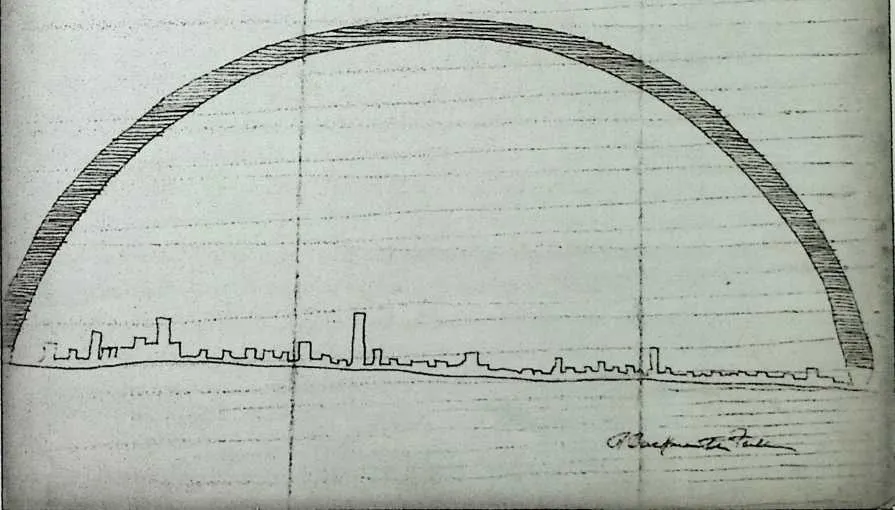
29 Fuller early on proposed a gigantic dome two miles in diameter and one mile high to be constructed on the northern end of Manhattan (fig. 6.1). This was not worked out into a full design, but in 1971 he created a far more detailed plan, as chief architect of the Old Man River Project, a domed city one-mile in diameter that was to transform the largely poor and black neighborhoods of East St. Louis (fig. 6.2). The Old Man River Project was never built, perhaps in good part because it was not merely a dome over an existing city but a far more costly and visionary idea: an entirely new structure organized with the conviction that cities had to be rethought from the ground up. As Fuller put it, ‘‘Cities developed entirely before the thought of electricity or automobiles or before any of the millions of inventions registered in the United States Patent Office. For eminently mobile man, cities have become obsolete.’’ It was necessary to rebuild, to demolish the old buildings and replace streets, water lines, and sewer
30 Figure 6.1
31 Sketch of proposed dome over Manhattan.
32 © Estate of R. Buckminster Fuller. All rights reserved. Used by permission. Source: Special Collections, Stanford University Libraries.
33 —: -y :
3435Because the area of a hemisphere is twice the area of its circular base, the enclosed volume ni the shell -tru-iurt between its inner and outer surfaces ill be twice the volume of the buildings in the enU> < .1 base circle Future cities may have all housed activity - dwelling - commercial and administrative - within d:c duni»* shell, reserving whole Interior of dome for a tropically gardened public park and community building area.. I>med spaces in shell will be equivalent to mountain sites with inward and outward views and inner and outer balcony terraces Thpj’fiTample room within the dome structure shell for ascending roadways and there .would be speed vertical and circumferential transportation ua the inner surface of the shell.
37 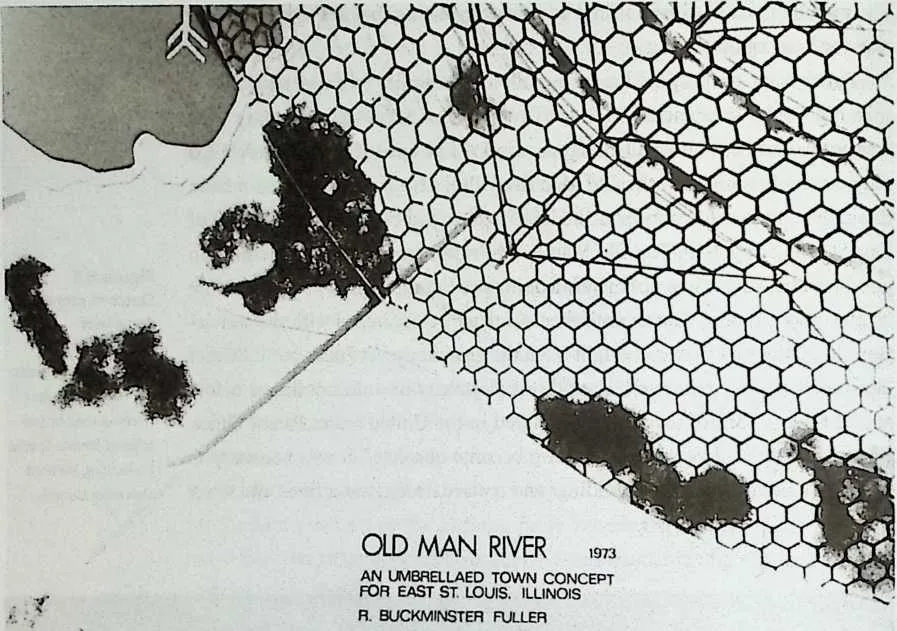 lines, and to give up on ‘‘yesterday’s no longer logical overall planning geometries.’’ The
proposed design appeared something like a moon crater and consisted of a circular building with
fifty curved terraces. The inward-facing terraces contained stores, offices, tennis courts, athletic
fields, and all the amenities of public life. On the outside of the circle structure, facing outward
and offering more privacy and stunning views, were thousands of apartments, divided from one
another by hedges and gardens (fig. 6.3).34 Conceivably, such a collectivized living arrangement
might have failed the sociological test of having thousands of families live in it, but there
can be no doubt that its shared walls, shielded from the winter’s cold, would have
been far more energy efficient than individual houses. Likewise, the entire space could
also have been air-conditioned at far less expense owing to economies of scale. Fuller
explained:
lines, and to give up on ‘‘yesterday’s no longer logical overall planning geometries.’’ The
proposed design appeared something like a moon crater and consisted of a circular building with
fifty curved terraces. The inward-facing terraces contained stores, offices, tennis courts, athletic
fields, and all the amenities of public life. On the outside of the circle structure, facing outward
and offering more privacy and stunning views, were thousands of apartments, divided from one
another by hedges and gardens (fig. 6.3).34 Conceivably, such a collectivized living arrangement
might have failed the sociological test of having thousands of families live in it, but there
can be no doubt that its shared walls, shielded from the winter’s cold, would have
been far more energy efficient than individual houses. Likewise, the entire space could
also have been air-conditioned at far less expense owing to economies of scale. Fuller
explained:
38 M$IGN DfVHOFMINt GBOUP
9.1 I
39WAlMHtUON UHIVHMtr j w rin&ssOH iti-HOo max
40 CHAi-HSU IU FIHG-PIHG HSU
41 C P WXHG TSAi CHI
42 Figure 6.2
43 Cover of Old Man River proposal for East St Louis (1973). © Estate of R. Buckminster Fuller. All rights reserved. Used by permission. Source: Special Collections, Stanford University Libraries.
44 Throughout the year, Old Man River’s City will have a naturally mild climate. With a large, aerodynamically articulated, wind-and-weather-controlled ventilator system atop and round the dome, together with the 500-foot-high vertical opening that runs entirely around the city below the umbrella, the atmospheric controllability will guarantee fresh air as well as energy conservation. The umbrella will jut out above and beyond all the outer-slope residential terrace areas as does a grandstand roof, so that neither rain nor snow will drift horizontally inwardly.35
45 Just as important, the concentration of the population would have eliminated the need for automobiles, which had no place in this new urban center.
46 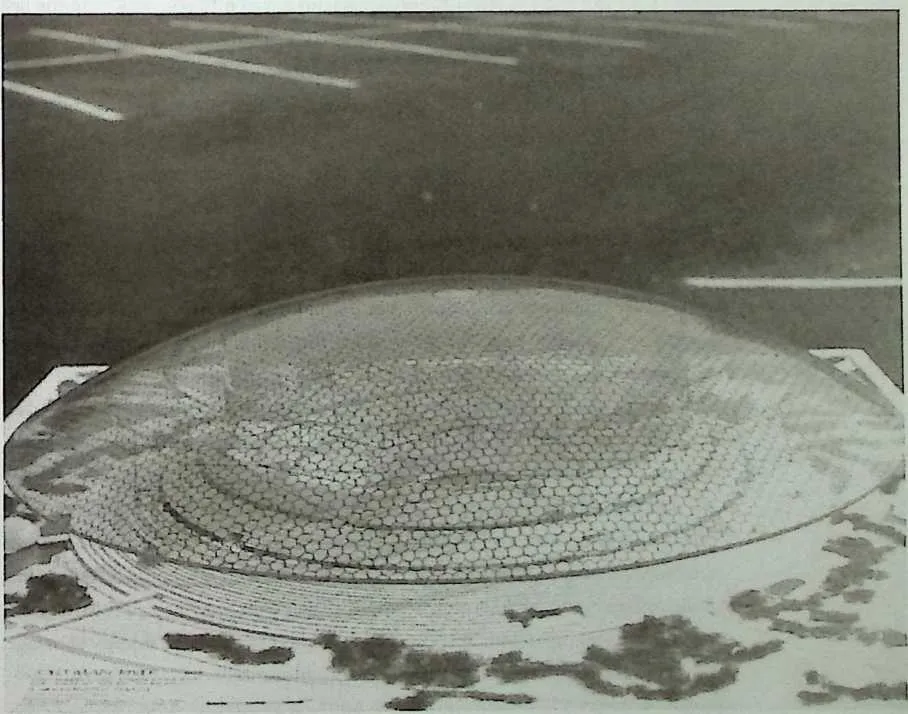 Though this gargantuan project was not attempted, geodesic domes were successfully
adopted by many corporations, international agencies, and world’s fairs, beginning in the early
1950s. Quite possibly the majority of the earth’s population has seen a geodesic dome
somewhere. Yet it does not seem to be fully understood. The most famous of his geodesic domes
remains the United States Pavilion at Montreal’s Expo 67. One architecture critic typically
summarized it as ‘‘a giant dome, roughly three-quarters of a sphere, designed to look like a lacy
filigree weightless against the sky. Height: 200 feet; spherical diameter: 250 feet. Construction: a
space frame of steel pipes enclosing 1,900 molded acrylic panels.’’36 However, the geodesic dome
is far more than a clever and attractive design that uses a small amount of material to enclose a
large space and becomes stronger the larger it is made. The physical properties of
the dome also manifest Fuller’s synergetic thinking. Domes embodied his concept of
‘‘ephemeralization,’’ or doing more with less, showing that energy efficiency is not only a
matter of making incremental improvements in existing designs and techniques. The
dome embodied radical new thinking, not only in its overall shape but also in the
construction of its individual components. In Synergetics every line is understood as an
inherently dynamic and always slightly curved element, and every object exists in time as
well as in space. The geodesic dome actualized Fuller’s ideas in a visible, functioning
pattern. As thousands of domes went up in all parts of the world, they were ‘‘tangible,
measurable illustrations of laws fundamental to the nature of the universe, of the spread and
temper of energy patterns…The domes perform according to the predictions of Energetic
Geometry.’’37
Though this gargantuan project was not attempted, geodesic domes were successfully
adopted by many corporations, international agencies, and world’s fairs, beginning in the early
1950s. Quite possibly the majority of the earth’s population has seen a geodesic dome
somewhere. Yet it does not seem to be fully understood. The most famous of his geodesic domes
remains the United States Pavilion at Montreal’s Expo 67. One architecture critic typically
summarized it as ‘‘a giant dome, roughly three-quarters of a sphere, designed to look like a lacy
filigree weightless against the sky. Height: 200 feet; spherical diameter: 250 feet. Construction: a
space frame of steel pipes enclosing 1,900 molded acrylic panels.’’36 However, the geodesic dome
is far more than a clever and attractive design that uses a small amount of material to enclose a
large space and becomes stronger the larger it is made. The physical properties of
the dome also manifest Fuller’s synergetic thinking. Domes embodied his concept of
‘‘ephemeralization,’’ or doing more with less, showing that energy efficiency is not only a
matter of making incremental improvements in existing designs and techniques. The
dome embodied radical new thinking, not only in its overall shape but also in the
construction of its individual components. In Synergetics every line is understood as an
inherently dynamic and always slightly curved element, and every object exists in time as
well as in space. The geodesic dome actualized Fuller’s ideas in a visible, functioning
pattern. As thousands of domes went up in all parts of the world, they were ‘‘tangible,
measurable illustrations of laws fundamental to the nature of the universe, of the spread and
temper of energy patterns…The domes perform according to the predictions of Energetic
Geometry.’’37
47 Figure 6.3
48 Photograph of the model for the Old Man River proposal. © Estate of R. Buckminster Fuller. All rights reserved. Used by permission. Source: Special Collections, Stanford University Libraries.
49 Like the shaggy Minnesota undergraduate who enthusiastically went to hear Fuller in 1972, the tens of thousands who heard him speak during the last decades of his life probably had not read Synergetics. However, they could grasp the simplicity, strength, and promise of this new form of architecture. It was economical with materials and therefore environmentally friendly. Undercutting the specialization of knowledge, it was easy to assemble and could likewise be disassembled and moved. A geodesic dome also could be adapted to make the most of passive solar energy or wind power. From Fuller’s talks, people learned to see the dome as part and parcel of a larger philosophy of energy that harked back to transcendentalism and that could be linked to other organic ways of seeing nature, while at the same time demonstrating its empirical validity as a working design. Fuller explained the energy crisis as a human failure to use resources intelligently. It was a failure that could be corrected and not a shortage of raw materials that spelled unavoidable hardship. When one looked at a geodesic dome, Fuller’s concept of ephemeralization not only made sense, but it also seemed the inevitable way forward. Whether his listeners preferred the stand-alone self-reliance of the ‘‘Fly’s Eye Dome,’’ embraced the idea of a global energy network linking all nations in a single electrical distribution system, or wanted to enclose their community in a protective giant geodesic dome, Fuller offered striking and original solutions that still may inspire future developments. Listening to him, it seemed, indeed, that ‘‘there is no energy shortage. There is no energy crisis. There is a crisis of ignorance.’’