
6 R. Buckminster Fuller: America’s Last Genuine Utopian?
2Howard P. Segal
3 This essay will explore six key aspects of R. Buckminster Fuller’s life and work and place them in broad historical context in order to appreciate more fully his contributions, as well as his limitations. Too often Fuller’s admirers and critics alike have treated him in a vacuum, detached from developments before and after his time. Any connections drawn with earlier visionaries, much less with those of our day, have generally been superficial.
4 R. Buckminster Fuller was above all else a technological utopian, someone who believed that technological advances would vastly improve—if not literally perfect—society. Far from being the first such American technological utopian, he was part of a long and rich tradition whose origins derive from European ideas and visionaries. Thus the common characterization of Fuller as a quintessential American dreamer or inventor must be at once revised and expanded. We must also reexamine the frequent emphasis on Fuller as primarily a twentieth-century successor of Margaret Fuller (he was her grandnephew) and other nineteenth-century American transcendentalists (fig. 3.1).
5 Utopias
6 Utopia means the perfect society. The term was coined by Thomas More (1478- 1535), lord chancellor of England, as epitomized in his Utopia (1516). Previously, as in Plato’s Republic, there was no expectation of genuine improvement but, instead, a lamentation of the insurmountable gap between the real and ideal worlds. ‘‘Platonic forms’’ like the Republic reflected that avowedly human condition. More, however, was the first to hold out the prospect, albeit dim, of actually establishing a perfect society and thereby altering human nature. It is true that the term utopia, which More coined from Greek roots, means ‘‘nowhere’’ (although it also means ‘‘good place’’) and that More considered human nature depraved. Nevertheless, he considered utopia a possibility, so that utopian need not mean ‘‘forlorn.’’ From More as well came a utopian tradition eventually traced back to Plato, a tradition that includes Fuller.
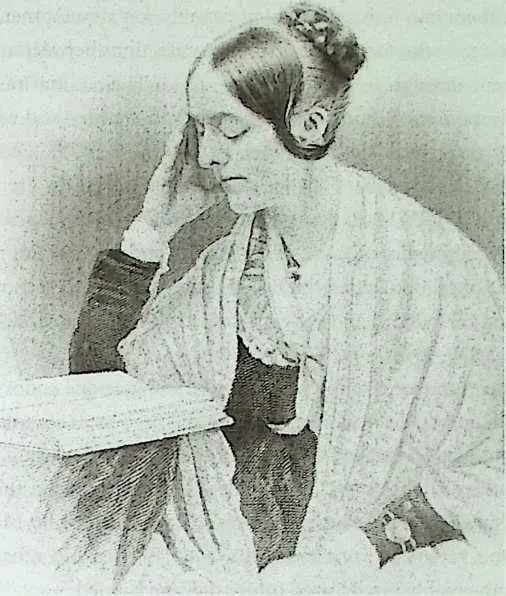
8 Figure 3.1
9 Margaret Fuller (1810–50), R. Buckminster Fuller’s great aunt.
10 Source: Special
11 Collections, Stanford
12 University Libraries.
13 As more than thought experiments—as visions that might actually be realized—utopianism is rooted in two European developments. The first was the growth, starting in the sixteenth century, of the Enlightenment faith in the power of reason to achieve steady human improvement, the logical outcome of which was unprecedented belief in the prospects for utopia. The second development was the rapid technological advances that, beginning in England’s textile industry in the mid-eighteenth century, led to the English industrial revolution and its spread to most of the rest of the world. These developments are intertwined, for it was the Enlightenment viewpoint, combined with those enormous technological advances, that made utopia look like an achievable goal. Most utopian schemes over the centuries have presupposed the availability of adequate food, clothing, and shelter, but only in modern times could the availability of such essentials be taken for granted.
14 Indeed, it was only in late nineteenth-century and early twentieth-century America and parts of Europe, when Fuller was growing up, that the longstanding assumption that natural resources were finite gradually gave way to the belief that, thanks to numerous technological advances, natural resources were infinite. Tools and machines to extract, transport, assemble, and process raw materials and to turn them into finished products were the key developments.
15 The European Utopians who forged the first real connections between utopianism and fulfillment through technology were varied. Their initial ranks included the Pansophists, a small number of late sixteenth-century and early seventeenth-century visionaries, including Francis Bacon (1561–1626), the scientist, philosopher, and, like More, lord chancellor of England; and the French philosophers and social critics Marquis de Condorcet (1743–94), Henri de Saint-Simon (1760–1825), Auguste Comte (1798–1857), and Charles Fourier (1772–1837). Later visionaries included the British industrialist and communitarian Robert Owen (1771–1858) and the communists Karl Marx (1818–83) and Friedrich Engels (1820–95).
16 Yet for all of their commitment to the power of technology, none endorsed unadulterated technological advance. That is, they did not see technology as the royal road to utopia. All insisted no less on other values. For example, Fourier insisted that there could be no utopia unless individuals could fulfill their varying sexual and other pleasure-providing desires. Meanwhile Marx and Engels insisted on a variety of work and leisure activities to avoid exhaustion and boredom in the highly mechanized future they envisioned.
6.1 Fuller as Utopian
17Fuller has been repeatedly criticized for an excessive focus on technological advances, to the neglect of other aspects of a more fulfilling existence. By definition as a technological utopian, Fuller was a technological determinist—that is, a believer in the notion that technology shapes society, economy, and culture. Although historians and other scholars of technology now know otherwise,1 Fuller was very much in line with countless other Americans of his day in assuming that, with the proper technological achievements, improvements in other domains would invariably come about in due course. Given the enormous changes in transportation, communications, commerce, construction, and other areas that ordinary Americans witnessed in everyday life in the late nineteenth and early twentieth centuries, it is hardly surprising that Fuller, like some other Americans, went a step further and envisioned technology as a panacea for nearly all human ills. For him it was a natural progression, not a deviation.
18 This does not, however, deny Fuller’s concern with the human element in technology. Unlike many other technological Utopians, Fuller was also interested in technology insofar as it would enhance the quality of life of ordinary people. He had an ethical dimension all too rare among technologically oriented visionaries.
19 Moreover, notwithstanding his abundant faith in technology, Fuller understood in young adulthood that, contrary to prevailing sentiments of his day, the earth’s resources remained finite. To his considerable credit, and long before it became conventional wisdom, he wisely did not equate humankind’s growing power over nature with an endless supply of raw materials. In recognizing what was later termed the ‘‘limits to growth,’’ Fuller was turning back to the outlook shared by most Americans throughout the eighteenth and early nineteenth centuries, prior to America’s own industrial revolution.2 Fuller’s inventions accommodated this reality, unlike some of his contemporaries, such as Herman Kahn and Julian Simon, who assumed that inventive humans either would always discover natural resources in hitherto unexplored places or would readily create adequate substitutes.
20 If Fuller was part of that historic tradition of technological utopianism, he was simultaneously the last popular American utopian who engaged in utopian thinking, speaking, writing, and building for their own sake rather than, as is common today, for commercial reasons. Fuller endured decades of poverty, indifference, and ridicule before obtaining respect, influence, income, and a following.
21 Fuller was not primarily concerned with earning a living—much less becoming rich—from his visionary activities. He was primarily concerned with trying to improve the world. Even when, in the 1920s, Fuller had to support his wife and child, he never indulged in speculation and invention just to make money. Far from it: in 1927, at age thirty-two, and after repeated business failures, he renounced personal success and financial gain. As he put it in his Grunch of Giants (1983), ‘‘I learned very early and painfully that you have to decide at the outset whether you are trying to make money or to make sense, as they are mutually exclusive.’’3 Given the coming Great Depression, maybe it was just as well. Yet this altruistic stance might also have been self-serving, a convenient rationale for Fuller’s business misadventures.
22 By contrast, most recent prominent American Utopians—such as Alvin and Heidi Toffler, John Naisbitt and Patricia Aburdene, Michael Dertouzos, Nicholas Negroponte, Bill Gates, and Virginia Postrel—have helped to transform forecasting into a lucrative big business. They write and speak largely for the marketplace, including the promotion of their respective business or academic or other enterprises. And they readily revise and update their predictions when, as is commonplace, events undermine their forecasts. Rarely, if ever, do they admit their errors.
23 To be sure, Fuller also resisted conceding mistakes and was also not above making up numbers, so one cannot exempt him from similar criticisms. But unlike the foremost visionaries, dating back to More and including Fuller, these contemporary prophets provide no genuine moral critique of the present, no serious effort to alter society for higher purposes. There are a few exceptions, especially Gates’s admirable philanthropy—as epitomized by his being chosen, along with his wife, Melinda, and rock star Bono, as Time magazine’s 2005 ‘‘People of the Year.’’ But the rest are not the kind of socially responsible citizens that Fuller and most of his predecessors were.4
24 This is not to deny Fuller’s acceptance of relatively large speaking fees in his later years, when he gave hundreds of lectures annually. Still, Fuller’s life and work had an integrity that should permanently enhance his reputation. This will be the case no matter what the long-term significance and influence of his material and professional achievements. Moreover, his earnestness is definitely shared with Margaret Fuller, Ralph Waldo Emerson, and others of their day. Yet the transcendentalists did not take a vow of poverty, and one can only wonder if Fuller would have renounced ‘‘making money’’ versus ‘‘making sense’’ if, by 1927, he had been financially successful to any degree. The real issue, though, is not his or any other visionary’s wealth or poverty but rather the extent to which one’s analyses and predictions are affected by economic self-interest.
25 Curiously, those contemporary high-tech zealots from the Tofflers onward rarely, if ever, consider the prospect that, far from being original, their respective crusades are only the latest in that rich Western tradition of technological utopianism outlined above. Because of their historical ignorance, they can naively proclaim the alleged uniqueness of their particular technological advances, above all the extent and the speed of the transformations to be brought about by technological advancement. They thereby skip over earlier claims about the alleged grand powers of earlier technologies—and not only with the English and American industrial revolutions but also with that of the Middle Ages.5 Fuller was hardly a professional historian, but he did grasp that he was not the first technological utopian—though surely the best.
26 Moreover, probably none of the contemporary high-tech prophets have any knowledge of how old-fashioned they really are in their celebrations of technology’s prospects for transforming the nation and, in due course, the world. As they insist, their particular advances may indeed operate and spread with unprecedented speed but not necessarily with unprecedented transforming powers—as compared, for instance, with life in rural England during its traumatic industrial revolution of the eighteenth and nineteenth centuries.
27 Fuller escapes much of this criticism because he grew up and began working in a cultural climate, at least within the United States, still fundamentally hopeful about the future and about technology’s transforming prospects. But Fuller’s later years and growing fame were certainly tarnished by his failure to recognize that the world had changed, as evidenced by questions about his ready acceptance of the Pentagon’s use of giant helicopters in the Vietnam War—a war he didn’t endorse—because they might later be employed to transport and deposit ever-larger geodesic domes elsewhere in the world and for other nonmilitary purposes.
28 Fuller was the first major American utopian who argued that the realization of utopia was possible within our own lifetimes rather than, as with all earlier Utopians, either at least two generations or more ahead or virtually impossible. Fuller’s Utopia or Oblivion: The Prospects for Humanity (1969) makes this point explicitly:
3031Not only did all the attempts to establish Utopias occur prematurely (in [the absence of our contemporary] technological capability to establish and maintain any bacteria- and virus-immune, hungerless, travel-anywhere Utopias), but all of the would-be Utopians disdained all the early manifestations of industrialization as ‘‘unnatural, stereotyped, and obnoxiously sterile.’’ The would-be Utopians, therefore, attempted only metaphysical and ideological transformations of man’s nature—unwitting any possible alternatives. It was then unthinkable that there might soon develop a full capability to satisfactorily transform the physical energy events and materials of the environment—not by altering man, but by helping him to become literate and to use his innate cerebral capabilities, and thereby to at least achieve man’s physical survival at a Utopianly successful level. All the attempts to establish Utopias were not only premature and misconceived, but they were also exclusive. Small groups of humanity withdrew from and forsook the welfare of the balance of humanity. Utopia must be, inherently, for all or none…
32…This moment of realization that it soon must be Utopia or Oblivion coincides exactly with the discovery by man that for the first time in history Utopia is, at least, physically possible of human attainment.6
33 The classic example of a utopia allegedly not intended to be established is Plato’s Republic. The starting point for utopias that could be established is More’s Utopia. For centuries thereafter, and continuing at least as late as James Hilton’s Lost Horizon (1933), utopia was usually discovered by Western travelers who came upon it by accident, such as through erroneous maps, storms at sea, or airplane crashes or, as with Edward Bellamy’s Looking Backward: 2000–1887 (1888), through falling asleep and awakening in utopia. Conditions that eventually brought utopia about included wars; postwar peacetime negotiations; natural disasters; and clashes between continents, nations, classes, races, and even sexes. These utopias were usually placed in the contemporary time of their authors. But as more of the world was explored and known, it became increasingly necessary to place utopia in unexplored, exotic places in order to claim some originality—for example, under the sea, inside the earth, or in outer space, as with the writings of Jules Verne, among others. As, however, these sites in turn became explored and relatively familiar, it became necessary to project utopia into the future.
34 At first, beginning with More, there were vague expectations of utopian fulfillment in the distant future—for example, the works of the various European visionaries just discussed—but usually no particular dates. Eventually, though, there arose visions to come about in a specified time within reach of the next generation or two, as with Looking Backward-, and, later, within one’s own lifetime or that of one’s children—as with the date of 1960 in the landmark World of Tomorrow exhibit at the 1939–40 New York World’s Fair. With Fuller’s Utopia or Oblivion, however, came the elimination of any delay: the future was now. This outlook has had enormous influence on later visionaries, from the Tofflers and Naisbitt and Aburdene through Gates and Dertouzos, regardless of their acknowledgment of Fuller’s work.
35 The extent to which this belief on Fuller’s part was belated or lifelong cannot be determined conclusively, but it surely was rooted in developments dating to his childhood and young adulthood. For example, he had endured personal and physical setbacks long before his 1927 decision not to commit suicide while standing on the shores of Lake Michigan: his terrible vision even as a toddler, the loss of his father when he was an adolescent, the taunts by his sister Leslie, and the leg injury that prevented him from playing football in college. Moreover, that decision itself may have reinforced his preexisting practical bent, his dedication to a ‘‘higher purpose’’ than financial success. Such a ‘‘can-do’’ spirit could in turn have spurred his ‘‘future is now’’ stance once the technology was available to transform the world.
36 From Idea to Reality
37 More than any other American utopian, Fuller bridged the common gap between those who write seriously and significantly about utopia and those who attempt to build it. Where such prominent European Utopians as Owen and Fourier at once wrote about and constructed or inspired actual communities, American communitarians have commonly been bereft of intellectually substantive plans; and most genuinely intellectual American visionaries—not least, those nineteenth-century transcendentalists among whom Margaret Fuller was a leading figure—have usually lacked the practical skills to establish successful communities. R. Buckminster Fuller is a notable, if only partial, exception.
38 By way of background, utopianism in general has taken various forms over the centuries, beginning with prophecies, speeches, and writings; continuing with political movements, actual communities, and world’s fairs; and moving recently to virtual communities in cyberspace. In late nineteenth-century and early twentieth-century America and parts of Europe it became clear that only thoughtful, reflective tracts could respond convincingly and appealingly to the complex contemporary developments—for example, industrialization, urbanization, immigration, poverty, and class conflict—that had by now turned actual utopian communities into marginal phenomena. This included such relatively successful American communities as the Shakers, Oneida, and Amana that combined traditional agriculture with industry and manufacturing for greater profits, balance, stability, and longevity. The key figure credited with the establishment of American utopian writings as a serious, modem intellectual genre was Bellamy (1850–98), whose extraordinarily popular Looking Backward demonstrated that writing was a superior means of examining these contemporary problems and of providing richer alternatives to existing society than even the foremost utopian communities. Admittedly, utopian speculation was obviously less risky when placed on paper than when placed on land, though Bellamy himself helped to launch a political crusade.
39 To be sure, utopian communities in the United States and elsewhere have continued to be established through the present. There have been periods of extensive community building, most notably the counterculture of the late 1960s and early 1970s and, more recently, cyberspace communities. But by the mid-twentieth century, no American utopian save Fuller was capable of both writing and building, of both theory and practice.
40 True, Fuller did not establish actual communities. But he invented enough actual components of potential communities to distinguish himself from virtually all other American Utopians: the Dymaxion car, the Dymaxion house and bathroom, the Dymaxion air-ocean world map, and geodesic dome. In all, Fuller received patents for twenty-eight inventions, a notable achievement in itself. Moreover, Fuller proposed land-based cities covered by geodesic domes, tetrahedronal cities floating on the sea, and cloud-structure spheres floating in air. Fuller was a de facto architect long before he got a license, which he was awarded honorarily when he was in his late sixties.7
41 Many prior communitarians had been no more specific than Fuller in their plans, so his providing a mere scaffolding for utopian communities rather than detailed blueprints hardly undermines his legitimacy here. In fact,
42 by designing artifacts that could be both moved and replicated, Fuller readily met a principal challenge facing most earlier (and later) communitarians: how to promote one’s vision beyond its base camp, so to speak. If, to take a notable exception, the Shakers met this challenge by building ever more communities, they simultaneously undermined their impact on the rest of America by ruling out procreation by existing members and by instead concentrating on luring outsiders to their ranks. Few other utopian communities created even a second site.
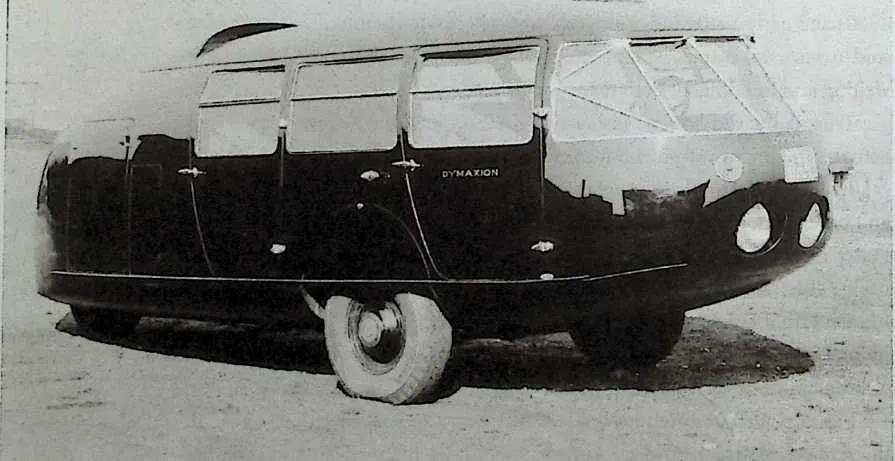
43 In addition, Fuller’s work was in the public eye in two major world’s fairs. At the 1933 Chicago fair he demonstrated his three-wheeled, rear engine, streamlined Dymaxion car (fig. 3.2). Seating eleven passengers, and getting remarkable gas mileage, the vehicle performed fine as a prototype. But production ceased because of bad publicity following a fatal accident just as potential investors watched. An investigation later concluded that the vehicle was not at fault.
44 Figure 3.2 Dymaxion car.
45 © Estate of R. Buckminster Fuller. All rights reserved. Used by permission. Source: Special Collections, Stanford University Libraries.
46 More directly, and much more positively, Fuller’s geodesic dome was chosen for the United States Pavilion at the 1967 Montreal fair. The twenty-story dome has remained structurally intact despite a major fire in 1976. Like so many others involved in world’s fairs, Fuller believed that bringing people from around the world to one locale and introducing them to cutting-edge technologies and products would somehow promote world peace and understanding, not just international commerce, and would in turn promote utopian community building. Here, as with his other designs noted above, Fuller followed many other utopian visionaries in taking for granted, rather naively, that new and presumably comfortable material settings would translate into permanent contentment for all inhabitants.
48 l.D-3–3
49 A similarly romantic notion colors, for example, Gerard O’Neill’s The High Frontier: Human Colonies in Space (1982) and his 2081: A Hopeful View of the Human Future (1981). The former book convincingly shows how space colonies could be established in the very near future and how life might be carried on within them. The colonies appear to be pleasant, fairly free, quite large suburbs circling the earth. If anything, the society portrayed here—and elaborated on in the latter book—is so harmonious and so earnest that it seems a bit dull, in the manner of Looking Backward. One wonders if the inhabitants of O’Neill’s colonies wouldn’t find life boring and confining once the thrill of being in space had faded—much like the inhabitants of Fuller’s proposed land-based cities covered by geodesic domes, tetrahedronal cities floating on the sea, and cloud-structure spheres floating in air.8
50 In all of these cases, however, Fuller can be faulted for not devoting sufficient thought—and design—to the ways in which communities might actually be established and maintained within his various giant scaffolds. The fact that the contents of his 1967 Montreal dome were wholly in others’ hands does not negate this point. Ironically, Fuller’s schemes appear to be more practical for individual nuclear families than for masses of families or extended families. By contrast, the Shakers, for example, devised innovative means of creating and preserving communities—such as their famous dances—despite their commitment to celibacy.
51 In the final two decades of his life, Fuller’s growing popularity through writings and lectures made utopianism popular again and, to a considerable extent, made it respectable again, in both the United States and much of the rest of the world.
52 Admittedly, objections to utopianism have been raised since Plato’s Republic. Utopianism has been persistently criticized as impractical, immoral, deviant, conformist, revolutionary, reactionary, stagnant, authoritarian, and libertarian. Beyond the obvious question of whether specific utopian schemes could ever be implemented has come the traditional concern over forcing individuals, groups, and entire societies to adopt values, institutions, and ways of life that many might otherwise reject—if offered a choice, given the equally persistent association of utopianism with the lack of choice.
53 Fair or not, this criticism has sometimes been leveled against Fuller as well for his proposed land-based, sea-based, and air-based cities. His contemporary Lewis Mumford was particularly scathing here. Mumford characterized all three of these projects as huge tombs akin to the Egyptian pyramids.9 How much conformity would be required for these huge communities? And how much individuality would be allowed? For that matter, what institutional arrangements would continue to make life interesting once the thrill of being on land or at sea or even in air wore off?
54 However, for roughly a century now, there have been two other main objections. First, insofar as the realization of utopia presumes human perfectibility, it is impractical. The technologically assisted horrors of the years since World War I have rendered forlorn any hope of improvement in human behavior. Second, and more perverse, the closer that science and technology bring us to being able to realize utopia, the less desirable it appears. Given the human propensity for selfish and exploitative behavior, achievement of the kind of planning and control required by utopia would result in ‘‘dystopia,’’ or antiutopia. The visions of Eugene Zamyatin’s We (1920) and of the more celebrated Aldous Huxley’s Brave New World (1932) and Orwell’s 1984 (1949) have transformed utopia from something to be yearned for to something to be dreaded.
55 Fuller’s eventual popularity, especially with youth, coincided not only with the growth of the counterculture—however hostile to modern technology many of his young admirers otherwise claimed to be—but also with their and others’ desire for more positive visions of the future to consider. Although the cold war would not end until several years after his death, Fuller’s avowed optimism offered alternatives to those classic dystopias then still dominant in the public consciousness.
56 Perhaps the most significant adoption of Fuller by the counterculture was Drop City, a community established in the hills of southern Colorado in the late 1960s. ‘‘Singled out by the media as exemplary, Drop City was known for its dome-style of architecture, which combined the principles and methods of …Fuller with inexpensive, found materials, such as sheet metal hacked off of junked car roofs.’’ Drop City’s founder, one Peter Douthit (a.k.a. ‘‘Peter Rabbit’’), actually corresponded with Fuller. Where he and three other original settlers—students from the University of Colorado and the University of Kansas—wanted a cheap and quiet place in which to pursue their interests, the media’s relentless coverage and its search for weirdness among the inhabitants at once prompted those four to depart and to attract others. But the newcomers were usually transient hippies, and Drop City was eventually vacated. By now most of the property has been developed commercially. The last of the ‘‘iconic domes’’ was removed in the late 1990s.10
57 No less important, Fuller’s emphasis on ‘‘Spaceship Earth’’—a term he coined—and on its fragile ecology contributed significantly to the growing awareness of a world of integrated parts and people, an earth whose environmental systems required constant care. The rhetoric of globalization and of ecology that have become buzzwords in recent years owe a good deal to Fuller’s earlier, and more serious, promotion of these basic ideas. Meanwhile, Fuller’s very ability to travel around the globe (122 times in all) and his passion for doing so reinforced people’s consciousness and mindfulness of the earth’s integrity of parts and people and of its simultaneous ecological fragility.
58 Ironically, Fuller’s persistent faith in being able to invent, manufacture, and sell cars, bathrooms, houses, domes—if not yet actual communities—that would supposedly overcome human ills and frailties may have been rendered obsolete by the ongoing genetic engineering advances of the years since his death. The prospect of being able to create human beings with the ‘‘desired’’ physical, mental, and even character traits clearly offers a solution to that fundamental dilemma confronting all prior Utopians dating back to Plato and More.
59 Finally, despite Fuller’s popularization of utopianism in the third quarter of the twentieth century, and notwithstanding the appeal of the contemporary visionaries cited above, technological utopianism has steadily lost much of its historic bedrock support in the United States. Consequently, Fuller’s legacy is by no means assured.
60 When my Technological Utopianism in American Culture appeared in 1985, two years after Fuller’s death, I believed that this phenomenon was already fading in the United States—where it had reached its peak from roughly 1920 until 1980. Technological utopianism had already long faded in Europe. The skepticism toward ‘‘progress,’’ and toward progress as technological progress, had pervaded Europe as an aftermath of World War I—the legacy of airplanes, machine guns, poison gas, tanks, and, above all, trench warfare on European soil. By 1985, Americans’ hitherto bedrock faith in that same equation of progress with technological progress had belatedly begun to decline. Just as Europeans’ prewar Victorian confidence and complacency were shattered by these technological developments, so, in a much slower and still ongoing manner, Americans’ historically optimistic outlook was undermined by (1) endless technology-related environmental crises; (2) repeated disappointments over nuclear power and other alleged technological panaceas; and (3) distrust of both public officials and technical experts, a distrust that grew out of the Vietnam War and the Watergate scandal of the Richard Nixon presidency.
61 Mumford’s dismissal in 1975 of Fuller as ‘‘that interminable tape recorder of‘salvation by technology’ ’’ may have been excessively harsh.11 But Mumford’s worldview was radically different from Fuller’s.12 It reflected the growing disillusionment with technological utopianism.
62 Admittedly, this analysis of contemporary attitudes toward technology may seem off-base. According to countless newspapers and magazines, television and radio programs, opinion surveys, and, not least, Web sites and Internet discussions, much of the world has for years now been experiencing unprecedented ‘‘techno-mania.’’ High tech is the buzzword that encompasses the various advances allegedly justifying this enthusiasm: broadly conceived as virtually all post-World War II technological developments but especially information technology—particularly computers, satellites, the Internet, and the World Wide Web—and biotechnology. Although Fuller died before several of these advances came about—and just two years after IBM introduced the first commercial personal computers—he might still be accorded heroic stature today.
63 Yet far from techno-mania’s being unique to the 1990s and early 2000s, the historical record demonstrates that most ordinary Americans today are actually much more ambivalent about technology and progress than ever before. They no longer subscribe to the tagline of the old General Electric advertisements that ‘‘Progress is our most important product.’’ Besides the obvious examples of nuclear power, oil drilling, and space exploration are concerns such as cell phones reducing drivers’ attention and intruding into pristine wilderness, e-mail reducing proper grammatical usage, and the supposedly paperless office generating ever more paper. No less significant, for instance, is the question of prolonging life in modern hospitals by various mechanical means that often undermine the quality and comfort of patients’ final days. For that matter, the highly touted unprecedented access to information—the glorious ‘‘Information Age’’ or ‘‘Knowledge Society’’—has hardly led to unprecedented wisdom, contrary to countless predictions.
64 In fact, since the 1960s there has been a diminishing faith in experts as supposedly objective analysts rather than as increasingly paid partisans of any cause that will hire them. The utopian claims from the 1960s and 1970s of systems ‘‘experts’’ like Simon Ramo to be able to solve all problems through the employment of sufficient experts ring hollow today in light of the cosmic failures of Secretary of Defense Robert McNamara and the other ‘‘Best and Brightest’’ government leaders in conducting the Vietnam War.13 Countless other examples from both military and civilian realms could be added. In many quarters a healthy skepticism about unadulterated technological advance might actually represent another form of progress. Fuller was certainly not a dull conventional technical expert—and so has escaped some of this criticism—but he was, after all, lauded as an expert visionary and community builder, as detailed above.
65 No less important, achievement in the twentieth century of so many historic dreams of scientific and technological achievement—be it automobiles, airplanes, nuclear power plants, and, above all, moon landings—invariably brought mixed blessings to most of their inventors, manufacturers, advertisers, and consumers. Nothing is more indicative of the fading of technological utopian fantasies among ordinary Americans and many other people than the relatively muted response on the twenty-fifth anniversary of the first moon landing. In 1994 there was hardly the euphoria that had characterized similar major anniversary celebrations of, say, New York City’s Brooklyn Bridge, the first transcontinental railway at Promontory Point, Utah, the first transcontinental telephone line, and the first Ford Motor Company Model T automobile. By 1994 it had become painfully clear to most people everywhere that, contrary to centuries of utopian dreams, the moon landings did not change the world. Like utopian communities, utopian writings, and world’s fairs, moon landings could not bring about lasting international—or even national—peace. Nor, as a result, has there persisted in recent decades the uncritical zeal for further space exploration and possible space colonies that was commonplace before 1969. Instead, one finds grassroots skepticism about the value of these mega-projects in view of more pressing needs on Earth. The same skepticism, of course, applies to other mega-projects like the ‘‘Star Wars’’ antimissile defense system and the now abandoned Texas Super Collider.14 Had he lived longer, Fuller’s own mega-projects would not have escaped this revisionist thinking.
66 When we add to these examples the enormous debates to date on just the early stages of genetic engineering—such as the cloning of certain animals, including pets, and the ability to predict whether terrible diseases will afflict some family members versus others—it is obvious that, more than any other contemporary technological development, this will hardly be deemed everyone’s panacea. Decades of heated debates on abortion will pale in comparison to those about genetic engineering.
67 But Fuller was not, of course, part of these developments. As noted earlier, he was very much in line with countless other Americans of his day in assuming that, with the proper technological achievements, improvements in other domains—not least, human behavior—would invariably come about in due course. His focus on technology as a panacea for nearly all human ills was in a sense part of the end of the so-called Enlightenment project, which had begun in the eighteenth and nineteenth centuries with such efforts as alleviating poverty, criminality, and insanity through new or redesigned asylums. It is hardly a stretch to consider Fuller’s—and O’Neill’s—projects as the other end of the same spectrum of optimistic rational planning as those asylums.
68 There is yet another limitation to Fuller’s legacy. Whereas during Fuller’s lifetime technology was commonly conceived as the solution to widely acknowledged large-scale problems like poverty, irrigation, electric power, and education, in recent decades technology has increasingly come to be viewed as the fulfillment on a small scale of individual needs and desires, ranging from online college degrees to virtual travel to cyberspace relationships. High tech enhances individual sanctity and provides choices in an ever more digitized, programmable world. If one major aspect of high tech is the shrinkage of the size of machines exactly as their power increases—thereby reversing the tradition in which Fuller lived of bigger being more powerful—another major aspect is the consumer mentality that asks what a specific item will do for oneself rather than for society. At this writing, Hewlett-Packard’s advertising slogan is ‘‘Everything Is Possible.’’ What could be clearer? Similarly, the tagline for most Microsoft advertisements in the same venues is ‘‘Your potential. Our passion.’’ There are no qualifications here either.
69 Thus we see a complete reversal from President John Kennedy’s famous 1961 inaugural address—when he suggested that individuals ask not what their country could do for them but what they could do for their country—to asking what one’s technology, and implicitly one’s country, can do for oneself. Surely Fuller subscribed to Kennedy’s position. Indeed, he went far beyond it in seeking such dedication and service on a global, not merely national, scale. He wanted people with integrity to contribute to ‘‘Spaceship Earth’’ rather than to the United States alone. His pioneering use of ‘‘globalization’’ meant infinitely more than the economic bottom line, unlike the early twenty-first century. No matter how much individual or individual family fulfillment Fuller offered Americans with his highly mobile Dymaxion artifacts, including homes and cars, there was always an expected simultaneous fulfillment of global objectives. No matter how many young people adopted some of Fuller’s ideas and inventions—as with Drop City—there was always a gap between those who dropped out of mainstream society and Fuller’s credo of working within mainstream society. Nothing was to operate in a vacuum. Nowadays, insofar as experts are still relied on, it is a matter of consumers’ demands and expectations, not their unquestioning trust.
70 True, America’s consumer culture can be traced back at least to the late nineteenth century, as reflected in the rise of department stores throughout the country, but its pervasiveness and power have expanded along with high technology. The ramifications for utopianism today are extraordinary attention to material goods and to more individualized versions of ‘‘the good life’’ (no matter how many individuals ultimately choose the same version). The truism that one person’s utopia may be another’s ‘‘dystopia’’ surely applies to Fuller’s visions now more than ever before.
71 Conclusion: The Real Value and Goal of All Serious Utopias
72 Fuller’s utopias, like all serious utopias, are frequently misunderstood as supposedly scientific prophecies whose importance should be determined by the accuracy of their specific predictions. This view has grown increasingly popular in recent years, given the unprecedented electronic access to information and the consequent growth of supposedly objective forecasting. There is almost an inverse correlation between humankind’s continued inability to predict the future—save as shallow extrapolations from the present—and the growth of the forecasting industry. It was hardly an accident that in 1984 the head of the World Future Society, an otherwise highly respected scholar, chastised Orwell for his alleged failure to have predicted more accurately back in 1949 the ‘‘real world’’ of 1984—thereby completely missing Orwell’s mission to try to prevent 1984 from becoming reality. Yet the principal value of utopias has always been and remains their illumination of alleged problems and solutions back in the ‘‘real world’’ from which they spring. Utopias should therefore be played back on the real world rather than be held up as crystal balls, much less viewed as scorecards.
73 Consequently, it is as important to determine the sources of Fuller’s and his high-tech successors’ popularity as it is to analyze their respective visions. This is why historical context is so critical. He and they are among the successors to earlier advocates of American ‘‘positive thinking’’ dating to Benjamin Franklin, and continuing in the mid-twentieth century with Dale Carnegie and Norman Vincent Peale. They are also the counterparts to such other contemporary positive thinkers as Stephen Covey, Robert Schuller, and the Chicken Soup for the Soul authors. The popularity of Fuller and his high-tech successors reveals much about Americans’ and others’ apparent obsession with the future. Despite professional forecasting’s mediocre record, so many still feel compelled to try to uncover the future. That compulsion in turn reflects a deeper anxiety more than a superficial optimism, a profound uncertainty about the future that even our unprecedented access to information and to communication cannot overcome. The unceasing hype over our allegedly unique pace and extent of technological change has, I suspect, made many persons increasingly eager to figure out what comes next.
74 Equally misunderstood by many technocrats like Fuller is the critical role of politics in local, national, and world affairs and the inability to replace the messiness and unpredictability of politics with antipolitical technocratic thought and action. This is in part why one does not find in the writings of truly profound visionaries like Marx and Engels the kind of simpleminded technological determinism that colors not only Fuller’s books but also those like Alvin Toffler’s Future Shock (1970), Bill Gates’s The Road Ahead (1995), and Nicholas Negroponte’s Being Digital (1995). It is notable that Silicon Valley’s leading figures and companies belatedly grasped this elementary fact of life. Only then did they set up offices in Washington, DC, and make regular visits there themselves. Compare this with the pathetic antipolitical performance of the Technocracy movement in the 1930s and its failure to gain major influence in American government.15
75 Revealingly, in the introduction to his Inventions: The Patented Works of R. Buckminster Fuller (1983), written shortly before he died, Fuller provided an illuminating end-of-life reflection entitled ‘‘Guinea Pig B.’’ Here the normally bombastic, inscrutable, and self-centered utopian is surprisingly restrained, lucid, and modest. He characterizes himself more as God’s humble servant than as God’s anointed prophet: ‘‘I hope this book will prove to be an encouraging example of what the little, average human being can do if you have absolute faith in the eternal cosmic intelligence we call God.’’ Even his familiar utopian rhetoric is tempered by the recognition that the world, alas, is still far from anyone’s ideal: ‘‘We have reached a threshold moment where the individual human beings are in what I consider to be a ‘final examination’ as to whether they, individually, as a cosmic invention, are to graduate successfully into their mature cosmic functioning or, failing, are to be classified as ‘imperfects’ and ‘discontinued items’ on this planet or anywhere else in [the] Universe.’’16
76 Here, then, might be an appropriate starting place for reconsidering the life, times, and contributions of R. Buckminster Fuller.