Chapter 11
Genius and Talent
2Assuming Einstein’s postulate of fear and longing as the prime motivators to be correct, let us analyze the implication further, and utilize fear and longing as yardsticks in a general tracery of the history of creative design and the latter’s effect on economics and social movements.
3 While neither fear nor longing is experienced in pure form, nevertheless one or the other is always dominant for every specific moment. A person may be at one instant 90% dominated by longing and 10% by fear, at the next vice versa, and tomorrow 50--50. When, however, that persons life span has terminated, he may be analyzed sum-totally as having demonstrated for instance a 60% fear motivation and 40% longing. So, in terms of indicated sum-total of a personality, one may say that a person is dominantly to date a fear or a longing type. The genius and the talented person are specific members of the longing dominated group, although manifesting greatly diversified performance characteristics.
4 The GENIUS, as discovered by genetics, is characterized by a combination of highly divergent physical life cells that are representative of widely cross-bred parent chains. These cells engage in a ceaseless polar tug-of-war for dominance of the specific human offspring and the result is a dual or multiple personality manifestation. Each progressively revealed momentarily prevailing personality is a summary of the dominants of the whole hereditary line.
5 Dual or multiple personality provides, then, two or more viewpoints,—equivalent to the two eyes of a range finder, an instrument
6 lot
7 which mechanically widens the distance between the two human eyes; or to the multiple eyes of the Fairchild aerial camera. Thus genius has the ability to ‘‘fix’’ events by the convergent angle of two or more sight ‘‘lines,’’ not only in time or space) past, but, also, in time (or space) ahead, from the central perspective of selfNOW. Resultantly it becomes possible for genius first to analyze teleologically such ‘‘fixed’’ phenomena, and then to objectify them in a precise time-energy composition. Genius’s dual or multiple personalities may be said to be representative of a breadth of viewpoint, more-than-average, highly worldly, and having an exquisite sense of Timeliness.
8 Conversely, in the talented individual there is relatively no tugof-war for dominance on the part of the life cells, for talent has been found to be born of two parents of almost similar life cell characteristics. This talent in human beings is similar to a specific trait on which, and for which, breeders of horses or dogs continually concentrate and inbreed; for instance, ‘‘speed’’ in the horse, a special head in the dog, which requires parenthood as closely identical as possible. The product, ‘‘colt,’’ may be said to have a talent for speed. The word ‘‘talent’’ as applied to persons is derived from talentum, the name for a coin of varying value, or a measure of money. Its application to persons was intended to indicate, in a rate sense, persons of a special measure, not persons of a generally inclusive, average rate ability of performance.
9 In contrast to genius, talent has not the two or more viewpoints of genius, but has a ‘‘single track’’ visualization. The absence of a time-and-space measuring ability limits the sight to a single nonworldly view,—non-‘‘worldly’’ because, as we pointed out in our interpretation of Einstein’s formula, the conscious "world’’ is in fact energy radiantly manifest at relative rates of retarded speed, rate being the inseparable relationship of time and space.
10 The harmonious concord inherent in this characteristic of the solitary, talented personality, in contradistinction to the dual or multiple personality of genius, enables the talented individual calmly to preoccupy himself with the exquisite refinement of, or better rendition of, the compositions of genius, in all special articulation fields.
11 There is no implication, in this discussion of talent and genius, of a greater importance for either proclivity.
12 The function of genius is to provide new instruments and the process-means for the progressive growth of man; talents function is the precise and harmonious popularization of the otherwise popularly undetectable, and, therefore, otherwise non-useful products of genius. What is often mistermed as ‘‘plagiarism’’ is more precisely ‘‘talent.’’ ‘‘Plagiarism’’ is an ethical offshoot label of the false property illusion described in our phantom captain chapter.
13 The genius, in this postulate, may, however, be said to be initially responsible for all objective changes in world growth. A study of the interior and exterior functioning of genius would shed much light on paradoxes of history, and on current trends. But how may the processes of rationalization and objectification of genius be graphed?
14 The criterion of selective judgment in TIME, or TANGIBLE LIFE, is an inarticulate though truly present awareness of perfection. How may we graphically portray this perfection, this ‘‘truth,’’ which as Margaret Fuller said is ‘‘the nursing mother of genius’’? How may we graph genius’s abstraction of perfection?
15 To demonstrate what we mean by ‘‘truth,’’ when we use it as a gauge against which to measure the relative perfection of the selected articulations of genius, let us examine the postulate that the shortest distance between two points is a straight line.
16 Scientifically, a pencil-graphed point is microscopically evident only as an erosion-deposited dump-heap of lead upon paper. But lead is electrically radiant matter. Therefore, a graphed ‘‘point’’ is undemonstrable in any static graph. Nonetheless, a teleologist may employ this postulate for communicaing with other teleologists in the endeavor to develop mutual understanding. It should not, however, be used carelessly in communicating with non-teleologists, which would pauperize it into a mere means of dogmatic formularizing, inevitably short-circuiting rationalization growth.
17 Says genius—the artist-scientist-inventor-explorer (in-vention being the bringing into sensorial realization of that which already exists in the abstractly contacted universe of reason and radiation)—‘‘I am ready to admit that I can make neither a perfect point nor a perfect straight line composed presumably of a series of tangent points. However, an inability to make a perfect straight line is no reason why I should not now articulate the straightest line within my power, and, later, through experience-born improvements, a straighter, and yet a straighter line. If I do not TRY to do so, I shall not even have a starting-point means for my desired activity. This activity is to translate that truth of which I AM AWARE into articulation trends and specific progressive mechanisms for the survival-and-growth-use of others. I can at least express what my relativity or time-fix awareness enables me to see in the physical world about me.’’
18 So genius proceeds to draw a relatively straight line.
19 Inspecting it carefully, he detects its errors or curves, then draws another, straighter line, and repeats the process again and again, using more and more precise tools, and operating under microscopic observance. Despite the fact that the line becomes ever straighter and finer, errors of curvature are always detectable by an increasingly high-powered microscope so long as a graphic depositing means is used. Obviously, at the very instant an absolutely straight line might be attained, it would physically cease to exist, and become what it originally was; non-physically-demonstrable because conceived in the mind, which, alone, can conceive perfection. Moreover, it was made up of a series of points which are abstract convention centers of the radii of the radiant matter, lead, which genius by scientific privilege employed for graph progression purposes.
20 A graph progression is the only way in which a static spacial demonstration can be made of that which is, in truth, time-andmotion. The abstract straight line indicated by inference in the progression may, however, be quite precisely demonstrated as the ‘‘line of sight’’ between the surveyor’s telescope and the ‘‘rod.’’ In short, the progression of the articulation of truth by genius is one of progression toward ephemerality.
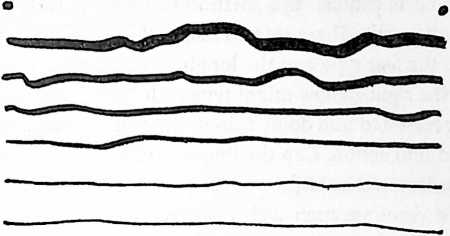
23 Truth or perfection is abstract only, just as Einstein’s factor of truth in his E=Mc2 formula is an abstract, that is, speed or rate. Though detectable only through interception this abstract, ‘‘speed’’ is nevertheless a perfect reality. Stand in the path of an onrushing auto and deny this truth!
24 ‘‘Now,’’ continues genius, ‘‘granted that the mind perceives the abstract straight line of truth, how can I formulate this for the Murphys? How may the lines—without disgression from truth—be made sensorial and consequently useful to them? Useful in a breadand-butter sense for abetting their daily growth? The Murphys cannot see abstract straight lines, and are not spontaneously interested in anything abstract.’’
25 Genius may, for instance, articulate the line with light-refracting materials,—let us say with red or blue crayon—without digressing from the demonstration of truth. Furthermore, the colored line may be divided into harmonic intervals, or it may be made to smell thus and so, or it may be endowed with textnral characteristics discernible directly by frictional touch (contact), or, indirectly, by vibratory radiation reception.
26 ‘‘But’’ reflects genius, ‘‘this method of demonstration might not appeal to all people. There are two major classes of human beings in the world, the fear type and the longing type, or the might-makesright and the right-makes-might types. The longing type likes to be pleased or reasoned into doing things; the fear type must be damned or irritated into action. Can the line of truth be deployed to appeal to or be understood by both?
27 ‘‘My first demonstration with color or by synchronization or by textural treatment is of appeal particularly to the longing type. If the straight line is considered structurally as a rod of wood then, when tensed at its terminals, it will be seen to tend to pull ‘true’; when compressed at its terminals, it tends to bend. I can employ the pulled or tensed line to appeal to the longing or right-makes-might type, and I can use the compressed or bent line to appeal to the might-makes-right minded or fear-dominated person. I am not saying that relaxed tension will not also appeal to the longing type.’’
28 Since genius’s function is to make sensorial use contact with the Murphys, he is entitled to tense or compress the line of truth as required. The tensed line may be called the major mode, the bent line the minor mode.
29 In flexion as in tension, the line of truth may be exposed by means of color, smell, tactile or aural appeal, in continuity or alternately. The tensed, bent or slacked line is still the same ‘‘truth’’ representative so long as genius, always aware of the abstract straight line, remains responsible for the specific tension or bending.
30 Here, then, we have not only a scientific means of graphing truth but, also, a theory of art which we define as the harmonic objectification, or harmonic synchronization, or syncopated articulation of truth within the ‘‘satisfaction’’ ken of the Murphys.
31 ‘‘The further art advances the closer it approaches science,’’ said Leonardo da Vinci, painter, sculptor, architect, engineer, and inventor of the wheelbarrow, and other useful instruments from the speaking tube to a mechanically gyp-proof whorehouse, ‘‘and the further science advances the closer it approaches art.’’