Chapter 5
WHAT IS A HOUSE?
2‘‘A HOUSE, darling,’’—indeed.
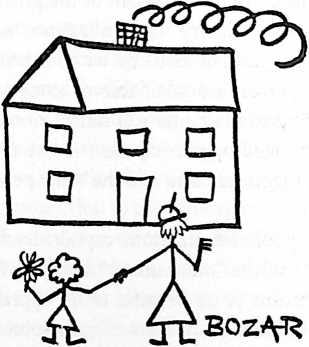
3 The accompanying sketch is symbolic of the ordinary depth of penetration into the phenomenon ‘‘house.’’
5 ‘‘Come now,’’ says the average reader. ‘‘I am not as dumb and old-fashioned as that. Why only last Sunday I was immensely interested in pictures of a Moto-home. Surely that is scientific?’’
6 Answer—NO.
7 Compare ‘‘Jones’’ and the Moto-home as to complexity of requirement and as to efficiency of fulfillment of that requirement on a spacial, weight, mobility, adaptability, longevity or maintenance basis. Consider further that the abortive Moto-home is not even crudely valid, inasmuch as it is completely beyond the price range of the populace for which it was designed. The price of a Moto-home is approximately $14,000 or three times what 75% of the population can pay.
8 No, Mr. Average Reader, you are wrong. You don’t know what a house is. The house in your mind is but a composite image of confusion, ineffectuality, and romance, of the exploitation of every weakness of ‘‘Jones’’ and ‘‘Murphy.’’ There is no scientific sincerity apparent on the part of the producers of the Moto-home. It was devised as an outlet for their particular products of exploitation (electric toasters, wall paper, vacuum cleaners, et cetera'). They carefully saw to it, not malevolently but because their ‘‘modern accessories’’ are dependent thereon, that the design of the Moto-home was subject to every land arterial tie-up and to political and finance bogging.
9 The Moto-home was successful as an advertising display and as a bauble for the bauble-affording 2%. It was, moreover, most pitifully a teaser to hundreds of thousands of home needers and longforers. There it ended, and baby may now draw the Moto-home thus:
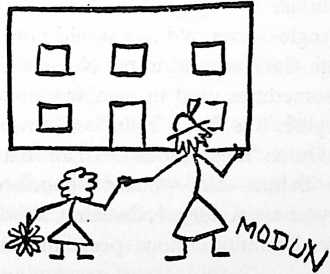
11 The peak-top and the chimney are omitted, but the same old Wind-O-s are present (despite the fact that it has ‘‘air-conditioning’’). There are books on plumbing (to be read while using the plumbing), asbestos or cement (instead of wood walls) covered with washable celluloid-collar paper, and several electric gadgets. There is no furniture, other than displayed in it by the department store from which it is hoped Murphy will buy, after being saddled with the Moto-home. In other words, the Moto-home relative to a cotswold cottage replica is analogous to the transition from Mother Goose’s shoe to Uncle Don’s flaked-cereal ‘‘premium’’ paper house.
12 Returning to the inside-out designer who was so boldly prosaic and scientific as to ask, ‘‘What is this phenomenon, house?’’ we find that before designing a house from the inside-out, he probably asked himself the further question, ‘‘What do I know about a house?’’
13 ‘‘It is evident,’’ he reasoned, ‘‘that to see what a house MAY look like, if it is not to be a confused symbol of superstition, compromise, perversion, exploitation, and even of social degeneracy and sloth, but a dwelling that will be truly articulate of satisfaction of requirements, it is essential that a sincere attempt be made to take stock of all known forces, current facilities, and trends.’’
14 In the language of various ‘‘human’’ groups residing on the isotherm of central population (the latitude of an average mean low temperature of 32° F.) there is a remarkable similarity in the ‘‘sound’’ that designates a house.
15 It is ‘‘hus’’ in Anglo-Saxon, old Saxon, old French, mid-low, old- high and mid-high German, and in the Norse and Gothic tongues. (In Gothic it is sometimes used in combination with Gud—Gud- house.) In old English, it is ‘‘hus,’’ ‘‘hous,’’ or ‘‘howes’’; in Danish and Swedish ‘‘hus,’’ in Dutch ‘‘huis,’’ and in German ‘‘haus.’’ It is etymologically connected with hut—hide—hoard—hood and hat, and among its various synonyms are residence, dwelling, abode, lodging, booth (bothy) and shelter. Its multitudinous special meanings include:
16 Whorehouse
17 Warehouse
18 Special chamber (smokehouse, toolhouse, etc.)
19 Household (meaning the family)
20 House of Rothschild (meaning a family of ancestors)
21 Legislative body
22 Audience of a play
23 Commercial firm
24 In astrology, 12th part of heaven.
25 The Anglo-Saxon origin of the synonym ‘‘shelter’’ would be: SHELL<scyld (shield) TER<trum (firm): That which covers or shields from exposure or danger; a place of safety, refuge or retreat.
26 ‘‘Since I am particularly interested in the shelter-dwelling-house,’’ continues the inside-outer, ‘‘which of its multitudinous requirements may I set down on paper as universal, that is, not only for the Murphys of New York but for Murphys everywhere, from Africa to Alaska, the tropics and the Arctic, as well as in the temperate zones?’’ See following page.
27 There is no traditional, mechanical or esthetic solution implicit in any of the foregoing requirements, which are universal to 2'/3 billion Earthians, since they have no specific continental, linguistic, racial, spacial or calendar-time limitations. Air transport passengers have digestive functions identical with those of house-holders. There is not implied in the solution of the requirements a replica of a 600 B.C. cloaca maxima with such appendages as a Tammany sewer commissioner, improvement and maintenance taxes, and a mortgageable land-wedded arterial tie-up.
28 In his column of December 1, 1937, Westbrook Pegler reported a hypothetical citizen’s testimony before a Housing Commission which clarifies what we mean by ‘‘mortgageable land-wedded arterial tie-up’’ or political-finance bogged housing:
2930Q. You claim authority on housing? Why?
31A. Well, I built a house, I own a house and I live in a house.
32Q. You built a house yourself?
33A. No, I paid for building it.
34Q. You think a government housing program would run into trouble?
35A. Well, judging by my own case, yes.
36Q. State your experience.
37A. Well, there was the sewer. The real estate promoter promised to put in a sewer, but he went into bankruptcy without putting it in. He had several corporations. Everytime he bought another lot he would form another corporation, and the corporation that sold us our lot went bankrupt. So the sanitary inspector wouldn’t let us dig a cesspool and the corporation couldn’t build the sewer. So they had a receiver, and after a long time, with our house standing idle, they got things straightened out, but the receiver and his lawyers had taken all the money. So finally the town built the sewer and taxed us for it.
38Same way about the sidewalks and pavement. We paid for them in the purchase of the lot, but, after the little corporation went bankrupt, we had to pay for them again, in taxes. (The real estate man still had plenty of money, personally, but the corporation was broke.)
39Q. Was there something about a furnace?
40A. Yes, sir. The contractor made a deal with a furnace contractor and he installed an old furnace, just painted over, instead, of a new one, as the contract specified. It wouldn’t heat, the pipe froze, the furnace blew up and we had to move to a boarding house while they fixed it. I had to redecorate the boarding house walls where the children drew pictures with their crayons, all because of that furnace.
41Then, when they went to fix the frozen pipes, they discovered that the builder didn’t leave that little trap door so you could get at the pipes to fix them. So we had to get a carpenter to tear out the wall and a plasterer to make it over. Meantime, this new plumber discovered that the original plumber had used wax instead of solder on a big joint ‘way back under the bathroom floor. That was leaking, too. He could see it with his flashlight, but couldn’t get at it, so we had to wreck the floor and rebuild it.
42The furnace contractor didn’t have any backing, so couldn’t replace the furnace with a good one. And then the junk man who sold him the second-hand furnace came and got it, claiming he had not been paid for it. That didn’t leave me any furnace at all. And then the furnace workmen sued the furnace contractor for their wages and slapped a mechanic’s lien on my whole house. They said I had no right to let the junk man take the furnace off the place so they couldn’t attach it.
43 (Continued on page 36)
44 UNIVERSAL REQUIREMENTS OF A DWELLING MACHINE
45 1. OPPOSITION TO EXTERNAL DESTRUCTIVE FORCES, via spacial control against:
| Earthquake | Flood | Gale | Gases |
| Fire | Pestilence | Tornado | Marauders |
| Selfishness (Politics, Business, Materialism) |
46 2. OPPOSITION TO INTERNAL DESTRUCTIVE FORCES, via spacial control for:
- A.
- Nerve Shock Proofing:
- 1.
- Visual
- 2.
- Aural
- 3.
- Tactile
- 4.
- Olfactoral
- B.
- Fatigue Proofing (Human Robotism, Drudgery)
- C.
- Repression Proofing (Don’t-proofing, Removal of Fear of Mechanical Inadequacy Developed by Accidents or Arbitrary Cellular Limits of Activity, i.e., Negative Partitioning)
- 3.
- PROVISION FOR UNSELFCONSCIOUS PERFORMANCE OF INEVITABLE MECHANICAL ROUTINE OF THE DWELLING AND ITS OCCUPANTS:
- A.
- FUELING of House or Occupants (Eating—Metabolism).
- B.
- REALIGNMENT of House or Occupants (Sleeping—Muscular, Nerve and Cellular Realignment).
- C.
- REFUSING of House or Occupants (Internal, i.e., Intestinal, etc.; External, i.e., Bathing or Pore Cleansing; Mental, i.e., Elimination by Empirical Dynamics; Circulatory, i.e., Atmospheric Control).
- 4.
- PROVISION OF ADEQUATE MECHANICAL MEANS FOR ALL DEVELOPMENT REQUIREMENTS OF GROWTH PHENOMENA allowing the Facile, No-time-loss, Scientifically Efficient and Unselfconscious development ofi
- A.
- SELECTIVE AWARENESS OF UNIVERSAL PROGRESSIONS, i.e.: Vital data on:
- 1.
- History—News—Forecasts (Library, Radio, Television)
- 2.
- Current Supply and Demand Conditions
- 3.
- Current Dynamic Conditions—Weather—Earthquakes—Latest Scientific Research Findings.
- B.
- ADEQUATE MECHANICS OF ARTICULATION (Prosaic or Harmonic) through Recording by Typewriter, Drawing Board, Conversation, i.e., Communication, Direct or Indirect, Aural, Visual, or Tactile. (This also includes the necessity of Transportation and bespeaks any and all Means of Objectification or Crystallization of Universal Progress.)
- C.
- PROCREATION.
- D.
- RECREATION.
47 Q. Any other liens?
4849A. I guess you could call them liens. Some lumber company that sold the builder the shingles served a paper on me because he didn’t pay them, although I paid him. Then some workmen who worked for the builder on another job served another lien on me, claiming I had to pay them a balance of $400 which I owed the builder because he owed them some wages. 1 said I wasn’t intending to pay him the $400 because of all the expense he had put me to. But he claims he is broke, too, so where do I get off suing him?
50Well, he had to rebuild the roof because it leaked, and some walls where the water destroyed the plaster, and now some union stands in front of my house yelling ‘‘SCAB!’’ because some of the workmen weren’t union. But I didn’t hire them. The contractor wouldn’t let me. Anyway, that would have canceled his responsibility.
51Q. So you think the government might have a serious difficulty building 3,000,000 houses?
52A. Difficulty? It would be a war!
53To add another ‘‘slant’’ in this picture from the design and method viewpoint, I quote from an article I wrote in 1927, after five years’ experience in the building business, during which I succeeded in aiding the erection of some 150 homes large and small out of more than 10,000 seriously discussed and partially attempted.
54‘‘If, today a man, wishing to acquire an automobile, were to visit one of five thousand automobile designers in New York City, equivalent to New York’s five thousand architects, and were to commence his retention of the designer by the limitation that he wanted the automobile to resemble outwardly a Venetian gondola, a jinricksha of the Tang Dynasty, a French fiacre, or a Coronation Coach of Great Britain, pictures of which he had obligingly brought with him, all final embellishment, of course, to be left to the election of his wife; and he and the ‘designer’ were together to pick and choose (from automobile accessory catalogues, advertisements, and ‘shows’) motors, fly wheels, fenders, frame parts offered in concrete, brass, sugar cane fibre, walnut, et cetera, and succeeded in designing an automobile somewhat after the style of some other fellow; and they were then to have the design bid upon by five local garages in Queens Village, picking one of the bidders for his ability, or price; and the successful bidder, chosen, let us say, because of his having built grandfather’s velocipede, were to insist on the use of some other wheels than those specified; and the local bank, in loaning the money to the prospective ‘owner’ to help him finance, had some practical man look over the plans so that, guessing at the cost, he might base a loan thereon, incidentally insisting on the replacement of several parts and methods by others in which the bank was ‘interested’; and then the insurance company was to condemn a number of the units used because they had not been paid for their ‘official approval’ and compel the substitution of other units; and fifty material and accessory manufacturers’ salesmen were informed by a reporting agency, whose business it was to ferret out this poor man’s private plans, that he was going to ‘build’ a car, and were to begin hounding him with specious promises; and, finally, if the local town council had to approve of the design and materials and give a permit for the automobile’s construction, sending around assertive inspectors, while it was being erected, it is certain that few of those desiring automobiles would have the temerity to go through with the ardors of acquiring them on such a ‘craft’ and ‘graft’ basis. Should they have the hardihood, the automobile would finally cost in the neighborhood of $50,000, and be highly unsatisfactory, being full of‘bugs,’ and completely without service when finished.
55 ‘‘This is exactly the condition in the home building field. Is it any wonder people crowd the city apartment? In the building of such an automobile, not one but many ill trained mechanics from different oddly named ‘trades’ would have to be employed, carpenters’ to apply the carburetor and ‘masons’ to assemble the chassis frame, though many times there would be but room for one man to work. The contractor, who would also be building other cars in Far Rockaway, Roslyn, et cetera, would stop in for an hour a day to look over the work, outside of which the job would receive no organization of method. There would probably be strikes by the plumbers or electricians who would insist on most of the improvements in design being left out due to their having no ‘jurisdiction’ permitting them. To cap all, the car would take from six months to a year to build, inasmuch as mechanics in the building trades average 30 steps per net useful contact today as opposed to 1/2 step in highly developed modern factory conditions, which fact, coupled with the consideration of high discomfiture of building trades’ exposed working conditions, and the fact that it is found by insurance companies to be second only to coal mining in point of fatal accident, indicates the extraordinary change of status that will occur in new housing industry, when mechanics will perform effective shelter service, economically rewarding such labor on an efficacy basis, indicative of wages many times higher than the present scale.’’
5657It is a law of evolution and design that designs, whether by man or by ‘‘nature,’’ are reproduced in direct proportion to their mechanical adequacy of satisfaction of universal requirements, whether it be a book, a rose, a pencil or a baby.
58The 1936 ‘‘Moto-home,’’ by this law, was not subject to mass production due to its inadequacy. Whether the government or private enterprise ever becomes successful in producing or reproducing 3,000,000 homes or 50,000,000 will be dependent upon the adequacy of the design, not only of the prototype end product house but of the prototype industrial service. It must be a ‘‘natural. ’’ If it is, no one will be able to stop its mass production and world-wide distribution by either the government or private enterprise.
59There is not implicit in this statement of the law of reproduction an attainment of immediate ‘‘perfection’’ in rendition of the prototype. Any present level of knowledge, standards, technique and available known elemental sources will tend to confine the physical characteristics of design-solution within that special era. Nevertheless, the development of public enlightenment and industrial management awareness is bringing with it recognition of the fact that any economic survival plan for industry must include not only accredited primary survival of shelter, but the expansion of shelter design to the point of maximum efficiency. Shelter of the human life process involves, in its most comprehensive meaning, consideration of all forces acting to retard or destroy it. It represents the measure of man’s intuitive and conscious mastery of equilibrium.
60 A new dwelling service industry must inevitably develop, even to the point of commanding all other industries.
61 HOUSES, like other instruments, have not only to be SCIENTIFICALLY DESIGNED but MUST BE PRODUCED, otherwise designers are going to be justly condemned for bringing about academic esthetic race suicide through a battle of words.
62 Final chapters in this book will discuss such production objectively. If successful performance is sincerely longed for, we must research broadly, then consolidate.
63 Obviously, with the achievement of adequate housing, existing theories of land economics must undergo a profound change, and as the new dwelling service industry correlates and engulfs other industries architecture itself will become enlarged in scope and definition.
64 The function of the architect will be to RAISE the level of universal existence to the progressively HIGHEST standard of survival and growth. This will manifest the EVOLUTIONARY COURSE of human growth as opposed to the revolutionary, lazy, stopshort method of levelling high standards of existence down to the lowest common denominator to satisfy an inferiority complex and excuse the political imposition of a devastating ‘‘class’’ wedge upon the masses.
65 The function of the architect-engineer will be the irrevocable integration into society of an universally accredited primary survival. This will be done through the adequate disposition of a constantly improving, available ‘‘best’’ shelter, clothing and sustenance, in a world which can already—through the effort of one man out of every five working but one day a month—produce and distribute the goods and services necessary to all.
66 Resourcefulness and industriousness, in the conscientious perusal of the myriad of available technological data for the integration involved, will triumph. Buck-passing of technical responsibility and hopeful guessing, progressively self-invalidating, will cease to be profitable.
6768The proper activity of the architect-engineer is purposeful. ‘‘It is not to devise a better society so as to arrive at a finer architecture; it is to provide a better architecture in order to arrive at a more desirable society.’’1 The combined function of architect, industrialist and synchronizing architect-engineer, since WHAT to do is known, is, first, to determine not causes but purposes, and, then, acting within this knowledge, to evolve an adequate shelter design that will make possible the rational and spiritual self-realization toward which man has ever so longingly striven.
70In this connection, Dr. Alexis Carrel holds that ‘‘The quality of life is more important than life itself,’’ and asks, ‘‘Is not this more important to man than the goods consumed by him?’’
71The answer is that if the quality of goods and shelter is improved, the quality of life automatically will improve.
72Carrel further asks, ‘‘Are health and comfort of any value if we become mentally and spiritually worthless?’’
73To this we reply, ‘‘The phantom captain will abandon ship and find a better one if the old one springs leaks and the machinery breaks down to the point of uneconomical repair.’’
74What is Carrel’s yardstick of worth? Both the mental and energy components of life are abstract. He confuses the articulation means,
- i.
- e., the mechanical body, with the cause. Aid man by eliminating drudgery and breakdowns in what he HAS to do, and make available to him, even to the point of unconscious awareness, complete tools of articulation for his every growth requirement, and the meaning in mind will flower forth with redolence. Intelligence is not quantitative.
7576Intelligence says, ‘‘Conscious inefficiency and non-adaptability to purpose, or change, are SUICIDAL.’’
77Therefore, as a stimulant for the mind-over-matterists to whom the privilege of furthering human emergence through shelter service will accrue, the adoption of the following resolution is recommended:
78 WHEREAS industry, which is science instrumented and coordinated cooperation, is more efficient than have been the arts and crafts tailoring methods in the mass production of universal requirement extensions and supplies, and
79 WHEREAS the scientific element of industry recognizes that we must do the most with the least, which, in view of change through the growth of knowledge, imposes not only ‘‘doing’’ but a specific ‘‘in-time-doing’’ if the search for the most with the least is not to delay an equation of use performance, and
80 WHEREAS, efficiency makes it mandatory that we USE forces, not FIGHT them, now, therefore,
81 BE IT RESOLVED, that in any plan of human emergence through shelter service the following three points become integral and necessary preliminaries:
- 1.
- The segregation and correlation of currently gleanable ‘‘attained conditions’’ of human survival, dramatically emphasizing the relative importance of the various ‘‘conditions’’ to a progressively growthful survival;
- 2.
- The summation of currently available knowledge, techniques, and instruments, as well as of the sources and extent of power for production and operation of all the means of satisfying vital requirements; and
- 3.
- The determination of mankind’s present status by an estimate of the general animate and inanimate trend momenta (evolutionary kinetics) for, and general animate and inanimate obstacles (evolutionary inertia) against the forthright, intelligent solution of the condition first mentioned by the means enumerated.
82 The proposed inventory, to be efficient, must be all-comprehensive of man’s estate, that is of his UNIVERSAL status quo.
83 Once the accounting is made, with calm deliberation, an improved future may be envisioned and rationally brought about; known defects can be remedied; and areas of advance achievement can be limitlessly extended.
84 The goal is the emergence of humanity.
85 The means is industrial. Not re-form, but to form.
86 Evolution tends toward the accelerated development of new form, embodying one or many of the basic elements, but in ever new streamlined alignment.
87 In architecture ‘‘form’’ is a noun; in industry, ‘‘form’’ is a verb. Industry is concerned with DOING, whereas architecture has been engrossed with making replicas of end results of what people have industrially demonstrated in the past. ‘‘Noun,’’ in our phonetic etymology, means ‘‘now-one,’’ i.e., the most recent chaos of thought reduced to an answer. The ‘‘now-one’’ or ‘‘noun’’ must, in due course through selection by the intellect, become two or more observed characteristics of the one, there being no absolute identity. Nouns, from a language viewpoint, are tenable only as ‘‘names’’ for facts recently determined. The noun is, therefore, more subject to constant revision than is any other part of speech. No longer is it ‘‘stone.’’ No longer is it ‘‘steel.’’ Industry is dealing in hundreds of different steels, physically more dissimilar than the Chinese and the Swiss.
88 The goal is not ‘‘housing,’’ but the universal extension of the phantom captain’s ship into new areas of environment control, possibly to continuity of survival without the necessity of intermittent ‘‘abandoning ship.’’