Chapter 7
WE CALL IT ‘‘EARTH’’
2Of one planet, the earth, in one little star system (the suns) in one relatively small galaxy, we know a little: its superficial geography, measurements, conditions and processes.
3 Of the nine planets in our solar system, the earth is the third nearest the sun, being 92 million miles distant from it. Mercury is nearest, with a minimum distance from the sun of 28 million miles, and Pluto is the farthest, being distant 3 billion 800 million miles. The ratio of distance from the sun to axial revolutions, or days, per annum is approximately of inverse proportion for all planets. Mercury has 88 days in a year, the earth 365, and Pluto 90,500.
4 We know that the earth is the densest body of the sun group, including the sun itself. If we were to call the density of the earth 1, Venus would be .88, the moon .60, and the sun .26.
5 The diameter of the earth is twice that of the smallest planet, Mercury, but is only one tenth that of Jupiter, the largest planet, the diameter of which, in turn, is but one tenth that of the sun. (The sun itself is a relatively small star, a new one having been discovered and measured in ‘37--‘38 so large as almost to equal that of the whole solar system.)
6 Three fourths of the earth’s surface is covered with a layer of moisture that is relatively thin (9/100 of 1 %), its greatest depth being only 35,410 feet in the Mindinao Deep between the Philippine Islands and Japan, as compared to the earth’s 8000 mile (42,000,000 ft.) diameter.
78The remaining quarter of the surface of the earth consists of dry land concentrated within a relatively small sector. Indeed, one may so revolve a globular replica of the earth that 85% of all dry land is visible from one perspective point. When so revolved, there appears a ‘‘land hemisphere’’ in which the north pole is approximately one eighth of the way down from the top center. The center of the ‘‘land hemisphere’’ is the Spanish Riviera. In this ‘‘land hemisphere’’ two main continental bodies are apparent. One comprises all of Africa, Europe and Asia, penetrated by a small canal (the Mediterranean and the Red Sea); the other consists of the Americas and Greenland. These two great bodies are joined at their upper limits by Alaska and northern Siberia, with the Aleutian Islands re-enforcing the juncture. Bering Strait is scarcely discernible.
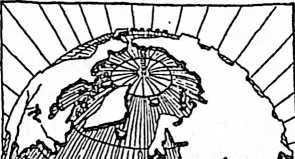
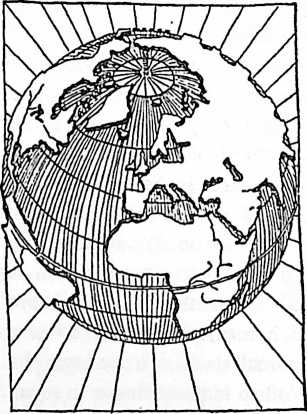
10 An SSA graph of universal architecture’s prime ‘‘town limits’’ for an
industrially emancipated human community.
11 The Equator appears as a draped line girdling the globe one quarter of the distance between the bottom and the top of this view of the earth. It transits the center of Africa and what can be seen of South America. Above the line designating the Equator lies 85% of all the earths dry land.
12 The ‘‘town plan’’ of an architect intent on devising an universal shelter service design is a fairly concentrated affair so far as the earth is concerned. This is emphasized by a study of population concentrations upon the earths surface. Of the 2'4 billion people currently on this earth-globe, only 13 million, or approximately /z of 1%, are in the non-visible area of our ‘‘town plan.’’ No teleologic designer, in view of the current world integration, can profess concern with building only within the ‘‘town plan’’ of Podunk when the materials, structures and tools he uses are so obviously derived from the entire surface of the earth. It is a different story from an early New England settler doing the best he could with the materials at hand quarrying for himself a bit of granite for shelter construction. That was architecture, for he did the most with the least out of the available materials and tools. We cannot claim that we are doing the most with the least without carefully referring to our cosmic inventory and ascertaining what is now most suitable and available.
13 Although the earth’s land and water surface is protected by a blanket of atmospheric gas, which is frictionally cohesive to the earth in its fast rotation, the differential of speed of the earth’s revolutions to that of the air and water produces a constant rotational current, in both its air and partial water covering, in a general direction of west to east. Scientifically, this is explainable as a slight rotational lag of the earth ball within its surface films of more mutably drawn liquid and gaseous elements,—drawn tidally by the electrical pull of the moon and possibly of the sun.
14 Were it not for the dryland projections into the gaseous and liquid films, these apparent currents would probably be true west to east currents. However, the continental projections, which, like three fingers, extend down from the north pole, set up turbulent back eddies in both the liquid and gaseous films around their southern extremities. Thus, warm equatorial waters are catch-basined into S-shaped
1516depressions between the two main continental bodies, where they swirl about in such manner as to cause great vagaries in temperature in relation to the earths theoretical parallels of latitude. These thermal conditions have a direct bearing on the areas favorable to human survival because the water content of the human is approximately 9 to 1, and water freezes at 32° E
17The west-east currents of the gaseous film are further interrupted by great mountain ranges on the windward slopes of both main continental bodies. Molten snow and ice, flowing down the windward side of these ranges, have caused small alluvial plains to form like a shelf along their windward base. This windward lip is so slight as in no way to alter a general cross-sectional contour of the continent, similar to a cross-section of an aeroplane wing foil, as the continent tapers from its western mountainous edge to its eastward leeward flat-lands.
18Whether or not there is significance in the coincidental streamline form of the continents (possibly so formed by air and oceans of yore passing over them from west to east), the fact remains that these westerly continental lead-edges cause a peculiar disturbance in their wake, to the east and over the hinterland. This still further affects the isotherm of average temperature, areas of moisture precipitation, and man-growth abetment conditions that must be heeded by the teleologic shelter designer.
19The isotherm, or abstract temperature belt or zone, of an annual average variation of 48° E and 32° E mean low and 72° mean high, swirls from Alaska down the coast to Vancouver, B.C., thence to lower Kansas, after which it rises gradually to Lake Erie, Boston, Newfoundland, South Greenland, and mid-northern Russia. Then it veers back to and down through the Scandinavian Penninsula, centrally through Europe to the Black Sea, and, finally, passing through the Caspian Sea, Turkey, Persia, northern India and central China, rises again to traverse Japan and follow the coast of Siberia back to the southern tip of Alaska. The significance of this isotherm is that it coincides with the central line of concentration of man population.
2122One and one half billion or 70% of the total 214 billion world population resides along this 48° range of temperature isotherm. This zone has an average rainfall of 40 inches annually and an average constant wind speed of 15 m.p.h. We are certainly getting down to specific conditions for the teleologic dwelling designer.
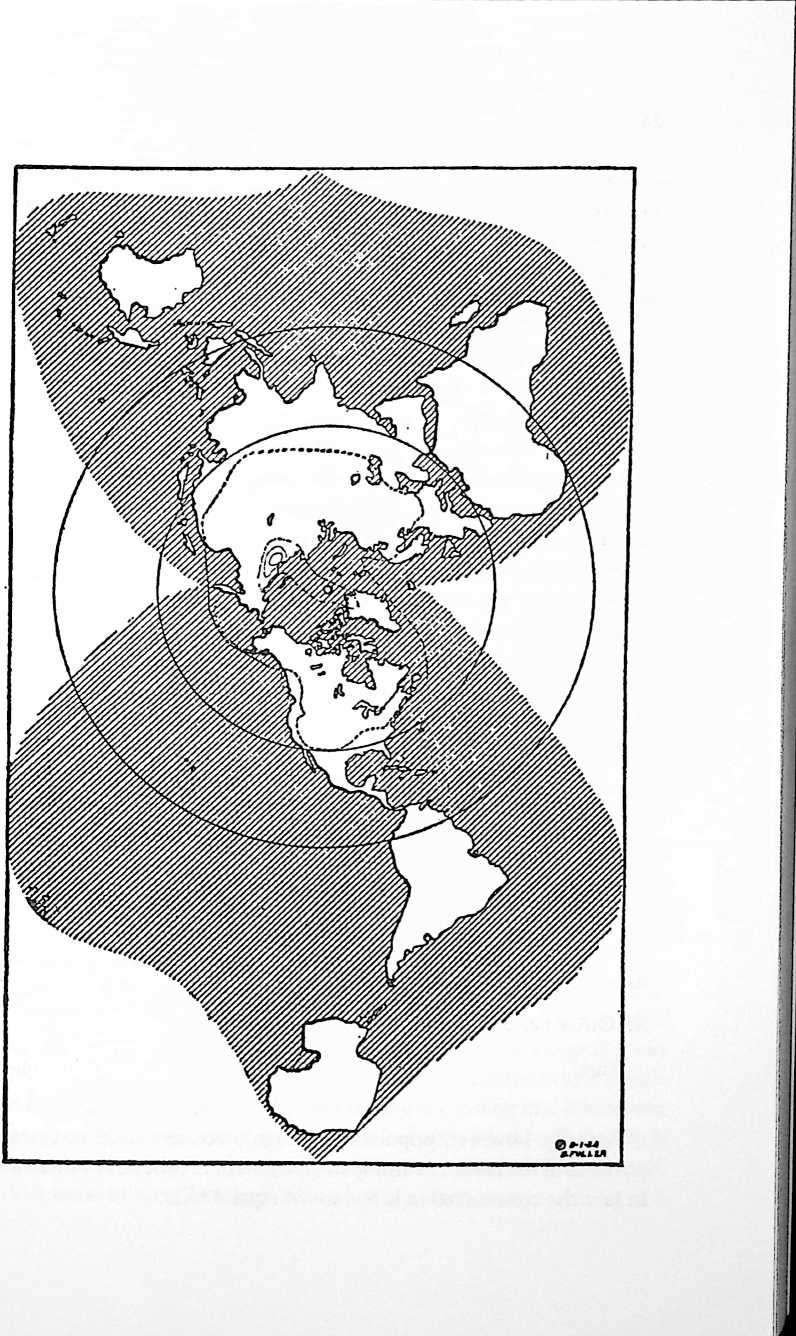
23We now submit a new world map more suitable for our teleologist than the ‘‘land hemisphere’’ previously sketched. It centers on the North Pole and in it the whole dry land of the earth may be seen to be ONE CONTINENT instead of two as shown in the first sketch. There is one continent similar to a 3-bladed propeller with the hub at the North Pole. The winding dotted line is that of our population isotherm.
24It will be noted from the following table that, if man were to be deployed over the whole surface of dry land, there would be but 40 persons to a square mile. At this rate, there would quite evidently be ample room on earth for man for a long time to come, this density being but one tenth that of the British Isles, or Rhode Island.
25 TABLE 1
|
28Continent |
29Sq. Mile (Millions) |
30Population (Millions) |
31Population (per Sq. Mile) |
|
32North America |
338.50 |
34180.0 |
3521 |
|
36South America |
376.8 |
3881.5 |
3912 |
|
40Europe |
413.7 |
42550.0 |
43149 |
|
44Asia |
4517.0 |
461,155.0 |
4767 |
|
48Africa |
4911.5 |
50150.0 |
5113 |
|
52All Other Land |
5310.0 |
54197.0 |
55— |
|
56Total |
5757.5 |
582,313.5 |
5940 (average) |
6667Actually, however, population is highly concentrated in certain portions of the land area and sparsely existent in others. For instance, in Java the concentration is 804 to the square mile.
68 TABLE 2
69 COMPARATIVE SPECIAL POPULATION DENSITIES
|
72Country |
73Sq. Mile (Millions) |
74Population (Millions) |
75Population (perSq. Mile) |
|
76Japan |
77.148 |
7864.0 |
79432 |
|
80Australia |
813.000 |
826.6 |
832 |
|
84British Isles |
85.120 |
8649.0 |
87409 |
|
88Java |
89.051 |
9041.0 |
91804 |
98 Of the dryland but approximately one half is arable and the population, were man theoretically deployed over all the pleasantly livable and arable land, would total 80 persons per square mile.
99 Reducing these figures further to comprehensible areas, on the basis of 80 inhabitants to the square mile of livable land, there would be 16 pleasant acres of land for each and every man, woman and child. However, the family unit is currently five and so, if mankind were completely deployed in family units over the ‘‘livable’’ dry land area, there would be 80 acres per family, or an area so large that, unless the family shelters were on hilltops, man need not be aware of the existence of others beyond the members of his immediate family group.
100 Man has evolved two unit measures of a mile: ‘‘statute’’ and ‘‘nautical.’’
101 The statute mile represents the earths surface equivalent in feet to a longitudinal minute at the latitude of Greenwich, England,—Greenwich being, also, the starting point for the longitudinal reckoning of standard sun time. This statute or ‘‘legal’’ English mile was arbitrarily arrived at by England, and, with the zero longitude, was imposed by her on the world by means of her commercially dominant position as Queen of the Seas during the sailing era. It has been perpetuated by habit and the ‘‘necessity’’ of property tide continuity. It must be irritating for the Japanese sailor-man always to find himself, as it were, in Row Z of the audience.
102103This lawyer’s or ‘‘statute’’ mile was a ‘‘flop’’ at sea. The mathematical navigator had to have something much more actual and reliable to go to sea on. So he evolved the nautical mile, which is 6,080.20 feet in length and is equal to one sixtieth of a degree of a great circle of a sphere whose surface is equal in area to the area of the surface of the earth. This serves as an identical unit of measure on any great circle with but negligible error.
104The nautical mile, which is 1.152 ‘‘statute’’ miles, was more scientifically determined, and is, therefore, more universally utilizable.
105Although it may seem to be a digression at this point, it is nevertheless vitally significant to the comprehension of our book to state that a RATE of speed of one nautical mile per hour is known, at sea, as one knot. The name derives from the knots in the chip log line thrown over the stern of the old sailing ship whose run-out count, by means of a sand glass, determined the vessel’s speed. It is improper, accordingly, to say ‘‘one knot per hour,’’ which is like saying ‘‘one mile an hour per hour.’’ The sailor says we are ‘‘making five knots at the present moment,’’ or ‘‘we have covered ten nautical miles.’’ We have no such speed or rate word relative to land miles, for land thinking has been relatively static and there has been no necessity for such a mobility word. On land, one measures in miles or hours. This has occasioned much mental confusion, in parlor talk about relativity, over the really very evident, from a rate viewpoint, integration of time and space. Among the first people on land to offer a rate word were the electrical engineers who evolved the DYNE (of the dynamo, dynamite, and dynamic family).
106DYNE is a measure of force which, acting on a gram for 1 second, imparts to it a velocity of 1 centimeter per second. Result = 1 erg = 118 feet an hour. 1 dyne=the additional force exerted by a clock 30 ft. in diameter to carry a fly weighing 1/453 lb. on the tip of its ‘‘minute’’ hand for one second. The exact additional work done by the clock to carry the fly completely around its circumference on the tip of the big hand would bean ERG hour. Three billionths of 10 is the hydraulic power cost of this erg-hour fly transportation. This is typical of the currently fine degree of appraisal of work costs, through these rate integrations.
107 The layman knows little about this except that he must pay for his electric light at some obscure rate, but the power sellers were quick to use it in their exploitation of this scientific phenomenon.
108 The earths circumference at the equator is 24,903 nautical miles, and its total surface is approximately 197 million square miles, of which 5714 million are dry land. As there are 33 million square feet to a square nautical mile, or 189 billion cubic feet to a cubic mile, the earth has a volume of 260 billion cubic miles, and weighs 6!4 thousand billion billion tons.
109 How does man stack up in size with all these volumes, weights and measures?
110 If all the earths 2/4 billion people were to stand on one another’s heads, they would form a chain 2,423,000 statute miles long, or nine complete chains to the moon; that is, they would reach to the moon and back four and one-half times. It would require only 50 such chains to reach the sun. Man is, therefore, empowered to a sense of personal contact with all astronomical bodies of the universe in addition to his earth.
111 Were all the members of the human family to gather together in one spot with a density equivalent to that of people jammed in a New York subway car aisle, they would cover an area of 139 square miles, which is approximately that of the Virgin Islands or Bermuda. Compare this with the 31,820 square miles of Lake Superior, the 121,000 square miles of the British Isles, and the 472,000 square miles of Hudson Bay!
112 The whole of our present human family—only one-ninth of which would be required, standing on one another’s shoulders, to reach to the not-so-far-away moon, could readily be housed overnight on the little speck of earth known as New York City, if the floor space of all the buildings were utilized for the purpose, although, of course, they could not be serviced with the city’s present facilities.
113 There are 10 billion cubic feet of people on earth (1/19 of a cubic mile). They weigh 115 million tons and would fill 111 Empire State Buildings. Yet if put under a gigantic hydraulic wine press, so that all the water and gas might be squeezed out of them, they could be compressed into one Empire State Building.
114115There are approximately 50 Panama Canals to a cubic mile and there are 317 MILLION cubic miles of ocean. The ‘‘nine chains to the moon’’ would make but a small splash in those 317 million cubic miles of water, which, however, the moon lifts tidally twice daily from a few inches to fifty feet. This earth-moon force, compared with the minute muscle power of the human army, indicates well the vast excess of man’s POTENTIAL mind power over his brawn potential, for he already CONTEMPLATES harnessing at least a portion of this vast earth-moon gravitational force.
116The 115 million tons of people on the earth have an annual turnover, by birth, growth and death, of approximately 2 Vs million tons, with a net one million tons increase. This weight increase of human flesh and bones is equal to 14 S/S Normandies (the total weight of man being equal to 1400 Normandies or 287 Empire State Buildings). Although new human units weigh-in at only 25,000 tons, they are increased by the conversion of energy from the sun and other stars (directly or indirectly, but from no other source) to twenty times their original weighing-in weight by the time they reach maturity.
117The source of power for the operation of all man’s instruments, inanimate as well as animate, is sun and other star energy, direct or indirect, primarily through latent storage depots of multitudinous forms. All people are nurtured and energized by the ultraviolet and gamma rays, as well as by most powerfully penetrating, highly energized cosmic rays. The latter are responsible, apparently, for all electrical polarity changes in integral-with-life mechanisms upon the earth’s surface, these polarity changes or ionizations, in turn, sponsoring the birth of all new species in plants, known as ‘‘sports.’’ The laws of chance, change and animate evolution are here involved.
118Scientific shelter design, therefore, is linked to the stars far more directly than to the earth. STAR-GAZING? Admittedly. But it is essential to accentuate the real source of energy and change in contrast to the emphasis that has always been placed on keeping man ‘‘down to earth.’’ The teleologic dwelling designer MUST visualize his little shelters upon the minutely thin dust surface of the earth-ball, dust which is a composite of inert rock erosion, star dust, and vegetable compost, all direct star (sun) energy resultants.
119 Man, living in shelters scattered over the earths dust film and energized and nurtured by the stars, has evolved, through self-research and the comprehension of the dynamics of his own mechanism, the phantom captains extension mechanisms. Through the leverage gained by his INANIMATE INSTRUMENT EXTENSIONS OF SELF, he has attained an extended mechanical ability far in excess of his own integral mechanical and energy content ability.
120 Utilizing sun-energized ‘‘fire’’ to work his metals and exercising intelligent selection and dynamic experience, man has harnessed inanimate power (of sun-star origin) to operate his extended depersonalized mechanisms. Thus he has ‘‘set’’ his environment under increasing control by the ceaseless operation of his depersonalized inanimate-powered mechanisms and, concomitantly, has broken down the original limitations of time and space (days, nights and seasons). We repeat: All of this has been done through radiant energy from the stars.
121 By means of his harnessed inanimate servant, power, and his extended mechanisms, man has now explored, measured, and ‘‘set’’ under control much of his earth’s crust and his once-‘‘outside’’ universe, entirely despite the inertia of vanities, superstitions, exploitation, humpty dumpty moralities, laws and destructive selfishness. He has flown in his imagination-conceived, intelligence-wrought, de-selfed mechanisms at 72,000 feet above the earth’s surface, almost three times the height of the earth’s highest mountain, and sixty times higher than the Empire State Building. Yet this is an insignificant feat compared with flights and heights to be attained in the NOT FAR AHEAD ‘‘NOW,’’ in new intelligence-to-be- wrought mechanisms of flight.
122 Most extraordinary of all man’s extension activities—and far superior to his extension physically into his physical universe by physical means—is his mental extension, on the basis of observations of the dynamic progressions involved in his tangible mechanisms, inferring progression continuity beyond the tangible bands, into an AWARENESS OF and EXPERIENCE IN the ABSTRACT. I do not mean the abstract of humpty dumpty, academic philosophizing or mysticism, but the mathematically rationalizable abstraction of electrical phenomena representing the 66 octaves or bands of radiation which he has discovered despite their non-sensorial nature. Not only has he explored much of the realm of RADIATION, but he is using it and ACTUALLY THINKING IN IT. The phantom captain’s extension into participation in events of exterior mechanism occurrence has provided an ‘‘actual’’ sense in the realm of radio in our younger men.
123124In this sense-extension into radiation lies the promise of man’s eventually understanding all the secrets of life-in-time, which, down through the ages, have evoked an intuitive, mystical and superstitious awe. Miracles, once irrational, will be continually rationalized and set under service to man by man.