
10 Buckminster Fuller and the Game of the World
2Medard Gabel
3 The Encyclopedia of the Future, a 1,115-page two-volume work first published in 1996, took over five years to produce and featured contributions from over four hundred different experts. It covered topics ranging from Abortion to Zion and is considered to be an authoritative source on all matters concerning the rapidly growing field of ‘‘futurology,’’ futurism, or futures studies. Featured in its appendix is a survey of professional futurists who were asked, ‘‘Who was the most influential futurist in the history of the world?’’
4 Buckminster Fuller is listed first—ahead of such luminaries as H. G. Wells, Isaac Newton, Arnold J. Toynbee, and Leonardo da Vinci.
5 Why? Why was such a distinction bestowed on the inventor of a house that never made it past the three-foot-model stage, a car that killed its test driver and never went into mass production, a mass-produced bathroom ensemble that never made it to the masses, a structure for enclosing large spaces that was best known for how it leaked, and a bunch of social theories and policies
6 that have been called everything from iconoclastic to bombastic? Why indeed.
7 The answer lies in Fuller’s grand perspective, his bold synthesis of technology and human values, and his integration of these into a tool for humanity to use in solving its planetary problems. As important as his inventions were in their own right (and as a more balanced presentation than the one above would soon disclose), they pale in comparison to their impact on the world’s imagination of what is possible. When Fuller proposed a housing service industry in the 1920s that would mass-produce ‘‘housing units’’ and air-deliver them via giant dirigible to any place in the world—and those same housing units would be hung from a central tower that contained all the services needed for the house to be autonomous—he was not just fifty to one hundred years ahead of his time, he was lighting a bonfire in the collective imagination of the world (and a firebomb in the straw house of the architectural profession). What Fuller’s original autonomous house did was present a way not only of building a revolutionary house in a revolutionary way, he presented a way of looking at building, housing, shelter, and architecture in a way that swept them all away in a grand vision of housing as a basic human need that all humans have (not just the client in traditional architectural circles) and which was a global, not local or personal problem that only the rich could afford to address while the rest of humanity had to make do. Fuller’s contribution went further: his methodology for addressing the housing problem was generalizable. You could, as did he, apply it to transportation, energy, education, pollution, accounting, governance, and a wealth of additional social problems.
8 The core of this approach was a concern with the whole: the whole Earth, the entire history of the planet, all of humanity—both those living now and those yet to be born. His approach, as he would later codify it, was:
- Comprehensive, starting from the whole system and working back to the special case, dealing with all facets of a problem, including the larger system the problem was a part of;
- Anticipatory, in that it sought to recognize the threats coming down the pike before they arrived full-blown on an unsuspecting or ill-prepared society, as well as to deal with the way things were going to be when the solution was going to be implemented, not the way things were in the present;
- A design strategy, in contradiction to a political, or let’s-pass-a-law-and- change-human-behavior, approach, that sought to change the larger system of which the specific problem was a part;
- A science-based methodology that used the latest advances of science to benefit humanity.
9 His ‘‘Comprehensive Anticipatory Design Science’’ was at least as much a perspective on the problems of the world as it was a methodology for tackling those problems. When applied to contemporary problems, whether those of Fuller’s day or of the twenty-first century, it leads to strikingly fresh insights and solutions. It was also the perspective that led to the World Game.
10 In the 1960s, Buckminster Fuller proposed a ‘‘great logistics game’’ and ‘‘world peace game’’ (later shortened to simply ‘‘World Game’’) that was intended to be a tool that would facilitate a comprehensive, anticipatory design science approach to the problems of the world. The use of ‘‘world’’ in the tide obviously reflects Fuller’s global perspective and his contention that we now need a systems approach that deals with the world as a whole, and not a piecemeal approach that tackles our problems in what he called a ‘‘local focus hocus pocus’’ manner. The entire world is now the relevant unit of analysis, not the city, state, or nation. We are, in Fuller’s words, aboard Spaceship Earth, and the illogic of two hundred nation-state admirals all trying to steer the spaceship in different directions is made clear through the metaphor—as well in Fuller’s more caustic assessment of nation-states as ‘‘blood clots’’ in the world’s global metabolism.
11 The logic for the use of the word ‘‘game’’ in the tide is even more instructive. It says a lot about Fuller’s approach to governance and social problem solving.
12 Obviously intending it as a very serious tool, Fuller chose to call his vision a ‘‘game’’ because he wanted it seen as something that was accessible to everyone, not just the elite few in the power structure who thought they were running the show. In this sense, it was one of Fuller’s more profoundly subversive visions. Fuller wanted a tool that would be accessible to everyone, whose findings would be widely disseminated to the masses through a free press, and that would, through this groundswell of public vetting and acceptance of solutions to society’s problems, ultimately force the political process to move in the direction that the values, imagination, and problem-solving skills of those playing the democratically open World Game dictated. It was a view of the political process that some might think naive, if they only saw the world for what it was when Fuller was proposing his idea (the 1960s)—minus personal computers and the Internet. It was not merely a matter of leveling the playing field; the good-old-boy political process was to be subverted out of existence by a process that would bring Thomas Jefferson into the twentieth century.
13 In order to have this kind of power, the game needed to have the kind of information and tools for manipulating that information that empowers. It needed a comprehensive database that would provide the players of the World Game with better data than their politically elected or appointed counterparts had. They needed an inventory of the world’s vital statistics—where everything was and in what quantities and qualities, from minerals, to manufactured goods and services, to humans and their unmet needs as well as capabilities. They also needed an information source that would monitor the current state of the world, bringing vital news into the ‘‘game room’’ live. None of this existed when Fuller began talking about the game. And then something funny happened on the way to the twenty-first century: CNN, personal computers, CD-ROMs, the Internet and the World Wide Web, supercomputer power on personal computers. Reams of data about the world, its resources, its problems, and potential solutions started to bubble to the surface and transform the world and the way we communicate, do business, research, and govern.
14 The World Game that Fuller envisioned was to be a place where individuals or teams of people came and competed, or cooperated, to
15 ‘‘make the world work,
16 for 100% of humanity,
17 in the shortest possible time,
18 through spontaneous cooperation,
19 without ecological offense
20 or the disadvantage of anyone.’’
21 The goal of making the world work for 100 percent of humanity reflects Fuller’s global perspective as well as his values. We are not here just to make ourselves rich, famous, or top consumer of the day or decade, or just for the 3 percent living in our part of the world, we’re here for all of humanity. The phrase ‘‘spontaneous cooperation’’ is instructive in light of the previous discussion of the choice of the word ‘‘game’’ as part of the title for this activity. Fuller’s statement of intent does not read ‘‘make the world work for 100% of humanity through a central government,’’ or ‘‘through enforced coercion by a strong military’’; he wanted it to work through a cooperation that would arise from a fundamental transparency of society and its needs. If everyone knows what the situation is and has a clear vision of what should be and what needs to be done, we cooperate to get it done—as we do as a society in times of emergency.
22 In Fuller’s vision of a world peace game, participants would come to play from around the world, irrespective of their political ideology or local concerns. One model of how it could work had players focused on a problem, like food availability or hunger, for a certain time period, say a week. The team or individual that demonstrated how, using current technology and known resources, hunger could be eliminated in ten years would ‘‘win.’’ The team that could show how it could be done in a shorter time, or by using less resources, or costing less, or accomplishing more than one thing at a time, such as providing clean water as well as eliminating malnutrition, would win round two. Round three would be won by an effort that was even ‘‘better.’’ The next week the focus would shift to energy, or health, or education. Eventually the focus would return to food. These efforts, as pointed out above, were not intended as academic exercises. Each new strategy that incrementally improved the method for solving a problem was one step closer to implementation in Fuller’s view. The strategies for solving a given problem would become ever more compelling as they demonstrated how all humanity ‘‘won’’—demonstrated that the World Game was not the zero-sum I-win/ you-lose variety of game, but the total-wealth-increasing kind.
23 Today the World Game is being developed by the World Game Institute, a nonprofit, nonpartisan, independent research and education organization based in Philadelphia, Pennsylvania. It is keeping Fuller’s vision alive and vital as it takes advantage of new advances in technology and data availability. One of its products is the World Game Workshop, an interactive, experiential workshop that takes place on top of the world’s largest and most accurate map of the whole world. Participants are placed in charge of the world and lead it into the twenty-first century. Net World Game is an Internet-based simulation of the global economy in which people from around the world assume leadership for the world for twenty years and address the problems of their region and the whole world. Some of the problems are local in origin, others are global. Both these active, information-intensive games involve people in solving the critical problems facing global humanity. Participants learn a huge amount about the world, its resources, problems, options for development, and what they can do to engage in solving the problems that their values deem important. They do this, as the word ‘‘game’’ implies, while having some fun in the process. Both these tools help people recognize, define, and solve global problems and local problems in a global context. They tap the creative imaginations of groups as varied as high school students and corporate executives. There is even now a Junior World Game for younger players.
24 In addition to these engaged-learning and problem-solving processes, the World Game Institute has also developed some research tools. One of these is the Global Data Manager CD-ROM. This is a vast collection of socioeconomic and environmental statistics for every country in the world, in time series from the 1960s on. It is one of the world’s largest collections, if not the largest collection, of world resources data, integrating over one hundred separate sources into one powerful database. It is the statistical foundation of the World Game Workshop and the NetWorld Game.
25 In addition, the institute conducts research into global problems and capabilities. One such
effort is its What the World Wants Project, illustrated by the accompanying chart that points
out that the world has the resources, tech
nology, and financial wherewithal to meet the basic human needs of 100 percent of humanity and
clean up the environment as well. It illustrates the institute’s continuing documentation of the
Fullerian intuition that the world could be made to work for 100 percent of humanity—with an
important addition: how it could be done.
26 WHAT THE W©E?LD WANTS
27 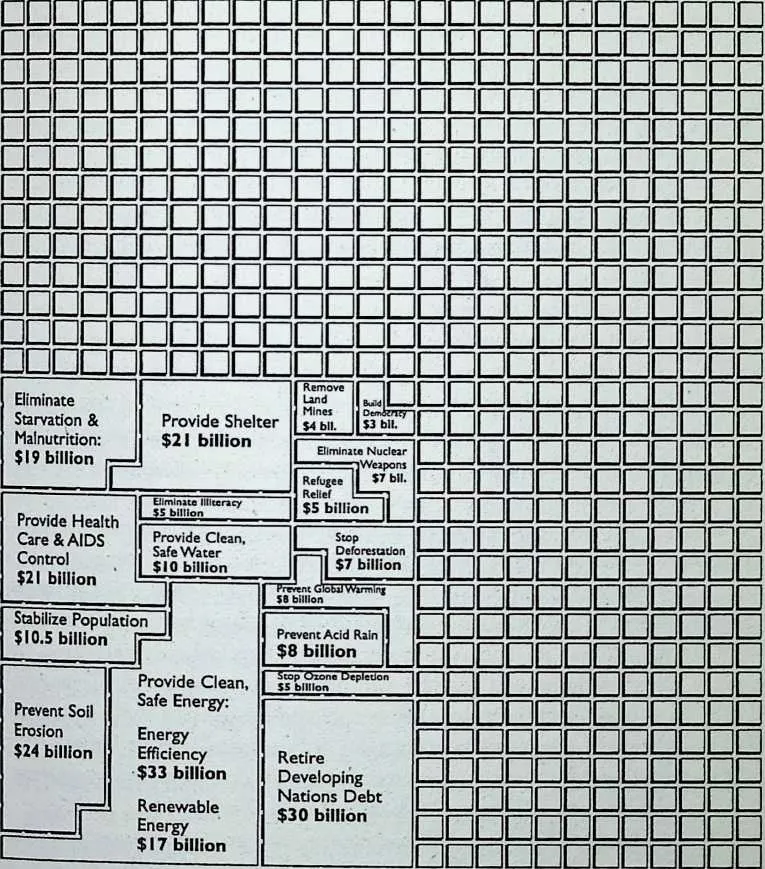 AND HOW TO PAY FOR IT
28 annual costs of various global programs for solving reprc‘‘nB A"nu>1 Worid
29 n‘‘d ^^environmental problems facing | I = SI billion
30 SSfor S 'Uhe amount needed to accomplish I—I
31 god tor all in need in the world. Their combined total cost
32 ^approximately 30% of the world's total annual military I ‘‘ Amount that was needed to eradicate Smallpox from the worid
33 °9enditures. z L±J (accomplished 1978): $300 million
3435World Gwno Inititvte, 3215 Rxco Strtet, Phllidelphla, Penruylvanta 19104 • PhonerllSJit-onO • F««:2ISJI7-3009 -mall: wgl@woHdgxme.org • World Wide Web: httpJ/www.wor<dgimex>rg o 1999 WorU Oine
36 © 1999 WORLD GAME INSTITUTE
37 The World Game—How to Make the World Work
3940 To start with, here is an educational bombshell: Take from all of today’s industrial nations all their industrial machinery and all their energy-distributing networks, and leave them all their ideologies, all their political leaders, and all their political organizations and I can tell you that within six months two billion people will die of starvation, having gone through great pain and deprivation along the way.
41 However, if we leave the industrial machinery and their energydistribution networks and leave them also all the people who have routine jobs operating the industrial machinery and distributing its products, and we take away from all the industrial countries all their ideologies and all the politicians and political machine workers, people would keep right on eating. Possibly getting on a little better than before.
42 The fact is that now—for the first time in the history of man for the last ten years, all the political theories and all the concepts of political functions—in any other than secondary roles as housekeeping organizations—are completely obsolete. All of them were developed on the you-or-me basis. This whole realization that mankind can and may be comprehensively successful is startling.
43 In pursuance of this theme and under auspices to be announced later we are going to undertake at Southern Illinois University, in the next five years, a very extraordinary computerized program to be known as ‘‘How to Make the World Work.’’
44 Here on Southern Illinois’ campus we are going to set up a great computer program. We are going to introduce the many variables now known to be operative in economics. We will store all the basic data in the machine’s memory bank; where and how much of each class of the physical resources; where are the people, what are the trendings—all kinds of trendings of world man?
45 Next we are going to set up a computer feeding game, called ‘‘How Do We Make the World Work? ’’ We will start playing relatively soon. We will bring people from all over the world to play it. There will be competitive teams from all around earth to test their theories on how to make the world work. If a team resorts to political pressures to accelerate their advantages and is not able to wait for the going gestation rates to validate their theory they are apt to be in trouble. When you get into politics you are very liable to get into war. War is the ultimate tool of politics. If war develops the side inducing it loses the game.
46 Essence of the world’s working will be to make every man able to become a world citizen and able to enjoy the whole earth, going wherever he wants at any time, able to take care of all the needs of all his forward days without any interference with any other man and never at the cost of another man’s equal freedom and advantage. I think that the communication problem—of ‘‘How to Make the World Work’’—will become extremely popular the world around.
47 The game will be played by competing individuals and teams. The comprehensive logistical information upon which it is based is your Southern Illinois University-supported Inventory of World Resources Human Trends and Needs. It is also based upon the data and grand world strategies already evolved in the Design Science Decade being conducted, under our leadership here at Southern Illinois University, by world-around university students who, forsaking the political expedient of attempting to reform man, are committed to reforming the environment in such a manner as to ‘‘up’’ the performance per each unit of invested world resources until so much more is accomplished with so much less that an even higher standard of living will be effected for 100% of humanity than is now realized by the 40% of humanity who may now be classified as economically and physically successful.
48 ‘‘The game’’ will be hooked up with the now swifdy increasing major universities information network. This network’s information bank will soon be augmented by the world-around satellite-scanned live inventory of vital data. Spy satellites are now inadvertendy telephotoing the whereabouts and number of beef cattle around the surface of the entire earth. The exact condition of all the world’s crops is now simultaneously and totally scanned and inventoried. The interrelationship of the comprehensively scanned weather and the growing food supply of the entire earth are becoming manifest.
49 In playing ‘‘the game’’ the computer will remember all the plays made by previous players and will be able to remind each successive player of the ill fate of any poor move he might contemplate making. But the ever-changing inventory might make possible today that which would not work yesterday. Therefore the successful stratagems of the live game will vary from day to day. The game will not become stereotyped.
50 If a player resorts to political means for the realization of his strategy, he may be forced ultimately to use the war-waging equipment with which all national political systems maintain their sovereign power. If a player fires a gun—that is, if he resorts to warfare, large or small—he loses and must fall out of the game.
51 The general-systems-theory controls of the game will be predicated upon employing within a closed system the world’s continually updated total resource information in closely specified network complexes designed to facilitate attainment, at the earliest possible date, by every human being of complete enjoyment of the total planet earth, through the individual’s optional traveling, tarrying, or dwelling here and there. This world-around freedom of living, work, study, and enjoyment must be accomplished without any one individual interfering with another and without any individual being physically or economically advantaged at the cost of another.
52 Whichever player or team first attains total success for humanity wins the first round of the gaming. There are alternate ways of attaining success. The one who attains it in the shortest time wins the second round. Those who better the record at a later date win rounds 3,4, and so on.
53 All the foregoing objectives must be accomplished not only for those who now live but for all coming generations of humanity. How to make humanity a continuing success at the earliest possible moment will be the objective. The game will also be dynamic. The players will be forced to improve the program—failure to improve also results in retrogression of conditions. Conditions cannot be pegged to accomplishment. They must also grow either worse or better. This puts time at a premium in playing the game.
54 Major world individuals and teams will be asked to play the game. The game cannot help but become major world news. As it will be played from a high balcony overlooking a football-field-sized Dymaxion Airocean World Map with electrically illumined data transformations, the game will be visibly developed and may be live-televised the world over by a multi-Telstar relay system.
55 The world’s increasing confidence in electronic instrumentation in general—due to the demonstrated reliability of its gyrocompasses, and its ‘‘blind’’ instrument landings of airplanes at night in thick fog, and confidence in opinion-proof computers in particular, will make the ‘‘world game’’ playing of fundamental and spontaneous interest to all of humanity..
56 Ultimately its most successful winning techniques will become well known around the world and as the game’s solutions gain world favor they will be spontaneously resorted to as political emergencies accelerate.
57 Nothing in the game can solve the problem of two men falling in love with the same girl, or falling in love with the same shade under one specific tree. Some are going to have to take the shade of another equally inviting tree. Some may end up bachelors. Some may punch each other’s noses. For every problem solved a plurality o£ new problems arise to take their place. But the problems need not be those of physical and economic survival. They can be perplexing and absorbing in entirely metaphysical directions such as those which confront the philosophers, the artists, poets, and scientists.
58 The game must, however, find ways in which to provide many beautiful shade trees for each—that is to say a physical and economic abundance adequate for all. There will, of course, have to be matchings of times and desires, requiring many initial wait-listings. As time goes on, however, and world- around information becomes available, the peaks and valleys of men’s total time can be ever-improvedly smoothed out. Comprehensive coordination of bookings, resource, and accommodation information will soon bring about a 24-hour, world-around viewpoint of society which will operate and think transcendentally to local ‘‘seasons’’ and weathers of rooted botanical life. Humanity will become emancipated from its mental fixation on the seven-day- week frame of reference. I myself now have many winters and summers per year as I cross the equator from northern to southern hemisphere and back several times annually. I have now circled the earth so many times that I think of it and literally sense it in my sight as a sphere. I often jump in eight- and nine-hour time-zone air strides. As a consequence my metabolic coordination has become independent of local time fixations.
59 It is my intention to initiate on several occasions in a number of places anticipatory discussion of the necessary and desirable parameters to establish for playing the world game. I intend to nominate as participants both in these preliminary discussions and in formal play only those who are outstandingly capable of discussing these parameters. The participants must also be those well known for their lack of bias as well as for their forward-looking competence and practical experience.
60 In July 1969, when mankind was to take its epochal step and send its first man to the moon, the world's most powerful television network chose Walter Cronkite and Arthur C. Clarke to sit in the broadcast chairs. America's senior newsman, Walter Cronkite, regarded as one of the world's most trusted newscasters, would report this historic event. Cohost Arthur C. Clarke was selected for his years as a cosmic realist and futurist and for his scientific writings. In the 1950s, Clarke had developed, from concept to mathematical reality, synchronized orbit communications satellites, which we now call COMSAT. We are all familiar with 2001: A Space Odyssey, the imaginative 1968 film that Clarke wrote with director Stanley Kubrick. Based on a short story by Clarke, 2001 made a complete breakthrough into space-age moving picture and television concepts.
61 Clarke and Fuller first met at a university in the fifties, and Bucky visited him in Sri Lanka in 1978. Later, Bucky presented Clarke with a drawing of the "Earthian location" of the Fountains of Paradise, the title of a novel by Clarke. Clarke describes Bucky's response to the novel in his contribution piece.