
31 Epilogue
2 On June 16 and 17, 2000, a symposium was held in London, on R. Ruckminster Fuller: The Art of Design Science at the Royal Institute of British Architects. The sponsor of the event was CargoLifter A.G. in Germany, specializing in Airocean transportation by Zepplin, not unlike one of Fuller’s concepts in 1927.
3 The symposium was held in conjunction with the largest array of Fuller’s work exhibited in any one place, ever, by the Design Museum of London. Produced in Zurich by Claude Lichtenstein and Professor Joachim Krausse of the Museum fur Gestaltung Zurich, with Laurence Mauderli coordinating the London event, the exhibit will travel to ten cities over the next three years.
4 The symposium challenged and inspired in ways that one must ponder while reading this book. The significance of Bucky Fuller to the twenty-first century is sometimes direct, sometimes oblique, but always omnidirectional.
5 The program began with my laying a visual foundation presentation for the two-day symposium with an overview of the artifacts of R. Buckminster Fuller. Shoji Sadao, USA, shared his insights into the development and the importance of the Dymaxion Airocean world map. E. J. Applewhite, USA, commented on Fuller’s experiential approach to Geometry and Structure with Synergetics. Hinrich Schliephack, Germany, spoke on the Genesis of an industry, CargoLifter, made for the twenty-first century. Jaime Snyder, USA, spoke about Humanity’s Option for Success. James Meller, UK, Fuller’s first foreign student in the United States, gave a wider view of Fuller, and Caspar Schwabe, Switzerland, demonstrated his unique Kinematic Phenomena.
6 The second day began with Donald E. Ingber, M.D., USA, on the Architecture of Life, who discussed discoveries through bio-medicine that one day may lead via microbiology to medical applications for living cells and tissues, ‘‘buckyballs’’ to cure diseases by linking medication directly to the source without damaging the healthy area. He has also written, ‘‘Fuller was himself a miracle of Nature. Starting with a terribly nearsighted child, you end up with one of the most insightful men of the twentieth century.’’ He continued, ‘‘Cell biologists, such as myself, literally have observed molecular geodesic domes within the skeletal framework (‘cytoskeleton’) of living cells. We have discovered that the basic architectural principle of tensegrity that Fuller explored in theoretical terms—and his student, Kenneth Snelson, explored through sculpture—guides biological organization, from the simplest carbon molecules (‘Bucky Balls’) to the most complex living organisms. In other words, Fuller’s vision of Nature and the Universe was crystal clear; it was everyone else who needed inch-thick eyeglasses.’’
7 Dr. Jonathan Hare, UK, associate to Nobel chemist Harry Kroto, described working to discover new carbon molecules, fullerenes, and Nanotubes. Application of these new discoveries with micro-activity could easily benefit mankind. Professor Joe Clinton, USA, described Geodesics: before and after Fuller. Engineer and Professor Ing Jorg Schlaich, Germany, offered his thoughts on structural efficiency through double curvature and showed experiments of alternative units of energy. Martin Pawley, UK, author and editor, spoke of Fuller as a historic figure. Professor Dr. Joachim Krausse, Germany, mentioned the origins of Fuller’s key concepts. The symposium ended with Steve Lacy, USA, on the saxophone with Irene Aebi, France, a soprano and improviser of jazz, performing a geodesic jazz duo.
8 This London symposium would have made Bucky Fuller smile. I submit
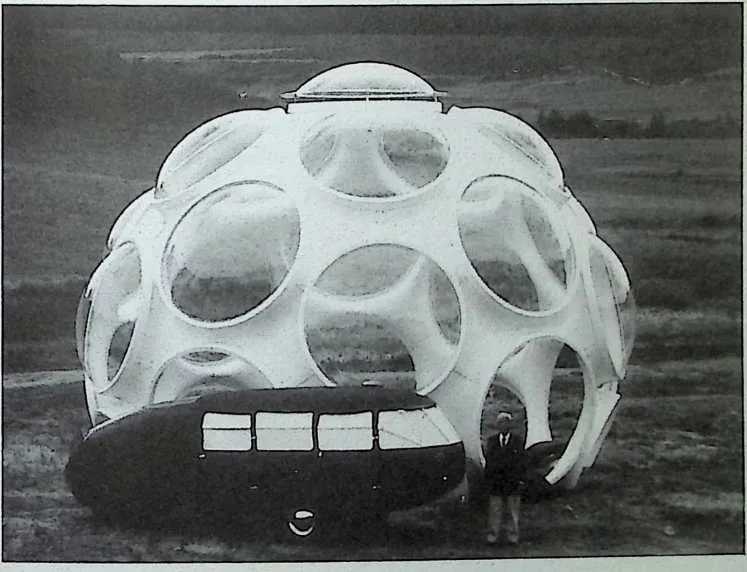
11 Fifty Years of Design Science
12 1933 Dymaxion Car 1983 Fly's Eye Dome (Photo taken on Bucky's 85lh Birthday)
13 COURTESY OF BUCKMINSTER FUELER INSTITUTE/R. STOLLER
14 from the variety of participation in the symposium that Fuller’s influence may well be described in the new millennium with micro and macro discoveries leading to the adaptation of tensegrity from molecules to cosmography. It would be Synergetics at its faculae.
15 In my mind it recalls a question that R. Buckminster Fuller posed to all of us in one of his last communications. Only he could write this perfect epilogue.
16 ‘‘Human integrity is the uncompromising courage of self determining whether or not to take initiatives, support or cooperate with others in accord with ‘all the truth and nothing but the truth’ as it is conceived in each individual.
17 ‘‘Whether humanity is to continue and comprehensively prosper on Spaceship Earth depends entirely on the integrity of the human individuals and not on the political and economic systems.
18 ‘‘The cosmic question has been asked—ARE HUMANS A WORTHWHILE TO UNIVERSE INVENTION?’’
19