
22 The Naming of Buckminsterfullerene
3 Systematic chemical nomenclature has always been corrupted—or enhanced, depending on your point of view—by the prevalence of eponyms. The fact that C60 was named buckminsterfullerene could be construed as (a) an erratic departure from the etiquette of attributing discoveries to individuals, (b) trivial, or (c) the validation of an intuitive vision of a designer of geodesic domes. H. W. Kroto said that the newly discovered carbon cage molecule was named buckminsterfullerene ‘‘because the geodesic ideas associated with the constructs of Buckminster Fuller had been instrumental in arriving at a plausible structure.’’1 It is becoming, in Fuller’s case, that he made no claim; the honor was bestowed by others. The Israeli poet Yehuda Amichai once described naming as ‘‘the primary cultural activity,’’ the crucial first step anyone must take before embarking on thought. John Stuart Mill declared, ‘‘The tendency
4 >H. W. Kroto, Nature 1987,329,529.
5 has always been strong to believe that whatever received a name must be an entity or being, having an independent existence of its own.’’
6 When Harry Kroto, Robert Curl, and Richard Smalley, the experimental chemists who discovered C^, named it buckminsterfullerene, they accorded to Richard Buckminster Fuller (1895-1983), the maverick American engineering and architectural genius, a kind of immortality that only a name can confer—particularly when it links a single historical person to a hitherto unrecognized universal design in the material world of nature: the symmetrical molecule C6Q. Smalley’s laboratory equipment could only tell them how many atoms there were in the molecule, not how they were arranged or bonded together. From Fuller’s model they intuited that the atoms were arrayed in the shape of a truncated icosahedron—a geodesic dome. Only after a novel phenomenon or concept is named can it be translated into the common currency of thought and speech.
7 This newly discovered molecule, a third allotrope of carbon—ancient and ubiquitous—transcends the historical or geographical significance of most named phenomena such as mountains of the moon or Antarctic peaks and ridges. Cartographers named two continents for Amerigo Vespucci, because he asserted (as Columbus did not) that the coasts of Brazil and the islands of the Caribbean were a landmass of their own and not just obstacles on the route to Asia. C60 is a far more elemental discovery, it is more ancient, and it pervades interstellar space. Fuller has no reason to envy Vespucci.
8 Buckminsterfullerene was discovered by chemists who were not looking for what they found. Kroto was looking for an interstellar molecule. Smalley said he hadn’t been very interested in soot, but they agreed to collaborate. Smalley’s laboratory at Rice University had the exquisite laser-vaporization and mass-spectrometry equipment to describe the atoms of newly created molecules. Scientific experimenters investigate nature at a level where revelation is often unpredictable and sometimes capricious. This is a phenomenon that Fuller (who was not a scientist, but a staunch defender of the scientific method) generalized into the dogmatic statement that all true discovery is precessional. For Fuller, the escape from accepted paradigms is precessionaL (Vespucci precessed; Columbus did not.) Fuller had a lifelong preoccupation with the counterintuitive, gyroscopic phenomenon of precession. He defined precession, quite broadly, as the effect of bodies in motion on other bodies in motion. Every time you take a step, he said to me many times, you precess the universe.
9 For that matter, one may say that Kroto and Smalley in recognizing the shape of the C60 molecule made a precessional discovery. Earlier, Osawa, in a paper published in Japanese in 1970, had described the C60 molecule with the truncated icosahedral shape; so had Bochvar and Gal’pem in 1973 when they published a paper in Russian on the basis of their calculations. They all
10 recognized the novelty of the molecule and conjectured that its structure should afford great stability and strength. However, neither Osawa nor Bochvar and Gal’pern had experimental evidence, nor did they consider their result important enough to follow up their finding with further work or to convince others to do so. Curiously, in 1984 a group of Exxon researchers made an experimental observation of C60 along with many other species. They failed, however, to discern the shape of this species and did not recognize its special importance. These precursors to Kroto and Smalley apparently lacked the requisite—precessional—insight to appreciate the significance of what they had found. Kroto and Smalley’s precessional insight was best manifested by their decision to give a name to the C60 molecule of the truncated icosahedral shape.
11 As a longtime close friend of the Fuller family, as his collaborator on his Synergetics (1975) and Synergetics 2 (1979), and as a trustee of the Buckminster Fuller Institute (BFI), I rejoiced vicariously in the molecular celebration of his name. I preserved the copy of its first pubheation in Nature (November 1985), with the C60 molecule on its cover, and, with the compulsion of an archivist, I documented the proliferation of reports on this molecule in the professional literature for some while thereafter. While I sensed that Professors Kroto and Smalley had granted the name for perhaps trivial reasons, I felt that there was a greater resonance between C60 and Fuller’s writings and design philosophy than the mere congruence of the topology of that molecule and Fuller’s geodesic domes. Fuller did not develop his peculiar geometry in order to build a dome. Of course, he delighted in building domes and built a great many of them (though all were replicable, no two of his prototypes were the same), and he succeeded admirably in containing a greater volume of space in an enclosed stable structure than any architect or engineer before him had ever done. (He had a dozen or so patents relating to his domes.) But I knew that Fuller was one of the most celebrated but least understood original thinkers of his day. Fuller did not develop his original great-circle coordinate geometry in order to build domes; he built domes because otherwise people would not understand the geometry—which rejected the XYZ coordinate system of standard mensuration. He advanced synergetics as nothing less than a new way of measuring experience and as a new strategy of design science which started with wholes rather than parts.
12 Although I felt that it was presumptuous for me, as a nonscientist, to address Kroto and Smalley on Fuller’s behalf, I nevertheless offered them copies of Fuller’s Synergetics books and drew their attention to collateral aspects of Fuller’s work that might be relevant to their major discovery. I was careful to disavow any claim for priority of discovery on Fuller’s behalf. He did not anticipate C60, but its discovery did validate his intuitions that geodesic design plays a more significant role in nature’s arrangements than had hitherto been recognized. Fuller would have been less surprised than any of us to learn that the sixty-atom array possessed an extraordinary property of stability. Although he regarded the hydrogen atom as the simplest—and hence the most beautiful—design in nature, Fuller had a lifelong interest in the carbon atom, and, in many of his writings and lectures, he celebrated J. H. van’t Hoffs 1874 concept of the tetrahedral configuration of carbon bonds.
13 Some years later, on March 21, 1991, on a visit to Houston, I had the opportunity to call on Professor Smalley in his laboratory at Rice University and pay him homage, specifically on behalf of the Fuller family and the BFI—expressing our gratification in the luster that he and Professor Kroto had added to Fuller’s name. He greeted me with a hospitality, a sympathy, and an enthusiasm matching the cordiality of the correspondence I had initiated with Professor Kroto at the University of Sussex in Brighton. A sense of destiny permeates his large, comfortable office; he told me I was sitting on the very couch where he and Kroto had christened the new molecule on September 9, 1985. He told me about how he and his colleagues had sat up all night making models out of Gummi Bear jelly beans and paper cutouts of pentagons and hexagons. I recalled that Fuller as a child had made models out of toothpicks and dried peas, and he had always felt that geometry should be taught as a hands-on laboratory discipline. Smalley said that he had overcome any initial reservations he might have had to Kroto’s proposal to name C60 buckminsterfullerene. For one thing, the standard IUPAC name for the molecule was impossibly awkward and difficult to read, much less speak. When I asked him why he found the name so appropriate, he said that it was because it conveys in a single word so much information about the shape of the molecule, and he found a happy congruence in the fact that its twenty letters match the twenty faces of the icosahedron—a letter for each facet. All even-number carbon cluster-cage molecules are now termed fullerenes. The root name Fuller lent itself to generic applications with the various other conventional suffixes, producing not just fullerenes, but fulleranes, fullerenium, fullerides, ful- lerites, fulleroids, fulleronium, metallofullerenes, and so forth. Colloquially—even affectionately—they are subsumed as buckyballs.
14 As Smalley escorted me out of the laboratory complex on that steaming hot March afternoon (Houston is like that), I was exhilarated by his convicition that C60 is one of the most stable and photoresistant molecules known to chemistry, and also probably the most proliferating, and possibly the oldest. A new branch of organic chemistry indeed—and countless textbooks had instantly been rendered out of date.
15 After a few letters objecting to the name ‘‘buckminsterfullerene’ ’ had appeared in the columns of Nature, Harry Kroto gallantly defended its choice on the grounds that no other name—none of the forms of the classic Greek geometers—described the essential three properties of lightness, strength, and the internal cavity that the geodesic dome affords. To the protest that nobody had ever heard of Fuller, he submitted that the name would have educational value. A fine exercise of onomastic prerogative.
16 Fuller was not a chemist. He was not even a scientist, and made no pretension of adhering rigidly to an experimental and deductive methodology, and he did not follow the rules of submitting published papers to peer review. But he had an extraordinary facility for intuitive conceptioning. Jim Baggott, in his superb account Perfect Symmetry: The Accidental Discovery of Buckminsterfullerene,1 quotes Fuller in an epigraph: ‘‘Are there in nature behaviors of whole systems unpredicted by the parts? This is exactly what the chemist has discovered to be true.’’ Baggott goes on to describe how Fuller had derived his vector equilibrium (cuboctahedron, in conventional geometry) from the closest packing of spheres of energy. What he had was a principle that led to the design of geodesic structures capable of a strength-to-weight ratio impossible in more conventional structures. Fuller had a highly generalized definition of the function of architecture that put him outside the scope of the academicians’ view of their discipline. Bucky said that ‘‘architecture is the making of macrostructures out of microstructures.’’ Baggott concludes: ‘‘Fuller’s thoughts about the patterns of forces in structures formed from energy spheres had led him to the geodesic domes. …That his geodesic domes should serve as a basis for rediscovering these principles in the context of a new form of carbon microstructure has a certain symmetry that Fuller would have found pleasing, if not very surprising.’’
18 The Mind of Buckminster Fuller from Synergetics Dictionary
19 Sample Entries Edited by Fuller
22 Cycle:
23 Convergence to frequency magnitude is tunability.
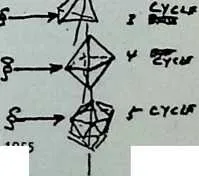
25 As with all wave phenomena, tunability is in terms of to
26 whole cycles iu 1 <gyul«d wi-m ? T‘‘4 a vertex.
27 Three intervals plus three events - tetra.
28 Four intervals plus four events
29 Five intervals plus five events
30 There are no other fundamental cycles
33 Cite RBF holograph, Synergetics Notes, 1955Sketch by RB?, Santa Barbara, 10 Feb173COURTESY OF THE BUCKMINSTER FULLER INSTITUTE
34 Dvmaxion Airocean World Map: (a)
35 "I am attaching a copy of the world map published by LIFE on my new universal-hinging projection. I have taken off the global map onto this new projection in several other ways, for instance, with the North Pole and again the magnetic North Pole, ana the pole of the ecliptic as centers of triangles instead of squares. And another takeoff, particularly useful for navigational purposes, is that in which the vertexes of squares and triangles coincide at the poles.
36 "The new projection method is also extremely useful in relating the astronomical map to the land map of the world. This is because the spherical angles are all proportionately or symmetrically reduced when translated to plane geometry and vice versa; furthermore, every point on my plane geometry projection is vertically above the universally deployed center of the earth. All interior points retain their symmetrical positioning whether graphed in spherical or plane geometry. Therefore points in the astronomical projections may be made to occur vertically above points on the earth when they are actually in zenith, with the triangulation of astronomical positions usefully related by direct graphical method to the terrestrial map."
37 - Cite RUF Ltr. to Gilbert Grosvenor, Wash., DC; 29 Apr'43
39 Dvmaxion Airocean World Tap: (b)
40 "The article in LIFE did not describe any of the mathematical properties of my projection method. I am sure that you would be interested to have it pointed out that the triangular sections of my projection method represent those unique spherical triangles whose several vertexes are each coincident with a vertex of another identical triangle of a system of eight triangles, altogether forming a spherical triangular lattice of great circle arcs of b0° completely enclosing the sphere. This spherical triangular lattice (with equilateral spherical quadrangle interstices) represents the surface coincidence with a sphere of a unique system of tetrahedral segments of a sphere, all of whose apexes coincide at the center of the sphere. It happens that these particular equiangular spherical triangles of the infinite number between 180° and 60° are the only spherical triangles whose chords together with their interior vertexial radii form a united system of lines describing uniform, unit size, equilateral 60° triangles whose interior apexes coincide with the center of the sphere.
41 "There is no set of spherical triangles which uniformly subdivides all the surface of a sphere (as with the eight 90° equiangular triangles or the faces of an icosahedron; whose central"
42 - Cite RBF Ltr. to Gilbert Grosvener, Wash., DC; 29 Apr'43
44 Dvmaxion Airocean World Map; (c)
45 n60° apexes also coincide at the center of the sphere. The apexes of all other spherical segment tetrahedra either fall beyond the center or fall short of the spherical center.
46 COURTESY OF THE BUCKMINSTER FULLER INSTITUTE
47 This particular spherical triangle and tetrahedral unit which I have used is the only exception.
48 "It happens, however, that this symmetrical subdivision of the surface of the sphere by my eight spherical tetrahedra leaves a void of six spherical squares whose chords and radii form spherical pyramids whose apexes also coincide with the center of the sphere. Thus this system provides uniform and symmetrical chords and radii, any right angle or diagonal subdivision of which on the spherical surface must be the intersection of a plane passing through the center of the sphere and is therefore a great circle. Thus it is possible by employing these unique spherical equiangular triangles and ’squares' (quadrangles) to provide a quadrangular grid of great circles in the square and unique symmetrical triangular grid of great circles in the triangle (great circle phenomena not found in any other symmetrical spherical triangle) both symmetrically and uniformly subdividing the enclosing boundaries that allows of universal plane geometry projection"
49 Dynaxion Airocean './orld l-.ao: jd
5051 "in the terms of the same uniform and symmetrical subdivisions without defractions of angles of transferred data along the hinges of the necessarily sectional projections, required for universal direction of unwrapping of the spherical map.
52 "All the interior structural geometry of the model thus devised consists of universally symmetrical equilateral and equiangular inside truss structure, united individually at their external vertexes and all joined internally at a universal vertex center, represents the unique stabilized, nonredundant four-dimensional force diagram of any dynamically radiant or convergent spherical organization. It provides a mathematical module system ’tri-' and 'bi-'secting central angular unity an i graphic model of the decimal twelve, or duodecimal system, essential to mathematical facility in radionics. It relates simple geometry to dynamic graphical requirements of electronics.
53 "The respective interior triangular and quadrangular great circle grids which terminally intercept the enclosing sides ^iS-J,rsEheF’-cal triangle? and six spherical squares in mutually uniform linear intervals may oe collapsed to plane*
54 - Cite RBF Ltr. to Gilbert Grosvener, Wash. DC; 29 Apr'A3
56 Dvmaxion Airocean World fap: (e)
5758 "surface grids uniformly subdivided by interior triangles and squares. This collapsing may be accomplished by ’loosing' the unit apex centers of the tetrahedrons and quadrahedrons while holding the vertex positions of the squares or triangles and allowing the radii to 'dangle' parallel to one another with their loosed terminals in one place.
59 "Uniform subsidence of the spherical arc segments of the major spherical triangles and squares of the spherical projection lattice into plane geometry sections of squares and triangles is accomplished by concentric shrinking to the chordal plane in such a manner that the right-angle relationship of all interior points in respect to the enclosing sides remains intact. It is the retention of the interior perpendicularity of points to enclosing sides that makes the hinging of the triangles and squares possible in a manner that, at the same time, does not disproportionate or refract the contours of areas partially occurring on adjacent triangles or squares.
60 "It is also this method of uniformly progressive concentric correction by subsidence from spherical segment to plane geometry which provides the unloue characteristic or this
61 - Cite RUF Ltr. to Gilbert Grosvenor, Wash. DC: 29 Apr'43
63 Dvr-axion Airocean World isap: (f)
6465 "method of projection which distinguishes it from all other methods. The unique characteristic referred to is that the projected diagram retains true measurement, shape, direction, and distance throughout all of the enclosing boundaries of the segments with mathematically controlled distortion •massaged' to the center of the projection areas. All other projections are true in measure, shaping, and direction only at an interior point or along one side or along one or several separated lines or arcs crossing the projection with progressive distortion articulated outwards towards one or more of the enclosing edges of the projected diagram. In other words, my new projection is uniformly corrected by Internalization while all other projections are corrected by some systematic externalization of error. This allows of true external association of my projection units, which is impossible in all other methods demonstrated to date.
66 COURTESY OF THE BUCKMINSTER FULLER INSTITUTE
6768 "Only in the case of the azimuthal or gnomonic projections where correction is radiantly distributed does this exterladza- tion of correction allow of uniform relationship of one portion o f the spherical projection to another; but in the cases of the azimuthal or gnoi:nnic hemispheres, there is only"
69 Often referred to as Mr. Cleveland, Herbert E. Strawbridge first met Bucky in 1967 when he and his wife, Marie, along with their daughter, Holly, attended an Energetics Society symposium sponsored by Constantinos A. Doxiadis. Other attendees included Margaret Mead, Marshall Mcluhan, Lawrence Halprin, Arnold Toynbee, Edmund Bacon, and Jonas Salk.
70 In Cleveland, where Fuller had an architectural office, Strawbridge implemented some of Doxiadis's ideas with his formation of the Northern Ohio Urban Systems Research Corporation (NOUS), a regional planning study with global impact. He is now a retired CEO of the Higbee's Department Stores. Strawbridge initiated the revitalization of Cleveland's Flats area, which has become the city's entertainment district. Partially thanks to his effort, Cleveland is now known as a "comeback city" that has recovered after having fallen on hard times.
71 Panayis Psomopoulos, the secretary of the World Society for Ekistics; Dr. Wesley W. Posvar, President Emeritus of the University of Pittsburgh; and Strawbridge and others help keep alive the Ekistics Society to provide a forum for discussing world problems at conferences. Currently Strawbridge is president of the educational John P. Murphy Foundation and the Kulas Foundation.