
11 The Fountains of Paradise
2 Sir Arthur C. Clarke, C.B.E.
3 Although we met only a few times, Bucky had a considerable influence on me—as on thousands of others. Our first encounter was at a university symposium in the late 1950s, which he effordessly dominated with the aid of a monstrous instrument that served as both hearing aid and megaphone.
4 In 1978 I had the great privilege of flying him around Sri Lanka and showing him the locales I had used in my novel The Fountains of Paradise. A decade later this resulted in one of the most amazing coincidences in my life—one so extraordinary that I sometimes wonder if I’m in an advanced stage of terminal solipsism. But judge for yourself.
5 The theme of Fountains was the building of a ‘‘Space Elevator’’ reaching from Earth up to the
geostationary orbit 22,000 miles above, where a satellite can hover apparently motionless over the
same spot on the equator. If we
could construct such an orbital tower, escaping from Earth would require less than a
thousand dollars’ worth of electricity per passenger—not hundreds of tons of rocket
fuel.
6 When I wrote Fountains in 1977, only one material was known with sufficient strength to build what its Russian inventor, Yuri Artsutanov, called a ‘‘cosmic funicular.’’ Unfortunately it is not available in the megaton quantities required: it is the crystalline form of carbon, better known as diamond.
7 However, in 1985 the necessary building material was discovered, and it turned out to be yet another form of carbon, C60—immediately named ‘‘Buckminsterfullerene’’ because of its exact resemblance to Bucky’s famous geodesic domes. How he would have enjoyed this discovery! Alas, he missed it by only two years.
8 Now for the amazing coincidence. In 1979 I made a recording (Caedmon TC 1606) of Fountains II on a 12-inch LP (remember them?). And who do you think was kind enough, despite his coundess commitments, to write the sleeve notes and even make a sketch of the space elevator reaching up from Earth to the stationary orbit?
9 Here are Bucky’s own comments on my novel. When the space elevator is built, some time in the twenty-first century, it will be his greatest memorial.
10 ‘‘Today, Arthur lives on that jewel-shaped Indian Ocean island of Sri Lanka (Ceylon). He loves it so much, he intends never again to travel away from it.
11 ‘‘I am fortunate enough to have been his guest on Sri Lanka, and to have
12 visited Taprobane (pronounced ta-PROB-a-nee) and its magic, awe-inspiring Adam’s Peak (Sri Kanda), et al. We flew figure eights around Adam’s Peak, the Demon Rock, and Ceylon’s highest mountain, Pidurutalagala. A map of Ceylon, including only the loci featured in my story, is on the preceding page.
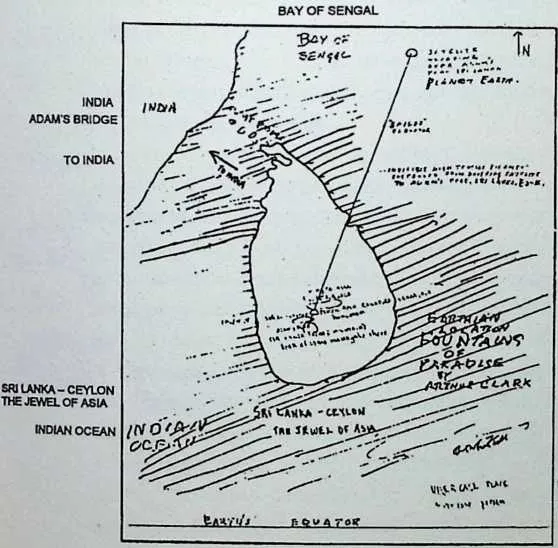
15 Satellite hovering over ADAM'S PEAK SRI LANKA PLANET EARTH
17 Invisible high tensile filament suspended from hovering satellite to ADAM'S PEAK. SRI LANKA, EARTH
18 EARTH IAN LOCATION FOUNTAINS OF PARADISE by
20 Buckminster Fuller signature
21 UPPERCASE PLACE Lower case person
22 COURTESY OF ARTHUR C. CLARKE
23 ‘‘I have spent some years thinking realistically about engineering undertakings somewhat akin to those Arthur Clarke incorporates into this moving story and can attest to his thorough respect of physical laws. In 1951,1 designed a free floating tensegrity ring-bridge to be installed way out from and around the Earth’s equator. Within this ‘halo’ bridge, the Earth would continue its spinning while the circular bridge would revolve at its own rate. I foresaw Earthian traffic vertically ascending to the bridge, revolving and descending at preferred Earth loci.
24 ‘‘I think you will be deeply and unforgettably moved by his Taprobane. I love it.’’
25 Spaceship Earth from Operating Manual for Spaceship Earth
26 Our little Spaceship Earth is only eight thousand miles in diameter, which is almost a negligible dimension in the great vastness of space. Our nearest star—our energy-supplying mother-ship, the Sun—is ninety-two million miles away, and the next nearest star is one hundred thousand times further away. It takes two and one-half years for light to get to us from the next nearest energy supply ship star. That is the kind of space-distanced pattern we are flying. Our little Spaceship Earth is right now traveling at sixty thousand miles an hour around the sun and is also spinning axially, which, at the latitude of Washington, D.C., adds approximately one thousand miles per hour to our motion. Each minute we both spin at one hundred miles and zip in orbit at one thousand miles. That is a whole lot of spin and zip. When we launch our rocketed space capsules at fifteen thousand miles an hour, that additional acceleration speed we give the rocket to attain its own orbit around our speeding Spaceship Earth is only one-fourth greater than the speed of our big planetary spaceship.
27 Spaceship Earth was so extraordinarily well invented and designed that to our knowledge humans have been on board it for two million years not even knowing that they were on board a ship. And our spaceship is so superbly designed as to be able to keep life regenerating on board despite the phenomenon, entropy, by which all local physical systems lose energy. So we have to obtain our biological life-regenerating energy from another spaceship—the sun.
28 Our sun is flying in company with us, within the vast reaches of the Galactic system, at just the right distance to give us enough radiation to keep us alive, yet not close enough to burn us up. And the whole scheme of Spaceship Earth and its live passengers is so superbly designed that the Van Allen belts, which we didn’t even know we had until yesterday, filter the sun and other star radiation which as it impinges upon our spherical ramparts is so concentrated that if we went nakedly outside the Van Allen belts it would kill us. Our Spaceship Earth’s designed infusion of that radiant energy of the stars is processed in such a way that you and I can carry on safely. You and I can go out and take a sunbath, but are unable to take in enough energy through our skins to keep alive. So part of the invention of the Spaceship Earth and its biological life-sustaining is that the vegetation on the land and the algae in the sea, employing photosynthesis, are designed to impound the life-regenerating energy for us to adequate amount.
29 But we can’t eat all the vegetation. As a matter of fact, we can eat very little of it. We can’t eat the bark nor wood of the trees nor the grasses. But insects can eat these, and there are many other animals and creatures that can. We get the energy relayed to us by taking the milk and meat from the animals. The animals can eat the vegetation, and there are a few of the fruits and tender vegetation petals and seeds that we can eat. We have learned to cultivate more of those botanical edibles by genetical inbreeding.
30 That we are endowed with such intuitive and intellectual capabilities as that of discovering the genes and the R.N.A. and D.N.A. and other fundamental principles governing the fundamental design controls of life systems as well as of nuclear energy and chemical structuring is part of the extraordinary design of the Spaceship Earth, its equipment, passengers, and internal support systems. It is therefore paradoxical but strategically explicable, as we shall see, that up to now we have been mis-using, abusing, and polluting this extraordinary chemical energy-interchanging system for successfully regenerating all life aboard our planetary spaceship.
31 One of the interesting things to me about our spaceship is that it is a mechanical vehicle, just as is an automobile. If you own an automobile, you realize that you must put oil and gas into it, and you must put water in the radiator and take care of the car as a whole. You begin to develop quite a little thermodynamic sense. You know that you’re either going to have to keep the machine in good order or it’s going to be in trouble and fail to function. We have not been seeing our Spaceship Earth as an integrally-designed machine which to be persistently successful must be comprehended and serviced in total.
32 Now there is one outstandingly important fact regarding Spaceship Earth, and that is that no instruction book came with it. I think it’s very significant that there is no instruction book for successfully operating our ship. In view of the infinite attention to all other details displayed by our ship, it must be taken as deliberate and purposeful that an instruction book was omitted. Lack of instruction has forced us to find that there are two kinds of berries—red berries that will kill us and red berries that will nourish us. And we had to find out ways of telling which-was-which red berry before we ate it or otherwise we would die. So we were forced, because of the lack of an instruction
33 book, to use our intellect, which is our supreme faculty, to devise scientific experimental procedures and to interpret effectively the significance of the experimental findings. Thus, because the instruction manual was missing we are learning how we safely can anticipate the consequences of an increasing number of alternative ways of extending our satisfactory survival and growth—both physical and metaphysical.
34 Quite clearly, all of life as designed and born is utterly helpless at the moment of birth. The human child stays helpless longer than does the young of any other species. Apparently it is part of the invention ‘‘man’’ that he is meant to be utterly helpless through certain anthropological phases and that, when he begins to be able to get on a little better, he is meant to discover some of the physical leverage-multiplying principles inherent in universe as well as the many nonobvious resources around him which will further compound- ingly multiply his knowledge-regenerating and life-fostering advantages.
35 I would say that designed into this Spaceship Earth’s total wealth was a big safety factor which allowed man to be very ignorant for a long time until he had amassed enough experiences from which to extract progressively the system of generalized principles governing the increases of energy managing advances over environment. The designed omission of the instruction book on how to operate and maintain Spaceship Earth and its complex life-supporting and regenerating systems has forced man to discover retrospectively just what his most important forward capabilities are. His intellect had to discover itself. Intellect in turn had to compound the facts of his experience. Comprehensive reviews of the compounded facts of experiences by intellect brought forth awareness of the generalized principles underlying all special and only superficially-sensed experiences. Objective employment of those generalized principles in rearranging the physical resources of environment seems to be leading to humanity’s eventually total success and readiness to cope with far faster problems of universe.
36 To comprehend this total scheme we note that long ago a man went through the woods, as you may have done, and I certainly have, trying to find the shortest way through the woods in a given direction. He found trees fallen across his path. He climbed over those crisscrossed trees and suddenly found himself poised on a tree that was slowly teetering. It happened to be lying across another great tree, and the other end of the tree on which he found himself teetering lay under a third great fallen tree. As he teetered he saw the third big tree lifting. It seemed impossible to him. He went over and tried using his own muscles to lift that great tree. He couldn’t budge it. Then he climbed back atop the first smaller tree, purposefully teetering it, and surely enough it again elevated the larger tree. I’m certain that the first man who found such a tree thought that it was a magic tree, and may have dragged it home and erected it as man’s first totem. It was probably a long time before he learned that any stout tree would do, and thus extracted the concept of the generalized principle of leverage out of all his earlier successive special-case experiences with such accidental discoveries. Only as he learned to generalize fundamental principles of physical universe did man learn to use his intellect effectively.
37 Once man comprehended that any tree would serve as a lever his intellectual advantages accelerated. Man freed of special-case superstition by intellect has had his survival potentials multiplied millions fold. By virtue of the leverage principles in gears, pulleys, transistors, and so forth, it is literally possible to do more with less in a multitude of physio-chemical ways. Possibly it was this intellectual augmentation of humanity’s survival and success through the metaphysical perception of generalized principles which may be objectively employed that Christ was trying to teach in the obscurely told story of the loaves and the fishes.
38 One of the people most admired by Bucky Fuller was his great-aunt Margaret Fuller Ossoli. She was a literary critic for the New York Herald and became the first woman foreign correspondent. With Ralph Waldo Emerson, she coedited the Tran- scendentalist quarterly The Dial, which was the first journal to publish Thoreau. A social reformer and a very early feminist, she wrote the influential book Woman in the Nineteenth Century. One summer, in the early 1980s, actress Ellen Burstyn traveled to Maine to confer with Bucky about doing a story about Great-Aunt Margaret; it would have been timely.
39 Bucky, who supported the feminist movement, spoke up strongly for the passage of the Equal Rights Amendment and did not hesitate to admonish those who opposed this important bill defending the rights of American women. Among the women he befriended were Barbara Marx Hubbard and Marilyn Ferguson, who had founded the Committee for the Future, to inspire effective thinking among the young and to encourage them to act with integrity. Though always apolitical, Bucky did suggest that Cleveland's Cuyahoga County Commissioner Timothy F. Hagan run for higher office and that Hubbard run for president of the United States against Richard Nixon.
40 Since that time, Hubbard has founded the Foundation for Conscious Evolution. In her contribution here she recounts her experiences with Fuller, particularly her Bucky-inspired presidential aspirations.