
14 My Best Friend's Father
3 In 1935, Allegra Fuller and I were in the third grade together at the Dalton School in New York City. Our friendship started the day we first met, and a ritual spon began. In the afternoons we walked from 108 East 89th Street to her home on the second floor of a small building at 105 East 88th Street. I would telephone my mother and ask if I could have dinner at the Fullers’.
4 ‘‘Where are you now?’’ she would ask.
6 I was supposed to go right home after school, but my mother, though strict, was also very kind. She understood. She always let me stay at the Fullers’.
7 Their apartment was small, tidy, and shadowy until evening when the lights were turned on. In Allegra’s room, there was a large chest packed with dresses, scarves, costume jewelry, ribbons, feathers, and pieces of fabric left over from the pretty dresses her mother made for her. We matched and mismatched, traded and discarded the finery. We invented stories to go with our outlandish costumes. We tried out lipstick colors and eye shadows and powders. The time flew by. I never wanted to leave.
8 The Fullers and the Seldeses came to Dalton to see their daughters in the plays and dances we performed. Because of Allegra’s passion for dance I was swept into her world of the ballet. In a ‘‘Color Ballet’’ at school, she wore white as Light, I wore purple as Sorrow. In Everyman, the morality play, I played the tide part and Allegra was Good Deeds. In the Christmas pageants, she was an Angel, and so, surprisingly, was I. Our halos were held on by tight ribbons of elastic that gave us headaches, but I felt I was in heaven.
9 Allegra was a beautiful and beloved child. There had been a tragedy in 1922 when her sister, Alexandra, four years old, died of spinal meningitis. Allegra told me, and I brought the knowledge of it with me the first day I met her parents. I could not imagine that a child could die that way. It haunted me. The Fullers never spoke of it in my presence.
10 In all my years of knowing them, I never heard self-pity, unkindness, sarcasm, or pettiness in anything they said to each other. The depth of their love and respect for each other reached out into the world around them. .
11 Mrs. Fuller, the delicate, aristocratic Anne, was usually dressed in black, her hair pulled back tightly from her brow. Her voice, sweet and pitched rather high, was soft. Her laughter was almost silent, her smile fleeting. She would sit and sew and watch us act out scenes in our improvised costumes: a few stitches, a glance toward the fairy-tale princess (Allegra) and the wicked queen (me), and then back to her stitching.
12 Mr. Fuller, Allegra’s father, was a presence in the room. His eyes looked huge and bright behind the thick lenses of his glasses. Before I ever heard his voice I was welcomed by his eyes.
13 He sat like a Buddha on the couch at the far end of the living room, often wearing what looked like a Japanese kimono and sandals. It set him apart from any other adult I had seen. When he wore a simple black suit, white shirt, and narrow tie, I missed the kimono. It was, I thought, his costume.
14 When it was time for dinner, he moved to join us. The meals were delicious, the portions small. Allegra’s father would talk. Never having heard either an inventor or a genius in my first seven years of life, I was mesmerized.
15 On a low table was a model of the Dymaxion house and a copy of his book Nine Chains to the Moon. He gave me the book to hold in my hands. It is dedicated to his daughter Alexandra. He explained the Dymaxion house to me. I wanted to live in it. The New York Times said, ‘‘Mr. Fuller’s space frame and enclosures represent the greatest advance in building since the invention of the arch.’’ And as far as I was concerned, he had invented the moon.
16 Soon Mr. and Mrs. Fuller became Bucky and Anne to me. And the names
17 I heard at the dinner table—Morley, Noguchi, Kirstein, Cunningham, Graham—became Chris, Isamu, Lincoln, Merce, and Martha. Bucky was interested in everything and everyone. In the early 1940s when my father, Gilbert Seldes, began planning television programs for CBS, Bucky went to the studio to talk with him and to appear on one of the first TV programs ever to be aired.
18 In August 1940, I spent my twelfth birthday with the Fullers on Bear Island off the coast of Maine. Here Bucky was at his most content. We were a Utopian community of family and friends living and working together in the big house or small cabins. His sister Rosie—energetic, passionate about the same things as Bucky, and equally generous of spirit—helped to organize the simple daily routines. She became a lifelong friend. The sun and moon were our lights. Lying on the beach we stared at the night sky—the stars above us seemed near enough to touch. Bucky taught us the shapes and names of the constellations.
19 Allegra went to boarding school, then college. I went to theater school and became an actress. We saw each other as often as possible, and she kept me in touch with her parents. When I was on tour with Judith Anderson in Medea, in 1948,1 went to one of Bucky’s lectures in Chicago. He wove his spell on the audience of students; his quickly paced words poured out of his brain.
20 More than ten years had passed since the evenings on East 88th Street, and I was still not able to understand everything he said, but I was enthralled by his view of a universe in which we could all take part.
21 Years later, I attended a lecture Allegra gave about her discoveries in the world of dance. Before my eyes was an incarnation of her father—the same utter selflessness, the passion to communicate the material, not the personality. And because of this, the purity of her mind informed every spoken word. Like her father, Allegra had the qualities of an inspired missionary, a preacher of truth in art and life.
22 In 1955, when my mother died, Anne Fuller’s letter was the most beautiful I received. Her exquisite handwriting—even on the envelope—moved me; her words comforted me.
23 When my father died, Bucky took me to dinner at a restaurant called Louise’s on East 58th Street. He ordered rare steak and sliced tomato for both of us. He drank no liquor, had no dessert, but the food was like a feast. Louise hovered over him like a loving friend. Bucky showed me many closely typed pages of his appointments and itinerary for the next two years. Every day was accounted for and almost every hour. Dates with friends, world leaders, businessmen, and family were all noted. I was amazed—how could he accomplish all he had planned and also live his private life? I saw that it was all one. Life and work and family were all included in each day’s tasks. Looking at his face that did not seem to age, I saw a happy man.
24 The universe I saw now included Bucky’s shapes everywhere. The small Dome Restaurant in Woods Hole, Massachusetts, the 200-£oot-high U.S. Pavilion at the Expo in Montreal, movie theaters, play domes for children, stage designs, maps of the world—and when the astronauts landed on the moon, I remember thinking of their flight as being made of nine invisible, integral chains.
25 In 1953, Bucky’s first grandchild, Alexandra Snyder, was born, and I became a godmother. In 1955 on April 28, on the same day my own daughter Katharine was born, Jaime Snyder, his grandson, was born. These two marvelous people bring Bucky and Anne into my life whenever I see or think of them. And now there are great-grandchildren, and Bucky lives on in them, too.
26 People magazine quoted ‘‘philosopher-architect’’ Bucky from a statement in 1974: ‘‘I am convinced all of humanity is born with more gifts than we know. Most are born geniuses and just get de-geniused rapidly.’’
27 November 1967: Bucky drew a geodesic sphere for my twelve-year-old Katharine and they discussed the concept of ‘‘doing the most with least.’’ She already had his drawing of a Thanksgiving turkey with instructions on how to carve it in a frame over her desk.
28 April 1996: PBS aired Puckminster Fuller: Thinking Out Loud on the American Masters television series. I prerecorded some of the narration. One critic called the program ‘‘jaunty.’’ Bucky would have loved that.
29 It is August 1999. In the electronic weekly New York Press for the week of August 4-10, writer Alan Cabal began his article on scientists: ‘‘I don’t know much about science, but I know what I like. I like Nikola Tesla, Wilhelm Reich, L. Ron Hubbard, R. D. Laing. I love Bucky Fuller….’’ My birthday is today and I am remembering Bucky on Bear Island.
30 I miss him always and love him, too.
31 Prologue from Tetrascroll: Goldilocks and the Three Bears, A Cosmic Fairy Tale
3233 One day in 1930, when our daughter Allegra was three years old, she said, ‘‘Daddy, tell me about Goldilocks and the Three Bears.’’ The story had been read to her many times from a child’s illustrated book. As I started telling it, I began to think of new and heretofore unknown details of the famous story. Allegra was delighted with the innovations. From time to time she would ask me to tell her the story again. Gradually, with new insights into their characters, both Goldy and the Three Bears became much more interesting personalities as may the personalities in the comic strips.
34 At that time I was studying Einstein and others whose work promised to revolutionize the frontiers of thought. One day, when Allegra asked me to tell her a Goldilocks story, I decided to try out a scientific seminar conducted by Goldy with the Three Bears as students asking pertinent questions and getting lucid answers, and explanations from Goldy. This intrigued Allegra much more than facetious behavior on the part of the bears and Goldy.
35 After the bears and Goldy made ice cream sodas and were comfortably seated in their famous chairs—with Goldy in a new portable movie director’s chair—they would start talking about this and that, which would always lead to the most scientifically and philosophically challenging subjects. But the bears and Goldy never called it science or mathematics.
36 This was the beginning of my spontaneous thinking-out-loud discourses such as I now give publicly.
37 I became convinced that through imagined expansion of the recallable inventory of fundamental experiences of the child, achieved through description of analogous experiences of others, altered only in magnitude and always similar in principle to the child’s experience recalls, it would be possible to effectively induce that child’s discovery of the most complex and profound phenomena.
38 I was also convinced that the best way to study the thoughts of the scientists I was reading was to test myself by disclosing what I understood to a child.
39 Tricap 1 from Tetrascroll: Goldilocks and the Three Bears
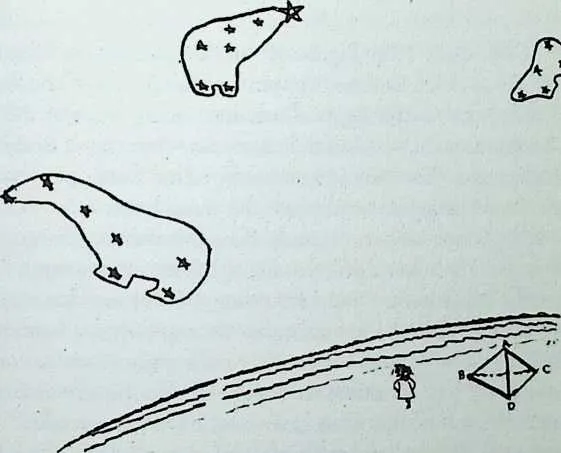
4041 Here is Goldy having a sky party with her three friends, the Polar Bear family. Goldy says the sky party is a ‘‘system’’ because Goldy plus the Three Bears equals four entities (or star events), and it takes four events to produce a system. A system divides all the universe into six parts: all the universe outside the system (the macrocosm), all the universe inside the system (the microcosm), and the four star events A, B, C, D, which do the dividing.
43 COURTESY OF THE BUCKMINSTER FULLER INSTITUTE
4445 The tetrahedron’s four-comer star events do not have to occur at the same time. Goldy found that light traveled six and one-half trillion miles in a year, and was fascinated when an astronomer told her that the star in the nose of the Big Bear is a live show taking place 210 light-years away-and-ago, as the American colonists are first thinking about revolting from English rule: and the pole star at Mommy Bear’s nose is a live show taking place 680 light-years away-and-ago, as Dante is writing The Inferno-, and the star at Wee Bear’s front toe
is a live show taking place forty-three light-years away-and-ago as Franklin Delano Roosevelt is being elected to the USA presidency for the first time, at the depth of the great 1929-39 Depression: While she, Goldy, is also a live show taking place no time away-and-ago. Altogether Goldy’s four live shows constitute a scenario of nonsimultaneous but omni-interrelated events, which can and do define the four corners of a minimum system—the tetrahedron.
46 She now understands Einstein’s concept that Universe is a scenario and not a single simultaneous structure. One picture of a caterpillar does not tell you it is going to transform into a butterfly, and it takes many frames of the cinema to inform you that the butterfly can fly.
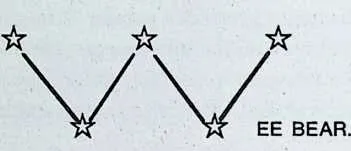
47 Here is Goldy having a sky party with her three friends, the Polar Bear family. Big Bear gave Mommy the Pole Star to wear on her nose when she gave birth to
49 COURTESY OF THE BUCKMINSTER FULLER
51 Daddy—Ursa Major, ‘‘The Big Bear’’—is often called the ‘‘Big Dipper’’ because he drinks so much iced tea. Mommy—Ursa Minor, ‘‘The Little Bear’’—is usually called the ‘‘Little Dipper’’ because being right at the cold North Pole she drinks much hot tea but in little cups—that way it doesn’t have time to get cold, she says. Wee Bear is sometimes called Cassiopeia because he sits in the high chair Cassiopeia used when she was a baby.
52 Goldy says, ‘‘I have drawn Mommy Bear in reverse. I forgot when I was drawing her that if it is to be printed direcdy from my drawing, it requires an original mirror-image master. But I am going to leave her that way because it’s well to remind everyone at the outset that we can only get from here to there by a series of errors—errors forwardly to the right, then a correcting forwardly error to the left, each time reducing error but never eliminating it. This is what generates waves; this what generates the experience life.’’
53 Goldy says the sky is a ‘‘system’’ because Goldy plus the Three Bears equals four entities (or star events), and it takes four events to produce a system. A system divides all the universe into six parts: all the universe outside the system (the macrocosm), all the universe inside the system (the microcosm), and the four star events A, B, C, D, which do the dividing.
54 Two star or three star event-entities have only ‘‘Betweenness’’ but no ‘‘insideness.’’
55 Insideness outsideness separation begins only with completion of the six interrelationship lines of the four separate entity-producing events. The four
56 star events A, B, C, D, have six separate, unique and most economical interrelationship lines AB, AC, AD, BC, BD, CD. These six lines and their four interconnected star-corners inadvertently produce four triangular facets of the minimum polyhedron—which four facets completely enclose the system to exclude the macrocosm and include the microcosm. A system consists at minimum of four nonsimultaneous but co-occurrent, because overlapping, yet dissimilarly beginning and enduring star entity-events of six interrelationship lines and four nothingness-window-facets plus twelve unique intercovariant vertex angles—twenty-six conceptual, topological components of a system to which must be added the multiplicative, ultravisible, macrocosmic outside- ness and infravisible, microcosmic insideness as well as the inseparably cooccurring inside concavity and outside convexity and the bipoled axis of rotation of all systems: for a total component inventory of thirty-two items.
57 Three thousand years ago the Greek geometers named this minimum system the tetrahedron—tetra = four, hedron = sides.
58 A system cannot have less than four triangular polygon ‘‘faces’’ (or sides or windows) or less than three triangular (polygon) faces surrounding each of the system’s four event corners. The triangle is the minimum polygon face. You cannot have a polygon of less than three edges. You cannot have a location fix-point that is less than one fix-point, you cannot have an event tracing line that is less than a line, you cannot have an angle that is less than a minimum angle, and you cannot have a system of less than thirty-two uniquely differentiable and geometrically describable characteristics. All the characteristics of a system are absolute because each of its components is the minimum-limit case in its respective conceptual category, for all conceptuality, as the great mathematician Euler discovered and proved, consists at minimum of points, areas, and lines. Goldy further clarifies and simplifies Euler by saying an area is nothingness, a plurality of areas are framingly separated views of nothingness, a point is a somethingness. A line is a relationship between two somethingnesses. An enlarged, seemingly single somethingness may prove to consist of a plurality of somethingnesses between which the defined interrelationship lines fence off the nothingness into a plurality of separate views of the same nothingnesses. Points are unresolvable, untunable somethingness occurring in the twilight zone between visible and subvisible. Nothingness is the unresolvable untunableness occurring in the twilight zone between visible and supravisible experience.
59 Life minimally described is ‘‘awareness,’’ which is inherently plural, for at minimum it consists of the individual system which becomes aware and the first minimum ‘‘otherness’’ of which it is aware, the otherness being either integrally internal or separately external to the observing system’s fourteen integral, topologically componented subsystems (4V + 4A + 6L).
60 Together the observer and the observed constitute two points differentiated against an omni-environment of nothingness with one inherent line of ‘‘awareness’’ interrelationship running between these two points. Euler’s generalized formula, which he named topology, says the number of points plus the number of areas will always equal the number of lines plus the number 2, which Goldy finds to be at minimum 2P + 1A = IL + 2, which minimum set of awareness aspects of life adds to four, i.e., (A) the observer, (B) the observed, (C) the line of interrelationship, and (D) the nothingness area against which the somethingness is observed.
61 There are no known experimentally demonstrable absolute maximum limits.
62 Only the minimum limit is demonstrably absolute. The minimum limit experienceable is always a system—even when it looks only like a point. A point is a system so macro remote or micro small as to appear only as an indivisible something in a specific direction relationship to the observer’s integral systems arrangement of, for instance, head, toe, front, and back. ‘‘That’s nifty,’’ says Wee Bear. ‘‘It’s magnificent,’’ says Big Bear. ‘‘I call it both nifty and magnificent,’’ says Mommy Bear.
63 Goldy has a tetrahedron beside her on the beach. Its four vertexes (which may also be called: locations; stars, event-fixes; points) are oriented as are Goldy and the Three Bears, with Mommy and her pole star at A, Daddy at B, Wee Bear at C, and Goldy at D.
64 The tetrahedron’s four-corner star events do not have to occur at the same time. Goldy saw a man way down the beach pounding to drive a post into the sand. She heard each pounding a moment after she saw it occur. When she was told about light’s speed having been measured in a vacuum by scientists, she understood that the light with which she saw the event, like sound, also had a limit speed. She was told that sound traveled at about 700 miles an hour and that light traveled a million times faster, which though very fast is much slower than 700 million miles in no time at all.
65 Multiplying 700 million by the number of hours in a year, Goldy found that light traveled six and one-half trillion miles in a year, and was fascinated when an astronomer told her that the star in the nose of the Big Bear is a live show taking place 210 light-years away-and-ago, as the American colonists are first thinking about revolting from English rule: and the pole star at Mommy Bear’s nose is a live show taking place 680 light-years away-and-ago, as Dante is writing The Inferno: and the star at Wee Bear’s front toe is a live show taking place forty-three light-years away-and-ago as Franklin Delano Roosevelt is being elected to the USA presidency for the first time, at the depth of the great 1929-39 Depression: while she, Goldy, is also a live show taking place no time away-and-ago. Altogether Goldy’s four live shows constitute a scenario of nonsimultaneous but omni-interrelated events, which can and do define the four corners of a minimum system—the tetrahedron. Goldy, too, is a nonsimultaneous system. She, too, is a nonsimultaneous and only partially overlapping complex of insideness and outsideness experiences. The interrelated experiences of Goldy and the Three Bears are a scenario. She now understands Einstein’s concept that Universe is a scenario and not a single simultaneous structure. One picture of a caterpillar does not tell you it is going to transform into a butterfly, and it takes many frames of the cinema to inform you that the butterfly can fly and many thousands of frames to permit a possible replicative engineering discovery of how it can fly. Because any one single ‘‘frame’’ or picture in the scenario filmstrip cannot disclose ‘‘what the story is all about,’’ Goldy says to the bears, ‘‘When people look at you stars and say, ‘I wonder what is outside the outside of the stars,’ they are asking for a timeless, simultaneous, static-system concept where none exists. Their question is as ignorant as would be asking, ‘Which word is the dictionary?’’ ’
66 ‘‘You are right, Goldy,’’ says Daddy Bear. ‘‘Minds think exploratorially, sort and compose. One thought, which is one metaphysically conceptual system, which at minimum is one tetrahedron, can interrelate any four event points or subsystems in nonsimultaneous Universe. Because of inherent nonsimultaneity all thinking is tetratuning. The (system-thought) tetrahedron can and always does include four identities: (1) the thinking individual, (2) the present otherness, (3) the past otherness, (4) the future otherness.
67 To which thought of Daddy Bear Mommy adds, ‘‘And the ignorant question asking of the brain occurs because brains do not think. They only play back yesterday’s recordings. Brains are pretuned like bells and sound off when struck.’’
68 :ap 2 from Tetrascroll: Goldilocks and the Three Bears
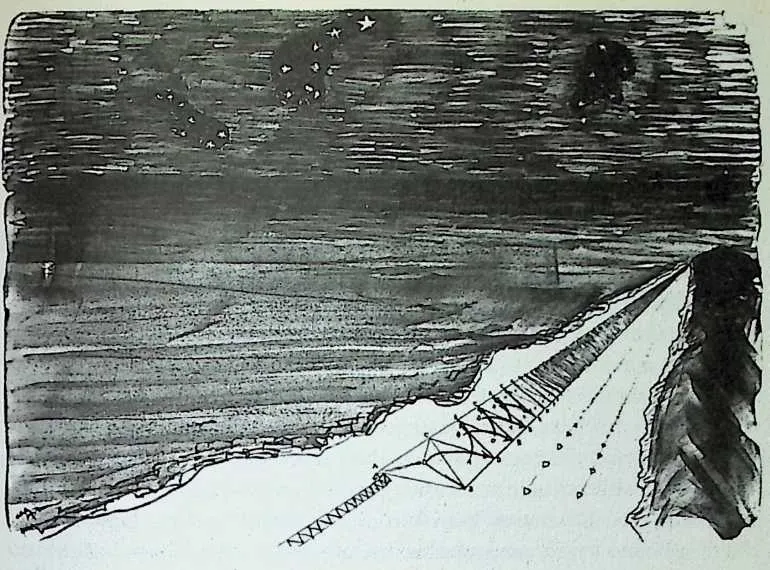
6970 Using the vast, water-smoothed surface of the many-miles-long sandy beach, and walking along as she talks, Goldy keeps drawing pictures large enough for the bears to see. Goldy says to the bears, ‘‘Let’s try an experiment with our tetrahedron.
71 By pushing successively on the tetrahedron’s top vertex, Goldy keeps rolling the tetrahedron ahead of her across the beach. This succession of rolling makes a long, parallel-edged ribbon with a line zigzagging between its edges to produce a succession of adjacent triangles.
72 Goldy says to the bears, ‘‘We have discovered a triangularly subdivided ribbon-printing machine—a wave-printing machine.’’ And Daddy bear says, ‘‘That is also the sand print patterning made by our four (A, B, C, D) bear’s feet when we are running. We can start our run with our right hind food D elevated. We then lunge forwardly over the hinge line running between our two front feet C, D, as foot A goes forwardly and down while foot B is elevated. Because a bear’s foot is itself a triangle, Goldy makes a pattern of Big Sky Bear’s footprints as he walks or runs eastwardly along the beach. Goldy uses the successive triangles as the frames for the succession of illustrations of her conversation with the bears. She says the ribbon is like a scenario filmstrip with the successive triangular pictures overlapping instead of being vertically separated.
73 Using the vast, water-smoothed surface of the many-miles-long sandy beach, and walking along as she talks, Goldy keeps drawing pictures large enough for the bears to see. The pictures illustrate each of her experimentally demonstrated explanations. She is recounting to the bears what humans have thus far learned regarding the principles employed by Scenario Universe to accomplish its eternal regeneration.
74 Goldy says to the bears, ‘‘Let’s try an experiment with out tetrahedron. Let’s see what happens if I use three of its four corners, A,
76 COURTESY OF THE BUCKMINSTER FULLER INSTITUTE
77 B, C, representing you three bears, as the tetrahedron’s base on the sand—because you have been together for billions of years—and corner D, which is the newcomer me—Goldy—I put at the top of the tetrahedron. Now I am taking hold of my corner D at the top and am rolling it over around its bottom edge BC until corner D lies down in the sand, pointing in an easterly direction to my right, along the beach. ’’ This rolling leaves the triangular print ABC in the sand westward, to Goldy’s left, where the tetrahedron had been sitting before that first rollover. Goldy now takes hold of corner A, which rose from the sand base to replace D at the tetrahedron’s top. She pushes the new top corner A again over and downwardly to her right around edge CD, which means farther eastwardly along the beach until A hits the beach, as comer B rises to take the top corner place of the tetrahedron, leaving a second triangular print BCD in the sand with its edge BC congruent with BC of the first printed triangle ABC. She now pushes top corner B eastward, rolling it over and down around bottom edge DA, which brings corner C to the top and leaves a third successive triangular print CDA. She next rolls top comer C eastward over bottom edge BA to leave a fourth successive print DAB, making an altogether eastwardly developing ribbon of triangular prints. Goldy then pushes top comer D, then successively tops A, B, C, D again and again, as each rotates to the top to replace the one Goldy last rolled over and downward, eastwardly to her right. By pushing successively eastward the tetrahedron’s successively latest top vertex, Goldy keeps rolling the tetrahedron ahead of her along the
78 beach. This succession of rollings makes a long parallel-edged ribbon with a line zigzagging between its edges to produce a succession of adjacent triangles. One of the ribbon’s edges reads successively AC, AC, AC, AC, while its other edge reads BD, BD, BD, BD. The succession of eastwardly occurring tops reads D, A, B, C, D, A, B, C, D, and so on.
79 Goldy says to the bears, ‘‘We have discovered a triangularly subdivided ribbon-printing machine—a wave-printing machine.’’ And Daddy Bear says, ‘‘That is also the sand print patterning made by our four (A, B, C, D) bear’s feet when we are running. We can start our run with our right hind foot D elevated. We then lunge forwardly over the hinge line running between our two front feet C, D, as foot A goes forwardly and down while foot B is elevated.’’
80 Because a bear’s foot is itself a triangle, Goldy makes a pattern of Big Sky Bear’s footprints as he walks or runs eastwardly along the beach. Goldy uses the successive triangles as the frames for the succession of illustrations of her conversation with the bears. She says the ribbon is like a scenario filmstrip with the successive triangular pictures overlapping instead of being vertically separated. ‘‘You may notice,’’ says Wee Bear, ‘‘That the starry pattern of the chair Cassiopeia left for me looks like the first three triangular frames of that scenario filmstrip.’’ ‘‘Yes,’’ Goldy replies, ‘‘and I see that if I print these triangular frames of the scenario strip of overlapping conceptual events on a heavy paper ribbon, the strip can be spooled onto a tetrahedron. This will make a tetrahedron book that can be progressively unrolled from a tetrahedron at one end and rerolled to form another tetrahedron at the other end of the, strip, with the progressively exposed strip in between telling the picture story—the scenario—of ‘‘nonsimultaneous universe,’’ with both the fourdimensional tetrahedronal othernesses scrolls of tomorrow and yesterday as yet unrolled or already rolled back in, and therefore consciously and directionally identifiable but inscrutable. Because the tetrahedra are serving as four-dimensional scrolls, we will call our first such book The 4D Tetrascroll.
81 After graduating from Milton Academy in Massachusetts, R. Buckminster Fuller entered Harvard University, the fifth generation of Fullers to do so. But Bucky was not accepted into any of Harvard's so-called final clubs. Bucky found another interest, as he called it: being "a stage-door Johnny." His chief attraction was an actress named Marilyn Miller, who was starring in George White's Scandals, a musical extravaganza similar to the Ziegfeld Follies. One day Bucky took Marilyn and the chorus to New York City and treated the whole gang to dinner at Churchill's, thereby blowing his entire year's tuition. Since the tuition wasn't paid, Harvard dismissed Bucky. His mother's disappointment led Bucky to reapply to Harvard, but he quickly left the college a second time—Bucky himself used the word "fired"—because he was bored and felt he was wasting his mother's resources.
82 Almost half a century later, in 1961, Harvard appointed Bucky to the prestigious Charles Eliot Norton Professorship, a poetry chair. One of the Fuller company's attorneys, Robert D. Storey, in later years served as a member of the Harvard University Board of Overseers, and he has told me how pleased Bucky always was when he donned cap and gown on ceremonial occasions and marched through the Yard with President Derek Bok. Bucky would beam, a twinkle in his eyes, no doubt feeling redeemed in his mother's eyes for his double dismissal.
83 Dr. Arthur L. Loeb of the Department of Visual and Environmental Studies, located at the Carpenter Center, was Bucky's longtime associate and friend at Harvard. It was Loeb who introduced students to the patterns of Bucky's geometry and the new language Bucky called "synergetics." Through Loeb's academic support and interest in Fuller's work, Bucky lives on at Harvard. Loeb's contribution offers an analysis of some of Bucky's mathematical theories.