
8 Bucky Fuller—Nine Epiphanies
2The Very Reverend James Parks Morton
3 So far I have witnessed nine significant Bucky epiphanies in my brief seventy years on spaceship earth: in February, June, November, and December 1978, February 1979, September 1983, October 1991, November 1995, and June 1996.1 hope this book will be the tenth, and I expect more to come.
4 Epiphany I
5 Bucky entered my life forcefully in February of 1978 on a sun-drenched atoll in the Seychelles. Prince Chahram Palavi of Iran had assembled fifteen environmental activists on his tiny island of D’Arros and given them a serious task: to develop a strategy for preserving the earth! Bucky on this subject, morning, noon, and night for seven straight days was overwhelming for everyone, and to me transforming. In addition to seeing him at our group gatherings, which Bucky dominated, I met with him privately several times—extraordinary meetings. He asked me to read his new rewrite of the Lord’s Prayer to the group, and I asked him how we should continue building New York’s Cathedral of St. John the Divine for the solar age.
6 By the time we left D’Arros, Bucky had agreed to preach at the Cathedral the first Sunday in June. More: Bucky most astonishingly volunteered to plan with me over the next few months how to complete the Cathedral as a vast solar bioshelter ‘‘to export solar energy to the surrounding community.’’
7 Epiphany II
8 Bucky’s cathedral sermon at the eleven-o’clock service on June 4, 1978, was an hour-long dialogue in which I related the appointed scripture—doing the truth—with Bucky’s insistence that things work because they are true. I called our dialogue sermon ‘‘Technology and Theology’’ and began by pitching this question: ‘‘Bucky, your second book was called No More Secondhand God. So I ask you: what does firsthand experience with God, not secondhand experience, really mean?’’
9 Bucky: ‘‘At the age of thirty-two, having grown up on a world in which I was continually being told, ‘Never mind what you think—pay attention to what we’re trying to teach you,’ …I came to the conclusion that I must do my own thinking and give up all the things that I’ve been taught to believe—that is, accepting the explanation of physical phenomena without experimental evidence. I said, if I’m going to have to go on direct experience in doing my own thinking, I think the first question you must ask yourself is ‘Do you have any experiential necessity to assume a greater intellect to be operating in the universe than that manifested by humans?’ And I said I’m overwhelmed by the intellect and the intelligence and the order manifest in the universe, which is completely transcendental to any human capability.’’
10 Bucky then spoke of his early discovery that the universe is both eternally regenerative and accelerating—the one and only system that is 100 percent regenerative—‘‘meaning that all of the familiar design alternatives as such are intercomplementary. That is what is meant by ecology.’’
11 After reflecting on the acceleration of events in his early years—when he was three, the electron was discovered; at eight, the Wright brothers flew; at twelve, there was the first wireless SOS—Bucky expanded on the new relationship of humans to the universe.
12 ‘‘Human beings are given mind and not muscle. So I say the most important of all the truths that we are being confronted with is that we are here for our mind functioning. Why are we included in an eternally regenerative design in a universe that has no waste? We are apparently here as local information gatherers. Being given the capacity to understand principles so we can develop instruments to go into great macrocosms and microcosms, to deal in a universe which is 99 percent nonsensorily contactable, we are able then to deal with what is common to all lives in all history: problems, problems, problems. We are here for problem solving, not to get over into some universe with no problem of any kind. No, the better you are at problem solving, the worse problems you’re going to get. We are here for that. That is our function.’’
13 Bucky then came to the final challenge of his sermon—illustrated with a maple seed from the Cathedral close, which he threw sailing into the congregation.
14 ‘‘Humanity is now in a very critical and what I feel is a final examination. When nature has a very important function like humans, this human mind of local information gathering and problem solving, she doesn’t leave it all in this one investment, she makes many alternate starts. This morning when I came in from outside, I picked up this little seed from a maple tree. Now, a tree’s function is to impound the sun’s radiation, to convert it by photosynthesis, and to bring energy and its circulation into the whole ecology, because you and I can’t take the sun’s energy through our skins. But with this seed the tree is able to get the new little trees out from under its shadow so they can get the sun. So she makes these beautiful flying machines. And I say she has many alternate plantings in our universe besides human beings. So we’re into a kind of final examination right now, now that it has become clear. The information is here. We do have the capability to make it. It does not have to be you or me ever again.
15 ‘‘We’re really going back to the first two laws we were ever taught today: Love thy God, this is the truth. And love thy neighbor as thyself. Finally you can afford to love thy neighbor as thyself. It does not have to be you or me ever again.
16 ‘‘I would like personally to end this way. I’ve witnessed one miracle after another through my whole life, extraordinary things happening. I see that God tries very hard and apparently is intent to make us a success if it is possible. So if we don’t make it, it is because of each individual. You can’t leave it to your politicians to represent you; you can’t leave it to your ministers to pray for you. It’s going to be how each individual reacts in relation to the truth.’’
17 The huge congregation stood up and burst into thunderous applause. As I thanked Bucky, I asked everyone to close their eyes as I read once again, at Bucky’s request, his latest version (dated May 8, 1978) of ‘‘Ever Rethinking the Lord’s Prayer.’’
18 Epiphany III
19 Bucky also kept his word about the solar bioshelter project for the Cathedral, and we met together twice early in the fall of 1978. In November, Bucky and Shoji Sadao came to my office bearing the completed model of wood and clear plastic showing banks of photovoltaic solar collectors along the entire 600 feet of roof. But the crowning glory was an immense tower rising 600 feet above the central dome with a geodesic globe 75 feet in diameter near its apex. People would enter the tower by elevators at its four bases and rise to the geodesic globe above. Bucky wanted the upper half of the glass globe, etched with the constellations of the night sky, to rotate according to the season so that the New York beholder’s view would always be aligned with the constellation directly overhead. The lower half of the geodesic globe was to function as a solar bioshelter of living green plants and small trees, making the Cathedral’s great tower indeed the midpoint compass between the stars of heaven above and the green earth below!
20 Epiphany IV
21 The task now confronting me was deeply intriguing. Bucky had indeed presented a concrete response to my question about greening the Cathedral for the solar age. But was his monumental solar Eiffel Tower a precise design to translate into an architectural program? Or was his solar bioshelter scheme an overall direction to pursue when the Cathedral resumed building? Cathedral construction had stopped with Pearl Harbor and had remained dormant for almost forty years. But since 1976 the Fabric Committee had been busy designing a new apprenticeship program to train young people from Harlem and the Upper West Side in the venerable trade of stonemasonry, in line with the Cathedral’s commitment to community development. Could Bucky’s most advanced, cutting-edge technology and the most ancient cathedral craft of stonecutting work in sync?
22 We decided that the two disciplines could and must combine—tradition and innovation together. So in late December of 1978, two important events took place in response to the challenge of Bucky’s 2-by-4-foot model prominently displayed on my desk. The first event was a brief think-tank meeting of my five-man ‘‘environmental-architectural mafia,’’1 in which we agreed to an expanded two-day think tank focused on Bucky’s proposal, to which we would invite for their critique three or four architects and engineers whose expertise was in solar technology and bioshelter design. Prince Chahram agreed to cover the expenses of the meeting in early 1979 as an anniversary follow-up to the D’Arros meeting with Bucky.
24 The second event in late December of 1978 was the widely publicized press conference announcing resumption of Cathedral construction after forty years. The first goal was to complete the half-built southwest tower at the front of the Cathedral—a task that Bucky approved and had included in his model—by training young men and women from the neighborhood to be stonecutters and masons.
25 Epiphany V
26 The two-day think tank on Bucky’s solar bioshelter model took place in snowy February 1979 and was passionate and very opinionated. Bucky’s solar tower scheme was deemed by our guests brilliant, inspirational, and wildly impractical, considering the still low energy yield of the best solar voltaics—even with a full acre of them side by side on the Cathedral roof—and the huge energy demands of elevators and the rotating geodesic hemisphere at the top of the tower. ‘‘Well, Bucky may say the tower will export energy to all of New York, but we see it as a huge sinkhole, a colossal energy drain!’’ But Bucky’s notion of a solar bioshelter, on the other hand, enthusiastically carried the day and inspired the future project for a green Cathedral. My mafia again convened and proposed that we commission a small, invited group of the most innovative ‘‘solar’’ architects to submit schemes for a solar bioshelter as an integral part of the Cathedral. Prince Chahram was intensely interested in the development of what he called the ‘‘Bucky Fuller Cathedral Project’’ and once again graciously covered the expense of what is now known as the Solar Bioshelter Competition of 1979.2 And guess who won? David Sellers—brilliantly making the unbuilt south transept into Bucky’s solar bioshelter with exterior limestone Trombe walls encased in glass and a glass roof over the attic vault: a vast solar greenhouse in the sky with the Gothic outline of Cram’s original transept.
28 Nineteen seventy-nine also brought the Iranian revolution and a very different new life in London for Prince Chahram. But in 1980 he arranged for a second meeting of the D’Arros group in England. Bucky was not able to attend, but his indomitable spirit was with us. Tom Berry, Rene Dubos, John Todd, and I represented the Cathedral bioshelter mafia. In April of 1979 the one hundred Episcopal cathedral deans held their annual conference at St. John’s and attended lectures about solar bioshelters and geodesic domes by John Todd and Rene Dubos. Bucky Fuller (an Episcopalian) became a member of an expanded Cathedral family.
29 Then on June 21, the summer solstice, the new Cathedral stoneyard was dedicated and the first five apprentices began our third building period!
30 Epiphany VI
31 Bucky died on July 1,1983, and thirty-six hours later, on July 3, his wife, Anne Hewlett Fuller, died. On Tuesday, September 27,1983, the great public memorial service took place at noon at the Cathedral for both Bucky and Anne. It was an extraordinary epiphany: Bucky’s granddaughter, Alexandra Snyder, read the first lesson from Ecclesiasticus, ‘‘Let us now sing the praises of the heroes of our nation’s history …’’; Arthur Penn read excerpts from Bucky’s No More Secondhand God; and Paula Robison played the flute solo sarabande from Bach’s A Minor Partita. Harris L. Wofford, Jr., gave the eulogy:
3233Listen to what he wrote a few years ago to a friend who sent word his wife had died. Bucky wrote back: ‘‘Long ago we had irrefutable scientific evidence that whatever life may be it is not physical. I assume all humans to be immortal. Being now on the eve of seventy-nine years of age I have written to old friends only to receive letters from their wives or husbands telling me of their sometime-past death. I have always replied that receipt of their letter did not alter my sense of the absolute livingness of the friends to whom I had written, which livingness was in no way altered by the news of their being no longer temporally available. I go right on seeing them. There they are.’’
34 Or this story from his friend of fifty years Clare Boothe Luce:
3536When he stopped to visit her in Hawaii she decided to have dinner with the man she considered the brightest on the island, a leading admiral of the navy. She told the admiral that he was going to meet a true genius. When the two men met, Bucky asked the admiral what the navy was doing to harness windpower. The islands were ideal for great windmills, said Bucky. The admiral demurred. Bucky persisted. Frank Lloyd Wright called Bucky ‘‘a man with more absolute integrity than any man I’ve ever known.’’ All of us who knew Bucky would also agree he was the man with more absolute stubbornness than anyone we’ve ever known. So that night in Hawaii he argued on about windpower. When the exasperated admiral left he said to Mrs. Luce, ‘‘You invited me to talk with the genius of the world, and I spent the evening arguing with a stubborn old man hipped on windmills.’’ Three years later the admiral called Mrs. Luce with a confession. ‘‘You remember how nutty I thought your friend Fuller was,’’ the admiral said. ‘‘Well, I want you to tell him I’ve just accepted chairmanship of the navy’s urgent task force on windpower. Bucky was right.’’
37 Or this quote from Bucky himself after the tragedy of his first daughter’s death in 1927 and after disasters in his career when he resolved ‘‘to live a new kind of thinking.’’
3839When in 1927 I began to consider what the little individual could do on behalf of his fellow man that governments and corporations could not do, it became evident that the individual was the only one that could find time to think in a cosmically adequate manner.
40 Wofford concluded his eulogy with these words:
4142The Constitution of the World is crying out for recognition of an office every human being has a duty to play—the office of Citizen of the World. Bucky was a true Citizen of the World. In being it, he showed us the special kind of fun—the delight there can be—in doing our duty as world citizens. By his life, he demonstrated how much good we ‘‘little individuals’’ could do if we, too, played the World Game in our fives, and took the time to try to think ‘‘in a cosmically adequate manner.’’
43 The wonderful service ended with a prayer offered by Ellen Burstyn:
4445Almighty and everlasting God, who didst make the universe with all its marvelous order, its atoms, worlds, and galaxies, and the infinite complexity of living creatures; Grant that, as we probe the mysteries of thy creation and the laws behind all structure, we may, even as thy servant Buckminster, come to know thee more truly, and as certainly show forth the mind of our Maker; through Jesus Christ our Lord. Amen.
46 and with Bucky’s favorite hymn from his navy days:
47 Eternal Father, strong to save,
48 Whose arm hath bound the restless wave,
49 Who bidd’st the mighty ocean deep
50 Its own appointed limits keep:
51 O hear us when we cry to thee
52 For those in peril on the sea.
53 Epiphany VII
54 In 1991 the Cathedral received an amazing bequest from the French family of Rene Dubos, specifically designated to continue plans for the Solar Bioshelter inspired by Bucky and so enthusiastically championed by Dr. Dubos. Twelve years had passed since the Solar Bioshelter Competition of 1979. Rene and Bucky had been dead for over eight years, and with New York’s financial crisis of 1987, progress on both the stoneyard and the Solar Bioshelter Project had slowed to a crawl.
55 So the Dubos bequest was a gigantic shot in the arm. The newly configured ‘‘mafia’’ determined that the most propitious use of the gift would be a worldwide competition for the solar bioshelter to put Bucky’s inspired legacy in ‘‘prime time.’’ First, sixty-five of the world’s most renowned architects from seventeen countries were invited to compete by submitting statements of intention. Next a distinguished jury3 would select six finalists,3 four to come to New York for a two-day briefing and then submit a major project design with an accompanying model. There was an amazing convergence of energies in the unanimous selection of Santiago Calatrava as winner. He transformed the entire attic space of the Cathedral (600 feet long, 300 feet wide at the transepts, and 45 feet high) into an immense cruciform solar greenhouse, a powerful green cross atop the Cathedral for the airplanes passing overhead. Equally important, he returned to Bucky’s initial 1978 scheme with a 500-foot solar tower at the intersection of east-west and north-south axes, the compass between the starry heavens and the green earth. Bucky triumphant at last!
57 The competition was immensely visible, with coverage in the every architectural magazine and metropolitan newspaper across the nation. Herbert Muchamp did a splendid photographic review for the New York Times, and the Municipal Art Society mounted a gallery exhibit of all six finalists’ models. MOMA gave Santiago Calatrava a one-man show in 1992 with the twelve-
- 3.
- James Polshek, FAIA, Dean of the Columbia School of Architecture, chaired the jury of Philip Johnson, FAIA; Maya Lin, designer of the Vietnam Memorial; David Childs, FAIA, managing partner of SOM; and Professor Kenneth Frampton, all architects, in company with Lily Auch- incloss, chair of the Architectural Department of MOMA and a Cathedral trustee; the Rev. Robert Parks, Cathedral trustee, Rector of Trinity Church, Wall Street, and chair of the Fabric Committee; John Todd; and myself. John W. Barton, a young architect from Santa Fe, served as administrator of the competition.
58 foot model of the Cathedral and its solar bioshelter and tower as the centerpiece. The model has since traveled worldwide to London, Madrid, Berlin, Tokyo, and Istanbul.
59 But will Bucky’s inspiration ever be built? Here again Bucky’s wisdom must prevail: it is a decision for the universe—and in the universe’s time frame, not ours.
60 Epiphany VIII
61 In 1995, the centennial of Bucky’s birth, Professor Haresh Lalvani, a former doctoral student of Bucky’s and now professor of architecture at Pratt Institute and design scientist in residence at the Cathedral, organized a mammoth celebration of Bucky’s life’s work and influence worldwide. Haresh, of course, wanted the exhibition to be a comprehensive retrospective of Bucky’s personal achievement from the Dymaxion house and car to the famous geodesics, buckyballs, and World Game. But of even greater tribute he wanted to illustrate the robust innovations in design science and morphology of Bucky’s followers, and in other seminal explorations largely unknown to the architectural and design community. So in addition to the multitude of Bucky’s famous models and photographs were models and design schemes of eighty-six architects and scientists and designers—Bucky’s children—from all over the world. The two Cathedral Solar Bioshelter models—Bucky’s and Cala- trava’s—proudly occupied the first bay in the nave, and the immense space of the Cathedral was bejeweled with literally hundreds of the models and displays that have changed our vision and understanding of the structure of the universe. The formal title of the event was ‘‘Contemporary Developments in Design Science: The Buckminster Fuller Centennial Exhibition.’’
62 The grand opening on November 9 was a truly fantastic celebration organized by three distinguished co-chairs,4 an executive committee of fifteen old friends and colleagues, and a working committee of thirty-six, all under the honorary chair Lily Auchincloss. My task was to be circus ringmaster, herding the vast crowd away from the dazzling exhibition so we could start the show, and then introducing one stunning act after another. Ed Applewhite, Bucky’s associate of sixty years, beginning with the Dymaxion house at Beech Aircraft in Wichita and continuing today as Bucky’s literary executor, opened the evening. Bucky’s daughter Allegra Fuller Snyder followed with her wonderful recollections. She closed with a poem from Bucky’s father-in-law, James Monroe Hewlett—‘‘the man,’’ Allegra said, ‘‘who taught Bucky to believe in himself.’’ Hewlett was also an architect and designer, and in later years director of the American Academy in Rome. Bucky loved these four lines and often read them to Allegra:
64 The flying fish has flown again, with rainbow dripping wing
65 He doesn’t do it often and he cannot do it long
66 But if his flight reveals to us some rarely tried for things
67 ’Twill prove a fitting subject for our song.
68 Next spoke M. C. Richards—poet, potter, painter, teacher, friend—who was with Bucky at Black Mountain College in 1947. She told of Bucky’s delight when his Dymaxion dome fell down—because, he said, ‘‘it gave him an opportunity to see what was wrong so he could fix it.’’ The next summer it stayed up. Then M.C. described the Satie festival, which John Cage organized and in which Bucky played the lead role of the Baron Medusa, with Elaine de Kooning as his daughter and Merce Cunningham as the mechanical monkey who did seven dances. John Cage played the Satie score, Arthur Penn directed, and Bucky’s favorite line was ‘‘O I do love coffee, especially when it’s good.’’ M.C. concluded with an excerpt from No More Secondhand God.
69 Lim Chong Keat spoke next—a world architect, born in Singapore, with offices in Kuala Lumpur, Penang, and Singapore. He had become great friends with Bucky in the mid-1970s when the two founded the Campuan Conference on Global Issues. Lim was at the Cathedral for Bucky’s sermon in June 1978 and snapped the immortal photograph of Bucky in his red doctor’s gown in the pulpit.
70 Lim concluded his remarks with this ‘‘mental mouthful’’ from Bucky:
7172Human integrity is the uncompromising courage of self-determining whether or not to take initiatives, support or cooperate with others, in accord with all the truth and nothing but the truth, as it is conceived by the divine mind, always available in each individual. Whether humanity is to continue and comprehensibly prosper on Spaceship Earth depends entirely on the integrity of the human individuals and not on the political and economic systems. The Cosmic Question has been asked: Are humans worthwhile to universe invention?
73 For the principal address of the evening, we had invited William McDonough, who had met Bucky in 1972 as a twenty-one-year-old student at Dartmouth, was now dean of the Architectural School at the University of Virginia, and in 1992 would be commissioned by the city of Hanover to write the Hanover Principles for the World’s Fair of 2000 on the theme ‘‘Humanity, Nature, and Technology.’’ The core of Bill’s talk was a challenge for the second industrial revolution. He called the retroactive design of the first industrial revolution brute force: if brute force does not work you are not using enough of it.
7475Let’s design another industrial revolution that produces nothing hazardous, that measures productivity by how many people are working, that measures progress by how many buildings have no pipes, and prosperity by how much of our capital we can invest and how much of our solar income we can accrue. What Bucky called ‘‘Real Wealth.’’ I would like to mention a few projects to show the relationship to Bucky:
76For Herman Miller, we have just designed a factory to recycle furniture forever. It’s a zero-emissions site full of birds and frogs—all we did was say: ‘‘no pipes, we’re going to keep our water.’’
77In Chattanooga, we’re declaring zero-emissions zoning in the ‘‘Love Canal of the South.’’ You can do whatever you want, just don’t poison anybody. The people signing up for this are people like Du Pont.
78We are redesigning the carpet industry so that the carpet will be leased instead of purchased. It will go back to the company when you’re finished with it. Why would you want to own a carpet?
79Lastly, a little ‘‘flag of the next industrial revolution,’’ a fabric designed from Steelcase Corporation. We made the product from ramie, a perennial nettle in the Philippines, and wool from happy sheep in New Zealand. We said we’re going to design this as an organic nutrient to become compost. We need to put the filters in our heads, not at the end of water pipes or on smokestacks. Here’s the filter: no persistent toxins, no mutagens, no carcinogens, no biocumulative substances, no heavy metals, no endocrine disrupters. Seventy companies slammed the door and formed a consortium to block the project. We went to see the chairman of Ciba-Geigy in Basel; we explained it to him; he said, ‘‘I’m letting you in.’’ In thirty days we had analyzed 8,000 chemicals in the fabric industry, and with that filter we had to eliminate 7,962. We were left with thirty-eight. The entire fabric line was done with only those chemicals and meets every standard known for high- quality furnishing. This is the beginning of the Next Industrial Revolution. When the factory did its first run with this product, the Swiss government came to test the effluent and thought their equipment was broken. There was nothing there. It turned out that the fabric itself was further filtering the water. When a factory would rather use its effluent than Swiss drinking water, you’ve hit zero emissions.
80I could go on forever. Bucky could go on forever. I guess that’s the point. So, in an anticipatory design kind of way, let me say: ‘‘Here’s to the Earth that belongs to the Living, free to pursue and prosper, with life, liberty, happiness and free from a remote tyranny of ancestors. And the ancestors are us.’’ Thank you, Dr. Fuller.
81Interspersed between the addresses we had Bucky’s favorite music by his favorite artists Paula Robison and William Wadsworth: Mozart’s Andante in C Major, Massenet’s ‘‘Meditation’’ from That's, and the sarabande from Bach’s Partita in A Minor for solo flute, which Paula had also played at Bucky’s memorial.
82The incredible evening ended with Irene Worth. Walter Kerr wrote of her in the New York Times when she opened in Ibsen’s Hedda Gabler, ‘‘Miss Worth is just possibly the best actress in the world.’’ She read two letters of late 1982, the first written November 19:
83 Dear Buckminster Fuller:
8485My last grandmother died recently, as expected, but I didn’t expect to remember so much I forgot to talk with her about, and I’m a bit blue when I think of her. She was born about the time you were, and since your death soon could not be called unexpected, I want to send you a note of appreciation.
86Insofar as I represent the generation twice removed from yours (younger in human terms, older in Universe time), I want to thank you on behalf of all of us, for a life well done. There’s no question that you will be better known in fifty years than you are now, because every year your ideas, language, and general optimism appear to become more saturated in the collective consciousness.
87You have known the stagecoach, yet remain on the cutting edge of the electronic age. You are so wonderfully arranged that I can be assured that you will read this letter. How you come to God, I don’t understand, but God bless you,
88Love,
89Joe [Joseph Wheelwright]
90 Bucky’s reply is dated one month later, December 13, 1982:
91 Dear Joe:
9293There have been two generations of Wheelwright friends in the first half of my life. They were all admirable individuals. I interpret your spontaneous writing to me in so daringly tender a way as a message of comprehension and accord from all those whom I love who have died and in my youth were so often dismayed and alarmed by all the mistakes I had to make to become shocked into discovering what I had to learn. This was to thoughtfully discover on my own, in both the biggest and most exquisite ways, what needed to be done, and could now be done for the first time in history to make the world work for everybody. It was a task that required a special-case individual to initiate, an individual who had come to the point of suicide and was inspired to commit his total experience inventory only to the advantage of all others but self.
94There’s lots more to be done, which it seems to me I have to do before I die, as a follow-through in accomplishing all that with which I committed myself to
95cope. I never pray God to do anything, because God would not be God if the eternal, absolute intellectual competence needed my suggestions.
96I feel sure that God holds you in grace and will continue to do so. I thank God for an additional Wheelwright friend.
97Faithfully yours, Buckminster Fuller
98 Epiphany IX
99 Bucky’s great centennial exhibition in New York did not stop there. The following June 1996 in Istanbul the penultimate United Nations summit conference on major world problems was scheduled to open.5 Habitat H ’96 was to focus on the built environment, Bucky’s life work. Therefore a significant effort in 1995 was directed to bringing the Bucky centennial to its most global venue. The secretary-general of the United Nations, Boutros Boutros-Ghali, was very supportive of the project, as was the Hon. Wally N’Dow of Gambia, the deputy secretary-general for the Habitat Summit. The logistics, expense, and red tape of shipping such a large and complicated exhibition were formidable, but the universe clearly wanted it to happen. And it did! The stated goal of Habitat II was ‘‘Adequate and Sustainable Shelter for All in Harmony with Nature,’’ so we revised our title to ‘‘Building for the Future: The Buckminster Fuller Centennial Exhibition.’’ Haresh Lalvani wrote these words in the prospectus :
101102Geometry is the great equalizer of cultures. The fundamental principles of space and structure provide the harmonious bridge between developed and developing economics, a symbol of hope and unity as well as a pragmatic scientific tool for providing shelter using less materials, yet having greater performance.
103We saw the occasion of Buckminster Fuller’s birth centennial as our opportunity to review worldwide innovations in design science. This is a robust frontier of exploration between design in nature and the art and science of architecture.
104 The Istanbul site for the exhibition was very beautiful and very distinguished: the Museum of Painting and Sculpture housed in the venerable Dolmabachce Palace on the Bosphorus. The exhibition opened on June 3 and continued through the summer of 1996. Architects, engineers, diplomats, scientists, housing administrators, community activists, and heads of state from 185 countries saw the work, the genius, and the legacy of Bucky.
105106Harris L. Wofford, Jr., had stated the proper context for Bucky in his eulogy at the memorial service: ‘‘The Constitution of the World is crying out for recognition of an office every human being has a duty to play—the office of Citizen of the World…. By his life, he demonstrated how much good we ‘little individuals’ could do if we, too, played the World Game . .. and took the time to try to think ‘in a cosmically adequate manner.’ ’’
107The Habitat II Summit of the United Nations in Istanbul provided the accurate and inevitable global context for Bucky’s life and work as a true Citizen of the World.
108 Introduction to Omnidirectional Halo
109 from No More Secondhand God
110111The useful but infrequently used word epistemology means science of the thought processes. A total epistemological reorientation and, to the best of my knowledge, a unique philosophical reconception- ing, regarding the regenerative constellar logic of the structuring of the universe (both as a new cosmology and as a new cosmogony), seem to have followed gradually upon my hypothetically initiated querying regarding the possibility of formulating more comprehensive and symmetrical statements regarding dawningly apparent natural laws. I intuited in irrepressible degree that such a potential formulation might be accruing and harvestable in all of our acceler- atingly reconsidered and progressively integrated world-around, all-history experience as now only diffusely inventoried at the middle decades of the twentieth century.
112Out of multi-overlaid experience pattemings there sometimes emerges an awareness of what we may call a coincidence pattern—a localized thickening of points. These emergent patterns of frequency congruences and concentrations display a unique configurationintegrity which has up to now been so dilute in any one experience as to be only invisibly common to many differentiated or special experiences, e.g., a pack of one hundred 4-inch by 5-inch file cards each riddled with hundreds of different sized small holes. Each card appears to be chaotically patterned with holes. However, when the cards are stacked with edges aligned three holes in each card are vertically aligned; all others are obscured by blank spaces on one card or another. A triangular pattern relationship of the light coming through three tubes in the stack of cards is now lucidly conceptual. To such persistendy emergent, uniquely mutual, coincidencepatterning relationships as the same triangle array of holes in each and every card we may apply the term ‘‘pattern generalization’’ as used in a mathematical sense, in contradistinction to the word ‘‘generalization’’ as used in the literary sense. The latter often means a too-ambitious subject range which consequently permits only superficial considerations of any specific case data.
113When the uniquely emergent generalized patternings become describable by us in mentally regenerative conceptual terms, as completely divorced from any one of the specific sensorial conditions of any of the special experiences out of which they emerged, yet apparendy, as seen in retrospect to have been persistent in every special case, then we may tentatively assume such unique mutual pattern content to be a generalized conceptual principle, as for instance the conception of tension as opposed to compression independent of textures, smells, colors, sound, or size of any one tension-dominated experience.
114It is in just such an epistemological process that we discover that size is not a generalized conceptual principle. Whether referring to the size of an object in respect to other objects or their sizes of any one object’s subdivision, size emerges exclusively as a frequency concept uniquely differentiating-out each ‘‘specialized case.’’ Generalized shape conceptioning is independent of size. A triangle is a triangle independent of size.
115When a second order of pattern distillation as a generalized conceptual principle emerges, but this time exclusively from the emergently induced coordinate consideration of a plurality of generalized conceptual principles themselves, each independent of any special case sensoriality, and in such a regeneratively recognizable manner of patterning as to provide a means of mathematical accounting and therefrom a tentative forecasting capability, not only of generalized developments but also of special forward experiences in the terms of specific sensorial conditions, and those calculated forecast conditions materialize, and the forecasting capability is subsequendy verified by recurrent experimental demonstrations under controlled generalized conditions, then we may tentatively assume that we have discovered at least a clause of ‘‘natural law.’’ For example, we tentatively assume that radiation is generalized compression and that gravity is generalized tension and that tension and compression are inseparable, precessionally complementary functions of universal structure.
116Newly recognized generalizable principles seem emergent in unprecedentedly accelerating accumulation as reported from the instrumentally extended range, velocity, and exactitude of special case experiences in the most recent moments of history’s scientific venturing. The many where local probings have been meticulously organized and reported regarding measurable relationships and rates of changing relationships throughout the vast macrocos- mic and exquisite microcosmic angle and frequency universe events both infra and ultra to man’s direct tunability yet instrumentally tunable and trans- formably readable within regeneratively informative tolerance despite inherently limited observational exactitude.
117 Out of cumulative patterning overlays there emerges what seem to be gen
118 eralized principles apparently governing all associative and disassociative transformings and their resultant regeneratively persistent hierarchy of con- stellar configurations. These hierarchies of constellar configurations disclose in turn a hierarchy of dynamically symmetrical constellation phases and their respective maxima-minima, asymmetric and complementary, accommodative transformabilities which are apparently permitted within an omnirational, omnidirectional, omniequieconomic, energy-accounting, co-ordinate system of universe. This omnirational, arithmetical-geometrical accountability is of such sublime simplicity in contrast to the awkward ‘‘mathematics’’ of all known yesterdays as to have occasioned an almost universal incredibility and nonconsideration of its potential significance though it has been in disclosure for one quarter of a century.
119120This co-ordinate system may be described as an isotropic vector system; that is, a generalized Avogadro system in which the energy conditions and relative quanta ratios are everywhere the same yet multi-differentiable in local patterning aspects, which aspects are interchangeably emergent without altering the comprehensive energy equilibrium or its unitary totality as implicit in the Law of Conservation of Energy by which it is assumed that energy may be neither created nor lost.
121The discovered co-ordinate system is apparently governed by generalized laws, some of whose mathematical equatability I have been allowed not only to discern (as far as I know for the first time by anyone) but also to codify and translate into unique structural realizations. This codification governs the total co-ordinate abundance ratios of the unique pattern aspect relationships of uniquely irreducible co-operative function aspects of locally nonsimultaneous events and their equilibrious pattern totality.
122Discovery of the primary and corollary laws of constantly co-ordinate relative abundance of pattern function-aspects of totality as an omnirational regularity governing all local patternings of universe as a minimum-maximum family of complexedly complementary yet uniquely identifiable conceptual function-patterning relationships followed upon intuitive formulations of the seemingly most comprehensive self-querying question I was capable of propounding to myself regarding possible detectable pattern significances accruing to progressive life experience integrations and overlays.
123That most comprehensive question was, ‘‘What do you mean by the word ‘universe’?’’ ‘‘If you cannot answer, you had best abandon use of the word ‘universe’ for it will have no meaning. ’’ My intuitively adopted rules for selfquestioning and answering were that the answer must be made exclusively from man’s experience patterns. I learned many years later that the Nobel physicist Percival Bridgeman had identified this same rule adopted by Einstein as ‘‘operational procedure,’’ subsequendy a much-abused phrase. My answer (or discard of the word ‘‘universe’’ as a communication tool) was operationally inherent: ‘‘Universe is the aggregate of all consciously apprehended and communicated (to self or relayed to others) experience of man.’’ If my finite answer holds against all specific experience challenges as being comprehensively anticipatory and adequate, the universe is finite, and all its components definable. Each life as we know it is definitive, i.e., consists of a plurality of terminable, ergo definite, experiences, beginning with each awakening and terminating with each surrender to sleep (no man can prove upon awakening that he is the man who he thinks went earlier to sleep, or that aught else which he thinks he recollects is other than a convincing dream). The intermittent beginnings and endings of conscious experience constitute an aggregate of definitive experiences—and the aggregate is therefore finite.
124In the recent moments of historical experience, men as scientists adopted the law of conservation of energy: as predicated upon the sum total experience of physicists which recalled no contradiction to this hypothesis. They thus accomplished a finite packaging of all physical behaviors of physical universe as predicated also upon the hypothesis that all physical phenomena are entirely energetic.
125By embracing all the energetic phenomena of total experience, the scientists secured a synergetic advantage for all energy accounting and prospecting. ‘‘Synergy’’ means ‘‘behavior of whole systems unpredicted by the behavior of any of its components or by any sub-array of its components.’’ Corollary to synergy is the law of the whole system. Systems are definite as they return upon themselves in a plurality of directions, ergo have concave inwardness and convex outwardness, ergo inherently subdivide universe into mutually exclusive definitive macro and micro entities. 'The law of whole system states that, given the sum of whole system pattern conception its component behaviors may be differentially discovered and predictably described as required by the already evidenced behavior functions implicit in the a priori- definitive experience and conceptioning of any given experience-verified system. Thus by the law of whole system as corollary of synergy, the component behaviors of systems may be predictably differentiated as primary and secondary componential sub-divisions of whole system and then progressively isolated and locally reconsidered for further dichotomy.
126Adopting synergetic advantage, science hypothesized that the physical portion of universe is energetic and finite. Under this hypothesis Einstein wrote his equation of physical universe as E=MC2. This said that the total of local system energy is the product of all concentric local systems of energy’s selfinterfered, shunt-holding patterns (M for mass) as multiplied by the entirely noninterfered local omnidirectional velocity of surface growth of an omnidirectional, outward-bound spherical wave of radiant energy (in terms of second power of radial wave module frequency growth rate).
127 In Einstein’s formula mass constitutes all the patterns of precessionally selfinterfered and concentrically shunted, ergo locally articulated and locally and periodically regenerative holding patterns of energy. This is also to say that M equals all the locally complex, concentric, self-associative, unique holding patterns of all energy, and C2 equals all the eccentrically disassociative individual patternings of all energy (C being the radial or linear speed of radiant energy, which is approximately 186,000 mps.).
128129But physical science lacked the experience which might have persuaded it to hypothesize what all universe is. Physical science therefore restricted its comprehensive accounting strategy to the special case of definitive isolations within the physical portion of universe. This left the remainder of all experiences, no matter how earnesdy and meticulously reconsidered, outside the definitive portion of comprehended experiences of universe, i.e., the physicists said all that is not physically encompassed as E=mc2 is metaphysical.
130However, by my definition of universe, all that was relegated to metaphysical nebulosity is now embraced by finite universe along with the physically energetic wherefore all the hitherto ‘‘inexact sciences’’ may become rigorously defined, enjoying equatable treatability at optimum degree of determinability.
131I have found a general law of total synergetical structuring, which we may call ‘‘The Law of Structure.’’ This law discloses that ‘‘universe’’ of total man experience may not be simultaneously recollected and reconsidered, but may be subdivided into a plurality of locally tunable event foci or ‘‘points’’ of which a minimum of four positive and four negative points are required as a ‘‘considerable set’’; that is, as a first finite subdivision of finite universe. (This fourness coincides with basic quanta strategy.) All experience is reduced to nonsimultaneously ‘‘considerable sets’’ and holds irrelevant to consideration all those experiences which are either too large and therefore too infrequent, or too minuscule and therefore too frequent, to be tunably considerable as pertaining to the residual constellation of approximately congruent recollections of experiences. A ‘‘considerable set’’ inherendy subdivides all the rest of irrelevant experiences of universe into macro-cosmic and micro-cosmic sets immediately outside or immediately within the considered set of experience foci.
132There are two inherent twilight zones of "tantalizingly almost-relevant recollections’’ spontaneously fed back in contiguous frequency bands—the macro-twilight and the micro-twilight.
133It is a corollary of this first subdivision of universe that a considerable set is a locally definitive system of universe returning upon its considerability in all circumferential directions and therefore has an inherent withinness and with- outness, which two latter differentiable functions inherendy subdivide all universe into the two unique extremes of macro and micro frequencies.
134The ‘‘Law of Structure’’ says that ‘‘local structure is a set of frequency associable (spontaneously timable) recollectable experience relationships, having a regenerative constellar patterning as the precessional resultants of concentrically shunted periodic self-interferences, or coincidences of its systematic plurality of definitive vectorial frequency, wave length and angle interrelationships.’’
135The precessionally regenerative concentricity of structure is antientropic, and evolutes toward optimally economic local compressibility and symmetry. (See The Dymaxion World of Buckminster Fuller, by Robert Marks, for Fuller’s Law of omnioptimally economic, omnitriangulated-point-system, symmetry relationships and relative abundance of frequency modulated multiplicative subdivision of unitary local systems; i.e., M (mass) means: All the universe’s self-interfering complexes having concentrically self-precessing, lo- cal-focal-holding patterns resulting in locally regenerative constellar associa- bilities as positive-outside-in structures. C2 (radiation) means: AU the universe’s nonself-interfering complexes having eccentricaUy inter-precessing, omnidirectionafiy diffusing patterns resulting in comprehensively degenerative negative limits of dissociabilities as negative (inside-out) de-structures.
136In the chapters on Energetic-Synergetic Geometry I identify second powering with the point population of any one radiant (eccentric) or gravitational (concentric) wave systems circumferential arrays of any given radius stated in terms of frequency of modular subdivisions of the circumferential arrays ra- diaUy read systems’ concentricity layering; third powering with the total point population of aU the successive wave layers of the system; fourth powering with the interpointal domain volumes; fifth and sixth powering as products of multiplication by frequency doublings and treblings, etc. The Doppler effect or wave reception frequency-modulation caused by motions of the observer and the observed are concentric wave system fourth and fifth powering accelerations.
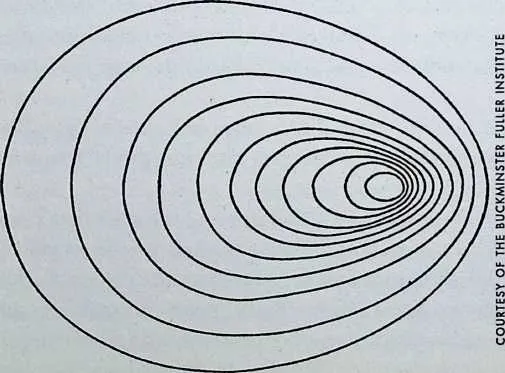
138139Fig. 1. Omnidoppler Effect
140The Doppler effect is usually conceived of as an approximately ‘‘linear’’ experience. ‘‘You,’’ the observer, stand beside a railway track (which is a ‘‘linear’’ model); a swift train approaches with whistle valve held open (at constant frequency pitch as heard ‘‘on board’’ by the engineer ‘‘blowing’’ the whistle). The whistle sound comes to you at approximately 700 mph, but the train is speeding toward you at 100 mph. The train’s motion reduces the interval between the successive wave emissions, which in effect decreases the wavelength which gives it ‘‘higher’’ pitch as heard at your remote and ‘‘approached’’ hearing position. After the train goes by, the train runs away from each successive wave emission, thus increasing the interval between wave ‘‘crests’’ and therefore lengthening the waves, which apparendy ‘‘lowers’’ the pitch as you hear it but not as others elsewhere may hear it. This is pure observational ‘‘relativity.’’ But the real picture of the Doppler effect is not linear; it is omnidirectional.
141The Doppler effect may also be explained in omnidirectional, experiencepatterning conceptionality which is more informative than the familiar linear conceptioning of the railroad train and ‘‘you, at the crossing.’’ ‘‘You’’ were flying in an air transport which exploded, and because of the sudden change in pressure differential between your in’ards and your out’ards at high altitude you personally have just been ‘‘exploded’’ into many separate parts receding from one another at high velocity. A series of secondary explosions follows from somewhere in the center of the galaxy of exploding debris, as one item after another of the late airplane’s explosive cargo is reached by progressive local conflagration-heat concentrations. The sound waves of the successive explosions speed after your receding parts amongst which are your two ear diaphragms as yet ‘‘stringily’’ interconnected with your exploding brain cells, which ‘‘hear’’ the explosion’s sound waves first at low pitch. But as your parts explode from one another at a decelerating rate because of air friction, etc., the waves of remote explosion sounds ‘‘shorten’’ and pitches go ‘‘up.’’ Now consider many separate, nonsimultaneous, secondary explosions of your various exploding parts all of varying intensities of energetic content and in varying degrees of remoteness and realize that the decelerations and accelerations of Doppler effects will render some of the explosive reverberations infra and some ultra to your tuning range limits of hearing, so that the sum total of heard events provides very different total conceptioning as heard from various points in the whole galaxy of exploding events whose separate components would tend to new grouping concentrations.
142The Halo discovered in the next chapter is that of an omnidirectional, complex, high-frequency, Doppler-effected hypothetical-zone experience in an omnidirectional universal maelstrom of nonsimultaneous near and far explosions and their interaccelerating refractive wave frequency patternings. Several of these fundamental concepts are also repeated several times in Halo, being reintroduced in various complex associations each of which provides unique discoveries.
143In order to generate a spontaneous comprehension of the significance of the thoughts expressed in ‘‘Halo,’’ which now follows, the latter essay will open with a swiftly martialed digest of the epistemological concepts of this introduction.
144R. Buckminster Fuller was interviewed by countless news media personalities. Of all the pieces written about him, Bucky considered Calvin Tomkins's "Profile" in The New Yorker the most accurate. And Tomkins considered his interviews with Bucky Fuller among his most exhilarating experiences as a writer.
145Tomkins wrote, "Fuller is one of this century's most astonishing works of art, and he has been devoted to exploring how nature really works. Radically innovative prototypes for mass-produced housing and a unique three-wheeled automobile and the nondistorting flat map of the world are practical applications of the generalized principles inherent in nature."
146A noted author and longtime staff writer for The New Yorker, Tomkins contributes an account of Bucky on his beloved Bear Island, where Fullers have been going (and still go) since before Bucky was born.