
1 The Mission of Guinea Pig B
23It was jump, or think. —RBF
1.1 Success and Failure
4‘‘I’d like to introduce myself as the world’s most successful failure.’’
5 R. Buckminster Fuller often launched his lectures with those startling words. Chunky and forthright, he did not have the looks or demeanor of an unsuccessful man. By conventional standards, however, he was a failure: Harvard had dismissed (he said ‘‘fired’’) him twice—the first time for taking a New York chorus line to dinner instead of taking his midterm exams. After the first firing, his outraged family shipped him off to learn some responsibility as an apprentice machinist in a Canadian cotton mill. He was, after all, the fifth generation of Fullers to attend Harvard. Margaret Fuller, the famous feminist/transcendentalism was his great aunt.
6 The mill gave him a dirty-hands feel for machinery and engineering that can only be gained by making, installing and troubleshooting complex mechanisms. (At that time, most technology was understandable by looking at it.) He also learned first-hand about the world of the blue-collar worker—experience that was rare among old-guard New England families. He did so well that his family and Harvard relented.
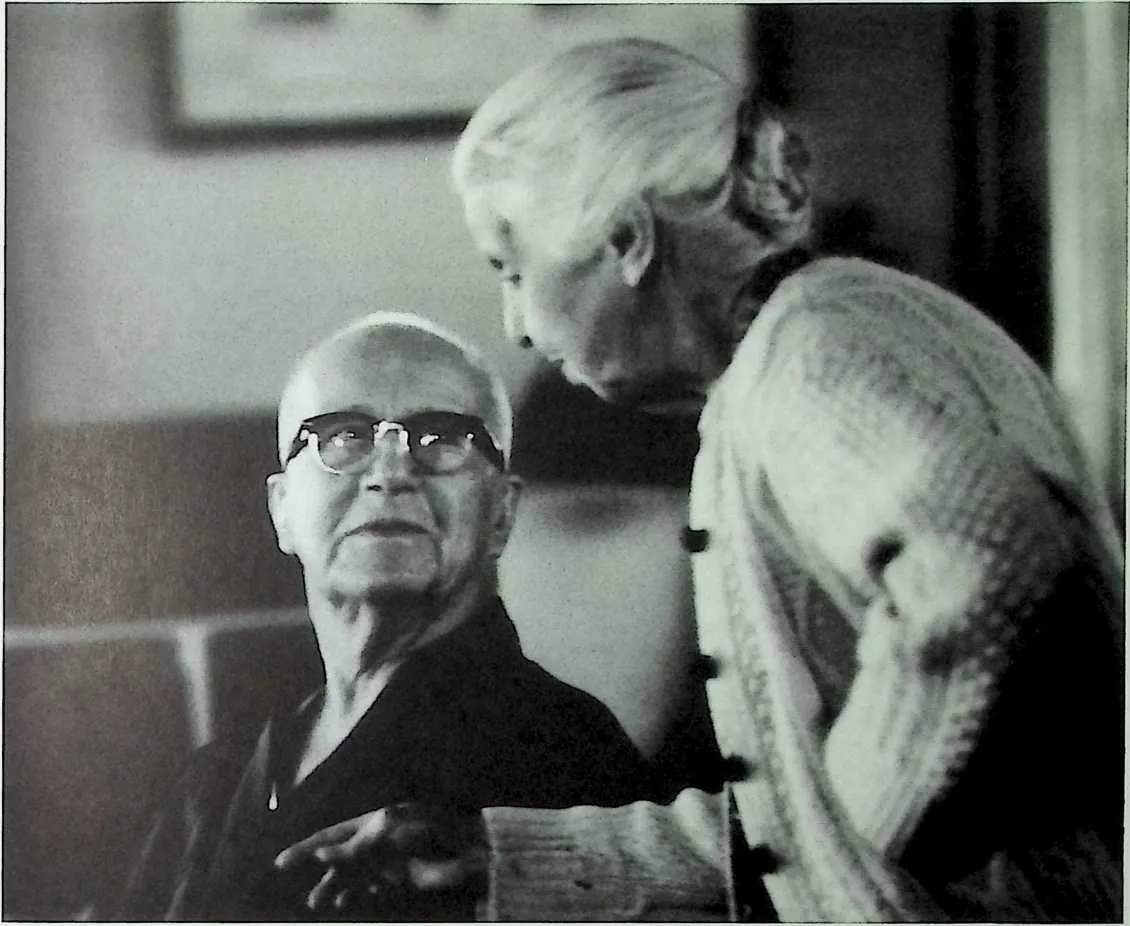
8 Unfortunately, his good performance in the cotton mill did not signal an improved respect for academia. Expelled a second time for ‘‘showing insufficient interest in his studies,’’ he got a job wrestling sides of beef in a meat-packing house. Bucky (everyone but his wife called him Bucky), never did acquire a college degree or the requisite awe of academe.
9 A stint as a Naval officer in World War I put his experience to work. He had the good luck to be assigned to a ship involved with wireless communications and aircraft—the most advanced technology of that era. Mechanical skills and ingenuity honed at the mill gave him the know-how to recognize and solve the problem of extracting pilots from ditched aircraft before they drowned. He designed a boom that enabled the crash boat to yank the aircraft from the water in seconds.
10 The Navy rewarded him with a few months at Annapolis, where he learned to think in terms of global communications, air travel, and logistics—all of which would become central to his future work. He had no trouble with those courses, and he recognized why: They dealt with reality—often a very harsh reality. Learning was easy for him when theory was connected to experience.
11 The war over, he resigned from the Navy and joined the seething pre-stock-market-crash business world of the 1920s. For a while, things went well for the aggressive, hard-drinking young Bucky. While in the Navy, he had married Anne Hewlett, the daughter of a prominent architect. They had a baby. He founded the Stockade Building System, making his father-in-law’s patented fiber-concrete building blocks. Then, in 1922, disaster struck. This time, it was more serious than a student’s problems with the dean. Bucky and Anne lost their first child to disease that he partially blamed on his inability to provide her with healthy living conditions.
12 Determined to do better, he worked furiously to win acceptance for his Stockade system. Acceptance proved to be a frustrating, and ultimately unachievable goal. He sold about 240 buildings, but the business was being strangled by local codes that required him to seek approval for each structure. Then, at the height of the struggle, a takeover drove him out of his own company, ruining him financially, and losing his friends’ money as well.
13 That blow brought him to a standstill. He was a failure, a ‘‘throwaway,’’ as he said. He had a healthy new daughter, but no job. He would not be able to take proper care of her, either. Worse, he had little incentive to get a new job and work hard in the same corrupt system that had put him out on the street through no fault of his own. It was the lbw point of his life. He considered suicide. ‘‘It was jump or think,’’ he said. He chose think.
1.2 Guinea Pig B
1516I saw that there was nothing to stop me from trying to think about our total planet Earth and thinking realistically about how to operate it on an enduringly sustainable basis as the magnificent human-passengered spaceship that it is. —RBF
17The crisis caused Bucky to consider carefully what people were for. He reasoned that humans, including himself, must have been made for some purpose. He determined to find out what that was—perhaps he’d been doing the wrong thing. (He did not consider that life might be meaningless, perhaps because his Fuller forefathers included many clergymen.)
18 Bucky noticed that Universe seemed to take care of all living things as long as they instinctively performed their designed roles (‘‘Fish don’t have to pay for swimming in the sea’’). Humans must have been designed to be a success. We’ve been here for millions of years. We must have a role to play in Universe. Thomas Malthus was wrong. (In 1810, Malthus had determined that population was outstripping supply, ensuring the permanent us-or-them condition that underlies politics and strife.) That was a brave conclusion, considering that the great majority of humans at that time lived short lives in desperate poverty.
19 At his birth in 1895, Bucky’s own life expectancy in a rapidly developing industrial society was just 42 years. His elders had advised him that to live even that long would require him to take advantage of other humans. For him to live well, others would have to suffer—a well-proved recipe for incessant war. Someone had just taken advantage of him, and he didn’t like it. People should not have to live like beasts.
20 He reasoned that humans differ from other animals in only one important way; we have minds. We can think. We are designed and built to think, and then act on those thoughts. We are the only animal that can control (to a degree) our own evolution—toward success or toward failure. We have been designed to do this. Other animals are much more automated than humans. If we behave like mindless animals, we may survive briefly, but our species will fail in the long run. If we use our minds for making humanity a success on Earth, Universe will take care of us, too.
21 Bucky concluded that he had no right to commit suicide—his unique experience might make a critical difference to the fate of humanity. He decided to ‘‘commit egocide’’ instead.
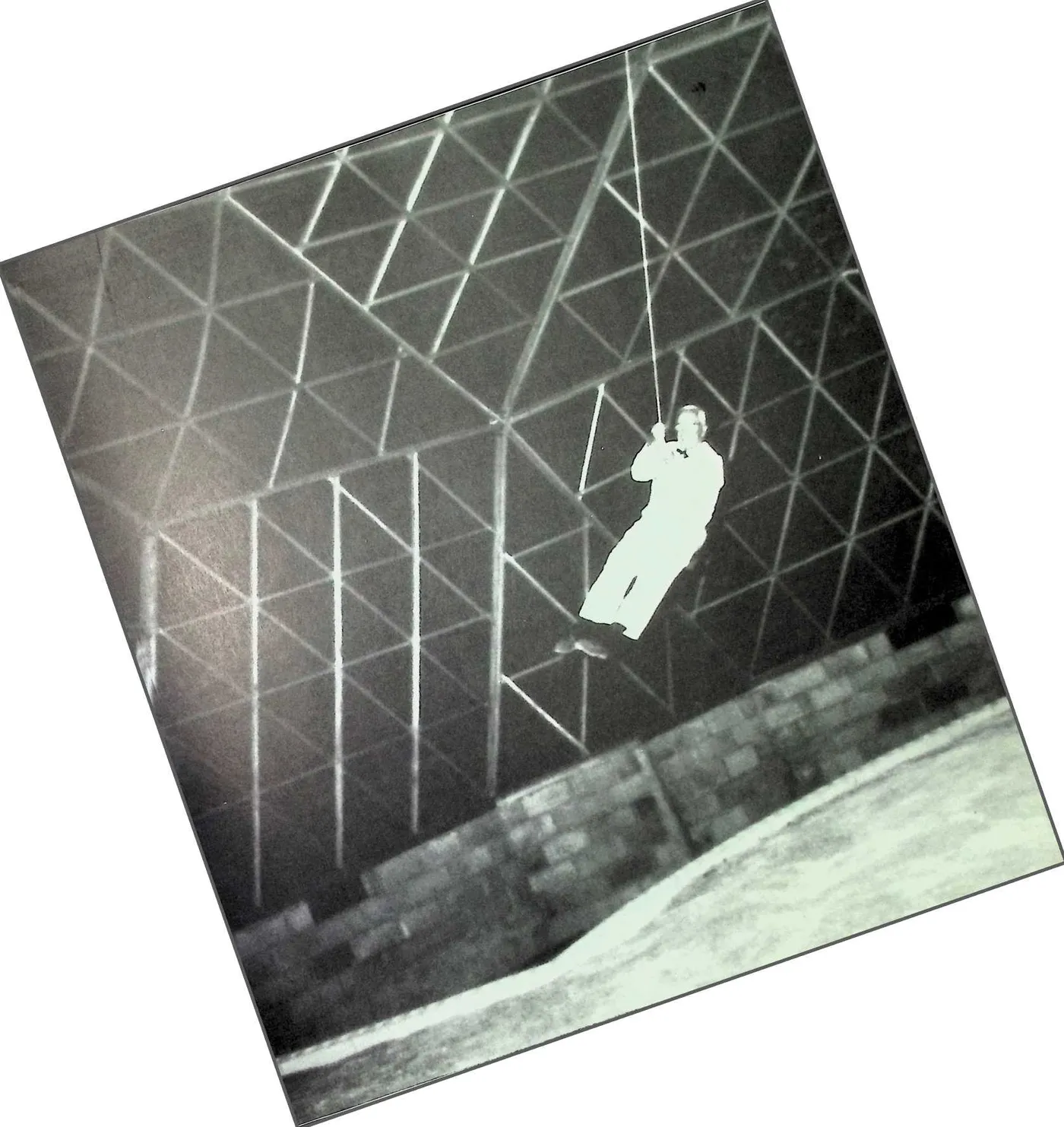
22 Bucky joins construction workers after hours for a salutary swing around the Dome Restaurant in Woods Hole, MA (see also Fig. 5-2). He had a good sense of humor, and was inclined to be downright playful when work was going well. Despite his hard-driving schedule, Bucky did, in fact,‘‘stop to smell the flowers.’’
23 Fig. 1-2
25 Then, he got to work. His goal was ‘‘a lifelong experiment designed to discover what—if anything—a healthy young male human of average size, experience, and capability with an economically dependent wife and newborn child, starting without capital or any kind of wealth, cash savings, account monies, credit, or university degree, could effectively do that could not be done by great nations or great private enterprise to lastingly improve the physical protection and support of all human lives, at the same time removing undesirable restraints and improving individual initiatives of any and all humans aboard our planet Earth.’’ A big order, one that could only be filled by a lifetime experiment. He appointed himself Guinea Pig B (for Bucky) to carry it out.
26 But where to start? Unlike most hotheads, Bucky had no respect for politics. The re-formed Bucky only trusted experience. Experience showed him that politics was based on fear and ignorance (he said zjpzord-ance), was structurally dishonest, and was ineffective in the long run. Politics always tries to pull down those at the top instead of pulling up those on the bottom. ‘‘Politics always ends up with the guns,’’ he said. Mere reform wouldn’t work. A new form might.
27 His alternative to politics was radical and deeply subversive. If we are designed like other animals to be a success, then nature must have provided enough of everything needed for all to live a healthy existence. People living well would have little interest in fighting and destruction. Bucky decided that reliable information and efficient design could identify and fairly distribute the Earths resources, bringing a good life to all. Developing that information and putting it to work would be the mission of Guinea Pig B.
1.3 The Chronofile
3031According to the truckers who moved it in 1994,
32Bucky’s archive weighs about 45 tons!
33Bucky had been keeping scrapbooks of things that interested him since 1907, but he didn’t officially name his collection ‘‘Chronofile’’ until a decade later. His realized that a career as a guinea pig would need to be recorded as a means of integrating his self-image with how others regarded him, and as credible proof of what one person could do to make the world work. Experimenters should always keep records for scientific credibility.
34 The Chronofile had already revealed that he did best when he was working on behalf of others rather than for himself. The more people that would benefit from his work, the better he did. He had done well in the Navy where he could innovate without having to show a profit. The Chronofile proved that doing what needed to be done wasn’t being ‘‘recklessly altruistic’’; it was being ultimately practical.
35 Bucky studied the Chronofile as a means of detecting macro-trends that were otherwise difficult to see in gee-whiz-driven public media. For instance, the Chronofile not only recorded the many new inventions and technologies that were appearing in the early 1900s, it clearly showed that the rate of innovation and social change was increasing rapidly. This gave Bucky the numbers he needed to make his gestation curves. Continuing the curves led him to call some of his predictions ‘‘inevitabilities.’’ He wasn’t always right about when a change would occur. Things often happened somewhat later than he said (or hoped?) they would, but he was quite accurate in what the result would be (Fig. ?? ).
36 Over the years, the Chronofile received sketches, clippings, statistics, trends, interesting new technologies, all of his correspondence (including love letters with carbon copies of his answers), even traffic tickets and dry cleaning bills. Certain occurrences that might be painful or embarrassing to others (and possibly to himself) were not recorded—the time he overturned his own Dymaxion car, for instance.
37 Some of the items he did keep are deeply personal evidence of the price he paid for his way of life: In the Chronofile for 1933, there is a letter from his young daughter asking when she was going to see him again. Work on the Dymaxion car kept him from home for months at a time. Obviously, he would not have kept such material if he had not intended that people read it someday. He wanted readers to understand how and why he hurtled through life as he did. He intent was not to brag, but to instruct and inspire.
38 The Chronofile is augmented by quantities of drawings, models, video and audio tapes, 64,000 feet of movie film, 50,000 slides and photographs, and 35 file drawers of manuscripts (including several unpublished books). He also kept a clipping file and a library of books that had influenced his thinking.
39 The complete trove probably makes Bucky the most thoroughly documented 20th-century man. He intended that the Chronofile should be used to fashion a definitive biography that would be an inspiring example of what one person could do. That biography has yet to be written.
1.4 Wind Sucks
4243I made up my mind as a Rule of Communication that I wouldn’t care if I was not understood—so long as I was not misunderstood. —RBF
44Bucky tells of spending his post-crisis year (1928) in wordless silence while exorcising thoughtlessly held beliefs not based on experience or science. ‘‘It was a little hard on my wife,’’ he quipped, but the Chronofile shows that he gave lectures during that time. Bucky often spoke in metaphor, and was not above an occasional parable. It was during that time that he developed his accurate, but sometimes opaque, language for expressing his ideas.
45 At his best, Bucky illuminated his insights in a way that changed your thought patterns, and spurred introspection. At other times, despite (or because of) his desire to be absolutely clear, even the cleverest translators are of limited help to his readers and listeners. The density of information is daunting. A single sentence might contain the seeds of an entirely new vision of physics.
46 He challenged your own word use as well. When Bucky announced that wind ‘‘sucked,’’ his audience usually laughed out loud. The statement certainly sounded funny, but he was serious. Talking about the wind ‘‘blowing’’ deflects the thoughts of speaker and listeners alike from what is actually happening. No force can push a huge parcel of air around Earth any more than you can push a flock of ducks into a barn. Push—compression—is local. Push doesn’t operate over long distances. In any case, what could be doing the pushing?
47 Nothing is doing the pushing; wind isn’t pushed. When you face the wind, you have your back to its cause. A distant low pressure area pulls denser air to itself, just as a bucket of feed in the barn will bring in the ducks. Suck—tension—can operate over vast distances. Suction is not deterred by obstacles. A northwest wind is actually a southeast suck. Our parents and teachers have told us wrong. As a consequence, we think about wind—and doubtless other related phenomena—in unrealistic and inappropriate ways. Bucky wanted us to question everything we have been told. If our teachers couldn’t get wind right, how can we trust anything else they say?
48 Bucky was also annoyed by ‘‘sunrise’’ and ‘‘sunset.’’ It frustrated him that even astronomers mindlessly used terms inherited from a time when people thought the earth was flat. He felt so strongly about this that he offered a prize to anyone who could come up with a better way of saying sunrise and sunset.
49 (Nobody won.)
50 Bucky also insisted, ‘‘If you still use the terms up and down, you’re still thinking in terms from the dark ages.’’ There is no ‘‘up’’ or ‘‘down,’’ only ‘‘in’’ or ‘‘out.’’ In is specific—in toward the center of the earth. No more upside-down Chinese dangling by their feet. Out is going anywhere away from the center of the earth. Except in a very local way—a carpenters plumb-bob, for instance—up and down are deceptive, flat-earth terms. But on a structure the length of the Verazzano suspension bridge connecting Staten Island to Brooklyn, the two plumb-bob-vertical towers are spaced so widely on Earths curved surface that they ‘‘lean’’ away from one another. Their tops are 1.62 inches (4.1 cm) further apart than their footings! That’s the reality that ‘‘up’’ and ‘‘down’’ don’t describe.
51 Is all this just semantic niggling? Not to Bucky. To him it was both pragmatic and a matter of principle. Language is a tool. Accurate word use sharpens communication. He wanted us to think about what we were saying. How could students gain a proper feel for Universe if they were taught common terms and phrases that wrongly described what was really going on?
52 His own talk was disciplined. He never used cuss words. He could be adamant about other people’s chatter. On one occasion during an eclipse of the moon, a relative remarked excitedly that the shadow was ‘‘coming across the moon more from the top than the side.’’ Bucky, usually polite, growled, ‘‘The moon doesn’t have any top, stupid,’’ causing a wave of muffled snickers. He sometimes berated associates and students for making puns—language is already imprecise without your making it worse. But he did that with a wicked glitter in his eye; he was notorious for his own bad puns.
53 Bucky was aware that manipulating popular word usage is difficult, but he knew (from experience, of course) that it could be done. He coined and used the word ‘debunk’ in 1927, then noted with satisfaction how fast it spread. The Chronofile has newspaper clipping proof.