
6 The Sorcerer’s Apprentices
2I do not engage in class instruction with repetitive curricula. — RBF
3 ‘‘Mind wind’’ is what Bucky called the feeling of imminentness when an idea is in the air. As soon as he realized the synergetic attributes of geodesics, mind wind became a typhoon of possible dome designs and applications, far more than he could ever explore as an individual through his own companies, Fuller Research Foundation and Geodesics, Inc. It seemed unlikely that venture capitalists, existing corporations, or the government would pay for exploratory research on an unproven idea with unknown market value. How could he speed geodesic evolution?
4 The answer was to recruit college students. Most were from architecture and design departments. Fortunately, Bucky had enough experience and prestige (and notoriety) to hold classes and research seminars at progressive schools, despite his lacking a degree. He didn’t have any problem filling his classes; truly new, non-establishment ideas have always attracted idealistic students. Unless suppressed, young people intuitively urge the next stage of evolution.
5 The arrangement was good for all concerned. The schools could point to a prestigious visiting professor, students received academic credit, and Bucky got something much more valuable than the welcome stipend: As his many-minded student teams investigated every nuance and blind alley, many of his ideas were quickly taken to the proof-of-concept stage. By bringing his
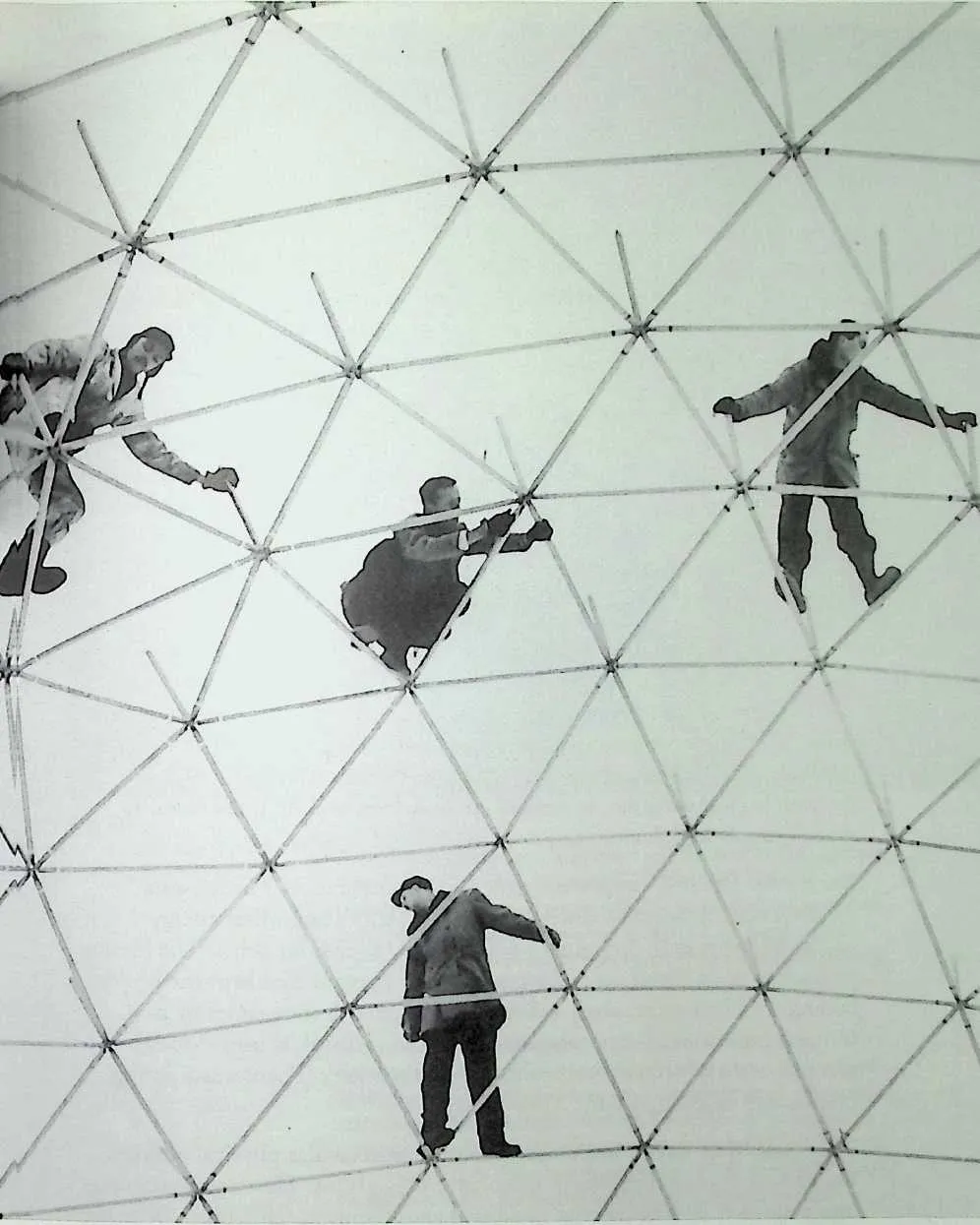
7 Fig 6-1
8 laboratory to the classroom, he didn’t have to buy materials, hire help, or rent facilities. It was also an irresistible opportunity to subversively augment his students’ overspecialized education with a bit of training in comprehensive thought.
9 Bucky rarely engaged his students in simulations, and never in contrived exercises. He gave them total responsibility for the task, but no hints as to how it might be done. Classwork consisted of real experiments being done for the first time. He often gave different schools identical assignments, deliberately concealing the existence of the groups from one another. The duplicate work ensured that evolution would indeed make many starts—one of his favorite subjects—and provided the assurance that comes from replicated experiments.
10 The policy also prevented cross-fertilization and mutual assistance. Some students were miffed by learning later that the findings of another team would have prevented them from needlessly working to a known dead-end. Despite protests (including mine), Bucky insisted that reinventing and rethinking was best. Maybe it was; he and his hardworking apprentices could point to an astonishing list of ideas refined into practice. I’ve wondered lately how he’d handle the worldwide Internet connections of a room-full of today’s apprentices.
11 Complaints did not extend to doing true research. The experiments were in dynamic, thrilling contrast to library research, which consists mostly of looking up what someone else has already done. (In this sense, a surprising percent of college courses amount to a history of their discipline.) With a week or two of hard work, an enthusiastic class could—and usually did—travel the path from speculation, to research, to drawings, and, in most cases, to models or full-scale demonstrations.
12 Destructive win/lose competition gave way to cooperation. Participants divided tasks and responsibilities. Goaded by Bucky’s boundless energy (didn’t he ever sleep?), they often worked twenty-four-hour shifts. The blazing pace added to an ambience of discovery and excitement that kept the project boiling. Problems were solved as fast as they appeared, sometimes by new teams assembled for the purpose. Students had to think things through comprehensively—often for the first time in their lives. There was a strong incentive to be daringly right. They often were.
13 The results were visible, touchable, sometimes spectacular physical entities, not mere studies culminating in speculative suggestions. The most gratifying result was that the photographs impressed your family at Christmas. Without pictures, the work would have been hard to explain to grandma.
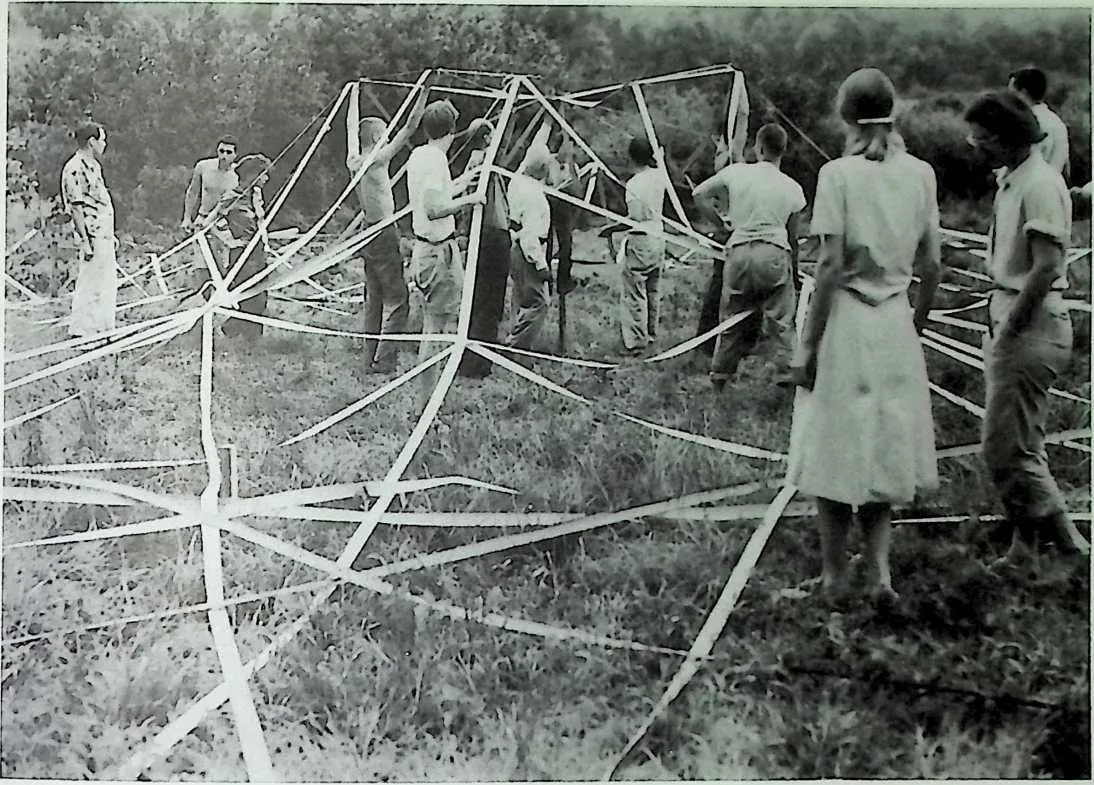
15 Fig. 6-2
16 Bucky’s first attempt at a large dome was this 48-foot (14.6-meter) ‘‘flopahedron’’ at Black Mountain College in 1949. Made of metal Venetian blind slatting, it was too flexible to stand. Some unverified accounts claim that the dome was reinforced and finally erected, but the ribbony chaos of this photograph makes that seem unlikely, and there is no photographic evidence of success to be found (so far) in the Chronofile.
17 A more probable explanation is that Bucky built this first prototype deliberately weak, a tactic he learned from Henry Ford. Strengthening the points of failure just enough to work satisfactorily assures optimized materials efficiency.Though crude compared to computer simulations, the method works surprisingly well; Bucky’s next dome (Fig. 8-1) was satisfyingly strong. (The strength of Ford’s Model T—the first product to be designed using this method—was legendary. Bucky thought highly of Ford’s design strategies and worldwide logistics.)
18 The experience of working with Bucky was both exciting and scary—more of an adventure than a class. It was a great way to learn. It adorned your portfolio with a record of unique, dirty-hands, design-science pioneering, far ahead of the usual student work. For several of Bucky’s students, it was the beginning of a career of applied geodesics: Don Richter, for instance, founded Temcor, the company that built the 164-foot (50-meter) dome over the South Pole and the 415-foot (126.5-meter) dome in Long Beach, CA intended for Howard Hughes’ enormous Spruce Goose seaplane. Kenneth Snelson made the first tensegrity construction, and later became famous for his tensegrity sculpture.
19 For Snelson and several others, working with Bucky was not always a pleasant experience. Their work and Bucky’s became inextricably entangled, and it was difficult to determine clearly whose ideas were whose. Arguments over credit were inevitable as students and other investigators enlarged upon Bucky’s discoveries. Bucky would say, ‘‘I built that dome,’’ when in fact his students had built it. In those days, it was expected that a professor would refer to student work in that way (many still do). Moreover, if it hadn’t been for his discoveries, the students would have had nothing to work on.
20 Nevertheless, the affected students were understandably rankled. Others were unable to comprehend the spirit of working without profit as the primary motive. They felt exploited, but because there was no evidence of Bucky getting rich, those complaints subsided. (He never did accumulate riches.)
21 Bucky gave credit where it was due (including to Snelson), but he often added a laconic, ‘‘. . . for his version of my invention.’’ Like many inventors who have faced years of sneers and invisibility, he needed—and demanded—recognition. He didn’t always get it. The sparkling dome at Disney’s Epcot Center in Florida may be the most famous geodesic dome in the world, but there is no mention of his name anywhere on it. Medard Gabel, director of The World Game Institute (Chapter 10), relates that Bucky was annoyed and disappointed by the lack of credit until it occurred to him that he himself didn’t refer to an airliner as a ‘‘Wright Brothers Boeing 747.’’
22 Bucky also suffered from a phenomenon that afflicts and frustrates designers who illuminate a concept so deeply and well that observers cannot remember what life was like without it. The idea is so logical, and so obviously right that it goes into the public mind instantly and painlessly, totally overrunning the old way of thinking.
23 Because the previously invisible idea is made so obvious, people will not give credit to the discoverer. To combat this phenomenon, and to deter
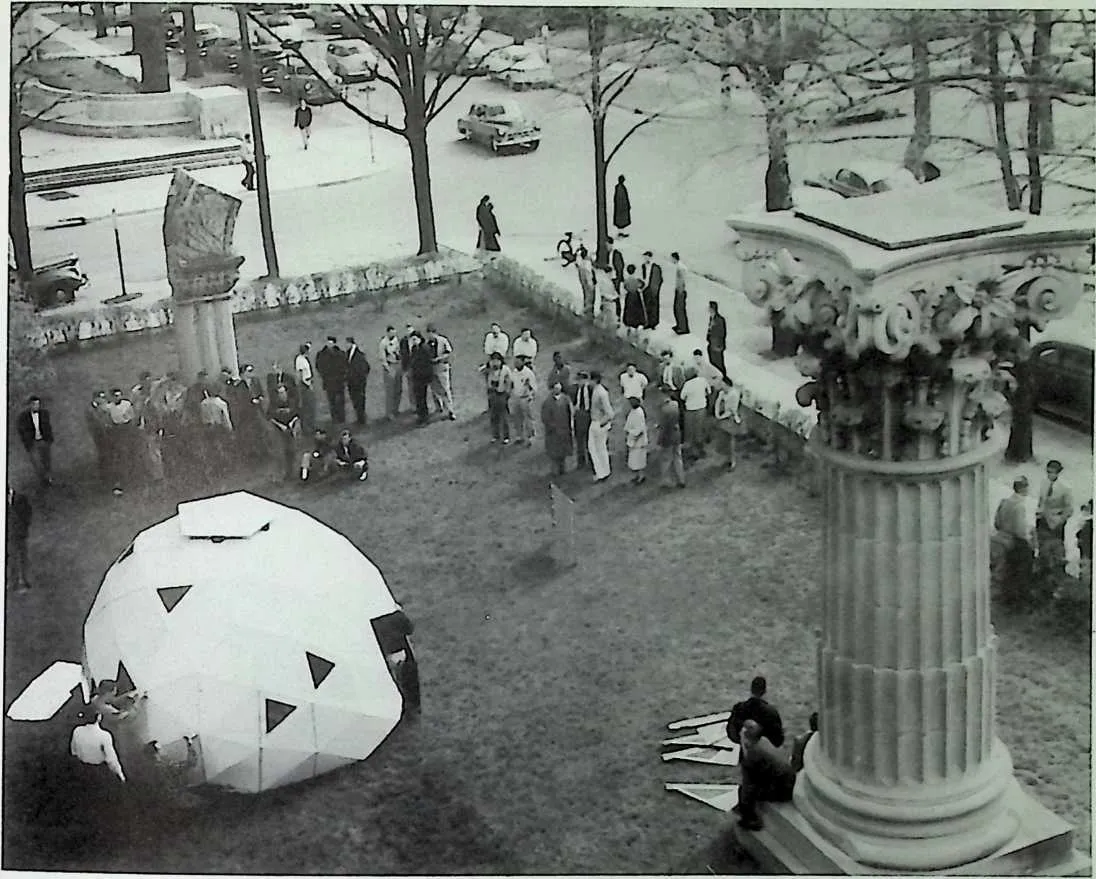
25 Fig. 6-3
26 This minimum-cost shelter was formed from corrugated cardboard cut and scored (grooved) into strips of triangles by a standard box-making machine. Panels were waterproofed with stinky polyester resin. Shipped as a flat bale, the strips were rapidly stapled together on-site. As with all domes, anchoring against high winds was critical: the first prototype blew away several times (once with me in it). University of Michigan students developed versions for the Marine Corps and a kid’s summer camp.
27 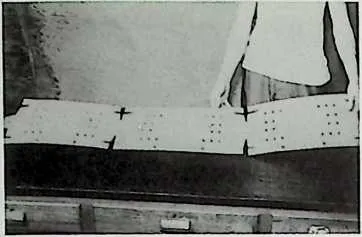
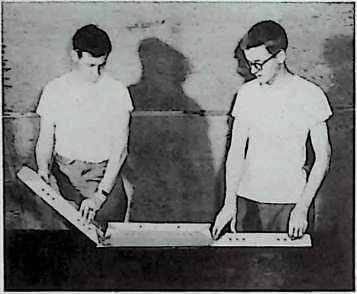
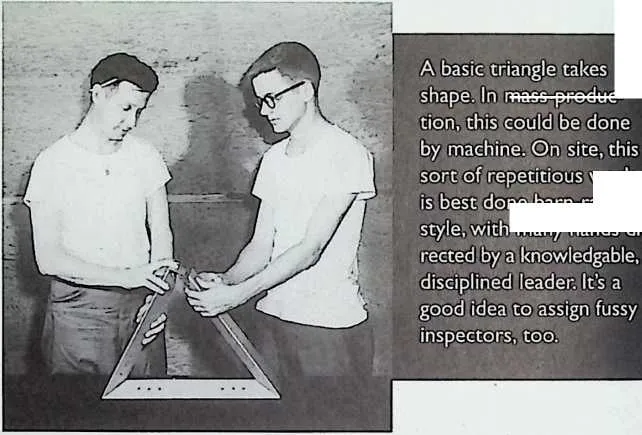 North Carolina State students learned a lot of geometry while patterning the
basic component of a cardboard dome. Because complex geodesic structures are especially
vulnerable to the consequences of ‘‘accumulated error,’’ patterns must be precise even in
low-tech cardboard. Custom-fitting the final component of a dome is considered proof of
ineptitude.
North Carolina State students learned a lot of geometry while patterning the
basic component of a cardboard dome. Because complex geodesic structures are especially
vulnerable to the consequences of ‘‘accumulated error,’’ patterns must be precise even in
low-tech cardboard. Custom-fitting the final component of a dome is considered proof of
ineptitude.
28 Fig. 6-4
29 Fig. 6-5
30 The thin, floppy cardboard stamping is first folded into triangular tubes to give it stiffness.
31 mass:
32 Fig. 6-6
33 work ^raising hands di-
34 incompentent applications that could give his inventions a bad name, Bucky spent a lot of time and money securing patents. The money he made from them went right back into his research.
35 Students at Work
36 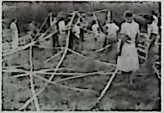 North Carolinas astonishing Black Mountain College (long gone, alas) was the scene of the
first large-scale experiment performed by Bucky’s students. Until then, their work had been
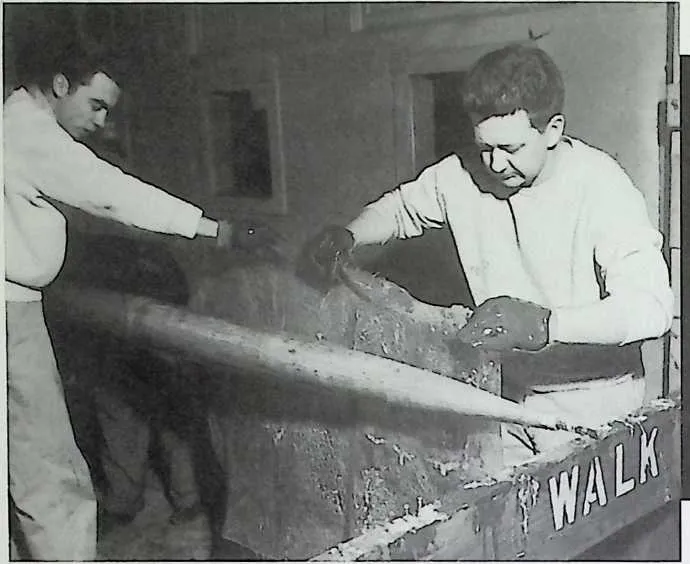
confined to indoor models. In 1949, a 48-foot (14.6-meter) dome was fashioned from
thin metal Venetian blind slatting, which turned out to be too flexible to support
a hemisphere of that diameter (Fig. 6-2). Bucky pondered the lessons learned from
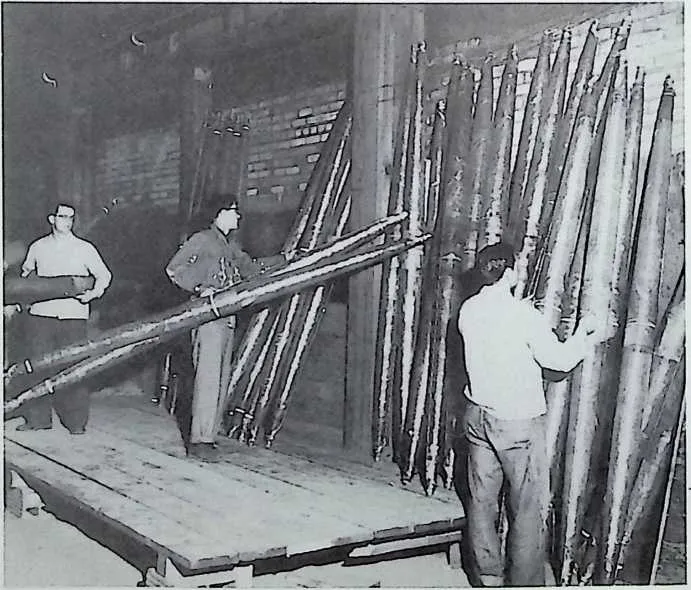
that experience, then produced a more modest 14-foot (4.26-meter) folding dome—a
size that students at Chicago’s Institute of Design had already proved feasible. It
worked
North Carolinas astonishing Black Mountain College (long gone, alas) was the scene of the
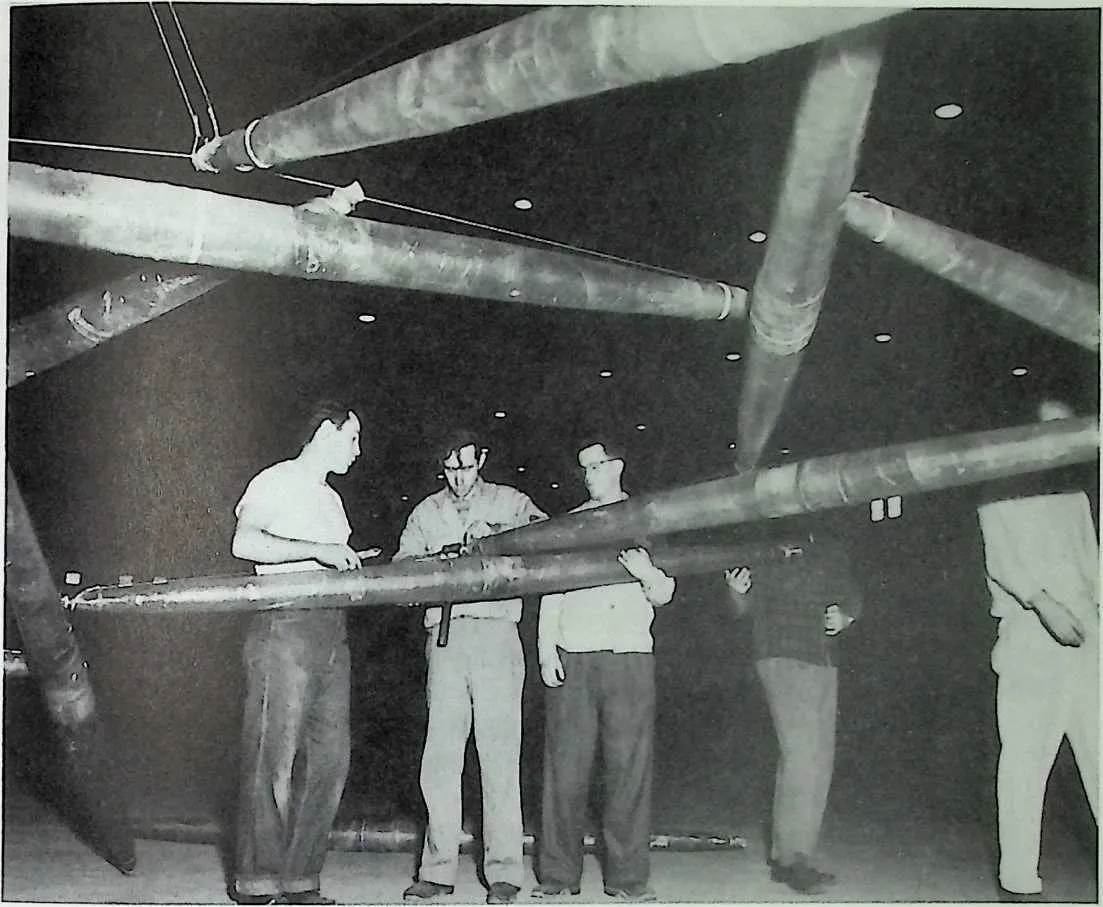
first large-scale experiment performed by Bucky’s students. Until then, their work had been
confined to indoor models. In 1949, a 48-foot (14.6-meter) dome was fashioned from
thin metal Venetian blind slatting, which turned out to be too flexible to support
a hemisphere of that diameter (Fig. 6-2). Bucky pondered the lessons learned from
that experience, then produced a more modest 14-foot (4.26-meter) folding dome—a
size that students at Chicago’s Institute of Design had already proved feasible. It
worked
37 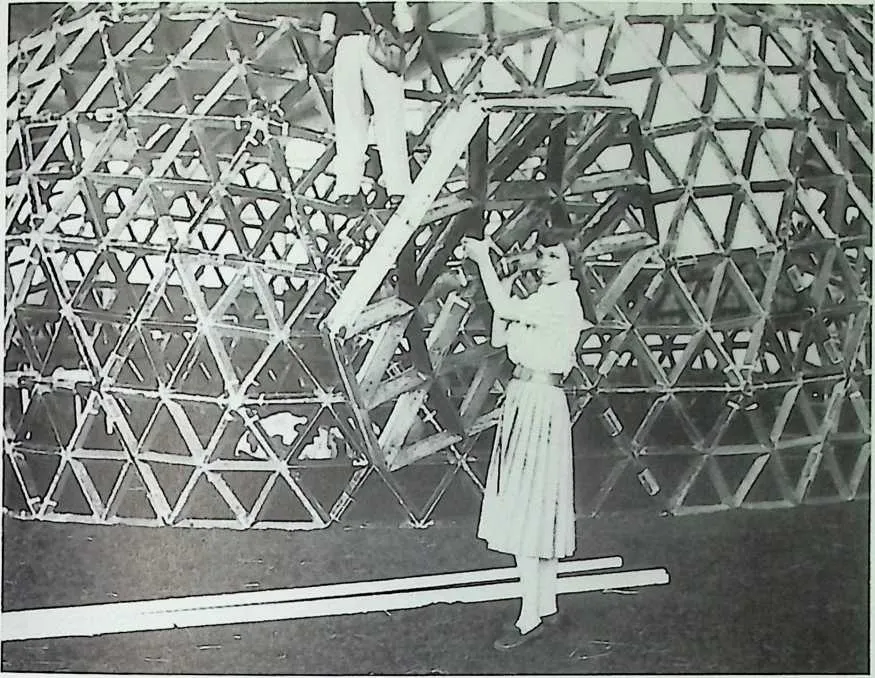 The basic triangular pieces are bound together with fiberglass filament tape to form
hexagonal or pentagonal ‘‘rafts’’ that simplify the final assembly of the dome.The small,
light-colored guide model at left center on the floor inside the dome reduces frustrating (and
embarrassing) assembly errors. Not many women took Buck/s courses, but there were usually a
few who enthusiastically joined the teams.
The basic triangular pieces are bound together with fiberglass filament tape to form
hexagonal or pentagonal ‘‘rafts’’ that simplify the final assembly of the dome.The small,
light-colored guide model at left center on the floor inside the dome reduces frustrating (and
embarrassing) assembly errors. Not many women took Buck/s courses, but there were usually a
few who enthusiastically joined the teams.
38 Fig. 6-7
39 Fig. 6-8
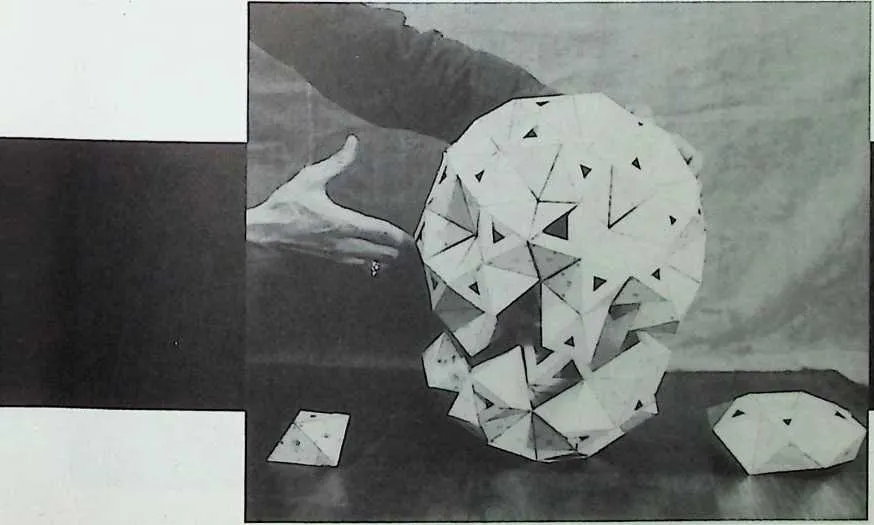
40 Its all octahedra.This octasphere is the sort of experiment that can reveal unsuspected relationships that are hard to visualize.


43 Fig. 6-9
44 University of Minnesota students designed and built the tooling, then produced the fiberglass tubular compression struts for this tensegrity domeaH
45 Bucky usually asked students to organize into teams, each with a specific task.Teams then divided the work among their members. Individual responsibility and a common goal soon developed noncompetitive cooperation s team finds out first hand how messy resin can be as they lay up the fiberglass struts. (Today, they’d wear masks and goggles.)
47 Stacked parts await assembly.The cigar-shape of the strut matches the distribution of the compression load on it—an example of doing more with less. In this information age, we’d call it ‘‘replacing material with information.’’ Efficient geometry increases corporate know-how and profits without reducing product quality.
48 Students usually obtained unusual materials free from manufacturers anxious to find new applications. Bucky taught a useful tactic for that purpose:Always go to the CEO first. Underlings will often refuse requests that might bring a reprimand; a polite ‘‘No’’ is safe. Even if they don’t turn you down, they’ll kick the request upstairs to the land of endlessly delayed approval. If approached in a spirited, but professional manner, the CEO will most likely order a subordinate to fulfill your request immediately. It's an effective move. Buck/s students literally got truckloads of materials in this way.
50 Fig 6-11
51 The tensegrity dome begins to take shape. Note how the struts are loaded only under compression from the ends.They don’t touch. Compression members are islands. Of course, the cables can only accept tensile loads.Tension is continuous.The division of duty uses materials in the most efficient way, synergetically adding materials efficiency to the already efficient geodesic geometry. Bucky claimed that Universe consists of ‘‘islands of compression in a sea of tension,’’ and expected structures made in that way would prove to be ultimately efficient
53 
 well, demonstrating the remarkable strength and light weight of a practical geodesic
structure. The 50-lb (22.8-kg) dome was also the first try at a ‘‘Garden-of-Eden’’ transparent,
climate-controlling shell (Fig. 8-1). A similar dome was later used to shelter another
student-developed idea—the ‘‘Autonomous Package’’ (Fig. 8-2).
well, demonstrating the remarkable strength and light weight of a practical geodesic
structure. The 50-lb (22.8-kg) dome was also the first try at a ‘‘Garden-of-Eden’’ transparent,
climate-controlling shell (Fig. 8-1). A similar dome was later used to shelter another
student-developed idea—the ‘‘Autonomous Package’’ (Fig. 8-2).
54 Over the years, students at hundreds of colleges and universities worked on a wide variety of dome geometries and designs—many of them intended to take maximum advantage of specific materials. Bucky focused on the use of materials that were produced in continuous processes with little waste that could not be reprocessed. Cardboard seemed particularly attractive. All it lacked was water, fire, and insect resistance, attributes that could easily be added to the sloppy stew before it was formed into sheets.
55  There are many ways to make cardboard domes. The simplest is to fold it into great-circle
strips of triangles—one pointed up, the next pointed down—that are overlapped and stapled
together like giant shingles to shed water. Because such domes have no folded sections framing
the panels, they can easily be distorted and ‘‘punched-in.’’ The 14-foot (4.26-meter) University of
Michigan dome (Fig. 6-3) needed wooden reinforcements to withstand snow loads, and was
unusually vulnerable to total blow-away because the stake-down loops pulled through the
cardboard in strong winds.
There are many ways to make cardboard domes. The simplest is to fold it into great-circle
strips of triangles—one pointed up, the next pointed down—that are overlapped and stapled
together like giant shingles to shed water. Because such domes have no folded sections framing
the panels, they can easily be distorted and ‘‘punched-in.’’ The 14-foot (4.26-meter) University of
Michigan dome (Fig. 6-3) needed wooden reinforcements to withstand snow loads, and was
unusually vulnerable to total blow-away because the stake-down loops pulled through the
cardboard in strong winds.
56 Fig. 6-12
57 Almost done, the crew considers the next moves. Since this dome was the first of its kind, there were no instructions. Solving problems under such circumstances is one of the best ways to learn how to think. Like any adventure, the process is exciting, scary, and unforgettable.This sort of experience is learning (and teaching) at its best.
58 Another cardboard design is shown in Figs. 6-4 through 6-7. After it was assembled, erected, and anchored, the framework was covered with a tight-fitting, plastic ‘‘bathing cap’’ to provide shelter. The same sort of triangular frame members could also be directly folded into the edges of cardboard triangles or diamonds, making a thick-rimmed tray. The most successful cardboard domes were made this way. A 42-foot (12.8-meter) cardboard dome won the grand prize at Italy’s Triennale exhibition in 1954.
59 For all their advantages of low cost, paperboard domes had a problem that was simple to fix conceptually, but difficult to vanquish in the field: the material loses its compression strength when it gets wet. (Wet tensile strength remains high.) Coating the the material with paint or resin before assembly, or after the dome is completed, is not sufficient. A single pinhole in the coating will let water soak the interior of the board.
60 Cardboard that has been impregnated with waterproofing is more durable, but is also more expensive, may smell nasty, and can be difficult to recycle. Fire resistance may be compromised by the waterproofing. Students also tried foil-coated board and several types of ‘‘bathing cap’’ covers. Nothing worked reliably. Even when rain wasn’t a problem, condensation on the interior was. (An energy-efficient answer to condensation remains to be found.)
61 Bucky also experimented with FomeCor®. These kraft-paper-clad plastic foam panels are waterproof and strong, but burn enthusiastically, and cost much more than cardboard. Many successful domes have been made from this material. Unfortunately, its cost places it in the difficult limbo of being too expensive to be temporary, and too flimsy to be permanent.
62 Nevertheless, paperboard and its derivatives and imitators remain a promising possibility. Perhaps Gridcore®, a recent rigid panel made from much the same ingredients as cardboard, will provide the first truly inexpensive, permanent geodesic dome. Perhaps some of Bucky’s students’ students will make the first one.
63 Experiments in fiberglass were typical of Bucky’s enthusiasm for new materials. World War II had made fiberglass practical, and it was well on the way to taking the place of wood in boats. That had the effect of bringing inexpensive, but very strong recreational boats to the market for the first time. Above all, they were maintenance-free. Owners could spend their time boating instead of repairing rot, and painting the craft yet again. Of course, Bucky thought that those attributes would make fiberglass ideal for buildings. As a ‘‘net shape’’ material it can be formed to almost any shape without waste.
64 Learn a Lot, Learning Fast
65 In the summer of1981, Amy C. Edmondson had been working just ten months in Bucky’s office as his engineering assistant. Here, she tells what it was like to find out how Bucky managed to get so much done. Hundreds—maybe thousands—of his exstudents could tell similar tales of learning and teaching at its exciting best. —JB
6667‘‘We are in a remote ski-resort, a hundred-and-twenty miles from the nearest airport (Reno, Nevada), for a late-summer conference of business people. Bucky is scheduled to lecture for a total of thirty-six hours during the six days, and I am looking forward to listening and learning. Crouched by my balsawood model, I am thrilled (and relieved) by the confirmation of months of agonizing mathematics. It works. Now it’s finished and we will celebrate, I think maybe with some ice cream. Bucky thoughtfully inspects my model, nods, and looks up.
68‘‘Suddenly, the unexpected. He is not joking; his voice is matter-of-fact: Bucky fully expects the hundred or so conference attendees to construct (led by me) a full-scale prototype of a dome I just finished the calculations for last week.
69The glue on my model is not yet dry. I begin to suspect that his eighty-six years are catching up with him. ‘I know for a fact,’ runs the voice inside my head, ‘these people are here with felt-tip pens, NOT with bandsaws and drill presses.’ I feel sad that Bucky will have to find out the hard way.
70‘‘No ice cream yet; he wants me to calculate the weight (‘‘assume Douglas fir’’) of tomorrow’s dome, figure out the stresses (‘‘use good quality wood, not too
71many knots’’), then tell someone what materials we’ll need. ‘How am I going to tell him?’ I wonder, embarrassed, dreading the confrontation.
72 ‘‘New to the job, I hadn’t yet seen Bucky Fuller in action; I didn’t know that the sight of all these people would evoke irresistable images of past projects, of campuses and students and domes built, it would seem, out of thin air. I didn’t know how many ‘‘impossible’’ tasks became sudden joyful history, how many structures were completed overnight, in how many different countries. To Bucky, a captive audience of one-hundred able-bodied Americans appearing right after the completion of his latest geodesic design was an open invitation!
73 ‘‘It turns out, of course, that he knows just what he’s doing. He knows that a truck will start towards Reno immediately to buy the necessary lumber; he knows that eager carpenters in the crowd will soon surface and offer their skills. So will contractors, guys with muscles, people with energy, hands, minds. .. The news flies around the complex. History in the making. He knows that his newest development, a prototype, a chance to participate in a tangible accomplishment such as this will tie people together, tantalize, excite, convince. I am the one learning—not the hard way at all—but rapidly, adrenaline flowing, excitement building. I begin to realize that something is really happening here. I soon will find myself thinking it’s as if people have been waiting their whole lives to put down their felt-tip pens and stand outside for hours holding twoby-fours in place until their necks ache, with their eyes wide open, listening to urgent instructions flying back and forth. This group will go home exhausted, rejuvinated, awed. None of us will ever forget it.
74 ‘‘Twenty-four hours and eight-hundred dollars later, a twenty-five-foot diameter geodesic dome stands complete, exhibiting a strength unpredicted by the relative frailty of its parts. The deceptively fragile-looking structure is the patient model for hours of photographing, the tolerant scaffold for amazed climbers (Can it really support me?), the makeshift chapel for a wedding (scheduled to take place two weeks later, but moved up in eager celebration of our accomplishment), and finally, an education.
75 ‘‘How many campuses were electrified in this way? I wonder, how many groups have shared this elation? I begin to understand that this sense of urgency, this skilful channeling of human energy, is the secret behind Fuller’s eighty-six years of perpetual motion.’’
7677Bucky explored several ways of efficiently deploying and retrieving domes: