3 The Design Science Revolution
2We are being taught. . . to assume as closely ffosible the tile the patience, and the competence of God.—RI
3 As it became clear to Bucky that political systems were incapable of reforming people in order to bring a good life to everyone, he announced a ‘‘design science revolution’’. Politics decides who gets to survive. Only by means of ‘‘comprehensive anticipatory design science’’ could the world’s resources be fairly distributed among all people, and the need for war made obsolete.
4 The Revolution
56Virtually no other designers were thinking that way at the time, and few are today. The environmental movement has focused attention on ecologically beneficial (or at least benign) design, but biology-based ecological designers tend to be suspicious of technology. Bucky did not claim to be a scientist, but he asserted that science-based, well-designed technology holds our only chance for survival. With it, we can ‘‘reform the environment [he meant the built environment] instead of people.’’ What led Bucky to think that a design revolution could work?
7He’d done his homework. By uncovering and analyzing the larger patterns in world commerce, and the rapid improvements in technology, Bucky concluded that there were plenty of resources if we didn’t squander them on weapons and inefficient designs, or waste them on fripperies (made and marketed by his imaginary, multinational corporate nemesis, Obnoxico). In the 1960s, he sharpened his earlier inventory with numbers generated during his ‘‘World Design Science Decade’’, an effort to assess all the worlds resources and know-how in defail. This was the start of the World Game, which carries on this acpotinting today. (See Chapter 10.)
8 With an inventory of available resources in hand, the next step for a designer is to use it well. Comprehensive anticipatory design science demands maximum overall efficiency with the least cost to society and ecology. Being comprehensive is a direction (Bucky called it ‘‘comprehensive prospecting’’) that implies extensive, omnidisciplinary research, a task recently made easier by the Internet. The goal is to optimize, rather than to compromise. Sacrifice, except in the heroic sense, should never be necessary. A well-designed product represents thousands of years of refined human experience.
9 Nature is not to be conquered or opposed, but she is to be regarded as a model of applied principles: Nature always does things in the most efficient and economical way. We need to learn how nature makes design decisions. The principles governing Universe have no exceptions, though in ignorance, humans often act as if they did. One of the starding things about the so-far-discovered principles is that they do not conflict with one another. Universe works as an harmonious system—incessantly regenerating as if it were the minimum perpetual motion machine. To be in tune with Universe, our designs should be regenerative. The current, overworked word ‘sustainable’ comes close.
10 Most design today is far too inefficient to be regenerative. Bucky s investigations showed that all of the worlds rotating machinery operated at an overall efficiency of about 5%, a shameful figure that has not improved much since he first noted it in 1927. Todays automobile fleet, for example, is about 6% efficient overall. Out of every $100.00 spent on fuel, about $94.00 is wasted in various ways. Some of the waste is inherent in entropic physical processes, but there is enormous room for improvement.
1112That pathetic 6% efficiency is not the result of greedy plotting by auto and oil companies, it is the result of widespread ignorance. Few people think about their car’s radiator, for example, a component engineered to throw away heat that their money just bought. Producing that heat also produced pollution. Both are waste. Waste is always a sign of poor design; pollution is a measure of inefficiency. The toll on consumer finances and the environment is enormous. Approximately 1% of humanity is scientists or engineers, and most of them are too specialized to understand the global effects of their work. The rest of humanity is technologically (and ecologically) illiterate.
13Bucky figured that doubling the overall efficiency of all machinery would boost the world economy to the point where everyone could be assured of sufficient food, reliable shelter, and decent health care. This could be accomplished today without any new technologies. It is a matter of thinking comprehensively, plus encouraging and rewarding individual integrity that overcomes fear and greed. The dog-eat-dog lifestyle that degrades people and the environment is obsolete.
14Naval experience and the information accumulating in his Chronofile, showed Bucky that technological advances most often derive from military requirements, or other conditions where high performance is necessary for survival. He noted that each round of improvements reduces the amount of materials required, and improves energy efficiency. (But pure science does not usually prosper during war; weapons employ the latest of what’s already known.)
15Military hardware eventually appears in civilian guise. Swords-into-plowshares, however, is a slow and costly way of going about things. If the same money and effort were put into civilian ‘‘plowshares’’ in the first place, the improved technology would become available to the general population much sooner, and without the middleman phase of inefficient, and often corrupt military contracts. There always seems to be enough tax money for the military development of a technology. If tax money is available for the military, tax money is there for civilian development. And the civilian goods can be sold. Military goods are in effect given away to the enemy, in the form of bombs, rockets, bullets, crashed aircraft, and so on.
16And what of computers, and our much-touted, rapidly developing digital capabilities? In a private letter, Bucky wrote ‘‘…The importance of man in the next generation of technical research is very much greater than in the previous.
17The computer cannot ask an original question. The computer can only re-ask questions which were originally asked by the human brain. No computer can apprehend the plurality of potentially significant patterns newly emergent in evolution. Men will continue and flourish as the great question-askers and exploratory inventors.’’
18 He also noted that ‘‘Development is programmable, but discovery is not programmable. Since the behaviors to be sought are unknown, computers cannot be instructed to watch out for them.’’ He considered the term ‘‘discover’’ to be more accurate than ‘‘create.’’ Bucky had been working on a computer design featuring geodesic architecture since 1964. Geodesics are by definition the shortest distance and least time between energy events. The patent drawings and descriptions, alas, are incomplete.
19 The anticipatory mandate of comprehensive anticipatory design science refers to looking ahead, taking into account the gestation rates of various technologies, and the time it takes to develop public acceptance. A designer should plan ahead in the same way a playwright prepares for opening night. Bucky’s predictions were often right on schedule. When they weren’t, it was usually because humanity behaved less well than he had hoped. He expected that designers and people acting as designers would become more comprehensive and scientific as know-how accumulated.
20 It is already happening, often inadvertently. Cities are reorienting to global air travel. Travel has gone from tracked to trackless as people take to the air. Satellites have advanced communication from wired to wireless. Photovoltaics and wind turbines can take the place of centralized power generating facilities for domestic electricity. Solar energy has reduced the need for piped fuel. Electronics and exotic alloys have taken technology from visible to invisible. Much mass has been replaced by information. Muscle is giving way to know-how and automation. But will the changes be large enough and in time?
21 Bucky didn’t say. He resolutely refused the role of guru or prophet. (His editor and collaborator, E. J. Applewhite, tersely observed that ‘‘Prophets don’t call themselves guinea pig.’’) If not a prophet, Bucky certainly was a missionary. Science fiction writer, Arthur C. Clark, remarked that Bucky may be our first engineering saint.
22 When pressed by this sort of accolade, Bucky would only claim to be a humble machinist, and produce his valid union card. When asked about the future, he said only that humanity had the resources and the know-how to make it a good one. Whether or not we do so is up to us.
2324High-Frequency Sleep and Odd Diets
25 The brain can only do its subconscious sorting when we are asleep.—RBF
26 Bucky not only lived his life as an experiment, he occasionally became a virtual guinea pig in his own laboratory. Extensive travel forced him into unfamiliar schedules of eating and sleeping. Obviously, this had not been a problem to previous generations of humans, who rarely traveled far, and could usually stop to eat or sleep as conditions required. Were sleep patterns unchangeably built into us, or could they be modified to fit the speed of modern life? If they were merely habit, he could train himself to sleep less. He’d have more time for work. He said, ‘‘Man as one being is awake and asleep, always two-thirds on duty.’’
27 A series of trials in 1932 and 1933 convinced him that feeling tired or sleepy was a sign that he had already overtaxed his body and mind to the point where they had to rest and recuperate. He decided to try deliberately sleeping before that point arrived. If he slept before pushing himself to exhaustion, repair and recuperation might not be necessary. Sleep would be for rest only. Perhaps it could be brief. If he kept to a certain routine, perhaps he would never be tired.
28 After trying many schemes, Bucky found a schedule that worked for him: He catnapped for approximately thirty minutes after each six hours of work; sooner if signaled by what he called ‘‘broken fixation of interest.’’ It worked (for him). I can personally attest that many of his younger colleagues and students could not keep up with him. He never seemed to tire. His lectures could go on for ten hours or more. He seemed to be always scribbling notes, reading, making models, or just prowling around. The ability to keep going in that manner continued undiminished well into his 70s.
29 The Arthur D. Little research organization investigated what some newspaper reporters were calling ‘‘Dymaxion Sleep’’ after Bucky finally published it in 1944. (Bucky himself did not use the term Dymaxion Sleep.) They corroborated his findings, but noted that not everyone was able to train themselves to sleep on command. Bucky disconcerted observers by going to sleep in thirty seconds, as if he had thrown an Off switch in his head. It happened so quickly that it looked like he had had a seizure.
30 Catnapping was one of the tactics that enabled Bucky to accomplish an unbelievable amount of work in his lifetime, but critics noted that the technique could also be used to flog a workforce into higher productivity. It was thus not politically correct in a time of rising union strength. The critics were right.
31 Buckys high-frequency sleep schedule has recently reappeared (without crediting Bucky) as ‘‘Power-Napping,’’ a way of increasing executive productivity in the face of vicious competition.
32 Bucky never presented his sleep experiments (or any others) in a peer-reviewed scientific paper. As experimenter, subject, client and peer-reviewer, Bucky left himself open to accusations of unscientific conflict of interest. He answered that criticism by retorting that the results spoke for themselves. High-frequency sleep worked, though it was difficult to synchronize with the ‘‘normal’’ sleep patterns and working hours of others. There was nobody to complain, except his wife, Anne. She did. He went back to a more common schedule, but continued to catnap whenever he felt himself getting unreliable.
33 Diet and the timing of meals also interested him. To the dismay of vegetarians and environmentalists, he announced that meat was the best way for humans to get the protein and amino acids needed for good nutrition. Let cows concentrate the nutrients in grass for us. Cows can graze on land that is useless for anything else. Humans eat meat whenever they can get it. For much of the year, Innuit eat nothing but meat. We are designed to eat at the top of the food chain.
34 To prove his point, Bucky developed a diet consisting only of steak, prunes, Jell-o®, and strong tea, taken three, and sometimes four times a day, synchronized with his naps. He seemed to thrive on it, losing excess weight that had plagued him for years, yet continuing to demonstrate amazing stamina.
35 His doctors—and health problems he attributed to advancing age—returned him to a more conventional diet in the mid-1970s, about the same time that the true environmental and social costs of beef-raising were made clear. The research culminating in his World Design Science Decade books revealed much he had not known about food-raising and nutrition around the world. Always ready to take advantage of the latest knowledge, Bucky became an advocate of the winged bean, and revived his work on a Garden-of-Eden, food-raising Dymaxion home (see Chapter 8).
36 By the way, Bucky did not use drugs. He considered drugs (and the habitual addiction to mindless ‘‘entertainment’’) to be a plot to sap youthful outrage at political corruption. At one time a hard drinker, he quit using alcohol when he found people beginning to attribute his ideas to drink, instead of regarding him as a serious investigator.
37 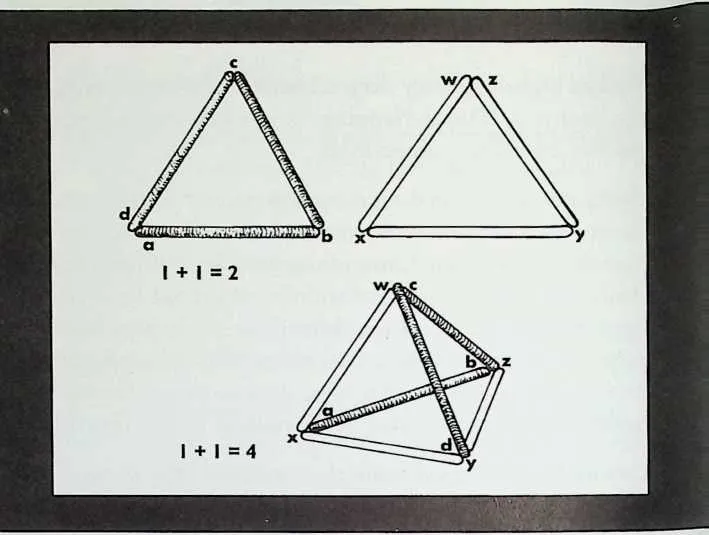 1 + 1=4.
38 Fig. 3-1
39 With six identical struts, you can make two triangles. But when they are arranged synergetically, the same six struts make a tetrahedron of four triangles.There is a bonus: volume (‘‘within-ness’’) divides Universe into what’s inside the tetrahedron, what's outside it, plus a little bit that does the dividing. Nothing about the struts or the triangles hints at the enormous advantage gained by connecting them in this way. Only their relationship has been changed to bring about this efficiency. Bucky identified the tetrahedron as the minimum system in Universe.
4041Synergetics
42 ‘‘I have discovered the coordinates of Universe’’—RBF
4344It took Bucky 1300 pages in Synergetics and Synergetics 2 to present what he discovered (see Appendix A). This brief section is intended to encourage your further engagement in synergetics. It is a subject that will take time and considerable effort to comprehend, but if Bucky is right about discovering the coordinates of Universe, you’ll be ahead of the pack. Even if Bucky’s synergetics isn’t right, or only partially right (most likely, since knowledge is always increasing in unexpected ways) you’ll learn a lot on the quest.
45‘‘Synergy’’ is defined as the performance of the whole unpredicted by an examination of the parts or any subassembly of the parts. Bucky’s favorite example was chrome nickel steel, an alloy that exhibits ten times the tensile strength of its weakest component and six times the tensile strength of the strongest. The tensile strength of the alloy is far greater than the sum of the tensile strengths of its components
46Synergy also occurs in geometry (Fig. 3-1) and chemistry. After finding many examples, Bucky finally concluded that all of nature is synergetic.
47 The word ‘‘synergetic’’ is a weld of synergy and energetic. Energetic refers to energetic geometry. Because everything in Universe is constantly in motion, the Cartesian X Y Z coordinate system is incomplete; it does not take time into account. It is a way of thinking left over from flat-earth conceptioning. We are so accustomed to 90 degree coordinates that it is a surprise to see what we really mean by ‘‘squaring’’ and ‘‘cubing’’ (Figs. 3-2 through 3-6).
48 Bucky was very clear about this matter. In an address in 1965, he said, ‘‘In fact, experiment shows that we see and comprehend very little of the totality of motions. Therefore society tends to think statically and is always being surprised, often uncomfortably, sometimes fatally. Lacking dynamic apprehension it is difficult for humanity to get out of its static fixations and specifically to see great trends evolving.’’
49 Synergetics requires 60 degree coordinates. No insubstantial points, straight lines, or infinite planes are employed. Synergetic mathematics is based on experience rather than physically impossible axioms. Everything physical must have shape and structure. Bucky expected shape and structure would follow certain laws. Synergetics describes and models those laws. Like angles, they are unchanged by scale. In physics, synergetics explains the apparent paradox of electromagnetic phenomena being both wave and particle. In design, synergetics reduces or eliminates compromise.
50 In energetic geometry, a line represents a vector. It does not and cannot go to infinity because there isn’t any infinity in regenerative scenario Universe. The line has length, angle, and an implied frequency. Time is always involved because real phenomena have duration. ‘‘ Time is the shortest distance between two points.’’
51 Synergetics can physically model relationships with four or more dimensions, making them visibly comprehendible for the first time. Bucky regarded his geodesic domes as irrefutable pedagogical demonstrations of the correctness of his synergetic-energetic geometry.
52 Geodesics are synergetic. Nature often employs geodesic structure for maximum strength and protection. The eyeballs and testicles of some vertebrate animals (not all have been examined) exhibit geodesic patterns. Many tiny radiolaria are geodesic, enabling them to withstand deep sea pressures. Viruses are geodesic; Bucky expected that a study of their geometry would reveal how they work and how to combat them. Stacked tetrahedra form a double helix. Could DNA be usefully studied as synergetic phenomena?
53 I
I
5455The five regular polyhedra, or ‘‘Platonic’’ solids.
56These are the only polyhedra with identical faces, and the same number effaces coming together at each vertex. If constructed of struts with unreinforced vertexes, only the tetrahedron, octahedron, and icosahedron are stable. This is not surprising, since the triangle is the only self-stabilizing shape, and these are the only regular polyhedra in which all faces are triangular.
57The unfolded shapes can be reproduced, cut out, folded on the dotted lines, and taped together to make solid models. Refer to p. 243 for enlarged patterns.
58 Models made from soda straws with string running l through them will reveal
5960
structural stability or lack of it.
61 Fig. 3-2
62 ‘‘Triangling versus ‘‘squaring.’’
63 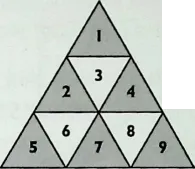 When we ‘‘square’’ a number, we multiply it by itself.The multiplication is actually taking
a number to the second power, but most people refer to squaring instead. Bucky considered this
convention to be obsolete, because Universe is better described with a more economical 60
degree coordinate system than with the popular, 90 degree X,Y, Z coordinates. In
this drawing, we see that ‘‘triangling’’ the number three achieves the same result as
‘‘squaring’’ it, but much more economically. A more descriptive term for either is ‘‘second
powering.’’
When we ‘‘square’’ a number, we multiply it by itself.The multiplication is actually taking
a number to the second power, but most people refer to squaring instead. Bucky considered this
convention to be obsolete, because Universe is better described with a more economical 60
degree coordinate system than with the popular, 90 degree X,Y, Z coordinates. In
this drawing, we see that ‘‘triangling’’ the number three achieves the same result as
‘‘squaring’’ it, but much more economically. A more descriptive term for either is ‘‘second
powering.’’
64 Fig. 3-3
66 16 Tetrahedra
67 I Inverted Tetrahedron
68 10 Tetrahedra
69 16 + I + 10 = 27 = Three raised to the third power (3x3x3 = 33)
70 Fig. 3-4
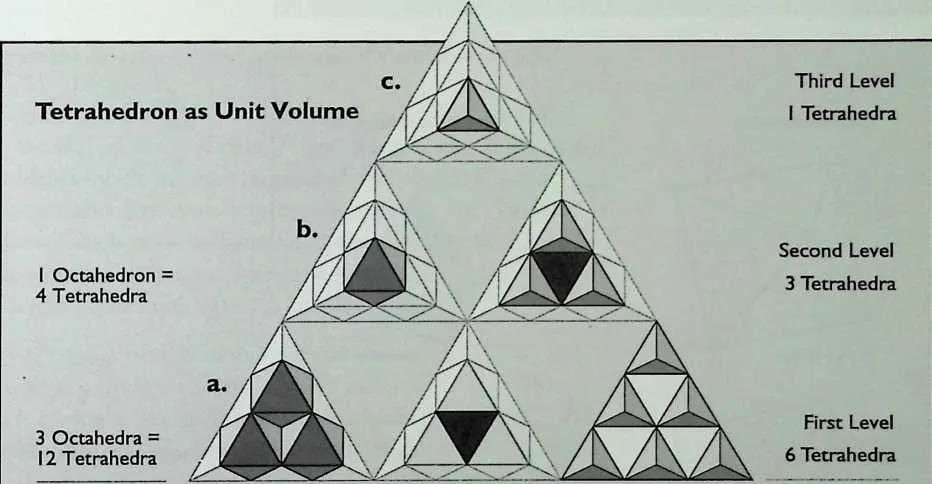
71 Following the same logic as in ‘‘triangling’’, we see that ‘‘cubing’’, which is actually raising a number to the third power, can be modeled more economically as ‘‘tetrahedroning’’. Assuming a little tetrahedron to be the unit of volume, it is harder to see the total of twentyseven in a 3X3X3 tetrahedron than in a 3X3X3 block of cubes. Here’s how it works:
72 (a.) On the ‘‘ground floor’’ of the 3X3X3 tetrahedron there are six little tetrahedra (right), three octahedra (left) and one inverted tetrahedron nested in the middle. Each octahedron has a volume equal to four of the little tetrahedra. (For an explanation of why the octahedron has a volume of four tetra-hedra, see Figs. 3-5 and 3-6.) Thus the first layer has the equivalent of nineteen tetrahedra.
73 (b.) The second level has three tetrahedra (right) sitting on top of the three octahedra of the first level. One octahedron, sitting on the inverted tetrahedron in the first level, nests between them.Total volume is seven tetrahedra.
74 (c.) The third level consists of just one tetrahedron, giving a total volume of twentyseven. Thus ‘‘tetrahedroning’’ is the same as ‘‘cubing’’ but is much more economical. A better term for both is ‘‘third powering.’’
75 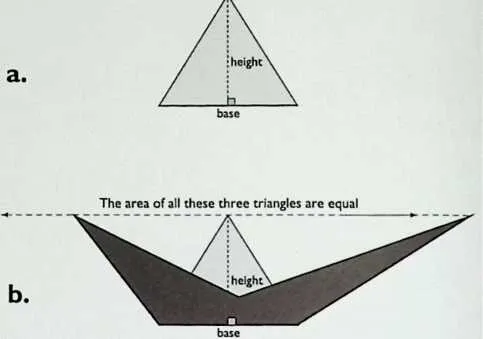 Area of a triangle = one-half the base times the height, (b.) ‘‘Shearing’’ a triangle along a
line parallel to its base does not change the area because the base and height are not changed.
Hence the areas of the three triangles shown are equal.
Area of a triangle = one-half the base times the height, (b.) ‘‘Shearing’’ a triangle along a
line parallel to its base does not change the area because the base and height are not changed.
Hence the areas of the three triangles shown are equal.
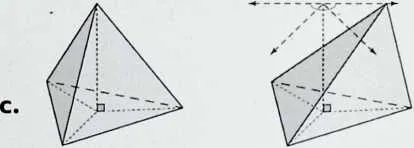
76 (c.) The volume of a tetrahedron = one-half the area of the base times the height. Shearing the tetrahedron does not change its volume because the height and the area of the base do not change.
77 OCTAHEDRON
78 TETRAHEDRON
79 Shearing Area and Volume
80 Fig. 3-5
83 Fig. 3-6
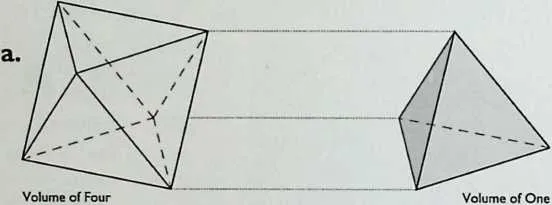
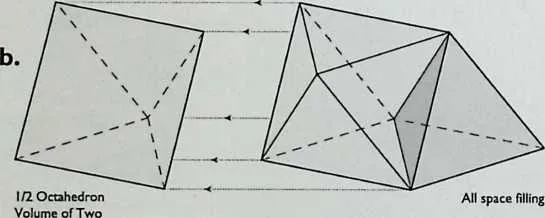
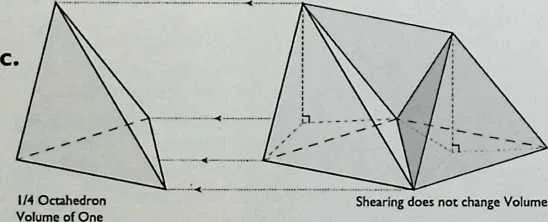
8485One octahedron equals four tetrahedra.
86(a.) If a tetrahedron and an octahedron have the same edge lengths, they also have the same size triangular faces. If the tetrahedron is assigned a volume of one, the octahedron with identical faces must have a volume of four. Here’s how it works.
87(b.) On the right, you can see that the tetrahedron and the octahedron have the same base size and the same height. (They fit together to make an ‘‘octet truss.’’) Slice the octahedron in half and remove it (left).
88(c.) Now remove half of that, leaving one-fourth of the octahedron. Because its base and height are the same as the tetrahedron, you can see that it is actually a sheared tetrahedron, and so must have the same volume.Thus, the octahedron has a volume of four tetrahedra.
89 Bucky went even further, saying that ‘‘understanding is symmetrically tetrahedronal’’—a typical Fullerian sentence requiring some background and thought to comprehend. Indeed, the subtitle of his Synergetics books is ‘‘Explorations in the Geometry of Thinking.’’
90 The introduction above is just a taste of the complex, interrelated phenomena explained by a study of synergetics. Though there has been no organized effort to examine all disciplines for synergetic relationships, Bucky’s ideas are beginning to show up more often.
91 The Octet Truss
9293I discovered that the tetrahedron was at the root of the matter. —RBF
94 The contest is to bridge a certain distance—two feet is usual—using nothing but toothpicks, sewing thread, and a bit of glue. The winning bridge is the one supporting the most red bricks with the least number of toothpicks. Once a favorite assignment for university freshman engineering students, the ‘‘bridge problem’’ is now common in high schools. Sometimes there are scholarships involved. An octet truss will win every time. I recently witnessed a 2-ounce (57 g) octet truss support 35 pounds (16 kg).
95 The octet truss consists of regular octahedra and tetrahedra, each with the same edge lengths, arrayed as a thick platform. They fit naturally (Fig. 3-6b). The octet arrangement is all-space-filling, as is an endless array of stacked cubes, but an octet truss is energetically three times more efficient than a cubic array. The octet truss is also triangulated in all directions. Cubes must have additional triangulating members to prevent collapse. This will be obvious if you make a model cube using soda straws laced together with thread running through the straws. Without reinforced corners, it is terminally floppy. An octet truss model will be stiff.
96 
 If you add a diagonal to stiffen each face of a cube, the diagonals will
form a tetrahedron. Bucky reasoned that it would be more economical to start with a
tetrahedron in the first place. But tetrahedra alone will not fill all space; they must have
octahedra in between. Bucky’s first commercial dome, the Ford Rotunda, consisted
entirely of octet trusses arranged as triangles. (See Figs. 5-6 —5-10). Octet trusses are
mostly air, but are remarkably stiff, as the floors in the Windstar dome show (Fig.
8-30). Because it is triangulated in all directions, and does not depend on gravity
for strength or integrity, octet geometry is often employed in space platforms and
satellites.
If you add a diagonal to stiffen each face of a cube, the diagonals will
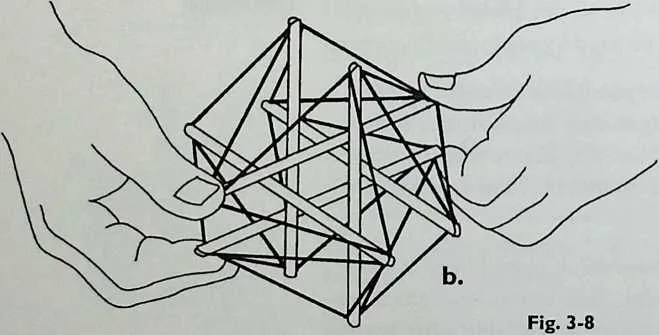
form a tetrahedron. Bucky reasoned that it would be more economical to start with a
tetrahedron in the first place. But tetrahedra alone will not fill all space; they must have
octahedra in between. Bucky’s first commercial dome, the Ford Rotunda, consisted
entirely of octet trusses arranged as triangles. (See Figs. 5-6 —5-10). Octet trusses are
mostly air, but are remarkably stiff, as the floors in the Windstar dome show (Fig.
8-30). Because it is triangulated in all directions, and does not depend on gravity
for strength or integrity, octet geometry is often employed in space platforms and
satellites.
9798
The 60-atom carbon molecule C6o, buckminsterfullerene, takes the shape of a soccer ball.The soccer ball pattern is a spherical icosahedron that has been ‘‘truncated.’’ That is, the tips of each of the 12 pentagonal vertexes of the icosahedron have been snipped off to make 60 vertexes, all of which are equidistant from the center of the sphere.
99 Buckminsterfullerene
100  Bucky did not discover, claim to discover, or even predict Cgo, the remarkable carbon
molecule that bears his name, but he did have an indirect hand in its recognition. A number of
researchers had encountered the unusual, 60-atom carbon molecule in the early 1970s. A few
suggested that it might have the soccer-ball pattern but none recognized the significance of what
they had discovered. A decade later, Harry Kroto and Richard Smalley independently found C60
while looking for other molecules, and did recognize what they had. Both had visited the
Montreal Expo dome (Fig. 8-21).
Bucky did not discover, claim to discover, or even predict Cgo, the remarkable carbon
molecule that bears his name, but he did have an indirect hand in its recognition. A number of
researchers had encountered the unusual, 60-atom carbon molecule in the early 1970s. A few
suggested that it might have the soccer-ball pattern but none recognized the significance of what
they had discovered. A decade later, Harry Kroto and Richard Smalley independently found C60
while looking for other molecules, and did recognize what they had. Both had visited the
Montreal Expo dome (Fig. 8-21).
101 Merely looking at that huge icosahedral dome gave them a subconscious clue to what the molecules shape might be. They looked at Marks’ book, The Dymaxion World of Buckminster Fuller (see Appendix A), but it took some experiments with toothpicks stuck into Gummy Bear hubs to demonstrate that pentagons were necessary. (The pentagons on big domes are hard to spot.) Geodesic constructions must have pentagons if they are to close in on themselves to make a volume. A dome cannot be all hexagons. Hexagons would be flat, like a hex-tile floor.
102 The unusually stable Cso molecule was explained by the pentagon-hexagon pattern seen on a soccer ball (Fig. 3-7). That pattern has five-fold symmetry related to the icosahedron. If you ‘‘truncate’’ (slice off the tips) of the 12 pentagonal vertexes of an icosahedron, you end up with the soccer ball’s pentagon-hexagon pattern, which has the necessary 60 vertexes. Kroto and Smalley eventually proved experimentally that the molecule did indeed have that shape.
103 They published their paper in 1985, two years after Bucky’s death. In it, they named the molecule ‘‘buckminsterfullerene,’’ acknowledging Bucky’s work with geodesics. The lengthy name has been popularly corrupted to ‘‘buckyball.’’ When Bucky’s collaborator and editor, E. J. Applewhite, saw the paper, he sent the discoverers copies of Bucky’s two Synergetics books which explain the mathematics and geometry involved in the icosahedron and its derivatives. Bucky also expounds at length on carbon and its tetrahedral bonds.
104 The story (so far) has been chronicled in Perfect Symmetry:The Accidental Discovery of Buckminsterfullerene, by Jim Baggot (1994, Oxford University Press), and The Most Beautiful Molecule, by Hugh Aldersey-Williams (1995, John Wiley). Mr. Applewhite continues to monitor and publish articles on the astonishing growth of the new branch of organic chemistry inspired by the discovery.
105 Tensegrity
106107There are no SOLIDS! There are no THINGS!—RBF
108 On stage, Bucky would bellow those claims in his most insistent voice. He contended that Universe consists of islands of compression in a sea of tension at any scale. Stars and planets are islands of compression in a sea of gravity.
109 The moon is hooked to Earth by a weightless gravitational ‘‘cable’’ of zero section, yet of exactly the required strength. Atoms are relatively spaced as far from one another as the planets are from one another. In all of Universe, nothing is actually touching anything else. It’s all energy, ordered by angle and frequency.
110 As usual, Bucky started with the biggest picture possible as he attempted to understand and explain the principles of structure. Any structure, any system, must have a shape. He was determined to find out why nature uses the shapes she does. Since nature always employs the most economical means, it seemed logical that we should too.
111 As a practical matter on Earth, tension and compression in buildings are handled by components such as cables and bricks. Steel beams, reinforced concrete, and wooden joists carry both compression and tension, but since tension is much more efficient than compression, Bucky preferred to have as much
112 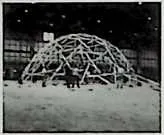 material as possible used in tension. He sought ways to make structures employing
continuous tension and discontinuous compression, reflecting what nature was doing at
macroscopic and microscopic scales. His student, Kenneth Snelson, made the first model
demonstrating that this was possible (Fig. 3-8). Bucky called such structures tensional integrities,
or ‘‘tensegrities.’’
material as possible used in tension. He sought ways to make structures employing
continuous tension and discontinuous compression, reflecting what nature was doing at
macroscopic and microscopic scales. His student, Kenneth Snelson, made the first model
demonstrating that this was possible (Fig. 3-8). Bucky called such structures tensional integrities,
or ‘‘tensegrities.’’
113 As is true of all systems, a geodesic structure has a frequency (Fig. 3-9). As frequency increases, the compression members get smaller and smaller, finally becoming subvisible. This can be continued in a fractal manner (angles and proportions do not change with frequency) right down to atomic level, where the tensile elements are reduced to sectionless gravitational attraction. This is the basis for Bucky’s remark that architecture is the art of making big structures from small structures. (See Fig. 6-12 for a tensegrity dome.)
114 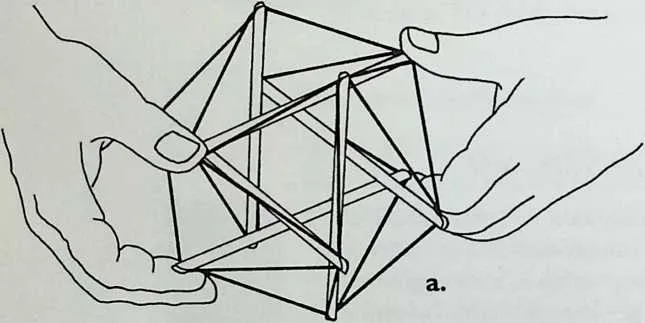
 This model clearly demonstrates the principle of tensegrity.The rubber cord provides
continuous tension that positions and maintains the shape defined by the six dowels. Like all
tensegrities, this figure is resonant, behaving pneumatically as if it were a crude balloon. It is
perfectly balanced—the short spans of rubber cord twang at the same note—and is remarkably
resistant to permanent deformation. (You can make this model yourself from dowels with slitted
tips, and identical rubber bands. It is also available as a kit from BFI, see Appendix
B.)
This model clearly demonstrates the principle of tensegrity.The rubber cord provides
continuous tension that positions and maintains the shape defined by the six dowels. Like all
tensegrities, this figure is resonant, behaving pneumatically as if it were a crude balloon. It is
perfectly balanced—the short spans of rubber cord twang at the same note—and is remarkably
resistant to permanent deformation. (You can make this model yourself from dowels with slitted
tips, and identical rubber bands. It is also available as a kit from BFI, see Appendix
B.)
115 (b.) When any two of the struts are squeezed together, the entire structure contracts uniformly and symmetrically, maintaining its topology and relationships. If the two struts are pried apart, the structure enlarges in the same way.When released, it will spring back to its original configuration.Tensegrities can take many shapes, including columns, spheres, and domes. Individual compression members can be replaced by higher frequency tensegrities, and those with still higher frequencies, until the structure becomes invisible and finally is down to atomic level.As this is done, strength increases!
116 FRONT VIEW

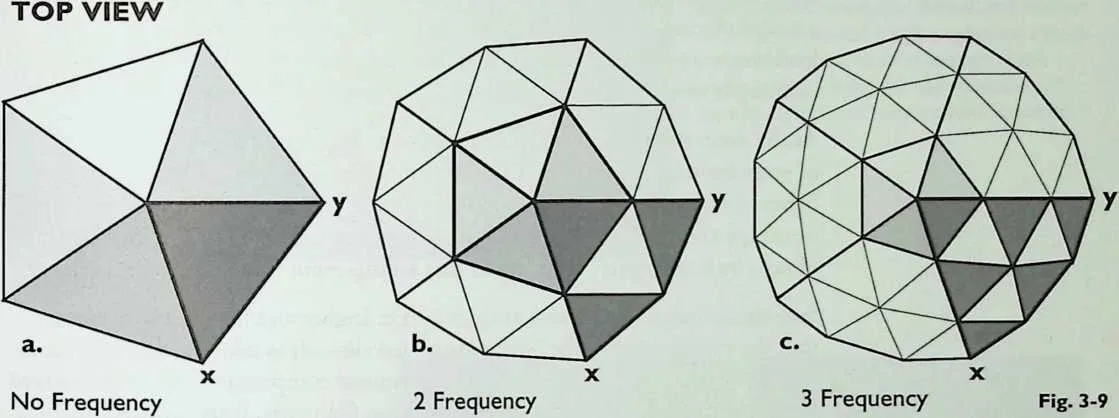
118 By raising the ‘‘frequency’’ of an icosahedron, the edges of the big, flat triangles are subdivided into shorter segments and smaller triangles to make the icosahedron more spherical. All vertexes would touch the inner surface of an enclosing sphere. It makes no difference whether the structure is made of struts, facets, or is solid.
119 (a.) The side and top view of one of the twelve pentagons of an icosahedron.
120 (b.) In a two-frequency dome, each edge of one face of the icosahedron (darkest shading) is subdivided into two slightly longer segments, producing a new, bulged triangular face made up of four smaller triangles.The vertexes X andY are actually the central vertexes of the neighboring pentagtons. Bucky claimed that all real spheres are actually very high frequency icosahedra with tiny triangular facets.
121 Calculating the volume of a faceted sphere does not require the use of the irrational (and annoying) pi.
122 (c.) In a three-frequency dome, the edges of the icosahedron are divided into three segments, producing a still more spherical, bulged face with nine triangles.The majority of small domes—up to about 40-foot (12-meter) diameter—are three-frequency (Fig. 8-22, for example). Again, X and Y are the center vertexes of the neighboring pentagtons. In this type of dome, counting the number of struts between the center vertexes of any two pentagons will reveal the frequency. On a complex dome such as the big one at Montreal (Figs. 8-17,8-21), the pentagons are hard to see, but they must be there.
123 He noted, however, that a study of the smaller structures does not hint at what bigger ones may be constructed from them. A look at one of Dr. Ingber’s cells (discussed below) gives no clue as to whether the cell is from a gnat or an elephant. By starting with the basic principles of tensegrity instead of a product using it, Bucky gained an understanding of the natural laws involved. He was then able to apply them to special cases as a matter of design.
124 Dr. Ingber’s Cells
125 Donald Ingber, M.D. saw his first simple tensegrity model while a student in a sculpture class at Yale in 1975. He was intrigued by the way that applied loads were transmitted almost instantly throughout the entire structure, deforming it without damage or changing its topology.
126 At the same time, he was culturing cells in a laboratory course. In a moment of serendipitous recognition, he noticed that the cells and the tensegrity model behaved in a similar way under load. In both cells and the tensegrity, the relationships and topology remain intact despite distortion. Could the architecture of cells be a tensegrity? If so, could that arrangement influence cell functions?
127 Subsequent experiments and analysis by Dr. Ingber and his associates suggest that the cytoskeleton—the ‘‘scaffolding’’ in cells—does take the form of a complex tensegrity with thousands of discontinuous compression members ordered and stabilized by continuous internal tension filaments. It seems likely that the nucleus is structured in the same way (Fig. 3-10). Such a system maintains its integrity without relying on gravity. By (almost) instantly distributing applied loads, it can act as a transducer, a receptor, and carrier of information that regulates cell behavior.
128 Bucky maintained that Universe, when viewed at any scale from galaxies to atoms, is made up of islands of compression in a continuous sea of tension. He insisted that nature had to utilize tensegrity containment because it is the most economical use of material. It is not surprising that he thought highly of Dr. Ingber’s pioneering work.
129 Dr. Ingber published a detailed paper in Journal of Cell Science (Volume 104, pp. 613-627, 1993) called ‘‘Cellular Tensegrity: Defining New Rules of Biological Design that Govern the Cytoskeleton.’’ Another paper, ‘‘Mechanotransduction Across the Cell Surface and Through the Cytoskeleton,’’ appeared in Science (Volume 260, 21 May 1993). He can be reached by e-mail: ingber_d@al .tch.harvard.edu
130 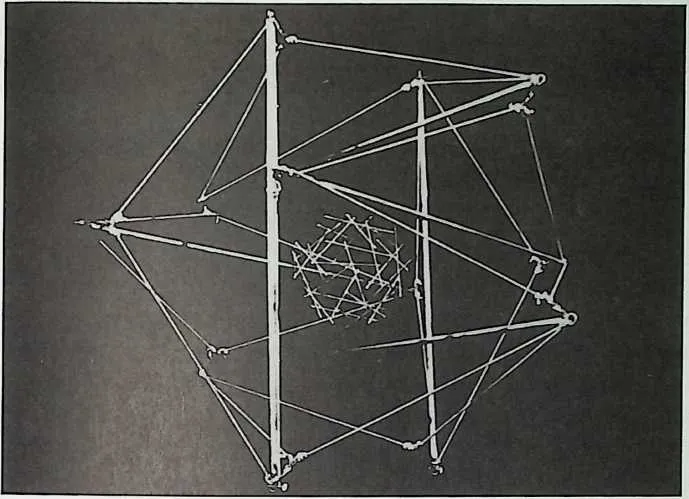 Dr. Ingber’s tensegrity model of simplified cell structure with its nucleus, itself a
tensegrity sphere.The struts of the cell model are connected by continuous elastic cord, as
are the struts of the nucleus. For clarity, the cell and the nucleus are connected in
tension by black elastic thread, made invisible against the black background in this
photograph to reduce visual confusion.This tensegrity model represents the cell and nucleus
as omnisymmetrical, roughly spherical shapes, maintained by the internal tension
of the elastic cords.A living cell has thousands of compression ‘‘struts’’ and tension
filaments.
Dr. Ingber’s tensegrity model of simplified cell structure with its nucleus, itself a
tensegrity sphere.The struts of the cell model are connected by continuous elastic cord, as
are the struts of the nucleus. For clarity, the cell and the nucleus are connected in
tension by black elastic thread, made invisible against the black background in this
photograph to reduce visual confusion.This tensegrity model represents the cell and nucleus
as omnisymmetrical, roughly spherical shapes, maintained by the internal tension
of the elastic cords.A living cell has thousands of compression ‘‘struts’’ and tension
filaments.
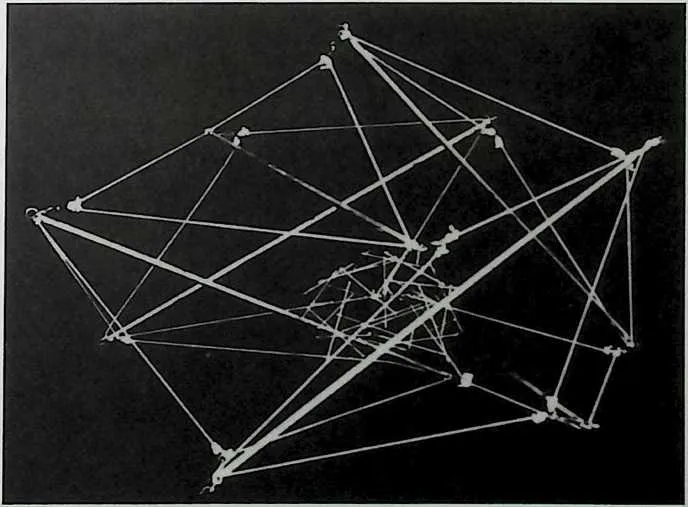
132 b. Fig. 3-10
133 (b.) The tensegrity cell model distorted and anchored to a firm substrate.The nucleus has distorted in concert with the cell to which it is connected, and has also dropped to the substrate. If released, the cell and nucleus will spring back to their original spherical state. Note that the relationships and topology have not changed as the cell shape is manipulated.
134135Was Bucky Right?
136 Laws require proof.
137 Synergetic principles and theories
138 Thus far described
139 have been experimentally demonstrated;
140 Their concurrent mathematical proof
141 Is the work of others. —RBF
142143Does synergetics describe the coordinates of Universe? That’s the Big Bucky Question. As a student in the 1950s, I could not understand why mainstream scientists neither derided nor applauded Bucky s concept of synergetics. If he was wrong, disproving his unconventional notions should have been easy. If he was right, why weren’t his ideas being used and taught? My professors resolutely dodged the question. Most refused to discuss Fuller at all. At the time, I thought they were avoiding discussion until they had familiarized themselves with his ideas. It’s been forty years. I’m still waiting.
144Attacks from academe would be easier to understand than refusal to debate. Scientists have a history of savaging upstarts. At about the same time Bucky began to promulgate his energetic/synergetic geometry (later shortened to ‘‘synergetics’’), Immanuel Velikovsky’s Worlds in Collision (1950, Doubleday) drew heavy fire for citing archaeological, geological, and anthropological evidence to dispute establishment astronomers. A few famous names were so incensed that they noisily (and rather unscientifically) denounced the book without reading it. Velikovsky was not permitted to reply in peerreviewed science publications. Few scientists dared agree publicly with anything Velikovsky said, for fear of committing professional suicide.
145Bucky’s concept of synergetics was more deeply radical and much more comprehensive than Velikovsky’s hubristic, turf-invading proposals, yet Bucky was not, and has not, been either attacked or vindicated by the scientific establishment. A handful of critics have sniped at his chemistry, or indicated a lack of respect for the inconsistencies (there are many) and occasionally fuzzy details in his seminal Synergtics books, but none have mounted an orchestrated assault on his major claims.
146Fullerphiles suggest that the silence is induced by fear. If Bucky is right about nature using a 60-degree coordinate system, the Cartesian 90-degree X Y Z coordinate system is mistaken or incomplete, however useful it may be. To bring that into public focus would be too confusing and destructive, not to say embarrassing.
147Another explanation is that overspecialization has bred a science community devoid of scholars with expertise sufficiently broad to mount a credible critique of Bucky’s comprehensive metaphysics. Moreover, unsupported hostility might be dangerous: Bucky had some powerful scientist allies. Among them were Jonas Salk and Linus Pauling—both experienced in dealing with self-induced controversy.
148 Fullerphobes dismiss him as a pseudoscientist, a more damning label than being deemed incompetent. He was not worth the trouble of disproving. Why even discuss his mathematics when he had no advanced degree in mathematics? In fact, he had no degree at all. (In this sort of argument, his 47 honorary doctorates don’t count.) Specialists want no part of dilettantes.
149 With no ‘‘license’’ in a specialty, Bucky was regarded as a ‘‘generalist’’, a polite term for persons with no real expertise. Generalists know a little bit about a lot of things. They tend to generalize to the point where credibility is lost. Regrettably, Bucky sometimes used ‘‘generalist’’ himself, when ‘‘comprehensivist’’ would have been more accurate. Comprehensivists concentrate, as he did, not just on things, but on connections and relationships. He certainly was an expert at that, but comprehensive analysis remains a discipline that is not yet widely understood or taught.
150 Bucky also was ignored, or taken for a crackpot because he seriously investigated phenomena considered to be suspect by most scientists. For instance, he openly studied and reported on numerology, thinking that ‘‘…it might contain very important bases for understanding new properties of mathematics.’’ The chapter on numerology in Synergetics 2 features some legitimate mathematical discoveries that he probably could have published in a journal, but he spurned peer review. His said his domes were adequate proof of the power of his mathematics and synergetic conceptualizing.
151 Bucky further discomfited scientists by daring to dispute Darwin, telling listeners that ‘‘We arrived from elsewhere in Universe as complete human beings.’’ He suggested that apes are degenerate humans, examples of devolution instead of being our ancestors. Audiences of scientists were aghast (or politely amused) when he exclaimed, ‘‘If gymnasts only married gymnasts, we’d come to monkeys very quickly.’’
152 He suggested that dolphins evolved from the first Earthians in their first home—which he insisted was Polynesia, not Africa. Polynesians swam and dove a lot. Over millions of years, some of them became extraordinarily good at it. He chose Polynesia because the first humans on Earth would have been landed where mild weather, abundant resources, and no dangerous land
153 animals made it easiest to survive without know-how. Later, forced to learn seamanship and navigation, islanders were better fitted than land people to explore and populate the rest of the planet.
154155More controversy: Bucky explained that the decline of the family as the basic social unit, and the concurrent increase of homosexuality, and (especially) bisexuality, were natural evolutionary developments in a species that no longer needs a high rate of reproduction. For the same reasons, he expected that recreational sex will continue to increase. He said that these changes are not good or bad, and it is futile to waste time opposing them. Animals instinctively and genetically adjust their procreative activities in ways appropriate to prevailing conditions.
156Perhaps most unacceptable to many serious scientists is that Bucky openly celebrated metaphysics, and the existence of God as the cosmic designer. Not an anthropomorphic God—more of a Divine Intelligence or Integrity—but God nonetheless. In his book Critical Path, he claims that his version of the Lord’s Prayer ‘‘constitutes a scientifically meticulous, direct-experience-based proof of God.’’ That sort of claim guarantees a hostile reaction, and undermines the scientific credibility of his other ideas. His denouncement of religion (‘‘The next most dangerous thing to the atomic bomb is organized religion.’’) failed to deflect such criticism, while assuring the hostility of conservative clerics, politicians, and school boards.
157These opinions, along with a famous outdoor lecture he gave to a group of several thousand ‘‘hippies’’ in San Francisco’s Golden Gate Park in the 1960s, caused political conservatives to regard him as a left-wing radical despite his avowed aversion to any political party, pole, or posture. The geodesic domes seen in many counterculture communes reinforced that impression, which even today hinders their acceptance by building inspectors and mortgage lenders. Bucky’s stint as lecturer for Werner Erhard’s est sessions didn’t help matters, and further sullied his reputation among scientists who didn’t appreciate Mr. Erhard. (When directly asked, Bucky stated firmly that he had not taken est training, and did not make use of est teachings, but he did think Erhard was a ‘‘good human being.’’)
158In another camp, Bucky irritated environmentalists by denouncing the Club of Rome’s popular book, Limits to Growth. (Donella Meadows et al, 1972, Universe) He correctly asserted that the book was fatally flawed because it ignored recycling, regeneration, and humanity’s ability to learn and improve. He insisted that the worrisome conclusions were a classic example of sophisticated computer analysis gone awry because of flawed input and the deplorably narrow experience of the investigators. The authors eventually agreed that he was right, but environmentalists had already idolized the book as proof of impending doom brought on by wicked technocrats—such as Bucky. They didn’t want to hear anything that would weaken arguments based on the book’s grim outook.
159 Biologically educated environmentalists were ambivalent about Bucky; not many understood that his mathematics and technology could help. Some attacked without doing their homework: A famous nature photographer accused him of ‘‘covering his formerly pristine island with technology’’ when, in fact, the Fuller family’s Bear Island, off Camden, ME, had no electricity or running water, and the main house had an outhouse out back.
160 He has annoyed feminists, too. Some do not appreciate his views on the difference between the sexes: ‘‘Man is discontinuous, he comes and goes. She carries the eggs, and so is continuous, like tension. She tends to stay with the young and the old. She is the consolidator of gains brought in by the male, deciding whether to feed it, skin it, milk it, ride it, or eat it. She was the first to industrialize.’’
161 Every one of his major projects had a strong woman present as it gathered momentum, and her role was important. If few women were to be seen later in the ‘‘man’s world’’ of construction, that was just how things were done in his day. There is no question that he regarded males and females equally when he spoke of education and our duties as humans in Universe. And through it all, his wife, Anne, backed him and supported him—a very difficult part to play. He died beside her sickbed. She died a day later, without waking. They had been together 66 years.
162 The foregoing is not intended as an apologia for Bucky’s flaws, foibles, and unproved exploratory suggestions. His ideas are not always easy to understand. His writings are not always consistent, especially to readers who expect his early ideas to remain unchanged as he learned. He spoke to a lay audience as an integrator. There is an internal consistency to synergetics. If the basic premises of synergetics are true, Bucky’s sometimes strange, always bold, assertions may also be true, for they follow logically.
163 There appears to be an enormous potential for more important discoveries of principles and connections in the study of synergetics. Though riddled with fuzzy details, Bucky’s systematic investigations were, like all science, edging toward truth. Physical manifestations of his discoveries have worked well. His concepts need to be rigorously tested by the usual scientific means. If synergetics withstand comprehensive scrutiny (piecemeal examination of details out of context, and quibbling over minor details won’t do), then synergetics should be widely taught and applied.