
10 Spaceship Earth
21,500AD 1840AD
3 The best average speed of horse drawn coaches on land and sailing ships at sea was approximately 10 m.p.h.
4 In reality, I have not left home. My backyard has just grown bigger. Now the world is my backyard.—RBF
5 iQlUU
6 mini
7 7,000 6,000 5,000 4,000 3,000
8 1 AD»
9 It’s a One-Town World
10 Isaac Newton’s sense of ‘‘normal’’ was to be at rest. To him, Universe was a sculpture. It was The Universe. Bucky noted sadly that adherents to the ‘‘Big Bang’’ theory are still caught in Newtonian thought: They regard Universe as an ‘‘it.’’
11 In contrast to Newton, Einsteins ‘‘normal’’ was the speed of light and other radiation. His Universe was made up of nonsimultaneous energy events. What we think of as real may not be there: Light from the North Star takes 640 years to get here. To Einstein (and to Bucky, who knew and admired him), Universe is a continuously changing scenario, unknowable except in principle, and in localized special cases. Because of this, Bucky liked to say, ‘‘Truth is always approximate,’’ or ‘‘Truth is a tendency.’’ Universe will always defy ‘‘thinkaboutability’’ to some extent. Process and direction are more important than goals.
12 Nothing is standing still, not even here on Earth. A person ‘‘at rest’’ on the equator is whizzing along at 1000 miles per hour (1609 kph) as Earth rotates on its axis. At the same time, Earth is speeding around the sun at 60,000
13 —j17. GOO
14 TThe Relative Size of the World As Travel Time Decreases
16 18501930
17 A A 1950’s
Q J Propeller aircraft
18 Steam locomotives averaged 65 mph, while steamships averaged 36 m.p.h.
19 averaged 300-400 m.p.h.
20 1960's
21 Jet passenger
aircraft
averaged
500-700 m.p.h. Jet
22 -SOO
23 2 000
24 XB-70
25 -Jet --1-soo super sonic
26 -1.000
27 First flight across the —too Atlantic iiiiiiin Automobile
28 50
29 Man on foot = 3 mph
30 400 500 600 700 800
31 The Speed of Communication
32 Carevel=5 mph.
33 I -
34 mil
35 Steam locomotive
36 Horse
37 Coach
38 -25
39 900 1000 1100 1200 1300
40 1400 1500 1600 1700
41 1800 1900
42 20 40 ao
43 80
44 1965
45 The Shrinking
of Our Planet by Man's
Increased Travel and
Communication Speeds
Around the Globe.
46 O Prior to 1441 AD.
47 Word of mouth, drums,smoke, relay runners, and hand-printed manuscripts.
48 ® 1441
49 The Gutenberg printing press.
50 © 1863
51 The rapid print Web newspaper press.
52 O 1876
53 The Bell telephone.
54 © 1895
55 The Maconi telegraph.
56 0 1920
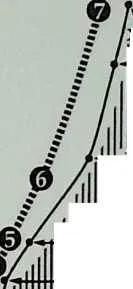
57 First commercial radio broadcast
58 O 1950
59 National television.
60 © 1965
61 Transcontinental T.V. with the introduction of Early Bird Satellite.
62 Fig. 10-1
63 Bucky drew this chart in 1965.The numbers assume state-of-the-art capability at that time. Predictions based on these curves have proved to be very close to what has happened since this was prepared.
64 miles per hour (96,558 kph). Our solar system is speeding through the galaxy, and the galaxy is speeding through space, at unimaginable speeds. Closer to home, we are increasingly speeding around on the surface of our planet as we become world beings.
65 The first Earth people were bunched together for survival. Then they scattered across the globe to live under various trying conditions. Those conditions caused what we mistakenly call ‘‘races’’ to evolve. Now people are coming back together. Bucky said that this was part of a vast plan for us. He said it must be a divine plan because there seems to be a very strong tendency for humanity to become one people, even though there is no organized effort to bring this about. It’s just happening.
66 Until very recently, the average human walked everywhere. (A brave few ventured upon the sea.) Many walkers never went further than the horizon during their lifetime. Bucky estimated that an average pedestrian covers about 1100 miles (1770 km) annually. By World War I, a typical citizen of an industrial nation still walked that distance, but added another 1100 miles by auto or train. World War II raised that to 1100 on foot and 10,000 miles a year by mechanical means, with a significant number of people travelling 50,000-100,000 miles a year.
67 The average U.S. family moves about every three years. (Statistics vary from one-and-a-half years to five years, depending whether military families are included.) How long have you been at your present address? When Bucky asked audiences that question, it usually turned out that the great majority had occupied their present home for less than five years. The demographics of cities is changing to accommodate air travel. We are on the move.
68 As people get around more (‘‘increase their sweepout,’’ in Bucky s phrase), the world is apparently shrinking. (Fig. 10-1). The literacy rate for all people hovers around 90%. Satellite broadcasting brings news and programs from all, to all, through wireless radio and TV. The commonly held knowledge undermines local authority (including parental authority). The Internet laces together its millions of users (mostly in English) in a manner that would startle A. G. Bell. English is well on the way to becoming the first or second language of most of the world’s citizens. English is becoming the first world language.
69 Credit cards and telephone cards now work in the major cities of most countries, and the outback in many. The dollar is acceptable nearly everywhere—if not officially, then on the street. It may become the first world currency.
70 Weights and measures, regulations for safety and pollution, industrial standards, travel protocols, music, movies, video and electronic communication compatibility, all are tending to international agreement. Shared technology unites peoples—especially their young. The world’s young are beginning to stir. Bucky thought that young people were our only hope.
71 Tourism is the largest business in the world. Millions of people visit virtually every country and region for business, pleasure, or mere curiosity. The improved efficiency of enormous aircraft now on the drawing boards will likely bring a drop in air fares. Airlines predict a doubling of passenger traffic by the turn of the century.
72 Multinational megacorporations move materials and products across national boundaries with impunity. Their employees are also multinational, moving around the world with casual ease. In most places, their passports are mere formalities. World citizenship will soon be a corporate matter rather than a political one.
73 These huge corporations manipulate entire economies—sometimes on purpose, other times inadvertently. As they exploit, manufacture, and market, they are able to exert increasing influence over governments large and small. Their behavior may be the key to the success or failure of our species.
74 Bucky was aware of the dangers inherent in the above phenomena. World citizenship could mean the end of cultural diversity. Bucky countered that what people usually mean by ‘‘cultural diversity’’ is actually recognition of quaint artifacts from past ignorance. Graceful women balancing pots of water on their heads may be picturesque, but the water-bearing women are, in fact, beasts of burden. They are soon crippled by damaged vertebrae. The culture-defenders who wish to preserve that way of life rarely include themselves in that unfortunate, but photogenic, group.
75 Colorful religious customs may be viewed in the same way. Most religions are based on a mordant vision of life on Earth as punishment or at least as a trial. Only the promise of a better afterlife makes today tolerable. Religious leaders have a vested interest in continuing things as they are. Custom is most often based on myth and political expediency. ‘‘Morality is what people say other people should do.’’
76 Bucky thought that many traditional cultures acted to uphold artificial nation-states whose rulers feared any changes that would raise the people's standard of living to the royal level. Past history shows that any such advance was to the detriment of the ruling class. Pulling the bottom up was never considered because there was never enough wealth to go around.
77 Design science has made that sorry state of affairs obsolete. It has made nations obsolete. Bucky hoped it would make politics obsolete. He considered the United States to be just that; United-States. We are certainly not one nation, but a collection of nations. With a bit of enlightenment, we could lead the change to what Bucky called ‘‘de-sovreignization’’—the change from many govern merits to world governance. Patriots are horrified by this idea. They’re still stuck in win-or-lose.
78 Of course, selfishness could continue to magnify the dark side of technology to bring us all down. The profiteering of industrial societies could subjugate the world, and complete the environmental destruction already under way. Bucky figured about 44% of humanity was still living in poverty. Increasing us-versus-them tension caused by greed and injustice could easily bring uncontrollable anarchy, as the underdogs—armed with powerful weapons for the first time in history—turned to organized terrorism. Think what would happen to air travel if a half-dozen airliners were randomly shot down by the Stinger missiles already in the hands of ‘‘extremists’’! An angry, clever, 15-year-old could do it.
79 On the other hand, enlightened multinational corporations—the richest and most powerful social entities now in operation—could be the agents that bring about the new era that Bucky demonstrated was at least possible. For the first time, there are worldwide organizations with talented people and the capability to make and distribute the goods and know-how—including environmental understanding—that can bring a good life to everyone. The artifacts of livingry are being developed by individuals and teams acting as design scientists all over the world. Many of the principles they employ were discovered or proposed by Bucky. The rest will have to come from us, perhaps from you.
80 The World Game Institute®
81 Bucky used the term ‘‘World Game’’ in two ways. The first refers to developing the know-how, hardware, and education to make the world work for everyone. (The dedication of this book [p. v] is the World Gamers creed.) Just about anything that works to that end could be considered ‘‘playing World Game.’’ GENI, a Global Dwelling Service, or a conference convened to solve a specific world problem would qualify as examples.
82 The other meaning refers to an organization Bucky founded in 1972—The World Game Institute®. This organization collects and disseminates accurate, comprehensive, world resource data to be used in World Game Workshops and large-scale planning. This World Game was intended as an antidote to the war games played by Cold War planners.
83 Bucky intended World Game to be played on a giant Dymaxion Map or a ‘‘Geoscope’’ globe covered with thousands of small lights. (A computer screen for each player would do, but would lack the dramatic impact and resolution of a large-scale display. ) Strategies entered on the players’ computers would interact, then appear as moving patterns of lights that everyone could see, rather like the graphics on a Goodyear blimp.
84 Real data (much of it from satellites) would be used in credible simulations of various moves that a country might make. Because such information would be free of political taint, it could be employed confidently without fear of losing face or accusations of corruption. People tend to trust hard computer data more than they trust the machinations of politicians. (Bucky pointed out that people confidently trust their lives to computers every time they travel by airplane.) United Nations delegates might conduct official games that would reveal mutually beneficial moves. Computers would analyze the subtle interactions and ‘‘side effects’’ of individual decisions. Animation would show effects over time. All players, and their constituents, could view the outcome of various proposals.
85 In addition to showing the results of strategic moves, World Game hardware and software could convincingly present all manner of other data. The spread of a disease could be displayed dramatically in moving lights. Filling of wetlands, distribution of cotton, mining of gravel, and the shipping of rice could be presented visually in a memorable and understandable way. The locations of surplus food, starving populations, and empty ships could be shown together, perhaps suggesting a remedy.
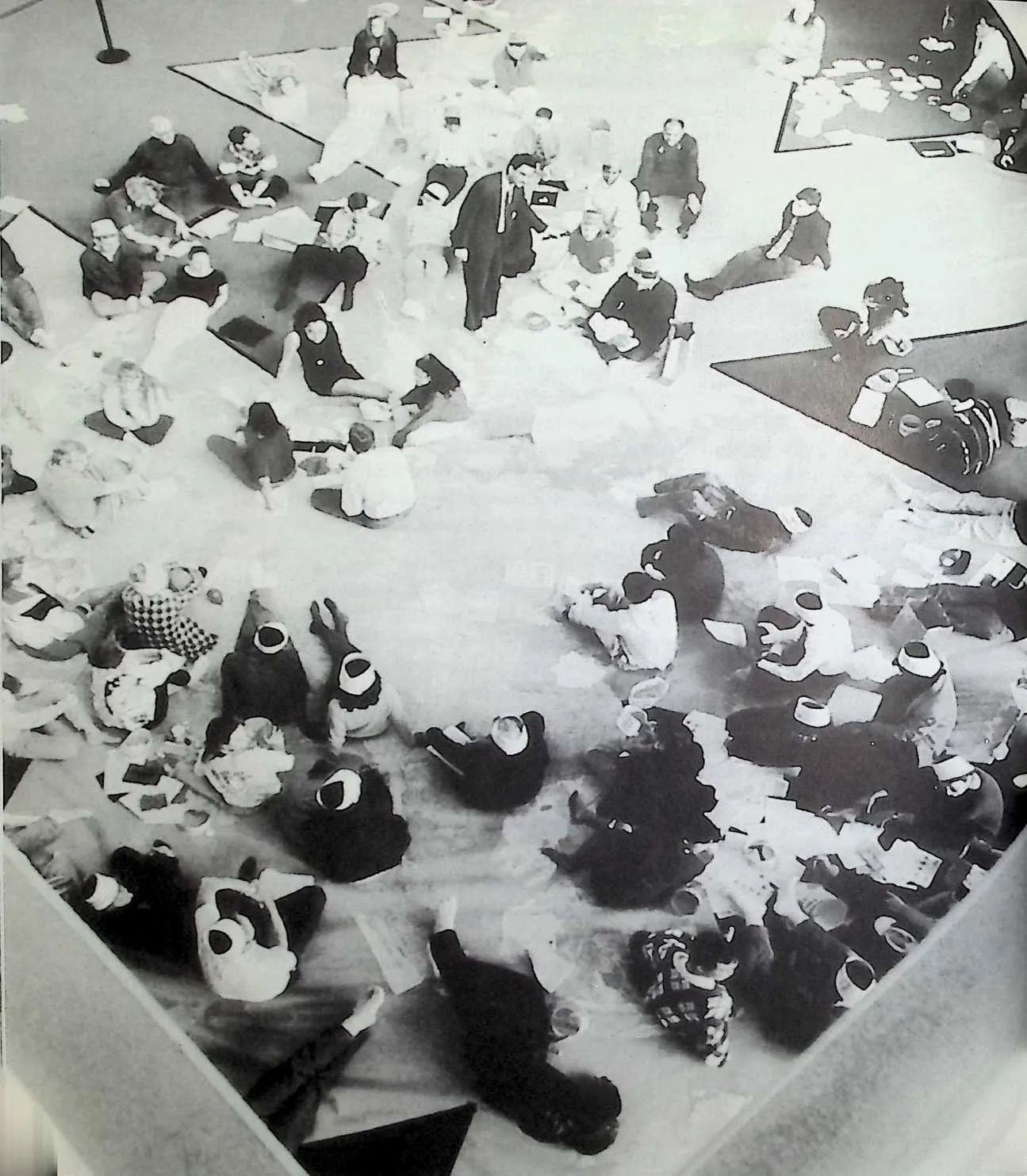
87 Bucky was confident World Game would show that international cooperation was so obviously advantageous that war would become unthinkable. Humans could then enter a new phase of their role in Universe.
88 While the world waits for an electronic Geoscope or Dymaxion Map, the World Game Institute conducts its more modest workshops. Thousands of people have participated over the last ten years. Players have included senators, bankers, generals, small children and college students. About 100 workshops are given each year.
89 The World Game Institute now has one of the largest world resource data banks in existence. (It may be the largest.) There are about 1000 entries for every country. Data include such things as mineral and agricultural resources, literacy levels, human rights records, soil conditions, medical facilities, average incomes, environmental problems, and life expectancies. Much of the data is available as useful software. (For further information on the World Game Institute, see Appendix B.)
90 Obviously, World Game can be played in various ways on the Internet. At this time, networking is probably the fastest way to convince large numbers of influential people that success for everyone is possible if only we organize to bring it about.
91 Of all his inventions and discoveries, Bucky considered World Game to be second only to synergetics as a force for making humans a successful species.
92 Players crowd the huge Dymaxion Map at a World Game Workshop®. Each of the hundred participants represents 1% of the world’s population. Each is equipped with appropriate resources and constraints in the form of cards. Players bicker, wheel and deal, and cooperate to make the world work for everyone without resorting to war (which is one of the options). There is a press corps. The complexity level rises quickly.The room gets noisy.Two things soon become obvious: (1) cooperation works,and (2) actually changing the world from coercion and war to peaceful cooperation is not going to be easy. It is a crude—but effective—version of a sophisticated electronic World Game that Bucky envisioned being played officially by United Nations delegates.
93 What the World Wants
94 and How to Pay for it Using Military Expenditures.
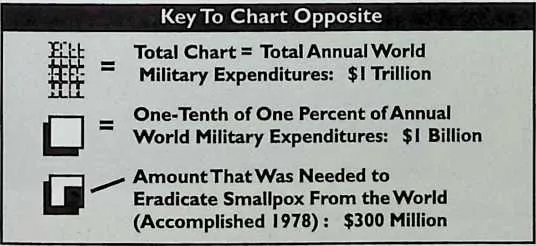
95 The discouraging, infuriating chart, with its appalling statistics, is typical of the macro-views revealed by a study of the date banks of the World Game Institute. Each square represents one-tenth of one percent of the annual world military expenditure of one trillion dollars.The total annual cost of global programs for solving the major human needs and environmental problems facing humanity would be approximately 25% of the annual world military budget. If asked by a child, how would you explain our failure to act on this information?
96 These notes represent the general direction, scope, and strategy of the chart on the facing page. A more detailed, attributed, explanation is found in Doing the Right Things, a paper available from the World Game Institute (see Appendix B).
97 Prevent and reverse soil erosion: $24 billion per year for ten years, to convert to pasture and woodland, one-tenth of the world’s cropland most susceptible to erosion and no longer able to sustain agriculture; and to conserve and regenerate topsoil on remaining lands through sustainable farming techniques.To be accomplished through a combination of government regulation, and incentive programs that remove the most vulnerable lands from crop production, and by farmer education through expanded in-country agricultural extension services.
98 Stabilize population: $ 10.5 billion per year for ten years, to make birth control universally available.
99 Stop ozone depletion: $5 billion per year for twenty years, to phase in substitutes for CFCs and provide incentives for further research and development.
100 Provide clean, safe energy: $17 billion per year for ten years, to fund research and provide incentives for renewable energy devices, and a graduated ten-year phaseout of subsidies to fossil and nuclear fuels. $33 billion per year for ten years, to increase car fleet fuel mileage to over 50 mpg, and to bring appliance, household, and industrial processes and materials efficiency to state-of-the-art.
102 Stop and reverse deforestation: $7 billion per year for ten years to reforest 150 million hectares needed to meet ecological, fuelwood, and wood products needs. Planting by local people would cost about $400 per hectare.There would be additional costs for legislation, financial incentives, protection, and enforcement.
103 Prevent global warming: $8 billion per year for thirty years to reduce carbon dioxide, methane, and CFC release into the atmosphere through a combination of international accords, carbon texes, and increased energy efficiency.
104 Prevent acid rain: $8 billion per year for ten years, for tax incentives, regulations, and direct assistance programs that place pollution control devices on coal-burning equipment. Retire Developing Nations’ debt: $30 billion per year for ten years to retire $450 billion or more of current debt discounted to 50% efface value. (Much of the developing world’s current debt is already discounted to 10-25% efface value.) Helps countries get out of debt, and helps banks stay solvent. Eliminate illiteracy: $5 billion per year for ten years—$2 billion for communications satellites; $2 billion for buying and distributing ten million television sets with satellite dishes and photovoltaic power supplies; the rest (90% of total) for culturally appropriate literacy programming and maintenance of the system.
105 Provide shelter: $21 billion per year for ten years to make materials, tools, and efficient building techniques available to people without adequate housing.
106 Provide health care: $15 billion per year for primary care through community health workers in areas without access to health care; $2.5 billion per year to supply vitamin A to children who lack it, thereby preventing blindness in 250,000 children a year; providing oral rehydration therapy for children with severe diarrhoea; and immunizing I billion children against measles, tuberculosis, diphtheria, whooping cough, polio and tetanus—thereby preventing the death of about 7 million children per year; $40 million per year for adding iodine to table salt, thereby reducing the number of cases of goiter (190 million) and overt cretinism (3 million).
107 Provide safe, clean water: $50 billion per year for ten years for water and sanitation projects and hardware.
108 Eliminate starvation and malnourishment: $2 billion per year for ten years for an international grain reserve and emergency famine relief; $ 10 billion per year for twenty years for farmer education and market incentives for local food production; $7 billion per year for indigenous fertilizer development
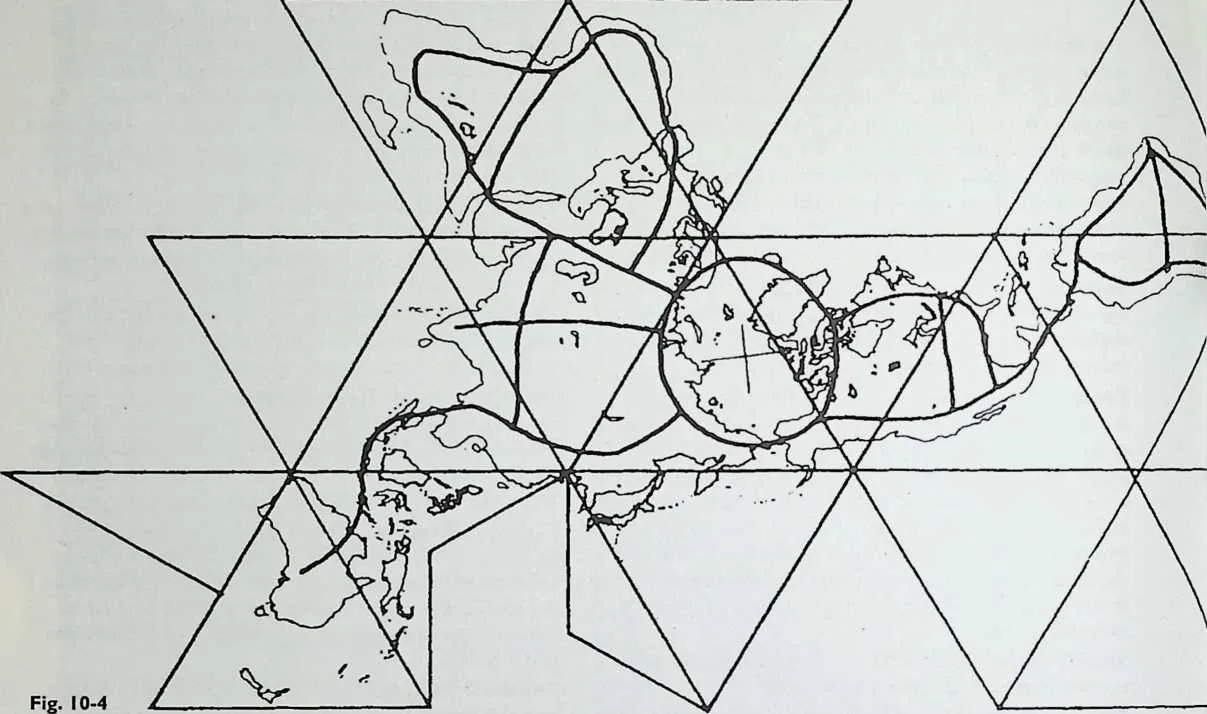
110 This Dymaxion Map shows the proposed interties of world electrical distribution grids. Smaller systems could join when they become large enough to play. Areas with autonomous systems would not need to join (they wouldn’t want to), but would benefit from the overall improvement in standard of living in their part of the world. All electricity users would benefit from more efficient end-use hardware—‘‘Megawatts’’ (the term coined by Amory Lovins) are the cheapest watts of all. For another Dymaxion Map, see Fig. 4-1.
111 GENI
112 Bucky considered World Game’s highest priority to be connecting the major electrical grids of the world, as he first proposed in 1927. Among the advantages of global interconnection:
- East-west power demand and supply can be matched worldwide to the time of day or night; north-south demand to the seasons (which, as you may recall, are opposite).
- It would be far more efficient—shared power means that generators running full time at their most efficient speed will take care of worldwide needs. Fewer of them would be needed. That means less pollution, too.
- Power companies would not need expensive, little-used extra capacity to level peak demand; if Los Angeles had a hot spell, the additional power needed for air conditioners could be ‘‘wheeled’’ (the official term) from a part of the world where demand was less.
113 8 The cost to consumers should drop as efficiency rises and power companies get more business—a win-win scenario.
- Political strife would be reduced; trade partners rarely fight.
- Population pressures should ease; statistics show that birthrates drop dramatically as rising electricity use brings a higher standard of living.
- Power from renewable sources—often from less developed countries that need the income—can be moved to where it is needed.
- Cooperative effort to build the connections would bring nations together.
114 Global Energy Network International—GENI—is prominent among organizations around the world that are working to bring this about. Both the high-voltage transmission technology, and computer controls are now available. The major obstacle is the lack of political will to put it in place. It is largely a matter of educating leaders and citizens to understand the advantages. That is the mission of GENI’s workers and their colleagues in other countries.
115 The enormous project is moving forward. Parts of the network are already under construction. GENI research shows that a link across the Bering Strait could be done for 5% of the annual military budgets of the U.S. and Russia, at an annual savings of billions for both countries. East and West Germany have already connected. Israel and its Arab neighbors are working on an inter-tie, a project that could help bring a stable peace to the area. Virtually all countries are talking about links. The United Nations is involved. The worldwide energy grid is happening.
116 A Global Dwelling Service
117 It took Bucky a while to understand why his designs did not revolutionize the building industry: There was no building industry to revolutionize. There still isn’t. It’s time.
118 We’ve had the technology to make Dymaxion Houses for about fifty years. Why can’t you buy one? As Bucky found out with his Stockade blocks (see p. 4), the product is only part of an industry. He didn’t have much luck dealing with marketing, distribution, servicing, customer relations, codes, zoning, environmental regulations, and all the rest of the infrastructure required to support a business. As we’ve seen, Bucky was a concept man.
119 There is also the matter of maintaining quality in a competitive situation.
120 People tend to buy on price alone, giving little thought to the cost of operation over the lifetime of the product. Using clever advertising, the cheapest product with tolerable quality wins most of the market.
121 What sells best is not necessarily the best. Moreover, there is no incentive for manufacturers to achieve state-of-the-art. Styling and other superficial changes keep customers coming. The huge capital outlay for a big change can be put off as long as possible. (The outlay can be huge indeed: Developing a completely new model of automobile costs several billion dollars.) Major improvements come slowly, as the discussion of gestation rates on page 12 shows.
122 Like any high-performance technology, a Dymaxion House would be optimized— a goal that does not cross the minds of most architects, much less the designers of mobile homes. Optimizing results in a different class of product. For example, the automobile and the airplane are about the same age. A century after their inception, automobiles are nowhere near as efficient or reliable as they can be. The finest European luxury cars are conceptually identical to a Model T—essentially the same except in detail.
123 Aircraft are built to be as efficient as possible. Reliable quality is a necessary goal—you can’t get out and walk if something goes wrong. The latest stealth bomber owes little to the Wright brothers.
124 A Dymaxion House owes little to past architects. It would be more akin to an aircraft than to a car. Except in price.
125 Aircraft are paid off over, many years of service. Autos don’t last long enough for that—they are prime examples of planned obsolescence. (Easily degraded conventional houses are examples of unplanned obsolescence.) The Dymaxion house would be close to the price of an auto—recall that Bucky correctly calculated that a high-tech house should cost about the same per pound as a car, and could thus be paid off as if it were a car. But that would still make it far too expensive for the very people who need it most. Bucky had an easy answer to that dilemma. Lease it—but not as a car is leased. Lease it in the same way that telephones were leased per month, before the breakup of the Bell Telephone System.
126 System is the key concept here. Alexander Graham Bell wisely concluded that he was not selling telephone equipment; he was selling communications service. He recognized that selling hardware would soon result in low-quality equipment that would degrade the quality of the whole system. Bell made its own phones at the highest possible quality to maximize performance and minimize the need for repairs. The company upgraded its owned equipment as technology advanced. Remember dials, ‘‘number please’’ phones, and the ones with a crank?
127 The monthly phone bill also reflected each customers tiny share of the enormously expensive system of wires, poles, switching apparatus, operating personnel, research, and manufacturing—all utterly unaffordable even to millionaires, if it had to be bought outright.
128 The scheme worked: The relative cost of calls has dropped every year since the company started, despite the company being a monopoly. In all but the poorest countries, telephone service is now available to everyone, at least on an emergency basis. Recent competition may or may not have reduced the cost of the system to the average user. Retail telephone hardware is certainly not as durable these days.
129 A Global Dwelling Service could take many forms. Complete Dymaxion Houses could be shipped assembled or as kits, with or without an Autonomous Package of some sort. They could be stacked to reduce land use and sprawl. They might be Garden-of-Eden climate-controlling shells that could be erected anywhere in the world to protect whatever was required.
130 Another scheme would ship molds and drums of molding compound instead of finished houses or kits of parts. Regional factories would then produce and service houses that were perfectly matched to local conditions and needs. Local industry could furnish the appliances and furniture, though the appliances would have to be of good quality and high performance to gain the advantages inherent in the Dymaxion structure.
131 Service would always be a part of the lease, and could include delivering supplies and removing waste. Appliances and the units themselves would be upgraded, replaced, or recycled as the technology improved. There would be a market for used houses and components.
132 Autonomous models would totally change the way people think of housing. House is architecture. Housing is a social matter. Widespread use could make cities obsolete in their present role as warehouses for goods and people. Bucky thought that, ‘‘Like a ship, houses will not be sold on a piece of land, any more than a ship is sold on a piece of water.’’ Worldwide standards would be applied to manufactured Dymaxion Houses. International agreements would make codes obsolete, just as autos and television sets do not have to meet the quirks of local codes.
133 Houses could be moved or replaced with more appropriately sized models if necessary. Seasonal migration would be feasible. Because the houses would be light enough to ship by air, less-developed countries would be able to raise their standard of living without building expensive and destructive road networks. They would enter the new era with air travel as the principal mode of long-distance transport. Birds don’t have to learn to run before they can fly.
134 Bucky saw a simple Dymaxion House as a replacement for the mobile home or prefab house, but there is no reason that deluxe models could not be developed. A worldwide market would demand the production quantities necessary to attract the capital and reap the benefits of mass production. It is an industry that has gestated long enough.
135 The first Global Dwelling Service consortium will be taking a risk, but they will also have the potential to completely change the fragmented way we build, just as the VW Beede transformed a business dominated by fat cars.
136 Initial financing may come from industries crippled by the collapse of the Cold War, finally bringing to pass the ‘‘weaponry-to-livingry’’ dream Bucky tried to bring in with the Wichita House. There was enough money to build Cold War killing hardware; the same money can now be used for more humane purposes. Once they are available, Dymaxion dwellings will be accepted worldwide for the same reason automobiles have been accepted worldwide: They fill a need. A true building industry is ready to be born.
137 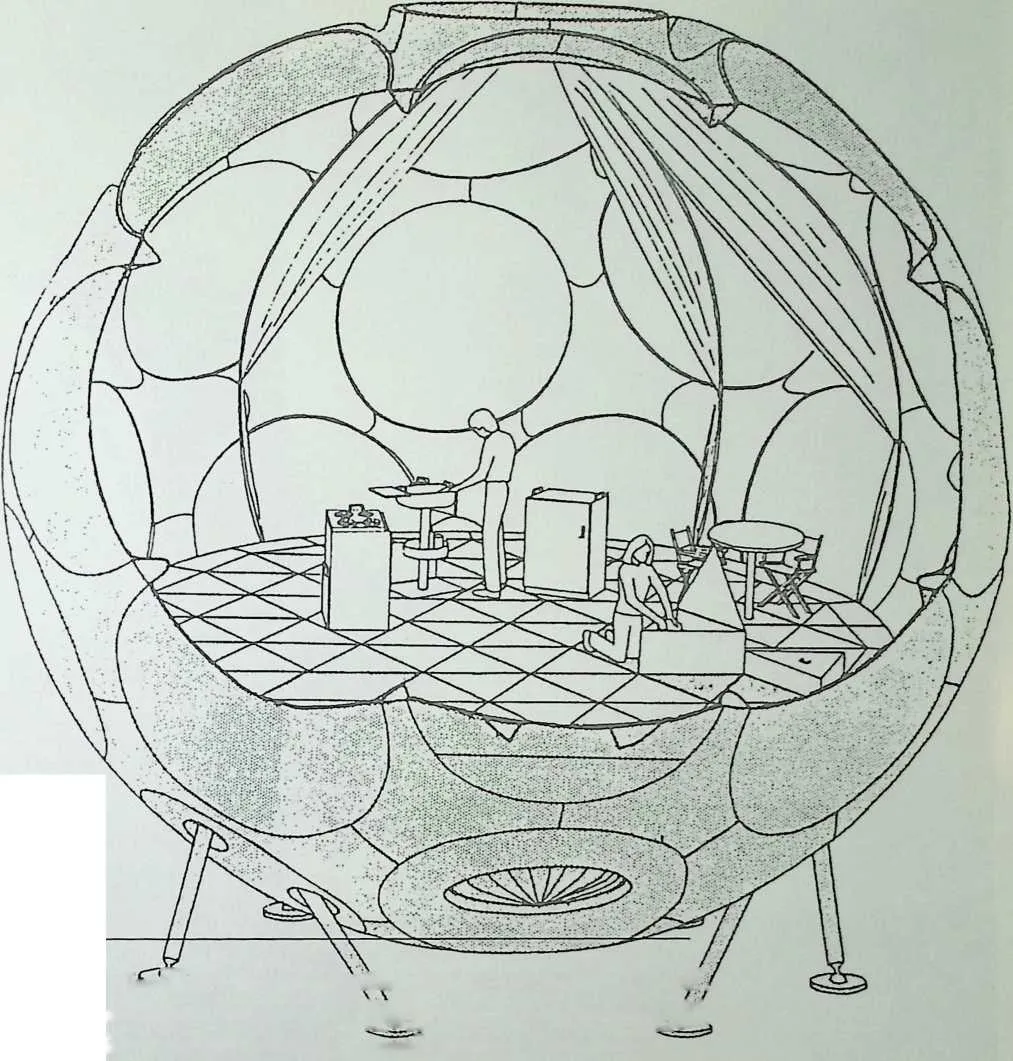 Fly’s Eyes
138139A Dymaxion HmtsSbas never far frornSBucky’s mind. The obsolete Wichita/> House could not be delivered ‘‘turnkey’’ rffryfor use—it required skillefff. on-site assembly. It was notfoolproof, its complex network of adjustable tension rods needed to be tunedfor perfect alignment of its hundreds of parts.
140A simpler design made from only a few types of self positioning components was needed. Bucky thought the Fly’s Eye concept had the potential to fulfill the requirements of a Global Dwelling Service. He was actively working on it at the time of his death. Several experimenters continue to develop Fly’s Eyes in a variety of sizes. Will they be the first to mass-produce a Dymaxion House?
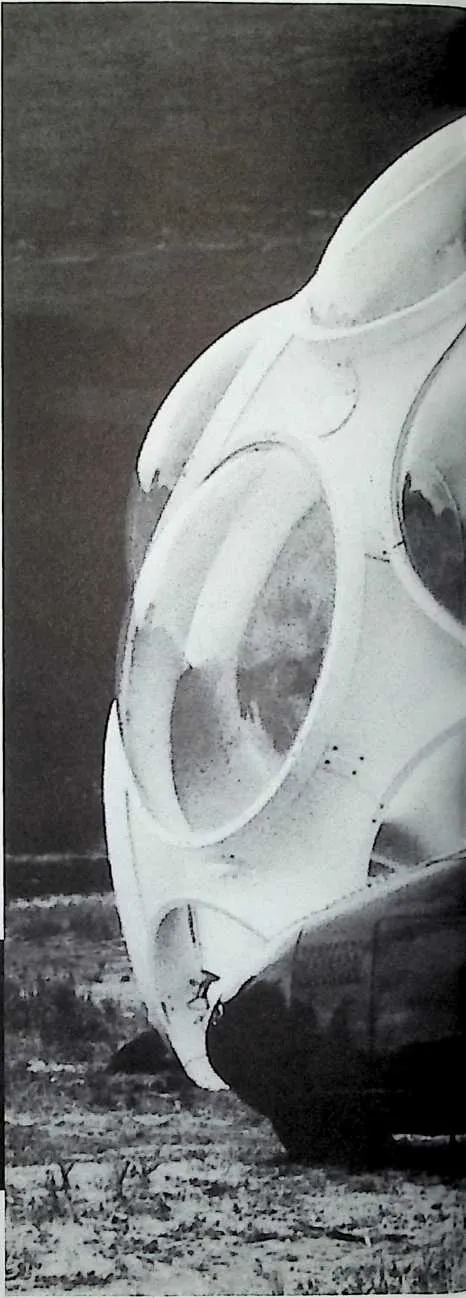
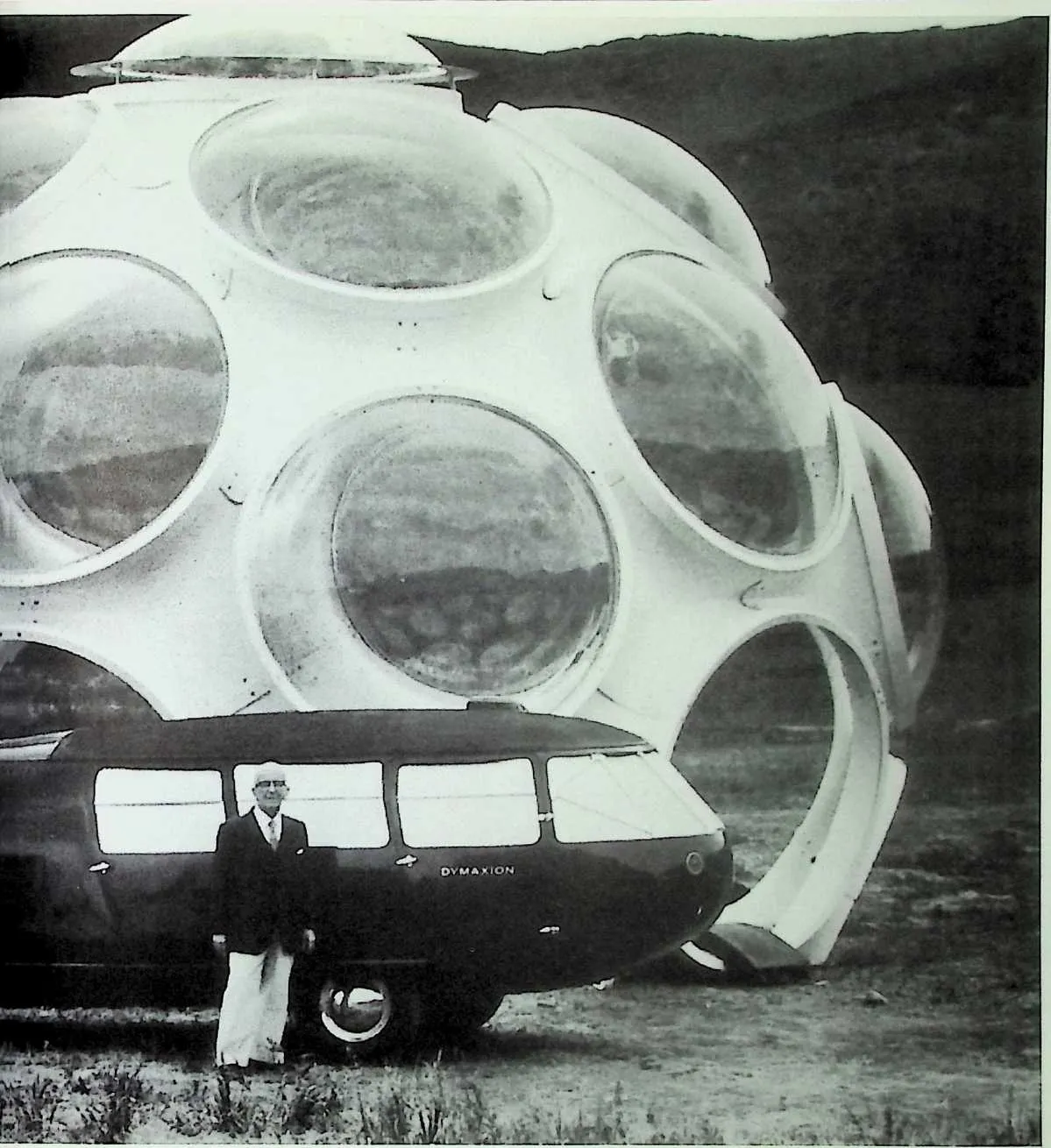
141 A taste of the future? Bucky and his 1934 Dymaxion car pose with his 26-foot (7.9-meter) Fly’s Eye dome during his 85th birthday party at the Windstar Foundation in Snowmass, CO, in 1981.
142 Fig. 10-5
146 Fig. 10-6
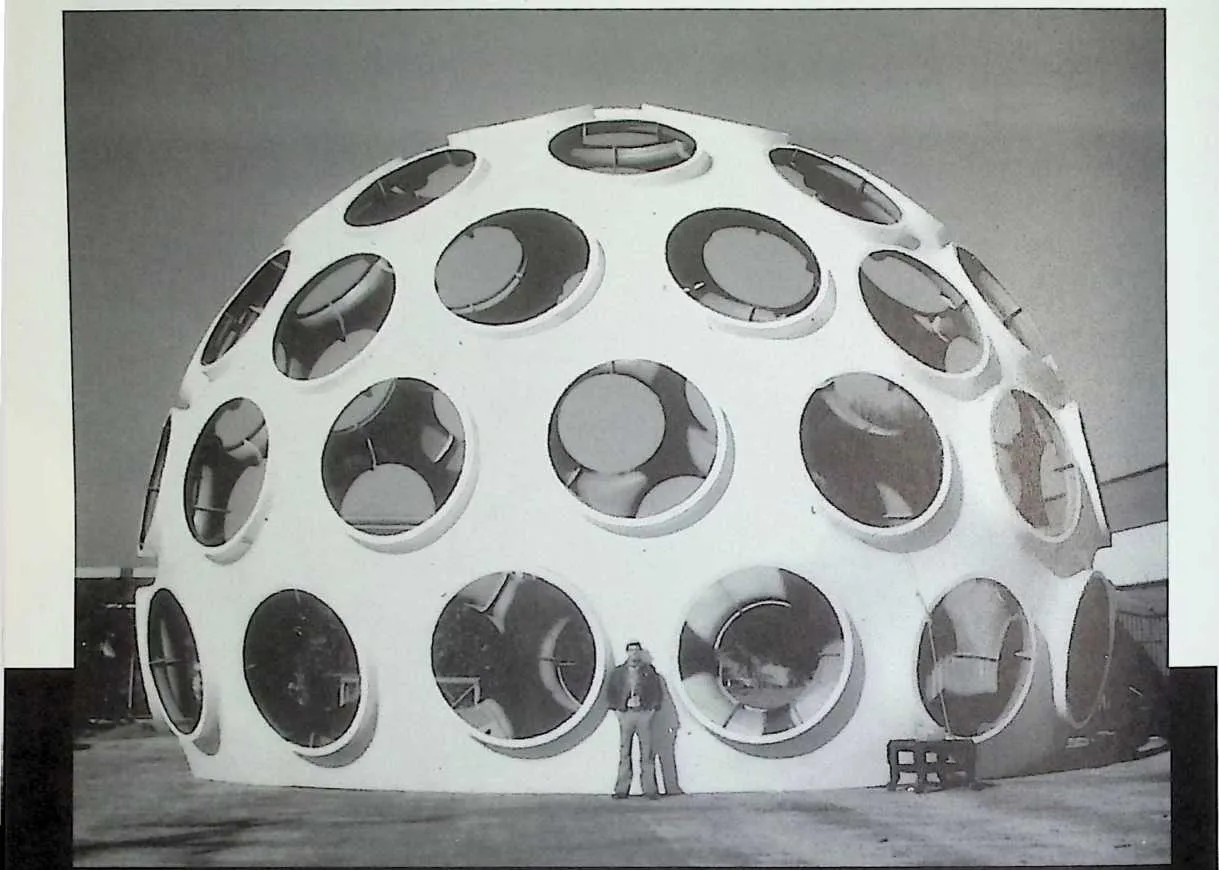
147 John Warren poses with the 50-foot (15.24-meter) Fly’s Eye he calculated and built to Bucky’s specification.The structure uses just three component sizes. Glazing and insulation remain to be worked out, but are not expected to present serious problems.The simple design allows amazingly quick assembly for a 4-story building.
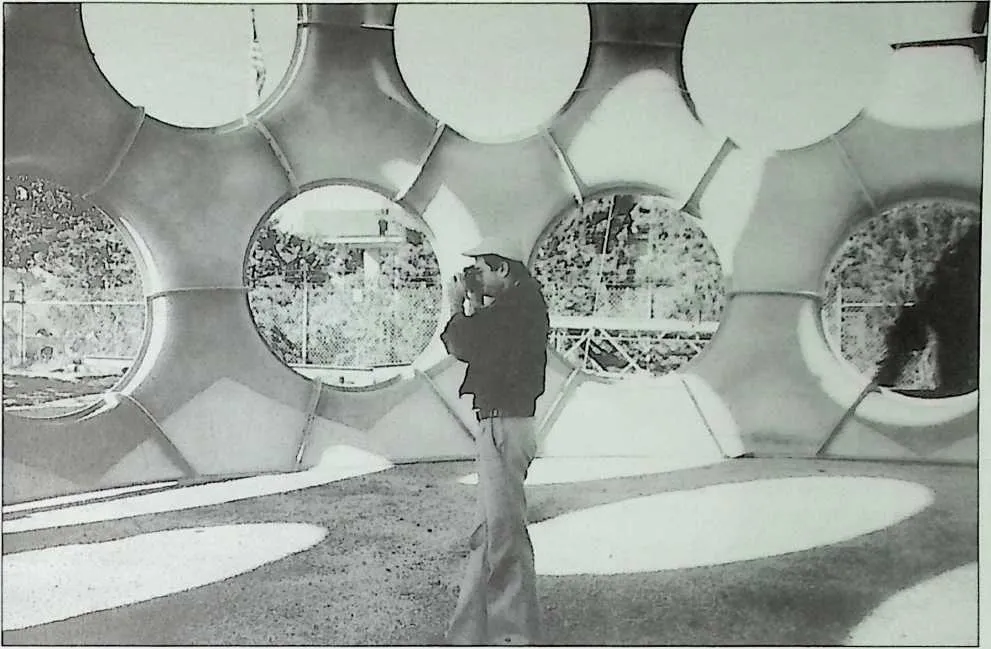
148 Bucky intended the 50-foot Fly’s Eye to be a Garden-of-Eden dome, but the large structural shadows shown here would
149 inhibit the growth of many sun-hungry
150 varieties of plants. Additional stiffening ribs
151 (visible at the panel joints) prevent compact stacking and shipping of parts, a solvable problem typical of those encountered in first prototypes. It has since been solved.
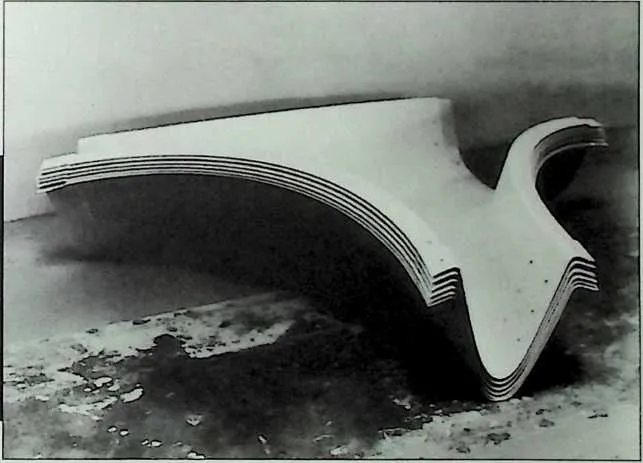
152 Fly’s Eye structural components are designed to nest tightly without damage, minimizing transportation and storage costs. Circular ‘‘eye’’ panels of various sorts would nest or stack flat, too. At this writing, the Fly’s Eye is undergoing development by several firms.
153 Fig. 10-8
156 The floor of this 26-foot (7.9-meter) Fly’s Eye
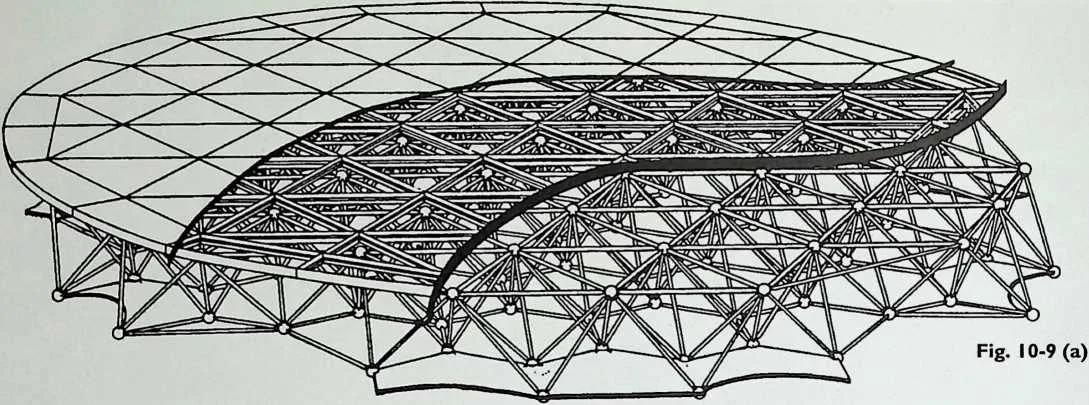
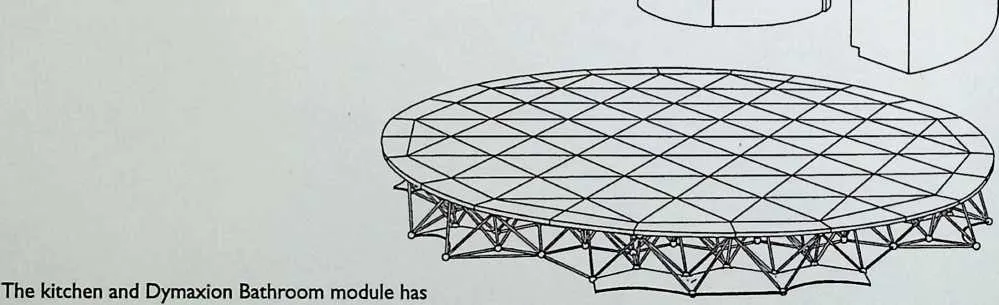
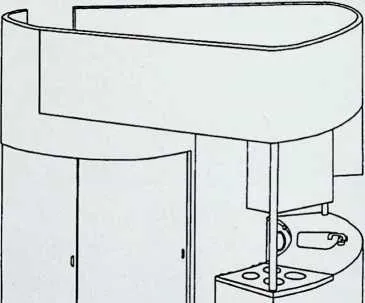
157158is an octet truss requiring no support columns. A complete or partial second deck could be made the same way.The diameter was chosen for its 7-foot (2.1-meter) circular openings—they’re large enough to accommodate practical doors.
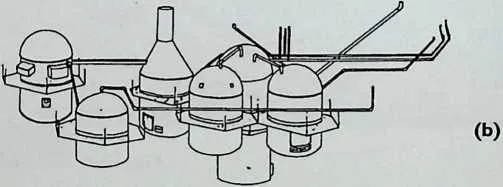
159sleeping or storage space above. Under-deck space is used for storage, tanks, and mechanical utilities.Water bags could provide thermal mass for passive solar heat storage. Using an entire sphere eliminates any need for a foundation, and gives remarkable structural integrity.
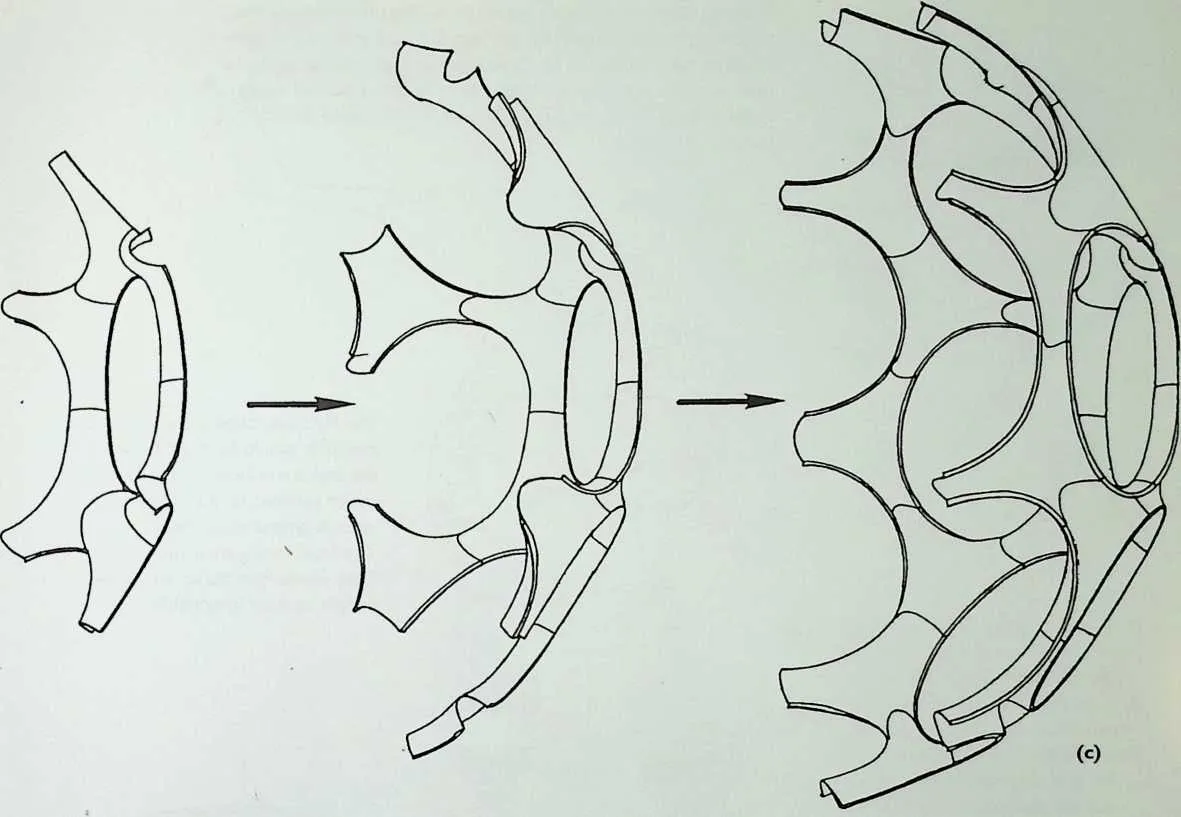
161 Only one size of three-branched, hyperbolic ‘‘saddle’’ is used to build up the structure of this 26-foot Fly’s Eye, greatly reducing tooling and manufacturing costs. Automated production is assumed.With precision-drilled holes and watertight,‘‘downhill’’ joints, there is little chance that assembly can go wrong.
162163
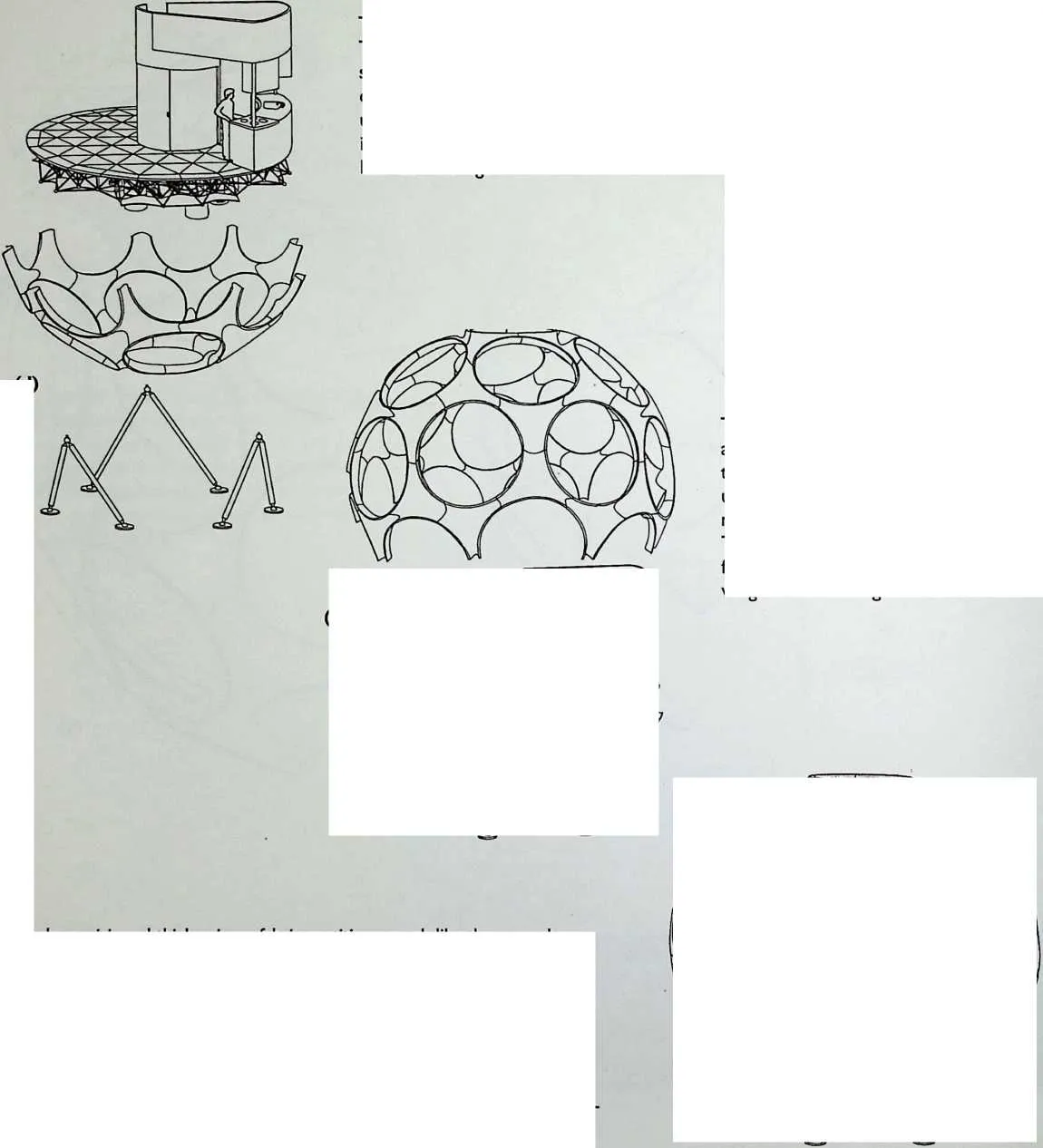
Bucky envisioned thick privacy fabric partitions, much like those used on the Dymaxion Deployment Units (see Fig. 2-14). A second deck could also be used as a space divider.With the mobile furnishings shown, the floor could be quickly cleared for parties or ballet, for example.
164 (d)
165 Three sets of adjustable legs serve as the triangulated ‘‘foundation.’’ The only earth-moving work would be drilling pier holes for the six concrete pads supporting the feet. On hard ground, the sphere could be held in position by three cable anchors similar to those used to brace utility poles. Earthquake resistance is total except in the unlikely event the ground fractured and spread directly between the legs.
166 The Fly’s Eye takes shape. On-site assembly would be done from the top down, hoisting the finished upper sections up a temporary mast in typical Bucky fashion. The load-bearing shell and trussed floor permit just about any lightweight interior imaginable.
167168
‘‘Eyes’’ could be filled with a variety of glazing, doors, vents, irises, or solar panels. Individual, circular eye-fillers do not carry structural loads other than those applied directly to them. Snow and wind loads on an eye are transferred to its six surrounding saddle components, which in turn distribute the load throughout the entire structure in a typical geodesic manner.
169A Fly’s Eye flies. Existing helicopters could easily deliver or move an assembled Fly’s Eye.A maintenance service would keep them up-to-date, replacing them with the latest models as necessary. If the neighborhood changes in an undesirable way, call the ‘copter and move out.The autonomous spheres would need no utility hookups.
171 Fig. 10-10
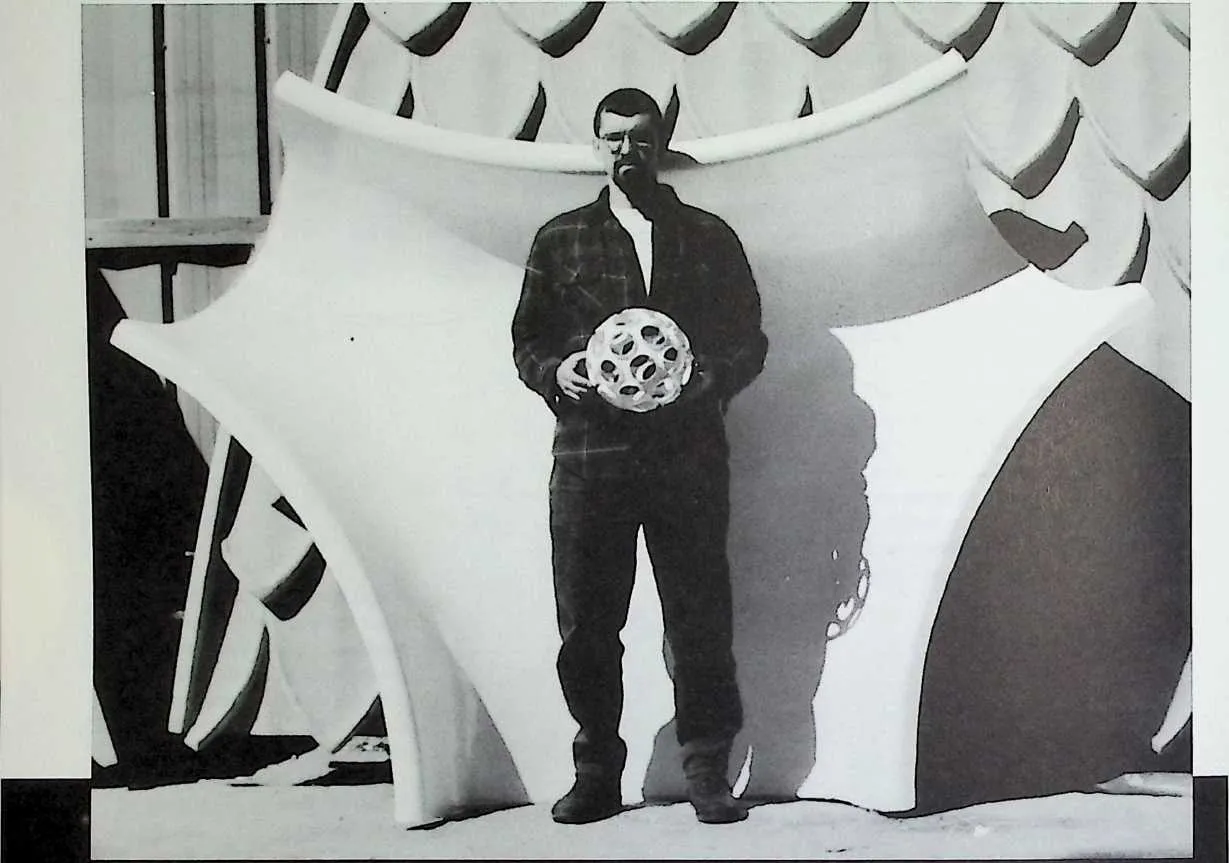
172 Designer-builder John Kuhtik poses with a model in front of a freshly-minted saddle component of a 33-foot (10-meter) Fly’s Eye he is developing. Private individual experiments are often slow and painful, but may bring important breakthroughs as ‘‘evolution makes many starts.’’ Plenty of time to think, and no bureaucratic penalty for failed attempts are among the reasons why.
174 •—*-
175176The Whole Earth Catalog
177‘‘The insights of Buckminster Fuller are what initiated this catalog,’’ wrote Stewart Brand in his first Whole Earth Catalog in 1968. It was a pioneering attempt to gather the information needed for independent thinking and living, a goal dear to Bucky’s heart. Stewart Brand insisted on good information, gathered from the experience of readers and subscribers. No subject was forbidden.
178A policy of reporting only positive results and recommendations engendered the positive attitude necessary for spirited exploratory effort. A policy of rejecting all advertising, political and religious ranting, sinner-smiting, and proselytizing on any subject made the information credible and trustworthy. Reader feedback corrected errors, kept things honest, and introduced innovation. Those publishing policies are still in force today.
179In 28 years of publishing, about 1.2 million copies of the various Whole Earth Catalogs have been sold. Reader response indicates that they have been put to good use. A Whole Earth Catalog is still published from time to time, and the companion magazine, Whole Earth Review, appears regularly as an eclectic quarterly that is often first to publish advanced ideas. There’s a Web site. The Whole Earth publications continue to fulfill the task of gathering, and, especially, winnowing information that Bucky saw as one of our most important duties as humans.
180(Another grain of salt: I am among the many Whole Earth editors.)
181All systems are polyhedra. —RBF
182The venerable and justly famous cyberneticist, Stafford Beer, has based his latest organization scheme on a single statement by Bucky, who insisted that all systems were polyhedra, whether or not they were conceived or perceived as such. Though corporate tables of organization are often presented as a flat branching arrangement with the boss at the top, real systems are always multidimensional. Professor Beer’s decades of work with the science of organization have included investigations of geometry as an organizing principle. He uses the icosahedron as a model for organizing projects for much the same reason Bucky used it for structure: efficiency.
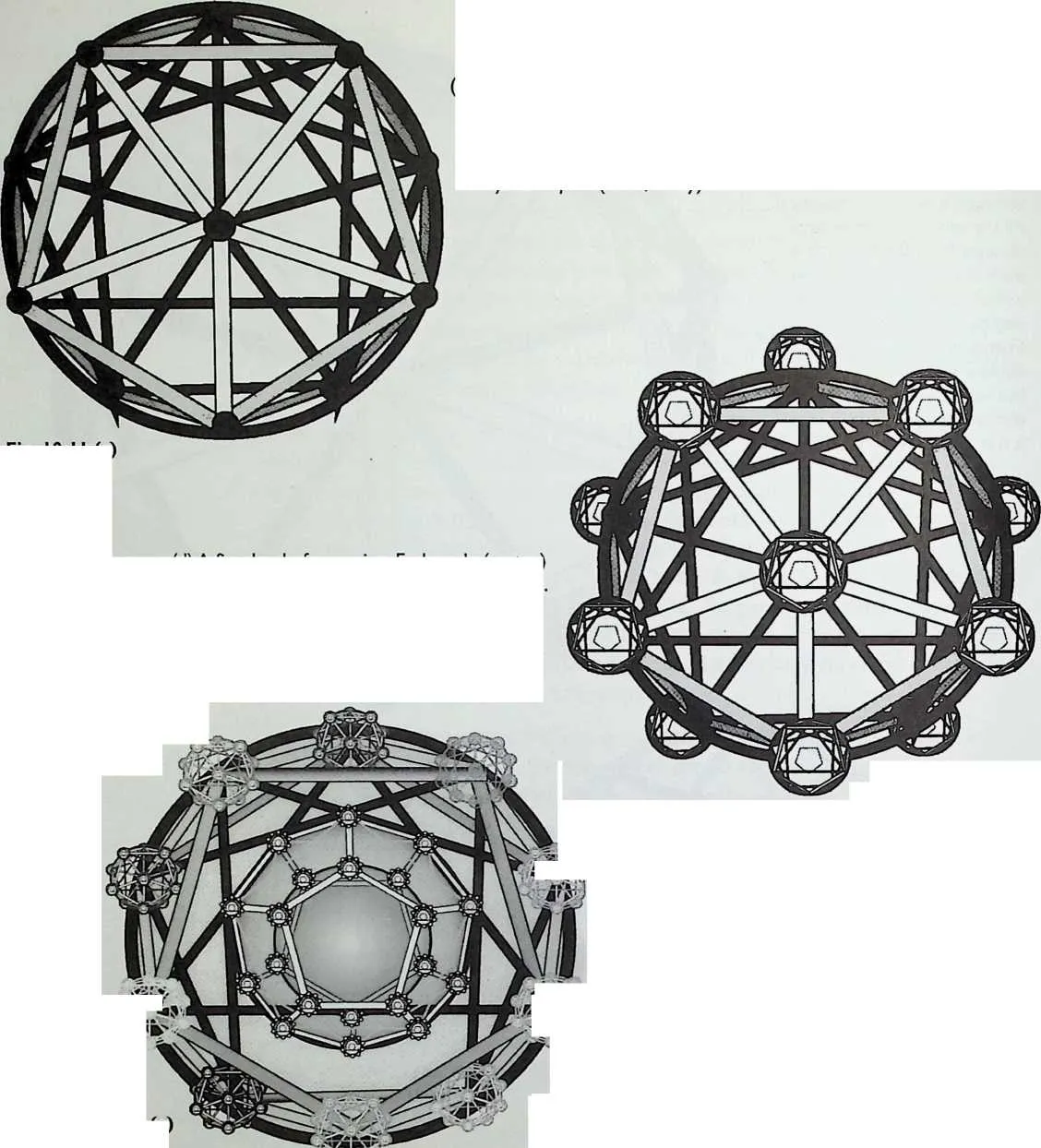
183Team Syntegrity® regards each of the 30 edges of the hollow icosahedron as a member of a decision-making team with a specific goal (Fig. 10-1 la). The 12 vertexes represent major aspects of the project. Each person thus has partial responsibility for two parts of the project, and works directly within two groups of five people. Those groups can connect with other groups on the surface and across the interior of the icosahedron as shown in Fig. 10-1 lc. The icosahedral pattern tends to be self-organizing and stable. No person or group is more than a few steps from any other. The short communication paths maximize participation and facilitate a role-equalizing process that is much more efficient than the usual boss-and-underlings arrangement.
184Of course, a ‘‘Syntegration’’® (from synergetic integrity) is more complicated than the explanation above. Professor Beer details the mathematical analysis in his book Beyond Dispute (1994, Wiley). His company, Team Syntegrity, Inc., conducts ‘‘Syntegrations’’ with people seeking to organize a project and get it done. Reports indicate that the technique shows great promise. In 1995, the team working on Old Man River’s City (Chapter 9) found that a Syntegration helped to revitalize and focus their work.
185Team Syntegrity continues to refine their methods. New developments include a version that requires less than 30 people—a boon for smaller enterprises. At the opposite end of the scale, Fig. 10-1 If shows how the Syntegrity protocols can be enlarged to bring order to enormous undertakings such as those Bucky envisioned for a just global economy. (For more information, see Appendix B.)
186 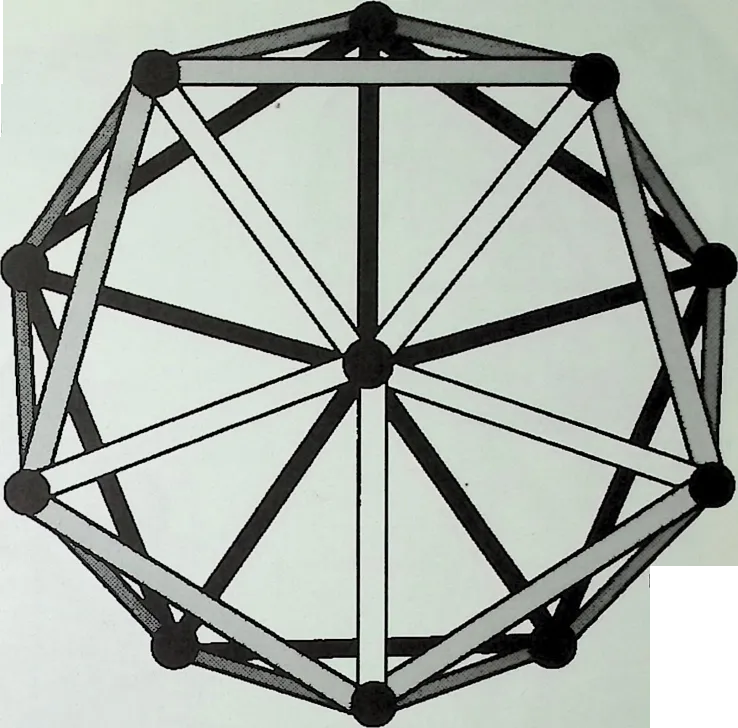 The icosahedron has 20 equilateral triangular faces, 30 edges, and 12 vertexes. It is
omni-symmetrical. All the vertexes are the same distance from the center. It is the most efficient
volume per unit of invested structure, and may be regarded as a one-frequency geodesic sphere.
Bucky noted that a geodesic line was not only the shortest distance between two events, it was
also the shortest time.
The icosahedron has 20 equilateral triangular faces, 30 edges, and 12 vertexes. It is
omni-symmetrical. All the vertexes are the same distance from the center. It is the most efficient
volume per unit of invested structure, and may be regarded as a one-frequency geodesic sphere.
Bucky noted that a geodesic line was not only the shortest distance between two events, it was
also the shortest time.
187 Fig. 10-11 (a)
189 Fig. 10-11 (b)
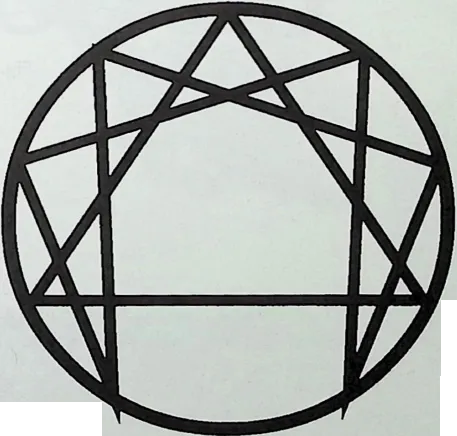
190 (b) The enneagram nine-pointed (ennea) figure is an ancient symbol of mystical geometry. Team Syntegrity® President, Joe Truss, noticed that the figure perfectly fits the interior of an icosahedron, literally bringing a new dimension into play.
192 Fig. 10-11 (e)
193 -•t Sv.
194 ...
195 (c)The icosahedron with an enneagram in position, making the traditionally flat ancient figure multidimensional for the first time.The resulting relationships are too com
196197plex to describe here; you’ll have to read Stafford Beer’s Beyond Dispute (1994,Wiley) for details.
198 Fig. 10-11 (c)
199 (d) A first level of recursion. Each node (vertex) of the icosahedron is a copy of the entire figure.
200 Fig. 10-11 (d)
201 w
202203(e) Cutaway view, with the front struts of the icosahedron (white in Fig. I l-d) removed for clarity.
204 The second recursion into the icosahedron is shown through the dodecahedron contained within. Again, each node contains the entire figure.You’ll have to make a model to really understand how they fit together, but at least a model is possible.
205 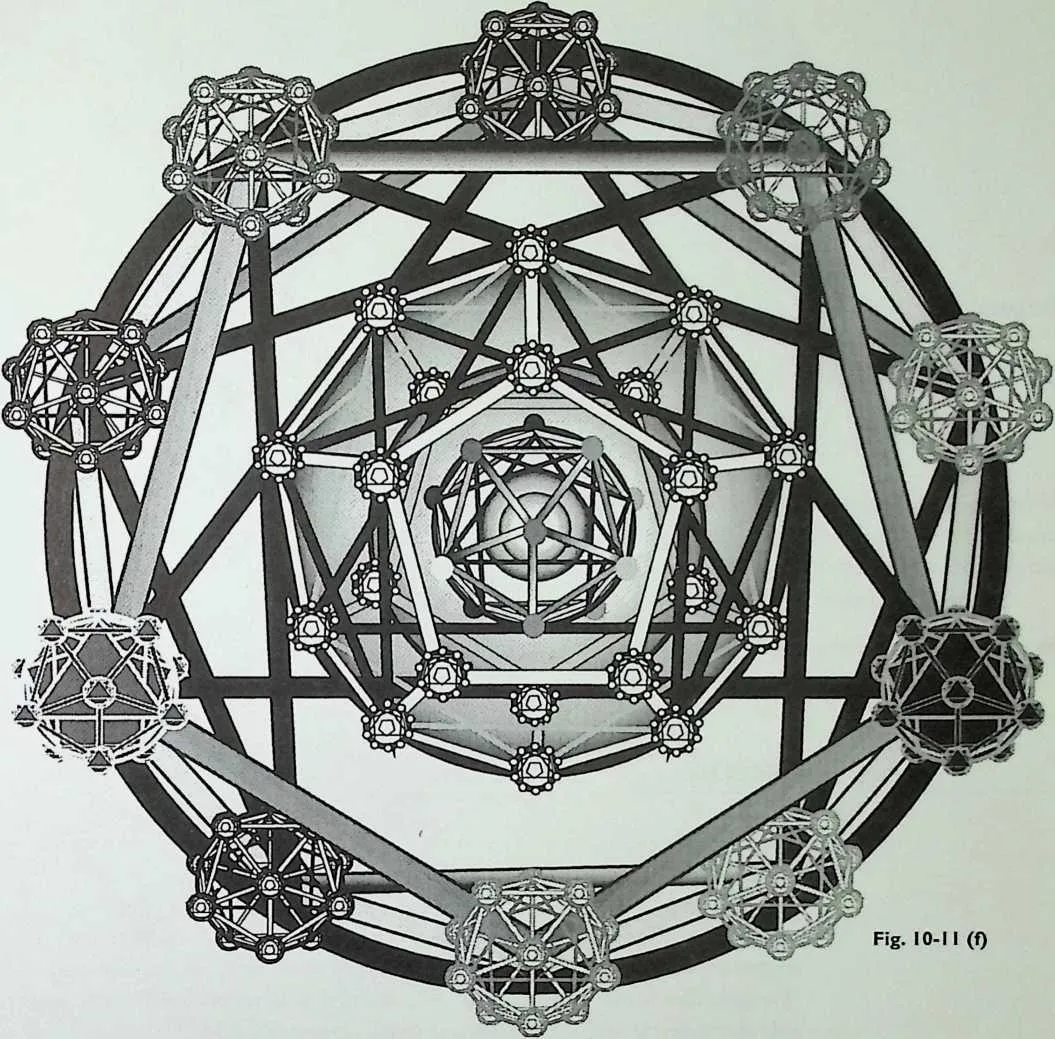 This full multi-recursive, fractal icosahedron shows three recursions into the interior,
starting with the outer icosahedron, then the dodecahedron, with another icosahedron inside
it.
This full multi-recursive, fractal icosahedron shows three recursions into the interior,
starting with the outer icosahedron, then the dodecahedron, with another icosahedron inside
it.
206 Moving out around the nodes (vertexes) of the outer icosahedron, each node is itself the entire figure. Recursions into and out of the original icosahedron can repeat as needed to handle the organization of enormous projects.