
11 Jobs and Work
2The trouble with Bucky’s lectures is that I go home afterwards all inspired and ready to work on the important things he talks about, but the next morning I just go right back to what I was doing the day before.
3 —Often overheard, in almost identical words, while leaving Bucky’s lectures.
4 The work ethic is not lost; work is largely obsolete.—RBF
5 Security
6 The usual reason for working at futile, boring jobs is that you have to make money in order to live. There’s rent to pay, food to buy, perhaps a car or a child that needs your care. Bucky noted, with irony, that 70% of all jobs do not produce life support. Many are with his metaphorical firm, ‘‘Obnoxico,’’ a growing megacorporation flooding the world with needless knickknacks. Working life’s hours away at that sort of enterprise soon reduces people to robots—a heavy price to pay for security. The goal is a good life later, like heaven. Workers work for financial security, with a health plan, and the prospect of a pleasant retirement.
7 Guinea Pig Bucky did not think much of that way of life. It is not what we were designed and built to do. A very small disturbance—illness or accident—will severely disrupt a person on the nine-to-five path. Much hard-earned money is spent on insurance that is not very sure. That cautious and obedient life strategy brings the illusion of security to many, but dependable security to very few. Yet Nature must have designed us to be a success.
8 Desirable alternatives to a steady job are hard to see. Most people depend on others for a job. Despite all the talk about leadership in school, we have been taught to obey without complaint. Mistakes—the only way to learn—are punished. The captain of the football team is the kid that most perfectly follows the rules set down by a previous generation.
9 The smartest people are trained in esoteric specialties that isolate them from understanding wholes, though nature is whole, and does not have departments. Academic specialties are a kind of competition; the best performer gets the prize. Competition, rather than adventure, is rewarded. The chance-taker straying over established boundaries rarely wins.
10 The urge toward financial security leads to psychological fortress-building. Investments, equity, and fear of ageing take precedence. Fortress-builders soon focus their lives on defense. They take up a conserve-MXNZ political position, and a mind-set that sees little merit in the imagination that drives evolution. Evolution, however, proceeds anyway, leaving them (insecurely) behind.
11 There is another kind of security: being too fast and agile to hit. This strategy requires taking chances and thinking for yourself. It can be effective: Bucky said, ‘‘All human advances occur in the outlaw area.’’ This sort of security is an individual matter, not dependent on insurance or politics.
12 There is risk, of course, but there always is, no matter what path you take. You may have to live simply. You may be lonely, as Bucky seemed to be despite his wife’s support. Bucky recommended self-discipline, high spirits, and trust in God. His accomplishments are astonishing, especially when you consider that he started his major push at age thirty-two. He insisted that anyone could have done what he did. That may have been excessively modest, but certainly anybody can gather their strength and try.
13 Nine-to-five jobs may seem safer, but they have an uneasy aspect: As population rises, there are fewer of them. Even in emerging industrial societies with low wage scales, ‘‘grunt work’’ is being displaced by automation. A significant number of the jobs that remain are unnecessary. They will be eliminated in the same way that ATMs have eliminated most bank tellers.
14 Bucky favored this trend toward the elimination of stultifying jobs. He said, ‘‘Automation displaces automatons.’’ He also had scant respect for reformers who recommended a return to an agrarian society. Humans are not built to be either cogs in an industrial process, or beasts of burden on a farm.
15 The feeling of insecurity that most people feel is based mostly upon threats arising from an unfair distribution of earths resources. Like air, the resources really belong to all of us. People should get the same pay for the same work no matter where they live. National differences in the value of money are purely artificial, serving only the interests of a tiny, parasitic elite. A skilled machinist should make the same money whether he is in San Diego or Tijuana. Only a line drawn on a map separates the two. The only true security will come when all people can live well without fear, working cooperatively to make the world work for everyone.
16 On a cool April evening in 1982, after the grand opening of the Pillowdome, four of us drove Bucky back to his quarters in Boston. We’d rented a large, cushy Buick for the trip, because he was still recovering from hip surgery. He was visibly tired—it had been an exhausting, but good, day. As we whizzed along the freeway in silence, he suddenly turned toward me and asked sharply, ‘‘Well, old man, when are you planning to retire?’’ Then he cackled like a fiend. The four of us cackled on and off, in waves, for the next ten miles.
17 Jobs, Work, Duty, and Earning a Living
18 You can’t run out of money any more than you can run out of inches.
19 Only humans need money. We don’t need it to be a physical success.—RBF
20 Bucky knew he astounded his audiences by asserting that they didn’t have to earn a living. A few unrealistic souls took that to mean that they didn’t have to work. Bucky meant nothing of the sort. There may not be enough jobs, but there is always plenty of work.
21 Financial journals are unanimous in claiming that the concept of a lifetime ‘‘career’’ is on the way out. People are now hired to work on projects. This is nothing new to innovators—they’ve always done that. The change from big corporate jobs to private projects is spreading. Jeremy Rifkin, in his 1995 book The End of Work (Tarcher/Putnam), discusses the international rise of what he calls ‘‘the third sector,’’ people working in areas left un-served by government and corporations. It’s a good place to work.
22 How do you decide what your personal project is to be? Bucky suggested that people able to do so should use the following strategy:
23 First, look for problems that need to be solved. That requires you to be comprehensively alert to everything, not just certain things that interest you. If you are ever bored, it’s a sign that an important part of your mind is asleep.
24 Sensitivity is required; some of the signals are hard to detect. Bucky claimed that ‘‘The best ideas seem to be musty, like they came complete from far away.’’ (He suggested that ideas might be projected, as a sort of metaphysical radiation.) Sensitivity is suppressed by seeking to eliminate pain, which is what people really mean when they say ‘‘security.’’ You have to be open to everything to be a good receiver. Sometimes you get knocked around a bit. That’s part of the game.
25 Second, learn all there is to know about the problem. Focused learning is a very powerful tool. Attend to what nature is trying to do—opposing nature is futile, inefficient, and is an old-mode way of regarding the world. You may have to experiment. Total commitment is essential.
26 You may have to work at a second job to finance your investigations, but Bucky said that Universe could be trusted to supply the needs of humans working at making all humans a success. Backup jobs should be selected for their potential as useful experience or practice.
27 It is well to have multiple skills as reserves in case of delays. Delays are also a good time to do background research to increase your knowledge base.
28 The third step is proof-of-concept. That’s when you transfer from the think-tank to the do-tank. You must demonstrate that you have solved the problem. You actually do it, make it, test it, or whatever is appropriate to get it to the people who need it. Though Bucky rarely had the time to do so, it is a good idea to live with, or in, your work. Make your own prototypes when possible. That way, you’ll achieve an intimate understanding of what you have designed.
29 When (not if) people protest that your idea will require too much money, ask, ‘‘What will it cost if we don’t do this?’’ (That was one of Bucky’s favorite questions.) The answer is the true cost. If there is competition, remember that your goal is inclusive, not exclusive. Also remember that ‘‘Obsoleting is different than competitive attack.’’
30 Finally, you need to be patient. Project work comes in waves. As we have seen, innovations have their own gestation rate. You are probably ahead of your time. You can’t hurry a rose by prying open the bud with a screwdriver. If you have done your work well, your discovery will slowly, inevitably, work its way to where it is most comprehensively effective. Bucky noted,’’If you’re right, you’ll do OK. This is where the courage comes in.’’ He certainly had courage: He did not regard the crashes, fires, and vandalism that plagued his projects as some sort of jinx, but as battle-hardening tests of his philosophy. Sometimes his life must have seemed to resemble that of Job in the Old Testament, but he never slowed.
31 Can you make a living working like this? Of course! Bucky did. Everyone I work with and write about has either started their own business, is an artist, or is working on a team that is engaged in making things better for everyone. All are teachers, though few are officially. Teaching is an essential part of a designer’s work. Bucky considered his artifacts to be pedagogy. Just looking at them teaches you something.
32 ‘ Teaching and learning are what we are here to do. Bucky said that biology balanced entropy. Humans were the most powerful (known) anti-entropic force of all, because we accumulate and purvey knowledge, adding local order to Universe in the same way that a plant synthesizes air, sunlight, and soil nutrients into botanical life. Bucky’s definition of Universe did not permit the discouraging concept of an overall entropic ‘‘winding down’’ into total disorderliness. There is always a building-up of orderliness someplace else in nonsimultaneous Universe. Because anti-entropy is a double negative, Bucky called it, ‘‘syntropy’’. Our purpose and duty as humans is to be syntropic.
33 The syntropic accumulation of know-how, combined with the 96 natural elements, is real wealth. We can’t know less. Einstein showed that matter can neither be created nor destroyed. Therefore, real wealth can only increase.
34 The Chronofile showed Bucky that every time real wealth is used, it increases. Using real wealth synergetically increases it faster still.
35 Knowing this, realizing this, gives us enormous power. In his later years, Bucky devoted a lot of effort toward convincing a critical mass of people to take advantage of this power before it was too late. He had expected the design science revolution to happen spontaneously and successfully long before. For most of his life as Guinea Pig B, he had been sure we would make it. His hopefulness was one of the things that attracted so many young idealists to his camp. At the time of his death, he was not so hopeful. We’re made to solve problems with our minds, but muscle is still in control. Could the successful failure of Guinea Pig B. ultimately fail?
36 We may be about to find out. Bucky considered now to be the Dark Ages compared to what we could accomplish. He worked 50 years ahead to give us some of the tools we would need to ‘‘graduate’’ into being a wholly successful species. He insisted to the end that nature is trying to make us a success, that nature is readying us for an important function. Among all known beings, we have been given access to the principles governing Universe. From our tiny planet, we can tell the chemical composition of stars in a 3.2 billion light-year radius around us! We have been developing for millions, possibly billions, of years. We must be important. We must have a big responsibility. We’d better get to work. Guinea Pig B left us plenty to work with.

38 Human integrity is the uncompromising
courage of self determining whether or
not to take initiatives, support or
cooperate with others in accord with
‘‘All the truth and nothing but the truth’’
as it is conceived by the divine mind
always available in each individual.
39 Whether humanity is to continue and
comprehensively prosper on Spaceship Earth
depends entirely on the integrity
of the human individuals and not on
the political and economic systems.
4041The cosmic question has been asked—
42ARE HUMANS A WORTHWHILE TO UNIVERSE INVENTION?
43 —Buckminster Fuller, St. Valentines Day
Penang, Malaysia, Feb. 14, 1983
And Chinese New Year
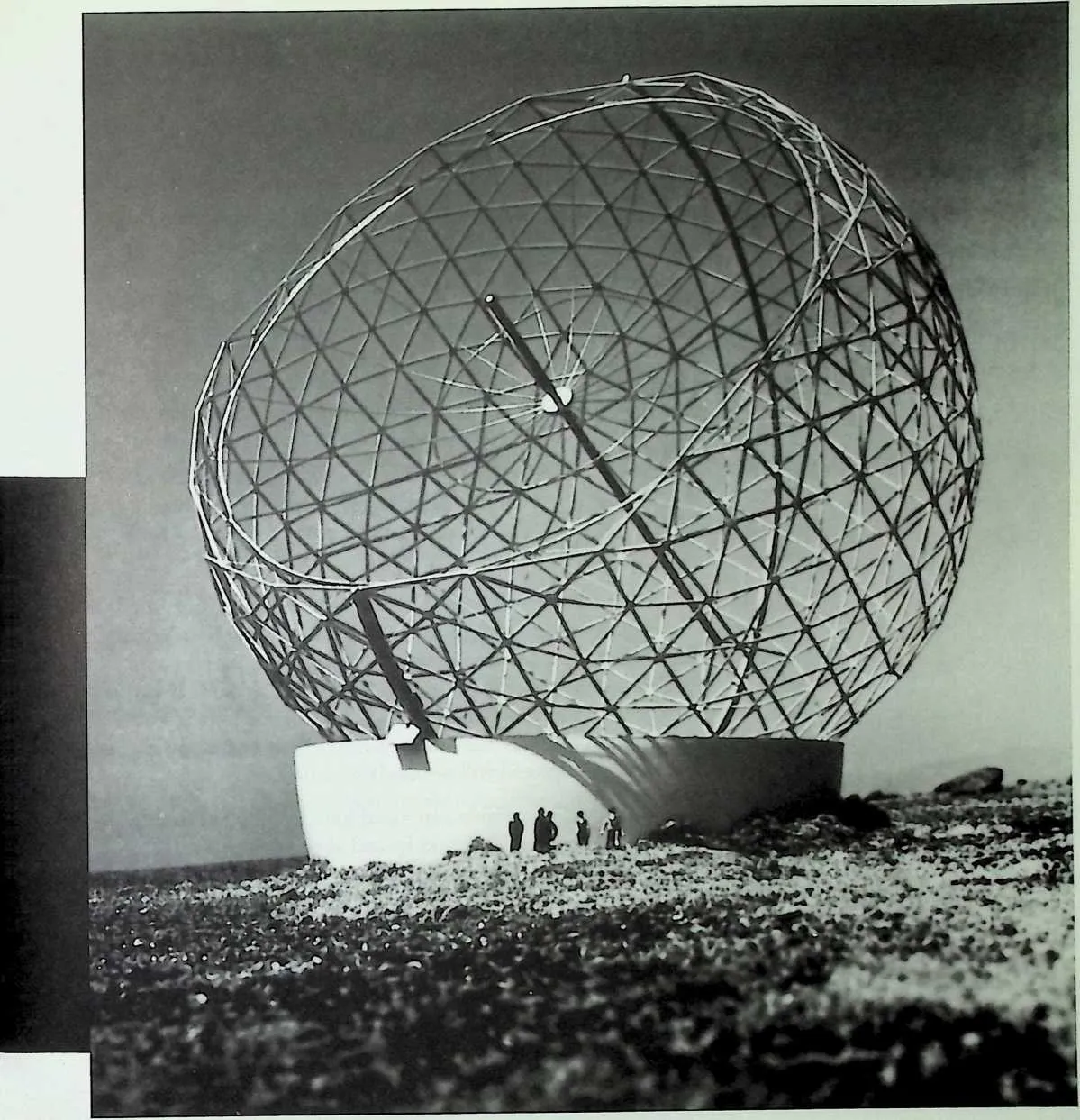
44 Charles Eames, famous for furniture design and the movie Powers ofTen, collaborated with Bucky on this proposal for a I OO-foot (30.5 meter) diameter geodesic radio telescope. Its hollow, sealed struts float it in a container of liquid, damping vibrations and allowing precision aiming.The geodesic support structure was designed to expand and contract without distorting the ‘‘lens.’’ The project never progressed beyond the model stage.
4647Fig. ll-l
48 Appendix A
49 Selected Bibliography
50 The following books, tapes, and videos have been chosen for their value as introductions to Bucky’s thought. I recommend Robert Snyder’s fascinating World of Buckminster Fuller video (see below) as the most effective way for a beginner to begin.
51 Many of the books listed are out of print. The Buckminster Fuller Institute (BFI) can help you find Bucky’s writings (see Appendix B), and offers Xeroxed versions of some. The rest will have to come from your local library or used bookstore. BFI also stocks most of the videos and tapes available, many model kits, the Dymaxion Projection Map, and a line of Bucky-related items. Some of the books are pricey, but keep in mind that most of Bucky’s ideas are at the forefront of human knowledge and will not easily go out of date.
52 BFI publishes a comprehensive, reliably annotated bibliography by educator Alex Gerber. It features more than 40 books by and about Bucky. Your local library might like a copy, too.
53 Selected Books by R. Buckminster Fuller
54 (in chronological order so you can sense the ideas developing):
55 4D Timelock, Self-published in 1928. Reprinted in 1970 by The Lama Foundation, Corrales, NM
56 Bucky’s first book presents the larval form of the basic concepts he would elucidate throughout his later work. The emphasis is on housing and thinking for yourself. Metaphysical, cantankerously self-justifying, and occasionally just plain wrong (he thought the stock market would carry us all to prosperity), the original thinking and extreme language established him as a visionary oddball that would bear watching.
57 Nine Chains to the Moon, J. B. Lippencott, 1938.
58 At the time it was written, if all Earths population had formed human chains to the moon by standing feet-on-shoulders, there would have been nine.
59 Most of the book establishes and refines the metaphysical basis for Bucky’s later work. Ephemeralization, Dymaxion principles, Einsteins ideas, and Bucky’s revisionist history are all here in surprisingly complete form. It’s still radical. (A new edition would have to be called Twenty Chains to the Moonl)
60 Education Automation, Southern Illinois University Press, 1962.
61 This treatise presciently calls for education by what we’d now call multimedia. Bucky outlines the campus planning that would facilitate it, but he was too far ahead of his time to convince entrenched school administrators with no interest in changing anything. His own Southern Illinois University not only rejected his ideas on education, it specified a non-geodesic dome for a new field house. Personal computers had not yet been invented, and there was no Internet, yet he called for the changes in worldwide education that we are witnessing and applauding today.
62 Operating Manual for Spaceship Earth, Penguin, 1973.
63 Bucky coined the term, Spaceship Earth, but this metaphor is not at all the mechanistic viewpoint that Bucky’s critics claim it to be. (Apparentl, they haven’t read further than the tide.) This vision of Earth stewardship is based on discovering the basic principles used by Universe, then applying them for the betterment of all humankind. Bucky assumes that safe, happy people will treat the planet and one another well.
64 Synergetics: Explorations in the Geometry of Thinking, Macmillan, 1975 Synergetics 2, Further Explorations in the Geometry of Thinking, Macmillan, 1979.
65 In these two weighty books, Bucky fills nearly 1300 pages with his Energetic/ Synergetic geometry (Synergetics), weaving its principles into a logical basis for everything he advocated and did. E.J. Applewhite collaborated with Bucky to winnow the enormous mass of information into usable form. The books are a challenging read, redolent with brilliant insights, interpretations of Universe, and tantalizing suggestions, all tempered by complicated explanations, metaphor, and baffling sentences. The second book has a paragraph-by-paragraph index to both. The many drawings help, but you will probably find Amy C. Edmondsons A Fuller Explanation (see below) essential. Cosmography can serve as a respectable introduction and review. An animated CD ROM combining both books is under construction. It promises to clear up inconsistencies and illuminate geometry difficult to visualize on a flat page. A publishing date has not been set; keep an eye on the Internet.
66 Critical Path, St. Martins Press, 1981.
67 This is Bucky’s most complete presentation of what we must do (soon) to make our species the success it can be. The major points of his earlier works are united into a grand strategy for education and action—truly a recipe for life. It’s the best review of his comprehensive thinking, and a lot easier to digest than Synergetics. The undertone of urgency is contagious. If you’re going to read just one book by Bucky, this is it.
68 Grunch* of Giants, St. Martin’s Press, 1983.
69 Crunch—*(Gross Universal Cash Heist) is Bucky’s term for the manipulation of world economies by multinational corporations acting for their own short-term gain at the expense of everything and everybody else. This brief, bitter satire emphasizes that technology has made poverty and greed obsolete and unnecessary. If enlightened multinationals acted on everyone’s behalf, we could all live well, and they’d still profit. If they continue their present policies, humanity is probably doomed. This subversive book has not been taken seriously, possibly because it is not a party-political diatribe. It is an extreme statement, but in your heart, you know it’s basically true.
70 Inventions—The Patented Works ofR. Buckminster Fuller,
71 St. Martin’s Press, 1983.
72 The book commences with Bucky’s last essay, Guinea Pig B, which was written specifically to support the logic underlying this collection of his 28 U.S. patents and their drawings. He personally wrote the patents and their introductions. Be warned that it takes patience to read a patent, even in the simplified form used here. The reward is a clear understanding of what he actually did after all the talking was done. A good book for doers.
73 Cosmography, Buckminster Fuller, Kiyisho Kuromyia adjuvant, Macmillan, 1992.
74 Published posthumously, these are Bucky’s last, highly distilled words on the basis and significance of his discoveries and inventions. It’s tough reading for utter beginners, but it’s a great introduction to Synergetics, and a welcome review for those with some background in his work. Good drawings.
75 Selected Books About Buckminster Fuller
76 The Dymaxion World of Buckminster Fuller, Robert W. Marks, Reinhold, 1960.
77 For thirty-six years, this photo-essay has been where the most people have learned the most about Bucky.
78 R. Buckminster Fuller-An Autobiographical Monologue/Scenario, Robert Snyder, St. Martin’s Press, 1980.
79 Adult beginners start here. Watch Bucky grow.
80 Bucky for Beginners, Mary Laycock, Activity Resources Company, 1984.
81 Kids start here.
82 The Artifacts of Buckminster Fidler, James Ward, editor, Garland, 1985.
83 This weighty, expensive, set of four hardbound volumes illustrate most of Bucky’s multitude of projects with drawings, blueprints, and photographs. Recent research in Bucky’s archives have made some of the accompanying academic commentary obsolete, but these rare books remain a major source of technical information for those interested in a more detailed look at Fullerian hardware.
84 Synergetics Dictionary, compiled and edited by E. J. Applewhite,
85 Garland, 1986.
86 Few graphics sully the 22,000 note cards faithfully reproduced in this four- volume set. The ranks of cards are irrefutably tiresome visually, but there is no better way (at present) to encounter Bucky’s thoughts on an astonishing array of subjects. Everything is sagaciously arranged and woven together by his friend and Synergetics collaborator, E. J. Applewhite. Corrections, comments, and
87 (more commonly and typically) additions, are often added in Bucky’s own scribble. I personally find this collection the most fascinating way to explore the many paths that led Bucky to his more radical conclusions.
88 A Fuller Explanation, Amy C. Edmondson, Birkhauser, 1987.
89 Working as Bucky’s personal engineer for the last three years of his life gave Amy Edmondson an intimate understanding of synergetics and its potential for making humans a success on Earth. Her clear narrative helps readers translate the difficult Synergetics books into familiar language, making them accessible to readers unable to deal with Bucky’s sometimes obtuse ways. Read alone, the book is the clearest available introduction to energetic-synergetic geometry.
90 Synergy, Holistic Education and R. Buckminster Fuller: Education for a World in Transformation, Alex Gerber, Gerber Education Resources, 1991.
91 Bucky’s ideas meet holistic thought in this dissertation. A more detailed version paper is due soon. You can get it from Alex Gerber, P.O. Box 2997, Kirkland, WA 98083.
92 Video and Audio Tapes
93 Around the Universe in 90 Minutes is a taped chat wherein Bucky works over some of his most famous concepts and discoveries. It’s a good place to start if you’ve not heard him before. BFI sells it.
94 Buckminster Fuller: The 50 Year Experiment catches three New Dimensions Radio broadcasts of Bucky on one 90 minute tape. BFI will take your order.
95 Buckminster Fuller: Thinking Out Loud, produced by Kirk Simon and Karen Goodman. This 90 minute video made for PBS is a remarkably detailed look into Bucky’s mind. Available from Simon and Goodman Picture Company, 2095 Broadway, New York, NY 10023. Phone: 212/721-0919.
96 Ecological Design Inventing the Future, produced and conceived by Brian Danitz and Chris Zelov, is an inspiring 64 minute video introduction to a couple of dozen contemporary designers with a good talk-do ratio. Bucky’s spirit pervades the elegantl produced film, and he shows up in it here and there, too. It’s won a number of prizes. (BFI has it.)
97 The ‘‘Everything I Know’’ audio tapes lets hard-core Fullerphiles listen to 42 hours of Bucky explaining everything. Some of the tapes are frustrating when he refers to unseen slides and models, but the essence is there, and you can
98 find most of the appropriate illustrations in Synergetics. One tape includes his croaked (I’m being charitable) rendition of ‘‘Home, Home in a Dome’’. Available from BFI. (BFI also owns, but does not yet sell, the 42-hour video version.)
99 World of Buckminster Fuller, is by award-winning documentary film maker Robert Snyder (Bucky’s son-in-law). Bucky talks for 84 minutes. That’s far less than his notorious verbal avalanches, but Mr. Snyder has craftily distilled it to the essentials. Brief, startling action footage of the Dymaxion car, and a look at some of Bucky’s more famous works makes it all convincing. It’s an un-usually intimate look at Bucky, and is by far the best way to get acquainted with his ideas. I have found that cool young people really get into it. From BFI.
100 Appendix B.
101 Resources
102 Bucky on the Internet: There are more than a hundred Internet conferences and Web sites as this is written, but addresses change faster than a book’s resource list can handle. I suggest using a Web browser to access a search site and then hunting under Bucky, Buckminster Fuller, domes, geodesics, synergy, and synergetics. The number of entries is growing vigorously. A few include much-needed animation of synergetic geometry.
103 Organizations
104 Buckminster Fuller Institute, 2040 Alameda Padre Serra, Suite 224, Santa Barbara, CA 93103, Phone: (805) 962-0022; Fax: (805) 962-4440. Books, reprints, Dymaxion maps, toys, models, Dymaxion Artifacts, video and audio tapes, information, and access to the Fuller Archives. An interesting gallery on the premises features Bucky s models and drawings. Members receive the newsletter, Trimtab.
105 Ecological Design Society, P.O. Box 11645, Berkeley, CA 94712; Phone: (510) 869-5015. Fax: (415) 332-5808. email: ecodesign@igc.apc.org.
106 What this group calls ‘‘ecological design’’ is very close to what Bucky called ‘‘Comprehensive Anticipatory Design Science.’’ Membership is encouraged.
107 GENI, P.O. Box 81565, San Diego, CA 92138. Phone: (619) 595-0139.
108 Fax: (619) 595-0403. email: GENI@CERF.NET. These folks are working hard to intertie the worlds electric grids, a cause dear to Bucky’s heart. Your membership will help. You’ll get a newsletter, too.
109 Monfort Associates, division of Alladin Products, Inc., RFD 2, Box 416, Wiscasset, ME 04578-9610. Geodesic Airolite boats, plans, and kits.
110 The National Automobile Museum, Lake and Mill Street, Reno, NV.
111 Phone: (702) 333-9300. The Museum has the only remaining Dymaxion car (the second one) partially restored.
112 Ocean Arks International, One Locust Street, Falmouth, MA 02540. Phone: (508) 540-6801. Information on Living Machines® that organically clean water in artificial wetlands without chemicals. It works. This important work is being recognized at last.
113 Rocky Mountain Institute, 1739 Snowmass Creek Road, Snowmass, CO 81654-9199. Phone: (970) 927-3851. Fax: (970) 927-4178. email: orders@rmi.org. Fresh-from-the-field information and publications on the Hypercar project and other bold moves toward a resource-efficient, sustainable society.
114 Synergetics Institute, 5-4 Nakajima-Cho, Naka-ku, Hiroshima 730 Japan. Phone: (082) 241-1609. Fax: (082) 240-8409. Yasushi Kajikawa has developed educational materials and Hypercard animations of icosahedral geometry.
115 Team Syntegrity, Inc. 34 Palmerston Square, Toronto, Ont. M6G 2S7 Canada. Phone/Fax: (416) 535-0369 Information on Stafford Beer’s revolutionary team organizing system. Contact Joe Truss, President.
116 The World Game Institute, 3215 Race Street, Philadelphia, PA 19104. Phone: (215) 387-0220. Fax: (215) 387-3009.
117 Information on World Game Workshops® and other dynamic programs, Global Recall® software, and access to their enormous world resource data bank.
118 Periodicals
119 Dome Magazine, 4401 Zephyr Street, Wheat Ridge, CO 80033-3299. Phone: (303) 934-5656. A regular source of interesting dome news from around the world. Dome producers and builders advertise here.
120 Whole Earth Catalog! Whole Earth Review magazine, 27 Gate 5 Road, Sausalito, CA 94965. Phone: (415) 332-1716. Fax: (415) 332-3110. For twenty-seven years, these publications have attended important matters that few others seem to notice. No politics or advertising interfere with the eclectic discourse.
121 Models
122 BioCrystal, Inc., P.O. Box 7053, Boulder, CO 80302-7053. Phone: (303) 786-9888.
123 Makers of Zometool, the most complex, most capable, and most expensive geometry-modeling kit available anywhere. Particularly useful for Buckyball work. Developed by Steve Baer, pioneer of zonahedra—a non-Fuller geometry that produces domes with useful rectangular openings.
124 Design Science Toys Ltd., 1362 Rt.. 9, Tivoli, NY 12583. Phone: (800) TX7- 2316; (914) 756-4221. Fax: (914) 756-4223. A wonderful selection of toys, models and other things geometrical.
125 Hoberman Designs Inc., 472 Greenwich St., 7th floor, New York, NY 100131362. Phone: (212) 941-6329. Fax: (212) 431-7061. Chuck Hoberman offers an astonishing articulated sphere that expands from 9 inches (22.9 cm) to 30 inches (76.2 cm) and back with a flick of the wrist.
126 BFI (address above) stocks many types of models. Write for their catalog. Several Internet and Web sites give extensive sources for models.
127 Commercial Dome Designers and Manufacturers
128 Fuller, Sadao Architects, 13000 Shaker Blvd., Cleveland OH 44120. Phone: (216) 752-3500. They designed the Montreal Expo dome.
129 Temcor, P.O. Box 6256, Carson, CA 90749. Phone: (800) 421-2263;
130 (310) 549--4311. Fax: (310) 549--4588. Temcor is the world’s largest and most experienced builder of domes based on geodesic mathematics and their own proprietary systems. They’ve built more than 4000. At this time, they offer only large commercial models.
131 Starnet International Corp., 200 Hope Street, Longwood, FL. Phone: (407) 830--1199. Fax: (407) 830--1817. Designs and builds commercial geodesic domes and other interesting structures to order. Their technical book, Spaceframe Basics, is a boon to designers and contractors.
132 For dome home manufacturers, see advertising in DOME magazine, listed above. There are too many to list here. The Japanese are especially active. There are extensive lists of dome designers and manufacturers on the Internet.
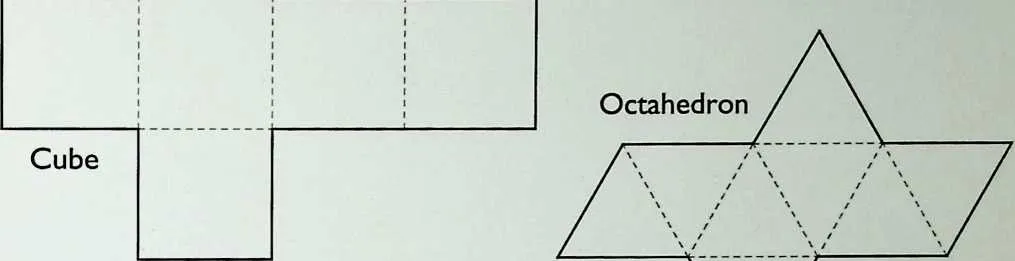
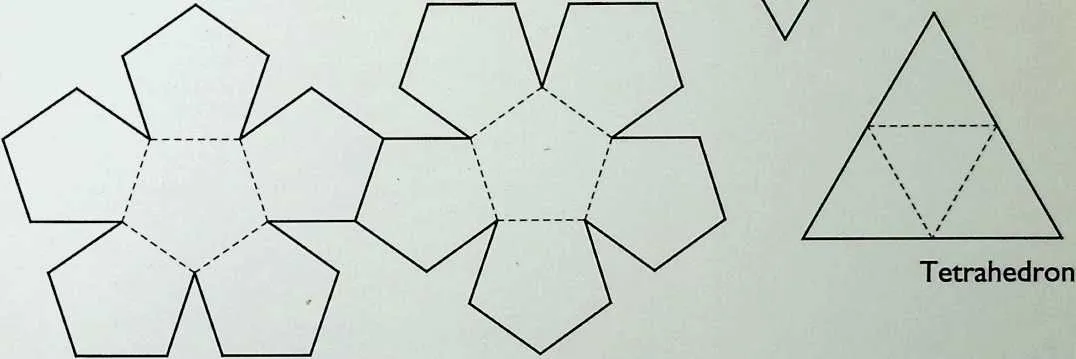
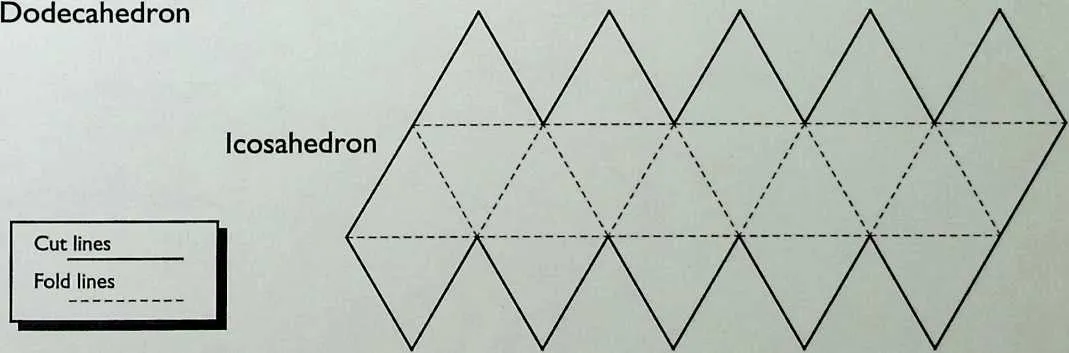
11.1 Patterns for Platonic Solids
133For best results copy or transfer patterns onto heavy paper.
134 Tape seams to create solids.

136 ISBN 0-471-12953-4