
10 TRICAP
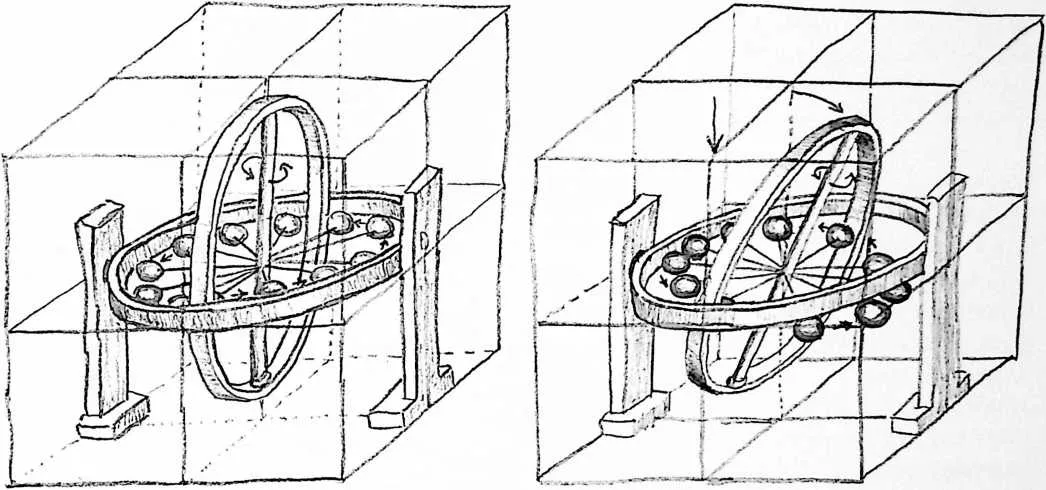
2Goldy starts the air gun’s impelment of the rotatable shaft’s turbo-blades, and the ‘‘grass-skirt’’ ring of balls rises to a vigorously maintained horizontality of rotation. Goldy lowers a mechanically guided steel finger to touch downwardly, around axis Y, once only on the top of each of the balls as each passes horizontally and tangentially by the point in the plane of rotation nearest to Goldy. Each separate ball is deflected downward a discrete angular amount, which results in the plane of the balls’ rotation tilting downward to the right around axis X as the powerful angular momentum of the balls’ pulling outwardly on the rotating shaft causes the shaft to rotate rightwardly from its previous verticality in plane C, having rotated the same discrete angular amount as that which the plane of the rotating balls has deflected downwardly and to the right around axis X to accommodate maintenance of its tensionally enforced perpendicularity to the plane of the balls’ rotation. Thus in turn, the inner rotatable annular ring in which the shaft is mounted is forced to accommodate the shaft’s reorientation, and it rotates the same exact angular amount around axis X in plane C as the angular change of the plane of the rotating balls and the shaft. Goldy stops the rotation and returns the shaft and inner annular ring to their vertical starting point, with the same ‘‘grass skirt’’ of attached balls hanging down limply around the shaft. Once again Goldy starts the air gun’s blowing of the turbo-blades. She finds that as she pulls the top of the annular ring rotationally toward herself around axis Y, it refuses to yield toward her and yields instead only leftward, as its rotating shaft and the plane of the rotating balls all tilt rightward and downward around axis X,X' as before in plane C in a direction at right angles to the plane of rotation of her pulling. With the machine in static (motionless condition) Goldy pulls the top of the vertical shaft toward her, and both it and the inner and outer rings immediately rotate toward her around axis Ybetween the two main stanchions.
3 STONE 8
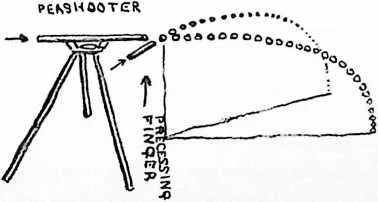

6 Goldy notes the complete difference between a fixed-position finger’s single-instance deflection and the progressively advancing, continually downward-pulling force applied to the trajectory by gravity. A crosswind would produce a continuing horizontal deflection force. If the originally fixed, horizontally impelled trajectory is continually altered by both gravity and a continuing crosswind, the succession of individually impelling forces results in a pattern of both horizontally and vertically curved trajectories altogether producing a downwardly-and-sidewise, spiraling trajectory similar to the tilted-and-bent, trailing-lower-edge feather shapes of a swiftly rotating lawn sprinkler.
7 Goldy now introduces another complex instructional device she calls ‘‘the precession demonstrator.’’ First she installs two immovable, rigid, vertical steel columns four feet high and four feet apart. Between them, at a height of two feet, she mounts, in ball bearings, a horizontal steel annular ring three feet in outside diameter. The ring is dynamically balanced and free to be continuously rotated between its two supporting columns or to stop in any angular position without any predilection to further alter its angular orientation.
8 Inside the first ring and at two diametric points ninety degrees away from that first ring’s two outer ball bearing trunnions, Goldy mounts a second and smaller ring two and a half feet in diameter. This second inner ring’s two outer trunnions are also mounted in ball bearings. This inner ring is also dynamically balanced and, if desirable, free to be continually rotated inside the outer ring or to stop in any position without further momentum prejudice. Inside the inner ring and at two diametrically opposed points, each ninety degrees away from the inner ring’s outside trunnion bearings, Goldy mounts a rotatable steel shaft in two end-thrust controlling, tapered roller bearings.
9 With everything described assembled into the machine and in proven ‘‘good working order,’’ Goldy rotates this central roller bearing shaft and its inner annular ring into a vertical position, with the outer or base ring in a horizontal position. Goldy now shows the bears that her machine has three axes of rotation symmetrically arrayed perpendicular to one another as those three axes intersect at her machine’s exact center. The X axis runs horizontally from mid-front center to mid-back of the machine. The Y axis runs horizontally from the-right- hand-side to the-left-hand-side of the machine, and the Z axis from mid-top to mid-bottom of the machine. The plane running horizontally from back to front of her machine, which plane is normal to both the X and Z axes Goldy calls plane A. The plane running vertically from front to back normal to both X and Z axes she calls the B plane and the plane running perpendicularly from right side to left side, normal to both Y and Z axes she calls plane C. ‘‘That’s quite a machine, Goldy,’’ says Mommy Bear, ‘‘Quite a lot for a little girl to produce.’’ Goldy replies, ‘‘If you know by experience that what you are thinking works, you can reliably and realistically produce such devices in your image-ination.’’
10 In ships of the sea this complex machine, imagined by Goldy to mountingly accommodate three-independent-axial freedoms, of rotation, is called a ‘‘gimbal.’’ Before development of modern liquid or air-support mountings ships’ magnetic or gyroscopic compasses were mounted in such gimbals.
11 Now Goldy also mounts a set of air-turbine blades around one end of the central shaft. After that, close above the complex gimballing, she mounts the nozzle of a high-volume air gun aimed tangentially at the shaft end’s turbine blades, the air jet having the ability to rotate the central shaft of goldy’s machine at high velocity. The compressed air is led to the set through the interconnected hollow bearings, hollow rings, and hollow stanchions of her machine with this air ducting connected to a tank of compressed air kept at an even pressure by a compressor.
12 With the rotatable shaft in the vertical position, Goldy hangs twelve steel balls with equallength woven, prestretched, flexible, stainless steel cables symmetrically positioned around the mid-shaft girth to provide a ‘‘grass skirt’’-like ring of steel balls, the balls being of such a diameter that when all are radially extended, each one is tangent to each of its two horizontally adjacent neighboring balls. Goldy starts the air gun’s impelment of the rotatable shaft’s turbo-blades, and the ‘‘grass-shirt’’ ring of balls rises to a vigorously maintained horizontality of rotation.
13 Goldy lowers a mechanically guided steel finger that is rotating downwardly, around axis Y, to touch once only on the top of each of the balls as each passes horizontally and tangentially by the point in the plane of rotation nearest to Goldy. Each separate ball is deflected downward a discrete angular amount, which results in the plane of the balls’ rotation being progressively tilted downward to the right around axis X as the powerful angular momentum of the balls’ pulling outwardly on the rotating shaft causes the shaft to rotate (rightwardly at its top, leftwardly at its bottom) from its previous verticality in plane C, having rotated the same discrete angular amount as that which the plane of the rotating balls has deflected downwardly and to the right around horizontally, fore and aft axis X to accommodate maintenance of its tensionally enforced perpendicularity to the plane of the balls’ rotation. Thus in turn, the inner rotatable annular ring in which the shaft is mounted is forced to accommodate the shaft’s reorientation, and it rotates the same exact angular amount around axis X in plane C as the angular change of the plane of the rotating balls and the shaft. Intent to better understand the transformation logic of this precessional behavior, Goldy stops the rotation and returns the shaft and inner annular ring to their vertical starting point, with the same ‘‘grass skirt’’ of attached balls hanging down limply around the shaft. Once again Goldy starts the air gun’s blowing of the turbo-blades.
14 This time, instead of touching downwardly (in plane B) upon the swiftly and horizontally rotating balls nearest to her, Goldy takes hold of the top of the inner annular ring just above the rotating shaft’s top bearing and pulls that point toward herself in plane B, pulling around horizontally, left to right, axis Y as she stands in front of the machine. To her now-dawning comprehension of what is transpiring precessionally, she finds that as she pulls the top of the annular ring rotationally toward herself around axis T, it refuses to yield toward her and yields instead only leftward, which is clockwise to Goldy, as its rotating shaft and the plane of the rotating balls all tilt rightward and downward around axis X, X' as before in plane C in a direction at right angles to the plane of rotation of her pulling. This time Goldy finds that as long as she continues pulling, the whole system keeps rotating clockwise in plane C. If she stops pulling, it ceases rotation. If she resumes pulling the top of the machine’s annular ring toward herself, it again refuses to yield toward her, and instead the rotating shaft plus the plane of the balls’ rotation plus the inner annular ring all tilt rightward and downward clockwise around axis X, X' in a plane C in a direction at right angles to fore and aft, vertical plane B or her would-be but frustrated pulling around horizontally left to right axis Y. The harder she pulls, the faster do the always congruently moving three-member group of (1) balls, (2) shaft, and (3) inner annular ring continue to rotate clockwise around the horizontal, fore and aft X axis in the vertical, left-to-right plane of rotation C---and they keep on doing so as long as Goldy keeps on pulling toward herself on the inner annular ring adjacent to the rotatable shaft end bearing. This is because her applied force is now a continuing and increasing force and not a single touch-impulse as before. At first this behavior seemed superficially perverse---with the system yielding only at right angles to the force of Goldy’s pulling toward herself.
15 To prove to herself and the bears the difference between the dynamic and static behavior of her ‘‘precession machine,’’ Goldy stops the air power and allows the cable-connected balls and their shaft to stop rotating. She then returns the central shaft and its annular ring to the vertical position and the outer ring to the horizontal. Now, with the machine in static (motionless condition) Goldy pulls the top of the vertical shaft toward her, and both it and the inner and outer rings immediately rotate toward her around axis Y between the two main stanchions of the machine as the cable-connected balls dangle center-of-earthward. Now she pushes the whole rig back into the same vertical starting position as for all the previous tests. Taking off the ‘‘grass skirt’’ of steel balls, she substitutes a solid flywheel around the mid-girth of the central shaft. Next, without air-starting the machine, she touches downwardly on the point of the flywheel nearest to her in front of the machine in exactly the same way she had touched down on each of the (air-and-shaft) accelerated steel balls. This time the shaft and wheel are not rotating, and therefore have no angular momentum. The ‘‘solid’’ flywheel, the shaft, and both the annular rings tip forwardly toward Goldy around axis Y of the system. She now once again opens the air power and accelerates the shaft and ‘‘solid’’ flywheel into swift rotation. Once again she touches on top of the wheel at the same, nearest-to-her, front-of-the- machine point at which she had touched each swiftly rotating steel ball of the ‘‘grass skirt’’ experiment, and this time the wheel and inner annular ring (but not the outside ring) rotate clockwise rightwardly and downwardly around axis X, just as did the succession of shaft- tethered balls in all the other dynamic experiments. Thus Goldy feels the difference between the static, no-momentum behavior of the unaccelerated system and that of the dynamic behavior of the accelerated, angular-momentum-dominated system. The flywheel’s atoms (but not the annular rings, shaft, and stanchions) attain such an acceleration as to render negligible the pull of gravity upon the outer rotating mass of the wheel. Gravity, however, pulls unopposedly earthward upon the nonrotating members of the machine.
16 As Professor Goddard realized, the earth rotating at an equatorial speed of 1,000 nautical miles per hour is itself also moving around the sun at 60,000 miles an hour. Goddard also realized that a pre-blast-off rocket uprightly poised on earth also travels congruently with the earth at 60,000 mph around the sun and, like a chip on a walking man’s shoulder, remains only seemingly ‘‘at rest’’ in respect to its larger companion-in-motion. If we ‘‘blast off’’ the rocket, accelerating it to a speed much greater than that of both the earth’s axial rotation and its sun-orbiting speed, then according to Newton’s and Galileo’s laws, every time the rocket doubles its distance away from the earth, the tendency to fall back to earth is reduced to one quarter of the previous tendency, and soon, if the original acceleration was adequate, or if it is boosted by a second stage firing, the rocket will get so far out from earth as no longer to tend to fall back earthward and will yield to the equilibriously integrated earth’s, sun’s, moon’s, and all other stars’ pulls, and thereafter, if beyond the earth’s outermost mantle’s frictional interferences and resultant retardations, will maintain its own independent orbit around the earth.
17 Earth’s gravity is rendered progressively less effective as acceleration is increased. That acceleration can be rotational as well as ‘‘linear.’’ That is, it can be angularly accelerated, as with the cable-connected balls of Goldy’s machine, or linearly, as with the hammer thrower’s cumulatively accelerated and released hammer. When the hammer thrower’s steel ball (hammer) is released from its six-foot radius of human rotation, it comes to rest on the earth, where it orbits in a vastly greater circle around the earth’s axis as the latter orbits in a ninety-two- million-mile radiused circle around the sun, whereby we learn that the so-called linear acceleration, as contrasted to so-called rotational (or angular) acceleration, is always rotational but of vastly different radius. The relative reduction-of-gravity effect attained by acceleration, Goldy explains, is the same whether rotationally or linearly accomplished. That is why a swiftly rotating gyroscope in a three-ring cage with a sharp bottom-of-system support point can be concentratedly base-supported on a pencil’s rubber end while leaning sidewise, not falling farther sidewise and floorward as would the same assembly when static (i.e., with its flywheel not rotating). Goldy explains that it is the linear acceleration of a bicycle that converts it from the static condition of lying prone on the ground when motionless to maintaining as vertical an attitude as possible, and the faster it goes, the more ‘‘muscularly’’ vertical does it become and the more does it tend to leave the earth altogether, as is manifest in the motorcyclist swiftly returning to the vertical after leaning sidewise to produce a steering effect. This out- ward-from-earth-center’s force keeps the bicycle’s center of gravity as far out from the earth’s center as is possible, while the residual but diminishing gravitational effect is residually apparent only as the integrated weight of the whole bicycle and rider are concentrated at the two points where the bicycle wheels’ tires touch the road. For this reason swiftly moving cyclists muscularly accumulating their momentum can ride around in a bowl, climbing its sides until reaching a horizontal attitude as they circle inside the top cylinder of the bowl. This dynamic horizontal stability is the same as that of the spinning gyroscope leaning horizontally outward from the pencil end with all the earthward gravity pull being exerted only at the support point as it rests on the pencil’s rubber end.
18 What occurs in the dynamic rotational phase of Goldy’s ‘‘precession machine’’ can be readily understood when we go back to both the peashooter and to the hammer thrower who lets go of his hammer handles not when they, and the hammer, are pointing in the direction he wishes the hammer to travel but at the point when the hammer and its handles are pointing sidewise at right angles to the direction in which the thrower wants the hammer to go. (Because people know only that a centrifuge separates cream from milk, they think of centrifugal separation as occurring outwardly in a radial line perpendicular to the rotating perimeter of the centrifuge, whereas the separation is always tangential to the spinning perimeter, which means at a right angle to the centrifuge’s radius end.)
19 Both the peas of the pea shooting experiment and the steel balls of Goldy’s machine experiment acted in exactly the same way, simply altering their planes of trajectory with those planes being reoriented around the same axis X an angular amount exactly proportional to that given by the single momentary deflection impulse given perpendicular to the original trajectory with that impulse administered downwardly around axis Y. ‘‘No mystery,’’ says Goldy. ‘‘Everything behaves as carefully reconsidered experience says it does. Nothing is perverse except humans’ natural propensity for trying to explain dynamic interrelationships while thinking only of static models. ’’
20 The machine that Goldy had built is called a gyroscope: gyro-scopus meaning ‘‘making visual the complex behaviors of dynamically rotating complexes.’’
21 Goldy says to the bears that her previously shared popular mis-sensing of the gyroscope’s behavior as being perverse did not take into account the cumulative dynamism of angular momentum and anticipated only a static system’s unacceleratedly yielding behavior. Thus Goldy comprehended that many of the experiences humanity has heretofore failed to understand can now be realistically understood as aided by such experimentally followed-through sensing of each of the combined behaviors of complexedly operative dynamic systems, and furthermore, all systems are dynamical and can only be comprehended as such---with the comprehender always aware that everything seemingly ‘‘at rest’’ is in congruent motion with its greater-momentum host. The bears concur, saying also that Universe is an omnidynamic operation that only deceptively seems to be motionless as little humans, like microbes on a large flywheel, fail to feel the wheel’s rotation. Humans on planet earth at the latitude of New York City are revolving around earth’s axis at about 700 miles per hour as their planet earth zooms orbitally around the sun at 60,000 miles per hour, doing it so efficiently and smoothly that it makes no sounds, which allows humans’ static ego to misperceive the sun to be ‘setting’ and earth to be ‘standing still.’ ’’
22 ‘‘From where we view you it seems incredible to us that you can’t feel your own motion,’’ say the astonished bears. ‘‘Your earth planet’s unretarded momentuming at 60,000 miles per hour in frictionless space within critical proximity of the sun-star’s massive gravitational pull, tethers onrushing earth like a lassoed steer so that it can only go thereafter in a gravity- retained orbit around the sun.’’
23 Coming in at this juncture, Daddy bear says that what Goldy has experienced would hold true in the case of a regular gyroscope and its regular (fallaciously described as ‘‘solid’’) flywheel, which is an aggregate of all the energy quanta of all the atoms, which act together just as did the individual steel balls when accelerated in her machine.
24 Goldy realizes that humans spontaneously misinform themselves in many directional matters because by twisting their necks they can look in preferred directions without also rotating their bodies. While wishing to propel an object in the ‘‘looked-at’’ direction, humans say that they are throwing or hitting the object to be propelled in that direction, whereas in operational fact, to send a tennis ball to the opposite court the player throws the ball vertically upward above his head---that is, in a direction at a right angle to the direction he wishes to send the ball---and then hits the ball only when the tennis racquet and his human arm propelling it are also pointed in a direction overhead, which is exactly at a right angle to the direction that the ball is to go. The baseball player lets go of the ball only when it is at the farthermost point of armswing away at a right angle from the direction he wishes the ball to go. The fact that the individual can consciously turn his head and eyes in directions at right angles to the subconsciously organized orientation of his body to produce the most cumulative energy effectiveness as well as the most accurate angular spin control, both of which occur subconsciously in a direction at right angles to that which he thinks he is facing, often fools individuals into thinking that they are really throwing balls in the direction they are facing---subconsciously remembering that when they wanted to push something in front of them away from themselves, they shoved it away perpendicularly with their arms or with a hand-held poking stick. Atrociously performing, untutored tennis novices often start their ineffective playing by facing only forward and trying to push-hit the ball forwardly in front of them, producing only a bounce-back or poke-back return of the ball. However, if the novices are fortunate enough to begin with a good professional tennis teacher, they will learn to jump into backhand or forehand positions, facing sharply at right angles away from the direction they wish to send the ball. Both the baseball batter and the golfer stand sidewise to the desired trajectory and hit the ball when it is exactly at a right angle away from the player’s desired direction of ball impelment. The reason both the golfer and baseball batter ‘‘follow through’’ with their bat or club swing after hitting the ball is to avoid putting any sidewise pushing or pulling spin on the ball at the moment of sidewise impact, which spin could misdirect or shorten the distance of accomplished trajectory. The athletes are taught to ‘‘follow through’’ because the action and sequence of events is too fast for human sensing, and the eyes and muscle have to be trained not to look in the direction they want the ball to go, but at the point where the critical action takes place at right angles to that line of impelment---where the angular momentum is transferred from the rotating arm, club, bat, or racquet to the free-to-travel ball.
25 Goldy remarks to the bears that since everything in Universe is in motion, the interactivation of all the macro and micro islands of energy of Universe are precessional, and because precession is not popularly understood, humanity is at yet generally in ignorance regarding almost everything that goes on; but because of the vanity employed by ignorance to cover lack of knowledge, humanity talks about problem-solving as though humans were the only ones in Universe capable of coping with important problems. The bears say to Goldy, ‘‘Even the earthian scientists have coped with precession only by use of theoretical mathematics, quantum mechanics, and without any personal sensing of the logical integrity of the phenomenon.’’ Earthian science has mistakenly thought it to be impossible to elucidate precession conceptually and exclusively in the terms of directly sensed human experience.
26 Because all bodies of Universe are either closely or remotely restrained by a plurality of mass inter-attractiveness always and continuously coexisting between themselves and other bodies in Universe, there can be no truly straight linear acceleration. There will always be only angular acceleration of vastly varying radii of restraint, often producing arcs of circles so great as to seem locally straight. But linear momentum is only ‘‘theoretically potential’’ it is made ‘‘eternally impossible’’ by the always-and-forever, unity-is-plural ‘‘otherness’’ inherent in Universe. ‘‘That was what probably occasioned Einstein’s ‘curved space,’ ’’ says Goldy. The bears say, ‘‘Sounds logical, Goldy.’’ While light and all other radiation have the same fixed speed and operate in finitely closed and quantized packages, gravity is omni-continuous and omniembracing, but is stretched in a multiplicity of ways varying from intensely strong to ephemerally weak, but no matter how relatively weak, it maintains its never completely exhausted omni-presence and its always and everywhere embracement in degree adequate to guarantee the eternally regenerative integrity of Universe. Gravity is the omni-embracing, omni-pervasive perfection of comprehension. Gravity is cosmic love.
27 Goldy next shows the bears how the three-face-bonded tetrahedra-arc in its initial, neutral, nontransmitting state becomes spirally extended positively or negatively to attain its information-transmitting state, only with the addition of one more face-bonded tetrahedron. She then shows that with every twenty tetrahedra the tetrahelix completes approximately one 360 degree helical revolution (352° 40' exactly), which tetrahelix is the mathematical model employed by the DNA-RNA helix, discovered by virological scientists (Watson-Crick-Wilkerson) to be always transmitting the specific information controlling the design of all biological species, with that 7° 20' of angle (less than 360°) being twist-sprung to introduce the unzipping force necessary to offspring (or give birth to) any given species’ off-molded offspring from the parent.
28 Goldy shows how the extended tetrahelix’s skin can be stripped off and laid out flat as a three-row, omni-triangulated, wavilinear ribbon. Goldy then identifies the positively or negatively asymmetrical tetrahelix patterning with lightning. Goldy then introduces Naga---the sea serpent---god of the oceanic world of the ancients. Naga is the wave.
29 Naga is a live tetrahelix. At sea the wavilinear profile of Naga’s back always rims the horizon. The ancient Hebraic language of the earliest biblical scripture came to contain the word nachash, which means serpent, or ‘‘whisper,’’ or ‘‘divine’’ (the ch being a guttural or g • sound)---i.e., Naga and Nachashol (or Nagashol) means ‘‘the sea,’’ and the root verb nacha ( = Naga) means to ‘‘lead,’’ ‘‘conduct,’’ ‘‘guide,’’ and Nacha---pronounced Naga---is also the name of the ancient seafarer N(O)(A)(C)H---Noah.
30 STONE 9
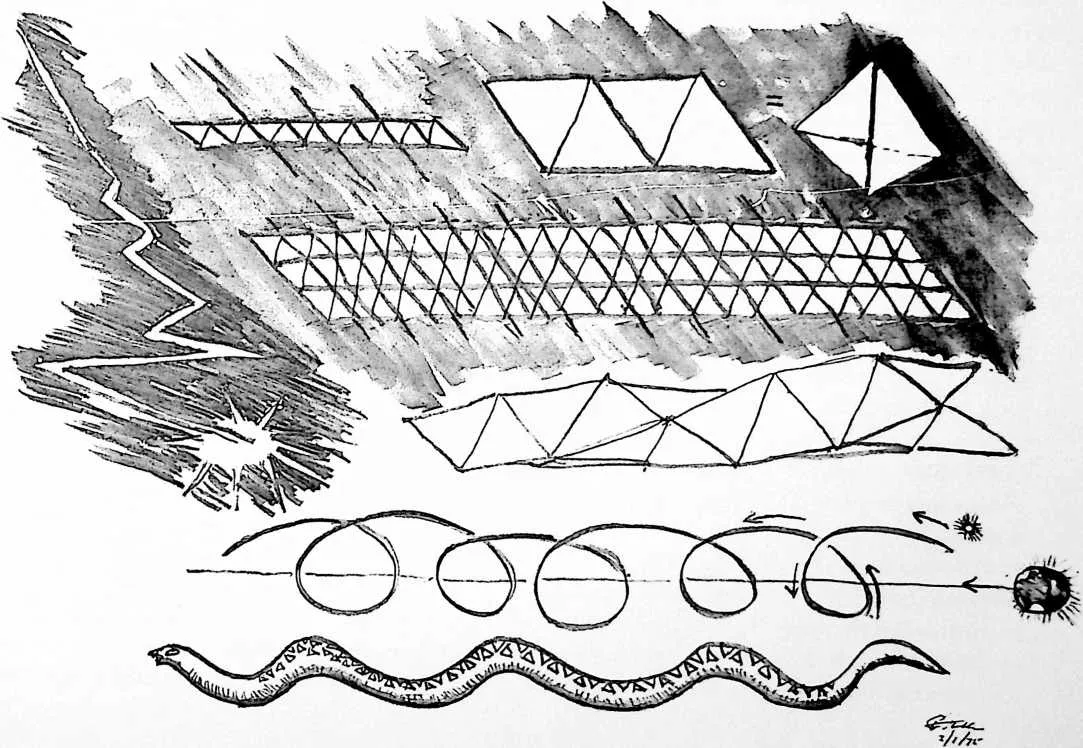
32 Goldy next shows the bears how the three-face-bonded tetrahedra-arc in its initial, neutral, nontransmitting state becomes spirally extended positively or negatively to attain its information-transmitting state, only with the addition of more face-bonded tetrahedra. She then shows that with every twenty tetrahedra the tetrahelix completes approximately one 360- degree helical revolution (352° 40' exactly), which tetrahelix is the mathematical model employed by the DNA-RNA helix, discovered by virological scientists (Watson-Crick-Wilkerson) to be always transmitting the specific information controlling the design of all biological species, with that 7° 20' of angle (less than 360°) being twist-sprung to introduce the unzipping force necessary to offspring (or give birth to) any given species’ off-molded offspring from the parent.
33 Goldy shows how the extended tetrahelix’s skin can be stripped off and laid out flat as a three- row, omni-triangulated, wavilinear ribbon. Goldy then identifies the positively or negatively asymmetrical tetrahelix patterning with lightning when, with the closure of an electron circuit from earth to cloud, the high-voltage atmospheric charges are transmitted to earth.
34 Goldy then introduces Naga---the sea serpent---god of the oceanic world of the ancients. Naga is the wave. Naga is a live tetrahelix. At sea the wavilinear profile of Naga’s back always rims the horizon.
35 Influenced by the language of previous millennia of long-distance ocean-traveling sailors coming originally from the atolls of the South Pacific and Indian Ocean into the Arabian Sea to reach Mesopotamia, and by the subsequent retracing of those world-encircling deep-sea routes by the Phoenicians, the ancient Hebraic language of the earliest biblical scripture came to contain the word nachash, which means ‘‘serpent,’’ or ‘‘whisper,’’ or ‘‘divine’’ (the ch being a guttural or g sound)---i.e., Naga and Nachashol (or Nagashol) means ‘‘the sea,’’ and the root verb nacha (= Naga) means ‘‘to lead,’’ ‘‘conduct,’’ ‘‘guide,’’ and Nacha [pronounced ‘‘Naga’’] is also the name of the ancient seafarer n (o) (a) (c)h---Noah.
36 Nachan (pronounced ‘‘Nagan’’) is the word for copper or bronze alloy, the latter being the high-strength form of the nonrustable metal with which all ship fastenings, fittings, and instruments have of necessity been fashioned since copper’s first discovery and its alloyed production as bronze by humans 5,000 years ago at Ban Chiang in Thailand, where the Bronze Age first took over from the Stone Age, in what was once a Venice-like complex of canals leading from the sea into all of the Southeast Asian lowlands on the Indochina coast, nearest to all the seafaring activities of the Southwest Pacific in the region where the Naga nation long ago came off the sea and put out upon the mainland and as yet lives. Where Hanoi now exists there existed 2,000 years ago a place called Nganna.
37 This Bronze Age birth occurs at the final peak of the Austronesian civilization. These ancient water people’s world embraced the Central and South Pacific, South Indian Ocean all the way westward to include Madagascar, and all the way eastward to include Easter Island and all the way northward to include both Japan and the Hawaiian Islands and southward to include New Zealand. This is the world of Naga, the na prefix being the na of na-vy; na-tivity; na-vi-ga-tion; na-tion; 180,000,000 of these Austronesians as yet are alive, and many are as yet living with the same maritime and insular artifacts as those of their possibly millions-of-years- ago forebears.