
7 TRICAP
2This brings Goldy to her necklace experiment, to discover, if possible, what produces structural stability. When the necklace flexes, the tubular beads do not bend or change their lengths. It is the tension connector angles between the tubes that change and accommodate variable draping of the necklace. One by one Goldy takes the inflexible tubes out of the necklace, which keeps on flexing around her neck and draping over her shoulders until there remain only three push-pull tubes and three tension connector angles. Now for the first time the necklace does not flex or drape around her neck. It is rigid. It is in the form of the triangle, which is the minimum polygon. There is no polygon of two sides and two angles. The necklace triangle has six separate parts: three rigid, push-pull tubular sides and three flexible tension angles, all six of which separate entity-events are interacting to produce a stable pattern. How do they do so?
3 Any two sides of the triangle constitute a pair of levers fulcrumed tensively together at one end---like a pair of scissors. The longer the two lever arms, the more powerful the shears. So the third side of the triangle is a rigid, push-pull strut taking hold of the two adjacent lever arms at their maximum lever-advantage ends, thereby stabilizing the angle opposite with minimum effort. So does each side of the triangle most effortlessly stabilize its opposite angle. Since a structure is a pattern-stabilizing complex of events, a triangle is structure. Structure is triangle. There are no other such minimum-effort, six- foldedly combined, minimum-limit-of-a-series, cosmic cases such as this one.
4 STONE 5
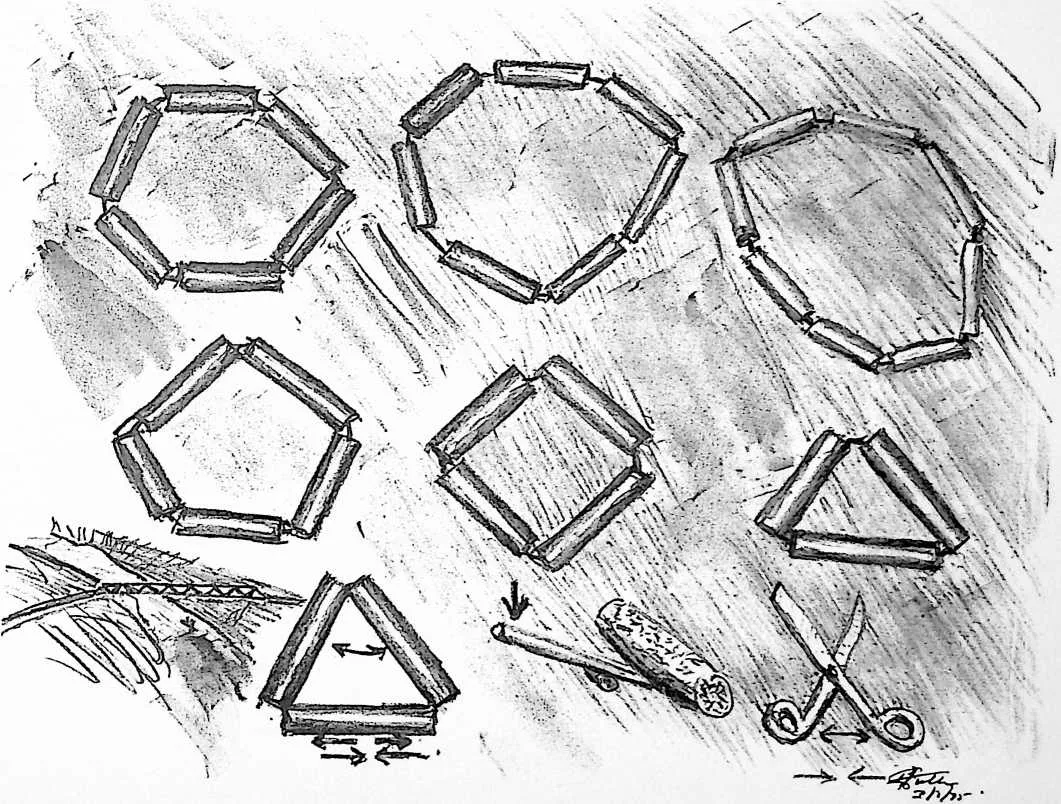
6 This brings Goldy to her necklace experiment, to discover, if possible, what produces structural stability. When the necklace flexes, the tubular beads do not bend or change their lengths. It is the tension connector angles between the tubes that change and accommodate variable draping of the necklace. One by one Goldy takes the inflexible tubes out of the necklace, which keeps on flexing around her neck and draping over her shoulders until there remain only three push-pull tubes and three tension connector angles. Now for the first time the necklace does not flex or drape around her neck. It is rigid. It is in the form of the triangle, which is the minimum polygon. There is no polygon of two sides and two angles. The necklace triangle has six separate parts: three rigid, push-pull tubular sides and three flexible tension angles, all six of which separate entity-events are interacting to produce a stable pattern. How do they do so?
7 Any two sides of the triangle constitute a pair of levers fulcrumed tensively together at one end---like a pair of scissors. The longer the two lever arms, the more powerful the shears. So the third side of the triangle is a rigid, push-pull strut taking hold of the two adjacent lever arms at their maximum lever-advantage ends, thereby stabilizing the angle opposite with minimum effort. So does each side of the triangle most effortlessly stabilize its opposite angle. Since a structure is a pattern-stabilizing complex of events, a triangle is structure. Structure is triangle. There are no other such minimum-effort, six-foldedly combined, minimum-limit-of-a-series, cosmic cases such as this one, which integrates: (1) minimum effort, (2) minimum system, (3) minimum polygon, (4) minimum polyhedron, (5) minimum conceptuality, (6) minimum think-aboutedness, all resulting in complex self-interstabilization. All six of these minimum limit conditions in an hierarchical series of conceptualities are utterly independent of size and time. So the tetrahedron, consisting exclusively of triangles, is not only the minimum system in Universe but is also the minimum structural system in Universe. It is the initiating point of the awareness which we call life. No otherness, no awareness. The minimum otherness is the minumum structural system in Universe---the tetrahedron---the minimum conceptuality---the minimum thought.
8 Goldy says to the bears, ‘‘Since the minimum otherness may look like a ‘speck’ but, when magnified, always proves to be a system or a complex of systems, there is no experienceable ‘‘one, two, or three dimensionality.’’ Dimensionality is at minimum four. All experience begins with a tetrahedronal system or a complex tetrahedronal structure, and all tetrahedra are fourdimensional---that is, they have four planes of persistent symmetry.’’ We learn of that persistent symmetry by using cheese to make (1) a cube, (2) an octahedron, (3) a dodecahedron, (4) a tetrahedron. Next we slice off a piece of cheese parallel to one of the faces of the cube---what is left is no longer a cube. If we slice parallel to one face of an octahedron, the octahedron is no longer an octahedron. So, too, is the dodecahedron destroyed by this assymetrical alteration of only one of the faces. There is, however, one exception. We slice parallel to one of the tetrahedron’s faces, and what remains is a smaller but omni-symmetrical tetrahedron. We try slicing parallel to each of the tetrahedron’s four faces, and what remains is always a regular tetrahedron.