
15 TRICAP
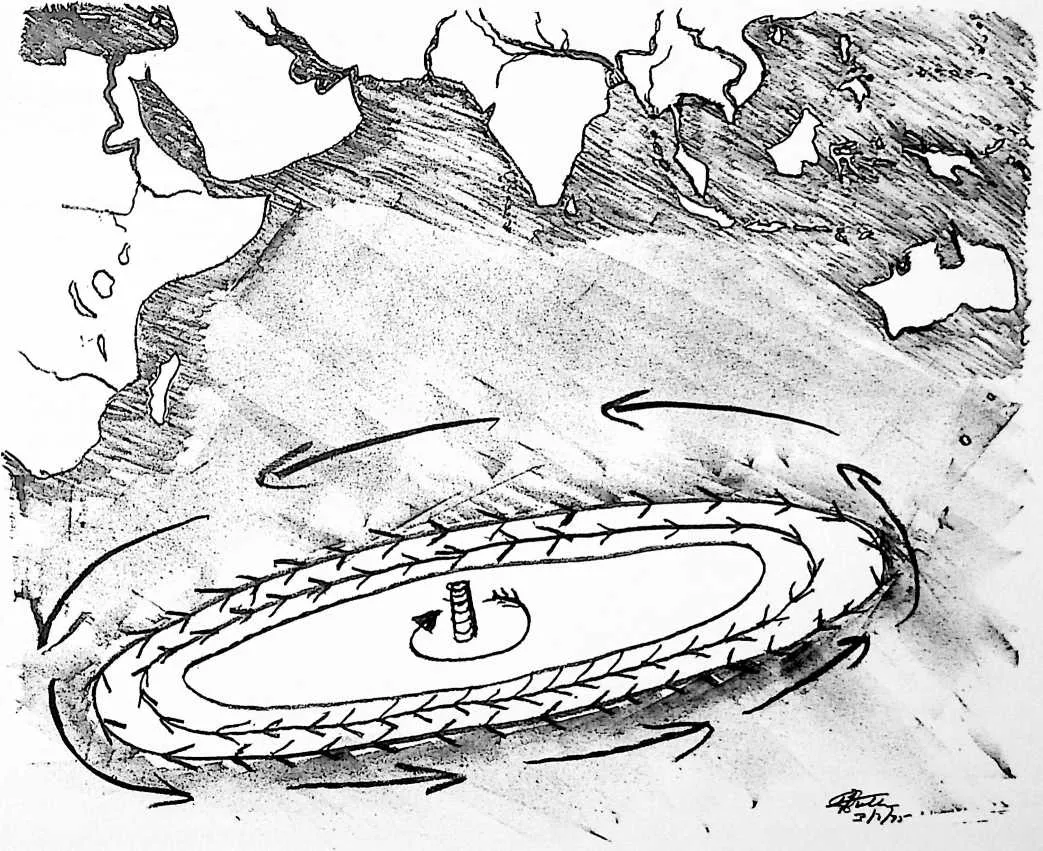
2Thus the human sailormen worked ever westward and ever farther off shore until in the lower latitudes of the Indian Ocean their westwardly headed voyaging was reversed by the powerful, eastwardly flowing Antarctic’s world whirlaround of wind and water. Six thousand miles south of, unbeknownst to any other, terrestrial humans this eastward world whirlaround distributed those voyagers into the Pacific, Atlantic, and Indian oceans. Many of those sailors not washed overboard from their craft and drowned were wrecked and marooned on the myriad of lonely, barren islands scattered widely apart in the world’s southern seas. Thus we find waterborne humanity first paddling, then rowing, then sailing determinedly westward into the wind to follow the life-giving sun’s sky course, gradually working farther off shore and at their southern extremes of voyaging being unexpectedly caught in and swept along by the world-around eastward forces to bring about human occupation of many of the very remote islands of our planet.
3 Those voyagers marooned on lonely islands who found the food, water, and sheltering means to survive became scavengers of subsequent shipwrecks on the treacherous rocks of those islands. Hundreds and even thousands of generations of remote inbreeding developed highly differentiated physical and cultural features.
4 The historically unprecedented swiftness of twentieth-century development of the world-around integrating transportation and communication means is now trending to rapidly integrate and cross-breed back to an average world-human all these isolated increments of humanity of the islands as well as of those inbred among isolated inland tribes. In this way ever-evolutionary Universe has contrived first to conserve by isolation all the lessons learned regarding humanity’s artifact-inventing ingenuity in coping with the most extreme conditions experienced around our planet and secondly to synergetically integrate all knowledge for the mutual advantage of all humanity.
5 STONE 14
7 Such paddled barges of royalty are as yet employed on state occasions by the king of Thailand and for many years were also so paraded annually by the great doges of Venice, clearly indicating the long-ago westward-reaching travel of these into-the-wind team paddlers. Later, standing and facing forward, the water people began also to use their steering oars mounted in oarlocks to propel them forwardly, as in the sampans of Thailand (and later gondolas of Venice), and thus developed the practical use of the lever in boat propulsion. This leverage advantage was not developed in full effectiveness until humans had crossed the Indian and Arabian seas in their sailing dugouts and in their four-of-five, bent-together-at-their-two-ends log rafts and sailing boats such as are as yet in use in southern India. After the sailors had reached northeastern Africa and had crossed overland from the Red Sea to the navigable waters of the Nile, most probably at the point where the Egyptian capital of Luxor developed, they flow-floated via the Nile northward to the Mediterranean. The trans-Indian Ocean sailors also sailed northward in the Red Sea to its two northern extremities, Aqaba and Suez, and went overland to build their boats anew in the Nile delta and along the Levantine coast of the Mediterranean. Others paddled their great, seagoing, ribbed canoes along the shores of India and Persia, to reach the Gulf of Oman and the Persian Gulf and thereby Mesopotamia, and at the headwaters of the Tigris and Euphrates rivers, ever following the sun, they caravaned overland through what became Damascus to reach the Mediterranean.
8 The multi-oared boat with oarsmen facing aft and only the steering-oar helmsman facing forward seems to have been a simultaneous invention by all these water people, all occurring in the Near and Middle East. They appear simultaneously in the Nile, Mediterranean, Indian Ocean, and Greece and were probably the principal vessels of Crete, thereafter rowing as well as sailing, developed to powerful degree with banks of slaves as the power source of the watercraft. With their new rowing capability humans coasted westward and-out through Gibraltar, then northward along the coast of Europe---finally reaching and rounding Scandinavia’s North Cape to reach the Arctic shores of Finland and Russia.
9 Goldy and the bears find the ‘‘sun boat’’ of the Egyptian pharaoh and the Vikings’ long boat dug out of the mud at Oslo, and the Phoenicians’ around-Africa and later across-both-the- Atlantic-and-Pacific voyaging craft, to be the same design---multi-ribbed, thonged-together, lap-straked, pitched seam, cross-thwarted, single bank, multi-oared rowing boat with a small, demountable, central mast and square, ‘‘with-the-wind’’ sail---and find that historic Oslo- Viking boat’s complicatedly carved Naga figurehead to be the same as one other only such known carved head in the world, which was found in the funeral-boat cave in North Borneo, indicating that the bull-horn headdress of the Vikings and the bull-horn symbol of the Cretans and the horse figurehead of the Phoenicians and Venetians are all symbols of the same sailormen, making it also clear that the powerfully rowed deep sea craft, in which horned cattle and horses were first carried as the trading money, were the same craft with which the Crete- Babylon axis plied their trade all the way east to Borneo and all the way westward and northward to the northwest coasts of Europe and the Americas. These hardy water people’s Arctic-Sea-reaching Vikings became the founders of Russia and went thereafter southward overland to the headwaters of the Volga, thence by boats again southward, returning to the Mediterranean via the Caspian and overland again to the Black, Bosphorus, and Aegean seas. With each experience-informed design advance and enlargement of the powerful, ribbed ships of the Viking-Phoenician type, the ever deeper south in the Indian Ocean and along the southern coast of Africa did their voyaging take them.
10 Thus the human sailormen worked ever westward and ever farther off shore until in the lower latitudes of the Indian Ocean their westwardly headed voyaging was reversed by the powerful, eastwardly flowing Antarctic’s world whirlaround of wind and water. Six thousand miles south of, and unbeknownst to any other terrestrial humans, this eastward world whirlaround distributed those voyagers into the Pacific, Atlantic, and Indian oceans. Many of those sailors not washed overboard from their craft and drowned were wrecked and marooned on the myriad of lonely, barren islands scattered widely apart in the world’s southern seas. Thus we find waterborne humanity first paddling, then rowing, then sailing determinedly westward into the wind to follow the life-giving sun’s sky course, gradually working farther off shore and at their southern extremes of voyaging being unexpectedly caught in and swept along by the world-around eastward forces to bring about human occupation of many of the very remote islands of our planet.
11 Those voyagers marooned on lonely islands who found the food, water, and sheltering means to survive became scavengers of subsequent shipwrecks on the treacherous rocks of those islands. Hundreds and even thousands of generations of remote inbreeding developed highly differentiated physical and cultural features.
12 The historically unprecedented swiftness of twentieth-century development of the world- around integrating transportation and communication means is now trending to rapidly integrate and cross-breed back to an average-world human all these isolated increments of humanity of the islands as well as of those inbred among isolated inland tribes. In this way ever-evolutionary Universe has contrived first to conserve by isolation all the lessons learned regarding humanity’s artifact-inventing ingenuity in coping with the most extreme conditions experienced around our planet and secondly to synergetically integrate all knowledge for the mutual advantage of all humanity.
13 A major portion of the great historical heritage emanates from these first atoll-incubated humans. In addition to Goldy’s discovery of the commonality amongst the Pacific water people of---(1) three-way basketry and other triangular structural weaving, (2) their upswept architectural foundations and roof-lines, (3) their total inability to accredit ‘‘credit’’ and to conduct business in the land-founded ‘‘Western’’ way---Goldy observes four other common characteristics of her water-world people: (4) their common Polynesian language base, covering an area one-quarter of earth’s surface (which is in marked contrast to the diverse multiplicity of the language bases of the mainland peoples of earth, which often change every few miles, (5) the commonality of the binomial mathematical base of the Polynesians, (6) the commonality of their spontaneous unalterable omni-world, omni-motion, omni-equi-advantaging world community viewpoint and initiative, and (7) their omni-conviction that the physical organic body is not life, that life is abstract, weightless, immortal. The water people’s funeral pyres are celebrations of happiness.
14 Goldy says to the bears, ‘‘Your thought-communicated knowledge guided me intuitively as I speculated my way through that early history, and I am grateful.’’ So---here we go again- having jumped from the Arabian into the eastern Mediterranean, where we come to the 1400 B.C. palace at Knossos on Crete, where we find the sign of the king carved into the stone walls of his chambers. The king’s sign is a hexagon enclosing a set of six equilateral triangles surrounding a central point arranged in six sixty-degree angular increments. Contrasting with this king’s symbol we find in the household area of the palace the distaff symbol carved into the walls. The ‘‘distaff’’ is a square enclosing two crosses---the perpendicular and the diagonal. It resembles the British flag divided centrally into ninety-degree and forty-five-degree angles.
15 The Cretan water king’s symbol is that of the three-way Oriental water people’s triangular basketry weaving and triangular celestial navigation, while the distaff symbol of the land people’s area is the two-way square-weaving symbol of the world’s dry-land ‘‘square’’-dealing civilizations.
16 As carved into the king’s wall, one of the six points of the hexagon is topmost, another bottommost. The almost exclusively land-minded archaeologists have misidentified this form with what they call the double or two-way axe head. They assumed the vertical axis of the hexagon to be the staff of the axe with two-way blades, one facing right, one facing left. However, it is more probable that the vertical axis hexagon of the Cretan king’s wall symbol was an angularly formalized profile of a spherical earth, showing (A) its north-south polar axis and (B) its Arctic and Antarctic areas and also showing the earth’s central angle between the Tropics of Cancer and Capricorn, between whose latitudes occurred the most propitious sailing and living conditions. Goldy says that with the first coinages of humanity now being brought out from Mediterranean ocean bottoms, one of the most frequent is that of the sailor’s symbol---the double-headed, two-way-facing Janus whose overall contour is that of the king’s symbol, the vertical axis hexagon. Dry-land anthropologists and archaeologists have minis- terpreted the Janus symbol as meaning only that the sailor was a notorious liar, professing to be going one way but actually going the other. To the maritime archaeologists and anthropologists the Janus symbol clearly reveals that the sailors knew that they could face in any direction and, traveling constantly in that great-circle direction, come back to where they started because the earth is a sphere.
17 The Three Bears say that this latter knowledgeable interpretation of Goldy’s is powerfully fortified by the forehead-crowning symbol the Egyptian navigator priests always gave to their land-preoccupied pharaohs. This crowning symbol consists of the sea god, Naga, the sea serpent, rising two ways around an orb to join together at its top. This either-way-around-the- world voyaging symbol was never understood by the land-preoccupied pharaohs. For thousands of years the navigator-‘astronomer-’ mathematician-priests successfully monopolized the secret knowledge of the earth’s sphericity and of its faraway, fabulous life-support resources as well as of startlingly unfamiliar mineral, metallic, and other herb resources, which resources were exclusively reachable ‘‘overseas’’ only by the priest-navigators. But either the navigator-priests or the Phoenicians left their traditional symbol in Central America in a number of pottery spheres entirely around whose spherical surfaces the Nagas (serpents) wind.
18 The bears tell Goldy that these navigator-priests were the ones who had secreted to their own advantage the ancient knowledge of yin-yang etcetera. The bears then tell Goldy that they had witnessed with interest how the navigator-priests’ capability had inadvertently evolved into a ‘‘miracle’’ resource only infrequently employed by atoll, islander, and mainland chieftains and monarchs when those supposedly divinely ordained leaders found the tribal credit for their kingly wisdom as a lawmaker, judge, or fighter to be deteriorating. They knew that all they had to do was to ask their navigator-priests for a miracle, which the navigator always was able to produce for them in the form of any object completely unfamiliar to his people because it was non-occurrent in his islanded kingdom, having been brought from other distant, ocean- intervened lands.
19 The kings knew nothing of navigation or of the foreign lands. They had no idea how the navigator-priest obtained the miracle. All they knew was that the priest-navigator could always produce a never-before-seen item with which they could confront their people, the obvious strangeness of which object restored their people’s superstitious belief in the divine origin and continuing divinely administered wisdom of their leader. Navigation of the intuitively sensitive, complex integration and calculation, carried on entirely in their heads and requiring lifelong experience and courage to sail away out of sight of any land for days, moving toward an invisible destination, was not an art that could be stolen from them and was one they imparted only to their own sons or adopted sons. This put the navigator-priest in an utterly mysterious and privileged category throughout all the past history of humans. He is the ‘‘Merlin’’ of the King Arthur legend’s court, which evolved in the dim past of those allEuropean, harbor-commanding, Anglo-Saxon islands, which were reached at least 3,500 years ago by the westwardly rowing Phoenicians and Vikings, which date is attested to by the 1500 B.C., uniquely Mycenaean type of gold breastplate and sword found buried in the ground at Stonehenge.
20 The great empires of Mesopotamia and Egypt saw these navigator-priests, in a long succession of their profession from its origin in Austronesian atolls, from time to time coming out upon the ever-westwardly attained lands to secretly control the local kings and thereby secretly to manipulate for better or for worse the societies of those various lands. The priests’ secrets were never in jeopardy of discovery by others when the navigators placed bejeweled gold orbs in the hands of the kings as symbols of their king’s omni-sovereignty, knowing that the landlubber, flat-earth-fixated kings would not comprehend the sphere’s significance as a model of the spherical world. The kings were aware only of their flatly mapped, local, dry-land domains.
21 Ever pioneering northwestward into the wind, following the life-giving sun, the navigatorpriests came all the way from Austronesia, the Indian Ocean, and Arabian Sea, crossing overland northwestward into the Mediterranean Sea and its Aegean, Ionian, Adriatic, and Tyrrhenian sea components. The historically great power of three-and-one-half-millennia-ago Crete was the supreme power of the navigator-priest exercised over the king. As with the two- millennia-later Venice, Crete had no need for fortifications because at its time, together with its Indian-Ocean-traffic-mastering, Babylonian colleague, it ruled supremely over all the surrounding seas and all the water-borne lines of intersupply existing between all the people and all their far-flung life-support resources. The waters of spherical earth constitute one continuous ocean; the lands are isolated. Water people are world people. The sailor’s symbol was the six-triangle hexagon, for only triangles are structurally stable. With their keeled, triangularly trussed framing and triangularly rigged ships, sailor-navigators have encircled the spherical earth. Land people have been historically local and ignorantly subservient to the earth’s sphericity, commencing their wall buildings with stone, the land-holding and -guarding people build compressively, squarely, redundantly, and heavily. Commencing their shipbuilding with wood, water people build tensively, curvilinearly, triangularly, and with utmost efficiency of realized function per each ounce of weight, minute of time, and erg of energy designedly invested in their ‘‘environment-controlling’’ vessels. They must do ever more with ever less in order to float controllably in any manner of storms, while doing so much with so relatively little.