
14 TRICAP
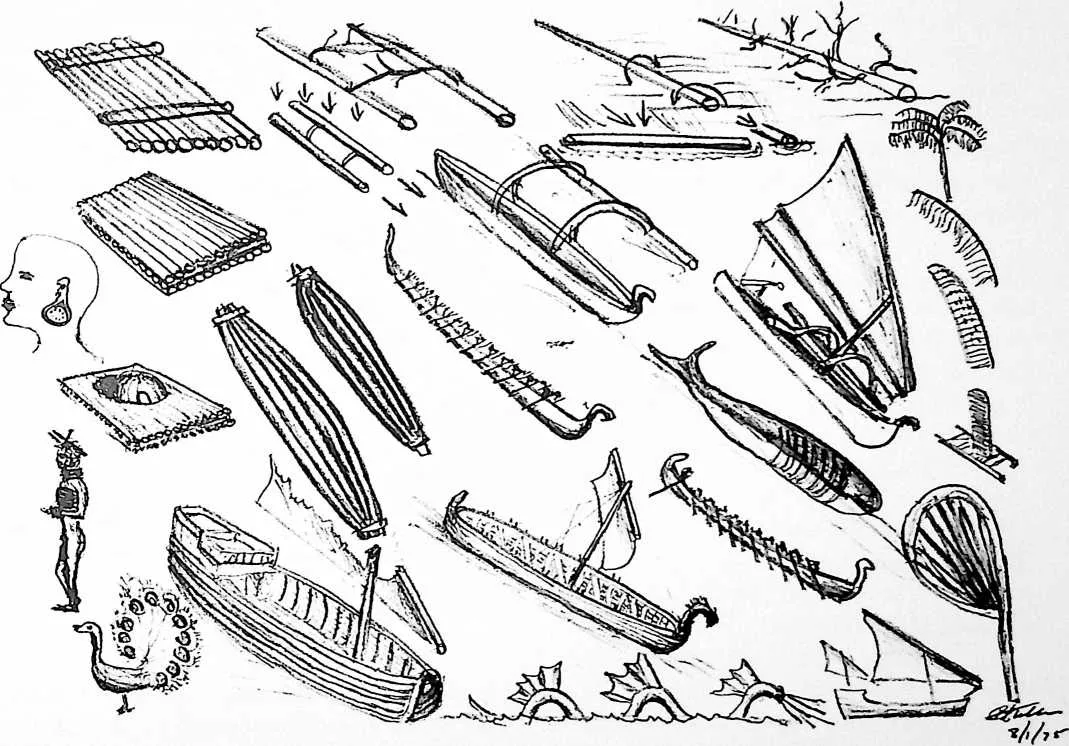
2Atoll humans quickly learned that wood floats and stones sink. They learned that a single floating log rolls and that two floating logs held cross-connected by their branches do not roll, but provide a structurally stable floating device from which they could fish or dive for edible mollusks. The atoll dwellers soon learned to build both multilogged rafts and dugout log boats as well as outrigger-stabilized dugout canoes. Then they learned how to stitch together the palm tree’s fronds to make combined masts and sails and found that their outrigger canoes could sail zigzaggingly to windward while rafts could only ride with the ocean currents or drift to leeward with the wind. The outrigger canoes could be worked (or could ‘‘beat’’) to windward by a succession of individual ‘‘tackings,’’ first leftward, then rightward, at a firmly sail-filling angle, which is about thirty degrees one side or the other of the direction from which the wind is coming. This produced a low atmospheric pressure on the forward and leeward side of their sails, which, as with twentieth-century airplane wingfoils, pulled their boats forward in the direction of least resistance, which direction could be modifyingly controlled by steering oars or paddles. The atoll sailors, facing forwardly in their much-earlier-developed, large, dugout, outrigger canoes, learned to paddle them into the wind to become, undoubtedly, the first successful westward sea travelers against the prevailing winds. But this windward travel against the waves took both musclepower and much food to support it, which curtailed the length of voyaging. Nonetheless, it did make possible for the first time in history the predetermined (and celestialnavigation-maintained) direction of travel independent of the direction winds of and ocean currents, team paddling powered their voyages of discovery around islands, along seacoasts, and inland to explore the rivers. It established the principal mode of travel of the canaled, water-state kings of those four-cornered cosmological models (of kingly ascent into the realm of the gods).
3 STONE 13
5 The bears tell Goldy that they had witnessed the early, large-rafting, Pacific water people going from the Pacific into the Atlantic, thence into the Indian and back again into the Pacific, blown dominantly west to east by winds, waves, and currents of the ‘‘roaring south latitude forties’’ not-so-merrily-go-rounding south of Capes Horn, Hope and South Island of New Zealand. This South Pole encircling confirmed to these water people incredible millennia ago that their world is a sphere---a spherical vessel going around the sun.
6 Their little independent world---their vessel seemed also to define a sphere of their locally controlled activity, within which spherical vessel (like the moon) they were encircling the larger world.
7 Undoubtedly endowed with same brains and minds as present-day humans---but naked, pocketless, and ofttimes drenched by overbreaking seas---these raft voyagers spent millions of long, clear-skied nights of their untold millennia to millions of sea travel years studying the familiar, nightly repeated view of their remote starry sky patterns as their spherical world rotated around its North Star and Southern Cross axis. They learned how the angular directions of these nightly viewed patterns gradually changed with their travel to disclose old or new star guides. As they went north, ‘‘the Southern Cross’’ became lost to sight and the North Pole star appeared ever higher above their horizon, and as they went south the pole star gradually became lost to view while ‘‘the Cross’’ became ever more elevatedly prominent, There being an equatorial area from which both the North Pole star and the South Pole’s cross could be mutually but only vaguely viewed because of their proximities to the diametrically opposite horizon points.
8 Having no paper or writing tools with which to record their discoveries, the raft sailors lashed together complex, crisscrossed bamboo stick grids which faithfully corresponded with the sighted angles at different times when held aloft to their eyes to sight the interstar patterns. Thus the water people’s rafts became the world’s first ‘‘observatories’’ and these voyagers the first great astronomers, oceanographers, and mathematicians. As ocean currents and trade winds periodically reversed their drifting, they reconfirmed those seafarers’ earlier powerfully remembered, stick-codified sightings.
9 During all their long years of voyaging, having no written means of amassing records of their experiences, they composed songs which, of very many verses, chronicled not only their own experiences but also those relayingly learned from the many generations of their ancestors, through the overlapping of their lives, who, too, had progressively amassed the records of their sea-voyaging experiences in chants. The Naga chants became the Ragas of the Japanese or Balinese, meaning ‘‘the tales of the old people’’ or the sagas of the Vikings. They were rehearsed day after day, year after year, century after century by these long voyagers who kept track of the verses by successive identification of the verses with their succession of ancestors, each identified with a successive log in their rafts. Later each rib in their boats was identified with the successively chanted-of ancestor. When these people came later to turn their boats upside down on the land to protect the voyagers from the inclement weather, they gradually developed therefrom ribbed, roofed, and columned buildings for nonseagoing communal purposes. Thereafter they carved faces, arms, and legs on the columns and affixed small mother-of-pearl shell ‘‘eyes’’ on these faces, to represent the succession of earlier ancestors, and sung their chants before them.
10 However, long before those ribs appeared in the boats, the atoll sailors, facing forwardly in their much-earlier-developed, large, dugout, outrigger canoes, learned to paddle them into the wind to become, undoubtedly, the first successful westward sea travelers against the prevailing winds. But this windward travel against the waves took both musclepower and much food to support it, which curtailed the length of voyaging. Nonetheless, it did make possible for the first time in history the predetermined (and celestial-navigation-maintained) direction of travel independent of the direction of winds and ocean currents. Team paddling powered their voyages of discovery around islands, along sea coasts, and inland to explore the rivers. It established the principal mode of travel of the canaled, water-state kings of those four-cornered cosmological models (of kingly ascent into the realm of the gods).