
19 TRICAP
2The Austronesians assumed that the gods were not concerned with the people but only with posthumous deifying of the king. With a few millennia of development and proliferation of technological know-how, tools, physical materials, and building capability, civilization realized that in addition to equipping the god-monarch for safe passage into the afterlife, it would be feasible also to assist the nobles to reach the next world. This was done by preparation of elaborate tombs in which were secreted all the riches, food and tools that the king (and later, nobles) would need in the next life. As millennia passed, so much know-how was accumulated in this life that during the last millennium b.g. it became technologically feasible to prepare elaborate mausoleums to enable the rich middle class to migrate safely into the next world. Finally it became technically feasible to prepare all of humanity for entering into the afterlife. This occurred at year zero. The concept of a cosmic intellectual integrity governing all Universe that is utterly concerned only with all humans which cosmic integrity, if properly worshipped and served, could arrange for the happy afterlife of every devout believer inspired inception of a plurality of new people’s religions and two millennia of church, cathedral, temple and mosque building. In addition to getting all ‘‘worthy’’ people into the next world, ever-multiplying technical know-how made it successively feasible to take care of the present life, first of kings (divine right of kings), then nobles (magna carta), then of the well-to-do middle class (Victorian period) and in the twentieth century for all humanity. This eliminated the necessity for two worlds---one universe now embraced all.
3 STONE 18
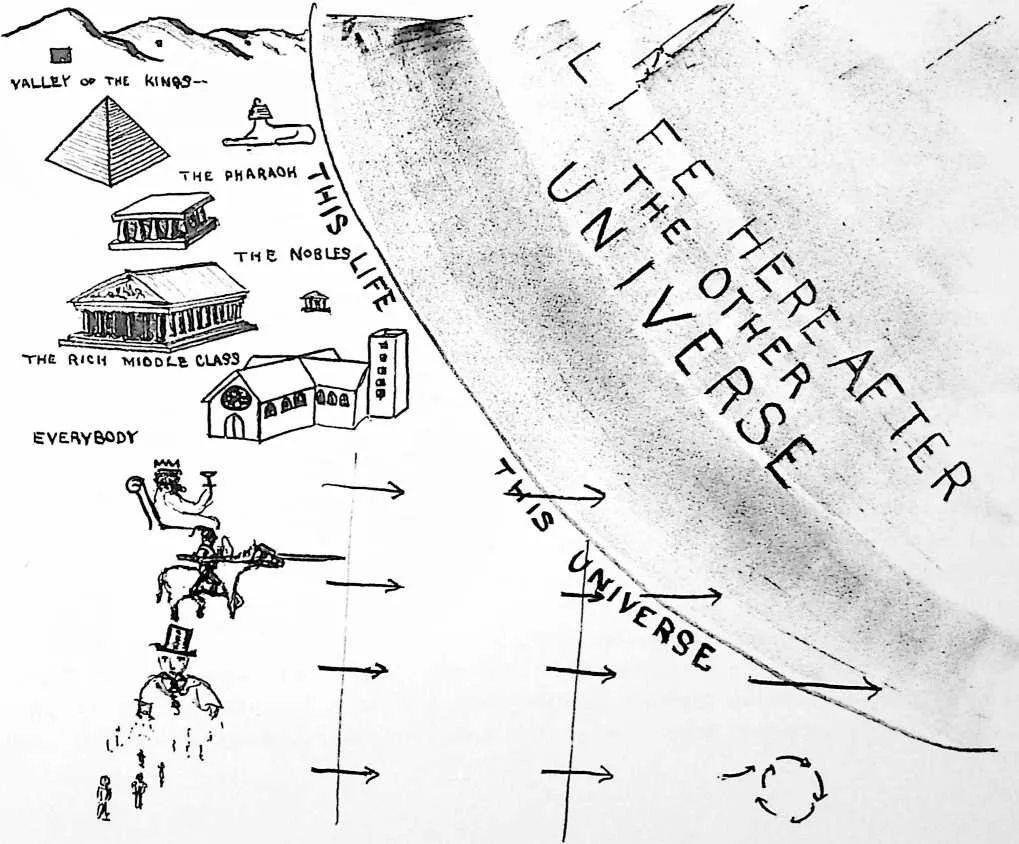
5 There arose a philosophic necessity to evolve a common people’s God who could and would welcome everybody into the afterlife. About 600 years prior to this, Buddha, an Indochina prince, renounced his royal claim on the throne and promulgated the concept of a cosmic intellectual integrity governing all Universe that is utterly concerned only with all humans, which cosmic integrity, if properly worshipped and served, could arrange for the happy afterlife of every devout believer. Employing the generally developed stone temple-building capability and thereby the feasibility of physically gratifying the common peoples’ superstitious yearning for access to the sublime vs. hellish afterlife by production of temples and a priesthood that would directly address the needs and problems of all ‘‘good’’ people, the east-west trading masters proceeded to import into Asia Minor the by-then-well-developed, proplebeian, concerned philosophy of 600 years earlier, naturally born Buddha but under new names and clothed in a variety of new and unique legends adjusted to the difference in everyday experiences of Occidental vs. Oriental people, of which Orientals the Occidental people had no knowledge whatsoever, it being of vast advantage to the east-west trade masters that neither the west nor the east people should have any knowledge of how they might obtain anything they needed except through the traders’ monopoly.
6 Following the Egyptian and Babylonian priests’ invention of the beginnings of humanity in the Garden of Eden and its coincidence with the dawning awareness of a potential afterlife for all those who disciplined themselves to live a God-fearing and worshipping life, various codes of conduct were religiously evolved in many areas of the Near East throughout the whole millennium, during which it was becoming progressively evident and popularly thinkable that not only was it feasible to provide means for getting the great ruler---as in the first dynasties of Egypt---into the next world and later also the nobles---as in the second set of dynasties of Egypt---and even later of getting in all the rich middle class---as in the late Greek and early Roman era---but the time had now come when it was feasible for all humanity to qualify for entry into the eternal happiness of the afterlife. In the Egyptian, east-west-waterroute-mastering world we have Moses (illegitimate son of a princess, ergo, like Buddha of royal stock) found floating in a basket in the bullrush swamp. Moses matures, counsels, and leads the common people, in contradistinction to the middle class or the nobles or the pharaoh, who would resent and resist sharing their exclusive afterlife prerogatives with the common people. Moses leads them out of their enslavement by the rich power structure of trade route 10 into a new promised land, that of trade route 9.
7 Under the dawning awareness of the feasibility of accommodating all humanity’s entrance into the next world, many scriptures were progressively written which adopted the composite history-won wisdom, philosophy, and experience of the East into Western comprehendibility and identified that philosophy and divine disclosure exclusively with a special living individual, a prophet, a savior, speaking with the authority of God as a native son of the Western World’s lands and peoples. Though Buddha, Christ, and Mohammed are each scriptured as being one unique, living individual, it is probable that each constituted an idealized composite individual, possessed of and professing the comprehensive quintessence of then evolving philosophy, cosmology, and mysticism. It is probable that there were many like-minded and identically committed humans, each one of whom might have been the central figure upon which the ‘‘official’’ character of their prophets was built.
8 After the legend of Moses the lawgiver a consortium consisting of the two Samarkand trade routes masters conglomerating with the Crete-Egypt-Red-Sea water route ‘‘world’’ trade masters, operating under the code name ‘‘the three wise men of the east,’’ hopeful of gaining the largest popular market control in Asia Minor, invented an even more uniquely born prophet bespeaking a Westernized adaptation of the Buddhist concepts whose miraculous birth by a virgin in Bethlehem close by Jerusalem, and whose sojourn in the wilderness, preaching, being betrayed and crucified, whose martyrdom, resurrection from the dead, and ascent into Heaven (from just outside Jerusalem) did indeed capture public acceptance far beyond the hope of its conceivers and powerfully enough eventually to command the dating of all world affairs from the new Western prophet.’s theoretical birthdate.
9 Five hundred years later, shaken by the success of the three wise men’s syndicate, operating trade route 7 from China via the Indian Ocean, Persian Gulf, Baghdad, Euphrates and caravan, their southernmost, routes-5-and-6-primarily-horse-mounted-overland competitors through the Khyber Pass and Kashmir, invented their prophet, who was much more like Buddha, was more realistically born in Mecca of mortal parents, was a wealthy but wise merchant who in his maturity went into the wilderness and evolved approximately the same Orient-evolved, comprehensively integrated all-history philosophy, and though making his birthplace, Mecca, the capital of his religious followers, did himself go to Jerusalem, where he competed in the ascent-into-Heaven event.
10 Thus did the successive northerly vs. southerly trade route masters alter history to suit their purposes. Thus for instance was the Roman Emperor Constantine puppeted into shifting Empire headquarters to the command city of the Bosphorus to re-establish the northernmost overland east-west trade route and to service the new greater European trade market reached by the Aegean, Adriatic, and Mediterranean waters by the (Pho)necian-(Ve)netian merchant ships. Thus one trade route mastery yielded to another as accomplished by the omni-ingenuity of the competitive route masters. The ‘‘Holy Grail’’ drive of the ‘‘Crusaders’’ was undertaken by the water traders hopeful of wresting from the horse-mounted Moslem-Saracens the control of both the Mesopotamian and Suez access to the Red Sea and Persian Gulf and therewith to the Arabian and Indian ocean trade routes.
11 Suddenly all ten of these Near East-transiting, overland or overseas, Orient-to-Europe trade routes were altogether eclipsed when Henry the Navigator of Portugal inaugurated sailing all the way from Europe to the Orient via the North and South Atlantic, around Africa to India and China. Thereafter a succession of European world-ocean masteries occurred which culminated in the East India Company’s ‘‘British-Empire’’-puppeted supremacy over all the world’s oceanic trade routes. This oceanic mastery suddenly terminated in World War II, when the line-of-supply control shifted into the air, and is now shifting again into the airless ocean of outer nothingness, intervening relativity’s cosmic events.