2 INTRODUCTION
2by Amei Wallach
3 In the spring of 1975, when she was not yet seventy-one, Tatyana Grosman began telling friends that her latest project involved ‘‘a young man, and I can’t keep up with him.’’ The young man was R. Buckminster Fuller. Working with Tatyana Grosman was his eightieth-birthday present.
4 Our present, too, it turns out, because the result of that improbable celebration is this book. Tetrascroll is for that 100 percent of humanity whom Tatyana Grosman regards as hungry for an experience that is both pure and beautiful. And it is for that 99 percent of humanity Buckminster Fuller calculates does not understand science, for the simple reason that most scientists are so awkward in explaining their world.
5 Buckminster Fuller has no such difficulties. Half a century ago he figured out how to explain Einstein and Eddington to his three-year-old daughter, Allegra. And now he is using that same technique to explain Buckminster Fuller to us. Synergy is at the heart of Buckminster Fuller’s findings, but synergy defined in a way it has never been defined before. Buckminster Fuller’s synergy is a science of relationships. The behavior of whole systems, he says, cannot be predicted by the behavior of individual systems acting alone. The difference lies in what happens between them when they interact. Tetrascroll is what happened in the interaction between two formidable systems named Buckminster Fuller and Tatyana Grosman. The story of Tetrascroll’s making is the story of that relationship. It is the story of Bucky and Tanya.
6 Despite their venerable years, awesome accomplishments, and a certain unstated imperiousness of manner, Buckminster Fuller immediately becomes ‘‘Bucky’’ to just about everyone who meets him, and Tatyana Grosman is simply ‘‘Tanya.’’ To everyone, that is, except the principals themselves. Throughout their creative adventure Tanya addressed Bucky as ‘‘Dr. Fuller’’ and he called her ‘‘Tatyana,’’ ‘‘My Dear,’’ or both, as in, ‘‘Tatyana, My Dear.’’
7 But for most of us the diminutive suits them, and this has something to do with the childlike directness and wonder with which each regards the world. In many ways every day is a birthday for both of them, a new day to start all over again, at the very beginning. A day to test and explore.
8 Tanya’s realm is fine art as manifested in the process of printmaking. Bucky’s is science---and philosophy, and poetry, and architecture, and mathematics, and technology, and metaphysics. Together they have brought forth a children’s book, a fable that requires intense concentration for an adult to fully understand. Children, with minds uncluttered by years of wrongheaded learning, will have an easier time with Tetrascroll than will many of their parents. The way to read this book is to remember Bucky’s advice: ‘‘See the drawings like a child. Do the drawings have meaning for a child?’’
9 Bucky calls the book ‘‘everything I think and feel in mathematics and philosophy and everything else.’’ For Tanya it is ‘‘a very beautiful achievement by an artist, a pure vision expressed in lithography.’’
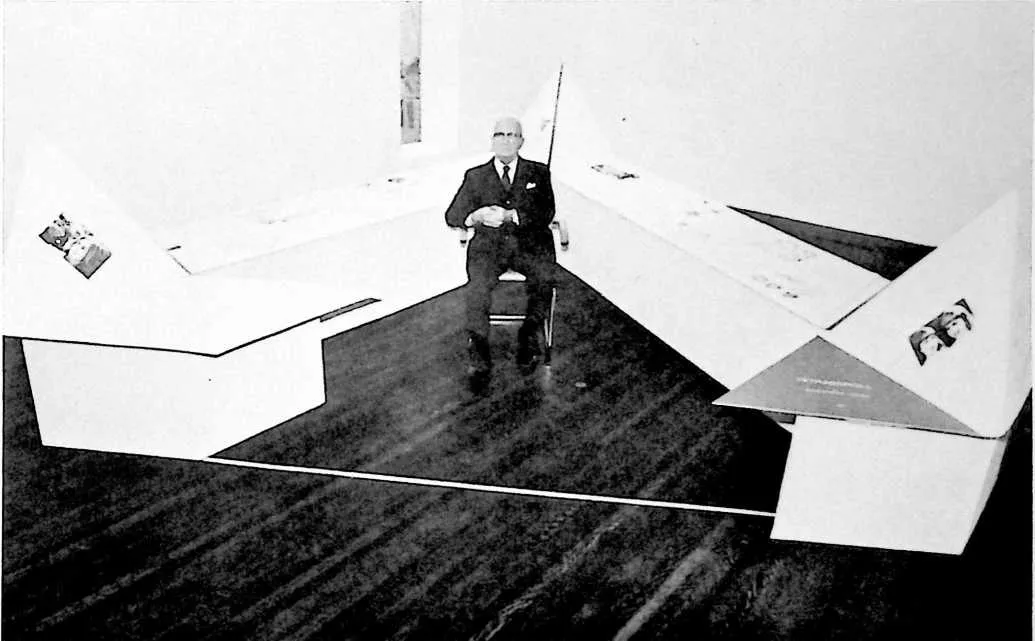
10 In its original incarnation Tetrascroll was a lithographic book-object that consisted of twenty-six pages bound together by the sturdy Dacron that is most commonly used in sailmaking. Each page was a thirty-six-inch equilateral triangle---one of the four faces of ‘‘the tetrahedron, which Bucky has established as the basic unit in nature. Each triangular page contained text and one of Bucky’s engaging drawings, which he had executed with crayon and pencil on lithographic stone. The pages were hinged to one another in such a way that they unfolded into any number of forms, including a circle. Tetrascroll could be spread out to a forty-foot strip, or it could be unfurled like a scroll at each end. Tetrascroll was first presented to the public on January 29, 1977, when it was exhibited in two of its possible forms at the Museum of Modern Art and at Ronald Feldman Fine Arts, a Manhattan gallery that specializes in the avant garde. The way the museum hung the book, it stretched across one wall, then, turning the corner, continued on an adjacent wall. At Feldman Tetrascroll lay face up on platforms set out in the middle of the gallery, like two sides of a massive triangle. As art, it was displayed in both places, and as art Tetrascroll was emphatically meant to be enjoyed. Still, at those January, 1977 openings, the guests discarded the habitual rite of socializing to concentrate closely on the text. Even in its guise of a deluxe art object limited to an edition of thirty-four, Tetrascroll was every bit a book meant for reading.
11 From the first, Bucky had intended that Tetrascroll should be available for a wider audience. He appreciated the exacting discipline of making beautiful lithographs at Tanya’s print workshop, Universal Limited Art Editions---and also her insistence on limiting each page of an edition to what a printer can print in a single day. For Tanya each page must be the expression of one day’s touch, its atmosphere and psychological state---unaltered by differences in weather, or family affairs, or whether or not breakfast was agreeable.
12 Bucky relished the intuitive and artistic in which everyone at ULAE had concentrated on his book. ‘‘Everyone was completely enchanted as the story unfolded itself,’’ he said on the day of the Museum of Modern Art opening. ‘‘Really, it unfolded itself like Tetrascroll unfolds.’’ But he wanted his million readers---not to mention everyone else---to be able to enjoy the story too. More than enjoy. Bucky is sure Tetrascroll'’?, message is vital if man is to make a success of himself. Besides, the words that appeared in the original Tetrascroll were only part of what he had to say. They were words distilled from a larger text, which appears in this version of the book interspersed with the twenty-one lithographs and their captions (‘‘tricaps’’), which contain the text from the original art-object Tetrascroll. Bucky wanted a commercial edition of the book, and Tanya and her studio manager, Bill Goldston, obliged by arranging a joint publication with Bucky’s commercial publisher, St. Martin’s Press. This edition of Tetrascroll is the first book co-published by ULAE, Inc. and a trade publisher.
13 Since 1956 lithography has been the primary concern of Universal Limited Art Editions, where Tanya presides. With stones discovered on her doorway path and a secondhand press purchased for fifteen dollars, ULAE began producing limited-edition lithographs of such precision, care, and lavish inventiveness that the studio helped revive the art of printmaking in the United States and earned itself a reputation as one of the finest print workshops in the world. After twenty- five years of publication Tanya, as Bucky had before her, won the coveted Brandeis Notable Achievement Award for ‘‘Genius, artistic excellence and notable accomplishment.’’
14 The list of artists who have worked at ULAE includes many who had no public at all when Tanya first found them. Now, however, it reads like a condensed ‘‘Who’s Who’’ of American art: Lee Bontecou, Jim Dine, Sam Francis, Helen Frankenthaler, Fritz Glarner, Jasper Johns, Alexander Liberman, Marisol, Robert Motherwell, Barnett Newman, Claes Oldenburg, Robert Rauschenberg, Larry Rivers, James Rosenquist, Saul Steinberg, Gy Twombly. Through a gift from Armand and Celeste Bartos, the Museum of Modem Art acquires number one of every edition of lithographs---and etchings and woodcuts---that the studio prints. And museums and galleries around the world are anxious to be first to display the latest ULAE accomplishment.
15 Bucky knew nothing of ULAE’s reputation in February, 1975, when his young friend Edwin Schlossberg suggested they visit the white frame house at 5 Skidmore Place in West Islip, Long Island, where Tanya and her presses reside. Bucky’s investigations into nature, technology, and the universe had in the past led him into byways like anthropology and poetry. His findings had already affected biology, medicine, physics, technology, and architecture. But never before had he had a great deal to do with the world of fine arts.
16 Tanya was aware in only the haziest way of Buckminster Fuller. She had heard something. That he was an engineer, an architect. Something. But Eddie Schlossberg they both knew, and well. Tanya had met the tall, tou- sle-haired poet-physicist in 1966, when he was twenty years old, a Columbia University undergraduate. He had come with Jasper Johns to watch the artist work at ULAE. Tanya asked the composed young man what he did, and when he said that he made poems, she asked to see his work. The result: Wordswordswords, an unbound, limited edition book of Schlossberg’s poems, printed in different ways on different materials. Some sheets are embossed, some etched, some pressed onto the back of the paper and meant to be read through the paper, some typed on sheets of aluminum, or black paper, or plastic, or regular typing bond. Options and alternatives.
17 Options and alternatives are at the core of Bucky’s vision, too. There are thirty different relationships in a tetrahedron. Recognizing the possibilities will make it possible for us to survive. Although Bucky and Schlossberg were bom a full half-century apart within a July week of one another, the two men have much in common. So much, in fact, that in the early months of their friendship, when Schlossberg was twenty-four and a doctoral candidate in physics and literature, Bucky had found himself irked---‘‘miffed’’ is the word he uses---at the letters Schlossberg wrote him. Eddie’s words and thoughts so closely resembled Bucky’s own that the younger man seemed to be aping the older. But after a while Bucky realized it was simply that they were so much alike that thinking and talking in a Fulleresque way came naturally to Schlossberg. At Southern Illinois University, where Bucky was Distinguished University Professor in the 1960s, Schlossberg helped him develop the World Game. The game offers a way of organizing data about the world’s resources and then suggesting hundreds, thousands of alternatives for dispersing them.
18 In 1975 Bucky would be eighty years old, and Schlossberg would be thirty. He wanted to give Bucky something special for his birthday. Most special of all for a creative man, Schlossberg decided, would be ‘‘something new to do.’’ Something new to do at Tanya’s.
19 With that end in mind Schlossberg rummaged in the Buckminster Fuller archives at the University City Science Center in Philadelphia, where Bucky has been World Fellow in Residence since 1972. Every scrap of paper, every contract, every note, every drawing that has ever crossed the redoubtable World Fellow’s path is housed there. Schlossberg rolled together drawings of such Fuller inventions as the three-wheeled Dymaxion car, the cable- suspended circular Dymaxion house, and the geodesic dome. He threw in a childish scrawl or two out of Bucky’s faraway past and then dispatched the bundle to Tanya.
20 She was baffled. She has no idea what to do with these puzzling ‘‘blueprints,’’ as she called them. ‘‘I was absolutely helpless looking at this material,’’ she remembers. ‘‘I couldn’t understand the connection from one drawing to another, or even why the drawings were done.’’
21 In the midst of all that arcana, however, were three drawings of a child. They looked as if one person had penciled in the outlines, someone else had colored them in, and a third person had written the captions with the uncertain lettering of a child. In fact, Bucky had drawn the outlines; his wife, Anne Hewlett Fuller, had colored them in; their daughter, Allegra, had written the captions underneath. Tanya’s favorite depicted a sneezing child who was identified as ‘‘Bugs’’ in a bold, wavering hand. She returned the ‘‘blueprints’’ to Schlossberg, kept the drawings, and awaited Bucky’s arrival for tea.
22 It was bright on the afternoon of Tuesday, February 25, 1975. And cold. The wind howled petulantly all day, and would the next. In the passenger seat of Schlossberg’s Volvo Bucky was playing the Milton Berle trick that has made it possible for him to go with a minimum of sleep for more than fifty years. He laid his head on his shoulder and snapped into a cat nap, leaving Schlossberg to contend with the traffic, which, as usual on Long Island, was hopelessly snarled.
23 It was 5:00 in the afternoon by the time they arrived. White linen napkins had been placed over the plates of food which Mrs. Jones, the ULAE cook (a Frenchwoman despite her name), had long since prepared when the two men stepped onto the wooden porch and into the small front room that doubles as ULAE archive and reception hall.
24 As usual, Bucky was wearing a dark suit. As usual, Tanya was elegant and erect as she motioned the men to the small, round table covered with white linen and lace and with the culinary delights with which she habitually greets her guests. Food is an important part of the ULAE ritual. Bucky declined everything but the tea, which he drinks incessantly and in a quantity that easily qualifies him for the ‘‘enraptured fireplug’’ description his biographer Hugh Kenner once employed in an article for The New York Times.
25 In repose, when he is not smiling, Bucky can resemble a rather clubby and humorless banker. His head is high and domed, his hazel eyes bland behind thick glasses, and his square chin folds in on itself like origami paper. Then he grins, and suddenly he is approachable, animated, and instantly recognizable as the foremost living practitioner of the four-hour, five-hour, ten-hour marathon talk. Bucky also happens to be decidedly squat. During all his time at ULAE he managed to forego all culinary pleasures except steak, spinach, and Jell-O. With that menu, repeated three times a day, he had reduced from a high of 206 pounds of too solid flesh, and with that menu he intended to maintain his accomplishment.
26 Most biographers say that Buckminster Fuller stands about five feet, two inches tall. While he agrees that he is ‘‘short by twentieth-century dimensions,’’ he asserts his height is five-six. Tanya, who is definitely diminutive at five-two, says she believes that she is taller than ‘‘this great man.’’ She is, however, slight to the point of delicacy.
27 Her face is small and softly pointed at the chin, and it wears a glow. Sometimes she tilts her chin expectantly; sometimes she firmly sets it straight. The eyes above are soft and vulnerable. She speaks softly, too, in a generously accented English derivative of Russian, and it is necessary to lean forward and listen hard in order to understand her.
28 Bucky talks forcefully and intemperately at a rate he estimates at 7,000 words per hour. The words tumble out, stumbling over one another, as he gulps for breath in odd places, the better to hold tight to a phrase at the end, thus forestalling any unforeseen interruptions before his thought has run its often convoluted course. His accent is that of upper-class New England. He often speaks in a chairman- of-the-board, matter-of-fact slur that makes it easy to miss whole paragraphs of what he is saying. Bucky is also rather deaf, a malady
29 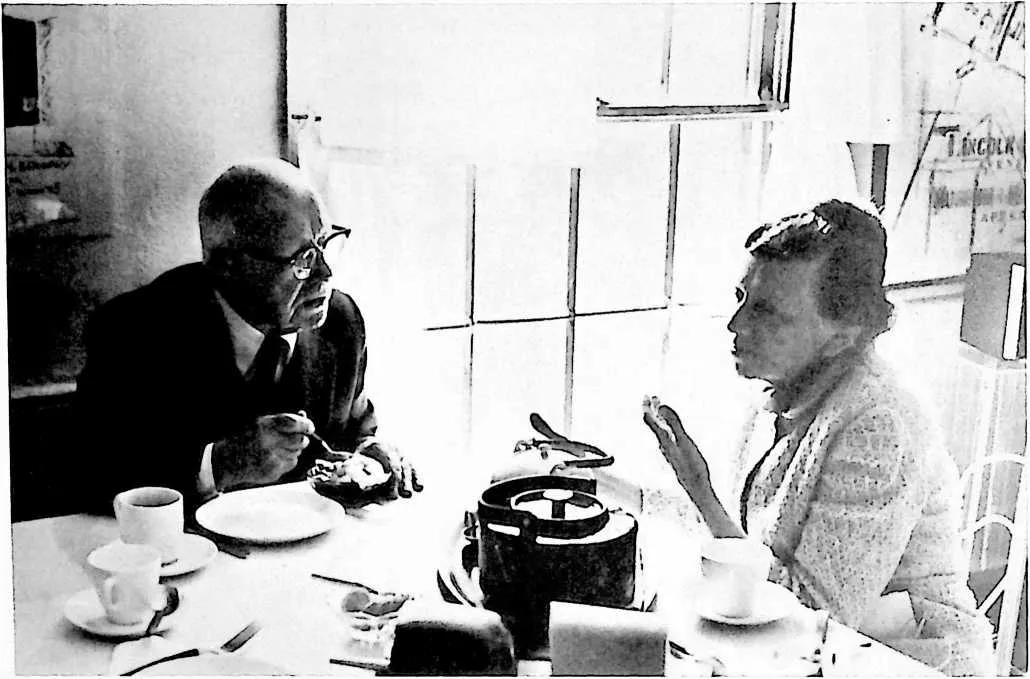 only partially offset by the hearing aids he wears in each ear.
30 ‘‘Tatyana, my dear.’’ ‘‘Dr. Fuller.’’
31 On that first day, in February of 1975, before Bucky and Tanya had learned the rhythms of each other’s speech or intuited the patterns that would render their words intelligible to one another, it was Schlossberg who interpreted. He sat between them at the small, round table, ear toward Tanya’s mouth, mouth toward Bucky’s ear, back and forth like a spectator at a tennis match. Not that there was anything the least competitive in the encounter.
32 There might have been. Bucky is accustomed to absolute monarchy in any space he occupies, benevolent as that dominion may be. Tanya’s way is clear to herself, and she is practiced in the art of teasing, cajoling, inspiring, and goading her artists into the paths she is sure will lead them right. But between Bucky and Tanya, those who watched have said, there was immediate and courtly respect.
33 The meeting had come at a difficult moment for Bucky. In just a month Synergetics [FA75]---the book that provides the underlying structure for Bucky’s lifetime of mathematical and scientific contributions---would be published. It had taken some fifty-two years of fits and starts, of articles here, talks everywhere, fourteen books on phases of the subject, and a nagging reminder provided by a locked, black briefcase crammed with manuscript pages. But R. Buckminster Fuller had finally completed his life’s work.
34 With the help of his logical and persistent friend, E. J. Applewhite, Bucky had at last laid out in writing the mathematical formulae and empirical observations on which he based his concept that all physical and metaphysical experience could be described in terms of a tetrahedron---that four-sided triangular configuration that Bucky is sure is the primary building block of nature and the universe. Synergetics---‘Bucky’s Principia, ’’as it has since come to be called---was due to be published on April 3, 1975, and Bucky’s friends felt some concern about him.
35  They were not yet aware that, his brain now unburdened of its accumulated eight decades
of thought, Bucky would begin all over again, spinning out new inventiveness that
would result in still more ideas, still newer books, including Synergetics 2. They knew
only that after rewriting the last of the galleys for the original Synergetics Bucky had
confessed to Applewhite that he felt disoriented. The exhilaration of unwinding from
himself that lifetime-evolved skein of formulae, diagrams, models, tables, numbers,
and
They were not yet aware that, his brain now unburdened of its accumulated eight decades
of thought, Bucky would begin all over again, spinning out new inventiveness that
would result in still more ideas, still newer books, including Synergetics 2. They knew
only that after rewriting the last of the galleys for the original Synergetics Bucky had
confessed to Applewhite that he felt disoriented. The exhilaration of unwinding from
himself that lifetime-evolved skein of formulae, diagrams, models, tables, numbers,
and
36 ‘‘The behavior of whole systems cannot be predicted by the behavior of individual systems acting alone.’’
37 XV
38 words had come undone. The focus of his inexhaustible energy was gone, and Bucky was somewhat at a loss. Schlossberg hoped Tanya would be the answer.
39 In West Islip, on the first day of their meeting, Tanya and Bucky sat for a time at the table in ULAE’s front room. Besides the nineteenth-century country chairs on which they sat, only prints and cabinets furnish the room. The floor is bare, the feeling spare. There are three doors in the room. One leads to the front stairs, one to the back office and kitchen, and one next door to what was once the garage of the house and is now the workshop in which the prints are made. Bucky and Tanya talked, and then Bill Goldston, who is the ULAE studio manager, and Tony Towle, a poet and for many years Tanya’s secretary, led the way upstairs to the immaculate viewing room. There, making a ceremony of it, they brought out some of the books ULAE has printed. Silently and carefully they turned each page. There was Schlossberg’s Wordswordswords, Barnett Newman’s 18 Cantos, and Robert Motherwell’s A la Pintura. Of the last, curator John J. McKendry had written in the catalog introduction for its Metropolitan Museum exhibit, ‘‘Motherwell has concentrated so much of his creativity into these pages that if all of his paintings, and other works, were destroyed, if only this book were to survive, Motherwell would still be seen as a major artist of the Twentieth Century.’’
40 It wasn’t too long after he began looking at the work, that Bucky called for a stone of his own. By the time Towle ended his day at 6:40, he was able to note in his diary: ‘‘Dr. Fuller is just drawing one of his domes on a stone with a No. 5 crayon.’’
41 As a child Bucky had loved drawing with charcoal. But his mother informed him that the men of their family became doctors and lawyers and ministers, and in 1905 he put away his drawing tools---those lovely tools. He had drawn diagrams since then, with a pen or pencil, taking care to be completely accurate. But this unrehearsed, pure concentration on line and feeling in Tanya’s studio was new. In fact, he pronounced it ‘‘thrilling.’’
42 That first drawing of a dome did not appear in the original book, and it has not been reproduced in this one. But it served its purpose. In the past Tanya had enticed unwilling artists to try the stone. (‘‘I began lithography reluctantly, thinking the second half of the 20th century was no time to start writing on rocks,’’ Robert Rauschenberg has written of his first, fateful encounter with Tanya.) She had grown adept at angling. This time she had hooked her big one without even trying. The work had begun. What happened next for Bucky and Tanya came out of their respective gifts, and their strengths, and the sum of their lives.
43 Buckminster Fuller and Tatyana Grosman are, as Bucky might say, simultaneous events, each encapsulating an important if finite chunk of history. He, the quintessential Yankee, descended from Puritans and Tran- scendentalists, married another Yankee, Anne Hewlett, whose families on both sides were among the original settlers of Long Island. The newspapers called it a wedding of ‘‘mothball aristocracy,’’ Bucky still tells with glee.
44 Tanya, the inward, extravagant Russian, resonating to Chekhov’s pauses and Pushkin’s poems, married an improvident, exuberant artist, Maurice Grosman. It was the first test of her indomitable will. Her family disliked the match. She took a solitary ski trip to decide, and returned to break with them.
45 Bucky imbibed the principles of practical experience during boyhood summers sailing off Bear Island in Maine’s Penobscot Bay, where, he wrote in his book, Ideas and Integrities [Ful63], ‘‘boat building is the parent technology.’’ There he learned an early intimacy with ‘‘such tension systems as seines, trawls, weirs, scallop drags, lobster pot heads, and traps together with all their respective drag and buoy gear’’ and practiced with ‘‘stout cordage and light lines’’ the techniques of ‘‘net-weaving, tying, splicing, and serving.’’
46 Tanya’s girlhood memories are of the drama of despair then playing out its final act in Russia, where she was born on June 30, 1904. Her hometown was Ekaterinburg, where later Czar Nicholas II and his family were to be shot. While the men played cards in their clubs on somnolent afternoons, a revolution was going on. Prisoners on their way to incarceration in a wing of her father’s house which had been commandeered for that purpose were lost along the way, fallen or pushed into mine shafts, where they could be heard singing for days, until the sound faded and then died. In the churches, and in the museums, where her father, a newspaper publisher, took her, there were jewel-encrusted icons and books encased in gold and silver and pearls. In the hospitals soldiers, stuffed three to a bed, called to Tanya in her role of volunteer nurse, ‘‘Mademoiselle, will you please just touch my hand?’’
47 Tanya measures her life in terms of the historical events that have swept her from country to country, from life to life. Turn-of- the-century Russia. The Revolution. Japan. Germany in full-blown hysteria after World War I. France and Left Bank Paris in the frenetic days between the wars. Hitler. World War II. Flight into Spain, as Jews. America.
48 Bucky notches his life according to the scientific discoveries and technological advances that have made his world travels both necessary and possible. Born on July 12,1895, in Milton, Massachusetts, he was three when radium was discovered; nine when the airplane was invented; ten when Einstein explained his theory of relativity; thirty-two when Lindbergh flew alone across the Atlantic; forty-three when the jet plane made his forty-eight trips around the world a feasibility.
49 There were 700 members of his class at Harvard, but only two, he remembers now, owned automobiles. And one of those was Ray Stanley, whose father had invented the Stanley Steamer. That was the class of’17. By graduation day, however, Bucky had been thrown out---‘‘fired,’’ he calls it---twice. The first time he was dismissed for cutting exams and squandering his tuition money on a memorable spree for the cast of the Ziegfeld Follies-, the second for a mutually diagnosed ‘‘lack of sustained interest in the processes within the university.’’ He was the first male member of his family since 1760 who did not graduate from Harvard.
50 Bucky’s memories of his World War I assignments in the Navy center on his participation in the development of ship-to-plane ‘‘radiotelephony.’’ His view of the Versailles Peace Conference---which so brutally exacerbated the war scars of Europe---is the first long-distance wireless arc telephony, which he helped install in the USS George Washington, the ship on which President Wilson traveled to France.
51 In World War I, Bucky has said, industry made the jump ‘‘from the track to the trackless, from the wire to the wireless, from visible structuring to invisible structuring of alloys.’’ Bucky calls this ‘‘invisible’’ behavior of whole systems unpredictable by the individual behavior of its parts ‘‘synergy.’’ Since World War I, advances in this realm---recently exemplified by the black box that can accommodate all of man’s body functions in space---have for the first time in history made it possible to do a great deal more with infinitely less. There is enough for everyone in the world, and it is time to drop ‘‘killingry’’ in favor of ‘‘livingry.’’ Now at last, at this moment of time, Bucky is sure, man has an opportunity to make a success of himself. The catch is that time is running out and the impending deadline keeps the eighty-seven- year-old technological prophet restlessly traveling, endlessly addressing anyone who will listen anywhere in the world.
52 There was a period from 1927 to 1929, however, when Bucky said hardly anything at all to anyone. In 1922, on her fourth birthday, his daughter Alexandra died of successive epidemics of influenza, spinal meningitis, and infantile paralysis. Bucky began drinking heavily at night, while by day he marketed a building system his father-in-law had invented. In 1927, after a takeover attempt, the business failed. The trustees blamed Bucky. After that he had nothing, including faith in people he had assumed to be his friends. Besides, his daughter Allegra had been born.
53 ‘‘I appeared to myself, in retrospect, a horrendous mess,’’ Bucky once remembered, for Quest magazine. ‘‘I found myself saying, ‘Am I an utter failure? If so, I had better get myself out of the way, so at least my wife and baby can be taken care of by my family.’ ’’
54 He stood at the shore of Lake Michigan, wondering whether it might not be best for his wife and child if he threw himself in. Instead he determined to dedicate the bundle of unique experience that he was to understanding the universe. For two years he reexamined everything he had ever felt, believed, learned, read, or anything anyone had ever taught him---including the meaning of language itself---in the light of his own empirical experience.
55 In 1930, about a year after he had ended his self-imposed silence, Bucky succumbed to Allegra’s pleas to ‘‘Tell me about Goldilocks and the Three Bears, Daddy.’’ As the story changed and became a seminar, meandering into the lands of geometry, history, sociology, physics, chemistry, and architecture, Bucky developed what has since become his public speaking style. He approaches a subject obliquely, veers off in whatever promising direction occurs to his fertile brain, only to return once more to the point, which is a convincing tetrahedral view of the universe.
56 In those stories, too, he practiced his newly evolved, idiosyncratic vocabulary, which to this day states his difficult concepts economically and with exacting accuracy. Bucky’s words have the staccato sound of the machine shop to them. The way in which he sets words to work is both practical and poetic---the kind of poetry Ralph Waldo Emerson was talking about when he spoke of saying the most important things in the simplest ways. Bucky, for instance, finds Einstein’s E = MC2 sheer poetic beauty. The stringent richness of his language has not gone unobserved. When Bucky finally returned to Harvard in 1961, it was as Charles Eliot Norton Professor of Poetry. Such absurd twists as that caused Bucky to exclaim on the day of his Museum of Modern Art opening, ‘‘My life is proof that the impossible happens, so I pay attention to nonsense.’’ The particular nonsense he had in mind that day was a fortune cookie that foolishly admonished him to ‘‘walk softly on new blades of grass.’’ He is far too wholehearted for that sort of tiptoeing. He’d rather ‘‘cast myself in God’s hands absolutely,’’ he told Tanya. ‘‘God is good and God is right, even when we don’t think so.’’
57 Tanya shares that mystical trust in a ‘‘meant’’ universe. So many terrifying, inexplicable, and marvelous things have happened to her in her life that she is a firm believer in miracles. There were the multiple miracles of the escape she and Maurice made from Nazi-occupied France in 1942, climaxed by a memorable climb over the Pyrenees into Spain. Tanya in her fur coat, Maurice with his easel. Not a toothbrush between them, they were artist and wife on a sketching expedition. When an official asked to see their papers, they showed him a certificate from the Louvre giving Maurice permission to copy in oil Velasquez’ portrait of the Infanta. It worked. Tanya loved that walk across the Pyrenees. ‘‘I felt extremely in my element,’’ she remembers of that time. ‘‘I felt beautiful. Maurice---he was more frightened at first than I was, but then he found the rhythm.’’
58 Once in New York, in 1943, Maurice painted and earned a living teaching and painting and making silk-screen reproductions, and Tanya resumed her role of femme d’artiste. This is how she describes that life:
59 ‘‘A femme d’artiste is a profession almost. You are everything. You are the muse, the inspiration. You hope you are until someone else walks in and takes your place. You are the participant, the audience. You share the life of the artist. It’s very unpredictable, unstable. He relies on himself. You are very protective promoting him. You try to take the burden. You have great belief, great faith in a great destiny. Someday everything will be glorious and fine.’’
60 In the sweltering summer of 1944 Tanya and Maurice visited friends on Long Island and decided to find a room with kitchen privileges to rent. All the rooms they saw were both dreadful and expensive, and Maurice, for one, wanted to go home. But Tanya, feeling something ‘‘meant’’ about their quest, insisted on staying, on walking on a particular road that felt right. And soon a long black limousine gave them a lift, and the gentleman riding in it invited them to come back at the end of the day if they had not found anything. When they returned, there were two gentlemen---Dominican brothers, they learned later---trimming the roses outside a mansion. The dilapidated caretaker’s cottage the brothers showed the couple became 5 Skidmore Place, and the rent was fifteen dollars a month. ‘‘It was,’’ Tanya often says in the telling, ‘‘as if an angel had passed.’’ By the time Maurice became ill in 1955, the Grosmans had bought the house, and it was there to live in while Tanya looked for something to which she could dedicate everything she had learned and felt and loved in her life---and earn money, too.
61 ‘‘There is a now,’’ she says. ‘‘Today is a day, and you have to survive the day. I had to face the world and there are many ways you can face the world and the way I faced the world was my way. There are better ways to do it, but you have to have faith in life, faith in miracles, something like that.’’
62 First she tried silk-screen reproductions, but that fast-turnover technique was not suited to her ideas of perfection. And there was once again a ‘‘meant’’ aspect to the discovery of lithographic stones on her own doorway path in 1957. She decided to make books. Limited-edition books first; later, books for mass circulation. In the meantime she and her artists began making lithographs.
63 Lithographs were simply not interesting to most American artists in the 1950s. Larry Rivers was the first artist she approached. He agreed to collaborate with his friend, the poet Frank O’Hara, on what would become the lithographic portfolio ‘‘Stones, ’’ only because of his relationship with Tanya, who had listened to his stories of an unhappy romance. ‘‘Among my peer group,’’ he says, ‘‘lithography was thought to be like the work of some downtown cornball who smoked a pipe and thought of himself as a ‘serious’ artist.’’ But Tanya, with her passion for ink, for the artists themselves, and for the act of creation most of all, helped change all that. What matters at ULAE is the process. She suggested that Mar- isol cover her body with oil and lie on two large stones for one print; that Oldenburg try painting his teapot on Balinese toilet paper; that Rauschenberg collaborate with the French novelist Alain Robbe-Grillet and the Russian poet Andrei Voznesensky. In Tanya’s studio the love of creating is at once as palpable and as intangible as music.
64 Robert Motherwell has written of ‘‘the ambience of her workshops, where it is simply assumed that the world of the spirit exists as concretely as lemon yellow or woman’s hair, but transcends everyday life.
65 Bucky’s most famous accomplishments have occurred in a world more commonly understood as concrete. He invented the Dymaxion house in 1927; the Dymaxion three-wheeled automobile in 1932--34; the Dymaxion World Map in 1935. The ubiquitous Geodesic Dome was first built commercially in 1950. All those inventions, however, are precessional by-products of his real concern with the structure of the universe. He is thoroughly at home with intangibles, and from the first day he was completely comfortable at 5 Skidmore Place as well.
66 February 26, 1975, was Bucky’s second day at ULAE. By then he had decided what he would do there. He would tell the story of Goldilocks as he had told it to Allegra. Through Goldilocks he would expound the theories in Synergetics as if he were explaining them to a child. ‘‘If I’m wrong,’’ he said, ‘‘a child won’t go for it. A child is the litmus test of the truth of a scientist.’’ Synergetics had been, in his words, ‘‘All immaculate mathematics.’’ Tetrascroll would also be feeling and fun. Its message might reach people who did not understand his other books, and Bucky felt some urgency in finishing it. ‘‘The Red Sea is still open,’’ he kept repeating. ‘‘We have to get this book out before it closes. Humanity needs its integrity and information.’’
67 He showed Tanya his meticulously plotted itinerary for the next two years, each short stop in his round-the-world schedule studded with flight numbers, speaking engagements, hotel names and telephone numbers. ULAE was quickly insinuated into the schedule, dropping into tight crevices of time or prying less important engagements off the page. It was Tuesday when Bucky first arrived, Wednesday when he came back to work in earnest.
68 Once again he sat in the front room at the round table, and a lithographic stone was brought to him. On it he drew the picture of Goldilocks on the beach and the Three Bears in the heavens, which opens this book. The original text recorded his delight with the vocabulary of the stone:
69 ‘‘Goldy says, ‘I have drawn Mommy Bear in reverse. I forgot when I was drawing her that if it is to be printed directly from my drawing, it requires an original mirror-image master. But I am going to leave her that way because it’s well to remind everyone at the outset that we can only get from here to there by a series of errors . . .’’
70 Lithography: An artist draws an image on a large, flat, smoothed-off stone (or zinc or aluminum plate) with either a special crayon or an oily liquid called tusche. The stone is then prepared by a printer and inked. When stone and paper are run through the press, the ink adheres to the paper, leaving an image which is a mirror image of the one drawn on the stone. At ULAE artists and printers have evolved all sorts of innovative variations on this technique.
71 When Barnett Newman created his deluxe, limited-edition book 18 Cantos at ULAE, the introduction he wrote became a kind of credo for lithography:
7273‘‘It [lithography] is an instrument. It is not a ‘medium’; it is not a poor man’s substitute for painting or for drawing. Nor do I consider it to be a kind of translation of something from one medium into another. For me, it is an instrument that one plays. It is like a piano or an orchestra, and as with an instrument, it interprets. And as in all the interpretive arts, so in lithography, creation is joined with the ‘playing’; in this case not of bow and string, but of stone and press. The definition of a lithograph is that it is writing on stone. But unlike Gertrude Stein’s rose, the stone is not a stone. The stone is a piece of paper.’’
74 Bucky’s first work session at ULAE lasted for three days and nights with brief intervals for naps. By 5:30 Sunday morning, with twelve drawings completed, Bucky felt ready to permit Bill Goldston, ULAE’s studio manager, to drive him to the airport, to catch the 6:30 flight to Philadelphia. ‘‘Now, Bill,’’ said Bucky, setting down his bags in the waiting room, ‘‘I’ll be okay. You drive safely and get some sleep. After that, an exhausted Tanya did not venture out of bed for two full days.
75 To Bucky, Bill Goldston---the man who gets impossible things done with ease---was ‘‘My Dear Man.’’ To Goldston, Dr. Fuller was the much honored genius of whom he had been aware even as a boy growing up on an Oklahoma farm. At the University of Minnesota in 1970 Goldston had tried hard to get into an overflowing Buckminster Fuller lecture, and had failed. His well-informed reverence for Bucky’s ideas was an integral part of the atmosphere that buoyed the work.
76 Early on, Bucky and the ULAE crew evolved a modus operandi that lasted throughout the nine months they worked together. While Bucky drew on his stones at one end of the long kitchen table, Tony Towle or another poet, Paul Violi, typed up the text that Bucky had scrawled in longhand on yellow sheets of paper, or white sheets, or whatever lay at hand. Freshly typed copy galvanizes Bucky, as his Synergetics co-participant, E. J. Applewhite, had already discovered. Bucky is moved to decorate clean copy with worms, squiggles, and inserts wedged willy- nilly into corners and between lines. In the case of Tetrascroll he was also dictating as he went along. There was a great deal of cutting and pasting. ‘‘Collaging,’’ Goldston calls it. ‘‘It was a very creative process.’’
77 ULAE had no quarrel at all with Bucky’s habits. Later, at a party celebrating Tetrascroll’s [Ful82] creation, he would be moved to say, ‘‘You can’t go all the way to heaven and back. But you can go almost there when you go to Universal Limited Art Editions.’’ Fostering creativity is ULAE’s primary industry. So Tanya goes to great lengths to construct a conducive setting, made up in equal parts of fine food, splendid company, a sense that time is seamless, and subtle reassurances provided by an author’s books or an artist’s work spread out in full view. She even dresses the part---a Russian-look blouse for the Russian poet Voznesensky; a South American coat Rauschenberg had given her when he arrives alone. All the elements must be in place, the stage set. Then the play can begin.
78 She has no doubt that the process of creation is one of evolution; she is quite content to patiently let matters take their course. It took six years for a prickly collaboration between Robert Rauschenberg and Alain Robbe-Grillet to produce the subtle and exquisite limited-edition book Traces Suspectes en Surface, nine years for Larry Rivers and Terry Southern to finish their crazy fairy tale, The Donkey and the Darling. At ULAE Tetrascroll easily expanded from its originally planned twelve pages to twenty-six. The preface page was signed on November 15, 1975, which is usually the signal that a work is complete. But Bucky drew two more stones after that. He always seemed to have more to wedge in here and there, to explicate a thought or accommodate yet another energetic drawing. That was fine. At ULAE it is assumed that the best work sometimes comes out of accidents. Once, when Rauschenberg was working there, the stone broke on the press. He tried again. It happened a second time. ‘‘Print it,’’ he said. The print was named ‘‘Accident,’’ and it won the Grand Prize at the International Biennial Exhibition of Prints in Ljubljana, Yugoslavia in 1963.
79 Bucky’s staple---talk---is a primary ingredient at the long dinners in ULAE’s white kitchen or during lunches outside under the catalpa tree. The artist who is working that day sits in the place of honor, at the head of the table. Friends, printers, staff, and guests range around. The food that day is the artist’s favorite. The talk, that easy family-joke chatter of people who have spent satisfying hours working together. Anecdotes. Ideas.
80 On one particular night, when the work had been long and hard and the dinner break did not come until 8:30, Tanya pointedly instructed her husband, Maurice, not to ask any questions. Bucky’s custom of answering every question from the very beginning of time was well known by then, and everyone was very tired that night. Undaunted and irrepressible, however, Maurice asked---there must have been a gleam in his knowing eye---‘‘Dr. Fuller, what do you think of the Mideast situation?’’
81 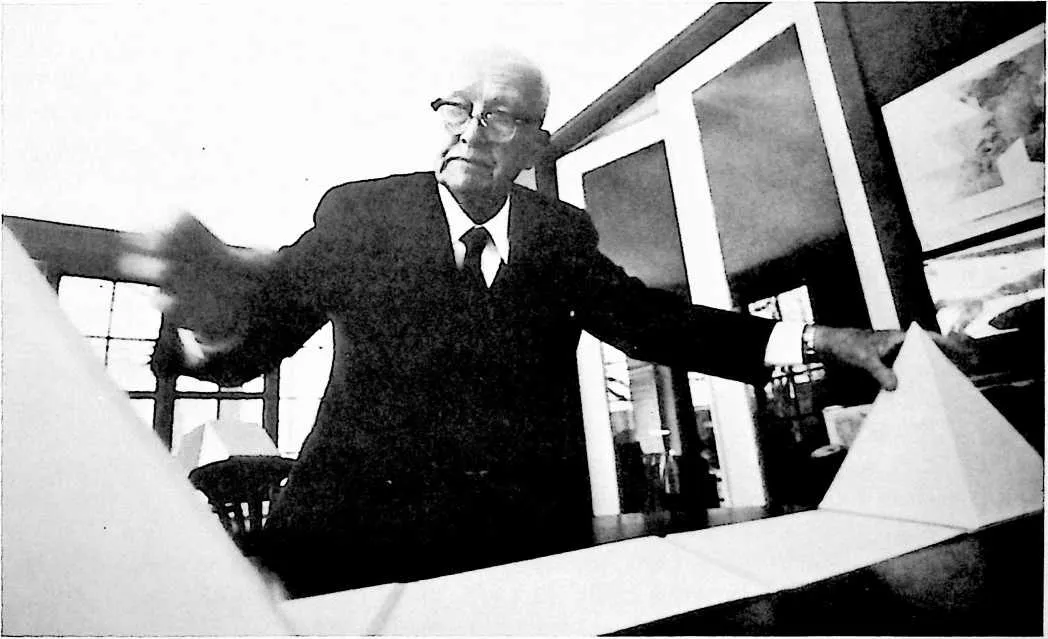 Bucky lay down his knife and fork and said, ‘‘Well, at the time of the pharaohs . . The
steak had long been forgotten when Maurice went up to bed at eleven o’clock, but Bucky was
still talking to anyone else left to listen. Three hours later a new drawing was born---the one that
shows Naga and Eden, and how the horizon looks like a snake’s back. The talk was father to the
drawing; the drawing spawned the text. The text spurred Bucky to try more drawings and yet
more text.
Bucky lay down his knife and fork and said, ‘‘Well, at the time of the pharaohs . . The
steak had long been forgotten when Maurice went up to bed at eleven o’clock, but Bucky was
still talking to anyone else left to listen. Three hours later a new drawing was born---the one that
shows Naga and Eden, and how the horizon looks like a snake’s back. The talk was father to the
drawing; the drawing spawned the text. The text spurred Bucky to try more drawings and yet
more text.
82 ‘‘A pure vision expressed in lithography.’’ --- Tatyana Grosman
83 At first Bucky was unsure about the drawing part. Helped by Schlossberg, who constructed models of Bucky’s geometric forms, he drew the triangles for his description of cubes and his definition of the tetrahedron. The absurdly charming, pregnant lady, however, was Bucky’s own roguish invention. As he worked, he grew surer of his medium. He wanted a sailor’s luminous sky--- and he got it. The last stone he drew---the one of a gyroscope in a cube---is shaded, complex, and beautiful. Once before, when he was technical consultant to Fortune magazine from 1938 to 1940, Bucky had drawn a gyroscope in order to prove that it was possible to reduce complicated concepts to forms that people could understand with their senses. This time, he feels, he did it better.
84 Sometimes he would make additions to a completed stone. He was accustomed to working that way with text on paper; why not with drawing on a stone? The bridge is a postcompletion addition to the stone on which scissors cohabitate with a necklace. At the end of March, 1975, Bucky for the first time brought his wife, Ann, to ULAE. By then, Towle’s diary entries had a frantic sound to them:
85 ‘‘April 2. Dr. Fuller went to New York (Thursday also) to meet with his publishers and do TV and radio interviews in connection with his new book, ‘Synergetics’…Everyone here relaxed for two days, which was afforded by Dr. Fuller’s absence.’’ The pace accelerated. Bucky arrived at 3 p.m. on Friday, May 16, missing by a few hours the live wires that had littered the street after a storm. He declined the motel room that usually was reserved for him.
86 ‘‘He told Tanya not to waste her money on a Holiday Inn, as he had to take a 9 a.m. plane to San Francisco and would nap here,’’ Towle noted in his diary. From San Francisco Saturday night Bucky would fly to Washington to talk with President Ford, and then he and Mrs. Fuller would head for a convention in Atlanta ‘‘for some fun’’---was Towle’s ironic comment.
87 Usually Bucky did sleep at the Holiday Inn, however briefly. Each morning Goldston would fetch him in the big white ULAE Olds. Bucky would be silent during the ride, but at breakfast, the sun pouring in over his left shoulder, Tanya at his right, a sleekly designed brown teapot between them, Bucky would begin to speak.
88 ‘‘In the car I was thinking of the Lord’s Prayer,’’ he would say. Then he would fold his hands and repeat his own version of the prayer. Each morning there was a different variation. Like every other idea he encounters Bucky has rethought the Lord’s Prayer from the very beginning. Tanya was coming to feel she was participating in a religious experience.
89 Then, on June 23, 1975, John McKen- dry died. He was forty-two. As curator of the Department of Prints and Photographs at the Metropolitan Museum of Art, he had been one of Tanya’s most loyal and cogent supporters. In his catalog introduction to Motherwell’s A la Pintura McKendry had written about Tanya’s ‘‘unrelenting and unreasonable love of illustrated books …It begins with a passion for paper . . . Like all great loves, Tatyana’s transforms its object. Like an alchemist changing lead into gold, she transforms this beautiful but simple substance into something so precious that its worth is beyond measure.’’
90 Tanya was at the hospital when McKen- dry died. Just minutes before, he had recognized her in his delirium, and he had spoken of building a door in his room so that she could work on the other side. ‘‘He didn’t want to die,’’ she was sure. ‘‘He wanted to work.’’ She telephoned ULAE.
91 Bucky was working there that day, and she told him, ‘‘A young friend has died.’’ ‘‘There is no death,’’ Bucky answered. It took Tanya three years to begin talking about that telephone conversation, and she was very small, and very intense in the telling. ‘‘Dr. Fuller said, ‘He is alive. There is always life in a different variation. He is alive in a different way, but we cannot communicate with him.’ That consoled me.’’
92 It consoled her even more eight months later, when Maurice Grosman died, on February 12, 1976. Maurice, the very essence of adventurous, jolly life. Who had shared the bad time with her in Germany. The artists’ life in France. The flight across the Pyrenees. The New York years, and ULAE. She had retreated to her bed when Bucky called. He repeated, ‘‘Maurice is close to you, but you cannot comprehend it,’’ she remembers now. ‘‘Without my knowing him well, Buckminster Fuller was vital at these two very painful moments, like a wound. He was with me.’’
93 Bucky believes that life is synergy, not chemistry. His quite specific view of what we call death is enunciated in Tetrascroll:
9495‘‘When human organisms are declared dead, all the physical chemistry misidentified by scientists as constituting the prime ingredients of human life are as yet present, ergo, those who speak of‘the chemistry of life’ are, unwittingly, self-misinforming. Life is not physical. Life is indestructible, immortal, eternal. Life is only weightlessly and omniinvisible present.’’
96 It is all, once again, based on the tetrahedron, on the way energy ebbs and flows in the universe, how ‘‘the weightless metaphysical tetrahedron is lost and regained in the universe as life dies out here and is reborn there.’’
97 It all begins again. That is why, instead of an epilog, Schlossberg provided an ‘‘Epilever’’ for Tetrascroll. He likes to pause when he mentions it. And smile. After all, ‘‘epilever’’ is such a Buckminster Fuller pun. Instead of acting as an ending, the ‘‘log’’ is made into a lever; an epilever brings the whole experience once more around to the beginning.
98 The exhibit of Tetrascroll at the Museum of Modern Art and at Ronald Feldman Fine Arts, in January, 1977, was one beginning. Bill Goldston had been up all night helping complete the binding, on which Tanya lavished the same care she bestows on every detail. She had chosen the Dacron out of which sails are made because Bucky adored his boat Intuition, and because he thinks the water-sailing peoples of the world long ago discovered the earth’s secrets and still best understand how to live.
99 At one point Tanya had considered red for the binding. She remembered that Chinese junks have reddish sails. Someone informed her the sails were dyed in pigs’ blood.
100 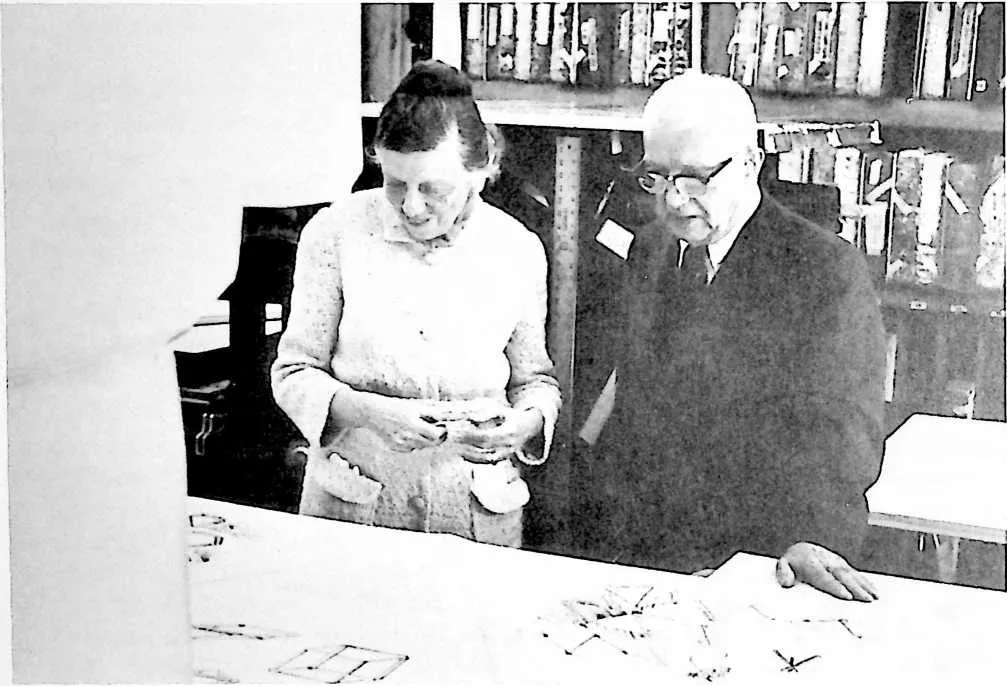 ‘‘We spoke to Mr. Fu of the Hong Kong Tourist Bureau,’’ Towle recorded in his diary,
‘‘who said the color of the sails is presently achieved by less exotic means.’’
‘‘We spoke to Mr. Fu of the Hong Kong Tourist Bureau,’’ Towle recorded in his diary,
‘‘who said the color of the sails is presently achieved by less exotic means.’’
101 ‘‘Tetrascroll is what happened in the interaction between two formidable systems named Buckminster Fuller and Tatyana Grosman.’’
102 The binding in its final form was an off- white-gray, the color of a seagull’s feathers. The book had been sent out into the world. With his hectic schedule Bucky did not see it again until a February day in 1980, when he found himself with a few free hours in New York. Between dropping off his latest book at his publishers and changing into a black tie for a dinner honoring Isamu Noguchi’s exhibition at the Whitney Museum, Bucky rode out to West Islip.
103 Once again, it was cold when Bucky arrived at ULAE. This time, however, the air was gray, with a blurred-over sun. Slightly to the east it was snowing in a half-hearted sort of way. Bucky looked over the new, facsimile version of Tetrascroll, enjoying the encounter. At lunch he told of his recent trip to China, the first in his life. But there was much that remained unspoken. Both Bucky and Tanya had been ill since they had seen each other last.
104 After naps for each, Bucky sat once more at the round white table, in his black suit and crisp
blue shirt. Tanya came downstairs, all in black, wearing her grandmother’s pearls
and
diamonds around her neck. Suddenly Bucky said, ‘‘I can’t get over looking at Tatyana. She’s so
beautiful. The sensitivity. The loveliness.’’
105 Maurice had once used almost those same words. At the time he was looking at a photograph that Rauschenberg would eventually transform into a lithograph called ‘‘Tanya.’’
106 When Bucky said the words, Tanya glowed for a moment and lifted her chin in remembered coquetry. Then she began to cry a little. And she spoke of John McKendry and Maurice, of how Bucky had helped her when they died. And Bucky said, ‘‘I say it is a mistake for humanity to make the assumption that the thing life is what we see. Physical. We’re only a transceiver---very fancy, very efficient.’’ And then there was a silence. They looked at one another. And he chortled in his throat. And grinned his transforming grin. And Tanya said, ‘‘Dr. Fuller is a very wise man.’’ And then, ‘‘My friend, Dr. Fuller.’’
107 ‘‘Everything I think and feel in mathematics and philosophy and everything else.’’