
17 TRICAP
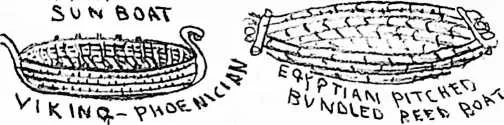
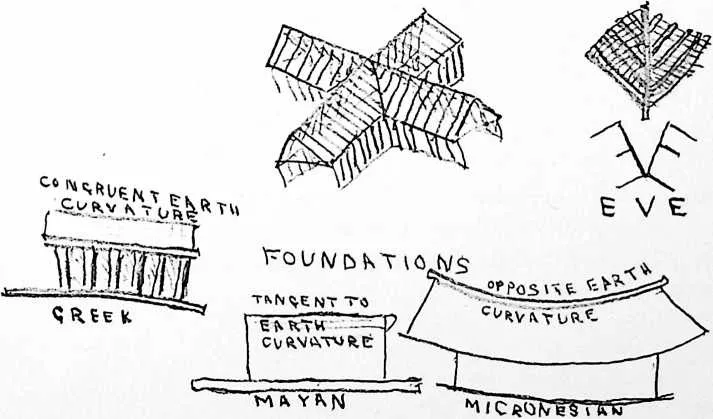
2When the blond-haired Vikings reached Scandinavia, they beached and overturned their large, powerfully keeled, transversely ribbed, thong-tied and pitch-seamed, longitudinally lap-straked boats to provide a watertight roof for their snow-covered winter homes. Mounting the boat ends on wooden ‘‘horses,’’ the Vikings often clustered four boats end to end in the form of a cross and draped skirts of skins from the gunwales to the ground. This became the cruciform prototype of subsequent cathedrals, whose stoneribbed ceilings’ eaves (Eves) became known as the ‘‘nave’’---the boat. Most of Austronesia was tropical. There were no snow loads to be supported. The beached boats were not overturned. The Japanese Austronesians also had reached far enough northward to have to cope with winter snows in the same manner as had the Vikings. The Japanese name for the house ‘‘roof’’ is the same as that meaning ‘‘bottom of the boat.’’ During their long years of voyaging, having no written means of amassing records, the water people composed many verses chronicling their experiences and those learned relayingly from previous generations. The Naga chants became the ragas of the Japanese and Balinese, meaning ‘‘the tales of the old people’’ or the sagas of the Vikings. Rehearsed daily, millennium after millennium, successive verses were identified with successive ancestors and logs in their rafts or ribs in their boats. Later turning their boats upside down on the land to protect against the storms, they developed therefrom ribbed, roofed, and columned buildings for nonseagoing communal purposes, with the ancestors’ features carved on their respective columns.
3 STONE 16




5 Goldy says that it is most probable that the westward-paddling, coastline-and-rivers-exploring, South Seas atolls people first landed on the mainland along the Malay Peninsula and the Indochina area, probably exploring the Mekong River as the first and largest of such great rivers nearest to the largest of the thousands of the Austronesian islands. The Mekong and other of the rivers they explored all led to the highland country northwest of the great Himalayan range in Tibet, whose eternal snow crown, melted by the southeast trade winds around its lower northwest slopes, shed their water eastward into the rivers of greater China as well as into India’s Brahmaputra, Ganges, and Indus rivers, thus to water the lands from which has sprung the food to feed more than half of all humanity throughout all known history.
6 The first Austronesian China coast landing could have started four million years ago. Goldy goes on to recall how these newly landed Austronesians gradually domesticated the wild water buffalo, sheep, goats, elephants, camels, and horses. Of all the latter the horse was easiest to mount and the swiftest of travel. As the people gradually penetrated inland, first in the rivers and then along the river valleys, they domesticated their flocks and herds. Those traveling on horses far outsped and outdistanced the herders, who followed on foot the local to-and-fro grazing of their animals, which tended to remain in favorable localities. Unquestionably the horsemen and camelmen penetrated inland and explored farther and far earlier than any of the other humans, as all of them, fast or slow, steadily adapted themselves to the land life. As a consequence it is most probable that the horsemen, hindered by at least one Ice Age, staying south of the devastating winters of Siberia yet skirting north of the formidable Himalayas as they traveled ever westward across the Mongolian deserts and negotiable mountain passes of Asia, came to reach and ride along the shores or to raft over the waters of the succession of lakes and inland seas leading farther westward to the Aral, Caspian, Azov, and Black seas, thence using their long-earlier-acquired memory of boatbuilding to produce the water-link passaging boats and rafts. Finally they passed by water through the Hellespont to occupy the islands along the shores of the Aegean and Mediterranean seas, penetrating all the way to the Atlantic coast. There they lived hundreds of thousands of years ago primarily as horsemen, and during the last Ice Age developed and painted in caves and, millennia later, in the Stone Age. Riding over all the Eastern European and Middle East lands, they built forts in the lowlands and citadels in the mountains, hunting, ruling, and exploiting the herders and the fruit, nuts, leaves, and root gatherers, as Goldy previously described. The intervening long Ice Age accounts for the otherwise incredibly long hiatus between the first overland arrival in Western Europe of the original, Orient-landed, westwardly venturing Austronesians. The millennia- long and even millions of years of inbreeding, originally on thousands of different islands and subsequently in landlocked tribes, accounts for the vast differentiation in the physical aspects of these early human groups---the bleaching out of some, the darkening and ruddying of others.