
16 TRICAP
2Traveling ever farther westward against the prevailing winds seemed to say that merchants and those who patronized them were deliberately contradicting the winds of God’s will. This sailor-popularized apprehension greatly frustrated realization of the vast wealth potential in the east-west high-seas trade. For the miracle answer the kings, nobles, and merchants of Mesopotamia turned to the navigator-astronomer-priests of Babylon. To convince everyone in the new western world that accounts of any earlier religions or people elsewhere on earth were false, the priests said that the beginnings of humans in
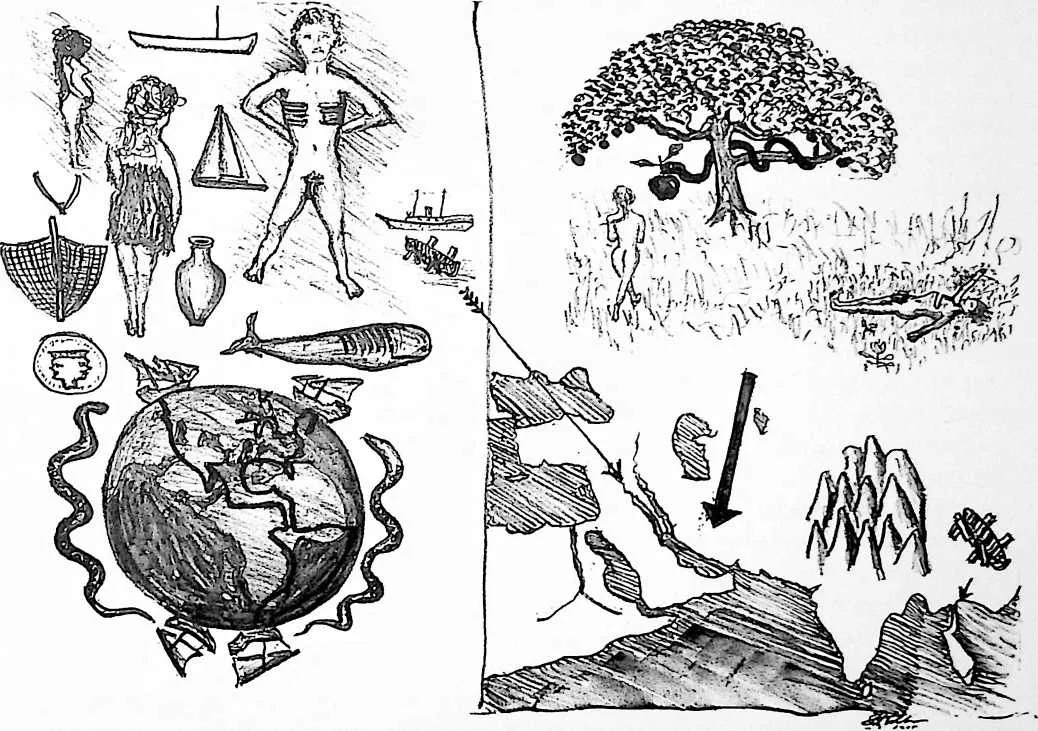
3 Universe had occurred nearby to Babylon in a garden called Eden. Their story from then on is well known. What seems pure nonsense in the Garden of Eden story of the creation of a woman from a man’s rib is explained as follows. Vessels of the sea are always female because they contain their crews in their interior wombs. The female ‘‘Eve’’ was the high-seas, world-around-sailable vessel; her great strength developed when navigators discovered the backbone-mounted rib cage employed by Nature in the design of whales, porpoises, seals and other sea creatures. So man built his high-seas vessel, ‘‘Eve,’’ with strong wooden ribs rising sidewise from her keel, planked ‘‘her’’ in, then leather-thong-fastened the planks’ edges together, tied them tightly into the ribs, and pitched her seams. Thus ‘‘Eve’’ the ship, built from Adam’s rib cage design, was temptingly ‘‘led on’’ by Naga the serpent, god of the sea, around the world, with Adam aboard. Thus Naga showed Adam, by means of Eve, that the earth is as round as the apple.
4 STONE 15
6 With the establishment of the Crete-Babylon navigator-priest axis came unified control of the sea-lane mastery of all the high-seas trade routes, eastward from the ‘‘Near East’’ to Malaysia and the Pacific via the Arabian Sea and Indian Ocean, and westward from the ‘‘Near East’’ to Europe via the Mediterranean and North Atlantic coast. Thus was established monopoly of a new and fabulously powerful ‘‘world’’ wealth growth, synergetically accruing to the exploitation of a vast variety of natural resources of our planet. A vast variety of human skills and an even vaster variety of human needs. The spices and herbs of the Orient rendered more palatable the swiftly decayable (un-iced and unrefrigerated) foods of the Western World, while Oriental pitches made watertight the new ribbed and thonged-together ship’s planking. The silks, precious stones, and metals brought powerful fortunes to those who possessed them. Ships can carry many-fold the cargoes transportable on the backs of animals or humans. So powerfully advantageous was the sea trade in these goods, and so much wealth could be had by bringing the gamut of remote resources to the ever newly colonizing Western World, that three great trade routes connecting the east and west ocean routes were established: (1) via East Africa’s Somaliland to Egypt and the Nile, (2) via the Red Sea, and (3) via the Gulf of Persia, the Tigris and Euphrates, and thence caravaning overland to the easternmost coast of the Mediterranean.
7 Because the Nile always flowed northward and the winds always blew southward, the Nile became the easiest and most immediately profitable interconnection between the Indian Ocean and the Mediterranean Sea but involved a chain of human cargo bearers between the Nile’s navigable headwaters and various routes to the Indian Ocean via Lake Victoria, etc. The Red Sea had one-way southwardly blowing winds but required paddling or rowing northward in lieu of long and laborious windward beating under sail, and since the rowing was much more effective, the Red Sea became the prime development waters of the Phoenicians’ small, square-sail-rigged rowing craft. Route 3 via the Gulf of Persia, caravaning from Baghdad to Jericho to Damascus to Lebanon, was probably profitable in its own right because of the large market of customers along its inland route. What is now Somaliland was known in Egyptian times as the land of Pun. The word pun means red. The Red Sea was the Pun Sea- the Sea of the Punicians---the Phoenicians. The waging of the Punic Wars against the Roman Empire was staged from Carthage on the North African coast. These ‘‘Puns’’ were the navigator pun-dits who invented their punts, i.e., their pole-pushed or single-oar-propelled boats--- which punts later became the ‘‘ponts’’ of the pontoon bridge.
8 The westward paddling, rowing, sailing, was accomplished in a relatively short historical time span of approximately one millennium, compared to the possible millions of years of dominantly eastward Pacific raft driftings propelled only by prevailing winds and ocean currents, that it was popularly assumed such millennia of drifting ever yielded to God’s will as expressed lucidly by the direction in which the winds and waters flowed. All humans had always assumed a benign omni-science and wisdom to be articulate in nature. The increasingly popular knowledge of humanity’s ability to go successfully ever farther westward against the prevailing winds seemed to say that merchants and those who patronized them were deliberately contradicting the winds of God’s will. This sailor-popularized apprehension greatly frustrated realization of the vast wealth potential in the east-west high-seas trade. The greater the sea trade, the larger grew the ship’s crews. While sailors see a lot of water and sky, they don’t know where they are at sea unless the captain or navigator tells them, and since they were never told where their ship might be at any given moment, and because the seas were frequently hostile, the sailors superstitiously interpreted the weather’s behavior as being the disapproving voice of God. Because all the powerful chieftains and major monarchs greatly profited by westward trade, credit for the powerful leaders’ wisdom in fostering the trade was deteriorating. Their power was threatened even more by the overland caravan trade from China, which was operating to the north in a relay system via the chain of inland seas and rivers. Caravaning could not carry the bulk and tonnage of the ocean vessels but could transport high-value, lightweight, and small bulk goods.
9 For the miracle answer the kings, nobles, and merchants of Mesopotamia turned to the navigator-astronomer-priests of Babylon, which was then the most central, population-wise, of their dilemma area. Probably conferring with their Egyptian and Cretan colleagues, the priests gave an answer that not only satisfied the popular need for a new philosophic explanation of what was transpiring in the world, but an answer that had several other effects beneficial to their particular monarchs and the latter’s most favored traders. But it was also an answer designed to throw off course, off scent, and off trail the few individuals who were becoming too curious about the world-around trade routes’ potentials and about the sources of the priests’ ‘‘miracle objects,’’ the knowledge of which the priests so carefully guarded. Conferring with their colleague chief priests of the Mediterranean and Arabian seas, it was agreed that above all the priests needed to convince everyone in the new Western World that accounts of any earlier religions of any other locals on earth were utterly false legends. Thus the priests said that the beginnings of humans in the Universe had occurred very nearby to Babylon in a garden called Eden. Their story from then on is well known. What they were covering up and needed to explain away were the sailors’ tales that the navigator-priests had known for at least 10,000 years, that the earth is a sphere and that the water people had in fact been circumnavigating it for millennia. The sailors were also getting close to being able to explain how the priests obtained their miracles. These Sinbad-the-sailor tales were told in the seagoing terms of the sea people. Their rationalization of what seems pure nonsense in the Garden of Eden story of the creation of a woman from a man’s rib is explained as follows.
10 Vessels of the sea are always female because they contain their crews in their interior wombs. The female ‘‘Eve’’ was in fact the high-seas, world-around-sailable vessel: ‘‘She’’ was capable of withstanding the great stresses of high-seas storms. This high-strength, multiribbed, big cargo-bellied vessel design was made possible when the navigators discovered the rib cage (analogous to that of humans) employed by Nature in the design of the backbone-mounted ribs of whales, porpoises, seals, walruses, and other large sea creatures, as well as noting the powerful structural stability attained in fishes by their longitudinal backbone and its sideways-arrayed rib bones. Clearly, man could produce a much more powerful and sturdy ship by employing this principle of a vertebral keel and its multirib structure to reinforce at right angles his too flexible, longitudinally organized log-plank boats of Cape Comorin and of Trivandrum on the southwest coast and of Mahabalipuram on the southeast coast of India as the prototypes of the first break away from large, single-tree ‘‘dug-out’’ hulls switching over to larger vessels, which were multi-log-built vessels with powerfully lashed together ends fashioned of naturally grown, curved-trunk tree logs with pitch-filled seams---copied later in treeless Egypt with thong, bailed, or tied-together papyrus ‘‘logs’’ bound secondarily together in the same manner as the South India prototype. Their papyrus craft were similar to Thor Heyerdahl’s twentieth-century ‘‘RA II’’---which successfully sailed westward from Egypt out of the Mediterranean and across the Atlantic.
11 It was of course man’s own rib cage that gave him a means of personally sensing the ribs’ structural functioning. Just as human rib cages allowed humans great freedom of motion, such structure would allow the ship to ‘‘work’’ in the storm. So man, using the wood of the tree, built his high-seas vessel, ‘‘Eve,’’ with strong wooden ribs mounted from its wooden keel, planked ‘‘her’’ (Eve) in, then leather-thong-fastened the planks’ edges together and tied them tightly into the ribs. Thereafter they pitched her (‘‘Eve’s’’) seams. Thus prepared, ‘‘Eve’’ the ship, built from Adam’s (lung-enclosing) rib cage design (this rib-born eve, deep-sea-capable ‘‘Eve’’) was temptingly led on by Naga the serpent, god of the sea. Eve followed Naga around the world with Adam aboard, and with this experience Naga (the sea serpent god of the sea) showed Adam, by means of Eve, that the earth is as round as the apple Naga had tempted her to realistically experience. The tree of knowledge was of course that possessed by the navigator-priest who had warned common humans not to try going too far in any direction lest they too discover that the earth is an apple and as such is a closed system, whereby if others went around it, the priests would have no more secret resources from which to produce their miracles. Big Bear says to Goldy, ‘‘Using one of your planet earth’s expressions, ‘you hit that one right on the nose.’ ’’