
9 TRICAP
2Next Goldy says to the Three Bears, ‘‘Unlike you constellations of stars who intercoordinate with combined gravity and precession and know the most about both, few people gravitationally cohered around precessionally steered planet earth comprehend either gravity or precession.’’
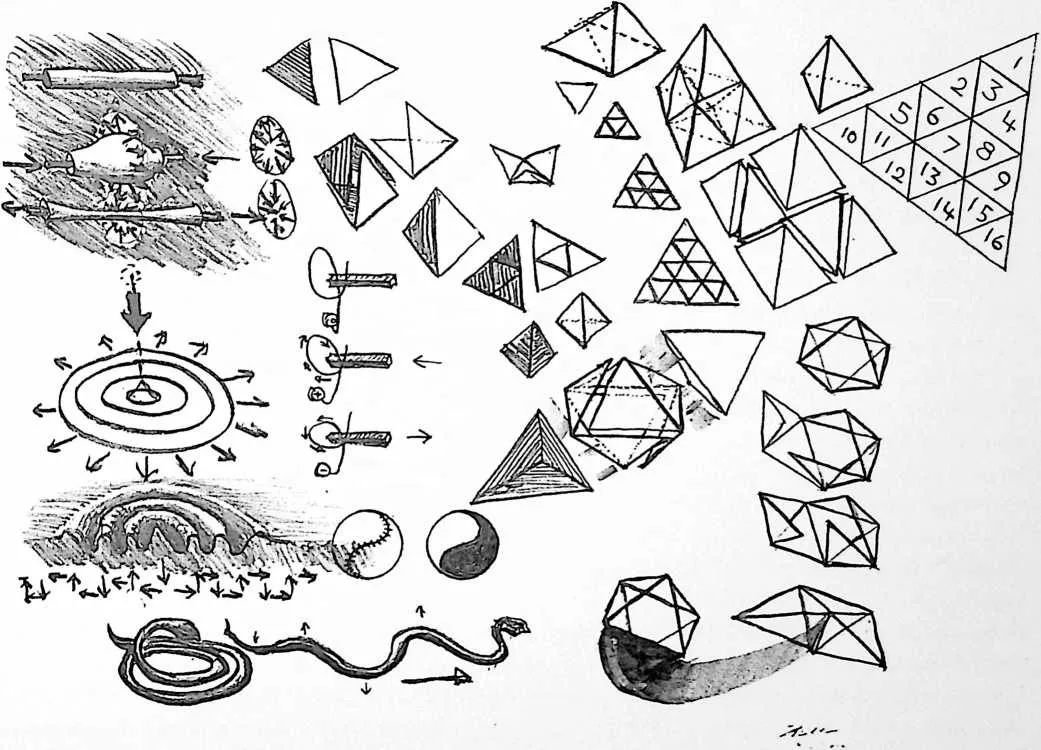
3 Goldy takes a closed cylinder made of flexible rubber which is filled with water. She presses its ends toward one another, and the cylinder bulges outward radially at its mid-girth, tensively stretching the rubber outward radially in a plane perpendicular to the axis of Goldy’s compressing. Next she pulls the two ends of the cylinder away from one another, and the cylinder contracts radially at its mid-girth, becoming compressed in a plane perpendicular to the axis of Goldy’s pulling.
4 These right-angle results of applied effort are called precession. Precession is the integrated effect of bodies in motion on other bodies in motion. The gravitational interattraction of the sun and earth results in the earth traveling around the sun in an orbit perpendicular to the line of the sun’s and the earth’s gravitational interattraction.
5 Precession is regenerative. Goldy drops a stone into the water. A circular wave is generated, growing outwardly in a plane perpendicular to the axis of the stone’s line of fall. Then the outward motion of the wave precesses the surrounding water, causing the water to rise as a complete circular ridge in an upward direction perpendicular to the plane of the wave’s horizontally outward growth, and the rising water in turn immediately reprecesses the surrounding water into further outwardly radiating horizontal growth.
6 STONE 7
8 Next Goldy says to the Three Bears, ‘‘Unlike you constellations of stars who intercoordinate with combined gravity and precession and know the most about both, few people gravitationally cohered around precessionally steered planet earth comprehend gravity or precession.’’
9 Goldy takes a closed cylinder made of flexible rubber which is filled with water. She presses its ends toward one another, and the cylinder bulges outward radially at its mid-girth, tensively stretching the rubber outward radially in a plane perpendicular to the axis of Goldy’s compressing. Next she pulls the two ends of the cylinder away from one another, and the cylinder contracts radially at its mid-girth, becoming compressed in a plane perpendicular to the axis of Goldy’s pulling.
10 These right-angle results of applied effort are called precession. Precession is the integrated effect of bodies in motion on other bodies in motion. The gravitational interattraction of the sun and earth results in the earth traveling around the sun in an orbit perpendicular to the line of the sun’s and the earth’s gravitational interattraction. Thus also is the moon precessed into orbit around the earth and the electrons into orbit around their atomic nuclei. And Goldy notes that humans also are precessed into orbits around other humans with whom they share mutual interattractions. Goldy may have made the first discovery of a scientific generalization that applies to social behaviors as well as to physics.
11 Precession is regenerative. Goldy drops a stone into the water. A circular wave is generated, growing outwardly in a plane perpendicular to the axis of the stone’s line of fall. Then the outward motion of the wave precesses the surrounding water, causing the water to rise as a complete circular ridge in an upward direction perpendicular to the plane of the wave’s horizontally outward growth, and the rising water in turn immediately reprecesses the surrounding water into further outwardly radiating horizontal growth, which immediately results in a further ninety-degree change of the water molecules displacement wherein the molecules sink perpendicularly, which developing action precesses again at ninety degrees to produce further, horizontally circular, outward growth of the water wave. Thus the circularly growing waves in water are progressively precessed into their familiar but usually unexplained behaviors.
12 Goldy points an iron bar magnet toward the center of a coil of copper wire looped in a plane perpendicular to the axis of her bar magnet. The coil has no electrical current but is attached to an instrument that will show the presence of electricity should it develop. Always pointing with the bar magnet toward the center of the copper coil, Goldy moves the bar toward that center of the coil. An electrical current is precessionally induced in the coil, which articulates as a clockwise orbital circuit in the plane of the copper wire coil. It is to be remembered that the plane is perpendicular to the line of approach of the magnet. Instantly the electrical current reprecesses at ninety degrees to produce a positive electromagnetic force-field that opposes the magnet’s approach, and the faster the magnet approaches perpendicularly to the coil, the more powerfully does the field resist it. The electrical current and its resultant forcefield which opposes the approach are generated only while Goldy keeps moving the magnet perpendicularly toward the center of the copper wire coil. The instant Goldy stops moving the magnet, the complex regeneration ceases, and both the electric current and the electromagnetic field vanish. When, however, Goldy starts to withdraw the bar magnet (perpendicularly away from the center of the coil), a reverse orbital direction of the electric current is precessionally induced in the coil, which in turn precesses to produce a negative electromagnetic field that resists the magnet’s further withdrawal. The faster the withdrawal, the more precessionally powerful is the field’s resistance.
13 Thinking about precession Goldy observes that fish fan their tails sideways to produce forward motion, that snakes wriggle sideways to produce forward motion. She sees that iceboats attain speeds of sixty miles per hour in a direction at right angles to wind blowing at half that speed. Coming back to her triangles and their synergetic surprise behaviors, Goldy flips one simple white triangle over and finds the other side is black. She realizes that there are two triangles, the obverse and reverse, always and only coexisting congruently. Goldy realizes that every sphere has a concave inside and a convex outside. She knows that convex and concave are not the same because concave reflectors concentrate energy as radiation and convex mirrors diffuse the radiant energy. Convex and concave are nature’s macro-to-micro or micro-to-macro radiant-energy transformers. Goldy realizes that unity is always plural and at minimum two. Unity does not mean the number one. She realizes that one does not and cannot exist by itself. In Universe life’s existence begins with awareness. No otherness, no awareness. The observed requires an observer. The subjective and objective always and only coexist and therewith demonstrate the inherent plurality of unity---inseparable union. Physics tends to think of ‘‘complementarity’’ (discovered a half-century ago) and the latter’s non-mirror-imaged complementation (discovered only 20 years ago) as being the interrelationship characteristics of two separate entities. However, the always-and-only-coexistent, non-mirror-imaged complementations also may coexist within inseparable plural unity.
14 Goldy finds she can interconnect the three mid-edge points of a triangle that subdivide the big triangle into four similar smaller triangles and can fold the three corner triangles along their connecting lines to produce two different tetrahedra, because folding the corner triangles under or over produces either a white tetrahedron with a black inside or a black tetrahedron with a white inside. Since the inside of the tetrahedron is concave and the outside is convex, there are two very real and separate tetrahedra in evidence whose eight (four white, four black) faces have been evolved from only four externally viewable triangles, which four were in turn evolved from one (unity is plural) triangle.
15 Since both the positive and negative concave tetrahedra have four different black faces and four different white faces, she can differentiate them by placing a red, a green, a yellow, and a blue dot in the center of each of their respective four white inside faces and an orange, a purple, a brown, and a gray dot in the center of each of their outside black triangles successively. Since each of the two tetrahedra can turn themselves inside out (as their respective three triangular corners or rotate around the central triangle’s three edge hinges, thus to open like a three-petalled flowerbud), each tetrahedron can be opened in four such flowerbud ways with three triangular petals around each of their four respective triangular, flower-receptacle base faces. These four separate cases of inside-outing transformability permit the production of four separate and unique positive and four separate and unique negative tetrahedra, all generated from the same unity---each of which tetrahedra can rank as Nature’s simplest structural system. Therefore, each prime structural system in Universe has nine separate and unique states of existence---four positive, four negative, plus one schematic unfolded nothingness state---which Goldy reminds the bears constitutes the same schematic ‘‘game’’ setup as that of physics quantum mechanics, with four positive and four negative ‘‘quanta’’ as we go from a central nothingness equilibrium to first one, then two, then three, then four high- frequency-regenerated, alternate, equi-integrity tetrahedral quanta, all eight of which have eight invisible counterparts.
60 Goldy now takes any two of these triangularly petalled tetrahedra each with three sixty-degree folded corners partially open and pointing out from their bases like petals of an opening tulip bud. Goldy rotates one of the sixty-degree petalled tetrahedra a sixth of a circle turn and precesses it axially sixty degrees which points its opened triangular petals toward the other’s sixty-degree openings. Goldy brings them convergently together edge-to-edge to produce the octahedron. Since the octahedron thus produced has a volume of four tetrahedra, and since we have learned that each tetrahedron is one energy quantum unit, Goldy has put one quantum and one quantum together to produce four quanta. Another quantum leap is demonstrated. What Goldy finds equally exciting is to realize that each of the two tetrahedra combining to make the octahedron can consist of the eight unique combinations of the black and white triangular faces and their four red, green, yellow, and blue center dots. This means an octahedron of eight black triangles, eight white, and one of four white plus four black, and the alternation of the four different color dots into all the possible combinations of eight produces four times twenty-six, which is the 104 possible combinations---where N = 8 and there are four sets of eight the formula for the number of combinations is 4 (N 2 N). This result has a startling proximity to the ninety-two unique regenerative chemical elements plus their twelve additional non-self-regenerative isotopes. The bears applaud.
61 When the celestial approbation subsides, Goldy tries putting a light inside a translucent tetrahedron. Next she encloses the illuminated, translucent tetrahedron inside a translucent, plastic sphere. The light at the system’s center casts the shadow lines of the tetrahedron’s six edges outwardly and symmetrically onto the plastic sphere to produce the outlines of a spherical tetrahedron. Goldy draws circles around each of the spherical tetrahedron’s four corners of such a unit radius that each of the four circles is tangent to each of the three others. Using a sharp-edged cutting tool she severingly follows around the perimeter of one circle to its point of tangency with the next adjacent circle, and there she inflects her cutting tool to follow around that next tangent circle to its next point of tangency, where she once more inflects her cutting tool’s severance-trace to follow around the next circle to reach the next tangent point. She repeats this procedure until finally returning to the point of origin she completes the severance and cuts the spherical tetrahedron’s surface apart in two similar equi-area sections, each of which corresponds to the two similar, dumbbell-profiled, skin sections of a baseball. With these two similar, half-a-sphere-surface sections precessingly aimed toward one another in such a manner that the bulge of one section registers symmetrically with the half-circle valley on the other, Goldy finds that she can sew the edges of the sections together around a core to produce a baseball.
62 Goldy shows the bears that when you look at the baseball with the inflection point of its ‘‘S’’ pattern ‘‘stitching’’ located at the circle’s center and aimed directly toward you, you will see that the baseball’s surface pattern is the same inflection pattern as that of the most profound Oriental symbol---yin-yang.
63 This observation makes Goldy say to the bears that it would seem that long ago human minds of the Orient had discovered precession, tetrahedra, and synergy. Goldy says that those ancient people who had discovered those principles must have kept them secret to surprise people and thereby gain powerful, popular, mystical accreditation and that during the ensuing millennia humanity had lost track of the yin-yang significance. Daddy Bear answers, ‘‘We have been watching the humans since they landed on your planet a few millions of years ago and can say that is just what happened.’’
64 Intrigued with her necklace experiment’s discovery that squares and cubes are unstable and that only triangles are structures, and also intrigued with discovery of the way in which the geometrical behaviors of energy events can interact precessionally to quantitatively multiply themselves in pure principle, Goldy goes on to discover that multiplying numbers by themselves can be identified not only with the rate at which the number of similar squares multiply within a modularly subdivided square but also with the rate at which the number of triangles multiply within a modularly subdivided triangle, accomplished by a symmetrical and modularly uniform three-way grid, subdividing any triangularly bound area. A triangle whose edge module is two has a two-times-two-equals-four-triangles area. A triangle with edge module three contains nine similar triangles. Edge four contains sixteen similar triangles, edge five contains twenty-five similar triangles, and so on. Whereas this phenomenon of ‘‘second powering’’ of numbers has always heretofore been identified (even by all scientists) only with ‘‘squares,’’ Goldy saw that a square consists of two triangles and that identifying the product of a given number multiplied by itself only with ‘‘squaring’’ requires twice as much area as does ‘‘triangling’’ and is therefore inefficient. Since she has been assured by physicists that Nature always employs the most economical (or least effort) solutions to its problems, Goldy decides to adopt ‘‘triangling’’ as her method of accounting area experiences and discoveries.
65 Goldy then discovers that a second multiplying of a number by itself (i.e., 2 X 2 X 2 = 8) as a method of volumetric accounting can be identified with the rate of omni-symmetrical expansive growth of tetrahedra, whereas scholars, including scientists, have always identified this third powering of a number exclusively with the rate at which cubes multiply themselves when symmetrically amassed in an arithmetical progression of the overall cubes’ symmetrically and modularly divided edges.
66 Goldy finds that each cube has six square faces which, being structurally unstable, collapse but which can be subdivided into two triangles each by the six diagonals that bisect each of the cube’s square faces. The six diagonals are produced by omni-interconnecting four of the cube’s eight corners---two of the opposite top corners with each other, and the latter with each of the two diagonally opposite bottom corners as well as interconnecting the latter two bottom comers with each other.
67 Not only do the six omni-interconnected diagonals of the six faces of the cube structurally stabilize the cube with minimum effort by omni-triangulation, but those diagonals are seen by Goldy also to be the six edges AB, AC, AD, BC, BD, CD of the tetrahedron, which Goldy has already found to be not only the minimum structural system of Universe but also to be one quantum unit of the quanta mathematics of the physicists.
68 Using the tetrahedron as her unit of volumetric accounting, Goldy also discovers that the volume of the equi-edged octahedron is exactly four times that of the tetrahedron. She discovered this by using the octahedron’s three symmetrical XYZ axes running between the octahedron’s six vertexes, which cross one another at ninety-degree angles at the center of volume of the octahedron. Goldy extracts the eight, one-eighth-octahedron, asymmetrical tetrahedra formed between the volumetric center point of the octahedron and each of the eight external triangular faces of the octahedron. Each of these one-eighth-octahedra has one equiangular face and three other isosceles-triangular faces, (one ninety-degree corner and two forty-five- degree corners each). Because the octahedron has a volume exactly four times that of the regular equiangular tetrahedron.
69 Goldy takes four of these one-eighth-octahedra, each having a volume half that of the tetrahedron (4 X l/2 = 2), and unites them symmetrically with the regular tetrahedra by matching the four one-eighth-octahedra’s equiangular triangle faces with the four equiangular triangle faces of the regular tetrahedra. This produces a polyhedron of four ninety-degree corners and four other corners of 45° + 45° = 90° each. This is, of course, the eight-cornered cube with its structurally stabilizing, six-faces-diagonaling, six-edged tetrahedron as its core. Having added four one-eighth octahedra with a total volume of two to one tetrahedron of a volume of one, we find that the cube has a volume of exactly three times that of its structureguaranteeing, one-quantum tetrahedron.
70 Goldy says that it is obviously necessary for Nature to use the tetrahedron as its volumetric accounting unit since Nature always insists on being most economical in all she does, and to use cubes for volumetric accounting obviously requires three times as much space as do tetrahedra. One important reason why less than one percent of humanity comprehends and copes effectively with science is because the three-dimensional, exclusively perpendicular and parallel, X, Y, Z, centimeter-gram second system uses three times as much space as is necessary and exhausts geometrical demonstrability with two-thirds more of Universe as yet to be identified. Science at present copes with this dilemma by use of complex, ‘‘imaginary numbers,’’ the ‘‘square’’ root of minus one, etc. The fourth-dimensional behaviors of energy as black body radiation cannot be demonstrated within physics’ exclusively three-dimensional model. Goldy and the bears agree that by employing Nature’s own convergent-divergent, sixty-degree-angled, vectorially structured, triangular and tetrahedronal, four-dimensional coordination, all scientific knowledge can be conceptually, rationally, holistically, and therefore sensibly comprehended by all humanity. With the tetrahedron’s volume as one, the cube’s volume is three, the octahedron’s is four, the rhombic dodecahedron’s is six, and the vector equilibrium’s (the old cubo-octahedron) is twenty---an omni-rational accounting system.
71 Goldy remembers that the philosopher Emerson said, ‘‘Poetry is saying the most important things in the simplest way.’’ So Goldy says, ‘‘Obviously, whatever Nature does is omni-impor- tant, and since Nature is always doing whatever it does in the most economical ways, everything Nature says is poetry. If what Nature is doing is described in the most economical words, the description too is poetry.’’ Goldy would rather have one poetically right word than a dozen familiar but inadequate words of prose. ‘‘Goldy, you are approaching our thinkable communication system when you reason that way,’’ Wee Bear says.
72 Suddenly Goldy realizes that all these discoveries she has been making combine to explain how it can be that the stars of the billions of now-discovered galaxies are giving off energies at incredible rates in such a manner that as discrete quanta of energy they become discontinued and apparently annihilated, yet the same quanta of energies reappear elsewhere, as for instance in the terrestrial vegetation’s photosynthetic reduction and proliferation of hydrocarbon molecules in biologic organisms and in crystallographic growths.
73 Since the pattern of two most dominant, critical-proximity, mass-interattraction (gravity) forces pulling diametrically on any one body produces the same model as that of Goldy’s water-filled rubber tube, the precessional squeezing of a symmetrical body such as that of an octahedron by two diametric gravitational forces pulling embracingly upon it as it passes between two neighboring cosmic bodies will cause some part of the octahedron’s integral, vectorial structure to yield precessionally in a plane oriented at right angles to the line between the two pulling forces, thus to transform the octahedron from its symmetrical form into an asymmetrical form. This is most economically accomplished by one of the octahedron’s equatorial vector-edges disconnecting at both of its equatorially engaged end vertexes and rotating precessionally ninety degrees to rejoin its two ends with the octahedron’s two polar vertexes. This local rotation results in the disappearance of the symmetrical octahedron and leaves in its stead the asymmetrical, face-bonded, three-tetrahedra assembly in the form of an arc, which is the neutral electromagnetic-wave-initiating state.
74 The asymmetrical arc-wave consists of the same twelve vector edges and the same eight equiangle triangles and the same six vertexes as those of the original octahedron. Topologically described, it is the same polyhedron. However, it is clearly observable that the transformation not only converted omni-directional symmetry into two-directional asymmetry, it also reduced the octahedron’s exact volume of four quanta to a volume of exactly three quanta in the form of the three face-interbonded tetrahedra. What has happened here is that matter (as the symmetric, crystalline octahedron) is precessionally transformed into a directionally oriented electromagnetic wave, which upon interference with other radiation or matter will again be precessionally transformed back into the crystallographic form of the octahedron, thus syntropically regaining not only its symmetry but the one tetrahedron quantum of energy it had entropically lost.
75 Goldy realizes that the scientist Boltzman had long ago hypothesized that the physical universe of energy as matter was able to export energies entropically from all the stars only because those energies were being importingly reassembled syntropically in vast numbers of elsewheres. Einstein, too, assumed the foregoing to be true. However, many scientists remained skeptical, saying that entropy was universal and increasingly disorderly and expansive, whereby Universe is spending itself inexorably and irrevocably. Since photons show that energy occurs only in discrete packages and is discontinuous, and since the stars lose energy quanta entropically, how can the lost quanta reappear elsewhere? Goldy says to the bears, ‘‘Vectorial geometry conceptually demonstrates the exact way in which energy quanta are lost and regained in the course of the entropic/syntropic turn-around events of astrophysics. The topological integrity of vectorial geometry elucidates both the one quantum loss and one quantum of energy recovery incidental to the entropic transforming from matter to radiation and the syntropic transforming from radiation to matter as clearly manifest in the octahedron to tetra-arc transformation and its reversal to the octahedron. This topological transformation (but not its energy-quantum relationship) was originally discovered in 1951 by the geodesic engineer-scientist, D. L. Richter.
76 ‘‘This elucidation of the way in which universe can temporarily drop out or regain its energy quanta elucidates much more,’’ says Goldy. ‘‘It explains what happens in the photosynthetic process as planet earth’s vegetation converts sun radiation receipts into beautiful hydrocarbon molecules. Energy quanta are regained on earth. It explains even more. It shows how the weightless metaphysical tetrahedron is lost and regained in universe as life dies out here and is reborn there. It shows how the triple-bonded addition of the recoverable one tetrahedron when added to the neutral phase (‘‘W’’ profiled, tetra-arc, triple-bonded assembly of three tetrahedra) must always produce either a male or a female twisting helix, which when extended becomes the DNA-RNA tetrahelix, which is the structural system programmer of all living species and individuals of those species.
77 Impressed by Goldy’s comprehension of one of their most important celestial ‘‘facts of life,’’ the bears say to her, ‘‘Can you still further elucidate precession in a manner that always corresponds exactly with the information acquired only through humans’ brain-coordinated, experience-sensing system?’’ Goldy replies that she thinks she can, and proceeds to so demonstrate to the bears.
78 Goldy first calls the bears’ attention to an athlete who competes as a ‘‘hammer’’-thrower. The ‘‘hammer’’ is a heavy steel ball attached to the ‘‘far’’ end of a steel rod at the ‘‘near’’ end of which there is a pair of triangularly shaped handles. Taking hold of the handles, each with one hand, and keeping his feet on one side of a marker bar, the ‘‘hammer’’ thrower accelerates the heavy ‘‘hammer’’ ball into a circular orbit, rotating his body by his leg muscles. He finds that the energy he puts into the orbital acceleration of the ‘‘hammer’’ is cumulative. The scientists speak of this as ‘‘angular momentum.’’ Using his muscle, he can rotate faster and faster, which accelerates the ball so greatly that it no longer tends to yield immediately to gravity. The faster the thrower orbits it, the farther the ‘‘hammer’’ elevates, until it is circling around at his shoulder height. Then he adds in a final lift force at ninety degrees to the orbiting momentum plane just as he deliberately lets go of the handles. The more power he has skillfully invested, the farther above the horizontal will the ‘‘hammer’’ travel as ‘‘linear momentum’’ before gravity progressively overpowers it, slows it, and finally pulls it to the ground.
79 Leaving the ‘‘hammer’’ thrower, Goldy experiments with an individual who has a peashooter---a tube whose diameter is slightly greater than that of the uniform-diameter, plastic peas to be blown through the tube. The peashooter tube is mounted in a fixed horizontal position by attaching it to a rigidly anchored tripod stand. It is mounted in a room where there are no air currents. With his mouth full of peas the ‘‘shooter’’ starts blowing them in the fixed horizontal direction, which is axis Y of Goldy’s experiment. This Y axis is at right angles to Goldy’s line of view. The peas pass from Goldy’s left to right. The projected peas exiting the tube horizontally describe a progressively descending trajectory as gravity gradually deflects each pea toward ultimate touchdown from its original horizontal of travel.
80 If the experimenter blows a little harder, the pea will go farther---it, too, can gain momentum from progressive initial energy investment in the act of blowing. The pea will travel ever shorter distances as the blower reduces the force of blowing. But short or long the peas all travel curvilinearly in one fixed, vertical plane, described by two separate forces acting upon them after the initial blowing: (1) the resistance of the air, (2) the earthward pull of gravity.
81 Aided by another bracket-mounted, screw-controlled, horizontally protrudable, steel ‘‘finger’’ pointing perpendicularly away from Goldy in axis X with its tip at the same height as the centerline of the peashooting tube’s exit trajectory, Goldy experiments by intruding the mechanically controlled finger one-sixteenth of an inch distance into the peashooter’s one- quarter-inch-in-diameter trajectory. As each pea hits the trajectory-intruding finger and is deflected angularly sidewise (away from Goldy)---each pea’s trajectory in exactly the same angular amount. Gravity continues to pull the trajected peas earthward in the same manner as it did before the deflecting steel finger was intruded. Therefore, the peas continue traveling in a new but as yet vertical plane that is angled away from Goldy a slight amount around vertical axis Z, which is common to both the new vertical plane and the earlier vertical plane of the previously undeflected peas. Goldy next discovers that by progressively intruding her ‘‘finger’’ precessionally (forwardly away from herself) along axis X horizontally and at right angles to both the peashooter’s axis Y and to the vertical axis Z, her touching of the trajectoried peas produces rotation of the also gravity-precessed vertical plane described by the peas’ trajectories as rotated around vertical axis Z.
82 This demonstrates that once a pea has been deflected, it continues in the same horizontal compass direction and does not have a memory that tries to return it to its previous course, and that the interference deflection has no impelment momentum---it gives a discrete angular change of the trajectory, no more, no less. In the first phase of the described trajectories each pea is being separately and successively governed by four primary forces: (1) the initial, but not sustained, blown-air impelment; (2) the horizontally aimed guidance of the peashooter’s tubing; (3) the continuously applied vertical deflective force of gravity; (4) the resistance of the air. In the second trajectory phase a fifth force is added: (5) the noncontinuing, single-instance, horizontal deflection of the intruding finger.
83 If the horizontally intruding finger were mechanically actuated to intrude slowly but continuously from the right-hand side of the trajectory, the horizontal deflection of successively deflected individual peas would find each pea descending in a new vertical plane, each a little to the left of the previous one, until the intruding finger crossed the centerline of the tube’s aim, which would result in the impelled peas being stopped altogether in their horizontal paths, each bouncing backward slightly toward the tube and then yielding entirely to gravity as it falls ever faster toward the ground.
84 What we are learning is that each pea’s course is individually altered to conform exactly to the last applied force. There is no remembered inclination to return to any previous governance by any forces operating upon the trajected unit from outside itself.