
6 TRICAP
2Exploring synergy further, Goldy takes apart the four edge-bonded triangles of the tetrahedron and reassociates them, this time joining them only by their vertexes, which produces the octahedron, or eight-triangular-faceted polyhedron with four inadvertently produced, structurally stable, empty triangular window facets. Here is synergy again with 1 + 1 + 1 + 1 = 8. This clearly seen structural system’s symmetrical intertransformation from 4 to 8---i.e., 1 to 2---Goldy explains, is the simple principle which, being nongeometrically conceptualized by the physicists, is called by them ‘‘a quantum leap.’’ The scientists continue to ‘‘fly blindly on instruments.’’ In addition to the eight triangular facets the octahedron has six vertex (star-entity) events and twelve structural edges.
3 Since half the triangles are empty and only half are filled, Goldy becomes curious and cuts four triangular windows in each of the four filled triangular facets, and she finds the octahedron as yet stable. It seems to Goldy that the twelve edges held together by the six vertexes must be producing the structural stability.
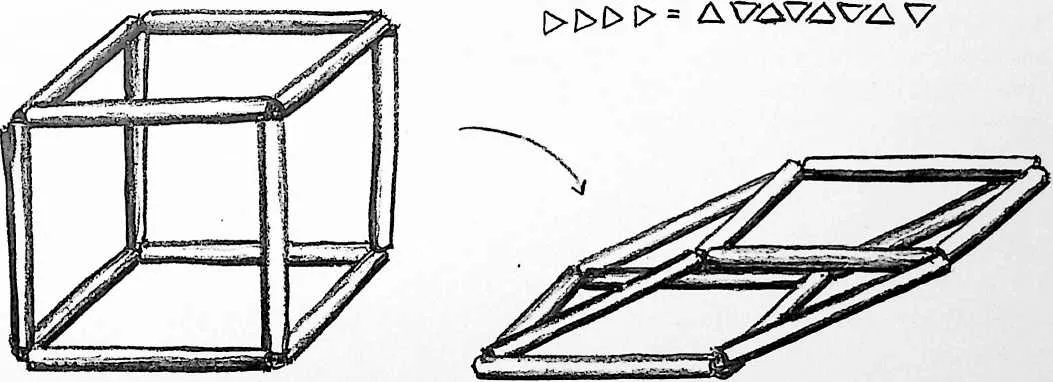
4 So Goldy next takes two sets, each of twelve equal-length tubes, threads a string through the tubes, and fastens them together in two different ways: (1) with four tubes joined at each of six corners to make the octahedron, which is structurally stable, and (2) with three tubes joined at each of eight corners to make the cube, which proves to be structurally unstable and collapses.
5 STONE 4
6 1+1+ 1+ s a -12
7 12=0
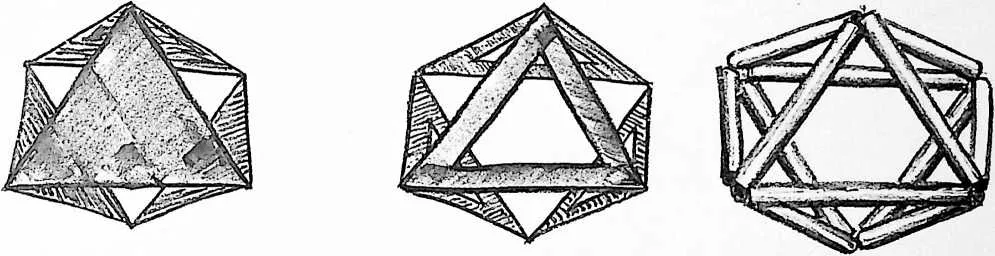
9 Exploring synergy further, Goldy takes apart the four edge-bonded triangles of the tetrahedron and reassociates them, this time joining them only by their vertexes, which produces the octahedron, or eight-triangular-faceted polyhedron with four inadvertently produced, structurally stable, empty triangular window facets. Here is synergy again with 1 + 1+1 + 1=8. This clearly seen structural system’s symmetrical intertransformation from 4 to 8---(i.e., 1 to 2)---Goldy explains, is the simple principle which, being nongeometrically conceptualized by the physicists, is called by them ‘‘a quantum leap.’’ The scientists continue to ‘‘fly blindly on instruments.’’ In addition to the eight triangular facets the octahedron has six vertex (star-entity) events and twelve structural edges.
10 Since half the triangles are empty and only half are filled, Goldy becomes curious and cuts four triangular windows in each of the four filled triangular facets, and she finds the octahedron as yet stable. It seems to Goldy that the twelve edges held together by the six vertexes must be producing the structural stability.
11 So Goldy next takes two sets, each of twelve equal-length tubes, threads a string through the tubes, and fastens them together in two different ways: (1) with four tubes joined at each of six corners to make the octahedron, which is structurally stable; and (2) with three tubes joined at each of eight corners to make the cube, which proves to be structurally unstable and collapses.