1 1
2The young boy, Bucky Fuller, knew two fixed points in the compass of his universe: Bear Island, Maine, and Milton, Massachusetts.
3 In the town of Milton, Columbine Avenue curves gently down into Central Avenue. Large wooded lots and big old houses give one the feeling of a country road. For years, people had come out from Boston to spend the summer in Milton. In the 1890’s, more and more Bostonians decided it was a good place in which to live and raise a family the year round. Among these were Richard and Caroline Fuller, who drove out in their horse-drawn carriage to watch the building of their new house.
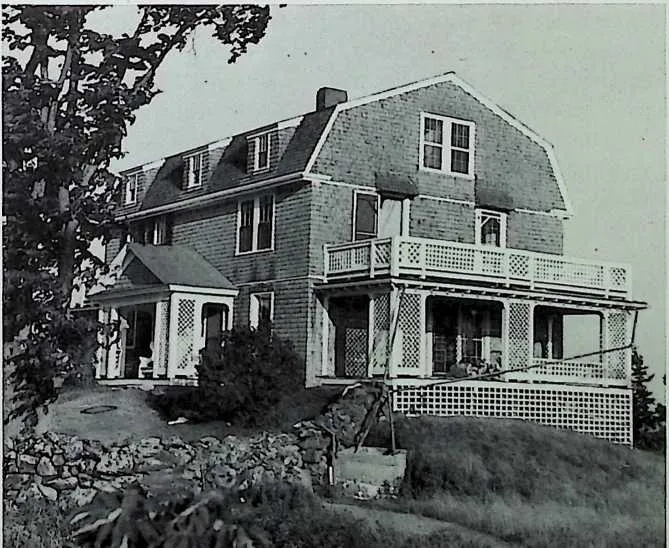
4 The house stood tall on a bluff with its entrance facing the side of the lot. It was a handsome house inside as well as out. The dining room was paneled with the white wood of the magnolia tree. White carved fireplaces warmed the dining room and living room. Dutch doors at the back of the hall and the den let cool breezes enter in the summer. A broad staircase with a cherry-wood banister led to the four bedrooms above and still higher to the servants’ bedrooms in the attic. Richard Fuller’s good friend and classmate, Henry Wadsworth Longfellow, Jr., had designed it for them. (Eleven years later he designed their Great House on Bear Island, too.)
5 July 12, 1895, was a rare summer day: clear, cloudless, and mildly warm. On that day, the new house saw the birth of a new member of the Fuller family. As the first son, he was doubly welcome and named Richard Buckminster for his father.
6 No one knew the strange world that the young Bucky lived in. Born both cross-eyed and far-sighted, he saw only blurs, blobs, and outlines. Looking back on his childhood, Bucky said, ‘‘While I saw two dark areas on human faces, I did not see a human eye or a teardrop or a human hair until I was four years old.’’ He added, ‘‘There is luck in everything. My luck is that I was born cross-eyed.’’ He was forced to use all his senses and brain power to understand the world around him. To recognize people, he depended on hearing their voices, touching them, and identifying the outline of their shapes. He never lost the habit of seeing things by wholes. Finding the large patterns in what he sees led him to important ideas and discoveries.
7 At four, Bucky was fitted with glasses. The heavy thick lenses made him look like a serious owlet. No more tumbling, no more stumbling over things he couldn’t see. Those round, gold-rimmed glasses showed him the color of his big sister Leslie’s eyes, baby brother Wooly’s plump cheeks, his father’s loving smile. And a million new things that he had only heard other people talking about: sparkling morning dew, brilliant butterflies, marching ants. He had heard the whispers of the wind through the trees. Now he saw with wonder and delight the veined green leaves that did the whispering. Everything looked newly made just for him. It marked the beginning of Bucky’s lifelong love affair with the Universe.
8 Bucky’s short, stocky legs pumped ever faster to explore the new world around him. The days were never long enough. Leslie, exercising the privilege of being the oldest, insisted that she should go to bed last. Bucky had a quick answer to that argument: ‘‘Ladies first, gentlemen soon after.’’
9 Bucky treasured most the time that he spent with his father. Mr. Fuller, a successful businessman, imported exotic teas and leathers. To find and buy these goods, he often took long trips to far parts of the globe. When Mr. Fuller was home, he and Bucky walked hand-in-hand on Sundays to St. Michael’s Episcopal Church. On the way, his father would talk to him about God and the Fuller family. Bucky especially liked to hear the family stories.
10 Great-grandfather Timothy, a minister, had been a delegate from Massachusetts to the convention at which the Constitution was written. When the delegates did not put in a paragraph to forbid slavery, Timothy refused to sign the Constitution. Grandfather Arthur, also a minister, had not only made speeches against slavery but even fought in the Civil War. He was killed while leading a charge across the river at Freder-
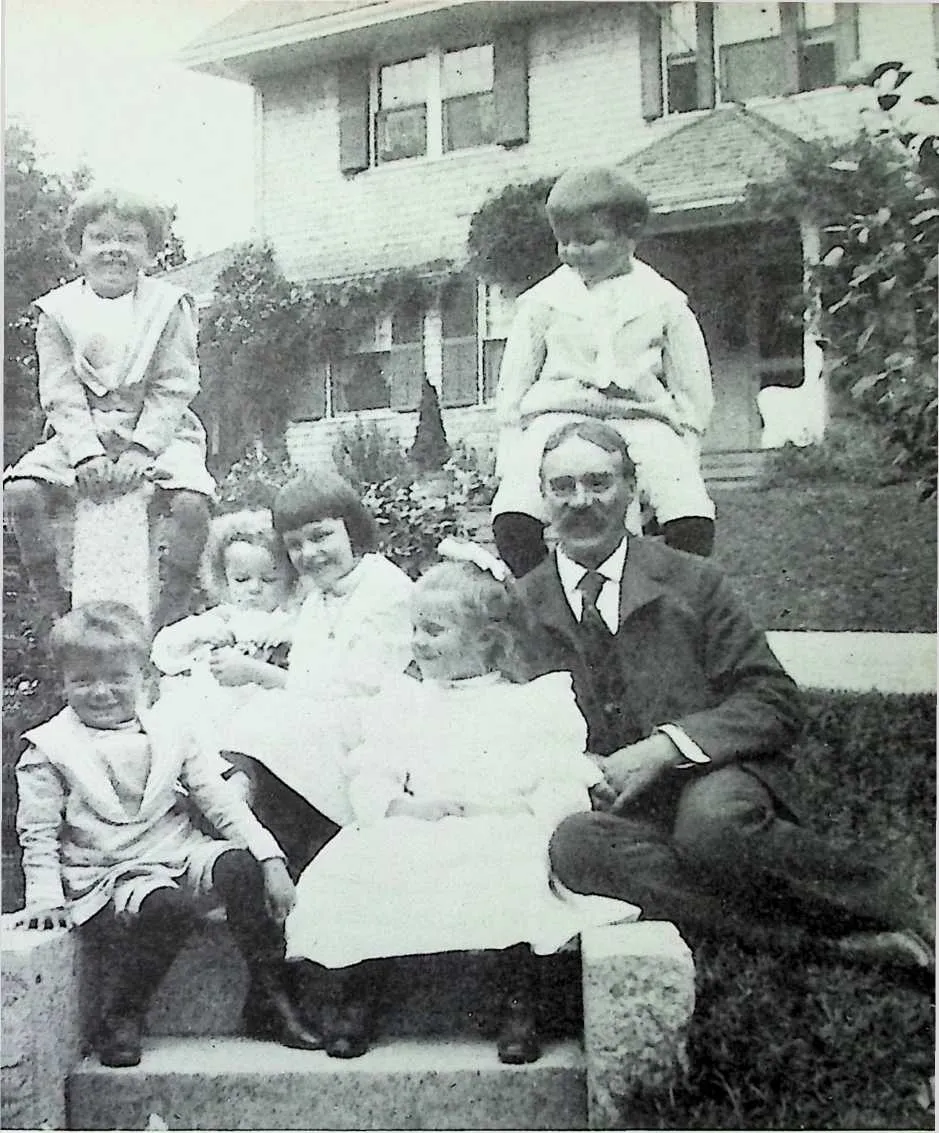
12 Fullers in Milton, 1899: front, left to right, Cousin Richard, Wolcott, Leslie, Cousin Eugenia, Uncle Waldo Fuller; behind them, Bucky (left) and Cousin Duncan
13 icksburg. While other women kept themselves busy by raising a family, Great-aunt Margaret Fuller learned five languages and started a famous literary magazine, The Dial. No question about it. The Fullers were the kind of people who did more than just talk about their opinions and beliefs.
14 On weekdays, Bucky walked to school, a little one with a kindergarten and three grades. It was right next door to St. Michael’s Church. Always exploring, always questioning, he played with the dried peas and sticks on the kindergarten table. He pushed sticks into the peas and discovered that a three- legged pyramid would stand upright. Adding on more and more triangles, his structure went out in different directions to become a curious tower. His teacher was impressed and called the other teacher to come admire the result.
15 Sixty years later, people crowded around to admire an airy, spidery creation in the garden of the Museum of Modern Art in New York City. Reworked with gold-colored aluminum tubes, the kindergarten tower of peas and sticks had turned into a soaring ‘‘Octet truss.’’ It looked as if it should fall down. But, in fact, it could support enormous loads, a discovery important to the building industry.
16 Questions popped constantly into Bucky’s mind, and sometimes he tried to find the answer himself. One afternoon his mother went out to have tea with her friends. Tiptoeing into her room, Bucky ‘‘borrowed’’ her diamond ring. Then, racing back to his room, he tested what he had heard. He dug the diamond hard against the windowpane, and the initials R.B.F. appeared. So it was true after all. Diamonds could cut glass. The satisfaction of finding out for himself was worth being sent upstairs without dinner. Besides, he had a talent for wheedling food out of the cook, so he didn’t miss his dinner after all.
17 On many days, Bucky used his own special way to leave the house. From his bedroom window it was an easy jump down to the side porch roof. Dropping to the ground, he could cut through the woods to meet his best friend, Lincoln Pierce.
18 ‘‘Get up a game of Hare and Hounds?’’ he greeted Line.
19 ‘‘Sure enough.’’
20 Patiently, the boys cut hundreds of pieces of paper to lay a trail.
21 ‘‘Both of us will be the Hare. You all be the Hounds,’’ Bucky said to the others collected for the game.
22 The Hounds had to chase and catch them within an hour. On the west side of Milton was the Blue Hills Reservation, a state park. In the thick shrubs and endless trees of Blue Hills, the two boys could lay a trail and yet never get caught. It was no wonder that they got too confident.
23 Neither boy could resist the challenge of May Day; both were positive that they could hang a basket without being traced or caught.
24 ‘‘You know those girls can’t run worth a darn,’’ said Line.
25 A wide grin spread across Bucky’s face and he agreed. At the crack of dawn that May i, two small figures hunted through the woods for spring flowers. They filled the May basket with pink cranesbills, white May apples, and violets. Malang sure that no one was around to see them, they slipped up to Hathaway House, the dormitory for Milton Academy female students. After hanging the basket on the door, they raced off. Looking back, Line saw with horror that Bucky had stopped.
26 ‘‘Run, Bucky, run!’’
27 ‘‘I can’t!’’ came Bucky’s agonized cry. ‘‘I have to find my glasses. They fell off!’’
28 Head down, Bucky was feeling through the grass. Line turned back to help him. Behind them, a crowd of girls appeared with shrieks, shouts, and laughter. What a triumph it would be to catch those two little boys who teased the girls so. The red-faced, panting boys barely escaped. For consolation, they headed for Turner’s Ice House at the pond. To snitch a piece of dripping ice to suck on was a better treat than money could buy.
29 Summertime days are supposed to be the laziest ones, but not Bucky’s. The bustle and chores of packing for the yearly summer visit to Bear Island began early in the season. The one place where he could use all his mind and energy without
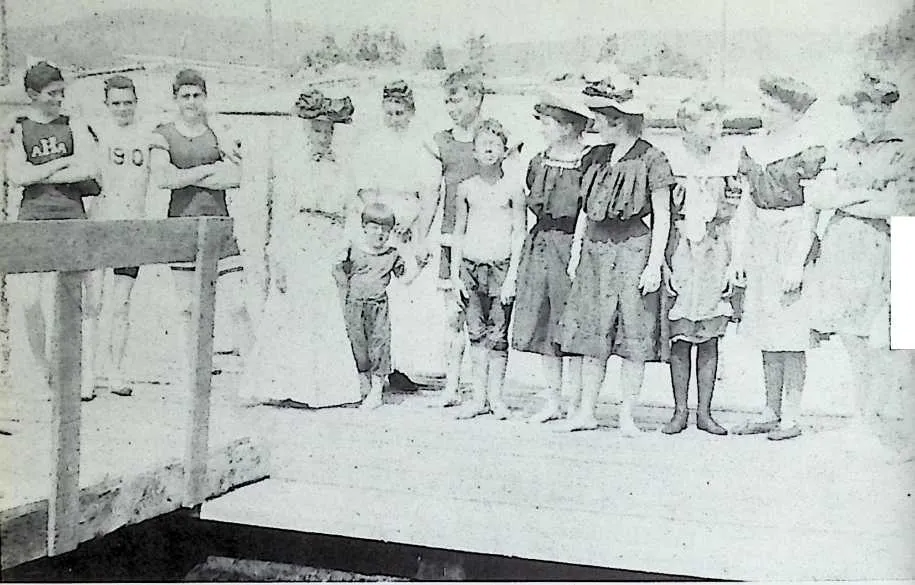
31 A family gathering at Bear Island, 1906: fourth from left, Grandma Andrews; in the center, Bucky (wearing glasses); tenth from left, Bucky's mother; at far right, Leslie and Wooly getting into trouble was Bear Island. Exploring the island and the sea around it, Bucky found plenty to see and do.
32 He watched the fishermen deal with winds, currents, and ten- to fifteen-foot tides. Survival depended on their mastering Nature’s rhythms. He noticed that they used Nature’s own designs to do this. Trees bend in the wind, so boat masts were made of wood to bend but not break. A single strand of a spider’s web is a fragile thing, but woven together, the strands have strength to catch and hold flies. The fishermen’s woven nets did likewise, catching and holding fish. Bucky was learning some important lessons, with ships, sailors, and the sea as his teachers.
33 Nights on Bear Island, Bucky lilted to stand outside and watch the stars. He thought of those stars, born millions of years ago, as a ‘‘live show of yesterdays.’’ Feet braced wide apart, he faced the North Star. Fifteen, twenty, the minutes seemed endless. Then he had his reward. Yes, there was definitely a gentle
34 pressure on his left foot. Everyone knows (with his mind) that the earth rotates. In Bucky’s experiment, he could actually sense with his body the motion of the earth turning in the night sky.
35 Besides watching, Bucky learned by doing. His clever hands with long curving thumbs made good use of the island’s rich resources. Using beach-dried driftwood, he whittled boats and all kinds of moving vehicles. The newest baby in the family, Rosamond, or Rosy, loved to play with those models. In St. Nicholas Magazine, he found the plans for a small cabin. He used lumber from the stands of good timber to build his first real structure. Although Bucky was just thirteen years old, he produced a solid building that any man would be proud to claim as his own. A snug little slope-roofed cabin, Birch Lodge is still used today to house visitors to the island.
36 Grandmother Andrews had bought one of the earliest gas- powered engines for the sloop. Making those early engines work was a tricky business. Breakdowns happened often and parts were scarce. Bucky used gallons of sweat and all his inventive ability to master that engine. In doing this, he learned to appreciate technology, which takes scientific ideas and puts them to work for practical purposes.
37 The main house on Bear Island