
6 6
2If Bucky was totally happy with his personal world, he was daily less satisfied with his business life. His aim was to build better housing for more people. Most of the world’s people were still poorly housed. Even in America, only a small percentage of the nenju housing had indoor plumbing! Bucky did not care much whether the company profits increased rapidly. A new board of directors disagreed; these men wanted the company to earn more money faster than before and made business decisions accordingly. Despite these differences, Bucky was taken by surprise when the board of directors called him in. The single statement which they delivered struck him like a blow:
3 ‘‘Your services are no longer needed.’’
4 He was pushed out of the company. Fired. Most companies give either notice ahead of time or extra pay for firing without warning. Bucky got neither. Somehow, a stunned Bucky made his way home to the apartment and Anne. He should have known better than to ignore the businessman’s love of money. What a fool he had been to follow his own ideas. Especially at this time when the new baby and Anne depended upon him.
5 As he finished telling Anne the news, he looked down at those clever hands with the long curving thumbs. It seemed as if everything he touched came to a bad end. The only words to describe himself were a ‘‘black, horrendous mess,’’ he concluded bitterly. An unruffled Anne disagreed. Bucky’s shoulders stayed hunched up in despair. How could he make her understand? There was more here than being fired. In the business world, he was discredited; no one would hire a man who neglected the goal of making money. Bucky had never been good at saving money, so they were penniless besides.
6 Sleepless nights followed restless days as he tried to sort out what to do next. His despair pushed him out of the apartment and into the streets of Chicago. He crossed boulevards packed with lines of honking cars, passed under the clattering, roaring elevated railways, and walked through leafy-green, bird-filled parks. Richard Buckminster Fuller saw and heard nothing.
7 He was haunted by the question: ‘‘Am I an utter failure?’’
8 On one of those endless walks, he found himself on the shore of Lake Michigan at midnight. A cold wind blew. Looking into the black waters of the lake, he could see one solution. He could, very simply, jump in the lake, kill himself. If nothing else, that would give Anne and Allegra a chance to find someone better able to take care of them. His stern New England conscience told him that such a decision was, perhaps, a too- easy way out. What are the choices, Bucky asked himself. The only other choice was …to think. And Bucky began thinking harder than ever before in his life. Having lost his job, money, and reputation, what did he have left?
9 He said to himself, ‘‘I have faith …in the …wisdom which we may call ‘God.’ ’’
10 The questions flew into his mind and the answers came haltingly.
11 ‘‘Do I know best or does God know best whether I may be of any value to the integrity of the universe?’’
12 ‘‘You don’t know and no man knows….’’ But, he concluded, ‘‘You do not have the right to eliminate yourself, you do not belong to you. You belong to the universe. …You and all men are here for the sake of other men.’’
13 Bucky straightened up and looked out into his universe. The shining stars looked like newly punched holes in the sky. In devoting the rest of his life to something greater than he was, he believed that his own life would straighten itself out.
14 Years later, in recalling that ‘‘pinch point of pain’’ and crisis in his life, Bucky wrote, ‘‘I did have many more types of experience than most …just by the good luck of being fired out of this and forced into that pattern. …So I had to do something about looldng my experience over.’’
15 Trust Bucky Fuller to call being fired ‘‘good luck.’’
16 ‘‘And, if these experiences are put in order, they might be of use to others…. Whether I like it or not, I am the caretaker of a vital resource: me!’’
17 He would try to convert all his experiences to the benefit of others.
18 In Bucky’s planned research program, there was neither room nor time ‘‘to earn a living.’’ He seemed to feel that the Lord would provide. Few men have been so fortunate in their marriages as Bucky Fuller. Anne accepted his stubborn faith and the changes in their life style with her usual serenity. They moved to a tiny, shabby apartment on Belmont Street in a neighborhood of poor people and run-down buildings. If Bucky gave her a dollar for food, then Anne made do with that single dollar. Some of their meals were slim ones, but there was always something on the table each day. Where did those little dribs and drabs of money come from? A relative died, leaving them a small amount of money; an old friend stopped by to repay a loan. Somehow, in one way or another, their needs were taken care of. The Lord or Providence did, indeed, provide.
19 Even more startling was the change in Bucky himself. Talkative, fun-loving, partying Bucky cut himself off from his friends and withdrew into almost total silence. It was not the silence of depression or despair but, rather, a planned part of his program. He had decided that ‘‘the way [he] had acquired bad rules and conflicting thoughts was through 'words.’’ He had been too willing to believe what others asked him to believe. As he has put it, ‘‘I became very suspicious of words.’’ Words are obviously tools, and he was enough of a mechanic to know that you can use tools in the wrong way.
20 Bucky changed not only his speaking habits but also his sleeping habits. He had noticed that when a dog gets tired it simply lies down and sleeps. The dog does not wait for a ‘‘bedtime’’ or night. Also, when it wakes, the dog springs into action with all energies available. Could it be that if a man lay down the minute that he was tired, he would need far less sleep? Bucky tried out his idea. Whenever he felt his concentration slipping, he would drop off for a half-hour nap. It worked. Out of each
21 twenty-four hours, he slept only two or three hours altogether. So he had more than twenty hours each day to read, think, and put facts and experiences together.
22 For information, he turned to the public libraries of Chicago. Since he rarely had a dime in his pocket for bus fare, he walked to the nearest branches, and sometimes even farther to the main library. He studied an extraordinary variety of subjects and authors from the geographer Mackinder to the scientist Einstein. Strange as his actions seemed, he was following in the footsteps of other great thinkers. Thoreau, Descartes, Gandhi —each had retreated from the world to do his own thinking.
23 Meanwhile, friends and family once again shook their heads over Bucky’s ‘‘irresponsible’’ behavior. For heaven’s sake, what was Bucky thinking about? Anne, who made all his contacts with the outside world, explained his purpose and defended his actions fiercely. For man’s sake, Bucky was thinking about the heavens, the whole of the universe, and man’s place in it.
24 Centuries ago, a man named Thomas Malthus worked out the idea that the world’s population was multiplying too fast. Malthus said (and used mathematics to prove it) that the food supply could not keep up with the increasing number of people. A natural conclusion to this was that only the strongest would survive. Many people accepted this picture of a ‘‘you-or-me’’ world; many governments operated on the belief that there wouldn’t be enough to go around.
25 Against Malthus’s ideas, Bucky weighed what he knew about the history of manldnd and the basic patterns of Nature. Man was so perfectly designed to fit in this universe that Bucky refused to believe that Nature meant him to be a failure. He suspected that scientists had already developed the skills or know-how to meet all needs, present and future.
26 In wartime, people used every bit of knowledge they had of science, chemistry, and mathematics to win battles. They spent millions and billions of dollars developing new weapons, new transports, and new tools. Electric light bulbs and refrigerators
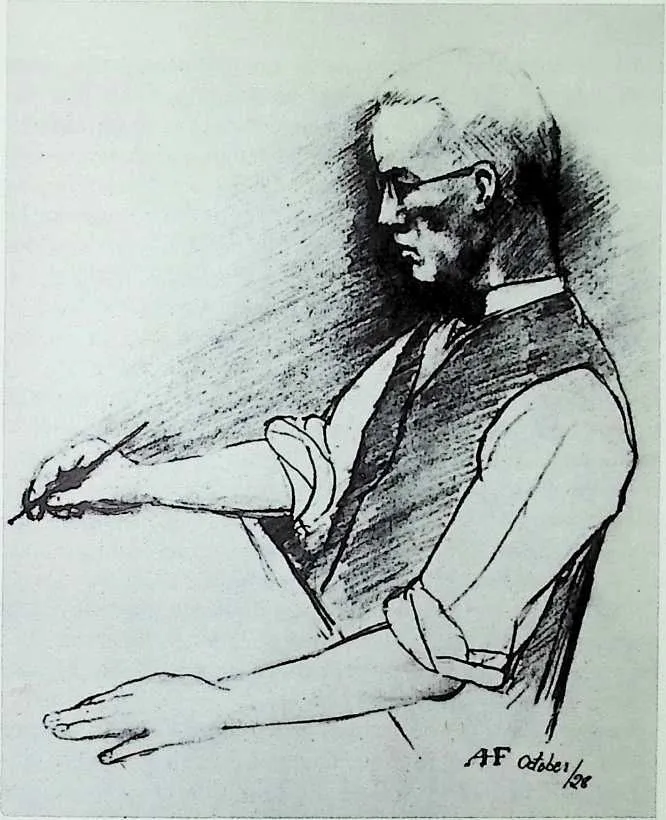
28 Portrait of Bucky, 1928, by Anne Fuller
29 first came into common use on battleships. Only afterward did the rest of the world benefit from such advances.
30 What would happen if society applied the highest technology directly to making man a success on earth? Was anyone working toward that goal? The mayor of a city plans around this year’s budget; the president of a company worries about next spring’s profits while the governor of a state campaigns for next fall’s election. Neither governments nor businesses care about such a far-off goal. But wasn’t it nonsense to think that one man with no money and no credit could help bring about a world of ‘‘you-rtrcd-me’’ in which all human needs were met?
31 By asking himself such questions, Bucky was organizing his experiences and ideas. For months, he continued to exercise his own special method of ‘‘thinking.’’ He devoted every waking moment to this effort. Even on the long walks pushing Al- legra in her baby carriage through Lincoln Park, he carried on silent dialogues with himself. He did not then find all the answers, nor does he claim to have them all even today. But, as one admirer pointed out: ‘‘The genius of Richard Buckminster Fuller is that he knows exactly what questions to ask and in what order [to ask them].’’
32 Answering the question of whether one man can be effective, Bucky drew on his experiences with boats and planes. A ship does not change course by its bow but by its rudder at the stern. The rudders have a little trim tab on the edge. By moving the trim tab in one direction, you can build a low pressure that pulls the whole around. There was no doubt in his mind. The individual can be a trim tab that turns the whole ship of state around with almost no effort at all.
33 Bucky Fuller was a practical man. In exploring what one person could do, he resolved never to spend any of his time trying to reform people. Rather than a reformer, he decided to be a ‘‘new former.’’ He chose to work through the science of design on the problems of man’s surroundings. Of all human needs, one of the greatest is shelter. Yet, he noted, it is among the last to receive scientific attention. The problems of shelter met all his requirements for action. He would be working on problems that no one else was working on and in a field that he knew well. By applying the latest scientific knowledge to housebuilding, he was sure that he could do more with less to everybody’s benefit.
34 Bucky was not only thinking, he was also writing furiously. He wrote two thousand pages in that winter of 1927. The
35 essay, 4D, contained most of his basic ideas. Since he himself paid for the printing of two hundred copies, he cut down and crammed the work into less than fifty pages. Some readers found it ‘‘scholarly’’; most found it cloudy and confusing. A man who invents his own words and gives new meanings to others was bound to be confusing. (He renamed architecture, calling it ‘‘environmental designing.’’ ‘‘Livingry’’ is Bucky’s single word to describe all the machines, tools, and things which keep people alive and well.)
36 Years ago, Bucky had invented a character called Spongee. According to Bucky, Spongee discovered America long before Columbus. In witty verse, Bucky had created a whole family for Spongee and drawn a fine, carefully detailed sketch of Spongee’s ship. (The black-and-white sketch hangs today on a wall in the den of the Pierce home.) This private myth or joke, shared with his friend Line Pierce, had been Bucky’s ‘‘discovery of the past.’’ In 1927, the essay, 4D, and the plans which he drew were his first attempts to share with others his serious ‘‘discovery of the future.’’ Many people dismissed his designs for the future as a joke and labeled Bucky a ‘‘charming nut.’’ Forty-five years later, time proved Bucky’s vision to be a true one.
37 What did his plans show that was so strange and different? Among other things, he designed lightweight buildings that could be ‘‘planted like trees.’’
38 For hundreds of years, men have built houses by piling up stones or bricks, one on top of another. Gravity pulling the top stones down holds them tightly together. Meanwhile, the bottom stone or brick must withstand the crushing weight of the ones above. The force pushing back is called compression. In walls built up that way, compression works vertically and tends to pull things apart. To carry loads in compression, men had to choose those building materials that would best resist crushing or being pulled apart.
39 Conventional houses with bricks piled up to support the roof and other parts are almost pure examples of compfessionstrength structures. Very few houses or structures ever used the
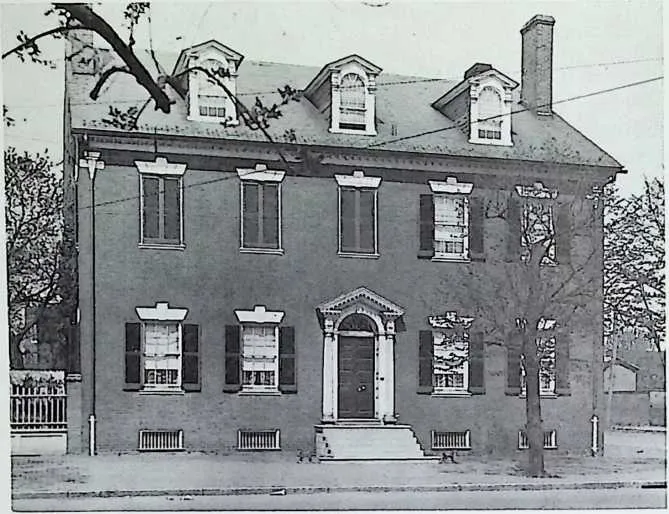
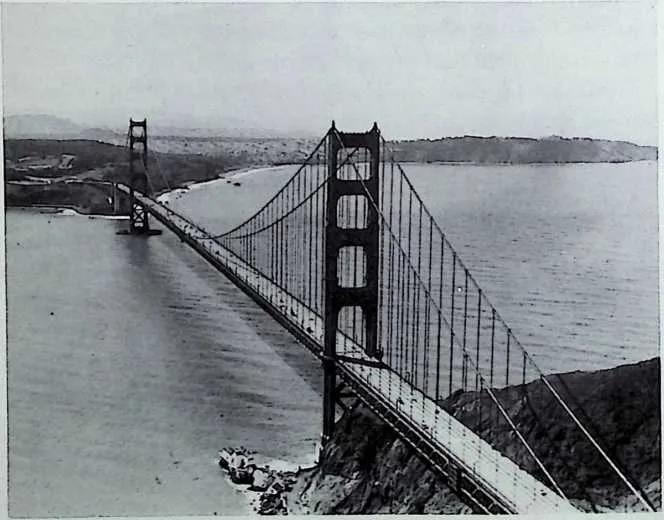
41 Above: a brick house shows compression strength; below: the Golden Gate Bridge in San Francisco is supported by a combination of compression and tension
43 tensile or pulled-taut strength of materials, a strength that exists along with compression strength. One exception to this is the tent or tepee, which depends for support on the tensile strength of its lightweight materials.
44 Suspension bridges like the Golden Gate Bridge are a partnership of these two kinds of strength. Towers carry the compressive load while the steel wire cables hung in tension support the roadway. (These cables demonstrate that tension works horizontally and can be made to hold things together.)
45 Bucky understood these principles of building and facts of engineering. He knew, too, that technology was constantly improving the tensile strength of materials. Even at that time, some metals and alloys had greater strength when used in tension than in compression. For his own house, he looked to the new aircraft industry where designers were using both kinds of strength to the greatest advantage. In their structures, the framework (in compression) was tied together by metal alloy cables (in tension). Thus, they created the strongest possible structures with the least possible weight. Like an airplane, the Fuller buildings were designed to have compression parts (a central mast) and tension parts (suspended walls and decks) separated out, re-
4647Vn Fuller1 s new design, single decks in the shape of hexagons (left) would be hung from a central mast (right)
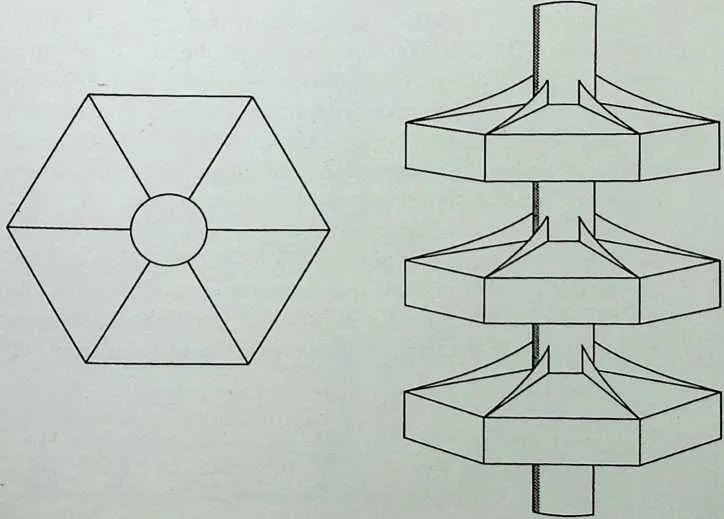
49 suiting in the same advantage. Another way to understand the idea behind Fuller’s design is to picture a simple wire wheel of a bicycle turned over to rest on its hub rather than its rim. The hub then acts as a mast.
50 ‘‘Toward a New Architecture’’ read the caption over the newspaper sketch of a fantastic-looking structure. Readers of the accompanying article in the Chicago Evening Post learned that:
5152These new homes are structured after the natural system of humans and trees with a central stem or backbone from which all is independently hung….
53 Drawings showed a ten-deck building that hung from a central, trunklike mast. The tower building, a blend of the American skyscraper and the oriental hexagonal pagoda, looked something like a six-sided tree. Since the floors and ceilings were supported by cables, the walls of the entire house could be transparent or opaque, giving it an airy, crystalline look. All the machinery to make the building work—plumbing, wiring for electricity, and generators—was already assembled (before construction) in the mast itself. The largest standard one-mast model included a swimming pool that ringed the building in the outer rim of one deck. Other decks contained a gymnasium, hospital, library; some were labeled ‘‘decks of necessity.’’
54 Buckminster Fuller wrote that article, which appeared on December 18, 1928, and gave the general public the imaginative results of his thinking. An exhibition of models and drawings by well-known European and American architects was to open in Chicago within the next month. Fuller, who had had no architectural training whatsoever, dared to suggest that his sketch might be ‘‘termed a universal design.’’
55 Actually, he was offering more than a new-style apartment building or house; he was proposing
a whole new industry. He had figured out that two billion new homes would be needed by the
end of the century. Old methods of building could never keep up with the demands of an
ever-increasing population. In
stead of hammering together houses one-by-one on each site, Bucky suggested a revolutionary
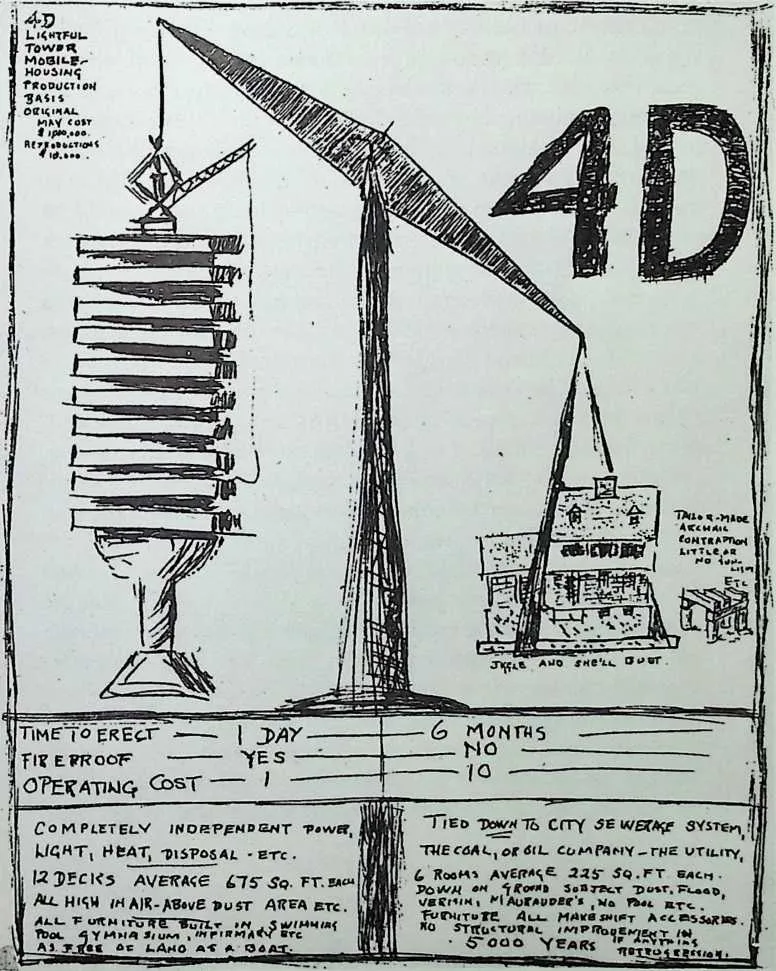
new way to build. All the parts of his apartment houses would be made in factories just as
automobiles and airplanes were. He estimated that to develop this new industry and the factories
would cost a billion dollars.
56 Fuller's sketch and notes compare his 4D tower house with a conventional six-room house
58 How to deliver these fully assembled buildings? It is not very practical to move thousands and thousands of house trailers through crowded city streets. Nor could such loads squeeze through narrow tunnels and under low bridges, It is practical, however, to carry them through the air, which is free and clear from obstacles. So he designed his towers to have minimum weight but maximum strength. He planned to make delivery by zeppelins, those huge cigar-shaped airships.
59 Approaching the building site, the dirigible or zeppelin would throw out an anchor to steady itself and drop a bomb to make a hole for the foundation. Then, ‘‘down comes the 4D tower house from the sky. Featherweight.’’ After being lowered into the hole, the tower would be tied in with cables; concrete poured around the foundation would make it secure. ‘‘Off goes the zep to make a few more deliveries,’’ Fuller wrote. His note underlined the speed with which a sky-scraping tower could be put up. Like the telephone company, this new service industry would ‘‘install’’ a building anywhere at a day’s notice.
60 Besides ‘‘universal design,’’ Bucky had still another conclusion and plan, his eye-opening idea of an ‘‘Air Ocean World Town Plan.’’ Three quarters of the earth is water. Of the one quarter that is land, very little has been lived on by man. Fuller wrote, ‘‘Trees have roots, men have legs.’’ As a creature designed to move, man should be able to shelter anywhere in the world.
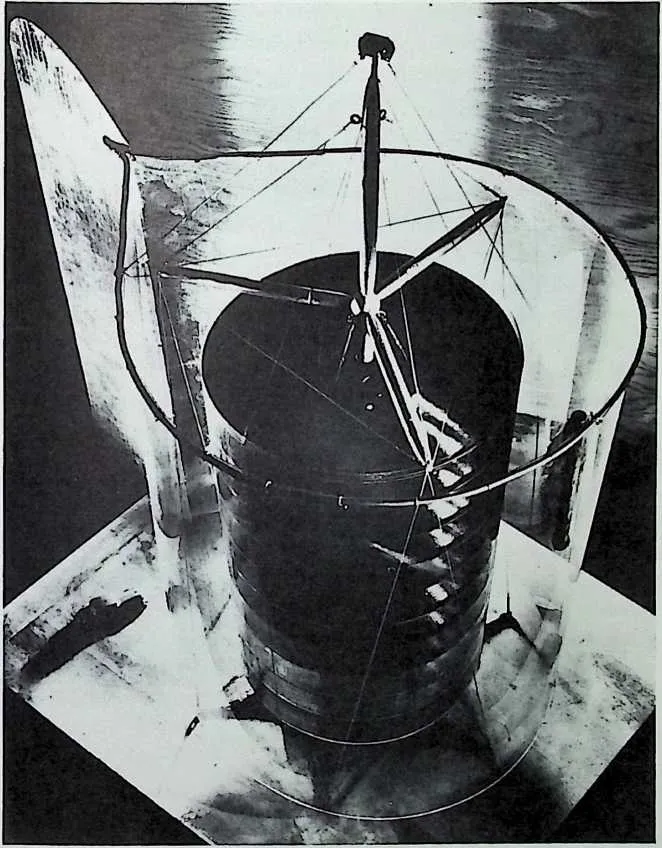
61 Following this idea to its natural end, Bucky designed structures that did not need the mechanical services and support of a city. Each building was independent, capturing the wind for power, the sun for heat and light. No building had to be hooked up to sewer or electric power lines. Making delivery by air eliminated the need for roads or highways. With a streamlined plastic shield to surround and protect them from hostile weather and environment, these buildings could be planted anywhere from the Alaskan coast to the Sahara.
62 Man had been crowding into 5 percent of the dry spots on earth. If people could live anywhere on the globe, there might be space enough for that ever-increasing population.
6364Some people took Fuller’s ideas seriously. With their financial help, Bucky formed the 4D Company to continue his work. He rented a post office box, prepared patent applications, and found students to help him build models. For her part, Anne took care of the daily chores of living. Carrying in the groceries, taking out the garbage, she often had the help of a neighbor. When Anne spied a gun under the man’s jacket, she made no comment. Neighbors on Belmont Street did not ask one another questions. He might be a gangster working for a Chicago mob, but he was polite and helpful to her. She was more concerned with keeping Allegra from harm and danger spots like the hot stove and the elevator shaft. Rather than say ‘‘no, no’’ every minute of the day, Anne found clever ways to draw Allegra’s attention elsewhere. Bucky admired Anne’s way of encouraging Allegra to develop freely with safety. He was less admiring of the time Anne had to spend cleaning up the day’s dirt and trash.
65When he scaled down the ten-deck building to a design for a one-family house, he offered solutions to these problems of daily safety and constant cleaning. The one-family house, too, was hung by tension cables from a central mast. To an amazing degree, his ‘‘scientific dwelling machine’’ harnessed the natural energies of the sun and wind. Lenses in the mast collected and used the light and heat of the sun, while a central pipe carried rain water through the mast. Up top, a windmill caught breezes to operate the power generator. Air coming in through vents in the central mast was cleaned, cooled or heated, and then circulated through the house. Air-conditioned, dustless, soundproof—this machine for living almost took care of itself.
66Working as a comprehensive designer, Bucky asked himself questions that never occurred to the architects of his day. A typical question was: What do people use water for? He knew that each American was then using two hundred gallons per day. Only one gallon a day was used for eating and drinking. The other one hundred and ninety-nine gallons were spent ‘‘to dunk themselves, and gadgets, and to act as a …system for carrying specks of dirt to the sea.’’ All of this led him to the
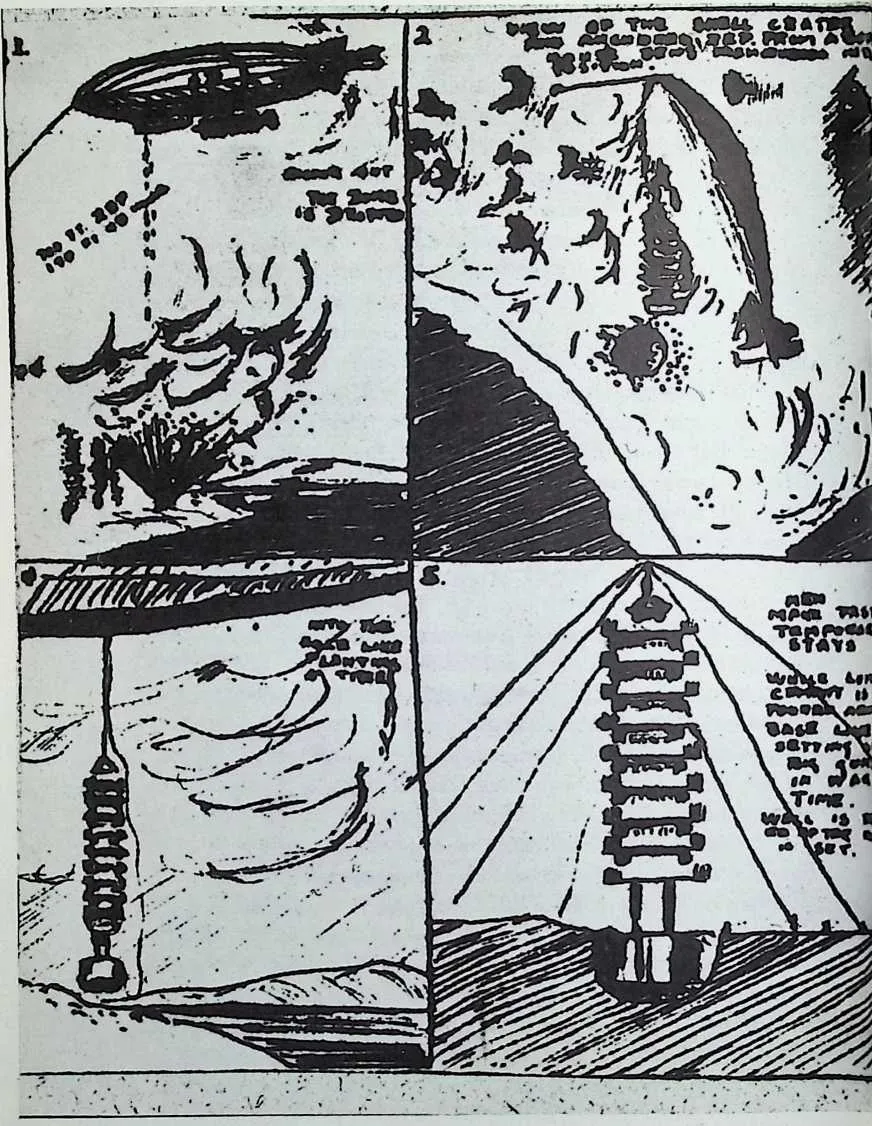
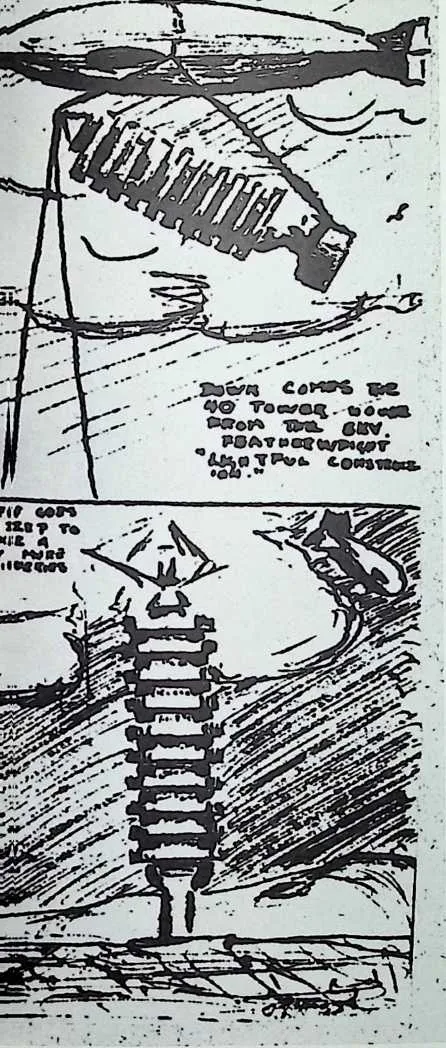
69 Fuller's drawings show a zeppelin delivery of a 4D tower house
70 6o next question: ‘‘Are there not superior ways to effect many of the end purposes involving no water at all? …’’ And the next: ‘‘Where water is found to be essential can it not be separated out? . .
71 His inventive conclusion was that a person using his ‘‘fog gun’’ could shower in just one quart of water. And that quart of water would be collected, filtered, sterilized, and used again.
72 In the 4D House, machines did all the work automatically. His dishwasher not only cleaned and dried the dishes but also put them away in the cupboards. All the closets had shelves that revolved mechanically. A central vacuum system and compressed air would do whatever cleaning needed to be done. Freed from the drudgery of daily chores, people could educate themselves in the go-ahead-with-Iife room. A kind of library, that room would hold maps, globes, revolving bookshelves, and a radio-television receiver (something not yet developed).
73 Many of the machines and materials designed into his house had not yet been invented. But they were not wild science fiction drawn just from his imagination. He based them on his experiences and research, experimental models, and known scientific ideas. He was convinced, for example, that light energy could be converted into electrical energy. Perhaps, by interrupting a light beam with a wave of the hand, doors and windows could be opened automatically. In 1927, Bucky had written to his brother Wolcott, an engineer with General Electric, and asked if anyone was working out this idea.
74 In answer, Wolcott wrote: ‘‘Bucky, I love you dearly. But can’t you make it easier for your relatives and friends by not including your preposterous ideas?’’
75 A telegram came for Bucky just one year later. The telegram was from Wolcott and said:
7677YOU CAN OPEN YOUR DOOR BY WAVING YOUR HAND AFTER ALL STOP WE HAVE DEVELOPED PHOTOELECTRIC CELL AND RELAY STOP SEVENTY-TWO DOLLARS FOR THE SET STOP.
78 Today many supermarkets, banks, and businesses use electrically opened doors.
79 Bucky met the same reaction when he talked with the engineers about the aluminum he needed for his central mast. The mast had to be lightweight but strong. In 1928, aluminum
8081Model of a ten-deck 4D house surrounded by a plastic shield
83 was used only for things like pots, ashtrays, and cheap trinkets. An engineer’s irritated reply was, ‘‘We have two kinds of aluminum: soft and softer. Which kind do you want?’’ Only an idiot would talk then about using aluminum for buildings. But five years later the heat-treated alloys of aluminum that Bucky was looking for became widely available.
84 Bucky Fuller was neither surprised nor dismayed by such reactions from the people he approached. By deliberate choice, he was working roughly fifty years ahead of his time. He had measured the gaps between when an invention or discovery was made and when it got put to use as a practical tool. In radio, it took two years; in the airplane industry, five years. For the housing industry to put either new methods or machines into use would take at least forty-five years.
85 In 1972, a conversation with a business leader proved Bucky’s timetable right.
86 The community leader said, ‘‘We’ve got a new industry coming to East St. Louis. I suppose you’ve heard about it….’’
87 ‘‘What is it?’’
88 ‘‘Mass production of bathrooms.’’
89 Was there the ghost of a smile on Fuller’s face? He answered, ‘‘They are right on time. I designed the first one forty-five years ago.’’