11 11
2One of Bucky’s beliefs is that what is going on at the moment is not really what is important or counts in Nature’s game plan. For a honey bee, chasing the nectar is what’s important; for Nature, the important happening is the cross-pollination of plants that occurs.
3 Bucky Fuller was chasing bigger things than the ‘‘honey’’ that the Wichita House might have brought. The Wichita House project had been a detour. Along the way, he had caught a glimpse of something else to be explored in his developing mathematics. With enough time, he thought that he could pin it down.
4 Meanwhile it was summer, and time to enjoy the first glimpse of Bear Island as it came into sight. Thanks to sister Rosy, who loved the place passionately, no outsiders owned any part of the island now. Scraping together all her money, Rosy had bought back the shares which had gone to Bucky’s creditors for the Dymaxion Car. Over the years, a grateful Bucky had managed to pay her back.
5 Now the boat nosed into the harbor toward Hardie’s headland and he could see the ledge on the right. He craned his head to look and the broad grin grew even broader. Yes, just as he had expected, there was a fish hawk’s nest on the ledge as there had been every year.
6 The summer before, Bucky had set up some tricky walkways in the ice pond. Painting the kitchen, teaching Allegra to sail, fixing gutters…There was always more than enough to fill the days at Bear Island. At night, after supper, he wrote up columns of happenings on the island. When people came down to breakfast, each found a copy of this morning newspaper neatly folded by the plate.
7 Throughout the vacation and afterward, Bucky reviewed his situation. What had he accomplished so far in fifty years of living? Should he continue in his work which he called ‘‘comprehensive anticipatory design science’’? Was the world right in declaring him a failure?
8 Yet Bucky Fuller had evidence that some of his hunches were correct. War needs and improved instruments had begun washing out the lines that separated the sciences. The new sciences emerging, like biochemistry and biophysics, supported his argument. To understand the Universe, it was necessary to study the whole system rather than specialize in one department of study. A small but increasing number of scientists had begun to agree with him.
9 In Washington, Bucky had discussed his work with the scientists who met for lunch at the Cosmos Club. Thornton Wilder, a playwright and also an excellent mathematician, urged Bucky to copyright his ideas before someone else took credit for them. Wilder felt that Bucky was uncovering some of the most important principles since Isaac Newton had discovered gravity. Additionally, every one of his prototypes had worked, and worked very well indeed. All this gave Bucky confidence.
10 Once again Bucky Fuller came to an important decision. With the little money that he had saved in the war years, he would buy time. No more detours into other work. From now on, he would concentrate on developing his geometry of energy.
11 The apartment in Forest Hills, New York, became his laboratory, study, and workshop. There was scarcely space left over in the little three-room apartment for the purposes of living. Diagrams, figures, formulas—Bucky scribbled constantly. He would wake up in the night, sit up, and work for hours. He wrote on the backs of envelopes, napkins, any piece of paper that was at hand. For this project, he knew his figures had to be absolutely accurate. Using spherical trigonometry, he worked for two years.
12 Although Bucky worked steadily, he did not cut himself off from the world this time. Whenever and wherever he was invited to talk, he accepted.
13 At Dartmouth College in 1947, the program chairman mentioned that R. Buckminster Fuller had been a guest speaker there many years ago. With a gleam in his eye, Bucky stood up to begin his lecture. His voice went in fits and starts, like an engine revving up slowly. The audience listened attentively to Bucky as he went through his thinking-out-loud process.
14 Over the past seventeen years, he had consumed and processed tons and tons of food, air, and water. His body had long since shed the skin, nail, and hair cells that had been Bucky Fuller in 1930. Even the hall where he had spoken before had disappeared in a fire. Possibly, he concluded, the only part of him that had been on the Dartmouth campus before was his glasses.
15 A laughing, delighted audience leaned forward to hear more from this man who produced one startling idea after another. Young people in particular always responded warmly to Bucky’s ideas and his way of putting them across.
16 As a guest lecturer in the 1948 Summer Institute of Black Mountain College in North Carolina, Bucky got room, board, and a tiny salary. Better than money, though, was the bonus of eager students willing to listen and work with him. Together they made strange-looking models of spheres and half spheres. The models were strange-looking because their rounded surfaces were networks of triangles. Bucky was testing an idea that had occurred to him while working on his Dymaxion Map.
17 Bucky and students in 1948
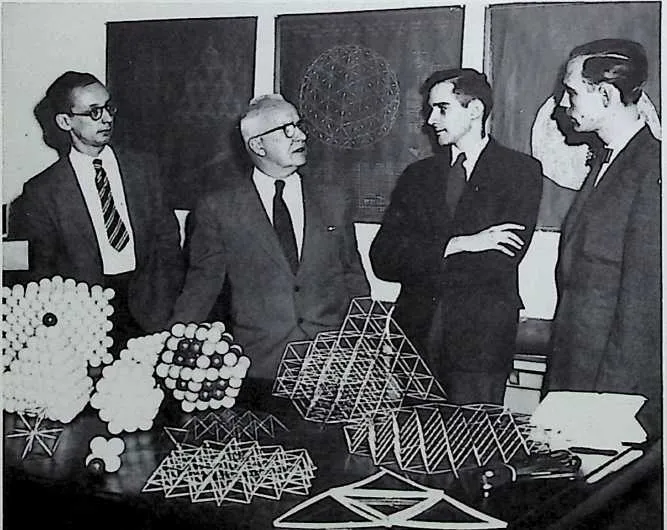
19 If he could develop a three-way great circle grid or network …If he could divide his triangles into smaller and smaller ones …If he could do the geometry properly …Why, then the dome would behave in an extraordinary way. He should end up with the strongest, lightest, and most efficient means of enclosing space ever made by man. If he did the geometry accurately.
20 By early 1949, Bucky was satisfied with his calculations. The time had come to build real domes, big ones that would prove his theories and demonstrate this quality of super-strength. Only one problem remained, the same one that he always bumped up against. Money. Where could he go for money? The business world had dismissed Bucky as a fool about money and a failure. Bucky himself, burned by the Wichita House disaster, had no wish to put his project at the mercy of outside backers. Still, he needed money. Around and around Bucky’s thoughts went and finally, as always, he shared them with Anne.
21 He needed money to buy materials, the best possible materials for his prototypes. But who besides Bucky could believe in a structure whose strength depended on the mind and geometry of one man?
22 Cutting through to the heart of the matter, Anne asked a practical question. How much money? Then she pointed out that he could ‘‘go’’ to her for the money. Her latest legacy included valuable shares of stock. Since she had always had confidence in Bucky, she willingly sold the shares. It was just enough to make the difference.
23 A cheerful, confident Bucky drove south to Black Mountain College. Students from the Chicago Institute of Design joined him there to work on the summer’s project, setting up a fourteen-foot hemisphere. When spread out on the ground, the makings of the dome looked like the pieces of a giant Tinkertoy. Aluminum aircraft tubing with cables laced through made up the dozens of triangles.
24 Almost everybody at the Institute turned out to watch it go up. Some must have let their breaths out in a sigh of relief. It went up and stayed up. Now to test its strength.
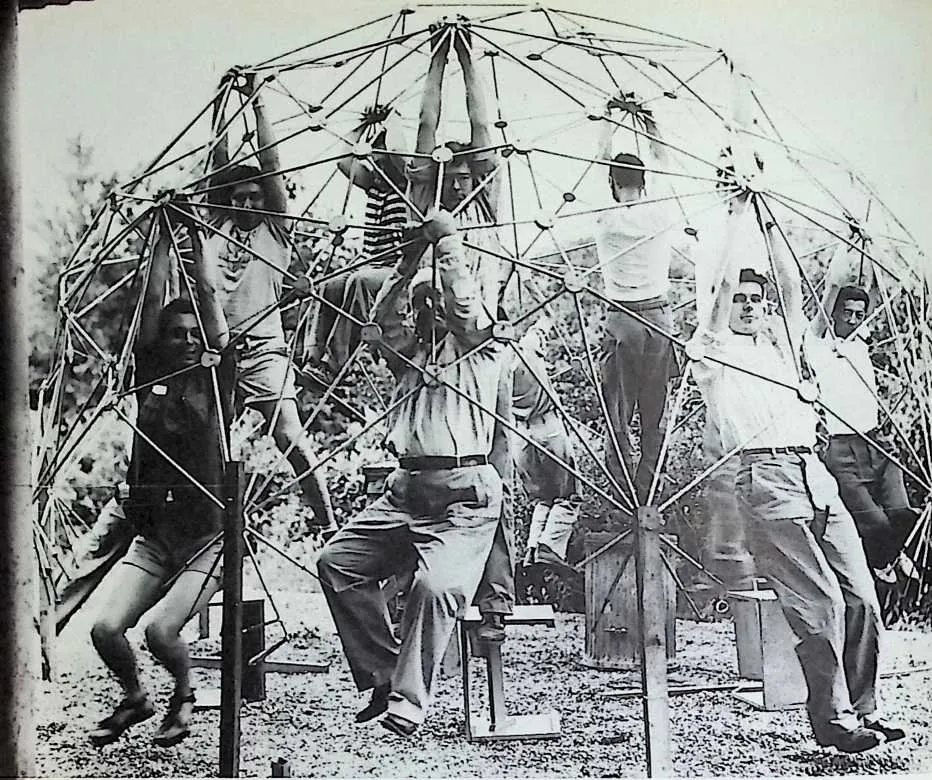
26 Bucky and students test a geodesic dome at Black Mountain College in 1949
27 Standing under the dome, nine men grabbed at the joints of the triangles. Then, swinging their feet clear from the ground, they hung like monkeys from the dome. That spidery, fragile- looking network of tubes and cables stood fast. No dimpling, no caving in. All the forces, inside and outside, pushing and pulling, were perfectly balanced to provide the greatest possible strength.
28 Bucky Fuller had successfully used Nature’s basic event, the tetrahedron, to make his spherical framework. The edges of the tetrahedrons joined to make great circle arcs. In mathematics, the shortest distance between two points on a sphere is called a geodesic. Consequently, Bucky named his structure a geodesic dome.
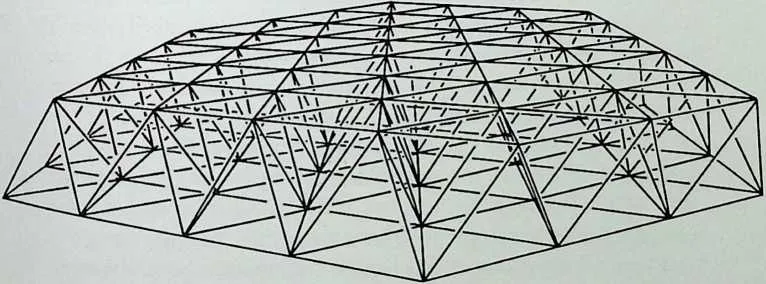
29 Another practical application of his mathematics, one of alternating tetrahedrons and octahedrons, he called the Octet truss. This truss can carry enormous loads. Even Bucky was surprised by the performance of his Octet truss. An aluminum one weighing only sixty-five pounds supported a load of six tons, or the equal of a small Army tank.
30 His Octet truss demonstrated the meaning of synergy, one of Bucky’s favorite words. By his definition, synergy is the only word in our language meaning the behavior of wholes unpredicted by behavior of their parts.
31 To illustrate, he asks audiences to consider the metals of chrome, nickel, and iron. Each one has a certain pulling strength. Combine these together into the alloy chrome-nickel steel. Adding the strengths of these metals together, you would expect the new alloy to have a strength of 260,000 pounds per square inch, or the sum of its parts. But, in fact, you get a surprise: The alloy has a pulling strength of 350,000 pounds per square inch, or a ‘‘whole’’ that is greater than the strength of all its linked parts added together. Synergy plays a key part in Bucky’s Synergetic-Energetic Geometry.
32 Bucky traveled from college to college and his lectures stimulated students to build bigger and bigger domes. Under his direction, the students’ domes demonstrated another valuable quality. Because his dome’s strength lies in the invisible mathematics, it
3334Drawing of an Octet truss
36 could be made of almost any material. Wood, plastic, aluminum —even cardboard—worked. And it used less material to cover more space than any building ever seen.
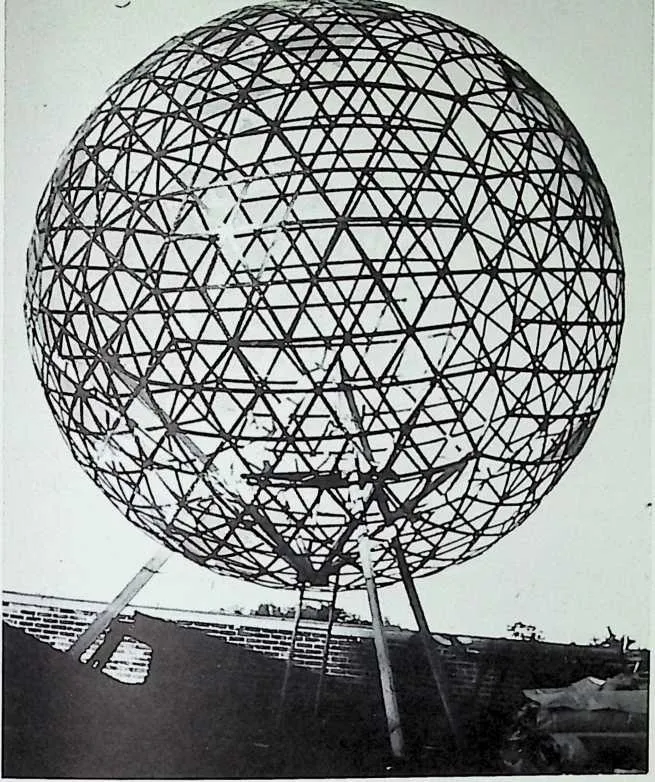
37 Cornell students built a geodesic Miniature Earth. Standing inside this geodesic earth dome, you could see through the open network of struts to the heavens above. It was as if you had taken an elevator to the center of the earth and had x-ray eyes to look up, around, and out. The eye could trace a bronze screen overlay of the continents. Its North-South Pole axis paralleled the earth’s axis and all the real stars in the heavens appeared in true zenith over the Miniature Earth just as they did over the real earth. In this strikingly effective planetarium, Fuller says you could ‘‘see and feel the earth to be revolving in the presence of the stars.’’
38 Although 90 percent of Americans had heard of those strange things called flying saucers, only a tiny fraction of a percent had heard of Fuller’s domes. Even fewer thought that the domes had any value or could fill any real need. Many dismissed them as beautiful but useless objects, a novelty to be admired in the Pentagon Garden or the Museum of Modern Art. Fuller was undisturbed by those opinions. He invented and then waited until the world came around to needing what he invented.
39 In the case of the domes, the need appeared when the Ford Motor Company planned to celebrate its fiftieth anniversary in 1953. Next to the River Rouge plant in Michigan stood the Rotunda, a circular office building with a courtyard open to the sky. The first Henry Ford had often wished that the courtyard could be covered by a dome and used all year round. To mark the company’s anniversary, his grandson, young Henry Ford, decided to cover the courtyard. He asked the leading architects and engineers for a design.
40 ‘‘No way,’’ said the experts. A conventional dome of the size needed would weigh 160 tons. Such a weight would crush the walls of the Rotunda. Still, young Henry continued to hunt for a way to carry out his grandfather’s wish.
41 If an ordinary dome could not be put on top, how about an
43 Miniature Earth at Cornell University, 1952
44 extraordinary one? Perhaps something like the domes that Buckminster Fuller demonstrated and lectured about?
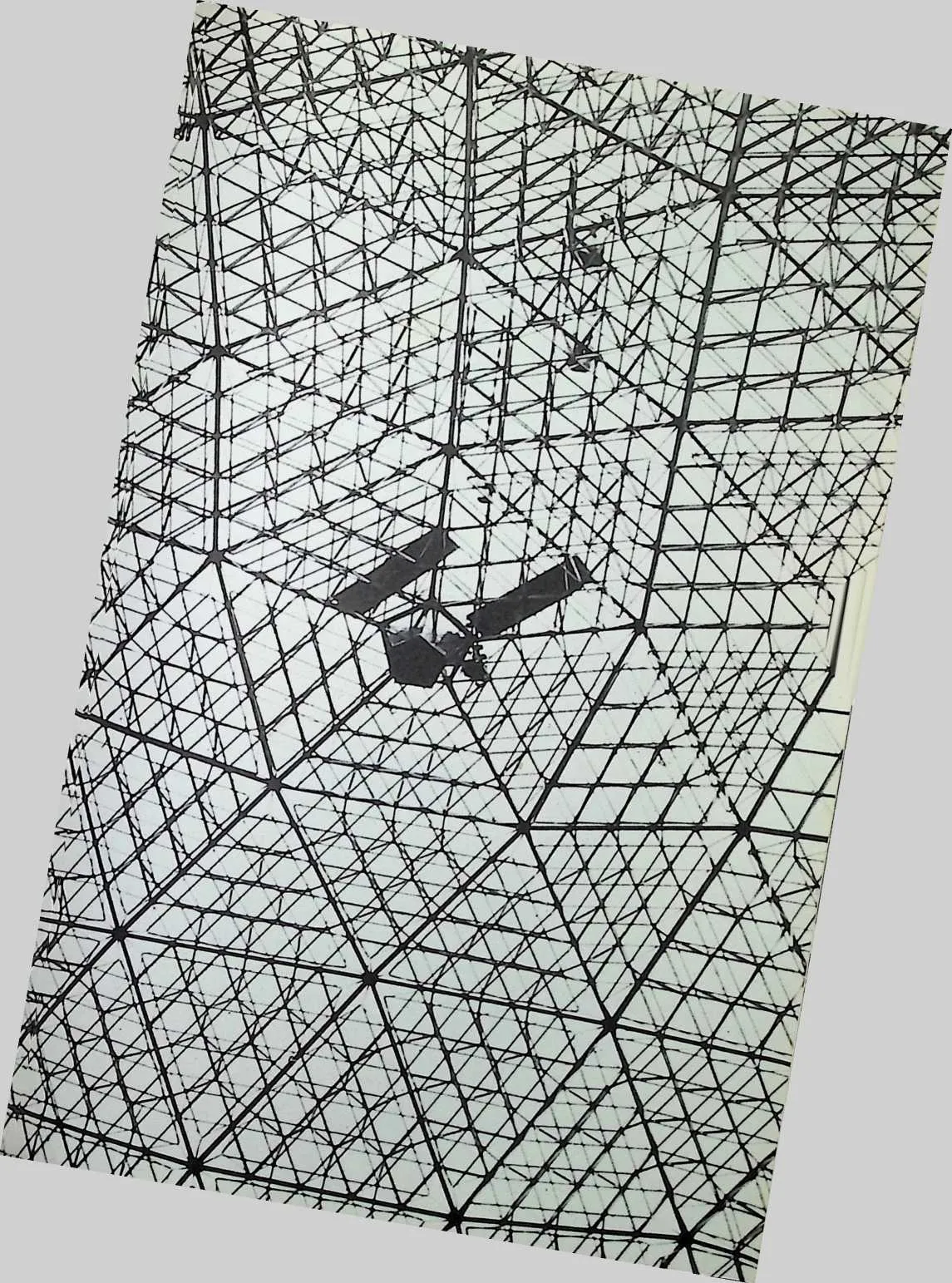
45 ‘‘Yes,’’ Bucky answered simply and without hesitation. It could be done.
46 ‘‘Only a fool or crackpot like Fuller would try,’’ said the experts. Besides the engineering problems, there was an added problem of time. Ford wanted the dome finished in less than four months.
47 Bucky himself had no doubts. The two years that he had invested in those pages and pages of careful calculations were
48 now ready to pay off. Once the calculations had been done, they could be used for any size dome that had the parts arranged in the same fashion.
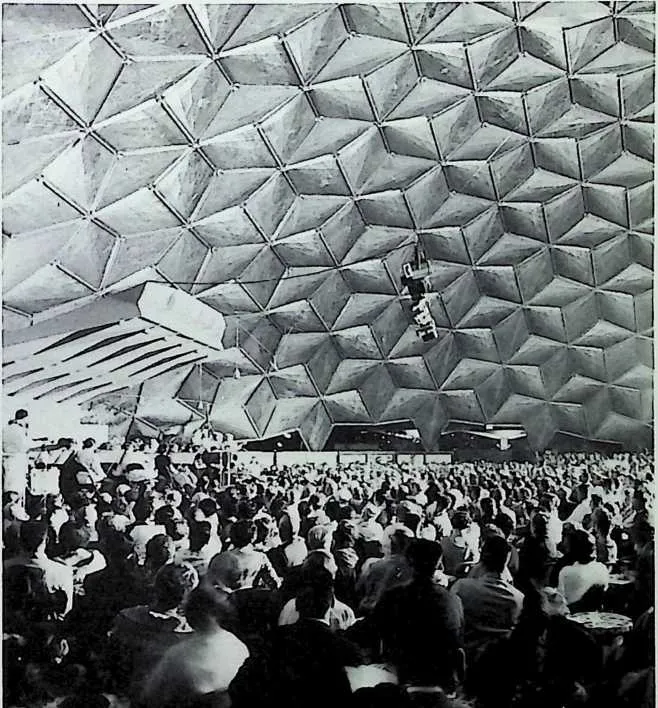
49 Still, Bucky took no chances on this job. He used the Octet truss with more struts than were strictly necessary. Even so, the ninety-three-foot dome that he designed weighed just eight and a half tons. (A much larger dome designed later for the Ford Company weighed only a fraction of that first one.)
50 ‘‘Bucky Fuller Finds a Client,’’ headlined the article in the architects’ magazine. At last someone had come to Bucky to buy what he had designed. The customer found, too, that Bucky had locked up this formula which came straight from Nature. Five months after he celebrated his fifty-sixth birthday, Bucky had applied for a patent on his ‘‘framework for enclosing space.’’ No one could build a geodesic dome without a license or permission from Fuller.
51 Once the contract was signed, the Ford Company moved quickly to manufacture the parts. Punches designed especially for this job made holes in the ends of the struts; workmen riveted the struts into small triangles and joined the small triangles to larger triangles. High over the open Rotunda court, a giant lacy web of struts began spreading out. Two days before the deadline in April, the last strut was riveted into place. Fuller had pulled it off; the impossible had been done. The Rotunda had been covered in record-breaking time at less cost than expected. Stockholders who came to the annual meeting found it beautiful as well.
52 Bucky, always quick with a rhyme, wrote a jingle to be sung to the tune of ‘‘Home on the Range.’’ The last lines went:
5354Just give me a home in a great circle dome Where the stresses and strains are at ease.
55 At right: A view from inside the Ford Rotunda dome
57 After the success of the Ford Company dome, the whole world seemed to take up Bucky’s song. The Air Force, the Marines, the Department of Commerce all came shopping for the domes. Each order presented a different set of problems and requirements. Yet Bucky’s domes satisfied each one’s needs.
58 For the Marines, Fuller designed a small hut that could shelter six men. The shelters were so cheap that they could be used and then left behind when the troops moved out. The Marines nicknamed this paperboard container ‘‘the Kleenex House.’’ More soberly, their leaders declared it the first major improvement in military shelter since the introduction of the tent over two thousand years ago. In different sizes, the domes replaced forty-seven different kinds of shelter that the Marines had been using.
59 ‘‘I personally can appreciate Fuller and his dome,’’ wrote one grateful Marine pilot in a letter to Time magazine. The pilots landing on a barren island had had to fight winds and choking dirt. As if by magic, two huge hangar domes appeared shortly after to protect men and planes. Here was shelter delivered by air to remote parts of the globe, just as Bucky Fuller had predicted in 1927.
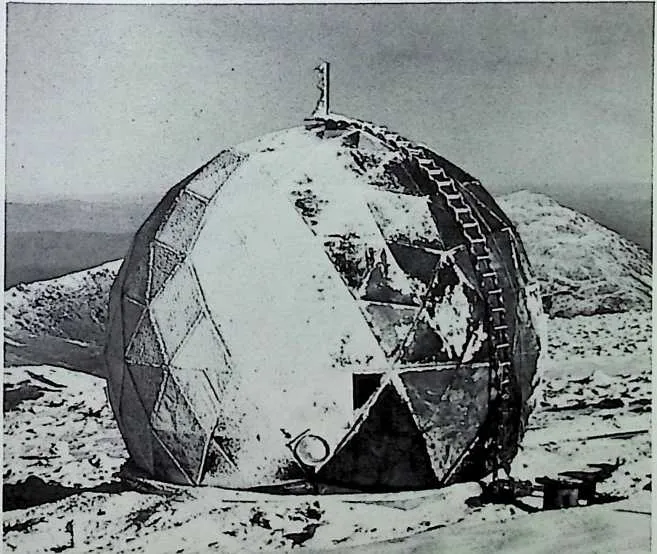
60 The Air Force planned a string of radar installations along the Arctic Circle to defend America against surprise attacks. Because of the extreme weather conditions in the Arctic, the Air Force asked Fuller for a structure that could be flown in pieces and put together in less than a day. The materials in such a structure had to stand up against winds of 210 miles an hour yet allow radar beams to pass through. (Structural steel, which reflects radar beams, could not be used.) Fuller more than met the requirements with a forty-foot-high fiberglass plastic dome. His ‘‘radome’’ went up in fourteen hours and withstood winds of 220 miles an hour. Hugging the northern edges of Canada and Alaska, the three-thousand-mile strip of radomes forms America’s DEW (Distant Early Warning) line.
61 While he was working on such military projects, the armed services insisted that he be investigated.
62 ‘‘Why?’’ asked Bucky Fuller.
63 Because whatever he created for them would naturally become ‘‘top secret,’’ he was told. Only those people who had been investigated and proven reliable for security purposes could work with top secrets.
64 With firm logic and a straight face, Bucky replied: ‘‘It is not necessary for me to be cleared in order to trust myself. I already know my own top secrets.’’
65 Knowledge of such ‘‘top secrets’’ as the domes had spread rapidly through the civilian world. The Department of Commerce ordered a dome to house the U.S. exhibit at the International Trade Fair in far-off Afghanistan. A single DC-4 plane carried all the parts for a dome to the city of Kabul. A single engineer went along to direct the construction. When the load was unpacked, the air buzzed with questions.
66 What were the Americans thinking of? How could the unskilled Afghan tribesmen who spoke no English put together this advanced piece of technology?
67 Bucky’s design included a color code which made the job incredibly easy. The workmen had only one simple direction to follow. Bolt blue-ended parts to blue parts, red ends to red
68 The first radome, on top of Mt. Washington
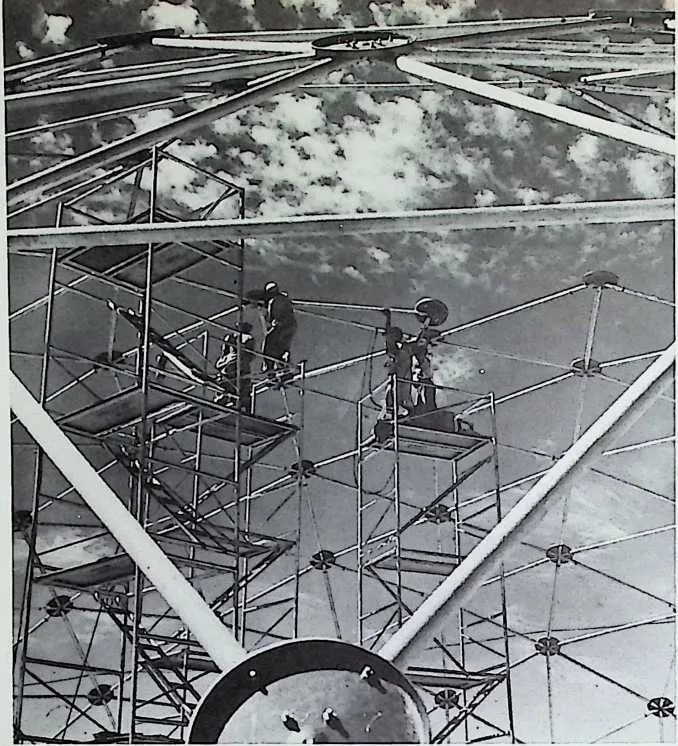
71 Assembling the U.S. Pavilion for the International Trade Fair in Kabul, Afghanistan parts. Within forty-eight hours, the aluminum tubes had all been bolted together and covered by a nylon skin.
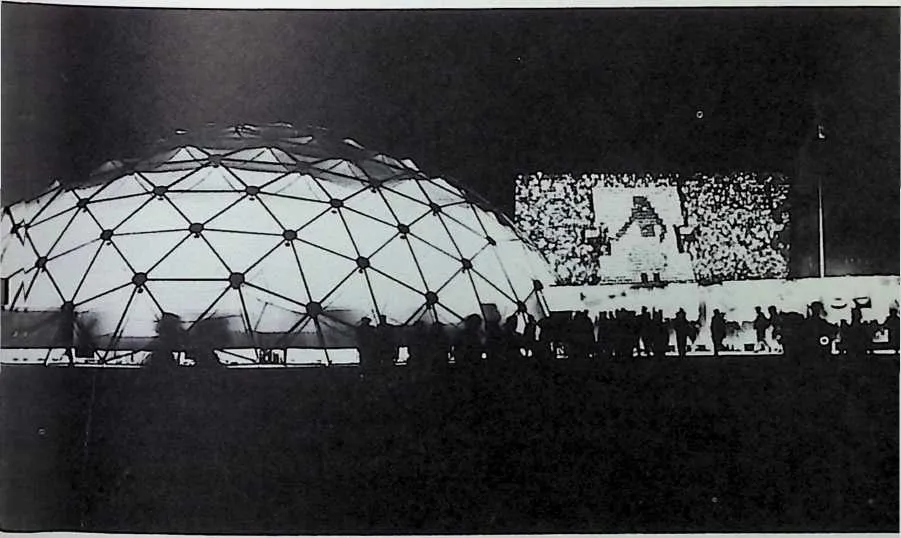
72 The magical speed with which the dome went up stunned both natives and visitors. For weeks and months, laborers had been working on the Russian and Chinese Communist buildings and had yet to finish. Overnight, the Americans had created a palace that might have come out of a fairy tale. The Afghans approved wholeheartedly of this modern cousin to their traditional buildings, the rounded yurts, while the foreigners murmured admiringly about the grace, elegance, and strength of the dome.
73 The huge dome drew record-breaking crowds and pages of praise for America’s technology. The Department of Commerce
74 realized that the domes served a double purpose. They were superbly suited to house exhibits and were themselves an attractive exhibit or symbol of American ‘‘know-how.’’ The government promptly ordered more and bigger domes for fairs and exhibitions everywhere. Fuller domes flew around the globe—Europe, Africa, Asia—to earn him a worldwide reputation.
75 There seems to be no limit to the usefulness of geodesic domes or the speed with which they can be put together.
76 The Kaiser Aluminum Company manufactured one for use as an auditorium in Honolulu. The day that construction started, Henry Kaiser flew from the mainland to Hawaii. He wanted to see the dome being put together. By the time he landed, it was too late. The dome was finished. Twenty-two hours after the parts had landed on the island, an audience of over one thousand people sat in the dome listening with pleasure to a concert by the Hawaiian Symphony Orchestra.
7778The finished -pavilion at night, Kabul, Afghanistan
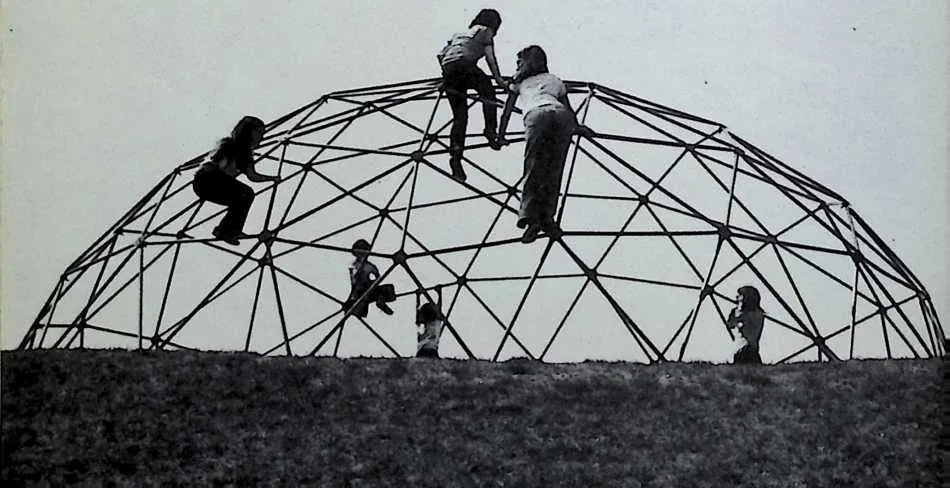
80 Children everywhere know and love Fuller’s domes. Playdomes, small ones, went into mass production in 1957. Daily, children clamber over these in parks, school playgrounds, and their own backyards. They stretch both their minds and muscles as they swing from the bars, play King of the Mountain, or imagine themselves in a jungle.
81 A long, snaking train of railroad cars glides into a twelve- story-high dome in Louisiana. This dome is a plant for rebuilding railroad cars. A thousand different kinds of plants grow on different levels in the enormous greenhouse dome called the Climatron in St. Louis.
82 Banks, chapels, restaurants, homes, theaters. The domes are serving the people in countless ways. Thousands of domes dot the world today.
83 Bucky Fuller was a man who designed for tomorrow and tomorrow had finally arrived.
84 Children on a -playdome in Albany, N.Y.
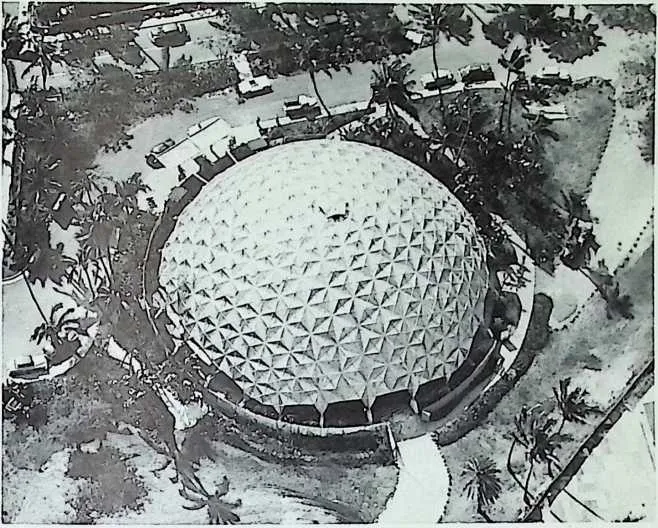
87 The exterior (above) and interior (below) of a Kaiser dome in Honolulu, Hawaii